Abstract
This paper presents how new technologies based on digital recreations can contribute to the preservation of architectural heritage, considering the role of three-dimensional technologies, immersive environments, and AI, proposed as tools for cultural safeguarding and dissemination. Qualitative and exploratory in nature, the study is based on bibliographic and documentary research on preservation, memory and virtuality, emphasizing potential benefits and risks related to each technology and their converging use in the field of built heritage preservation. Results indicate that the virtual does not oppose the real but extends it, functioning as a complementary language of experience and heritage mediation, as well as a tool for preserving the physical buildings themselves. Digital reconstructions and immersive experiences can enhance public access, enable remote engagement, and facilitate participatory memory-making, while AI-driven analysis assists in condition assessment, predictive maintenance, and large-scale archival organization. Thus, the convergence between digital tools and the possibility of expanding the preservation of buildings and the memories linked to them presents a special potential for the future of urban memory. In making this statement, the article understands that digital architecture can re-signify collective memory, broadening access, awareness, and engagement, by treating preservation as a hybrid process between materiality and imagination. The study also highlights ethical and epistemological challenges, such as authenticity, representation biases, data permanence, and the potential for commodification. The article concludes with recommendations for interdisciplinary frameworks, community involvement, and critical design practices to responsibly integrate digital technologies into heritage stewardship.
|
Published in
|
Humanities and Social Sciences (Volume 14, Issue 2)
|
|
DOI
|
10.11648/j.hss.20261402.16
|
|
Page(s)
|
116-124 |
|
Creative Commons
|

This is an Open Access article, distributed under the terms of the Creative Commons Attribution 4.0 International License (http://creativecommons.org/licenses/by/4.0/), which permits unrestricted use, distribution and reproduction in any medium or format, provided the original work is properly cited.
|
|
Copyright
|
Copyright © The Author(s), 2026. Published by Science Publishing Group
|
Keywords
Architectural Heritage, Digital Preservation, Virtual Reality, Collective Memory, Artificial Intelligence
1. Introduction
The preservation of architectural heritage is essential for maintaining collective memory, cultural identity, and the history of a society. However, degradation caused by the passage of time, urban conflicts, natural disasters, and institutional neglect have emerged as the main causes of the deterioration of architectural assets. Simultaneously, we live in an era where digital technology has expanded as a tool for documentation, communication, and immersion, enabling new ways of seeing and experiencing space.
In this context, virtual three-dimensional representations emerge as viable and effective alternatives for heritage preservation, allowing its digital recreation and facilitating access, study, and public awareness. The virtualization of tangible heritage does not replace physical conservation but rather represents a complementary field for safeguarding and disseminating knowledge, especially regarding assets that have already been lost or have limited access. This distinction, however, should not be understood simplistically. The virtual should not be seen as mere simulation, falsification, or an alternative to the real, but as a dimension of experience, possessing value in itself.
As Pierre Lévy
| [1] | LÉVY, Pierre What is the virtual? Sao Paulo: Ed. 34, 1996. |
[1]
states, the virtual is not the opposite of the real, but a "modality of being" that enhances experiences and expands the field of possibilities and human action. A virtual visit to a historical building does not replace physical experience, but neither is it reduced to an illusory or less interesting experience. It is a distinct form of interaction, capable of arousing emotions, transmitting knowledge, and creating authentic memories, even if mediated by technology. Walter Benjamin
| [2] | BENJAMIN, Walter. Magic and technique, art and politics: essays on literature and cultural history. São Paulo: Brasiliense, 2012. |
[2]
, reflecting on technical reproducibility, even while defending the concept of "aura" carried by an original work, already pointed out that new media transform the individual's relationship with the original work, not only copying it, but producing new forms of access and enjoyment. Thus, digital representation can be understood as a legitimate space for cultural construction, where heritage reinvents itself.
In this view, the real and the virtual are not seen as opposing poles, but as complementary dimensions capable of interacting with each other. While physical preservation ensures the material integrity of the asset, virtualization expands its reach and redefines its existence in the contemporary world, offering multiple ways to experience it. By integrating these two fields, a hybrid territory is created in which architecture projects itself beyond its materiality, preserving itself both in stone and in pixel form.
The aim here is to present how virtual models can contribute to the preservation of architectural heritage in digital times, with special emphasis on immersive environments and the possibilities opened by AI. Technical, cultural, and sensory aspects of these representations will be addressed, as well as their educational and conservational impact. The analysis also considers future perspectives with emerging technologies such as augmented reality (AR), virtual reality (VR), and artificial intelligence (AI). This work proposes to analyze and reflect on interactive memory as a means of resistance and renewal, in which the building, even if threatened in its materiality, can remain alive and accessible through digital means, creating bridges between the past, present, and future.
2. Digitization and Virtual Representations in the Heritage Context
Digitization and virtual representations emerge as transformative tools in the preservation of architectural heritage, expanding access, recording capacity, and forms of interaction with cultural assets
| [3] | CAMERON, Fiona; KENDERDINE, Sarah (org.). Theorizing Digital Cultural Heritage: A Critical Discourse. Cambridge, MA: MIT Press, 2007. |
| [1] | LÉVY, Pierre What is the virtual? Sao Paulo: Ed. 34, 1996. |
[3, 1]
(CAMERON; KENDERDINE, 2007; LÉVY, 1996). These technologies are presented in different formats, from three-dimensional (3D) models and digital twins to immersive virtual reality (VR) and augmented reality (AR) platforms, and can reconfigure conservation, mediation, and heritage education practices
| [4] | LATOUR, Bruno. Reassembling the Social: An Introduction to Actor-Network Theory. Salvador: EDUFBA, 2012. |
[4]
. The incorporation of these innovations does not replace physical conservation, but complements it, allowing for detailed records and continuous monitoring essential to the planning and execution of restorative interventions
| [5] | UNESCO; ICCROM; IUCN. Disaster Risk Management Cycle, 2010. |
[5]
.
Furthermore, the virtualization of heritage promotes the democratization of cultural access, enabling people in different locations and social conditions to experience and learn about architectural assets that are often restricted by physical, geographical, or even legal issues. By creating multiple layers of experience (visual, tactile, auditory, and interactive), these digital tools open new possibilities for heritage education and the collective construction of memory.
The increasing incorporation of digital technologies into the field of architecture has significantly transformed the ways of conceiving, representing, and preserving built spaces. Historically, architectural representations depended on analog methods, such as technical drawings on paper, physical models, and photographs. With the expansion of digital technologies, especially from the 1990s onwards, tools such as CAD (Computer- Aided Design) have allowed the development of two-dimensional and three-dimensional representations with greater precision and speed. The subsequent transition from CAD to BIM (Building Information Modeling) marked a qualitative leap, offering not only visual modeling but also an integrated database where each element of the building carries physical, functional, and historical information. This technology has become especially relevant for heritage preservation by enabling the meticulous cataloging of materials, construction techniques, and building pathologies, contributing to more conscious interventions
| [6] | LOGOTHETIS, S. et al. Building Information Modeling for Cultural Heritage: A Review. ISPRS Annals of the Photogrammetry, Remote Sensing and Spatial Information Sciences, vol. 2, no. 5, p. 177–183, 2015. |
[6]
.
In the field of built heritage, these digital tools have proven essential in documentation, restoration, and reconstruction processes, especially in contexts where the cultural asset has been partially or totally lost. One of the most significant advances in this regard is the use of 3D laser scanning and digital photogrammetry, which allow the capture of point clouds with high fidelity, converted into accurate three-dimensional models. These techniques enable a kind of digital "freeze" of the architectural object, serving as a basis for digital analyses, interventions, and recreations, and are widely used by institutions such as CyArk and the Open Heritage project, focused on the digitization of threatened historical sites.
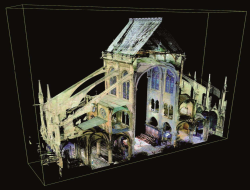
The 3D digitization of Notre-Dame Cathedral, carried out by Andrew Tallon years before the 2019 fire, became a paradigmatic example of the potential of these technologies. From the point clouds generated with laser scanners, it was possible to reconstruct with millimeter precision areas compromised by the fire, reaffirming the preventive value of digital documentation
. This type of archive, in addition to its practical utility, has symbolic value by immortalizing the state of a monument at a specific moment in its history.
Figure 1. Model of the Notredame Cathedral. Source: FAPESP Research / Andrew Tallon / Vassar College.
Beyond scanning and modeling, emerging technologies such as Digital Twins are gaining ground in the heritage sector. A Digital Twin is a dynamic virtual representation that not only precisely reflects the physical object but is also fed real-time with operational, environmental, and usage data. In heritage preservation, this translates into the possibility of monitoring the structural, climatic, and accessibility conditions of a historic building in real time, favoring preventive and sustainable conservation strategies
| [8] | GRIEVES, Michael. Digital Twin: Manufacturing Excellence through Virtual Factory replication. Florida Institute of Technology, 2014. |
[8]
. Although Digital Twins are more established in contemporary engineering projects, their use in heritage assets has been tested in initiatives such as the digitization of the historic city of Dubrovnik, Croatia, and the intelligent monitoring of the Palace of Versailles.
It is important to highlight that the use of these technologies requires a critical and interdisciplinary approach. Digitization and modeling cannot be seen merely as ends in themselves, but as tools embedded in a logic of ethical, respectful, and historically conscious preservation. In this sense, the London Charter on Digital Heritage (2009)
| [9] | UNESCO. London Charter on Digital Heritage. 2009. |
[9]
advocates the need for accurate documentation, interpretative contextualization, and methodological transparency in the use of digital representations, reinforcing the idea that such models should be reproducible, auditable, and accessible for educational and scientific purposes
| [10] | DENARD, Hugh. The London Charter for the Computer- Based Visualisation of Cultural Heritage. London, 2009. Available at:
https://www.londoncharter.org Accessed on: June 2, 2025. |
[10]
.
The evolution of Virtual Reality (VR) and Augmented Reality (AR) has also expanded the possibilities for experiencing and accessing digitized heritage. By allowing users to explore reconstructed historical environments, these technologies become effective tools for both heritage education and accessible tourism. Practical examples include "Virtual Rome", a virtual reality reconstruction of Ancient Rome coordinated by the University of Reading, and immersive exhibitions promoted by museums such as the British Museum and the Louvre, which have been using VR to display collections and archaeological sites in interactive three-dimensional contexts.
Another promising application lies in integrating these technologies with georeferencing systems and open databases, enabling the construction of collaborative preservation platforms. Projects such as “Heritage BIM” and “CHISEL” (Cultural Heritage) are examples. The Heritage BIM project seeks to adapt the traditional Building Information methodology. Modeling for historic buildings and heritage sites offers three-dimensional models which are rich in technical, historical, and material information, allowing for the simulation of future interventions, monitoring of structural aging, and analysis of compatibility with original construction techniques
| [11] | MURPHY, Maurice; MC GOVERN, E.; PIAZZA, C. Historic Building Information Modelling – Adding intelligence to laser and image-based surveys of European classical architecture. ISPRS Journal of Photogrammetry and Remote Sensing, [Sl.], v. 76, p. 89–102, 2013.
https://doi.org/10.1016/j.isprsjprs.2012.11.006 |
[11]
. Meanwhile, CHISEL, an interdisciplinary initiative developed by European researchers, proposes a collaborative virtual learning environment where students, technicians, and local communities can explore digital heritage models, accessing not only their geometries but also historical texts, restoration documents, old photographs, and interviews with residents—creating an integrative database focused on preservation and the construction of collective memory
| [12] | KALAY, Yehuda E.; KOLLI, R.; SMITH, MA Collaborative design and learning: A platform for computer-supported collaborative learning (CSCL) in architecture. Automation in Construction, [Sl.], v. 16, no. 3, p. 368–376, 2007.
https://doi.org/10.1016/j.autcon.2006.10.007 |
[12]
. These projects demonstrate how digital technologies, when applied contextually, not only document heritage but also create bridges between technical knowledge and human experiences, promoting a more democratic, accessible, and sensitive culture of preservation that recognizes the multiple layers of value associated with architectural assets.
3. 3D Modeling and Digital Twins as Preservation Tools
The evolution of digital tools in recent decades has brought about a significant transformation in approaches to heritage preservation, expanding the possibilities for documentation, analysis, conservation, and dissemination of cultural and architectural assets. Among these innovations, three-dimensional (3D) modeling and Digital Twins stand out, representing a fundamental advance in the field of architectural heritage preservation by allowing for the reconstruction, monitoring, and interaction with historical buildings in a precise, accessible, and continuous manner.
These representations can be generated from various sources, such as laser scans (LiDAR), photogrammetry, point clouds, digitized floor plans, among others. In heritage preservation, this technique has proven particularly effective, as it allows for the meticulous recording of structures that are often in an advanced state of deterioration, at risk of collapse, or located in hard-to-reach areas. As highlighted by Fai et al.
| [13] | FAI, S.; GOSBEY, T.; GRAHAM, K. Building Information Modeling and Heritage Documentation. Journal of Cultural Heritage Management and Sustainable Development, vol. 1, no. 2, p. 134-145, 2011. |
[13]
, 3D modeling not only records the architectural form but also carries essential information about materials, textures, structural damage, and interventions carried out over time.
In this scenario, Digital Twins represent a more advanced and interactive development of 3D modeling. The concept of Digital Twin, originating in engineering and industrial manufacturing, refers to the creation of a digital replica of a physical system, updated in real time with data from the object itself
| [8] | GRIEVES, Michael. Digital Twin: Manufacturing Excellence through Virtual Factory replication. Florida Institute of Technology, 2014. |
[8]
. When applied to architectural heritage, the Digital Twin ceases to be merely a static model and becomes a dynamic representation, capable of simulating structural behaviors, environmental conditions, wear and tear, and even the interaction of visitors in digital musealization contexts.
The application of Digital Twins in the field of heritage preservation is still recent, but it has been adopted with promising results. According to Arayici et al.
| [14] | ARAYICI, Y.; COUNSELL, J.; MAHTABY, F. Heritage Building Information Modeling. International Journal of Architectural Computing, vol. 15, no. 4, p. 334–348, 2017. |
[14]
, the integration of IoT (Internet of Things) sensors into historical buildings allows for the continuous monitoring of variables such as temperature, humidity, vibration, and pressure, which feed the digital twin and enable the anticipation of structural failures or damage caused by climate change, visitor flows, or seismic events. This predictive capacity is valuable in buildings that, due to their historical value or fragility, require highly controlled conservation strategies.
A notable example of the application of these technologies is the digitization project of St. Peter's Basilica in the Vatican. In partnership with Microsoft and the French company Iconem, the Vatican created a digital twin of the basilica using drones, cameras, and lasers to scan the structure. The resulting model, composed of more than 400,000 photographs, allows for virtual visits and detailed monitoring of the structure for preservation and restoration purposes. Another relevant case is that of Löfstad Castle in Sweden, where sensors were installed to monitor internal environmental conditions. The collected data feeds into a digital twin that assists in managing the internal climate, aiming at the conservation of the building and its collections.
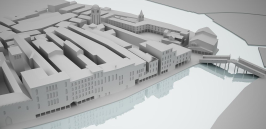
Figure 2. Venice digital twin. Source: EPFL/Venice Time Machine.
The creation of digital twins has also been applied in urban preservation projects, such as the Venice Time Machine, which aims to build a multidimensional digital model of Venice, encompassing over a thousand years of the city's evolution. This project combines the digitization of historical documents with 3D modeling to reconstruct Venice's urban history. These examples demonstrate how the integration of 3D modeling with digital twins offers a comprehensive approach to heritage preservation, allowing not only the accurate documentation of buildings but also the continuous monitoring of their conditions and the simulation of future interventions.
The interactive possibilities of Digital Twins also allow their application in immersive experiences focused on heritage education. Using virtual reality (VR) glasses, augmented reality (AR) environments, or projections in physical spaces, the public can interact with digital models in a sensory and meaningful way. Museums and cultural institutions have adopted these technologies to recreate vanished buildings, such as the Crystal Palace in London, or to allow virtual visits to hard-to-reach places, such as the tomb of Nefertari in Egypt
| [15] | FALKINGHAM, P. Digital reconstruction of the Crystal Palace: A case study in virtual heritage. Digital Applications in Archeology and Cultural Heritage, vol. 1, p. 45–57, 2012. |
[15]
. This approach broadens the reach of historical memory, democratizes access to heritage, and strengthens identity ties through engaging technological experiences. ppropriate headings to enhance clarity and organization.
4. Future Perspectives and Technological Innovations
More than just tools, the premise is that technological advances are not limited to pragmatic issues; in fact, they expand as epistemological structures, altering what it means to document, restore, narrate, and experience heritage. Just as the emergence of photography in the 19th century reconfigured the gaze and the digitization of recent decades transformed archival systems, immersive technologies, artificial intelligence (AI), and virtual worlds point to a new economy of preservation, in which heritage exists simultaneously as a material object, as informational data, and as an accessible experience.
This expands the question of how to apply technology to heritage, and what kind of heritage becomes possible and accessible as technologies mature. New regimes of authenticity arise when AI intervenes in reconstruction/restoration; management models that incorporate digital twins to predict risks and guide policies; hybrid museums that function both as physical spaces and interactive platforms; and the possibility that heritage can be projected in multiple layers, coexisting in the real and virtual as two legitimate modes of presence.
This forward-looking movement is not mere speculation; it is anchored in innovative and critical concepts of modern thought: the notion of memory as affective reconstruction
| [16] | RICOEUR, Paul. Memory, History, Forgetting. Campinas: Unicamp, 2007. |
[16]
, social participation mediated by technologies
| [17] | JENKINS, Henry. Convergence Culture. Sao Paulo: Aleph, 2009. |
[17]
, distributed presence
| [18] | GUMBRECHT, Hans Ulrich. Production of Presence: What Meaning Cannot Convey. Rio de Janeiro: Contraponto; PUC-Rio, 2010. |
[18]
, convergent culture
| [19] | GALBRAITH, Patrick W.; KARLIN, Jason G. (Org.). Media Convergence in Japan. London: Kinema Club; Yokohama: Inter-Asia Cultural Studies, 2016. |
[19]
, and the phenomenology of experience
| [20] | RUSSELL, Bertrand. Human Knowledge: Its Scope and Limits. London: Allen & Unwin, 1948. |
| [21] | PALLASMAA, Juhani. The Eyes of the Skin: Architecture and the Senses. Sao Paulo: WMF Martins Fontes, 2012. |
[20, 21]
. The future of heritage is not only technical; it is cultural, sensory, political, and epistemological.
Historically, architectural knowledge has been mediated by sight. Renaissance perspective, technical drawing, and photography consolidated a visual tradition that separated subject and object, observer and space. However, as Merleau-Ponty
| [22] | MERLEAU-PONTY, Maurice. Phenomenology of Perception. Sao Paulo: Martins Fontes, 1999. |
[22]
observed, "to see is always also to be within the world that one sees," and this phenomenological condition of presence becomes central to contemporary immersive forms. AR and VR reenact this principle by allowing the body to perceive, act, and be affected within digital space, creating a cognitive presence, a way of thinking with the senses, in which perception becomes an operation of knowledge.
Augmented reality (AR), by overlaying digital information onto physical space, does not replace the material: it extends, expands, and reinterprets it. This overlay creates what can be understood as a digital palimpsest, in which different temporal and informational layers coexist. A visitor exploring a historical center equipped with AR devices can observe the construction phases of a building, visualize vanished facades, or understand urban transformations over the centuries. This simultaneity between what exists and what existed inaugurates a new patrimonial sensitivity, no longer based solely on contemplation, but on the correspondence between body, time, and memory. Thus, physical space ceases to be static and becomes an active interface of historical knowledge and emotions.
Virtual reality (VR), on the other hand, transports the subject to an entirely digital environment, where architecture is reconstructed as a total experience. VR creates cognitive spaces, laboratories of perception in which the visitor not only observes but also lives spatial hypotheses. The reconstruction of ruins, of vanished monuments, or immersion in ancient cities cease to be mere acts of documentation and become acts of sensory learning. As Pallasmaa
| [21] | PALLASMAA, Juhani. The Eyes of the Skin: Architecture and the Senses. Sao Paulo: WMF Martins Fontes, 2012. |
[21]
states, “architecture is essentially an extension of human skin – it measures the world from the body, not from the eyes.” This quote summarizes the fundamental principle of immersion as a form of knowledge: understanding space is not seeing it, but feeling it with the body. Virtuality, in this context, becomes a cognitive extension of human corporeality.
This learning through the body resonates with the ideas of Russell
| [20] | RUSSELL, Bertrand. Human Knowledge: Its Scope and Limits. London: Allen & Unwin, 1948. |
[20]
, for whom all experience is mediated by the interaction between sensation and interpretation. Reality, therefore, is not apprehended in its objective purity, but in its sensory and symbolic configuration. Applied to heritage, AR and VR allow the visitor to simultaneously experience the tactile, auditory, and visual dimensions of architecture, producing a type of embodied knowledge, in which the understanding of the past emerges from perceptual immersion and not merely from reading data. Space, in this case, is a real-time narrative that is updated according to the gaze and movement of each observer.
This epistemological transformation has direct consequences for preservation. When AR and VR become means of transmitting heritage, memory is no longer merely recorded: it is relived, reinterpreted, and felt, along with all the stimuli that technology allows to be added. Knowledge about heritage comes to include what Pallasmaa
| [21] | PALLASMAA, Juhani. The Eyes of the Skin: Architecture and the Senses. Sao Paulo: WMF Martins Fontes, 2012. |
[21]
calls "wisdom of the senses," a form of cognition that incorporates affects, atmospheres, and bodily rhythms. This means that learning about space – and therefore about history – also happens in the emotional dimension. The visitor who finds themselves immersed in a reconstructed historical environment not only understands the past: they feel it, and it is this experience that consolidates memory in a lasting way.
AR and VR also alter the notion of authenticity. If previously the physical presence of the building was an indispensable condition for the heritage experience, now immersion allows for other legitimate forms of contact and understanding. Authenticity ceases to be dependent on matter and comes to reside in the intensity of the experience, in the way the space is reconstructed and felt. This perspective, defended by authors such as Gumbrecht
| [18] | GUMBRECHT, Hans Ulrich. Production of Presence: What Meaning Cannot Convey. Rio de Janeiro: Contraponto; PUC-Rio, 2010. |
[18]
, redefines "presence" as a category of contemporary knowledge: that which is lived intensely acquires the value of reality, even when technologically mediated.
However, these new possibilities raise questions. Immersion can be seductive due to spectacle and lose interpretative depth; excessive sensory stimulation can replace critical reflection with mere emotion. Therefore, it is necessary to develop mediation methodologies that articulate experience and historical knowledge, ensuring that immersion does not become mere distraction. As Choay
| [23] | CHOAY, Françoise. The Allegory of Heritage. Sao Paulo: UNESP, 2001. |
[23]
warns, the risk of contemporary heritage culture is "total musealization," the transformation of all experience into aesthetic consumption. AR and VR, when used based on these reflections, can precisely avoid this fate: by reintroducing the body, affect, and presence into the heritage experience, they place the human being back at the center of architectural knowledge. In this way, the sensory immersion proposed by AR and VR is not a rupture with reality, but an expanded continuity of it. Knowing heritage, in this context, is to traverse times, layers, and perceptions; it is to perceive that the past can be felt, not just studied. Immersion thus becomes a legitimate way of thinking about and learning architecture: a form of knowledge that unites technique, body, and emotion.
5. The Evolution to Web 3.0
If immersive technologies have ushered in a new form of sensory knowledge of space, the evolution towards Web 3.0 and the metaverse projects architectural heritage into an even more complex dimension: collective, distributed, and persistent. Because it is a new technology whose use is likely to expand soon, it becomes inevitable to explore its possibilities for heritage preservation in this document. In this case, the focus shifts from solely the individual experience of immersion (as occurs in virtual reality) to the creation of shared digital ecosystems, where different individuals, institutions, and communities actively participate in the reconstruction, management, and experience of cultural assets. Architecture ceases to be an object to be seen and becomes a place to be inhabited collectively, both materially and virtually.
The so-called Web 3.0 represents the third generation of the internet, a phase that succeeds Web 1.0, centered on information, and Web 2.0, marked by social interaction on centralized platforms. In Web 3.0, the fundamental principle is decentralization: data ceases to belong to large corporations and begins to be stored on distributed networks (blockchain, IPFS, collective databases), so that control and authorship of information are shared among the users themselves
| [24] | BERNERS-LEE, Tim. Web 3 and the Original Vision of the World Wide Web. London: World Wide Web Foundation, 2022. |
[24]
.
Applied to the field of heritage, this decentralization signifies a radical change: knowledge about heritage is no longer concentrated in a few institutional bodies but is co-constructed and preserved in a network. Three-dimensional models, photographic records, sound archives, and metadata of architectural collections can be hosted collaboratively, guaranteeing authenticity and traceability. Research in cultural heritage has been discussing the use of blockchain for the authenticity and preservation of digital collections, while UNESCO pilot projects in education demonstrate the public viability of this technology
. In the urban-cultural sphere, cities like Seoul already operate metaverse experiences with cultural services and content
, and recent reviews point to the application of the metaverse in reconstructions, global accessibility, and heritage education
. In Asian countries, museums have combined digital twins, VR, and 3D platforms for cultural mediation
.
Furthermore, Web 3.0 allows digital assets to be treated as commons, that is, a common good with public access, a concept already advocated by Elinor Ostrom
| [29] | OSTROM, Elinor. Governing the Commons: The Evolution of Institutions for Collective Action. Cambridge: Cambridge University Press, 2010. |
[29]
and expanded to the cultural field by Lawrence Lessig
| [30] | LESSIG, Lawrence. Free Culture: How Big Media Uses Technology and the Law to Lock Down Culture and Control Creativity. New York: Penguin, 2004. |
[30]
. This reinforces the idea of the democratization of memory, now technically supported by secure and transparent network infrastructures. Instead of merely consuming heritage, citizens become co-curators of collective memory, contributing to its constant updating.
The metaverse, a term popularized after 2021, refers to a three-dimensional and persistent digital environment, accessed through virtual reality devices, augmented reality, or simply 3D browsers. Unlike isolated AR and VR experiences, the metaverse is interconnected and continuous: in it, people can meet, interact, build, and modify the space simultaneously. In countries such as China, South Korea, and Japan, state and private initiatives have developed urban metaverses that replicate real cities for educational, tourist, and cultural purposes. The city of Seoul, for example, created the Metaverse Seoul Project in 2023, a publicly accessible digital space that includes historical reconstructions and virtual museums.
Applied to heritage preservation, the metaverse inaugurates what Gumbrecht
| [18] | GUMBRECHT, Hans Ulrich. Production of Presence: What Meaning Cannot Convey. Rio de Janeiro: Contraponto; PUC-Rio, 2010. |
[18]
, as we saw earlier, calls "distributed presence," the capacity of an object or place to exist in multiple layers of reality, both physical and digital. A virtually restored temple, for example, remains physically visitable, but can also be inhabited in the metaverse, allowing global access and experimentation impossible in real physical space. In this context, heritage value shifts from matter to the continuous relationship between experience and meaning.
In this new hybrid territory, heritage ceases to be an “archive” and begins to function as a living platform, where communities interact with the past in real time. 3D models of ruins, museum collections, and architectural complexes can not only be visualized but also experienced and updated collectively, keeping memory in constant motion. As Jenkins
| [17] | JENKINS, Henry. Convergence Culture. Sao Paulo: Aleph, 2009. |
[17]
observes, contemporary digital culture is defined by “convergent participation,” a mode of meaning-making that mixes users, creators, and institutions in the same field of action. The metaverse, in this sense, expands the reach of heritage education and promotes new forms of cultural belonging.
However, distributed presence also brings challenges. Decentralization implies shared responsibility, and heritage, when transformed into data, faces risks of technological obsolescence, digital exclusion, and information manipulation. Unequal access to immersive technologies can reproduce the same asymmetries that digitization sought to correct. Furthermore, the creation of alternative versions of buildings and cities raises questions about authenticity and cultural authority: who decides what is accurate, what should be preserved, and what can be reinvented? Therefore, distributed presence must be accompanied by public policies and ethical guidelines that guarantee diversity, transparency, and representativeness in digital reconstruction. The contemporary challenge is not only to create perfect copies, but to make the metaverse a critical and accessible space for learning and historical awareness.
The metaverse and Web 3.0 therefore propose a new ecology of preservation: heritage is no longer confined to a place or institution and comes to inhabit a network of interconnected presences, where the real and the virtual coexist in continuity. This condition, which Gumbrecht
| [18] | GUMBRECHT, Hans Ulrich. Production of Presence: What Meaning Cannot Convey. Rio de Janeiro: Contraponto; PUC-Rio, 2010. |
[18]
describes as the "production of presence," redefines the very idea of authenticity: no longer as material fidelity, but as intensity of experience and symbolic sharing.
Thus, heritage preservation in the 21st century is not merely technical, but also cultural and relational. The goal, tirelessly emphasized, is not to replace reality, but to expand its presence, ensuring that the past remains accessible, habitable, and reinterpretable in new digital landscapes. This notion leads us to the next topic, which will address the role of artificial intelligence as an agent of predictive reconstruction and automated curation of heritage, further expanding the field of possibilities for the future of architectural memory.
6. Architecture Under the Use of AI
Artificial Intelligence (AI) has established itself in recent decades as one of the most transformative technologies of our time. What was once confined to laboratories and science fiction has become part of everyday life: recommendation systems, virtual assistants, medical diagnoses, autonomous cars, and, more recently, creative tools for generating images and texts. This rapid and transversal expansion, which Russell and Norvig
| [31] | RUSSELL, Stuart; NORVIG, Peter. Artificial Intelligence: A Modern Approach. 4th ed. Upper Saddle River: Pearson, 2021. |
[31]
call "algorithmic omnipresence," has modified not only technical processes but also forms of perception and cultural production. In architecture and heritage preservation, AI now emerges as an instrument for reading, synthesizing, and projecting memory, expanding the reach of digital representations and proposing new possibilities for the future of conservation.
A new horizon is introduced here: the possibility of anticipating, reconstructing, and reimagining what has been lost. AI, instead of being merely a means of recording, acts as an interpretive agent, capable of processing visual, historical, and material data to infer absences and suggest continuities. In this sense, heritage memory ceases to be merely an archive of the past and becomes a field of projection, a "memory under construction," in the sense proposed by Ricoeur
| [16] | RICOEUR, Paul. Memory, History, Forgetting. Campinas: Unicamp, 2007. |
[16]
, for whom remembering is also reconfiguring and reinterpreting lived experience.
Deep learning models have been applied to architectural reconstruction projects with significant results. Tools such as convolutional neural networks (CNNs) and generative algorithms (GANs) can analyze old photographs, point clouds from incomplete scans, and textual descriptions to reconstruct missing parts of historical monuments and buildings. One of the most emblematic examples is that of Notre-Dame Cathedral in Paris, already mentioned here, whose restoration after the 2019 fire included the use of AI algorithms trained with millions of images captured by researchers and tourists to recreate lost details of the structure and stained-glass windows
| [32] | LADJALI, Karim. Notre-Dame number: IA and reconstruction heritage. Paris: CNRS Éditions, 2023. |
[32]
.
Another notable case is the work of Iconem, a UNESCO partner company, which applied artificial intelligence to digitally reconstruct destroyed sites in Syria and Afghanistan, such as Palmyra and Mosul. Using aerial and ground-level images, predictive models were able to reconstruct entire temples and streets in 3D, preserving not only the morphology but also the urban and symbolic context of these places. More recently, the DeepHeritage project, developed by MIT in collaboration with Cultural Analytics, has also been a significant example. The project has used generative AI to propose plausible reconstructions of architectural structures whose material records are fragmentary. The system learns characteristic patterns of proportion, texture, and ornamentation of each period, creating simulations that are not intended to be substitutes for what existed, but visual hypotheses of what could have existed
| [33] | MIT - Massachusetts Institute of Technology. DeepHeritage: AI- based Predictive Reconstruction for Cultural Heritage. Cambridge, MA, 2024. Available at:
https://culturalanalytics.mit.edu/ Accessed on: November 3, 2025. |
[33]
.
These examples reveal a significant shift: digital preservation is no longer limited to documenting what remains, but has come to incorporate a speculative dimension, in which the past is reconstructed as a possibility, a form of technical imagination that combines scientific rigor and historical sensitivity.
AI redefines how we understand the relationship between time, matter, and memory. If, according to Ricoeur
| [16] | RICOEUR, Paul. Memory, History, Forgetting. Campinas: Unicamp, 2007. |
[16]
, every memory is a reconstruction mediated by language and desire, predictive reconstructions only make explicit this interpretative character of memory. What is projected through algorithms is not the "authentic past", but a probabilistic translation of it, anchored in data, but also in gaps, and it is precisely in these gaps that patrimonial imagination is realized.
The notion of “projective memory” manifests itself here as the use of technology to make the invisible intelligible: the walls that no longer remain, the forms that time has erased, the atmospheres that matter no longer contains. In this process, AI acts as a mediator between the real and the virtual, establishing a kind of “latent presence,” in which heritage is simultaneously remembered and reinvented. As Pallasmaa
| [21] | PALLASMAA, Juhani. The Eyes of the Skin: Architecture and the Senses. Sao Paulo: WMF Martins Fontes, 2012. |
[21]
observes, architectural experience is inseparable from imagination – “to see is always also to remember” – and digital models only amplify this perceptive gesture, projecting new possibilities for encounters between body, space, and history.
The entry of AI into the field of heritage preservation, however, demands ethical caution. When an algorithm reconstructs a lost facade, who is the author? The programmer? The model? The data set that feeds it? This indeterminacy opens a debate about authorship, authenticity, and intentions. Algorithmic reconstructions should, therefore, be understood as critical interpretations, not as absolute restitutions. To ensure this, international organizations such as ICOM and UNESCO have been advocating the adoption of ethical guidelines for automated digital reconstructions, prioritizing transparency, documentation of processes, and identification of the data sources used.
In this context, AI should be seen not as a substitute for human experience, but as an instrument of cognitive mediation, a way of thinking with the machine, and not through it. Thus, patrimonial value shifts from material fidelity to the collective intelligence that emerges from the dialogue between humans and algorithms.
Beyond visual form, AI has been employed in the sensory restitution of heritage, simulating light, acoustics, and atmosphere. In European projects reconstructing churches and urban spaces, neural networks have analyzed the geometry of environments to recreate original sound conditions, reproducing the echo and reverberation characteristic of each space
| [34] | Mueller-Trapet, M., Batista da Cunha, I., & Mahn, J. (2021, August). Subjective studies on impact sound in times of a pandemic--a comparison between a laboratory study and an online listening test. In INTER-NOISE and NOISE-CON Congress and Conference Proceedings (Vol. 263, No. 1, pp. 5090-5096). Institute of Noise Control Engineering. |
| [35] | FORTIN, Paul; et al. Digital Heritage and Sound Reconstruction: The Role of Artificial Intelligence in Virtual Acoustics. Journal of Cultural Heritage, vol. 62, p. 34–47, 2023. |
[34, 35]
. The same occurs with systems that calculate solar incidence and light diffusion in historical buildings, allowing us to understand how light modulated the architectural experience. These applications inaugurate the field of so-called computational phenomenology, in which the algorithm not only reproduces physical data but also learns to express the sensitive qualities of space
| [36] | KENDERDINE, Sarah. Embodied Museography: Digital Interfaces for Immersive Cultural Experience. In: Heritage and Archeology in the Digital Age. London: Springer, 2020. |
[36]
. Heritage recovers its perceptive dimension, contributing to a deeper and more empathetic understanding of historical experience.
Artificial Intelligence expands heritage preservation beyond the past: it transforms memory into projection, into an open field of interpretative possibilities. By reconstructing what was lost and imagining what could have been, AI does not destroy authenticity; it reinvents it as a living process. In this sense, digital memory does not oppose reality but prolongs it; it does not replace heritage, but translates it into algorithmic language, allowing it to continue to be perceived, studied, and felt by new generations. The future of preservation, therefore, is also the future of imagination; a convergence between technique, history, and sensitivity, where the machine becomes an extension of the human gaze upon time and an allied tool for what is yet to come.
The convergence of AI, sensory immersion, and distributed networks therefore points to a new stage in preservation: that of interactive architecture, in which heritage representation ceases to be merely observed and begins to respond to human presence. Digitally reconstructed environments become platforms for collective experimentation, where each gesture, path, or choice of the visitor subtly alters the narrative and reconfigures the experience of memory. This interactive condition transforms preservation into a dynamic and shared process, a "living memory" that is updated in the encounter between body, technology, and history.
The trend is that the coming decades will witness an increasing integration between mixed reality, artificial intelligence, and digital twins, resulting in living models for monitoring, restoring, and managing architectural assets. Instead of static documents, we will have dynamic representations that evolve along with the buildings themselves, capturing changes, predicting degradation, and suggesting sustainable interventions. AI, thus, no longer acts merely as a reconstruction tool, but as a cognitive agent of interpretation, capable of expanding the human perspective and preserving not only forms, but atmospheres and emotions.
These advancements also bring the possibility of continuous and immersive heritage education, in which schools, museums, and universities use interactive virtual environments to promote experiences of belonging and memory. Such digital spaces, whether metaverse platforms, hybrid urban installations, or collaborative 3D models, allow communities to reconstruct and share their own narratives, ensuring diversity and decentralization in the construction of collective memory.
However, the future of digital heritage will depend on an ethical and cultural commitment to historical truth and inclusion. The challenge will be to balance innovation and responsibility, ensuring that technological mediation does not produce exclusions, erasures, or symbolic distortions. In this sense, the role of the architect, the researcher, and the educator will be that of curator of experience, mediator between the sensitive and the technical, between the past and the possible.
Abbreviations
3D | Three Dimensional |
AI | Artificial Intelligence |
AR | Augmented Reality |
BIM | Building Information Modeling |
CAD | Computer Aided Design |
CNNs | Convolutional Neural Networks |
GANs | Generative Algorithms |
ICOM | International Council of Museums |
IoT | Internet of Things |
UNESCO | United Nations Educational, Scientific and Cultural Organization |
VR | Virtual Reality |
Author Contributions
Nathalia Lira Vergeti Peixoto: Conceptualization, Investigation, Writing – original draft
Walcler de Lima Mendes Junior: Conceptualization, Supervision
Juliana Michaello Macêdo Dias: Writing – review & editing
Conflicts of Interest
The authors declare no conflicts of interest.
References
| [1] |
LÉVY, Pierre What is the virtual? Sao Paulo: Ed. 34, 1996.
|
| [2] |
BENJAMIN, Walter. Magic and technique, art and politics: essays on literature and cultural history. São Paulo: Brasiliense, 2012.
|
| [3] |
CAMERON, Fiona; KENDERDINE, Sarah (org.). Theorizing Digital Cultural Heritage: A Critical Discourse. Cambridge, MA: MIT Press, 2007.
|
| [4] |
LATOUR, Bruno. Reassembling the Social: An Introduction to Actor-Network Theory. Salvador: EDUFBA, 2012.
|
| [5] |
UNESCO; ICCROM; IUCN. Disaster Risk Management Cycle, 2010.
|
| [6] |
LOGOTHETIS, S. et al. Building Information Modeling for Cultural Heritage: A Review. ISPRS Annals of the Photogrammetry, Remote Sensing and Spatial Information Sciences, vol. 2, no. 5, p. 177–183, 2015.
|
| [7] |
TALLON, Andrew. Notre-Dame de Paris: the Historic Scan. National Geographic, 2018. Available at:
https://www.nationalgeographic.com
Accessed on: June 2, 2025.
|
| [8] |
GRIEVES, Michael. Digital Twin: Manufacturing Excellence through Virtual Factory replication. Florida Institute of Technology, 2014.
|
| [9] |
UNESCO. London Charter on Digital Heritage. 2009.
|
| [10] |
DENARD, Hugh. The London Charter for the Computer- Based Visualisation of Cultural Heritage. London, 2009. Available at:
https://www.londoncharter.org
Accessed on: June 2, 2025.
|
| [11] |
MURPHY, Maurice; MC GOVERN, E.; PIAZZA, C. Historic Building Information Modelling – Adding intelligence to laser and image-based surveys of European classical architecture. ISPRS Journal of Photogrammetry and Remote Sensing, [Sl.], v. 76, p. 89–102, 2013.
https://doi.org/10.1016/j.isprsjprs.2012.11.006
|
| [12] |
KALAY, Yehuda E.; KOLLI, R.; SMITH, MA Collaborative design and learning: A platform for computer-supported collaborative learning (CSCL) in architecture. Automation in Construction, [Sl.], v. 16, no. 3, p. 368–376, 2007.
https://doi.org/10.1016/j.autcon.2006.10.007
|
| [13] |
FAI, S.; GOSBEY, T.; GRAHAM, K. Building Information Modeling and Heritage Documentation. Journal of Cultural Heritage Management and Sustainable Development, vol. 1, no. 2, p. 134-145, 2011.
|
| [14] |
ARAYICI, Y.; COUNSELL, J.; MAHTABY, F. Heritage Building Information Modeling. International Journal of Architectural Computing, vol. 15, no. 4, p. 334–348, 2017.
|
| [15] |
FALKINGHAM, P. Digital reconstruction of the Crystal Palace: A case study in virtual heritage. Digital Applications in Archeology and Cultural Heritage, vol. 1, p. 45–57, 2012.
|
| [16] |
RICOEUR, Paul. Memory, History, Forgetting. Campinas: Unicamp, 2007.
|
| [17] |
JENKINS, Henry. Convergence Culture. Sao Paulo: Aleph, 2009.
|
| [18] |
GUMBRECHT, Hans Ulrich. Production of Presence: What Meaning Cannot Convey. Rio de Janeiro: Contraponto; PUC-Rio, 2010.
|
| [19] |
GALBRAITH, Patrick W.; KARLIN, Jason G. (Org.). Media Convergence in Japan. London: Kinema Club; Yokohama: Inter-Asia Cultural Studies, 2016.
|
| [20] |
RUSSELL, Bertrand. Human Knowledge: Its Scope and Limits. London: Allen & Unwin, 1948.
|
| [21] |
PALLASMAA, Juhani. The Eyes of the Skin: Architecture and the Senses. Sao Paulo: WMF Martins Fontes, 2012.
|
| [22] |
MERLEAU-PONTY, Maurice. Phenomenology of Perception. Sao Paulo: Martins Fontes, 1999.
|
| [23] |
CHOAY, Françoise. The Allegory of Heritage. Sao Paulo: UNESP, 2001.
|
| [24] |
BERNERS-LEE, Tim. Web 3 and the Original Vision of the World Wide Web. London: World Wide Web Foundation, 2022.
|
| [25] |
LIU, X. et al. Blockchain in digital cultural heritage resources. Heritage Science, 2025. Available at:
https://www.nature.com/articles/s40494-025-01818-4
Accessed on: November 2, 2025.
|
| [26] |
SEOUL METROPOLITAN GOVERNMENT. Official release of Metaverse Seoul. January 25, 2023. Available at:
https://english.seoul.go.kr/official-release-of-metaverse-seoul/
Accessed on: November 2, 2025.
|
| [27] |
BURAGOHAIN, D. Digitizing cultural heritage through metaverse Applications. Heritage Science, 2024. Available at:
https://www.nature.com/articles/s40494-024-01403-1
Accessed on: November 1, 2025.
|
| [28] |
CHINA DAILY. Chinese museums embrace technologies … July 30, 2024. Available at:
https://regional.chinadaily.com.cn/Qiushi/2024-07/30/c_1008717.htm
Accessed on: November 2, 2025.
|
| [29] |
OSTROM, Elinor. Governing the Commons: The Evolution of Institutions for Collective Action. Cambridge: Cambridge University Press, 2010.
|
| [30] |
LESSIG, Lawrence. Free Culture: How Big Media Uses Technology and the Law to Lock Down Culture and Control Creativity. New York: Penguin, 2004.
|
| [31] |
RUSSELL, Stuart; NORVIG, Peter. Artificial Intelligence: A Modern Approach. 4th ed. Upper Saddle River: Pearson, 2021.
|
| [32] |
LADJALI, Karim. Notre-Dame number: IA and reconstruction heritage. Paris: CNRS Éditions, 2023.
|
| [33] |
MIT - Massachusetts Institute of Technology. DeepHeritage: AI- based Predictive Reconstruction for Cultural Heritage. Cambridge, MA, 2024. Available at:
https://culturalanalytics.mit.edu/
Accessed on: November 3, 2025.
|
| [34] |
Mueller-Trapet, M., Batista da Cunha, I., & Mahn, J. (2021, August). Subjective studies on impact sound in times of a pandemic--a comparison between a laboratory study and an online listening test. In INTER-NOISE and NOISE-CON Congress and Conference Proceedings (Vol. 263, No. 1, pp. 5090-5096). Institute of Noise Control Engineering.
|
| [35] |
FORTIN, Paul; et al. Digital Heritage and Sound Reconstruction: The Role of Artificial Intelligence in Virtual Acoustics. Journal of Cultural Heritage, vol. 62, p. 34–47, 2023.
|
| [36] |
KENDERDINE, Sarah. Embodied Museography: Digital Interfaces for Immersive Cultural Experience. In: Heritage and Archeology in the Digital Age. London: Springer, 2020.
|
Cite This Article
-
APA Style
Peixoto, N. L. V., Junior, W. D. L. M., Dias, J. M. M. (2026). Interactive Memory: Pathes to Preserving Architectural Heritage in the Digital Age. Humanities and Social Sciences, 14(2), 116-124. https://doi.org/10.11648/j.hss.20261402.16
 Copy
|
Copy
|
 Download
ACS Style
Peixoto, N. L. V.; Junior, W. D. L. M.; Dias, J. M. M. Interactive Memory: Pathes to Preserving Architectural Heritage in the Digital Age. Humanit. Soc. Sci. 2026, 14(2), 116-124. doi: 10.11648/j.hss.20261402.16
Copy
|
Download
AMA Style
Peixoto NLV, Junior WDLM, Dias JMM. Interactive Memory: Pathes to Preserving Architectural Heritage in the Digital Age. Humanit Soc Sci. 2026;14(2):116-124. doi: 10.11648/j.hss.20261402.16
Copy
|
Download
-
@article{10.11648/j.hss.20261402.16,
  author = {Nathalia Lira Vergeti Peixoto and Walcler de Lima Mendes Junior and Juliana Michaello Macêdo Dias},
  title = {Interactive Memory: Pathes to Preserving Architectural Heritage in the Digital Age},
  journal = {Humanities and Social Sciences},
  volume = {14},
  number = {2},
  pages = {116-124},
  doi = {10.11648/j.hss.20261402.16},
  url = {https://doi.org/10.11648/j.hss.20261402.16},
  eprint = {https://article.sciencepublishinggroup.com/pdf/10.11648.j.hss.20261402.16},
  abstract = {This paper presents how new technologies based on digital recreations can contribute to the preservation of architectural heritage, considering the role of three-dimensional technologies, immersive environments, and AI, proposed as tools for cultural safeguarding and dissemination. Qualitative and exploratory in nature, the study is based on bibliographic and documentary research on preservation, memory and virtuality, emphasizing potential benefits and risks related to each technology and their converging use in the field of built heritage preservation. Results indicate that the virtual does not oppose the real but extends it, functioning as a complementary language of experience and heritage mediation, as well as a tool for preserving the physical buildings themselves. Digital reconstructions and immersive experiences can enhance public access, enable remote engagement, and facilitate participatory memory-making, while AI-driven analysis assists in condition assessment, predictive maintenance, and large-scale archival organization. Thus, the convergence between digital tools and the possibility of expanding the preservation of buildings and the memories linked to them presents a special potential for the future of urban memory. In making this statement, the article understands that digital architecture can re-signify collective memory, broadening access, awareness, and engagement, by treating preservation as a hybrid process between materiality and imagination. The study also highlights ethical and epistemological challenges, such as authenticity, representation biases, data permanence, and the potential for commodification. The article concludes with recommendations for interdisciplinary frameworks, community involvement, and critical design practices to responsibly integrate digital technologies into heritage stewardship.},
 year = {2026}
}
Copy
|
Download
-
TY  - JOUR
T1  - Interactive Memory: Pathes to Preserving Architectural Heritage in the Digital Age
AU  - Nathalia Lira Vergeti Peixoto
AU  - Walcler de Lima Mendes Junior
AU  - Juliana Michaello Macêdo Dias
Y1  - 2026/03/31
PY  - 2026
N1  - https://doi.org/10.11648/j.hss.20261402.16
DO  - 10.11648/j.hss.20261402.16
T2  - Humanities and Social Sciences
JF  - Humanities and Social Sciences
JO  - Humanities and Social Sciences
SP  - 116
EP  - 124
PB  - Science Publishing Group
SN  - 2330-8184
UR  - https://doi.org/10.11648/j.hss.20261402.16
AB  - This paper presents how new technologies based on digital recreations can contribute to the preservation of architectural heritage, considering the role of three-dimensional technologies, immersive environments, and AI, proposed as tools for cultural safeguarding and dissemination. Qualitative and exploratory in nature, the study is based on bibliographic and documentary research on preservation, memory and virtuality, emphasizing potential benefits and risks related to each technology and their converging use in the field of built heritage preservation. Results indicate that the virtual does not oppose the real but extends it, functioning as a complementary language of experience and heritage mediation, as well as a tool for preserving the physical buildings themselves. Digital reconstructions and immersive experiences can enhance public access, enable remote engagement, and facilitate participatory memory-making, while AI-driven analysis assists in condition assessment, predictive maintenance, and large-scale archival organization. Thus, the convergence between digital tools and the possibility of expanding the preservation of buildings and the memories linked to them presents a special potential for the future of urban memory. In making this statement, the article understands that digital architecture can re-signify collective memory, broadening access, awareness, and engagement, by treating preservation as a hybrid process between materiality and imagination. The study also highlights ethical and epistemological challenges, such as authenticity, representation biases, data permanence, and the potential for commodification. The article concludes with recommendations for interdisciplinary frameworks, community involvement, and critical design practices to responsibly integrate digital technologies into heritage stewardship.
VL  - 14
IS  - 2
ER  -
Copy
|
Download




 Share This Article
 Twitter
 Linked In
 Facebook