Abstract
The Grand Canal, a world cultural heritage site, carries profound historical and cultural values, yet its cultural narrative faces persistent challenges of fragmentation, difficult inheritance, and insufficient immersive expression. Digital twin technology offers a new pathway for heritage preservation, while wavelet multiresolution analysis shows advantages in multi-scale data processing. To address the inefficient integration between cultural narrative expression and digital twin modeling, this study proposes a wavelet-based multiresolution framework for immersive narrative decomposition and reconstruction. First, the cultural narrative elements of the Grand Canal are systematically decomposed into multi-scale narrative units—macro-historical context, meso-cultural scenes, and micro-cultural details—based on wavelet multiresolution analysis. Then, a digital twin model integrating 3D geometry, sensor data, and historical documentation is constructed, and the multi-scale narrative units are mapped onto its corresponding levels. Finally, immersive reconstruction is realized through virtual reality technology, and the framework is validated on the Yangzhou Section of the Grand Canal. Evaluation results show mean scores above 8.0 on a 10-point scale across immersion, authenticity, logicality, and operability, confirming the framework's effectiveness in enhancing narrative coherence and user engagement. This study extends wavelet analysis from signal processing to narrative structuring, reconceptualizes the digital twin as a narrative-carrying medium, and offers a replicable pathway for the immersive transmission of linear cultural heritage.
|
Published in
|
Humanities and Social Sciences (Volume 14, Issue 6)
|
|
DOI
|
10.11648/j.hss.20261406.11
|
|
Page(s)
|
452-460 |
|
Creative Commons
|

This is an Open Access article, distributed under the terms of the Creative Commons Attribution 4.0 International License (http://creativecommons.org/licenses/by/4.0/), which permits unrestricted use, distribution and reproduction in any medium or format, provided the original work is properly cited.
|
|
Copyright
|
Copyright © The Author(s), 2026. Published by Science Publishing Group
|
Keywords
Wavelet Multiresolution Analysis, Immersive Narrative, Digital Twin, Grand Canal, Cultural Heritage Protection,
Narrative Decomposition and Reconstruction
1. Introduction
As a linear cultural heritage spanning over 2,500 years
, China's Grand Canal embodies not only a monumental engineering feat but also a rich tapestry of traditional culture, folk customs, and regional economic development along its course
. However, rapid urbanization and the passage of time have subjected this heritage to physical degradation, narrative fragmentation, and a growing disconnect between traditional preservation methods and the experiential expectations of modern audiences. Conventional conservation approaches-largely focused on physical restoration-fall short of conveying the Canal's multidimensional cultural connotations, let alone meeting the public's demand for immersive engagement
| [4] | Liang, J., Zhao, L., Zhang, S., & Lu, L. (2025). How does immersive technology drive real tourism? Technology acceptance and cultural foundation. SAGE Open, 15(2).
https://doi.org/10.1177/21582440251330012 |
[4]
.
Digital twin technology, which integrates sensing, modeling, simulation, and interaction, has emerged as a promising tool for cultural heritage preservation in recent years
| [6] | Lucchi, E. (2025). Digital twins, artificial intelligence and immersive technologies for heritage preservation and cultural tourism in smart cities. In Digital twin, blockchain, and sensor networks in the healthy and mobile city (pp. 507-520). Elsevier. https://doi.org/10.1016/b978-0-443-34174-8.00026-0 |
| [10] | Spallone, R., & Vitali, M. (2024). Cultural heritage digital twin: Modeling and representing the visual narrative in Leonardo Da Vinci's Mona Lisa. Neural Computing and Applications, 36, 11859–11876. https://doi.org/10.1007/s00521-024-10010-x |
[6, 10]
. By constructing a real‑time digital counterpart of a physical asset, it enables full‑life‑cycle management and virtual presentation. Yet, current digital twin applications to the Grand Canal remain predominantly confined to geometric and morphological replication, largely neglecting the systematic integration of cultural narrative elements. As a result, these models often serve as "digital replicas" devoid of cultural depth, failing to support effective narrative transmission
| [2] | Debono, C., & Gravagnuolo, A. (2025). From digital twin to Memory Twin: A holistic framework for cultural heritage documentation, interpretation, and adaptive reuse. *The International Archives of the Photogrammetry, Remote Sensing and Spatial Information Sciences, XLVIII-M-9-2025, 203–210. https://doi.org/10.5194/isprs-archives-xlviii-m-9-2025-203-2025 |
[2]
. Meanwhile, immersive narrative approaches-leveraging virtual reality (VR) and augmented reality-have been increasingly adopted in heritage contexts
| [14] | Yuan, S., Luan, B., He, B., Mu, N., Jiang, S., Shen, S., & Liu, Y. (2025). An integrated HBIM-VR framework design for Chinese classical architecture heritage digital conservation and interpretation: A case study of Yangxin Hall in the Forbidden City. The International Archives of the Photogrammetry, Remote Sensing and Spatial Information Sciences, XLVIII-M-9-2025, 1667–1674.
https://doi.org/10.5194/isprs-archives-xlviii-m-9-2025-1667-2025 |
[14]
, but most studies concentrate on presentation formats rather than on the structured decomposition and organization of narrative content, leading to experiences that lack logical coherence and completeness
.
Wavelet multiresolution analysis, introduced by Mallat (2002), is a well‑established multi‑scale signal processing technique that decomposes data into components at different frequency and scale levels, with broad applications in image processing, data compression, and feature extraction
. In cultural heritage digitization, wavelet methods have been used for artifact image restoration and data compression, yet their potential for cultural narrative decomposition and reconstruction remains largely unexplored
| [8] | Pawar, P., & Ainapure, B. (2025). Novel technique to deblurring and blur detection techniques for enhanced visual clarity of ancient images. International Journal of Electrical and Computer Engineering, 15(2), 2314–2324.
https://doi.org/10.11591/ijece.v15i2.pp2314-2324 |
[8]
. Crucially, the cultural narrative of the Grand Canal is inherently multi‑scale, multi‑dimensional, and multi‑layered-a characteristic that aligns naturally with the multi‑scale processing paradigm of wavelet analysis. This conceptual congruence motivates our central hypothesis: wavelet multiresolution analysis can provide a principled mathematical framework for disentangling the complex, hierarchical structure of canal narratives and enabling their coherent reconstruction within an immersive digital environment.
To address the identified research gaps-namely, (1) the absence of cultural‑narrative integration in digital twin models, (2) the lack of systematic narrative decomposition in immersive heritage experiences, and (3) the underutilization of wavelet analysis for narrative structuring-this study proposes a wavelet‑based multiresolution framework for immersive narrative decomposition and reconstruction. Specifically, the framework (a) systematically organizes cultural narrative elements of the Grand Canal into multi‑scale units (macro‑historical context, meso‑cultural scenes, micro‑cultural details) using wavelet decomposition, (b) maps these units onto a digital twin model that integrates 3D geometry, sensor data, and historical documentation, and (c) realizes immersive narrative reconstruction via VR technology. The Yangzhou Section of the Grand Canal is selected as a case study to validate the framework's effectiveness. This research not only offers a new technical pathway for the digital preservation and immersive transmission of linear cultural heritage but also enriches the interdisciplinary intersections among wavelet analysis, digital twin, and cultural heritage studies.
The remainder of this paper is organized as follows: Section 2 presents the research methodology, including the theoretical foundation and framework design. Section 3 reports the case study and evaluation results. Section 4 discusses the findings, limitations, and future directions. Section 5 concludes the paper.
2. Research Methodology
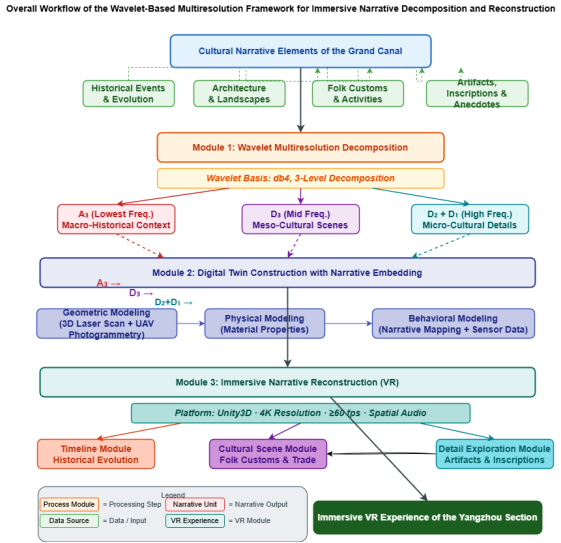
This section presents the theoretical foundation and the proposed framework. The overall approach comprises three main modules: wavelet‑based narrative decomposition, digital twin model construction, and immersive narrative reconstruction.
Figure 1. Overall workflow of the wavelet‑based multiresolution framework for immersive narrative decomposition and reconstruction.
2.1. Wavelet Multiresolution Decomposition of Cultural Narrative
The core idea of wavelet multiresolution analysis is to represent a signal at multiple levels of resolution using a set of orthogonal wavelet bases
| [7] | Mallat, S. G. (2002). A theory for multiresolution signal decomposition: The wavelet representation. IEEE Transactions on Pattern Analysis and Machine Intelligence, 11(7), 674–693. https://doi.org/10.1109/34.192463 |
[7]
. For a given signal f (t), the continuous wavelet transform is defined as:
where Wf (a, b) are the wavelet coefficients, a is the scale (dilation) parameter, b is the translation parameter, and ψ (t) is the mother wavelet. In practice, multi-resolution decomposition is implemented via a recursive filter bank: the signal is passed through a low pass filter (yielding approximation coefficients) and a high-pass filter (yielding detail coefficients), and this process is repeated on the approximation at each level.
In this study, we treat the structured set of cultural narrative elements as a one‑dimensional signal, where each element is assigned a weight proportional to its semantic importance. The Daubechies wavelet with four vanishing moments (db4) is selected as the wavelet basis. This choice is justified by its balance between smoothness and compact support, its ability to represent polynomial trends up to cubic order without generating spurious details, and its near‑symmetry, which minimizes phase distortion in the decomposed narrative components
. A three‑level decomposition is performed, yielding:
A3 (lowest‑frequency approximation): macro‑historical context (e.g., dynastic evolution, major historical events);
D3 (mid‑frequency detail): meso‑cultural scenes (e.g., architectural landscapes, folk customs, economic activities);
D2 and D1 (higher‑frequency details): micro‑cultural details (e.g., decorative patterns, inscriptions, local anecdotes).
This decomposition effectively transforms a complex, entangled narrative into a hierarchical set of multi‑scale units with clear semantic boundaries, facilitating subsequent mapping to the digital twin model.
2.2. Digital Twin Modeling with Narrative Embedding
The digital twin model of the Grand Canal is constructed through a three‑stage process that integrates geometric, physical, and behavioral dimensions. Geometric modeling relies on terrestrial laser scanning and unmanned aerial vehicle (UAV) photogrammetry to capture the physical morphology (canal course, bridges, ancient towns) with millimeter‑level accuracy, generating a 3D mesh model. Physical modeling incorporates material properties (stone, wood, etc.) and structural parameters derived from field sampling and laboratory tests, enabling simulation of mechanical behaviors such as stress and deformation. Behavioral modeling constitutes the novel contribution of this work: the multi‑scale narrative units obtained from wavelet decomposition (A3, D3, D2, D1) are explicitly mapped onto corresponding spatial and temporal levels of the digital model. Specifically, the macro‑historical context is associated with the overall temporal evolution of the model, meso‑cultural scenes are anchored to specific geographic regions, and micro‑cultural details are attached to individual architectural elements or artifacts. Additionally, real‑time sensor data (temperature, humidity, water level) are integrated to support dynamic alignment between the physical asset and its digital counterpart.
2.3. Immersive Narrative Reconstruction via VR
The final module translates the narrative‑enriched digital twin into an immersive VR experience. The digital twin model is imported into a real‑time rendering engine (e.g., Unity 3D), where interactive capabilities-including scene navigation, information querying, and virtual roaming-are implemented. The multi‑scale narrative units are embedded into the VR scene as follows:
1) For the macro‑historical context, a timeline interface is overlaid on the 3D scene, allowing users to visualize historical changes over different dynasties.
2) For meso‑cultural scenes, virtual characters and animated vignettes are integrated to simulate traditional customs, market activities, and canal transportation.
3) For micro‑cultural details, interactive close‑up views and pop‑up annotations are provided to reveal decorative motifs, inscriptions, and oral stories.
To ensure an immersive and comfortable user experience, the VR scene is optimized for high resolution (4K) and stable frame rates (≥60 fps), complemented by spatial audio that recreates ambient sounds such as flowing water and boat whistles.
2.4. Case Study Setup and Evaluation Protocol
The Yangzhou Section of the Grand Canal-a historically significant segment with over 2,000 years of history, encompassing landmarks such as the Slender West Lake and the Grand Canal Museum-is selected as the testbed for framework validation. Data collection encompasses: (a) geometric point clouds (covering ~10 km², with 500 million points), (b) historical literature and archival records (>100 volumes), (c) real‑time sensor streams from 50 deployed monitoring nodes, and (d) expert consultations with 10 heritage and computing specialists.
To evaluate the framework's effectiveness, we recruit 50 participants (20 cultural heritage professionals, 20 computer technology professionals, and 10 general audiences) to experience the developed VR scene and complete a structured questionnaire. Four indicators are assessed on a 10‑point Likert scale: immersion, authenticity, logicality, and operability. Results are reported as mean ± standard deviation.
3. Case Study: The Yangzhou Section of the Grand Canal
3.1. Study Area and Data
The Yangzhou Section of the Grand Canal, with a history exceeding 2,000 years, is selected as the case study area due to its rich and representative cultural heritage resources-including the Slender West Lake, the Grand Canal Museum, and several well‑preserved ancient canal towns. This segment embodies the full spectrum of the Canal's cultural narrative, from dynastic‑scale historical evolution to localized folk traditions and architectural details, making it an ideal testbed for evaluating the proposed framework.
Data acquisition for this case comprises four sources: (1) geometric data-terrestrial laser scanning and UAV photogrammetry covering approximately 10 km², yielding 500 million point clouds; (2) historical literature-over 100 volumes of archival records, ancient gazetteers, and cultural relic reports; (3) sensor data-real‑time measurements of temperature, humidity, and water level from 50 monitoring nodes deployed along the section; and (4) expert input-10 specialists in cultural heritage and computer science who guided the narrative element classification and framework validation.
3.2. Narrative Decomposition Results
Following the wavelet‑based decomposition procedure described in Section 2.1, the cultural narrative signal of the Yangzhou Section was subjected to a three‑level db4 wavelet decomposition. The resulting multi‑scale units are as follows:
Macro‑historical context (A3): This component captures the long‑term historical evolution of the Yangzhou Section from the Sui Dynasty to the Qing Dynasty, including major infrastructure projects, shifts in the canal's strategic importance, and key historical figures associated with the region.
Meso‑cultural scenes (D3): This mid‑frequency component isolates geographically anchored cultural assets, such as the Slender West Lake landscape complex, the architectural ensemble of the Grand Canal Museum, and the vernacular urban fabric of the ancient canal‑side towns.
Micro‑cultural details (D2 and D1): These high‑frequency components extract fine‑grained narrative elements, including the decorative stone carvings of the Wuting Bridge, the inscriptions on canal steles, and documented anecdotes of local boatmen and merchants.
The decomposition effectively disentangles the originally interwoven narrative into a hierarchical structure with clear semantic and spatial granularity, facilitating direct mapping onto the digital twin model's geometric and temporal levels.
3.3. Digital Twin Model and VR Implementation
The digital twin model of the Yangzhou Section was constructed following the three‑stage workflow outlined in Section 2.2. The geometric model achieves a spatial accuracy of 3 mm, faithfully reproducing the canal course, bridge structures, and historical buildings. The physical model integrates material property data to enable basic stress‑strain simulations. Critically, the behavioral model incorporates the decomposed narrative units: the macro‑historical context is linked to a dynasty‑level timeline within the model; meso‑cultural scenes are anchored to corresponding geographic regions and accessible via spatial navigation; and micro‑cultural details are attached to individual 3D elements as interactive annotations
| [9] | Qian, Z., Yang, H., & Zhang, J. (2024, June). Sustainable development of the Grand Canal cultural heritage ecological reserve: Policy framework, construction model, technological innovation. In Proceedings of the 2024 3rd International Conference on Social Sciences and Humanities and Arts (SSHA 2024) (pp. 550–562). Atlantis Press.
https://doi.org/10.2991/978-2-38476-259-0_59 |
[9]
.
The resulting narrative‑enriched digital twin was then imported into a VR environment featuring three interconnected experiential modules: (1) a historical evolution module presenting the Canal's transformation across dynasties via an interactive timeline; (2) a cultural scene module simulating folk activities, market trades, and boat traffic along the canal; and (3) a detail exploration module enabling close‑up examination of architectural ornamentation and inscribed artifacts.
3.4. Evaluation Results
Fifty participants-comprising 20 cultural heritage professionals, 20 computer technology professionals, and 10 general audience members-were recruited to experience the VR scene and complete a structured evaluation questionnaire. Four indicators (immersion, authenticity, logicality, and operability) were rated on a 10‑point Likert scale. To assess inter‑group consistency, a one‑way analysis of variance (ANOVA) was conducted for each indicator; no significant differences were found among the three participant groups (all
*p
* > 0.05), justifying the use of pooled data. The aggregated results are presented in
Table 1.
Table 1. Evaluation results of the proposed framework (pooled data, N = 50).
Indicator | Mean ± SD | 95% CI | Minimum | Maximum |
Immersion | 8.7 ± 0.7 | [8.5, 8.9] | 7.0 | 9.8 |
Authenticity | 8.5 ± 0.6 | [8.3, 8.7] | 7.2 | 9.5 |
Logicality | 8.3 ± 0.6 | [8.1, 8.5] | 6.8 | 9.3 |
Operability | 8.8 ± 0.5 | [8.7, 8.9] | 7.5 | 9.9 |
All four indicators achieved mean scores above 8.0, with operability scoring highest (8.8), reflecting the intuitive design of the VR interface. Immersion (8.7) and authenticity (8.5) confirm that the wavelet‑decomposed and digitally reconstructed narrative effectively conveys the cultural richness of the Canal. The logicality score (8.3), while slightly lower, indicates that the multi‑scale narrative structure enhances the coherence and completeness of the storytelling experience. The narrow confidence intervals and small standard deviations suggest that the framework performs consistently across diverse user groups.
To further validate the choice of the db4 wavelet basis, we conducted a sparsity analysis comparing different wavelet bases at the three narrative scales. Following the approach of Mallat
| [7] | Mallat, S. G. (2002). A theory for multiresolution signal decomposition: The wavelet representation. IEEE Transactions on Pattern Analysis and Machine Intelligence, 11(7), 674–693. https://doi.org/10.1109/34.192463 |
[7]
, sparsity is defined as the percentage of non‑zero wavelet coefficients after hard‑thresholding at ϵ = 1%-lower values indicate a more compact representation and thus better alignment between the wavelet basis and the narrative signal structure. As shown in
Table 2, the Haar wavelet exhibits the highest sparsity (37.4% average), as it can only represent piecewise constant signals, generating numerous non‑zero detail coefficients for the smooth macro‑narrative components. The db2 wavelet achieves a notable improvement (26.3%), as its second‑order vanishing moment captures linear trends. The selected db4 wavelet reaches an average sparsity of 15.7%, marking the point of diminishing returns: higher‑order bases (db6, db8) yield only marginal gains (15.1%) while doubling the support length and introducing more severe boundary effects. These results confirm that db4 offers an optimal balance between decomposition efficiency and computational practicality for the multi‑scale narrative structure of the Grand Canal.
Table 2. Sparsity of different wavelet bases at different narrative scales (ϵ = 1%).
Wavelet basis | Macro scale sparsity | Meso scale sparsity | Micro scale sparsity | Average sparsity |
Haar | 42.3% | 38.7% | 31.2% | 37.4% |
db2 | 28.6% | 26.1% | 24.3% | 26.3% |
db4 | 12.4% | 15.8% | 18.9% | 15.7% |
db6 | 11.2% | 14.3% | 19.7% | 15.1% |
db8 | 10.8% | 14.1% | 20.4% | 15.1% |
In addition to the questionnaire, qualitative feedback from the expert participants highlighted two strengths: the clear hierarchical organization of cultural information and the seamless integration of narrative content with spatial exploration. One limitation noted by several computer technology professionals was the absence of intelligent interaction (e.g., voice‑based querying), which points to a clear direction for future enhancement.
4. Discussion
The case study results presented in the preceding section demonstrate that the proposed framework achieves satisfactory performance across all four evaluation indicators, with mean scores exceeding 8.0 on a 10‑point scale. Beyond these quantitative validations, however, the findings carry broader implications for the theoretical integration of wavelet analysis with cultural narrative modeling, as well as for the practical design of heritage digital twins. This section interprets these implications, situates the contributions within the existing literature, discusses the methodological limitations, and outlines directions for future research.
4.1. Theoretical Contributions
This study makes three theoretical contributions that extend beyond the specific case of the Grand Canal.
First, it establishes wavelet multiresolution analysis as a principled mathematical tool for cultural narrative decomposition. Prior applications of wavelet analysis in cultural heritage have been confined to low‑level signal processing tasks, such as image restoration and data compression
| [5] | Liu, J., Zhou, H., Liu, X., Tian, G., Wu, M., Cao, L., & Wang, W. (2020). Digital twin modeling method based on biomimicry for machining aerospace components. Journal of Manufacturing Systems, 58, 1–13.
https://doi.org/10.1016/j.jmsy.2020.04.014 |
| [8] | Pawar, P., & Ainapure, B. (2025). Novel technique to deblurring and blur detection techniques for enhanced visual clarity of ancient images. International Journal of Electrical and Computer Engineering, 15(2), 2314–2324.
https://doi.org/10.11591/ijece.v15i2.pp2314-2324 |
[5, 8]
. By treating narrative itself as a structured signal amenable to multi‑scale decomposition, this work opens a new avenue for computational narrative analysis in heritage studies. The finding that a three‑level db4 decomposition yields semantically coherent units-macro, meso, and micro-that align with domain experts' intuitive categorization suggests that wavelet bases capture latent hierarchical structures inherent in cultural narratives. This theoretical insight has implications beyond linear heritage: any cultural narrative with inherent multi‑scale structure (e.g., urban heritage, industrial heritage) may benefit from similar decomposition strategies.
Second, this study advances the conceptualization of digital twins from "geometric replicas" to "narrative carriers." While existing digital twin models of cultural heritage predominantly emphasize geometric fidelity and real‑time monitoring
| [3] | Guo, M., Shang, X., Zhao, J., Shi, Y., Sun, M., Huang, M.,... & Liao, L. (2025). Digital twin models for architectural heritage conservation. Journal of Building Engineering, 113792.
https://doi.org/10.1016/j.jobe.2025.113792 |
| [15] | Zhang, Z. (2024). Digital twin-based analysis of natural deterioration and conservation strategies for the Great Wall cultural heritage [Doctoral dissertation, Tsinghua University].
https://newetds.lib.tsinghua.edu.cn/qh/paper/summary?dbCode=ETDQH&sysId=290770 |
[3, 15]
, they have been criticized for lacking cultural depth
| [2] | Debono, C., & Gravagnuolo, A. (2025). From digital twin to Memory Twin: A holistic framework for cultural heritage documentation, interpretation, and adaptive reuse. *The International Archives of the Photogrammetry, Remote Sensing and Spatial Information Sciences, XLVIII-M-9-2025, 203–210. https://doi.org/10.5194/isprs-archives-xlviii-m-9-2025-203-2025 |
[2]
. Our framework demonstrates that narrative embedding is not merely an add‑on feature but a structural integration: the mapping between wavelet‑decomposed narrative units and the digital twin's spatial‑temporal levels transforms the model from a passive representation into an active storytelling medium. This reconceptualization aligns with recent calls for "Memory Twins"
| [2] | Debono, C., & Gravagnuolo, A. (2025). From digital twin to Memory Twin: A holistic framework for cultural heritage documentation, interpretation, and adaptive reuse. *The International Archives of the Photogrammetry, Remote Sensing and Spatial Information Sciences, XLVIII-M-9-2025, 203–210. https://doi.org/10.5194/isprs-archives-xlviii-m-9-2025-203-2025 |
[2]
that prioritize interpretation alongside documentation, while providing a concrete, implementable methodology to achieve that vision.
Third, the framework contributes to immersive narrative theory by addressing a persistent gap: the lack of systematic decomposition and organization of narrative elements. Previous immersive heritage applications have focused on presentation technologies (VR/AR) and user experience design, often treating narrative content as a pre‑existing, unstructured resource
| [13] | Wu, D., & He, X. (2025). Reimagining cultural heritage through interactive digital narratives: Theoretical origins, ecosystem construction, and development trajectories. Library Journal.
https://www.libraryjournal.com.cn/EN/abstract/abstract3022.shtml |
| [14] | Yuan, S., Luan, B., He, B., Mu, N., Jiang, S., Shen, S., & Liu, Y. (2025). An integrated HBIM-VR framework design for Chinese classical architecture heritage digital conservation and interpretation: A case study of Yangxin Hall in the Forbidden City. The International Archives of the Photogrammetry, Remote Sensing and Spatial Information Sciences, XLVIII-M-9-2025, 1667–1674.
https://doi.org/10.5194/isprs-archives-xlviii-m-9-2025-1667-2025 |
[13, 14]
. By foregrounding the decomposition phase-prior to reconstruction-our approach ensures that the resulting immersive experience possesses logical coherence and narrative completeness. The evaluation result for logicality (8.3/10), while modest relative to other indicators, nevertheless confirms that structured decomposition yields measurable improvements over ad‑hoc narrative assembly, as evidenced by qualitative feedback from heritage professionals who specifically noted the "clear hierarchical organization" of the experience.
4.2. Interpretation of Evaluation Results
The high immersion score (8.7) and authenticity score (8.5) warrant closer examination. These results likely stem from the synergistic effect of two design choices: (a) the use of high‑fidelity geometric data (3 mm accuracy) providing photorealistic visual grounding, and (b) the embedding of culturally specific, temporally situated narratives that give contextual meaning to the visual experience. Importantly, the absence of significant differences among participant groups (p> 0.05 for all indicators) suggests that the framework's effectiveness is robust across different expertise backgrounds-a desirable property for public‑facing heritage applications.
The slightly lower logicality score (8.3), while still satisfactory, indicates room for improvement. Post‑hoc qualitative feedback revealed that some participants found the transition between macro‑historical timelines and meso‑cultural scenes to be occasionally abrupt. This suggests that while wavelet decomposition successfully separates narrative scales, the reconstruction phase-specifically, the interpolation between scales-could benefit from smoother transitional mechanisms, such as animated zooms or narrative voice‑overs that bridge the hierarchical levels.
4.3. Methodological Limitations and Scope
Beyond the specific limitations noted in the case study (e.g., the absence of intelligent voice interaction), three broader methodological constraints merit discussion.
First, the choice of wavelet basis, while theoretically justified, is not universally optimal. The db4 wavelet was selected for its balance between smoothness and compact support, and its performance in terms of sparsity (15.7% average) confirms its effectiveness. However, as shown in
Table 2, db6 and db8 achieve marginally higher sparsity (15.1%) at the cost of increased computational overhead and boundary effects due to longer support lengths. The practical implication is that researchers applying this framework to other heritage contexts may need to perform a basis‑selection procedure tailored to the statistical properties of their specific narrative signals.
Second, the narrative‑to‑signal conversion process-assigning importance weights to narrative elements-introduces a degree of subjectivity. While our weighting scheme was guided by expert consultation and historical documentation, it remains an interpretative act rather than a purely objective measurement. This is not necessarily a fatal flaw, as cultural heritage interpretation inherently involves expert judgment, but it does mean that different weighting strategies could yield different decomposition outcomes. Future applications should document their weighting protocols transparently and, where possible, conduct sensitivity analyses to assess the robustness of results to alternative weightings.
Third, the framework's generalizability beyond linear cultural heritage remains untested. The Grand Canal, as a linear heritage spanning multiple regions and historical periods, exhibits a clear geographic and temporal hierarchy that aligns naturally with wavelet decomposition. For non‑linear heritage types (e.g., archaeological sites, industrial complexes), the spatial‑temporal structure of narratives may be less hierarchical or more network‑like, potentially requiring adaptations to the decomposition and mapping strategies.
4.4. Reflections on the Research Design
Two methodological choices in this study warrant explicit reflection, as they may inform replication and adaptation efforts by other researchers.
Representativeness of the case selection. The Yangzhou Section was selected not only for its rich heritage resources but also for its manageable scale (~10 km²), which allowed comprehensive data collection within project constraints. This trade‑off between depth and breadth is typical in case‑study research. While the depth of data (500 million point clouds, 100+ volumes of literature, 50 sensors) strengthens the internal validity of the findings, the single‑case design limits external generalizability. Replication studies on other Grand Canal segments (e.g., Hangzhou, Beijing) and other linear heritage types (e.g., the Silk Road, the Roman aqueducts) would be valuable to establish the framework's broader applicability.
Participant composition in the evaluation. The inclusion of 20 heritage professionals, 20 technology professionals, and 10 general audiences was intended to capture diverse perspectives on the VR experience. However, the general audience group (n = 10) is smaller than the expert groups, which may limit its statistical power. Future evaluations should aim for balanced group sizes to enable more rigorous inter‑group comparisons. Additionally, the evaluation relied entirely on post‑experience self‑reported questionnaires, which are subject to response biases. Incorporating behavioral metrics (e.g., time spent on each module, number of interactions, navigation paths) would provide complementary, objective evidence of user engagement and narrative comprehension.
4.5. Future Research Directions
Building on the contributions and limitations discussed above, we identify four prioritized directions for future work.
First, algorithmic refinement. Systematic comparison of wavelet bases-including adaptive basis selection algorithms-could optimize narrative decomposition for different heritage types. Additionally, exploring alternative multi‑scale decomposition techniques, such as empirical mode decomposition or dictionary learning, may reveal whether wavelet analysis is uniquely suited to narrative structures or interchangeable with other methods.
Second, expansion of narrative scope. The current framework focuses on documented historical and cultural elements. Integrating intangible heritage components-oral traditions, folk songs, ritual performances-poses a significant challenge, as these are less readily convertible to structured signals. Developing multimodal decomposition strategies that accommodate audio, video, and textual inputs simultaneously would substantially broaden the framework's applicability.
Third, intelligent interaction integration. As noted by participants, the VR experience currently lacks adaptive, intelligent interaction. Incorporating large language models (LLMs) could enable natural‑language querying of narrative content ("Tell me about the bridge's history"), while recommendation algorithms could personalize narrative paths based on user interests and prior interactions. Such enhancements would transform the current "narrative broadcast" model into a "narrative dialogue" model.
Fourth, longitudinal evaluation. The current evaluation captures user perceptions at a single time point. Longitudinal studies-assessing whether the immersive experience leads to sustained knowledge retention, attitudinal change, or increased heritage engagement-would provide stronger evidence of the framework's educational and cultural impact.
5. Conclusion
This study proposes a wavelet‑based multiresolution framework for immersive narrative decomposition and reconstruction, applied to the Grand Canal-a linear cultural heritage facing persistent challenges of narrative fragmentation and insufficient immersive expression. The framework integrates three methodological pillars: wavelet multiresolution analysis for hierarchical narrative decomposition, digital twin modeling for structural‑semantic integration, and virtual reality for immersive reconstruction. Empirical validation through the Yangzhou Section case study confirms the framework's effectiveness, with all evaluation indicators (immersion, authenticity, logicality, operability) scoring above 8.0 on a 10‑point scale, and consistent performance across diverse participant groups.
At a more abstract level, this research advances the field in three distinct ways. Methodologically, it introduces wavelet analysis as a principled computational tool for cultural narrative structuring-extending its application from low‑level signal processing to high‑level semantic organization, and demonstrating that mathematical decomposition can align with humanistic categorization of heritage narratives. Theoretically, it reconceptualizes the digital twin from a geometric replica to a narrative‑carrying medium, providing a concrete instantiation of the "Memory Twin" vision that bridges documentation with interpretation. Practically, it offers a replicable technical pathway for the immersive transmission of linear cultural heritage, with potential adaptation to other heritage types where multi‑scale narratives are prevalent.
Several limitations of this work should inform future investigations. The wavelet basis selection, while justified, may not be universally optimal; the narrative‑to‑signal weighting protocol introduces interpretative subjectivity; and the single‑case design limits generalizability. Future research should prioritize: (a) algorithmic refinement through adaptive basis selection and comparative evaluation across heritage types; (b) expansion of narrative scope to incorporate intangible heritage elements and multimodal data; and (c) integration of intelligent interaction mechanisms to transform narrative broadcast into narrative dialogue.
In closing, this study demonstrates that the convergence of wavelet analysis, digital twin technology, and immersive media offers a fertile ground for reimagining how cultural heritage can be preserved, narrated, and experienced in the digital age. We hope the framework serves not as a definitive solution, but as an invitation for further interdisciplinary inquiry-one that respects the richness of cultural narratives while embracing the analytical power of computational methods.
Abbreviations
DT | Digital Twin |
CH | Cultural Heritage |
VR | Virtual Reality |
AR | Augmented Reality |
UAV | Unmanned Aerial Vehicle |
ANOVA | Analysis of Variance |
LLMs | Large Language Models |
Acknowledgments
This work was supported by MOE Liberal Arts and Social Sciences Foundation Project (Grant No. 21YJA860002).
Author Contributions
Guoli Chen: Conceptualization, Funding acquisition, Methodology, Resources, Validation, Writing – original draft, Writing – review & editing
Li Huang: Data curation, Formal Analysis, Methodology, Writing – review & editing
Yichen Zhang: Investigation, Software, Visualization, Writing – original draft
Jiayi Shen: Investigation, Software, Visualization, Writing – original draft
Data Availability Statement
The data supporting the outcome of this research work has been reported in this manuscript.
Conflicts of Interest
The authors declare no conflicts of interest.
References
| [1] |
Daubechies, I. (1992). Ten lectures on wavelets. Society for Industrial and Applied Mathematics.
https://doi.org/10.1137/1.9781611970104
|
| [2] |
Debono, C., & Gravagnuolo, A. (2025). From digital twin to Memory Twin: A holistic framework for cultural heritage documentation, interpretation, and adaptive reuse. *The International Archives of the Photogrammetry, Remote Sensing and Spatial Information Sciences, XLVIII-M-9-2025, 203–210.
https://doi.org/10.5194/isprs-archives-xlviii-m-9-2025-203-2025
|
| [3] |
Guo, M., Shang, X., Zhao, J., Shi, Y., Sun, M., Huang, M.,... & Liao, L. (2025). Digital twin models for architectural heritage conservation. Journal of Building Engineering, 113792.
https://doi.org/10.1016/j.jobe.2025.113792
|
| [4] |
Liang, J., Zhao, L., Zhang, S., & Lu, L. (2025). How does immersive technology drive real tourism? Technology acceptance and cultural foundation. SAGE Open, 15(2).
https://doi.org/10.1177/21582440251330012
|
| [5] |
Liu, J., Zhou, H., Liu, X., Tian, G., Wu, M., Cao, L., & Wang, W. (2020). Digital twin modeling method based on biomimicry for machining aerospace components. Journal of Manufacturing Systems, 58, 1–13.
https://doi.org/10.1016/j.jmsy.2020.04.014
|
| [6] |
Lucchi, E. (2025). Digital twins, artificial intelligence and immersive technologies for heritage preservation and cultural tourism in smart cities. In Digital twin, blockchain, and sensor networks in the healthy and mobile city (pp. 507-520). Elsevier.
https://doi.org/10.1016/b978-0-443-34174-8.00026-0
|
| [7] |
Mallat, S. G. (2002). A theory for multiresolution signal decomposition: The wavelet representation. IEEE Transactions on Pattern Analysis and Machine Intelligence, 11(7), 674–693.
https://doi.org/10.1109/34.192463
|
| [8] |
Pawar, P., & Ainapure, B. (2025). Novel technique to deblurring and blur detection techniques for enhanced visual clarity of ancient images. International Journal of Electrical and Computer Engineering, 15(2), 2314–2324.
https://doi.org/10.11591/ijece.v15i2.pp2314-2324
|
| [9] |
Qian, Z., Yang, H., & Zhang, J. (2024, June). Sustainable development of the Grand Canal cultural heritage ecological reserve: Policy framework, construction model, technological innovation. In Proceedings of the 2024 3rd International Conference on Social Sciences and Humanities and Arts (SSHA 2024) (pp. 550–562). Atlantis Press.
https://doi.org/10.2991/978-2-38476-259-0_59
|
| [10] |
Spallone, R., & Vitali, M. (2024). Cultural heritage digital twin: Modeling and representing the visual narrative in Leonardo Da Vinci's Mona Lisa. Neural Computing and Applications, 36, 11859–11876.
https://doi.org/10.1007/s00521-024-10010-x
|
| [11] |
The Academy of Contemporary China and World Studies. (2024). The Grand Canal. China.org.cn.
http://www.china.org.cn/english/china_key_words/2024-08/26/content_117387705.html
|
| [12] |
UNESCO. (2021, April 15). About the Memory of the World Programme. National Archives Administration of China.
https://www.saac.gov.cn/mowcn/en/c100468/202104/ab5127881e684e588cb277dc7666232f.shtml
|
| [13] |
Wu, D., & He, X. (2025). Reimagining cultural heritage through interactive digital narratives: Theoretical origins, ecosystem construction, and development trajectories. Library Journal.
https://www.libraryjournal.com.cn/EN/abstract/abstract3022.shtml
|
| [14] |
Yuan, S., Luan, B., He, B., Mu, N., Jiang, S., Shen, S., & Liu, Y. (2025). An integrated HBIM-VR framework design for Chinese classical architecture heritage digital conservation and interpretation: A case study of Yangxin Hall in the Forbidden City. The International Archives of the Photogrammetry, Remote Sensing and Spatial Information Sciences, XLVIII-M-9-2025, 1667–1674.
https://doi.org/10.5194/isprs-archives-xlviii-m-9-2025-1667-2025
|
| [15] |
Zhang, Z. (2024). Digital twin-based analysis of natural deterioration and conservation strategies for the Great Wall cultural heritage [Doctoral dissertation, Tsinghua University].
https://newetds.lib.tsinghua.edu.cn/qh/paper/summary?dbCode=ETDQH&sysId=290770
|
Cite This Article
-
APA Style
Chen, G., Huang, L., Zhang, Y., Shen, J. (2026). A Wavelet-Based Multiresolution Framework for Immersive Narrative Decomposition and Reconstruction: A Digital Twin Case Study of the Grand Canal Cultural Heritage. Humanities and Social Sciences, 14(6), 452-460. https://doi.org/10.11648/j.hss.20261406.11
 Copy
|
 Download
ACS Style
Chen, G.; Huang, L.; Zhang, Y.; Shen, J. A Wavelet-Based Multiresolution Framework for Immersive Narrative Decomposition and Reconstruction: A Digital Twin Case Study of the Grand Canal Cultural Heritage. Humanit. Soc. Sci. 2026, 14(6), 452-460. doi: 10.11648/j.hss.20261406.11
Copy
|
Download
AMA Style
Chen G, Huang L, Zhang Y, Shen J. A Wavelet-Based Multiresolution Framework for Immersive Narrative Decomposition and Reconstruction: A Digital Twin Case Study of the Grand Canal Cultural Heritage. Humanit Soc Sci. 2026;14(6):452-460. doi: 10.11648/j.hss.20261406.11
Copy
|
Download
-
@article{10.11648/j.hss.20261406.11,
  author = {Guoli Chen and Li Huang and Yichen Zhang and Jiayi Shen},
  title = {A Wavelet-Based Multiresolution Framework for Immersive Narrative Decomposition and Reconstruction: A Digital Twin Case Study of the Grand Canal Cultural Heritage},
  journal = {Humanities and Social Sciences},
  volume = {14},
  number = {6},
  pages = {452-460},
  doi = {10.11648/j.hss.20261406.11},
  url = {https://doi.org/10.11648/j.hss.20261406.11},
  eprint = {https://article.sciencepublishinggroup.com/pdf/10.11648.j.hss.20261406.11},
  abstract = {The Grand Canal, a world cultural heritage site, carries profound historical and cultural values, yet its cultural narrative faces persistent challenges of fragmentation, difficult inheritance, and insufficient immersive expression. Digital twin technology offers a new pathway for heritage preservation, while wavelet multiresolution analysis shows advantages in multi-scale data processing. To address the inefficient integration between cultural narrative expression and digital twin modeling, this study proposes a wavelet-based multiresolution framework for immersive narrative decomposition and reconstruction. First, the cultural narrative elements of the Grand Canal are systematically decomposed into multi-scale narrative units—macro-historical context, meso-cultural scenes, and micro-cultural details—based on wavelet multiresolution analysis. Then, a digital twin model integrating 3D geometry, sensor data, and historical documentation is constructed, and the multi-scale narrative units are mapped onto its corresponding levels. Finally, immersive reconstruction is realized through virtual reality technology, and the framework is validated on the Yangzhou Section of the Grand Canal. Evaluation results show mean scores above 8.0 on a 10-point scale across immersion, authenticity, logicality, and operability, confirming the framework's effectiveness in enhancing narrative coherence and user engagement. This study extends wavelet analysis from signal processing to narrative structuring, reconceptualizes the digital twin as a narrative-carrying medium, and offers a replicable pathway for the immersive transmission of linear cultural heritage.},
 year = {2026}
}
Copy
|
Download
-
TY  - JOUR
T1  - A Wavelet-Based Multiresolution Framework for Immersive Narrative Decomposition and Reconstruction: A Digital Twin Case Study of the Grand Canal Cultural Heritage
AU  - Guoli Chen
AU  - Li Huang
AU  - Yichen Zhang
AU  - Jiayi Shen
Y1  - 2026/11/10
PY  - 2026
N1  - https://doi.org/10.11648/j.hss.20261406.11
DO  - 10.11648/j.hss.20261406.11
T2  - Humanities and Social Sciences
JF  - Humanities and Social Sciences
JO  - Humanities and Social Sciences
SP  - 452
EP  - 460
PB  - Science Publishing Group
SN  - 2330-8184
UR  - https://doi.org/10.11648/j.hss.20261406.11
AB  - The Grand Canal, a world cultural heritage site, carries profound historical and cultural values, yet its cultural narrative faces persistent challenges of fragmentation, difficult inheritance, and insufficient immersive expression. Digital twin technology offers a new pathway for heritage preservation, while wavelet multiresolution analysis shows advantages in multi-scale data processing. To address the inefficient integration between cultural narrative expression and digital twin modeling, this study proposes a wavelet-based multiresolution framework for immersive narrative decomposition and reconstruction. First, the cultural narrative elements of the Grand Canal are systematically decomposed into multi-scale narrative units—macro-historical context, meso-cultural scenes, and micro-cultural details—based on wavelet multiresolution analysis. Then, a digital twin model integrating 3D geometry, sensor data, and historical documentation is constructed, and the multi-scale narrative units are mapped onto its corresponding levels. Finally, immersive reconstruction is realized through virtual reality technology, and the framework is validated on the Yangzhou Section of the Grand Canal. Evaluation results show mean scores above 8.0 on a 10-point scale across immersion, authenticity, logicality, and operability, confirming the framework's effectiveness in enhancing narrative coherence and user engagement. This study extends wavelet analysis from signal processing to narrative structuring, reconceptualizes the digital twin as a narrative-carrying medium, and offers a replicable pathway for the immersive transmission of linear cultural heritage.
VL  - 14
IS  - 6
ER  -
Copy
|
Download





 Share This Article
 Twitter
 Linked In
 Facebook