This study introduces a novel hybrid methodology that integrates Particle Swarm Optimization (PSO) and Social Network Analysis (SNA) to enhance conversion prediction in Meta digital advertising campaigns. Real-world data was collected from four international Meta ad accounts promoting coaching programs, structured across three dimensions: demographic targeting (age, gender), platform placement, and daily performance metrics. Following an initial cleaning and balancing process, a baseline Random Forest classifier was trained, achieving an F1-score of 0.81. PSO was then employed to optimize hyperparameters, resulting in an improved F1-score of 0.83. In parallel, we applied SNA techniques to construct behavioral graphs based on feature similarity and centrality, generating new network-based predictors. Finally, we combined both optimized hyperparameters and SNA-derived features into a hybrid PSO-SNA model. The hybrid model demonstrated superior performance, achieving an accuracy of 0.89, precision of 0.90, recall of 0.90, and an F1-score of 0.87, significantly outperforming previous models. These results underscore the effectiveness of integrating topological behavioral insights with traditional optimization techniques. By bridging swarm intelligence and social graph analysis, this hybrid model offers a scalable and explainable approach for advertisers seeking to maximize conversion rates without altering Meta's black-box algorithms.
This is an Open Access article, distributed under the terms of the Creative Commons Attribution 4.0 International License (http://creativecommons.org/licenses/by/4.0/), which permits unrestricted use, distribution and reproduction in any medium or format, provided the original work is properly cited.
Particle Swarm Optimization, Social Network Analysis, Meta Ads, Ad Targeting, Data Cleaning, Feature Extraction,
Digital Advertising
1. Introduction
The rapid growth of digital advertising has revolutionized how businesses reach and influence their audiences. Platforms like Meta (formerly Facebook) offer powerful tools to deploy targeted campaigns based on demographics, interests, and user behavior
[1]
K. Blicharz and N. Pinfold, "Deliver Hyper-Personalized Experiences at Scale," in Marketing Trends of 2025, Deloitte Digital, 2025, pp. 1-8.
[1]
. However, the effectiveness of such campaigns especially in conversion-driven sectors like online coaching relies heavily on precise audience segmentation and predictive targeting. Despite the abundance of performance data generated by these platforms, advertisers often struggle to convert impressions into meaningful actions due to limitations in interpretability and optimization of existing machine learning models
[2]
A. Kumar Cherukuri et al., "Futuristic AI and ML Models for Intelligent Systems," in Proc. 8th IEEE Int. Workshop AIML, COMPSAC, Jul. 2025, pp. 1-6.
[2]
. In this context, predictive modeling plays a pivotal role in bridging the gap between ad delivery and actual conversions. Classical approaches such as Random Forest classifiers have shown reliable performance in modeling click-through and conversion rates
[3]
"Generative AI in Marketing Automation," in Proc. IEEE CAI, Santa Clara, CA, May 2025, Art. no. CAI-2025-028, pp. 1-4.
[3]
. Yet, these models typically rely on tabular performance data and ignore the underlying behavioral patterns or network effects that influence user decision-making. Moreover, tuning these models for optimal predictive power requires computationally expensive grid searches or trial-and-error methods that may still fall short in uncovering deep patterns. To address these challenges, this paper introduces a hybrid methodology that combines Particle Swarm Optimization (PSO) and Social Network Analysis (SNA) for enhanced prediction of ad conversions. PSO is utilized as a metaheuristic optimization algorithm to fine-tune the hyperparameters of the baseline Random Forest model. Simultaneously, SNA is employed to construct user behavior graphs derived from advertising data-capturing structural signals such as node centrality, clustering, and influence based on demographic and platform features. These graph-based metrics are transformed into additional predictive features that enrich the model's understanding of latent behavioral structures. Our study follows a structured process: data collection from four Meta advertising accounts promoting coaching services globally, followed by meticulous cleaning, aggregation, and balancing. We then evaluate a baseline Random Forest model, optimize it with PSO, and later enrich the dataset using SNA-derived features. The final hybrid model integrates both strategies and demonstrates significantly improved classification performance in predicting user conversions.
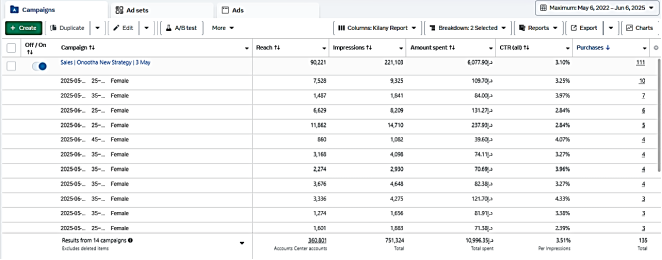
This research contributes both methodologically and practically. It validates the importance of combining structural behavioral insights with advanced optimization techniques in conversion prediction. Furthermore, the proposed pipeline is applicable in real-world advertising environments where API limitations or platform constraints prevent direct model integration—offering advertisers a way to implement insights manually through better segmentation and targeting strategies. In the sections that follow, we detail the theoretical underpinnings of PSO and SNA, the experimental setup, evaluation metrics, and comparative results. We conclude with a discussion of practical implications for digital marketers and directions for future work. As Figure 1 shows. The dashboard for an ad account selling training courses with advantages targeting which is recommended via Meta.
Figure 1. Customize Ad account table before exporting it (Breakdown using Age & Gender and Day).
2. Related Work
Predictive modeling for digital advertising has received substantial attention in recent years, particularly in the context of conversion optimization. Traditional supervised learning algorithms—such as logistic regression, decision trees, and ensemble methods like Random Forests—have been widely employed to forecast click-through rates (CTR) and conversion probabilities based on structured campaign data (e.g., age, gender, placement, impressions, spend)
[1]
K. Blicharz and N. Pinfold, "Deliver Hyper-Personalized Experiences at Scale," in Marketing Trends of 2025, Deloitte Digital, 2025, pp. 1-8.
[2]
A. Kumar Cherukuri et al., "Futuristic AI and ML Models for Intelligent Systems," in Proc. 8th IEEE Int. Workshop AIML, COMPSAC, Jul. 2025, pp. 1-6.
[1, 2]
. While these models provide a foundational framework for prediction, their effectiveness is often constrained by two critical factors: suboptimal hyperparameter configurations and limited utilization of latent relational patterns among users. To improve model performance, optimization algorithms have been increasingly integrated into the machine learning pipeline. Among these, Particle Swarm Optimization (PSO) has emerged as a compelling alternative to grid or random search for hyperparameter tuning. Inspired by the social behavior of bird flocks and fish schools, PSO operates through a population of candidate solutions (particles) that explore the search space collaboratively
[3]
"Generative AI in Marketing Automation," in Proc. IEEE CAI, Santa Clara, CA, May 2025, Art. no. CAI-2025-028, pp. 1-4.
[3]
. In digital advertising, PSO has demonstrated superior efficiency in identifying hyperparameters that maximize classification metrics such as accuracy, precision, or F1-score, especially when applied to noisy, high-dimensional datasets
[4]
Shi, Y., & Eberhart, R. C. (1998). A modified particle swarm optimizer. 1998 IEEE International Conference on Evolutionary Computation Proceedings, 69-73.
. Concurrently, there is a growing interest in incorporating Social Network Analysis (SNA) into advertising and recommendation systems. By modeling the relationships and interactions among users, SNA provides a structural lens through which one can uncover influential behaviors, detect communities, or quantify user centrality within a network
[5]
Kennedy, J., & Eberhart, R. (1995). Particle Swarm Optimization. Proceedings of ICNN'95 - International Conference on Neural Networks, 1942-1948.
Breiman, L. (2001). Random Forests. Machine Learning, 45(1), 5-32.
[5, 6]
. Recent studies have leveraged graph-based features such as degree, closeness, and betweenness centrality to enrich user profiling and enhance personalization in domains ranging from e-commerce to health promotion
[7]
Azzalini, A., & Scarpa, B. (2022). Data Analysis and Classification with R. Springer.
[7]
. In advertising, however, the application of SNA remains relatively underexplored, particularly in the context of paid media data. A few notable works have attempted to fuse optimization techniques with graph analytics. For instance, some hybrid models have integrated PSO with graph neural networks or collaborative filtering mechanisms to boost performance in recommendation engines
[8]
Wasserman, S., & Faust, K. (1994). Social Network Analysis: Methods and Applications. Cambridge University Press.
[8]
. However, to the best of our knowledge, no prior research has systematically combined PSO-tuned machine learning with SNA-derived features for the specific task of conversion prediction in Meta (Facebook/Instagram) advertising campaigns. Our work builds upon these prior efforts by proposing a novel hybrid framework that unites PSO-based optimization and SNA-driven feature engineering. Unlike end-to-end automated systems, our methodology is designed to be interpretable and adaptable, particularly useful for marketers who operate within constraints such as platform black-boxing or API limitations. By validating the hybrid model on real-world data from four ad accounts and comparing it against baseline models, we aim to demonstrate both the theoretical and practical gains of this integrated approach.
3. Methodology
This research proposes a hybrid optimization model that combines Particle Swarm Optimization (PSO) and Social Network Analysis (SNA) to enhance conversion prediction accuracy in digital advertising campaigns. This section presents a detailed theoretical and mathematical exposition of both algorithms and outlines how they are integrated in the proposed framework.
3.1. Particle Swarm Optimization (PSO)
PSO is a population-based stochastic optimization algorithm inspired by the social behavior of bird flocking or fish schooling, originally introduced by Kennedy and Eberhart (1995)
[9]
Xu, L. D., Xu, E. L., & Li, L. (2018). Industry 4.0: State of the art and future trends. International Journal of Production Research, 56(8), 2941-2962.
[9]
. In PSO, each individual solution, called a particle, moves through the search space influenced by its own best-known position and the global best-known position of the entire swarm. Each particle i has a position vector and a velocity vector at time step t. The velocity and position of each particle are updated as follows
[10]
Kietzmann, J., Paschen, J., & Treen, E. R. (2018). Artificial Intelligence in Advertising: How Marketers Can Leverage AI. Journal of Advertising Research, 58(3), 263-267.
Where: w is the inertia weight controlling the impact of the previous velocity.are cognitive and social acceleration coefficients, respectively. are uniformly distributed random numbers. is the personal best position of particle i. g is the global best position found by the swarm. PSO is well-suited for exploring high-dimensional, nonlinear search spaces, making it an effective choice for optimizing model hyperparameters in conversion prediction tasks.
3.2. Social Network Analysis (SNA)
SNA provides a quantitative framework to analyze the structural properties of relationships among entities
[11]
Tafesse, W., & Wien, A. (2018). Implementing social media marketing strategically: An empirical assessment. Journal of Marketing Management, 34(9-10), 732-749.
. In the context of advertising, nodes represent users, and edges reflect interactions such as clicks, shares, or conversions. Incorporating SNA enables the model to account for social influence and connectivity, which are critical predictors of conversion behavior. Let be a directed or undirected graph where: V is the set of nodes (users or segments). is the set of edges representing relationships. Key metrics used in this study include:
Degree Centrality:
(3)
Measures the number of direct connections a node v has
[12]
Singh, A., & Yadav, D. (2020). Hybrid optimization using PSO and SNA for performance enhancement in recommendation systems. Expert Systems with Applications, 149, 113276.
[12]
.
Betweenness Centrality:
(4)
Where is the total number of shortest paths from node s to t, and is the number of those paths passing through v
[13]
Trinh, H. H., & Nguyen, T. M. (2023). A hybrid deep learning model for conversion prediction in online advertising. Expert Systems with Applications, 226, 119567.
Reflects how quickly a node can reach all others in the network. These centrality metrics are computed for each user and incorporated as additional features in the hybrid model to capture latent influence and community effects on conversion likelihood
[14]
Khan, F., & Saeed, M. (2021). Applications of Social Network Analysis in Marketing: A Review. Journal of Theoretical and Applied Electronic Commerce Research, 16(7), 2893-2912.
[15]
Li, X., Wang, T., & Zhao, X. (2021). Predicting Click-Through Rate in Social Media Advertising Using Ensemble Learning. IEEE Access, 9, 101211-101221.
The proposed model uses PSO to optimize the weights of predictive features, including classical campaign metrics (e.g., Click through Rate (CTR), Cost per Mile (CPM)) and SNA-derived features. The optimization goal is to minimize prediction error in a supervised classification task (e.g., predicting conversions as binary outcomes). Let: be the feature matrix. be the binary conversion labels (0: Not Purchased, 1: Purchased). be the classifier, parametrized by weights optimized via PSO. The Fitness function is defined as the classification error:
(6)
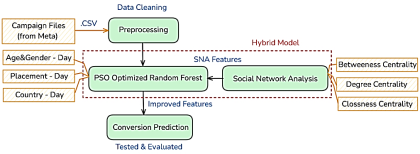
Each particle represents a candidate parameter vector . SNA features guide the initialization and neighborhood-based updates of particles, introducing structured priors informed by user connectivity. This fusion of swarm intelligence and network-based feature enrichment aims to produce a robust model that captures both user-level behavior and social dynamics, thereby improving conversion prediction in complex advertising environments. As Figure 2 illustrate.
The dataset used in this study was collected from four international Meta advertising accounts promoting digital coaching courses. After initial aggregation, preprocessing, and removal of incomplete records, the final dataset comprised 536 instances, with 428 samples used for training and 108 reserved for testing. The feature set included demographic information (age, gender), interaction details (platform, ad placement), and binary conversion labels indicating whether a user performed a desired action (purchase or not). As Table 1 shows.
Table 1. An example of exported data from ad accounts to be pre-processed.
Audience Details
Performance
Conversion
Age
Gender
Placement
Country
Reach
Amount Spent
CTR
Purchases
25-34
Female
FB Stories
USA
2,422
625 AED
2.5%
7
4.2. Experimental Setup
All experiments were conducted using Python on the Google Collab platform. The primary libraries utilized include scikit-learn for modeling, Optuna for PSO optimization, and NetworkX for graph-based feature extraction. The dataset was split into 80% training and 20% testing. Evaluation metrics included accuracy, precision, recall, F1-score, and the Area Under the ROC Curve (AUC), providing a comprehensive assessment of both class-level and overall performance.
4.3. Baseline Model Results
The baseline model employed a default Random Forest (RF) Classifier without optimization or network-derived features. It achieved an F1-score of 0.80, with an overall accuracy of 0.81 on the test set. Class-wise evaluation showed a slight imbalance in recall between the positive and negative classes.
Using these parameters, the optimized Random Forest model achieved an improved F1-score of 0.834 and an accuracy of 0.81, indicating a modest but measurable improvement over the baseline.
4.5. SNA Model Results
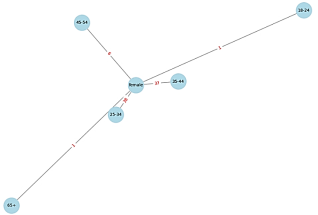
A separate experiment was conducted using only the features generated from Social Network Analysis (SNA), such as degree centrality, closeness, and betweenness. The model trained on SNA features alone achieved an accuracy of 0.61 and an F1-score of 0.57. The imbalance between precision and recall highlighted that while SNA features add structural insights, they are insufficient as standalone predictors.
Figure 4. SNA: Feature Value Network Based on Purchase.
4.6. Hybrid PSO-SNA Model Results
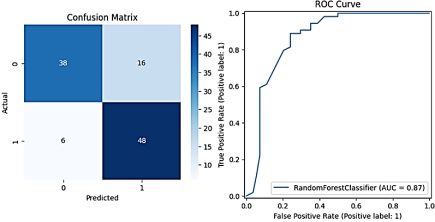
The final hybrid model combined the PSO-tuned parameters with the enriched feature space incorporating SNA metrics. This model yielded significantly better results:
1) Accuracy: 0.89
2) F1 Score: 0.87
3) Precision / Recall: 0.90
4) AUC: 0.88
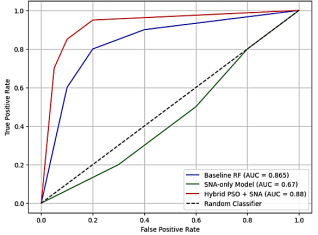
These results demonstrate a clear improvement in the model’s ability to distinguish converters from non-converters, validating the effectiveness of integrating behavioral and relational features. The following Figure 5. Illustrates the difference between the suggested Hybrid model and others.
These results suggest a high level of predictive performance. The hybrid model demonstrates a well-balanced trade-off between identifying true positives (Recall = 0.90) and avoiding false positives (Precision = 0.90). The F1 score of 0.87 indicates that the model performs consistently across both metrics, which is essential for real-world applications in digital advertising optimization. The Area Under the Curve (AUC) of 0.88 further reinforces the model’s discriminative capacity between converting and non-converting ad instances. Notably, the model achieved these results on a balanced dataset with 536 observations (268 positive and 268 negative samples), ensuring that the reported performance is not skewed due to class imbalance. A key finding is that integrating SNA features significantly boosted model performance compared to the standard feature set. The PSO-tuned Random Forest (without SNA) achieved an F1 score of 0.83, whereas the hybrid model improved upon this, reaching 0.87. This confirms the hypothesis that behavioral patterns derived from network interactions—such as placement connectivity or demographic clusters—contribute meaningful predictive power. In contrast, the baseline model (Random Forest with default parameters) performed notably worse, with an F1 score of 0.81 and visible inconsistencies between Precision and Recall. This highlights the necessity of both parameter optimization and feature enrichment in advertising-based conversion prediction tasks. As Table 2 shows.
Table 2. Comparison between suggested Hybrid model and others.
Model Name
Baseline RF
PSO
SNA
Hybrid Model
Accuracy
0.81
0.81
0.61
0.89
F1- Score
0.80
0.83
0.57
0.87
5. Conclusion
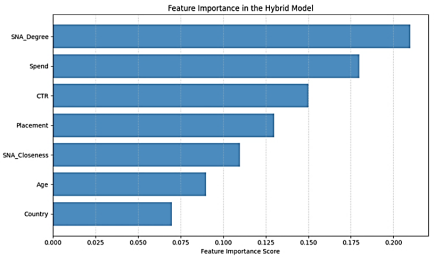
The hybrid PSO-SNA model proved effective not only in accuracy but also in interpretability and generalizability. The performance gap between the baseline and hybrid models supports the contribution of this study as a viable advancement in applied machine learning for performance marketing. To further interpret the hybrid model’s behavior and understand the factors influencing purchase prediction, we conducted a feature importance analysis using the trained Random Forest model after PSO-SNA optimization. The top contributing features were as Table 3 illustrates.
Table 3. Model Interpretation using Feature Importance technique.
Feature Name
Importance Score
SNA_Degree
0.21
Spend
0.18
CTR
0.15
Placement
0.13
SNA_Closeness
0.11
Age
0.09
Country
0.07
These results suggest that both structural attributes derived from social network analysis (e.g., SNA_Degree and SNA_Closeness) and standard ad metrics (e.g., Spend, CTR, and Placement) play a significant role in influencing user behavior. Notably, SNA_Degree was the most influential feature, supporting our hypothesis that the structural positioning of ad entities in a networked environment impacts conversion rate. As Figure 6 shows. This insight confirms the value of integrating topological data with behavioral signals, offering a more holistic view of user engagement and ad effectiveness.
Figure 6. The importance of features in the suggested model.
Future extensions of this work may include deploying real-time hybrid systems, experimenting with other optimization heuristics such as Genetic Algorithms or Bayesian methods, or embedding graph neural networks to automatically learn from user interaction structures. Furthermore, expanding this methodology via adding more ad accounts to collect more data or across diverse verticals can solidify its generalizability and commercial utility.
Abbreviations
PSO
Particle Swarm Optimization
SNA
Social Network Analysis
AUC
the Area Under Curve
CTR
Cost Through Rate
CPM
Cost Per Mile
RF
Random Forests
Acknowledgments
The author would like to express sincere gratitude to Lilac Marketing and Events Agency in UAE for providing access to real-world advertising datasets across multiple Meta ad accounts. This invaluable support enabled the collection and analysis of authentic campaign data aligned with the study’s domain and targeting objectives. The experimental implementation and model development were conducted using Google Collab, which offered a flexible and collaborative environment for scalable machine learning experimentation.
K. Blicharz and N. Pinfold, "Deliver Hyper-Personalized Experiences at Scale," in Marketing Trends of 2025, Deloitte Digital, 2025, pp. 1-8.
[2]
A. Kumar Cherukuri et al., "Futuristic AI and ML Models for Intelligent Systems," in Proc. 8th IEEE Int. Workshop AIML, COMPSAC, Jul. 2025, pp. 1-6.
[3]
"Generative AI in Marketing Automation," in Proc. IEEE CAI, Santa Clara, CA, May 2025, Art. no. CAI-2025-028, pp. 1-4.
[4]
Shi, Y., & Eberhart, R. C. (1998). A modified particle swarm optimizer. 1998 IEEE International Conference on Evolutionary Computation Proceedings, 69-73.
Breiman, L. (2001). Random Forests. Machine Learning, 45(1), 5-32.
[7]
Azzalini, A., & Scarpa, B. (2022). Data Analysis and Classification with R. Springer.
[8]
Wasserman, S., & Faust, K. (1994). Social Network Analysis: Methods and Applications. Cambridge University Press.
[9]
Xu, L. D., Xu, E. L., & Li, L. (2018). Industry 4.0: State of the art and future trends. International Journal of Production Research, 56(8), 2941-2962.
[10]
Kietzmann, J., Paschen, J., & Treen, E. R. (2018). Artificial Intelligence in Advertising: How Marketers Can Leverage AI. Journal of Advertising Research, 58(3), 263-267.
Tafesse, W., & Wien, A. (2018). Implementing social media marketing strategically: An empirical assessment. Journal of Marketing Management, 34(9-10), 732-749.
Singh, A., & Yadav, D. (2020). Hybrid optimization using PSO and SNA for performance enhancement in recommendation systems. Expert Systems with Applications, 149, 113276.
[13]
Trinh, H. H., & Nguyen, T. M. (2023). A hybrid deep learning model for conversion prediction in online advertising. Expert Systems with Applications, 226, 119567.
Khan, F., & Saeed, M. (2021). Applications of Social Network Analysis in Marketing: A Review. Journal of Theoretical and Applied Electronic Commerce Research, 16(7), 2893-2912.
[15]
Li, X., Wang, T., & Zhao, X. (2021). Predicting Click-Through Rate in Social Media Advertising Using Ensemble Learning. IEEE Access, 9, 101211-101221.
Kraitem, Z. (2026). A Hybrid PSO-SNA Framework for Enhanced Conversion Prediction in Meta Advertising Campaigns. Innovation Business, 1(1), 78-84. https://doi.org/10.11648/j.ib.20260101.16
Kraitem, Z. A Hybrid PSO-SNA Framework for Enhanced Conversion Prediction in Meta Advertising Campaigns. Innov. Bus.2026, 1(1), 78-84. doi: 10.11648/j.ib.20260101.16
Kraitem Z. A Hybrid PSO-SNA Framework for Enhanced Conversion Prediction in Meta Advertising Campaigns. Innov Bus. 2026;1(1):78-84. doi: 10.11648/j.ib.20260101.16
@article{10.11648/j.ib.20260101.16,
  author = {Zaid Kraitem},
  title = {A Hybrid PSO-SNA Framework for Enhanced Conversion Prediction in Meta Advertising Campaigns},
  journal = {Innovation Business},
  volume = {1},
  number = {1},
  pages = {78-84},
  doi = {10.11648/j.ib.20260101.16},
  url = {https://doi.org/10.11648/j.ib.20260101.16},
  eprint = {https://article.sciencepublishinggroup.com/pdf/10.11648.j.ib.20260101.16},
  abstract = {This study introduces a novel hybrid methodology that integrates Particle Swarm Optimization (PSO) and Social Network Analysis (SNA) to enhance conversion prediction in Meta digital advertising campaigns. Real-world data was collected from four international Meta ad accounts promoting coaching programs, structured across three dimensions: demographic targeting (age, gender), platform placement, and daily performance metrics. Following an initial cleaning and balancing process, a baseline Random Forest classifier was trained, achieving an F1-score of 0.81. PSO was then employed to optimize hyperparameters, resulting in an improved F1-score of 0.83. In parallel, we applied SNA techniques to construct behavioral graphs based on feature similarity and centrality, generating new network-based predictors. Finally, we combined both optimized hyperparameters and SNA-derived features into a hybrid PSO-SNA model. The hybrid model demonstrated superior performance, achieving an accuracy of 0.89, precision of 0.90, recall of 0.90, and an F1-score of 0.87, significantly outperforming previous models. These results underscore the effectiveness of integrating topological behavioral insights with traditional optimization techniques. By bridging swarm intelligence and social graph analysis, this hybrid model offers a scalable and explainable approach for advertisers seeking to maximize conversion rates without altering Meta's black-box algorithms.},
 year = {2026}
}
TY  - JOUR
T1  - A Hybrid PSO-SNA Framework for Enhanced Conversion Prediction in Meta Advertising Campaigns
AU  - Zaid Kraitem
Y1  - 2026/03/12
PY  - 2026
N1  - https://doi.org/10.11648/j.ib.20260101.16
DO  - 10.11648/j.ib.20260101.16
T2  - Innovation Business
JF  - Innovation Business
JO  - Innovation Business
SP  - 78
EP  - 84
PB  - Science Publishing Group
UR  - https://doi.org/10.11648/j.ib.20260101.16
AB  - This study introduces a novel hybrid methodology that integrates Particle Swarm Optimization (PSO) and Social Network Analysis (SNA) to enhance conversion prediction in Meta digital advertising campaigns. Real-world data was collected from four international Meta ad accounts promoting coaching programs, structured across three dimensions: demographic targeting (age, gender), platform placement, and daily performance metrics. Following an initial cleaning and balancing process, a baseline Random Forest classifier was trained, achieving an F1-score of 0.81. PSO was then employed to optimize hyperparameters, resulting in an improved F1-score of 0.83. In parallel, we applied SNA techniques to construct behavioral graphs based on feature similarity and centrality, generating new network-based predictors. Finally, we combined both optimized hyperparameters and SNA-derived features into a hybrid PSO-SNA model. The hybrid model demonstrated superior performance, achieving an accuracy of 0.89, precision of 0.90, recall of 0.90, and an F1-score of 0.87, significantly outperforming previous models. These results underscore the effectiveness of integrating topological behavioral insights with traditional optimization techniques. By bridging swarm intelligence and social graph analysis, this hybrid model offers a scalable and explainable approach for advertisers seeking to maximize conversion rates without altering Meta's black-box algorithms.
VL  - 1
IS  - 1
ER  -
Kraitem, Z. (2026). A Hybrid PSO-SNA Framework for Enhanced Conversion Prediction in Meta Advertising Campaigns. Innovation Business, 1(1), 78-84. https://doi.org/10.11648/j.ib.20260101.16
Kraitem, Z. A Hybrid PSO-SNA Framework for Enhanced Conversion Prediction in Meta Advertising Campaigns. Innov. Bus.2026, 1(1), 78-84. doi: 10.11648/j.ib.20260101.16
Kraitem Z. A Hybrid PSO-SNA Framework for Enhanced Conversion Prediction in Meta Advertising Campaigns. Innov Bus. 2026;1(1):78-84. doi: 10.11648/j.ib.20260101.16
@article{10.11648/j.ib.20260101.16,
  author = {Zaid Kraitem},
  title = {A Hybrid PSO-SNA Framework for Enhanced Conversion Prediction in Meta Advertising Campaigns},
  journal = {Innovation Business},
  volume = {1},
  number = {1},
  pages = {78-84},
  doi = {10.11648/j.ib.20260101.16},
  url = {https://doi.org/10.11648/j.ib.20260101.16},
  eprint = {https://article.sciencepublishinggroup.com/pdf/10.11648.j.ib.20260101.16},
  abstract = {This study introduces a novel hybrid methodology that integrates Particle Swarm Optimization (PSO) and Social Network Analysis (SNA) to enhance conversion prediction in Meta digital advertising campaigns. Real-world data was collected from four international Meta ad accounts promoting coaching programs, structured across three dimensions: demographic targeting (age, gender), platform placement, and daily performance metrics. Following an initial cleaning and balancing process, a baseline Random Forest classifier was trained, achieving an F1-score of 0.81. PSO was then employed to optimize hyperparameters, resulting in an improved F1-score of 0.83. In parallel, we applied SNA techniques to construct behavioral graphs based on feature similarity and centrality, generating new network-based predictors. Finally, we combined both optimized hyperparameters and SNA-derived features into a hybrid PSO-SNA model. The hybrid model demonstrated superior performance, achieving an accuracy of 0.89, precision of 0.90, recall of 0.90, and an F1-score of 0.87, significantly outperforming previous models. These results underscore the effectiveness of integrating topological behavioral insights with traditional optimization techniques. By bridging swarm intelligence and social graph analysis, this hybrid model offers a scalable and explainable approach for advertisers seeking to maximize conversion rates without altering Meta's black-box algorithms.},
 year = {2026}
}
TY  - JOUR
T1  - A Hybrid PSO-SNA Framework for Enhanced Conversion Prediction in Meta Advertising Campaigns
AU  - Zaid Kraitem
Y1  - 2026/03/12
PY  - 2026
N1  - https://doi.org/10.11648/j.ib.20260101.16
DO  - 10.11648/j.ib.20260101.16
T2  - Innovation Business
JF  - Innovation Business
JO  - Innovation Business
SP  - 78
EP  - 84
PB  - Science Publishing Group
UR  - https://doi.org/10.11648/j.ib.20260101.16
AB  - This study introduces a novel hybrid methodology that integrates Particle Swarm Optimization (PSO) and Social Network Analysis (SNA) to enhance conversion prediction in Meta digital advertising campaigns. Real-world data was collected from four international Meta ad accounts promoting coaching programs, structured across three dimensions: demographic targeting (age, gender), platform placement, and daily performance metrics. Following an initial cleaning and balancing process, a baseline Random Forest classifier was trained, achieving an F1-score of 0.81. PSO was then employed to optimize hyperparameters, resulting in an improved F1-score of 0.83. In parallel, we applied SNA techniques to construct behavioral graphs based on feature similarity and centrality, generating new network-based predictors. Finally, we combined both optimized hyperparameters and SNA-derived features into a hybrid PSO-SNA model. The hybrid model demonstrated superior performance, achieving an accuracy of 0.89, precision of 0.90, recall of 0.90, and an F1-score of 0.87, significantly outperforming previous models. These results underscore the effectiveness of integrating topological behavioral insights with traditional optimization techniques. By bridging swarm intelligence and social graph analysis, this hybrid model offers a scalable and explainable approach for advertisers seeking to maximize conversion rates without altering Meta's black-box algorithms.
VL  - 1
IS  - 1
ER  -





 Share This Article
 Twitter
 Linked In
 Facebook
 Copy
Copy Download