
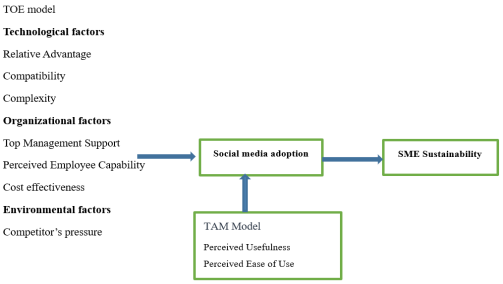
Small and Medium Enterprises (SMEs) are the vibrant and dynamic sector of world economy. SMEs employ social media (SM) to develop brand awareness, connect with consumers, and make sales at a nominal cost. This stakeholder interaction enables access to information. Sharing this information supports decision-making, which is key to SMEs’ performance and sustainability. The objective of the study is to explore the factors of social media adoption that impact the SMEs’ sustainability considering the TOE framework and TAM model in developing countries like Bangladesh. This study involved the TOE framework and TAM model as SM adoption factors that impact the sustainability of the SMEs. For the empirical examination, a closed-ended questionnaire has been used. A Google form questionnaire was used to gather information through an online survey. The respondents were selected randomly from Bangladeshi SMEs. A sample size of 231 respondents has been collected from SMEs’ proprietors and officials. The findings of the research indicate a positive and significant relationship between relative advantage and compatibility of technological factors, top management support and cost effectiveness of organizational factors with SMEs’ sustainability. This research helps SME firms identify the benefits of social media adoption and states the justification behind a firm’s investment in social media. It develops an empirical, multidimensional hypothesized model, including several determinants that may influence social media adoption. This study includes various recommendations for decisionmakers of SMEs, policymakers in the country context, and SME interested scholars.
| Published in | Innovation Business (Volume 1, Issue 4) |
| DOI | 10.11648/j.ib.20260104.12 |
| Page(s) | 191-207 |
| Creative Commons |
This is an Open Access article, distributed under the terms of the Creative Commons Attribution 4.0 International License (http://creativecommons.org/licenses/by/4.0/), which permits unrestricted use, distribution and reproduction in any medium or format, provided the original work is properly cited. |
| Copyright |
Copyright © The Author(s), 2026. Published by Science Publishing Group |
Factors of Social Media Adoption, SME’s Sustainability, Toe Framework, Tam Model
No of Employee | <25 | 168 | 72.73 |
25 to 50 | 32 | 13.85 | |
51 to 150 | 31 | 13.42 | |
Social Media Platform | Face book | 211 | 91.34 |
145 | 62.77 | ||
35 | 15.15 | ||
42 | 18.18 | ||
Others | 10 | 4.329 | |
Respondent | Owner | 198 | 85.71 |
Manager | 33 | 14.29 |
KMO and Bartlett's Test | ||
Kaiser-Meyer-Olkin Measure of Sampling Adequacy. | 0.560 | |
Bartlett's Test of Sphericity | Approx. Chi-Square | 12856.636 |
df | 2080 | |
Sig. | 0.000 | |
Variables | Items | Mean | Standard deviation (STDEV) | Loadings | Cronbach's alpha | Composite reliability (rho_c) | Average variance extracted (AVE) | VIF |
|---|---|---|---|---|---|---|---|---|
Relative Advantage | RA2 | 4.465 | 0.603 | 0.745 | 0.783 | 0.763 | 0.617 | 1.059 |
RA3 | 4.435 | 0.688 | 0.825 | 1.059 | ||||
Compatibility | COM1 | 4.439 | 0.720 | 0.878 | 0.872 | 0.859 | 0.753 | 1.343 |
COM2 | 4.450 | 0.705 | 0.857 | 1.343 | ||||
Complexity | COP1 | 4.357 | 0.683 | 0.778 | 0.815 | 0.833 | 0.715 | 1.246 |
COP3 | 4.426 | 0.706 | 0.908 | 1.246 | ||||
Top management support | TMS2 | 4.309 | 0.690 | 0.854 | 0.797 | 0.832 | 0.713 | 1.221 |
TMS4 | 4.391 | 0.806 | 0.835 | 1.221 | ||||
Perceived Employee Capability | PEC1 | 4.409 | 0.692 | 0.888 | 0.775 | 0.860 | 0.754 | 1.351 |
PEC2 | 4.339 | 0.819 | 0.849 | 1.351 | ||||
Cost- effectiveness | CE2 | 4.282 | 0.767 | 0.788 | 0.700 | 0.830 | 0.710 | 1.225 |
CE3 | 4.413 | 0.680 | 0.894 | 1.225 | ||||
Perceived usefulness | PU1 | 4.565 | 0.682 | 0.867 | 0.923 | 0.841 | 0.726 | 1.257 |
PU2 | 4.643 | 0.571 | 0.836 | 1.257 | ||||
perceived easy of usefulness | PEU1 | 4.252 | 0.780 | 0.796 | 0.832 | 0.809 | 0.680 | 1.151 |
PEU3 | 4.335 | 0.658 | 0.852 | 1.151 | ||||
social media adoption | SMA3 | 4.400 | 0.637 | 0.791 | 0.835 | 0.804 | 0.578 | 1.351 |
SMA4 | 4.483 | 0.710 | 0.759 | 1.336 | ||||
SMA5 | 4.574 | 0.569 | 0.730 | 1.154 | ||||
SME sustainability | SMEP3 | 4.570 | 0.614 | 0.853 | 0.760 | 0.862 | 0.675 | 1.599 |
SMEP4 | 4.639 | 0.602 | 0.796 | 1.477 | ||||
SMEP5 | 4.422 | 0.730 | 0.815 | 1.548 | ||||
Competitors’ pressure | CP1 | 4.400 | 0.721 | 0.812 | 0.753 | 0.817 | 0.691 | 1.171 |
CP3 | 4.509 | 0.652 | 0.850 | 1.171 |
CE | COM | COP | CP | PEC | PEU | PU | RA | SMA | SMEP | TMS | |
|---|---|---|---|---|---|---|---|---|---|---|---|
CE | |||||||||||
COM | 0.826 | ||||||||||
COP | 0.833 | 0.820 | |||||||||
CP | 0.825 | 0.819 | 0.731 | ||||||||
PEC | 0.627 | 0.846 | 0.616 | 0.844 | |||||||
PEU | 0.826 | 0.751 | 0.723 | 0.807 | 0.837 | ||||||
PU | 0.852 | 0.617 | 0.764 | 0.677 | 0.829 | 0.699 | |||||
RA | 0.524 | 0.592 | 0.601 | 0.577 | 0.491 | 0.799 | 0.534 | ||||
SMA | 0.643 | 0.722 | 0.851 | 0.833 | 0.759 | 0.814 | 0.793 | 0.551 | |||
SMEP | 0.840 | 0.746 | 0.832 | 0.831 | 0.835 | 0.358 | 0.850 | 0.647 | 0.832 | ||
TMS | 0.802 | 0.826 | 0.656 | 0.737 | 0.828 | 0.812 | 0.793 | 0.478 | 0.782 | 0.779 |
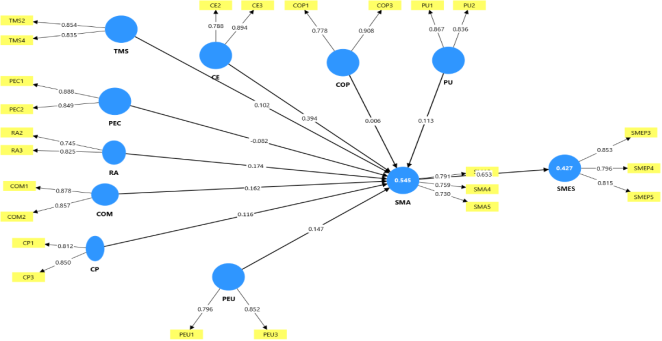
Original sample (O) | Sample mean (M) | Path coefficients | Path coefficients | (STDEV) | T statistics | P values | decision | ||
|---|---|---|---|---|---|---|---|---|---|
H5 | CE -> SMA | 0.394 | 0.389 | 0.394 | 0.072 | 5.444 | 0.000 | Supported | |
H2 | COM -> SMA | 0.162 | 0.161 | 0.162 | 0.080 | 2.019 | 0.044 | Supported | |
H3 | COP -> SMA | 0.006 | 0.009 | 0.006 | 0.069 | 0.089 | 0.929 | Not Supported | |
H7 | CP -> SMA | 0.116 | 0.116 | -0.116 | 0.072 | 1.609 | 0.108 | Not Supported | |
H6 | PEC -> SMA | -0.082 | -0.075 | 0.082 | 0.077 | 1.058 | 0.290 | Not Supported | |
H9 | PEU -> SMA | 0.147 | 0.145 | 0.147 | 0.059 | 2.497 | 0.013 | Supported | |
H8 | PU -> SMA | 0.113 | 0.111 | 0.113 | 0.081 | 2.028 | 0.042 | Supported | |
H1 | RA -> SMA | 0.374 | -0.014 | 0.220 | 0.069 | 2.528 | 0.020 | Supported | |
H10 | SMA -> SMEP | 0.653 | 0.659 | 0.053 | 0.037 | 17.517 | 0.000 | Supported | |
H4 | TMS -> SMA | 0.102 | 0.100 | 0.102 | 0.065 | 2.372 | 0.016 | Supported |
Q²predict | RMSE | MAE | R-square | Adjusted R-square | |
|---|---|---|---|---|---|
SMA | 0.482 | 0.727 | 0.532 | 0.545 | 0.526 |
SMEP | 0.484 | 0.729 | 0.548 | 0.427 | 0.424 |
SMEs | Small and medium-sized enterprises |
TAM | Technology Acceptance Model |
TOE | Technology-Organization-Environment |
SM | Social Media |
KMO | Kaiser-Meyer-Olkin |
CMB | Common Method Bias |
VIF | Variance Inflation Factor |
HTMT | Heterotrait-Monotrait ratio |
5 | 4 | 3 | 2 | 1 |
I strongly agree | I agree | Neutral | I do not agree | strongly disagree |
5 | 4 | 3 | 2 | 1 | |||
|---|---|---|---|---|---|---|---|
Technological Relative Advantage | RA1 | Social media marketing would enable our enterprise to market our products/ services in a better way. | |||||
RA2 | SM allows us to accomplish specific tasks more quickly. | ||||||
RA3 | Social media marketing would enable our enterprise to communicate with our customers effectively. | ||||||
RA4 | SM offers interactive mechanisms for value co-creation with our audience. | ||||||
RA5 | Social media marketing would assist us in developing better relationships with our customers. | ||||||
Compatibility | COM1 | SM adoption is compatible with the company’s IT infrastructure. | |||||
COM2 | SM adoption is compatible with our business processes and operations. | ||||||
COM3 | SM adoption is consistent with the company’s beliefs and values. | ||||||
COM4 | Search for general information related to customer and competitors. | ||||||
Complexity | CP1 | The use of social media marketing would require a lot of mental effort. | |||||
CP2 | The use of social media marketing would be frustrating. | ||||||
CP3 | Social media marketing would be too complex for our marketing activities. | ||||||
CP4 | The skills needed to use social media marketing would be too complex for employees of our enterprise | ||||||
Organizational Top management support | TMS1 | Social media adoption enables us to advertise, promote and deliver products/ services to the customer. | |||||
TMS2 | Our marketing budgets would be significant enough financial resources to support the adoption of social media marketing. | ||||||
TMS3 | Top management emphasis on R&D, technological leadership. | ||||||
TMS4 | Top management emphasis on innovations | ||||||
Cost effectiveness | CE1 | The cost involved in providing support systems for social media marketing would be too high | |||||
CE2 | SM platform saves costs relating to time and effort in marketing, branding and customer service. | ||||||
CE3 | The basic training for employees to use social media marketing would be very low | ||||||
CE4 | Both way communication is possible with low cost. | ||||||
Perceived Employee Capability (PEC) | PEC1 | Our employees would be capable of learning new social media marketing related technology easily. | |||||
PEC2 | Our employees would be capable of using social media marketing to interact with our customers. | ||||||
PEC3 | Our employees would be capable of providing new ideas on social media marketing use for our enterprise. | ||||||
PEC4 | Our employees would be capable of using social media marketing to solve our marketing problems easily. | ||||||
Environmental | |||||||
Competitive Pressure | COP1 | It is easy for our customers to switch to another company for similar services/products without much difficulty. | |||||
COP2 | There is rivalry among the firms in the industry; our firm is operating in an intense. | ||||||
COP3 | Customers are able to easily access to several available products which are different from ours but perform the same functions. | ||||||
COP4 | Our enterprise thinks that social media marketing has an influence on competition in their industry. | ||||||
Some of our competitors have already started using social media marketing. | |||||||
Perceived Customer Pressure | PCP1 | Our customers would demand that we establish relationships with them using social media marketing | |||||
PCP2 | Our relationship with our major customers would suffer if we did not adopt social media marketing. | ||||||
PCP3 | Customers want to get an instant response. | ||||||
PCP4 | Compared to other organizations, customers feel loyalty to be a stakeholder of social media-enabled firms | ||||||
TAM Model | PU1 | SM helps in B2B Relationship Building | |||||
Perceived Usefulness | PU2 | Social media directly expands information accessibility by allowing real-time sharing | |||||
PU3 | SM fixes one client while educating the wider user base. | ||||||
PU4 | Social media algorithms are built to prioritize engagement; content that gains initial traction is pushed to thousands of other users, creating a powerful loop of psychological pressure to conform | ||||||
Perceived Ease of Use | PEU1 | Users like, share, or buy things purely because they see millions of others doing it. | |||||
PEU2 | High usability lowers the mental barrier to participation. | ||||||
PEU3 | SM allows us to maintain customer relations in real-time sharing. | ||||||
PEU4 | Platform like WhatsApp or Instagram is simple and intuitive to navigate, users view it as more useful for accomplishing daily tasks. | ||||||
Social Media Adoption | SMA1 | SM allow us to create brand visibility. | |||||
SMA2 | SM allows us to promote our newest products | ||||||
SMA3 | Social sustainability improved overall stakeholder welfare. | ||||||
SMA4 | SM allows us to increase the visibility of the company. | ||||||
SMA5 | SM allows us to maintain customer relations in real-time sharing. | ||||||
SMEs’ Sustainab ility | SMEP1 | SM provides a cost-effective way to market products, expand customer bases and boost performance. | |||||
SMEP2 | SMEs use SM channels to announce their eco-friendly practices, directly shaping a positive green organizational identity. | ||||||
SMEP3 | SM allows real-time communication with customers and suppliers, fostering faithfulness and cooperative problem-solving | ||||||
SMEP4 | Digital integration helps firms sustain visibility and adapt during market disruptions | ||||||
SMEP5 | SM acts as a vital engine for SMEs to drive economic, social, and environmental sustainability. |
| [1] | Abdul Rasheed, A., & Nafiz, A. (2022). Factors Influencing the Adoption of Social Media Marketing by Micro, Small, and Medium-sized Enterprises (MSMEs) of the Maldives and its Impact on MSME Performance. International Journal of Social Research and Innovation, 47–73. |
| [2] | Abed, S. S., Dwivedi, Y. K., & Williams, M. D. (2016). Social commerce as a business tool in Saudi Arabia’s SMEs. International Journal of Indian Culture and Business Management, 13(1), 1. |
| [3] | Abu Bakar, A. R., Ahmad, S. Z., & Ahmad, N. (2019). SME social media use: A study of predictive factors in the United Arab Emirates. Global Business and Organizational Excellence, 38(5), 53–68. |
| [4] | Adam, I. O. (2020). Examining E-Government development effects on corruption in Africa: The mediating effects of ICT development and institutional quality. Technology in Society, 61, 101245. |
| [5] | Adoyi, J., Nnabuko, J. O., Uduji, J. I., Okoro, D. P., & Iloka, C. B. (2022). The Influence Of Social Media On Market Performance Of Smes In Nigeria. 20(20). |
| [6] | Ahmad, S. Z., Abu Bakar, A. R., & Ahmad, N. (2019). Social media adoption and its impact on firm performance: The case of the UAE. International Journal of Entrepreneurial Behavior & Research, 25(1), 84–111. |
| [7] | Ainin, S., Parveen, F., Moghavvemi, S., Jaafar, N. I., & Mohd Shuib, N. L. (2015). Factors influencing the use of social media by SMEs and its performance outcomes. Industrial Management & Data Systems, 115(3), 570–588. |
| [8] | Alatawi, F. M. H., Dwivedi, Y. K., & Williams, M. D. (2013). Developing a conceptual model for investigating adoption of knowledge management system in Saudi Arabian public sector. International Journal of Business Information Systems, 14(2), 135. |
| [9] | Alghamdi, O. A. (2024). Exploring the Link Between Social Media Adoption and Saudi Arabia SME’s Sustainable Performance: The Moderating Role of COVID-19. Sage Open, 14(4), 21582440241293043. |
| [10] | Ali Abbasi, G., Abdul Rahim, N. F., Wu, H., Iranmanesh, M., & Keong, B. N. C. (2022). Determinants of SME’s Social Media Marketing Adoption: Competitive Industry as a Moderator. Sage Open, 12(1), 21582440211067220. |
| [11] | Ali, F., Amin, M., & Cobanoglu, C. (2016). An Integrated Model of Service Experience, Emotions, Satisfaction, and Price Acceptance: An Empirical Analysis in the Chinese Hospitality Industry. Journal of Hospitality Marketing & Management, 25(4), 449–475. |
| [12] | Ali Qalati, S., Li, W., Ahmed, N., Ali Mirani, M., & Khan, A. (2020). Examining the Factors Affecting SME Performance: The Mediating Role of Social Media Adoption. Sustainability, 13(1), 75. |
| [13] | AlSharji, A., Ahmad, S. Z., & Abu Bakar, A. R. (2018). Understanding social media adoption in SMEs: Empirical evidence from the United Arab Emirates. Journal of Entrepreneurship in Emerging Economies, 10(2), 302–328. |
| [14] | Amoah, J., Belás, J., Khan, K. A., & Metzker, Z. (2021). Antecedents of Sustainable SMEs in the Social Media Space: A Partial Least Square-Structural Equation Modeling (PLS-SEM) Approach. Management & Marketing. Challenges for the Knowledge Society, 16(1), 26–46. |
| [15] | Amoah, J., Bruce, E., Shurong, Z., Bankuoru Egala, S., & Kwarteng, K. (2023). Social media adoption in smes sustainability: Evidence from an emerging economy. Cogent Business & Management, 10(1), 2183573. |
| [16] | Arianty, N., & Julita, J. (2019). The Impact Of Social Media Use On SME Progress. Journal of International Conference Proceedings, 2(3), 176–182. |
| [17] | Arshad, M., & Akram, M. S. (2018). Social Media Adoption by the Academic Community: Theoretical Insights and Empirical Evidence From Developing Countries. The International Review of Research in Open and Distributed Learning, 19(3). |
| [18] | Ashraf, S., Sangi, A. H., Hassan, Z. Y., & Luqman, M. (2018). Future of Cotton Sector in Pakistan: A 2025 Outlook. Pakistan Journal of Agricultural Research, 31(2). |
| [19] | Audretsch, D. B., & Belitski, M. (2021). Knowledge complexity and firm performance: Evidence from the European SMEs. Journal of Knowledge Management, 25(4), 693–713. |
| [20] | Berto Mulia Wibawa, Imam Baihaqi, Ninditya Nareswari, Rachma Rizqina Mardhotillah, & Faras Pramesti. (2022). Utilization of Social Media and Its Impact on Marketing Performance: A Case Study of SMEs in Indonesia. International Journal of Business and Society, 23(1), 19–34. |
| [21] | Brooks, J. R. (2019). Factors affecting social media adoption in small and medium enterprises: Evidence from the UAE. |
| [22] | Bruce, E., Keelson, S., Amoah, J., & Bankuoru Egala, S. (2023). Social media integration: An opportunity for SMEs sustainability. Cogent Business & Management, 10(1), 2173859. |
| [23] | Bruce, E., Shurong, Z., Egala, S. B., Amoah, J., Ying, D., Rui, H., & Lyu, T. (2022). Social Media Usage and SME Firms’ Sustainability: An Introspective Analysis from Ghana. Sustainability, 14(15), 9433. |
| [24] | Cahyadi, H., Tarigan, R. P., Masman, R. R., Trisnawati, E., & Wijaya, H. (2024). Exploring the dynamics of fintech usage behavior moderated by customer characteristics in Indonesia. International Journal of Innovative Research and Scientific Studies, 7(3), 997–1008. |
| [25] | Cao, G., & Weerawardena, J. (2023). Strategic use of social media in marketing and financial performance: The B2B SME context. Industrial Marketing Management, 111, 41–54. |
| [26] | Charoensukmongkol, P., & Sasatanun, P. (2017). Social media use for CRM and business performance satisfaction: The moderating roles of social skills and social media sales intensity. Asia Pacific Management Review, 22(1), 25–34. |
| [27] | Chatterjee, S., Chaudhuri, R., Sakka, G., Grandhi, B., Galati, A., Siachou, E., & Vrontis, D. (2021). Adoption of Social Media Marketing for Sustainable Business Growth of SMEs in Emerging Economies: The Moderating Role of Leadership Support. Sustainability, 13(21), 12134. |
| [28] | Chege, S. M., & Wang, D. (2020). The influence of technology innovation on SME performance through environmental sustainability practices in Kenya. Technology in Society, 60, 101210. |
| [29] | Daowd, A., Kamal, M. M., Eldabi, T., Hasan, R., Missi, F., & Dey, B. L. (2021). The impact of social media on the performance of microfinance institutions in developing countries: A quantitative approach. Information Technology & People, 34(1), 25–49. |
| [30] | Derham, R., Cragg, P., & Morrish, S. (2011). Creating Value: An SME And Social Media. Creating Value. |
| [31] | Dzandu, M. D., Boateng, H., Agyemang, F. G., & Quansah, F. (2016). Social media adoption among university students: The role of gender, perceived usefulness and perceived ease of use. International Journal of Social Media and Interactive Learning Environments, 4(2), 124. |
| [32] | Erdin, C., & Ozkaya, G. (2020). Contribution of small and medium enterprises to economic development and quality of life in Turkey. Heliyon, 6(2), e03215. |
| [33] | Ezekwe, C. I. (2025). International Journal of Research and Innovation in Social Science (IJRISS). SSRN Electronic Journal. |
| [34] | Fang, G. G., Qalati, S. A., Ostic, D., Shah, S. M. M., & Mirani, M. A. (2022). Effects of entrepreneurial orientation, social media, and innovation capabilities on SME performance in emerging countries: A mediated–moderated model. Technology Analysis & Strategic Management, 34(11), 1326–1338. |
| [35] | Franco, M., Haase, H., & Pereira, A. (2016). Empirical study about the role of social networks in SME performance. Journal of Systems and Information Technology, 18(4), 383–403. |
| [36] | Geurin, A. N., & Burch, L. M. (2017). User-generated branding via social media: An examination of six running brands. Sport Management Review, 20(3), 273–284. |
| [37] | Hansen, J. M., Saridakis, G., & Benson, V. (2018). Risk, trust, and the interaction of perceived ease of use and behavioral control in predicting consumers’ use of social media for transactions. Computers in Human Behavior, 80, 197–206. |
| [38] | Haque, R., Senathirajah, A. R. B. S., Khalil, Md. I., Qazi, S. Z., & Ahmed, S. (2024). A Structural Path Analysis Bangladeshi SMEs’ Sustainability through Social Media Marketing. Sustainability, 16(13), 5433. |
| [39] | Hassan, M. U., Iqbal, Z., Malik, M., & Ahmad, M. I. (2018). Exploring the role of technological developments and open innovation in the survival of SMEs: An empirical study of Pakistan. |
| [40] | He, W., Wang, F.-K., Chen, Y., & Zha, S. (2017). An exploratory investigation of social media adoption by small businesses. Information Technology and Management, 18(2), 149–160. |
| [41] | Honinah, M., & Alhakimi, W. (2021). Social Media Adoption in Yemeni Local NGOs. Journal of Impact, 2(2), 28–41. |
| [42] | Imran, M., & Jian, Z. (2018). Social Media Orientation and SME Export Performance: A Conceptual Framework. 5(6). |
| [43] | Kapoor, K. K., Tamilmani, K., Rana, N. P., Patil, P., Dwivedi, Y. K., & Nerur, S. (2018). Advances in Social Media Research: Past, Present and Future. Information Systems Frontiers, 20(3), 531–558. |
| [44] | Luthen, M. D., & Soelaiman, L. (2022). Factors Affecting the Use of Social-Media TikTok to Improve SME Performance: 3rd Tarumanagara International Conference on the Applications of Social Sciences and Humanities (TICASH 2021). |
| [45] | McCann, M., & Barlow, A. (2015). Use and measurement of social media for SMEs. Journal of Small Business and Enterprise Development, 22(2), 273–287. |
| [46] | Medjani, F., Rutter, R., & Nadeau, J. (2019). Social media management, objectification and measurement in an emerging market. |
| [47] | Mensah, I. K., Wang, R., Gui, L., & Wang, J. (2023). Exploring the Elements Influencing the Behavioral Adoption of E-Commerce by Chinese Small and Medium Enterprises (SMEs). Information Development, 39(4), 679–698. |
| [48] | Moulick, R. K., & Khan, S. (2025). Determinants of Credit Accessibility to Small and Medium Enterprises (SMEs) in Bangladesh. Rajshahi University Journal of Social Science and Business Studies, 29, 49–67. |
| [49] | Nurfarida, I. N., Sarwoko, E., & Arief, M. (2021). The Impact of Social Media Adoption on Customer Orientation and SME Performance: An Empirical Study in Indonesia. |
| [50] | Nuseir, M. T. (2018). Digital Media Impact on SMs Performance in the UAE. 24(1). |
| [51] | Nuseir, M. T., & Elrefae, G. (2022). The effect of social media marketing, compatibility and perceived ease of use on marketing performance: Evidence from hotel industry. International Journal of Data and Network Science, 6(3), 885–894. |
| [52] | Odoom, R., Anning-Dorson, T., & Acheampong, G. (2017). Antecedents of social media usage and performance benefits in small- and medium-sized enterprises (SMEs). Journal of Enterprise Information Management, 30(3), 383–399. |
| [53] | Odoom, R., & Mensah, P. (2019). Brand orientation and brand performance in SMEs. Management Research Review, 42(1), 155–171. |
| [54] | Oliveira, T., Faria, M., Thomas, M. A., & Popovič, A. (2014). Extending the understanding of mobile banking adoption: When UTAUT meets TTF and ITM. International Journal of Information Management, 34(5), 689–703. |
| [55] | Öztamur, D., & Karakadılar, İ. S. (2014). Exploring the Role of Social Media for SMEs: As a New Marketing Strategy Tool for the Firm Performance Perspective. Procedia - Social and Behavioral Sciences, 150, 511–520. |
| [56] | Patma, T. S., Wardana, L. W., Wibowo, A., Narmaditya, B. S., & Akbarina, F. (2021). The impact of social media marketing for Indonesian SMEs sustainability: Lesson from Covid-19 pandemic. Cogent Business & Management, 8(1), 1953679. |
| [57] | Pervin, Most. T., & Sarker, B. K. (2021). Benefits and challenges in adopting social media for SMEs: A case from Bangladesh. Journal of Sustainable Tourism and Entrepreneurship, 2(3), 171–185. |
| [58] | Qalati, S. A., Ostic, D., Sulaiman, M. A. B. A., Gopang, A. A., & Khan, A. (2022). Social Media and SMEs’ Performance in Developing Countries: Effects of Technological-Organizational-Environmental Factors on the Adoption of Social Media. SAGE Open, 12(2), 215824402210945. |
| [59] | Qalati, S. A., Yuan, L. W., Khan, M. A. S., & Anwar, F. (2021). A mediated model on the adoption of social media and SMEs’ performance in developing countries. Technology in Society, 64, 101513. |
| [60] | Rahman, N. A., Yaacob, Z., & Radzi, R. M. (2016). An Overview of Technological Innovation on SME Survival: A Conceptual Paper. Procedia - Social and Behavioral Sciences, 224, 508–515. |
| [61] | Salloum, S. A., Mhamdi, C., Kurdi, B. A., & Shaalan, K. (2018). Factors affecting the Adoption and Meaningful Use of Social Media: A Structural Equation Modeling Approach. |
| [62] | Samat, M. F., Yusoff, M. N. H., & Ismail, M. (2018). The Mediating Effect of Social Media Marketing Adoption between Competitive Intelligence and SME Performance. International Journal of Asian Social Science, 8(7), 379–387. |
| [63] | Sarosa, S. (2012). Adoption of Social Media Networks by Indonesian SME: A Case Study. Procedia Economics and Finance, 4, 244–254. |
| [64] | Sendawula, K., Najjinda, S., Kisubi, M. K., & Kintu, I. (2025). The contribution of social media competencies and privacy in catalyzing the sustainable performance of small and medium enterprises (SMEs) in Uganda. Journal of Ethics in Entrepreneurship and Technology, 5(2), 187–205. |
| [65] | Shareef, M. A., Mukerji, B., Alryalat, M. A. A., Wright, A., & Dwivedi, Y. K. (2018). Advertisements on Facebook: Identifying the persuasive elements in the development of positive attitudes in consumers. Journal of Retailing and Consumer Services, 43, 258–268. |
| [66] | Shi, S., Cao, Y., Chen, Y., & Chow, W. S. (2019). How social media brand pages contribute to functional conflict: The central role of commitment. International Journal of Information Management, 45, 95–106. |
| [67] | Solomon, O. H., Allen, T., & Wangombe, W. (2024). Analysing the factors that influence social media adoption among SMEs in developing countries. Journal of International Entrepreneurship, 22(2), 248–267. |
| [68] | Sugandini, D., Effendi, M. I., Istanto, Y., & Arundati, R. (2021, November). Social media adoption in SMEs in Indonesia: TOE model. In International Conference on Business and Technology (pp. 793-804). Cham: Springer International Publishing. |
| [69] | Sugandini, D., Effendi, M. I., Istanto, Y., Arundati, R., & Rahmawati, E. D. (2019). Technology-organization-environment model and technology acceptance model in adoption of social media marketing in SMEs tourism. Journal of Environmental Management & Tourism, 10(4 (36)), 878-885. |
| [70] | Tajpour, M., Hosseini, E., Ratten, V., Bahman-Zangi, B., & Soleymanian, S. M. (2023). The Role of Entrepreneurial Thinking Mediated by Social Media on the Sustainability of Small and Medium-Sized Enterprises in Iran. Sustainability, 15(5), 4518. |
| [71] | Tenaiji, A. A. A., & Cader, Y. (2010). Social Media Marketing in the UAE. Social Media Marketing. |
| [72] | Trawnih, A., Yaseen, H., Al-Adwan, A. S., Alsoud, A. R., & Jaber, O. A. (2021). Factors Influencing Social Media Adoption Among SMEs During Covid-19 Crisis. A. S., 24(6). |
| [73] | Veseli-Kurtishi, T. (2018). Social Media as a Tool for the Sustainability of Small and Medium Businesses in Macedonia. European Journal of Sustainable Development, 7(4). |
| [74] | Viswanathan, R., & Telukdarie, A. (2021). A systems dynamics approach to SME digitalization. Procedia Computer Science, 180, 816–824. |
| [75] | Wanyoike, J., & Kithae, P. P. (2019). Social Media Networks And SME Performance In The International Arena: A Case Of SMEs Operating In Kamukunji Area of Nairobi County, Kenya. European Journal of Business and Management Research, 4(5). |
| [76] | Wasudawan, K., Weissmann, M. A., & Nwobodo, S. (2025). Small and medium-sized enterprises perceived trust towards social media: Applying the extended technology acceptance model. Journal of Asia Business Studies, 19(4), 1085–1103. |
| [77] | Wong, L.-W., Leong, L.-Y., Hew, J.-J., Tan, G. W.-H., & Ooi, K.-B. (2020). Time to seize the digital evolution: Adoption of blockchain in operations and supply chain management among Malaysian SMEs. International Journal of Information Management, 52, 101997. |
APA Style
Moulick, R. K., Hossain, M. S., Banu, M. H., Haque, S. B. (2026). Social Media Engagement and SME Sustainability in Bangladesh: An Integrated TOE and TAM Framework. Innovation Business, 1(4), 191-207. https://doi.org/10.11648/j.ib.20260104.12
ACS Style
Moulick, R. K.; Hossain, M. S.; Banu, M. H.; Haque, S. B. Social Media Engagement and SME Sustainability in Bangladesh: An Integrated TOE and TAM Framework. Innov. Bus. 2026, 1(4), 191-207. doi: 10.11648/j.ib.20260104.12
@article{10.11648/j.ib.20260104.12,
  author = {Raj Kumar Moulick and Md. Sumon Hossain and Mst. Hasna Banu and Shamalia Binte Haque},
  title = {Social Media Engagement and SME Sustainability in Bangladesh: An Integrated TOE and TAM Framework},
  journal = {Innovation Business},
  volume = {1},
  number = {4},
  pages = {191-207},
  doi = {10.11648/j.ib.20260104.12},
  url = {https://doi.org/10.11648/j.ib.20260104.12},
  eprint = {https://article.sciencepublishinggroup.com/pdf/10.11648.j.ib.20260104.12},
  abstract = {Small and Medium Enterprises (SMEs) are the vibrant and dynamic sector of world economy. SMEs employ social media (SM) to develop brand awareness, connect with consumers, and make sales at a nominal cost. This stakeholder interaction enables access to information. Sharing this information supports decision-making, which is key to SMEs’ performance and sustainability. The objective of the study is to explore the factors of social media adoption that impact the SMEs’ sustainability considering the TOE framework and TAM model in developing countries like Bangladesh. This study involved the TOE framework and TAM model as SM adoption factors that impact the sustainability of the SMEs. For the empirical examination, a closed-ended questionnaire has been used. A Google form questionnaire was used to gather information through an online survey. The respondents were selected randomly from Bangladeshi SMEs. A sample size of 231 respondents has been collected from SMEs’ proprietors and officials. The findings of the research indicate a positive and significant relationship between relative advantage and compatibility of technological factors, top management support and cost effectiveness of organizational factors with SMEs’ sustainability. This research helps SME firms identify the benefits of social media adoption and states the justification behind a firm’s investment in social media. It develops an empirical, multidimensional hypothesized model, including several determinants that may influence social media adoption. This study includes various recommendations for decisionmakers of SMEs, policymakers in the country context, and SME interested scholars.},
 year = {2026}
}
TY  - JOUR
T1  - Social Media Engagement and SME Sustainability in Bangladesh: An Integrated TOE and TAM Framework
AU  - Raj Kumar Moulick
AU  - Md. Sumon Hossain
AU  - Mst. Hasna Banu
AU  - Shamalia Binte Haque
Y1  - 2026/11/16
PY  - 2026
N1  - https://doi.org/10.11648/j.ib.20260104.12
DO  - 10.11648/j.ib.20260104.12
T2  - Innovation Business
JF  - Innovation Business
JO  - Innovation Business
SP  - 191
EP  - 207
PB  - Science Publishing Group
SN  - 3142-8681
UR  - https://doi.org/10.11648/j.ib.20260104.12
AB  - Small and Medium Enterprises (SMEs) are the vibrant and dynamic sector of world economy. SMEs employ social media (SM) to develop brand awareness, connect with consumers, and make sales at a nominal cost. This stakeholder interaction enables access to information. Sharing this information supports decision-making, which is key to SMEs’ performance and sustainability. The objective of the study is to explore the factors of social media adoption that impact the SMEs’ sustainability considering the TOE framework and TAM model in developing countries like Bangladesh. This study involved the TOE framework and TAM model as SM adoption factors that impact the sustainability of the SMEs. For the empirical examination, a closed-ended questionnaire has been used. A Google form questionnaire was used to gather information through an online survey. The respondents were selected randomly from Bangladeshi SMEs. A sample size of 231 respondents has been collected from SMEs’ proprietors and officials. The findings of the research indicate a positive and significant relationship between relative advantage and compatibility of technological factors, top management support and cost effectiveness of organizational factors with SMEs’ sustainability. This research helps SME firms identify the benefits of social media adoption and states the justification behind a firm’s investment in social media. It develops an empirical, multidimensional hypothesized model, including several determinants that may influence social media adoption. This study includes various recommendations for decisionmakers of SMEs, policymakers in the country context, and SME interested scholars.
VL  - 1
IS  - 4
ER  -
Department of Accounting & Information Systems, University of Rajshahi, Rajshahi, Bangladesh
Department of Accounting & Information Systems, University of Rajshahi, Rajshahi, Bangladesh
Department of Accounting & Information Systems, University of Rajshahi, Rajshahi, Bangladesh
Department of Accounting & Information Systems, University of Rajshahi, Rajshahi, Bangladesh

Information



 Share This Article
 Twitter
 Linked In
 Facebook

 Copy
 Download