Abstract
Bamboo is a renewable, lightweight and versatile material with potential applications in sustainable building construction. This study explored the role of bamboo as a sustainable building material in architecture in Kano State, Nigeria, focusing on factors associated with its use, constraints limiting wider adoption, and strategies for improving its application. A descriptive survey design was adopted. Primary data were collected through a structured Likert-scale questionnaire and oral interviews. The study reported 80 respondents comprising 20 craftsmen and 60 architects. Simple random sampling was used, and responses were analysed descriptively using percentages and charts. The findings indicate that limited commercialization, poor architectural design, low patronage, perceived weak governmental support, discrimination against local materials, uncertainty about durability, moisture-related deterioration, small-scale production, poor transportation networks and lack of precise design specifications constrain wider adoption. Respondents strongly supported government cooperation, fiscal incentives, technical support, indigenous technology development, cost reduction and large-scale production. The study concludes that bamboo has potential as a sustainable building material, but its transition from traditional/local applications to modern architecture requires improved design knowledge, preservation, technical capacity, market development and supportive public policy.
Keywords
Bamboo, Sustainable Building Materials, Sustainable Architecture, Local Materials, Kano State, Nigeria, Construction
1. Introduction
1.1. Background
Bamboo is described in the source study as a renewable resource characterised by high strength, low weight and ease of working with simple tools
| [1] | American Bamboo Society. (2002). Bamboo as a raw material. |
[1]
. Its rapid growth and capacity for repeated harvesting contribute to its potential as a non-timber construction resource
| [6] | FAO. (2005). World bamboo resources: A thematic study prepared in the framework of the Global Forest Resources Assessment 2005. Rome. |
[6]
. The study notes that commercially significant species may mature in about four to five years, after which harvesting can continue
| [7] | Liese, W. (1986). Characterization and utilization of bamboo. In Bamboo production and utilization. |
[7]
. In Nigeria, bamboo is reported as widely distributed, particularly in the southern and Middle Belt regions, but underutilised as a modern construction material
| [8] | Igbokwe, G. O., Zubairu, Y. G., & Bello, G. A. (2016). Application of agroforestry techniques in the management of bamboo. International Journal of Sustainable Agricultural Research, 3(1), 29-34. |
[8]
. The thesis cites the Raw Materials Research and Development Council as identifying several states with abundant bamboo occurrence, including Edo, Anambra, Enugu, Osun, Ogun, Ondo, Oyo and Rivers
| [9] | Raw Materials Research and Development Council (RMRDC). (2004). Bamboo production and utilisation in Nigeria. RMRDC Publications. |
[9]
. Kano has comparatively rare natural occurrence in the source discussion, although Doguwa Local Government Area is proposed as potentially suitable for commercial-scale cultivation
| [2] | Nadabo, A. L. (2024). Exploring the role of bamboo as a sustainable building material in architecture: Evidence from Kano State, Nigeria. Undergraduate thesis, Department of Architecture, Bayero University, Kano. |
[2]
. Bamboo has potential applications in foundations, floors, walls, partitions, roofs, scaffolding, bridges and reinforcement when appropriately treated and designed
| [10] | Chung, K. F., & Siu, Y. C. (2002). Bamboo scaffolding in building construction—Erection of bamboo scaffolds. |
[10]
. Its sustainability potential is linked to renewability, low weight, workability and opportunities for local production
| [11] | Jayanetti, D. L., & Follet, P. R. (1998). Bamboo in construction. INBAR Technical Report No. 16. TRADA, U.K. |
[11]
. However, bamboo is anisotropic and its performance depends on species, age, growth conditions, moisture, geometry, treatment and detailing
| [12] | Kabir, M. F., Bhattacharjee, D. K., & Sattar, M. A. (1991). Physical and mechanical properties of four bamboo species. Bangladesh Journal of Forest Science, 20(1-2), 31-36. |
[12]
.
1.2. Problem Statement
Nigeria faces continuing pressure to provide affordable and sustainable buildings while conventional construction costs increase
| [13] | Harrison, S. W., & Sinha, B. P. (1995). A study of alternative building materials and technologies for housing in Bangalore, India. Construction and Building Materials, 9(4), 211-217. |
[13]
. Although bamboo is available in many parts of the country, the study reports limited use in building construction
| [3] | Arbisala, A. O. (1993). Raw Materials Revolution and Impact on Industrialization in Nigeria. Mednet Publications Ltd. |
[3]
. The problem therefore extends beyond physical availability to commercialization, design knowledge, technical skills, market demand, transportation, durability concerns and institutional support
| [14] | Salzer, C., Wallbaum, H., Lopez, L. F., & Kouyoumji, J. L. (2016). Sustainability of social housing in Asia. Sustainability, 8(2), 151. |
[14]
.
1.3. Aim and Objectives
The study aimed to explore the role of bamboo as a sustainable building material in architecture. Its objectives were to:
1) study the properties of bamboo as a building material;
2) examine the sustainability of bamboo as a building material;
3) study the challenges of bamboo as a material for building construction; and
4) propose recommendations that can enhance the use of bamboo as a building material in architecture.
2. Literature Review
2.1. Bamboo and Sustainable Architecture
Sustainability in the source study is presented as meeting present needs without compromising future generations and is associated with environmental, economic and social dimensions
| [4] | UNDP. (2000). United Nations Development Programme. |
[4]
. Sustainable architecture seeks to reduce negative environmental effects through site-responsive design, energy management and environmentally responsible materials
| [15] | Moroz, J. G., Lissel, S. L., & Hagel, M. D. (2014). Performance of bamboo reinforced concrete masonry shear walls. Construction and Building Materials, 61, 125-137. |
[15]
. Bamboo fits this framework because it is renewable and can be harvested while leaving its root system intact
| [6] | FAO. (2005). World bamboo resources: A thematic study prepared in the framework of the Global Forest Resources Assessment 2005. Rome. |
[6]
. The source study also highlights lightweight construction, flexibility, prefabrication, assembly, dismantling and reuse as potential sustainability advantages
| [16] | Paglione, J. P. F. (2003). Sustainable biomass production utilising bamboo as an alternative renewable non-wood resource. |
[16]
.
2.2. Relevant Material Properties
The thesis reports favourable tensile characteristics associated with the longitudinal fibre structure of bamboo
| [10] | Chung, K. F., & Siu, Y. C. (2002). Bamboo scaffolding in building construction—Erection of bamboo scaffolds. |
[10]
. Mechanical properties vary with species, climate, culm height and age
| [12] | Kabir, M. F., Bhattacharjee, D. K., & Sattar, M. A. (1991). Physical and mechanical properties of four bamboo species. Bangladesh Journal of Forest Science, 20(1-2), 31-36. |
[12]
. Bamboo is anisotropic, with longitudinal and transverse properties differing substantially
| [17] | Kabir, M. F., Bhattacharjee, D. K., & Sattar, M. A. (1993). Effect of age and height on strength properties of Dendrocalamus longispaths. Bamboo Information Centre India Bulletin, 3(1), 11-15. |
[17]
. The study also reports significant shrinkage as moisture is lost, making seasoning and moisture control important
| [18] | Rehman, M. A., & Ishaq, S. M. (1947). Seasoning and shrinkage of bamboo. Indian Forest Record, 4(21), 1-22. |
[18]
. Durability is a major consideration. The source identifies insect and fungal attack, particularly under damp conditions, as significant problems and states that preservation and treatment are necessary to improve service life
| [19] | Espiloy, Z. B. (1994). Effect of age on the physio-mechanical properties of some Philippine bamboo. In Bamboo in Asia and the Pacific. |
[19]
. This means sustainable bamboo construction requires responsible harvesting, treatment, detailing and maintenance rather than simply using untreated culms
| [20] | Sakaray, H., Togati, N. V. K., & Reddy, I. R. (2012). Investigation on properties of bamboo as reinforcing material in concrete. International Journal of Engineering Research and Application, 2, 77-83. |
[20]
.
3. Materials and Methods
3.1. Research Design and Study Area
A descriptive survey approach was adopted in Kano State, Nigeria
| [2] | Nadabo, A. L. (2024). Exploring the role of bamboo as a sustainable building material in architecture: Evidence from Kano State, Nigeria. Undergraduate thesis, Department of Architecture, Bayero University, Kano. |
[2]
. The target population reported in the thesis comprised 20 craftsmen and 60 architects associated with sustainable/local-material construction, and 80 responses were obtained
| [2] | Nadabo, A. L. (2024). Exploring the role of bamboo as a sustainable building material in architecture: Evidence from Kano State, Nigeria. Undergraduate thesis, Department of Architecture, Bayero University, Kano. |
| [4] | UNDP. (2000). United Nations Development Programme. |
| [5] | UNIDO. (2009). Bamboo skills development, production and demonstration centre. |
[2, 4, 5]
.
3.2. Data Collection
Primary data were collected using a structured questionnaire and oral interviews
| [2] | Nadabo, A. L. (2024). Exploring the role of bamboo as a sustainable building material in architecture: Evidence from Kano State, Nigeria. Undergraduate thesis, Department of Architecture, Bayero University, Kano. |
[2]
. The questionnaire used a five-point Likert scale: 1 = strongly disagree, 2 = disagree, 3 = undecided, 4 = agree and 5 = strongly agree
| [2] | Nadabo, A. L. (2024). Exploring the role of bamboo as a sustainable building material in architecture: Evidence from Kano State, Nigeria. Undergraduate thesis, Department of Architecture, Bayero University, Kano. |
[2]
.
3.3. Sampling and Data Analysis
The study adopted simple random sampling
| [2] | Nadabo, A. L. (2024). Exploring the role of bamboo as a sustainable building material in architecture: Evidence from Kano State, Nigeria. Undergraduate thesis, Department of Architecture, Bayero University, Kano. |
[2]
. Data were analysed descriptively and presented mainly through percentages and charts
| [2] | Nadabo, A. L. (2024). Exploring the role of bamboo as a sustainable building material in architecture: Evidence from Kano State, Nigeria. Undergraduate thesis, Department of Architecture, Bayero University, Kano. |
[2]
. The thesis contains an internal inconsistency in its sample-size calculation: the narrative reports 80 respondents, while the displayed calculation gives approximately 79.5 and subsequently states approximately 83
| [2] | Nadabo, A. L. (2024). Exploring the role of bamboo as a sustainable building material in architecture: Evidence from Kano State, Nigeria. Undergraduate thesis, Department of Architecture, Bayero University, Kano. |
[2]
. This article therefore uses the reported achieved sample of 80 and does not reconstruct unreported raw frequencies
| [2] | Nadabo, A. L. (2024). Exploring the role of bamboo as a sustainable building material in architecture: Evidence from Kano State, Nigeria. Undergraduate thesis, Department of Architecture, Bayero University, Kano. |
[2]
.
4. Results and Discussion
4.1. Respondent Characteristics
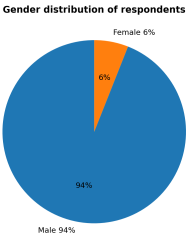
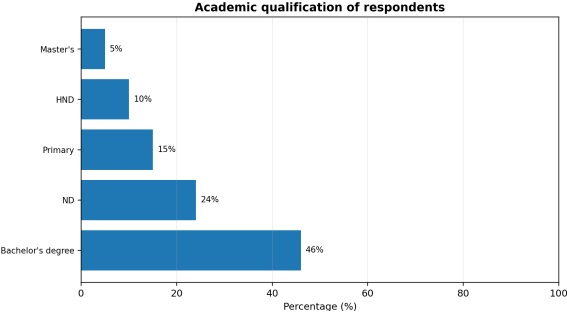
The respondent profile was predominantly male, with 94% male and 6% female respondents. Regarding qualification, 46% held bachelor's degrees, 24% held ND, 10% held HND, 5% held master's degrees and 15% were reported as having primary-school qualifications.
Figure 1. Gender distribution of respondents (source-study percentages).
Figure 1 shows the gender distribution of the respondents involved in the study. The result indicates that 94% of the respondents were male, while only 6% were female. This shows a strong male dominance among the respondents. The predominance of male respondents may be associated with the composition of the construction-related professionals and craftsmen involved in the study. Since the research concerns the use of bamboo in architectural and building construction, the result indicates that the opinions obtained were largely from male stakeholders. However, the relatively low proportion of female respondents should be considered when interpreting the findings, as the perspectives of women in architecture and construction are less represented in the sample.
Figure 2 presents the academic qualifications of the respondents. The results show that 46% possessed bachelor's degrees, 24% held National Diplomas (ND), 10% possessed Higher National Diplomas (HND), 5% had master's degrees, while 15% had primary-school qualifications. The relatively high proportion of respondents with bachelor's degrees suggests that a substantial part of the sample had formal tertiary education and could provide informed opinions concerning building materials and architectural practice. The presence of respondents with ND and HND qualifications also reflects the participation of technically oriented personnel and craftsmen. The 15% with primary-school qualifications may represent respondents whose practical experience in construction and bamboo utilisation provides knowledge gained through traditional or experiential practice. Thus, the combination of formal educational backgrounds and practical experience provides a broader basis for assessing bamboo as a building material.
Figure 2. Academic qualification of respondents (source-study percentages).
4.2. Factors Associated with Limited Bamboo Use
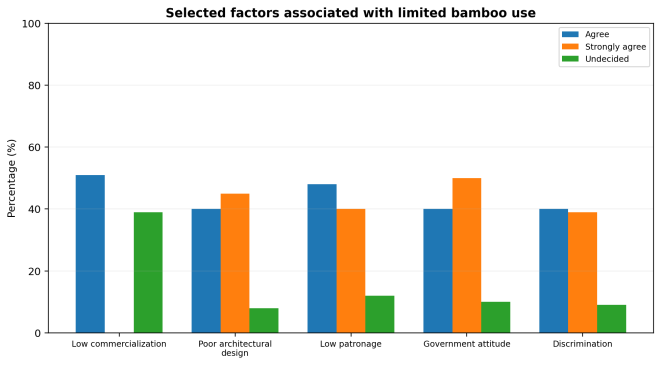
Figure 3 illustrates selected factors associated with the limited use of bamboo as a building material. The results reveal that low commercialisation, poor architectural design, low patronage, government attitude and discrimination against bamboo were identified as important factors. Low commercialisation recorded 51% agreement, indicating that more than half of the respondents considered inadequate commercial development of bamboo to be a major factor limiting its adoption. Poor architectural design attracted 40% agreement and 45% strong agreement, giving a combined positive response of 85%. This suggests that inadequate incorporation of bamboo into contemporary architectural design may significantly restrict its application. Similarly, low patronage recorded 48% agreement and 40% strong agreement, representing 88% positive responses. This suggests that market demand and public acceptance are important determinants of bamboo utilisation. Government attitude was also significant, with 40% agreeing and 50% strongly agreeing that governmental attitude towards local building materials affects bamboo utilisation. In addition, 40% agreed and 39% strongly agreed that discrimination against bamboo contributes to its limited adoption.
Figure 3. Selected factors associated with limited bamboo use. The chart reproduces reported percentages; categories not reported for an item are shown as zero.
The findings indicate that bamboo adoption is affected by both its perceived attributes and institutional or market barriers. Low commercialization was supported by 51% of respondents, while 39% were undecided. Poor architectural design attracted 40% agreement and 45% strong agreement. Low patronage was also strongly identified: 48% agreed and 40% strongly agreed that low patronage affects bamboo use. Government attitude was another prominent concern. Forty percent agreed and 50% strongly agreed that a lukewarm governmental attitude towards local building materials contributes to limited bamboo use. Similarly, 40% agreed and 39% strongly agreed that discrimination against bamboo contributes to its underuse.
4.3. Technical and Operational Constraints
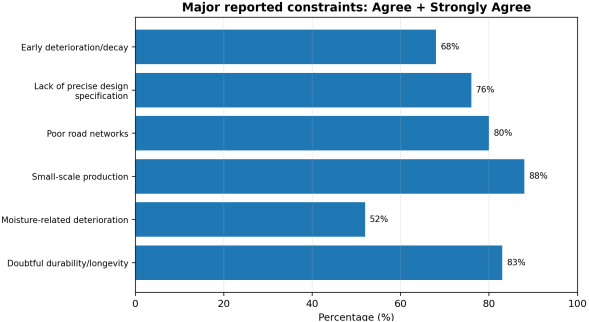
Figure 4 presents the major constraints affecting the utilisation of bamboo in building construction. The most prominent constraint was small-scale production, with 88% of respondents agreeing or strongly agreeing that it limits wider bamboo utilisation. This indicates that inadequate production capacity may make it difficult to ensure a consistent supply of bamboo for construction projects. Durability and moisture concerns were among the most important constraints. Eighty-three percent agreed or strongly agreed that doubt about bamboo's durability and longevity affects its use (48% agree; 35% strongly agree). Early deterioration or decay attracted 41% agreement and 27% strong agreement. Similarly, 52% agreed that moisture absorption contributes to deterioration.
Production and infrastructure constraints were also prominent. Eighty-eight percent agreed or strongly agreed that small-scale production limits wider use, while 80% agreed or strongly agreed that poor road networks for transporting materials to sites are a constraint. Lack of precise design specifications attracted 57% agreement and 19% strong agreement. These findings point to the need for design guidance, technical training, supply-chain development and professional capacity building.
Figure 4. Major reported constraints expressed as Agree + Strongly Agree, calculated from the source-study percentages.
Doubt about durability and longevity was also prominent, with 83% of respondents expressing agreement or strong agreement. This finding is important because perceived durability is a major consideration when selecting structural and building materials. Poor road networks recorded 80% combined agreement and strong agreement, indicating that transportation difficulties may further increase the challenges associated with moving bamboo from production areas to construction sites.
Furthermore, lack of precise design specifications recorded 76% combined agreement and strong agreement. This suggests that the absence of clear technical guidance may discourage architects, engineers and contractors from incorporating bamboo into building projects. Moisture-related deterioration also emerged as a concern, with 52% agreeing or strongly agreeing that moisture absorption contributes to deterioration. The findings therefore demonstrate that bamboo adoption requires more than simply increasing availability. Production, transportation, durability, preservation and standardised design specifications must be addressed simultaneously to improve its acceptance as a modern construction material.
4.4. Availability, Cost and Workability
The evidence on availability and cost was less decisive than the evidence on institutional and technical barriers. For the availability item, 47% disagreed and 20% strongly disagreed with the negative formulation, while 29% were undecided and 4% agreed. For cost, 31% agreed that bamboo is cheap to acquire, 3% strongly agreed and 55% were undecided. Workability also generated uncertainty: 37% agreed that bamboo is easily worked on, 14% disagreed and 49% were undecided.
The relatively high undecided proportions suggest uneven stakeholder experience with bamboo. Demonstration projects and technical education can therefore help stakeholders evaluate bamboo using documented performance and appropriate construction practice.
4.5. Strategies for Improving Bamboo Adoption
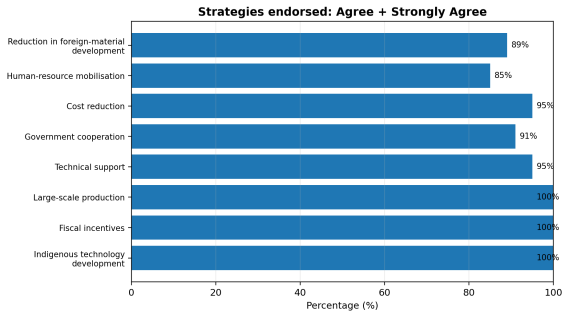
Figure 5 presents the strategies identified by respondents for improving the utilisation of bamboo as a building material. The results demonstrate particularly strong support for the proposed interventions. Indigenous technology development and fiscal incentives received 100% combined agreement and strong agreement, indicating unanimous support among the respondents.
Respondents strongly supported interventions intended to strengthen the bamboo value chain. Ninety-one percent agreed or strongly agreed that government cooperation could support bamboo development for housing. Fiscal incentives received unanimous positive responses in the reported data: 36% agreed and 64% strongly agreed. Technical support received 71% agreement and 24% strong agreement.
The strongest endorsement was for development and propagation of indigenous technology, with 39% agreeing and 61% strongly agreeing. Cost reduction was supported by 60% agreement and 35% strong agreement, while large-scale production received 64% agreement and 36% strong agreement. These results indicate that adoption requires coordinated interventions across policy, skills, technology, production and markets.
Figure 5. Strategies endorsed by respondents, expressed as Agree + Strongly Agree.
Large-scale production was also strongly supported, with 100% of respondents agreeing or strongly agreeing with the strategy as represented in the figure. Technical support received 95% positive responses, while cost reduction also recorded 95%. Government cooperation received 91%, while human-resource mobilisation and reduction of dependence on foreign-material development recorded 85% and 89%, respectively.
The results suggest that respondents perceive bamboo development as requiring a coordinated strategy involving government, industry, technical professionals, local entrepreneurs and skilled labour. In particular, the strong support for indigenous technology indicates the importance of developing local methods for processing, treating, designing and constructing with bamboo. Similarly, fiscal incentives and large-scale production could contribute to improving affordability and availability.
Therefore,
Figure 5 indicates that policy support, technological development, technical capacity and commercial-scale production are central to transforming bamboo from a relatively underutilised local material into a viable sustainable construction material.
4.6. Attitudes Toward Bamboo in Modern Construction
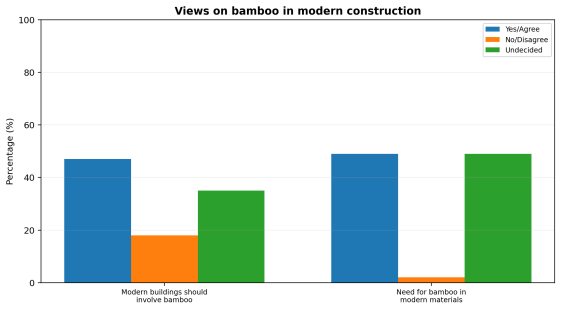
Figure 6 presents respondents' opinions concerning the incorporation of bamboo into modern building construction. The results show that 47% agreed that modern buildings should involve bamboo for sustainability, while 18% disagreed and 35% remained undecided. This indicates that although almost half of the respondents support the incorporation of bamboo into modern buildings, a considerable proportion remain uncertain. For the question concerning the need for bamboo in modern building materials, 49% agreed, 2% disagreed and 49% were undecided. The relatively high proportion of undecided respondents is significant. It suggests that many stakeholders may not yet have sufficient knowledge, experience or confidence regarding the performance and practical application of bamboo in contemporary buildings. The findings therefore indicate that acceptance of bamboo is emerging but is not yet universal. Demonstration buildings, professional training, technical specifications, experimental evidence and successful case studies could help reduce uncertainty and improve confidence among architects, engineers, contractors and building clients.
The final attitude questions showed a mixed but generally supportive position. Forty-seven percent agreed that modern buildings should involve bamboo for sustainability, 18% disagreed and 35% were undecided. On whether bamboo is needed in modern building materials, 49% agreed, 2% disagreed and 49% were undecided. Thus, the study indicates openness to bamboo alongside substantial uncertainty.
Figure 6. Respondents' views on incorporating bamboo into modern construction.
5. Discussion
The findings indicate that bamboo's sustainability potential is recognised more readily at the conceptual level than in routine construction practice. Renewable supply, low weight, flexibility and workability provide a foundation for sustainable architectural applications. However, concerns about durability, moisture, production scale, transportation and design specifications show that availability alone does not guarantee adoption.
The results are consistent with the source study's literature review, which identifies tensile strength, flexibility and low weight as favourable characteristics while recognising shrinkage, anisotropy, biological attack and connection limitations. Treatment is especially important because exposure to damp conditions can accelerate deterioration.
The strong endorsement of indigenous technology and technical support suggests that professional knowledge is a critical bridge between bamboo's inherent properties and practical application. A transition from informal or temporary use towards engineered and architecturally integrated systems would require design guidance, training, quality control, treatment facilities, market development and supportive public policy.
6. Conclusion
The study demonstrates meaningful potential for bamboo as a sustainable building material in architecture, but wider adoption in Kano State is constrained by technical, professional, market and institutional factors. Prominent concerns include durability and longevity, moisture-related deterioration, small-scale production, transportation, inadequate design specifications and limited patronage.
Respondents nevertheless strongly supported government cooperation, fiscal incentives, technical support, indigenous technology development, cost reduction and large-scale production. Bamboo should therefore be considered not merely as a traditional material but as a potential component of a broader sustainable-material strategy, provided that treatment, design, quality control and institutional support are strengthened.
7. Recommendations
1) Introduce indigenous building materials, including bamboo, into relevant tertiary curricula.
2) Develop and disseminate design specifications and technical guidance for bamboo construction.
3) Provide preservation and treatment facilities to improve service life.
4) Promote commercial-scale bamboo cultivation and local processing.
5) Support bamboo entrepreneurs through fiscal and technical incentives.
6) Implement demonstration projects showing safe, durable and aesthetically acceptable bamboo architecture.
7) Provide professional training in bamboo design, treatment, connections and construction.
8) Conduct further experimental research on mechanical performance, durability, connections, fire behaviour, life-cycle impacts and cost.
Abbreviations
ND | National Diploma |
HND | Higher National Diploma |
Author Contributions
Auwal Lawal Nadabo: Data curation, Methodology
Aliyu Abdurrahman Galadanchi: Visualization
John Azabeye Igbilishi: Validation
Conflicts of Interest
The authors declare no conflicts of interest.
References
| [1] |
American Bamboo Society. (2002). Bamboo as a raw material.
|
| [2] |
Nadabo, A. L. (2024). Exploring the role of bamboo as a sustainable building material in architecture: Evidence from Kano State, Nigeria. Undergraduate thesis, Department of Architecture, Bayero University, Kano.
|
| [3] |
Arbisala, A. O. (1993). Raw Materials Revolution and Impact on Industrialization in Nigeria. Mednet Publications Ltd.
|
| [4] |
UNDP. (2000). United Nations Development Programme.
|
| [5] |
UNIDO. (2009). Bamboo skills development, production and demonstration centre.
|
| [6] |
FAO. (2005). World bamboo resources: A thematic study prepared in the framework of the Global Forest Resources Assessment 2005. Rome.
|
| [7] |
Liese, W. (1986). Characterization and utilization of bamboo. In Bamboo production and utilization.
|
| [8] |
Igbokwe, G. O., Zubairu, Y. G., & Bello, G. A. (2016). Application of agroforestry techniques in the management of bamboo. International Journal of Sustainable Agricultural Research, 3(1), 29-34.
|
| [9] |
Raw Materials Research and Development Council (RMRDC). (2004). Bamboo production and utilisation in Nigeria. RMRDC Publications.
|
| [10] |
Chung, K. F., & Siu, Y. C. (2002). Bamboo scaffolding in building construction—Erection of bamboo scaffolds.
|
| [11] |
Jayanetti, D. L., & Follet, P. R. (1998). Bamboo in construction. INBAR Technical Report No. 16. TRADA, U.K.
|
| [12] |
Kabir, M. F., Bhattacharjee, D. K., & Sattar, M. A. (1991). Physical and mechanical properties of four bamboo species. Bangladesh Journal of Forest Science, 20(1-2), 31-36.
|
| [13] |
Harrison, S. W., & Sinha, B. P. (1995). A study of alternative building materials and technologies for housing in Bangalore, India. Construction and Building Materials, 9(4), 211-217.
|
| [14] |
Salzer, C., Wallbaum, H., Lopez, L. F., & Kouyoumji, J. L. (2016). Sustainability of social housing in Asia. Sustainability, 8(2), 151.
|
| [15] |
Moroz, J. G., Lissel, S. L., & Hagel, M. D. (2014). Performance of bamboo reinforced concrete masonry shear walls. Construction and Building Materials, 61, 125-137.
|
| [16] |
Paglione, J. P. F. (2003). Sustainable biomass production utilising bamboo as an alternative renewable non-wood resource.
|
| [17] |
Kabir, M. F., Bhattacharjee, D. K., & Sattar, M. A. (1993). Effect of age and height on strength properties of Dendrocalamus longispaths. Bamboo Information Centre India Bulletin, 3(1), 11-15.
|
| [18] |
Rehman, M. A., & Ishaq, S. M. (1947). Seasoning and shrinkage of bamboo. Indian Forest Record, 4(21), 1-22.
|
| [19] |
Espiloy, Z. B. (1994). Effect of age on the physio-mechanical properties of some Philippine bamboo. In Bamboo in Asia and the Pacific.
|
| [20] |
Sakaray, H., Togati, N. V. K., & Reddy, I. R. (2012). Investigation on properties of bamboo as reinforcing material in concrete. International Journal of Engineering Research and Application, 2, 77-83.
|
Cite This Article
-
APA Style
Nadabo, A. L., Galadanchi, A. A., Igbilishi, J. A. (2026). Exploring the Role of Bamboo as a Sustainable Building Material in Architecture: Evidence from Kano State, Nigeria. International Journal of Architecture, Arts and Applications, 12(4), 153-160. https://doi.org/10.11648/j.ijaaa.20261204.11
 Copy
|
 Download
ACS Style
Nadabo, A. L.; Galadanchi, A. A.; Igbilishi, J. A. Exploring the Role of Bamboo as a Sustainable Building Material in Architecture: Evidence from Kano State, Nigeria. Int. J. Archit. Arts Appl. 2026, 12(4), 153-160. doi: 10.11648/j.ijaaa.20261204.11
Copy
|
Download
AMA Style
Nadabo AL, Galadanchi AA, Igbilishi JA. Exploring the Role of Bamboo as a Sustainable Building Material in Architecture: Evidence from Kano State, Nigeria. Int J Archit Arts Appl. 2026;12(4):153-160. doi: 10.11648/j.ijaaa.20261204.11
Copy
|
Download
-
@article{10.11648/j.ijaaa.20261204.11,
  author = {Auwal Lawal Nadabo and Aliyu Abdurrahman Galadanchi and John Azabeye Igbilishi},
  title = {Exploring the Role of Bamboo as a Sustainable Building Material in Architecture: Evidence from Kano State, Nigeria},
  journal = {International Journal of Architecture, Arts and Applications},
  volume = {12},
  number = {4},
  pages = {153-160},
  doi = {10.11648/j.ijaaa.20261204.11},
  url = {https://doi.org/10.11648/j.ijaaa.20261204.11},
  eprint = {https://article.sciencepublishinggroup.com/pdf/10.11648.j.ijaaa.20261204.11},
  abstract = {Bamboo is a renewable, lightweight and versatile material with potential applications in sustainable building construction. This study explored the role of bamboo as a sustainable building material in architecture in Kano State, Nigeria, focusing on factors associated with its use, constraints limiting wider adoption, and strategies for improving its application. A descriptive survey design was adopted. Primary data were collected through a structured Likert-scale questionnaire and oral interviews. The study reported 80 respondents comprising 20 craftsmen and 60 architects. Simple random sampling was used, and responses were analysed descriptively using percentages and charts. The findings indicate that limited commercialization, poor architectural design, low patronage, perceived weak governmental support, discrimination against local materials, uncertainty about durability, moisture-related deterioration, small-scale production, poor transportation networks and lack of precise design specifications constrain wider adoption. Respondents strongly supported government cooperation, fiscal incentives, technical support, indigenous technology development, cost reduction and large-scale production. The study concludes that bamboo has potential as a sustainable building material, but its transition from traditional/local applications to modern architecture requires improved design knowledge, preservation, technical capacity, market development and supportive public policy.},
 year = {2026}
}
Copy
|
Download
-
TY  - JOUR
T1  - Exploring the Role of Bamboo as a Sustainable Building Material in Architecture: Evidence from Kano State, Nigeria
AU  - Auwal Lawal Nadabo
AU  - Aliyu Abdurrahman Galadanchi
AU  - John Azabeye Igbilishi
Y1  - 2026/11/13
PY  - 2026
N1  - https://doi.org/10.11648/j.ijaaa.20261204.11
DO  - 10.11648/j.ijaaa.20261204.11
T2  - International Journal of Architecture, Arts and Applications
JF  - International Journal of Architecture, Arts and Applications
JO  - International Journal of Architecture, Arts and Applications
SP  - 153
EP  - 160
PB  - Science Publishing Group
SN  - 2472-1131
UR  - https://doi.org/10.11648/j.ijaaa.20261204.11
AB  - Bamboo is a renewable, lightweight and versatile material with potential applications in sustainable building construction. This study explored the role of bamboo as a sustainable building material in architecture in Kano State, Nigeria, focusing on factors associated with its use, constraints limiting wider adoption, and strategies for improving its application. A descriptive survey design was adopted. Primary data were collected through a structured Likert-scale questionnaire and oral interviews. The study reported 80 respondents comprising 20 craftsmen and 60 architects. Simple random sampling was used, and responses were analysed descriptively using percentages and charts. The findings indicate that limited commercialization, poor architectural design, low patronage, perceived weak governmental support, discrimination against local materials, uncertainty about durability, moisture-related deterioration, small-scale production, poor transportation networks and lack of precise design specifications constrain wider adoption. Respondents strongly supported government cooperation, fiscal incentives, technical support, indigenous technology development, cost reduction and large-scale production. The study concludes that bamboo has potential as a sustainable building material, but its transition from traditional/local applications to modern architecture requires improved design knowledge, preservation, technical capacity, market development and supportive public policy.
VL  - 12
IS  - 4
ER  -
Copy
|
Download




 Share This Article
 Twitter
 Linked In
 Facebook
