Research Article | | Peer-Reviewed

An Assessment of the Constraints Faced by Fertilizer Value Chain Actors in Kaduna State, Nigeria

Received: 23 September 2026     Accepted: 5 October 2026     Published: 31 October 2026
Views:       Downloads:
Abstract

The study was conducted in Kaduna State, Nigeria to assess the constraints faced by fertilizer value chain actors. A multistage sampling technique was employed in selecting respondents for the study. Fertilizer Value Chain Actors selected for the study are; Blenders, Agro-dealers, Retailers, Transporters and farmers. Descriptive statistics was used in analysing the data. The data generation for the study was done through both cross-sectional and primary data. The results revealed the major constraints for blenders to be funding 78.3%, transportation 90.1%, policy inconsistencies 91.3%. Agro-dealers’ constraints are funding 95.3%, counterfeit products 96.4% and transportation 93%. Retailers had 94.5% funding constraints, 93.2% as availability of products and 82.1% quality of product. Transporters’ major challenges were cost of diesel 94.5%, poor roads 93.2% and port delays 87.6% while farmers had high prices of product as their major challenge at 72.3%. The study recommends low-cost funding through intervention funds for actors, construction of additional port facilities to ease discharge of fertilizer raw materials, repair of major roads to improve delivery time, stable policy framework to eliminate uncertainties and policy summersault, enforcement of quality control act for defaulters and establishment of rail cargo facilities as additional means of transporting raw materials and finished products.

Published in International Journal of Agricultural Economics (Volume 11, Issue 5)
DOI 10.11648/j.ijae.20261105.16
Page(s) 217-226
Creative Commons

This is an Open Access article, distributed under the terms of the Creative Commons Attribution 4.0 International License (http://creativecommons.org/licenses/by/4.0/), which permits unrestricted use, distribution and reproduction in any medium or format, provided the original work is properly cited.

Copyright

Copyright © The Author(s), 2026. Published by Science Publishing Group

Keywords

Fertilizer Value Chain, Constraints, Quality Control, Power Analysis, Agro-dealers

1. Introduction
Agriculture contributes significantly to Nigeria's economic development, recording a real Gross Domestic Product (GDP) growth of 3.15% and contributing 18.11% to nominal GDP in the first quarter of 2026 . The agricultural sector remains a vital component of Nigeria’s economy, contributing more than a fifth of the GDP and employing almost two-third of the total working population. The sector is, however, faced with a plethora of challenges, which continues to stifle production and productivity, thereby resulting in declining food self-sufficiency, as reflected in increased food and industrial raw material imports .
Global and regional fertilizer value chain actors face severe structural, geopolitical, and financial constraints, driven by volatile energy costs, foreign exchange scarcity, and regional logistical bottlenecks. Recent analyses, such as the Food and Agriculture Organisation (FAO) Global Agrifood Report and studies on African input markets, highlight key systemic barriers across different tiers of the chain . Fertilizer value chain describes the activities involved in the production of fertilizers right from the raw material stage and the transformation it goes through with value addition at every stage until it reaches the final consumer . Actors in Nigeria's fertilizer value chain face severe constraints including high distribution and transport costs, limited access to formal agricultural credit, weak and understaffed extension systems, and poor rural transport infrastructure. Additional barriers involve adulterated or substandard products, untimeliness in product availability, and lingering macro-policy or foreign exchange (FOREX) induced price volatilities . Furthermore, the transportation and distribution of fertilizers are often inefficient, resulting in high transport costs and further increasing fertilizer prices. The lack of efficient logistics and distribution systems hinders the availability and affordability of fertilizers, particularly in remote and rural areas .
The Agricultural Transformation Agenda (ATA) (2010/11–2016) and the agricultural promotion policy (APP) (2016–2020) argue that low agricultural productivity driven by low use of modern agricultural inputs or technologies, such as improved seed and inorganic fertilizer, is the major constraint hindering the performance of the agriculture sector in the country. Poor rural financial service was identified as a basic constraint limiting adoption of these agricultural technologies . Nigeria’s agribusiness sector remains underdeveloped, facing significant challenges such as low productivity, poor infrastructure, and limited access to modern agricultural inputs. These challenges are exacerbated by historical neglect and a focus on subsistence farming for food security, which has limited the sector’s growth and competitiveness .
In the Nigerian context, these global trends have had mixed impacts. On one hand, they have created opportunities for Nigerian farmers to access larger markets and diversify their income sources. On the other hand, the reduction in government support and the exposure to global competition have exacerbated existing vulnerabilities in the Nigerian agricultural sector, such as inadequate infrastructure, limited access to finance, and a lack of technical know-how . Key constraints include inadequate access to credit facilities for smallholder farmers, weak coordination between producers and processors, insufficient market information systems, and fragile institutional support mechanisms . This study aims to address critical research gaps in understanding the primary and secondary constraints including other prominent ones among the actors in the fertilizer value chain. The identified and clearly analysed challenges from this research work are meant to provide and insight into how the actors operate in Nigeria and within the fertilizer space. It will also spell out those constraints that affects or hinders their efficiency and effectiveness in ensuring that the chain activities continue its optimal performance.
2. Materials and Methods
The study was conducted in Kaduna State, Nigeria. A multistage sampling technique was employed in selecting respondents for the study. The first stage involved the random selection of five Local Government Areas because all the Local Governments are involved in agricultural production and they are; Igabi, Giwa, Lere, Makarfi and Soba, all the 10 blending plants in Kaduna State as at the time of the study, all the agro-dealers registered with the blending companies, registered transporters while power analysis was used to select the actual number of retailers and farmers.
Descriptive statistics was used to analyse the constraints faced by the fertilizer value chain actors, they include measures of central tendency such as mean, frequency distribution, and percentages, were employed to assess the constraints faced by the actors.
3. Results and Discussions
Constraints Faced by Actors in the Fertilizer Value Chain
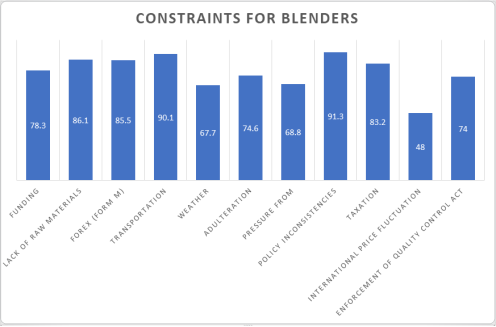
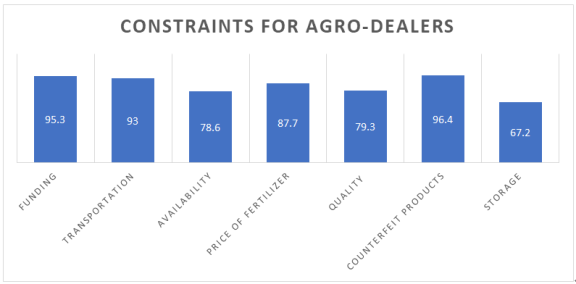
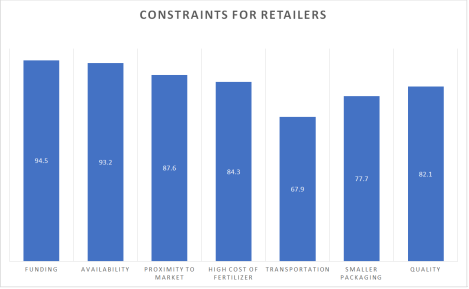
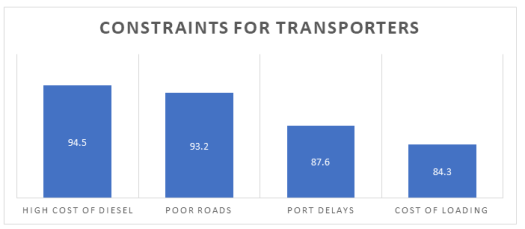
The outcomes depicted in Figures 1-5 unveiled significant insights into the prominent and lesser constraints encountered by various actors in the fertilizer value chain, namely blenders, agro-dealers, retailers, transporters, and farmers. This comprehensive analysis revealed noteworthy patterns that shed light on the challenges faced by each actor, and the implications for the overall functioning of the fertilizer market.
Blenders’ Constraints in the Fertilizer Value Chain
The results indicated that blenders confront several formidable challenges. Chief among these are policy inconsistencies, which top the list at 91.3 per cent. This inconsistency creates an environment of uncertainty, disrupting long-term planning for companies. The intricate issue of transportation ranks significantly high at 90.1 per cent, closely followed by the foreign exchange (FOREX) requirements for form M approval at 85.5 per cent. Furthermore, the scarcity of raw materials poses a notable challenge at 86.1 per cent. Other constraints include taxation (83.2 per cent), funding hurdles (78.3 per cent), concerns of adulteration (74.6 per cent), and the enforcement of quality control acts (74 per cent).
Policy inconsistencies have far-reaching ramifications, disrupting the equilibrium of the fertilizer market and unsettling the operational landscape for blenders. This is in line with , who highlight the history of fluctuating government policies in the Nigerian fertilizer sector. The privatization attempt of 1997, despite its laudable intent, lacked implementation follow-through, ultimately impacting the industry's stability and causing a significant drop in fertilizer usage. Change in policy of the government affects the company’s ability to plan and procure raw materials which affects their ability to produce fertilizer and make it available to farmers. Public governance is no longer understood as an exclusive domain of the state, but rather as an interactive arena involving multiple actors across sectors who possess different authorities, resources, and capacities. In the context of agricultural governance, especially fertilizer distribution, the interaction between government institutions, private companies, farmer groups, and civil society organizations becomes increasingly important because the effectiveness of public policy depends not only on formal regulations but also on the collective capability of actors involved in implementation processes .
Transportation Woes: Transportation emerges as a critical bottleneck for the value chain, particularly due to the parlous state of roads and the adverse effects of inclement weather. The costs associated with subpar transportation infrastructure ripple through the supply chain, inflating product prices and hindering farmers' access to adequate fertilizer quantities. Notably, the disparities in fertilizer prices across states in Nigeria are influenced by the logistical costs borne by agro-dealers . The lack of efficient logistics and distribution systems hinders the availability and affordability of fertilizers, particularly in remote and rural areas . Higher energy prices also increase transport and logistics costs. Many African economies rely heavily on imported fertilizers from Gulf producers, and even moderate price increases can significantly reduce fertilizer use among smallholder farmers .
Foreign Exchange and Raw Material Scarcity: The scarcity of foreign exchange for importers, coupled with the prohibition on fertilizer importation (including raw materials), compounds the challenges for blenders. Raw material importation, monopolized by the government, disregards the seasonal dynamics of fertilizer production, affecting availability during rainy seasons. This finding underscore systemic barriers affecting the supply chain and market stability. Foreign exchange (FOREX) constraints act as a major bottleneck across agricultural supply networks, severely impacting how fertilizer is manufactured, imported, distributed, and used. Because the fertilizer market relies heavily on global trade, a shortage of foreign currency triggers a chain reaction that harms every person involved in the process . Fertilizer value chain actors in Nigeria face critical raw material constraints driven by a heavy dependence on imported inputs like muriate of potash (MOP) and complex chemical components, foreign exchange volatility, and inadequate domestic processing infrastructure .
Funding Challenges: Obtaining funding from financial institutions remains a pivotal challenge for blenders, characterized by onerous collateral demands, high borrowing interest rates, and bureaucratic hurdles. These financial constraints resonate with whose observations on the implications of financial difficulties on fertilizer production and marketing timelines. These constraints underscore the intricate web of challenges faced by various actors in the fertilizer value chain. Policy consistency, transportation infrastructure, foreign exchange availability, raw material access, and funding hurdles collectively influence market dynamics and shape stakeholders' decision-making processes. Increasing agricultural production, implementing new farming methods and enhancing the distribution of rural income require availability of sufficient financing .
Figure 1. Constraints faced by Blender.
Agro-dealer Constraints in the Fertilizer Value Chain
The revelations extracted from the study's findings bring to light pivotal constraints experienced by agro-dealers, shedding light on both primary challenges and secondary concerns that shape their operational landscape. This comprehensive analysis offered valuable insights into the dynamics influencing agro-dealers' roles and decision-making within the intricate fertilizer value chain.
Primary Constraints for Agro-Dealers: The study's focal point revolves around four major constraints confronting agro-dealers, each carrying significant implications. Counterfeit products loom large as the most pervasive challenge, constituting a staggering 96.4%. This menace poses a substantial threat to the integrity of the fertilizer market, casting a shadow over consumer trust and product efficacy. Funding follows closely, at 95.3%, accentuating the critical need for financial resources to sustain operations and navigate market dynamics. The transportation dilemma, encompassing a substantial 93 per cent, underscores the logistical intricacies faced by agro-dealers in ensuring timely and efficient product distribution. Notably, the pricing of fertilizer materials emerges as a critical concern, standing at 87.7 per cent, accentuating the pivotal role of cost dynamics in shaping market access and competitiveness.
Secondary Constraints: While quality, availability, and storage constraints are not ranked as major concerns, they nevertheless assume relevance in the agro-dealer landscape. Quality, at 79.3 per cent, resonates with the observations by , underscoring the enduring challenge of maintaining consistent fertilizer quality standards within Nigeria. According to Ezema et al. , In Nigeria, blended fertilizers are purchased in accordance with their brand names with perceived differences in quality in respective of same labelled content inscription. There is a price signal in these brands with perceived differences in quality. According to Liverpool-Tasie et al. , inferior products manufactured abroad and imported into the country, adulteration, chemical content different from that advertised, underweight bags, poor packing material, misbranded and fake fertilizers, and poorly labeled fertilizers which are largely associated with fertilizer products in the open market. The prevalence of counterfeit, adulterated, and misbranded fertilizers signifies a pressing need for stringent quality control measures to safeguard farmers' interests and incentivize increased fertilizer use. Regulatory and quality control challenges further complicate the landscape, with evidence of misbranded, adulterated, or under-weighted products undermining farmer trust and limiting the effective benefits of increased supply . This also aligned with the findings of and , emphasizing farmers' willingness to embrace higher fertilizer application if assured of superior quality.
Quality Challenges and Farmer Engagement: The alignment with who underscores the depth of fertilizer quality concerns, warranting a multidimensional approach to regulating and enhancing product quality. The evident interest among farmers to augment fertilizer usage in the face of assured quality emphasizes the pivotal role of quality control in spurring greater agricultural productivity and sustainable practices. The study's revelations regarding agro-dealer constraints unmask a multifaceted spectrum of challenges, ranging from counterfeit products and funding limitations to transportation intricacies and pricing dynamics. These findings accentuate the imperative of fortifying the agro-dealer segment within the fertilizer value chain to foster a resilient and sustainable agricultural ecosystem.
Figure 2. Constraints faced by Agro-dealers.
Retailer Constraints within the Fertilizer Value Chain
The intricate web of retailer constraints that emerged from this study unveils a spectrum of challenges that significantly influence the dynamics of the fertilizer value chain. These findings offer valuable insights into the barriers faced by retailers and underscore the multifaceted nature of their operational landscape.
Primary Constraints for Retailers: The findings underscore funding as a pivotal constraint for retailers, with a substantial prevalence rate of 94.5 per cent. This points to a pressing need for financial resources to support and sustain retailer activities within the value chain. Availability, a constraint experienced by 93.2 per cent of retailers, highlights the challenge of ensuring a consistent and timely supply of fertilizers to meet market demand. Proximity to markets emerges as another significant hurdle, resonating at 87.6 per cent, indicating the crucial role of location in shaping retailers' ability to efficiently transport goods and access customers. The high cost of fertilizers, evidenced by the 84.3 per cent rate, highlights the interplay between pricing dynamics and market competitiveness. Additionally, quality, at 82.1 per cent, surfaces as a core concern, signifying the essential role of product integrity in influencing consumer choices and retailer credibility.
Secondary Constraints: While smaller packaging and transportation are categorized as least constraints, they nonetheless warrant attention within the retailer landscape. Smaller packaging constraints, standing at 77.7 per cent, hint at the packaging intricacies that can influence both storage and consumer preferences. Transportation, at 67.9 per cent, underlines the logistical challenges faced by retailers, reflecting the impact of transportation efficiency on cost, delivery timelines, and product accessibility. Multiple factors underpin this persistent gap. The issue extends beyond fertilizer quantities and prices to include regulatory weaknesses, institutional failures, and unequal access across the value chain. Although the Presidential Fertilizer Initiative (PFI) and related reforms have expanded domestic blending capacity and improved national availability, mixed incentives from past subsidy and procurement programs have shaped market behavior in ways that either crowd in or crowd out private-sector participation .
The constraints illuminated by this study have far-reaching implications for retailers and the broader fertilizer value chain. The pronounced funding challenge underscores the need for streamlined financial support mechanisms that can alleviate the burden of high collateral demands, bureaucratic loan processes, and reluctance from lenders. This resonates with the broader agricultural context, where constrained access to credit can hinder productivity and growth.
The availability constraint raises concerns about supply chain efficiency and the need for robust inventory management strategies to ensure that retailers can meet market demands in a timely manner. Proximity to markets emphasizes the strategic importance of retailer location in optimizing distribution and minimizing transportation costs. Quality emerges as a pivotal consideration, highlighting the need for stringent quality control measures to safeguard consumer trust, encourage higher fertilizer adoption rates, and enhance the overall reputation of retailers. Policy design and market trust strongly influence fertilizer use. The Growth Enhancement Support (GES) scheme demonstrated that well-designed subsidies could increase fertilizer uptake by about 16 percent . However, uneven implementation, such as targeting errors, delivery delays, and administrative disruptions, has often reduced effectiveness and discouraged private-sector participation. Widespread concerns about fertilizer quality, including fake or diluted products, further undermine trust and reduce demand even when fertilizers are physically available .
The interplay between price fluctuations and market dynamics aligns with broader economic principles, emphasizing the influence of pricing on technology adoption and consumer behavior. This underscores the importance of stability and transparency in pricing mechanisms within the fertilizer sector. The unveiled retailer constraints within the fertilizer value chain offer a nuanced understanding of the challenges faced by this segment. By addressing these challenges, stakeholders can collectively work towards fostering a more efficient, resilient, and inclusive value chain that ultimately benefits farmers and agricultural productivity.
Figure 3. Constraints faced by retailers.
Transporter Challenges within the Fertilizer Value Chain
Within the intricate tapestry of the fertilizer value chain, the challenges faced by transporters emerge as a critical factor influencing the efficiency and effectiveness of the entire ecosystem. The findings of this study shine a spotlight on these challenges, shedding light on their magnitude and potential implications.
The study underscores the pressing issue of the high cost of diesel, with a substantial prevalence rate of 98.3 per cent. This cost burden weighs heavily on transporters, potentially contributing to increased operational expenses and, consequently, affecting the overall cost structure of fertilizer distribution.
Poor road conditions loom large as a formidable obstacle, registering at 97.1 per cent. This constraint accentuates the urgency of addressing infrastructure deficiencies, as road quality directly affects transportation efficiency, costs, and delivery timelines. Port delays, a challenge faced by 86 per cent of transporters, unveil the intricacies of logistics and supply chain dynamics within the fertilizer sector. In contrast, the cost of loading emerged as a lesser constraint at 64.2per cent, suggesting that while loading expenses remain a consideration, they may be relatively more manageable compared to other challenges.
The implications of these transporter constraints reverberate throughout the fertilizer value chain and extend to the broader agricultural landscape. The high cost of diesel directly impacts operational viability, potentially exerting upward pressure on overall transportation costs. Poor road conditions introduce inefficiencies, affecting delivery timelines and adding an additional layer of expense. Moreover, the prevalence of port delays underscores the need for streamlined logistics and supply chain management to mitigate delays and ensure a smooth flow of fertilizer products. Poor road and transportation systems are not isolated challenges; rather, they are interconnected factors that amplify the hurdles faced by farmers and stakeholders. The constraint of limited access to markets due to transportation bottlenecks aligns with the notion that factors beyond direct price subsidies can significantly impact fertilizer use. Transportation is a fundamental aspect of the agricultural supply chain that ultimately determines access to markets, transaction costs, and price transmission efficiency . According to Ncube et al. , the final retail prices are typically more than double the free-on-board (FOB) price, with transport accounting for 15% of the difference. Minten et al. showed how transport costs from fertilizer distribution centers to farmers are roughly twice as high as the expenses incurred to bring fertilizer from the port to remote parts of Ethiopia.
Addressing transporter constraints is pivotal for optimizing the fertilizer value chain. Remedying road conditions, streamlining port operations, and exploring strategies to manage the high cost of diesel could collectively enhance transportation efficiency. Policy initiatives aimed at infrastructure development and logistical improvements could potentially alleviate these challenges, benefiting transporters, stakeholders, and ultimately farmers.
Figure 4. Constraints faced by transporters.
Farmer Constraints in the Fertilizer Value Chain:
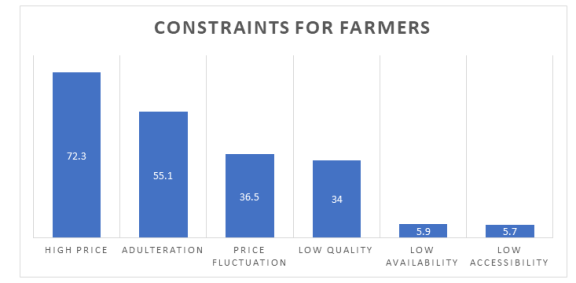
A glimpse into the challenges encountered by farmers within the fertilizer value chain unveils a nuanced narrative, revealing both the predominant hindrances and the lesser constraints that shape their experiences. The outcomes highlighted in Figure 4 offer valuable insights into these constraints, facilitating a deeper understanding of their implications.
Prominent Constraints: The findings prominently underscore two major constraints experienced by farmers: the high price of the fertilizer product, accounting for 72.3 per cent, and the issue of adulteration, which registers at 55.1 per cent. These constraints have far-reaching implications for farmers' decision-making and profitability. The high cost of the fertilizer product directly impacts farmers' cost-benefit calculations, potentially affecting the feasibility of its use. Adulteration poses a substantial threat to both crop health and yield outcomes, thus highlighting the significance of ensuring the availability of genuine and effective fertilizers.
The identification of price instability and fluctuation as a constraint by 36.3 per cent of respondents aligns with larger economic principles. The observation resonates with the notion of demand and supply dynamics as elucidated by . These findings emphasize the vulnerability of the agricultural sector, particularly small-scale farmers, to market fluctuations that can influence input affordability and ultimately yield potential.
Minor Constraints: Conversely, the study reveals that certain constraints held relatively less sway over farmers' experiences. Low quality (34per cent), low availability (5.9 per cent), and low accessibility (5.7 per cent) emerged as minor challenges. Inadequate market outlets, limited knowledge of modern inputs, and governmental support gaps converge as recurring themes, emphasizing the multifaceted nature of constraints faced by farmers.
Additionally, the juxtaposition of findings from , further substantiates the far-reaching impact of constraints across agricultural studies. Poor transportation, investment capital shortages, and the burden of pests and diseases resonate as universal challenges impeding farmers' endeavors. Financial constraints are associated with the economic limitations that impede farmers' capabilities to adopt new technologies or practices . Technical constraints are associated with gaps in knowledge, insufficient extension services, weak connections between research and farmers, and limited access to innovations . Okoye et al. emphasized that underdeveloped rural credit markets compelled farmers to rely on informal lending, which proved inadequate for financing capital intensive initiatives.
Communication and Market Dynamics: The notion of information asymmetry emerges as a noteworthy factor contributing to certain challenges, such as complaints of very high fertilizer prices voiced by certain marketers. The lack of access to timely and accurate market information can distort pricing dynamics, potentially disadvantaging farmers. The study underscores the potential benefits of improving the availability of marketing information, which can empower farmers to engage in more informed negotiations, thus fostering a more equitable distribution of products from rural to urban areas. The implications of these findings extend beyond individual constraints, advocating for a holistic approach to value chain enhancement. Addressing major constraints such as high product prices and adulteration demands collaborative efforts between stakeholders. Similarly, targeted interventions addressing lesser constraints can collectively uplift farmers' prospects, improve yield outcomes, and contribute to overall food security. This agrees with who stated that fertilizer value chain actors in Nigeria face critical communication and information constraints, including an over-reliance on informal word-of-mouth networks, infrequent contact with public extension agents, and severe digital infrastructure bottlenecks. Adegbola and Aromolaran reported that limited interaction with end-users restricts product quality improvement and market responsiveness. While a range of communication methods, such as mobile phones, face-to-face interactions, radio programs, SMS alerts, and social media platforms, is available, their use remains inconsistent and uneven. Information is the key driver of contemporary agricultural value chains. It removes gaps and brings market information closer to users and by extension lower cost of production, processing, transportation and sales . Information and Communication Technology (ICT) is increasingly recognized as a transformative tool to address these challenges, offering innovative solutions that enhance productivity, improve market connectivity, and provide critical agricultural information .
Figure 5. Constraints faced by farmers.
4. Conclusion
The results from the study revealed that funding challenges constituted major constraints for Blenders 78.3%, Agro-dealers 95.3%, Retailers 94.5% in the study area. The other high constraint areas for Blenders are cost of transportation 90.1% and policy inconsistencies 91.3%. the study revealed that primary constraints for agro-dealers among others are counterfeit products 96.4% which constituted a serious menace and transportation 93%. For retailers, in addition to funding, availability of the product took a whopping 93.2% followed by quality of the product 82.1%. the data also revealed that the major constraints for transporters were high cost of diesel 94.5%, poor roads 93.2%, port delays 87.6% and cost of loading 84.3% while the farmer constraints were high prices of fertilizer 72.3%, adulteration 55.1% and price fluctuation 36.5%. The constraints are capable of affecting the value chain as all actors are linked by the chain, if the constraints are not addressed, the value chain will be broken and the product will not reach other actors along the fertilizer chain.
5. Recommendation
Based on the results obtained from the research, the following recommendations were made to addressed some of the major constraints faced by fertilizer value chain actors in the study area. Addressing these constraints will ensure that the chain of activities is not broken because they are interlinked;
The need for policy makers to come up with intervention funds tailored at supporting actors in order to ensure continuous flow of the product and at low rates to have a direct effect on the final products.
Means of transporting raw materials and finished products should be increased to include rail cargo transportation that could transport large cargos and possibly lower the cost of transportation for actors. The cost of transportation has a direct impact on the cost of final product.
Policy makers should be encouraged to adhere to policies and not to change them consistently in such a way that it will affect the market and industry players. Constant changes in policies are capable of disrupting the flow of products.
Enforcement of the quality control act by the relevant agencies of the government will go a long way in reducing counterfeit products. The agencies should be empowered to sanction defaulters.
Additional port facilities by government and private sector partnership should be encouraged to reduce port congestions and delays in evacuating raw materials.
Government is encouraged to fix roads and work in partnership with private sectors to repair roads for faster delivery of both raw materials and finished products.
Abbreviations

GDP

Gross Domestic Product

FAO

Food and Agriculture Organisation

FOREX

Foreign Exchange

ATA

Agriculture Transformation Agenda

APP

Agricultural Promotion Policy

FGN

Federal Government of Nigeria

PFI

Presidential Fertilizer Initiative

GES

Growth Enhancement Support Scheme

ICT

Information and Communication Technology

Author Contributions
Mohammed Maina: Conceptualization, Data curation, Formal Analysis, Funding acquisition, Methodology, Resources, Visualization, Writing – original draft
Aisha Simbiat Hussaini: Data curation, Software, Writing – review & editing
Hajara Shuaibu: Supervision, Visualization, Writing – review & editing
Conflicts of Interest
The authors declare no conflict of interest.
References
[1] Abhishek, T., Srivastava, S., & Sailaja, P. (2021). Loan as a back bone for agriculture: Evidence from banks. Turkish Journal of Computer and Mathematics Education, 12(11), 106–114.
[2] Adegbola, P. Y., & Aromolaran, A. B. (2020). The role of communication networks in the cassava market chain in Nigeria. Journal of Agricultural Extension, 24(1), 1–13.
[3] Ajiboye, A. O., Ogunniyi, A. G., Tsaku, D. O., Ohida, M. E., & Mustapha, A. M. (2024). Effects of road transportation infrastructural facilities on the development of poultry farming in Remoland, Ogun State, Nigeria. Department of Urban and Regional Planning, Federal University of Technology Akure, Nigeria.
[4] Alabi, R. A., & Oshobugie, O. A. (2020). The impact of e-wallet fertilizer subsidy scheme and its implication on food security in Nigeria. AERC.
[5] Balana. B. B., & Fasoranti. A.S. (2022) A Historical Review of Fertilizer Policies in Nigeria. IFPRI Discussion Paper 02145. 136660.pdf (ifpri.org).
[6] Balana, B. B., and Oyeyemi, M. A. (2022). Agricultural credit constraints in smallholder farming in developing countries: Evidence from Nigeria.” World Development Sustainability 1, 100012.
[7] CBN (2026). Central Bank of Nigeria 2026 report on Agricultural Sector.
[8] Chude, V. 2006. Fertilizer situation in Nigeria. Paper presented by Alhaji Bello Sule, Director Fertilizer Department, to the Program Advisory Committee on Agriculture and Food Security on 6 September, 2006. Abuja, Nigeria.
[9] Ezema, R. A., Omeje, T. E., Omeje, B. A., & Okadi, A. O. (2023). Quality Assessment of Blended NPK Fertilizers Available to Quality Assessment of Blended NPK Fertilizers Available to Quality Assessment of Blended NPK Fertilizers Available to Farmers in Enugu State, Nigeria: Evidence for Stronger Jurisdiction. Direct Research Journal of Agriculture and Food Science Vol. 11(7), Pp. 190-197, July 2023
[10] Faisal, A. F., Ahmad, B., Ibrahim, M. A., & Abdullah, M. T. (2025). Multi-Actors Capability in Meeting Fertilizer Needs in Maros Regency. Journal of Management and Administration Provision Vol. 5, Issue 3, 2025 Page 614-623.
[11] Federal Government of Nigeria (FGN) (2006). Nigeria Fertilizer Summit Strategy Report. Report prepared by the Group of Core Experts of the Technical Sub-Committee of the Africa Fertilizer Summit.
[12] Food and Agriculture Organisation (FAO) (2016). The State of Food and Agriculture 2016. Climate change, agriculture and food security.
[13] Food and Agriculture Organisation (FAO). (2021). The state of the world’s land and water resources for food and agriculture: Systems at breaking point. FAO.
[14] Food and Agriculture Organisation (FAO) (2026). Global Agrifood Implications of the 2026 Conflict in the Middle East. Impacts on energy and fertilizer trade, and food security. Information note 15 March 2026.
[15] Fasoranti, A., Oliver, K. K., Popoola, O., Ali, S., Olanrewaju, O. (2025). Bridging Nigeria’s Fertilizer Supply-Demand Gap for Agricultural Transformation. International Food Policy Research Institute (IFPRI). Policy note December, 2025.
[16] IFDC. (2013). The Quality of Fertilizer Traded in West Africa: Evidence for Stronger Control. IFDC.
[17] IFDC (2025). Fertilizer Statistics Overview Nigeria 2019 – 2023, 2024 Edition.
[18] Ikuemonisan, E.S. (2024). Challenges and strategies in Nigerian agribusiness entrepreneurship for sustainable development. CABI Agriculture and Bioscience (2024) 5: 115
[19] Liverpool –Tasie, S., B.Olaniyan, S. Salau, & J. Sakey. (2010). A review of fertilizer policy issue in Nigeria. Nigeria Strategy Support Program, Policy Note No 28.
[20] Maina, M., Abdulrahman, S., Oladimeji, Y. U., & Hussaini, A. S., (2026). Information flow competitiveness and the benefits among fertilizer value chain actors in Kaduna State. International Journal of Versatile Research and Analysis (IJVRA) © 2026 IJVRA | Volume 4, Issue 7, July 2026 | IJVRA.ORG.
[21] Maina, M., Hussaini, A.S., & Sanni, A. (2026). An Analysis of Product Flow Along the Fertilizer Value Chain in Kaduna State. International Journal of Agricultural Economics 2026, Vol. 11, No. 4, pp. 123–130
[22] Maina, M. (2026). An Assessment of the Factors Influencing Farmers’ Access to Fertilizer Markets in Some Selected Local Government Areas in Kaduna State, Nigeria. International Journal of Agricultural Economics 2024, Vol. 9, No. 2, pp. 41-45
[23] Maina, M., Oladimeji, Y. U., Abdulrahman S., Hussaini, A.S., Ammani, A. A., and Shuaibu, H. (2026). Analysis of Competitiveness among Fertilizer Value Chain Actors in Kaduna State, Nigeria. Journal of Agricultural Research and Entrepreneurship - Vol 1, Issue 1 (2024). Pp 23-32.
[24] Minten B, Koru B, Stifel D. 2013. The last mile(s) in modern input distribution: pricing, profitability, and adoption. Agric. Econ. 44(6): 629–46. September 2013.
[25] Musa, A., & Salihu, B. (2023). Constraints and opportunities in ginger value chain development in Nigeria. Journal of Agribusiness and Rural Development, 17(2): 89–102. ISSN (Print): 2811-1885.
[26] Nagy, J. G., & Edun, O. (2002): Assessment of Nigerian government Fertilizer policy and suggested alternative market – friendly policies.
[27] Naudé W. (2016). Is the entrepreneurial state the answer? Revisiting the development state. J Dev Stud. 2016; 52(7): 893–909.
[28] National Bureau of Statistics (NBS) (2012). Annual Abstract of Statistics
[29] National Bureau of Statistics (NBS) (2026).
[30] Ncube, P., Roberts, S., Vilakaz, T. (2016). Regulation and rivalry in transport and supply in the fertilizer industry in Malawi, Tanzania and Zambia. In Competition in Africa: Insights from Key Industries, ed. S Roberts. HSRC Press.
[31] Ndanitsa, M. A., Umar, I. S., Olaleye, R. S., Ibrahim, M., Sallawu, H. & Tyabo, I. S. (2013). Evaluation of Women’s Participation in National (Special) Programme for Food Security in Niger State, Nigeria. Savannah Journal of Agriculture. Volume 8(1); June, 2013.
[32] Okadi, A. O., Agu, R. I., & Ndu, A. U. (2024). Role of Information and Communication Technology in Promoting Household Food Security in Nigeria, Direct Research Journal of Agriculture and Food Science, 12(1), Pp 52-58.
[33] Okoye, C., Eze, C., & Onah, J. (2022). Financial inclusion and rural agricultural development in Nigeria: The role of microfinance. Journal of Agricultural Economics and Rural Development, 14(3), 87–99.
[34] Olaniyi, I. A., Osuafor, O. O., Nwafor, S. C., Edeh, O. U., & Ekeh, D. (2024). Assessing the Influence of Information and Communication Technology Constraints on Cassava Value Chain Actors in Anambra State. Torkwase Journal of Agricultural Research.
[35] Owoade, O. A. (2019). Sustaining Agricultural Transformation in Nigeria: Challenges, Issues and Strategies. International Journal of Innovative Agriculture & Biology Research 7(4): 13-22, Oct-Dec., 2019
[36] Yegbemey, R. N., Yabi, J. A., Aïhounton, G. B., & Paraïso, A. (2014). Farm households’ decision making and level of participation in sustainable land management practices in Benin. Sustainability, 6(7), 4536–4559.
Cite This Article
  • APA Style

    Maina, M., Shuaibu, H., Hussaini, A. S. (2026). An Assessment of the Constraints Faced by Fertilizer Value Chain Actors in Kaduna State, Nigeria. International Journal of Agricultural Economics, 11(5), 217-226. https://doi.org/10.11648/j.ijae.20261105.16

    Copy | Download

    ACS Style

    Maina, M.; Shuaibu, H.; Hussaini, A. S. An Assessment of the Constraints Faced by Fertilizer Value Chain Actors in Kaduna State, Nigeria. Int. J. Agric. Econ. 2026, 11(5), 217-226. doi: 10.11648/j.ijae.20261105.16

    Copy | Download

    AMA Style

    Maina M, Shuaibu H, Hussaini AS. An Assessment of the Constraints Faced by Fertilizer Value Chain Actors in Kaduna State, Nigeria. Int J Agric Econ. 2026;11(5):217-226. doi: 10.11648/j.ijae.20261105.16

    Copy | Download

  • @article{10.11648/j.ijae.20261105.16,
      author = {Mohammed Maina and Hajara Shuaibu and Aisha Simbiat Hussaini},
      title = {An Assessment of the Constraints Faced by Fertilizer Value Chain Actors in Kaduna State, Nigeria},
      journal = {International Journal of Agricultural Economics},
      volume = {11},
      number = {5},
      pages = {217-226},
      doi = {10.11648/j.ijae.20261105.16},
      url = {https://doi.org/10.11648/j.ijae.20261105.16},
      eprint = {https://article.sciencepublishinggroup.com/pdf/10.11648.j.ijae.20261105.16},
      abstract = {The study was conducted in Kaduna State, Nigeria to assess the constraints faced by fertilizer value chain actors. A multistage sampling technique was employed in selecting respondents for the study. Fertilizer Value Chain Actors selected for the study are; Blenders, Agro-dealers, Retailers, Transporters and farmers. Descriptive statistics was used in analysing the data. The data generation for the study was done through both cross-sectional and primary data. The results revealed the major constraints for blenders to be funding 78.3%, transportation 90.1%, policy inconsistencies 91.3%. Agro-dealers’ constraints are funding 95.3%, counterfeit products 96.4% and transportation 93%. Retailers had 94.5% funding constraints, 93.2% as availability of products and 82.1% quality of product. Transporters’ major challenges were cost of diesel 94.5%, poor roads 93.2% and port delays 87.6% while farmers had high prices of product as their major challenge at 72.3%. The study recommends low-cost funding through intervention funds for actors, construction of additional port facilities to ease discharge of fertilizer raw materials, repair of major roads to improve delivery time, stable policy framework to eliminate uncertainties and policy summersault, enforcement of quality control act for defaulters and establishment of rail cargo facilities as additional means of transporting raw materials and finished products.},
     year = {2026}
    }
    

    Copy | Download

  • TY  - JOUR
    T1  - An Assessment of the Constraints Faced by Fertilizer Value Chain Actors in Kaduna State, Nigeria
    AU  - Mohammed Maina
    AU  - Hajara Shuaibu
    AU  - Aisha Simbiat Hussaini
    Y1  - 2026/10/31
    PY  - 2026
    N1  - https://doi.org/10.11648/j.ijae.20261105.16
    DO  - 10.11648/j.ijae.20261105.16
    T2  - International Journal of Agricultural Economics
    JF  - International Journal of Agricultural Economics
    JO  - International Journal of Agricultural Economics
    SP  - 217
    EP  - 226
    PB  - Science Publishing Group
    SN  - 2575-3843
    UR  - https://doi.org/10.11648/j.ijae.20261105.16
    AB  - The study was conducted in Kaduna State, Nigeria to assess the constraints faced by fertilizer value chain actors. A multistage sampling technique was employed in selecting respondents for the study. Fertilizer Value Chain Actors selected for the study are; Blenders, Agro-dealers, Retailers, Transporters and farmers. Descriptive statistics was used in analysing the data. The data generation for the study was done through both cross-sectional and primary data. The results revealed the major constraints for blenders to be funding 78.3%, transportation 90.1%, policy inconsistencies 91.3%. Agro-dealers’ constraints are funding 95.3%, counterfeit products 96.4% and transportation 93%. Retailers had 94.5% funding constraints, 93.2% as availability of products and 82.1% quality of product. Transporters’ major challenges were cost of diesel 94.5%, poor roads 93.2% and port delays 87.6% while farmers had high prices of product as their major challenge at 72.3%. The study recommends low-cost funding through intervention funds for actors, construction of additional port facilities to ease discharge of fertilizer raw materials, repair of major roads to improve delivery time, stable policy framework to eliminate uncertainties and policy summersault, enforcement of quality control act for defaulters and establishment of rail cargo facilities as additional means of transporting raw materials and finished products.
    VL  - 11
    IS  - 5
    ER  - 

    Copy | Download

Author Information