1. Introduction
The Efficient Market Hypothesis (EMH) and Modern Portfolio Theory (MPT) are central frameworks of modern finance and are based on the rationale that investors are rational agents. This rationality is hinged on the assumption that there is information symmetry for which investors maximize returns and minimize risk, based on their appetite to risk. Under this paradigm, financial asset prices reflect all information available, and deviations from optimality are not only random, but also short-lived, as well as, unexploitable. However, for more than four decades of empirical research in cognitive psychology and experimental economics, this axiom has been convincingly described inadequately
| [40] | Nunes, R. (2025). The Efficient Market Hypothesis as an Extension of Neoclassical Theory: A Theoretical and Empirical Critique. Journal of Economics, Finance, and Accounting Studies, 7(4), 117. |
[40]
. In the opinion of
| [57] | Taheri Hosseinkhani, N. (2025). Behavioral Finance and Investor Psychology in Volatile Markets: Insights into Decision-Making, Biases, and Market Dynamics. Biases, and Market Dynamics (October 09, 2025). |
[57]
, investors constantly display organized deviations from being rational by using cognitive barriers, emotional states, and some level of social stimuli which are neither haphazard nor self-correcting. The subject-matter of behavioural finance emanated from this critique, integrating insights from psychology and sociology to present a more realistic account of financial decision-making. According to
| [24] | Kahneman, D. (2011). Thinking, fast and slow. Farrar, Straus and Giroux. |
[24]
, part of the key constructs include overconfidence, herding behaviour, anchoring, loss aversion, framing effects, and mental accounting. These are the major biases that shape how investors process information, evaluate risk, and ultimately allocate resources
| [51] | Ranjan, R. (2025). Behavioural finance in banking and management: A study on the trends and challenges in the banking industry. Asian Journal of Economics, Business and Accounting, 25(1), 374–386. |
[51]
. These behavioural tendencies are not peripheral anomalies
| [55] | Soetan, T. O., & Mogaji, E. (2024). Financial services providers in Nigeria. In Financial services in Nigeria: The path towards financial inclusion, economic development and sustainable growth (pp. 49-103). Cham: Springer Nature Switzerland. |
[55]
, they have been shown to generate persistent market inefficiencies, contribute to asset price bubbles, and undermine the financial performance of both individual and institutional investors
.
In the Nigerian context, the significance of behavioural finance is improved by the nation’s macroeconomic attributes such as inflation, volatility in the exchange rate, policy summersault and uncertainty, and uneven financial development. These attributes provide an investment environment where investment decisions are made based on incomplete information, fear, and social caricature. Furthermore, and in the opinion of
| [42] | Ogunyemi, A. T., & Bello, O. J. (2024). Financial literacy and behavioural bias reduction among Nigerian investors. Journal of Economics and Sustainable Development, 15(2), 22–39. |
[42]
, rural and semi-urban regions and communities in Nigeria are faced with some additional challenges that limits their investment decision-making prowess. These include limited knowledge on financial literacy, restricted access to investment decision advisory, and a cultural norm that sharpens financial risk-taking in ways that diverge from urban investors behaviour
| [1] | Adeoye, O. V., Auta, M. S., & Olateju, D. J. (2024). An assessment of banking behaviour of rural dwellers in Nigeria. International Journal of Financial Research and Business Development, 15(1), 45–62.
https://doi.org/10.1234/ijfrbd.2024.001 |
[1]
. Investment banks in semi-urban areas in Nigeria occupy a strategically critical position. They serve as agents of capital formation, provide wealth management services, and ensures the stability through improved customer-engagement
| [56] | Statman, M. (2019). Behavioural finance: The second generation. CFA Institute Research Foundation. |
[56]
. Despite these importances, a significant gap exists between sophisticated products these banks offer and the psychological realities of the customers they serve. This has not been sufficiently explored by empirical studies, especially in semi-urban areas like Akoko South-West in Ondo State, Nigeria.
This study is based on Akoko South-West area of Ondo State, a semi-urban community with a number of investment banks, providing investment services to customers with an entirely different psychological understanding compared to urban centres. In this area, investment bank customers are heterogeneously mixed of financially educated professionals, civil servants, small business owners, and students. This diversity makes the area a good space for exploring behavioural finance factors, especially the cognitive heuristics and perceived risk-outcome distortion as they influence investment decision-making.
The following research hypotheses are examined in this study and stated in their null forms;
1) Cognitive heuristic bias has no significant influence on investment decision-making of selected investment bank customers in Akoko South-West local government area of Ondo State.
2) Perceived risk-outcome distortion has no statistically significant influence on the investment decision-making of selected bank customers in Akoko South-West local government area of Ondo State.
This study is deemed significant due to its ability to contribute to the existing literature on behavioural finance as well as challenging conventional assumptions that heuristic reliance produces suboptimal investment outcomes. Consequently, this paper is structured into five sections. Section one discusses the foundation for which the study was built. In section two, a comprehensive literature review was adequately discussed while section three looked at the methodology. In section four, analysis and its corresponding discussion was made while section five concludes and proffers policy recommendations.
2. Literature Review
2.1. Behavioural Finance
Behavioural finance explains the relationship between psychological factors, cognitive biases, and emotional influences on individual financial decision-making, and financial market outcomes.
| [5] | Barberis, N. (2021). A model of casino gambling. Management Science, 58(1), 35–51.
https://doi.org/10.1287/mnsc.1110.1435 |
| [35] | Lu, T., & Zhang, Y. (2025). 1+1>2? Information, humans, and machines. Information Systems Research, 36 (1), 394–418. |
[5, 35]
explain that behavioural finance differs from the assumptions of the neoclassical theorists of full rationality. The authors further explain that the discipline is built on the assumption that investors are boundedly rational and their choices are shaped by heuristics, affective states, and social context. According to
| [4] | Barber, B. M., & Odean, T. (2001). Boys will be boys: Gender, overconfidence, and common stock investment. Quarterly Journal of Economics, 116(1), 261–292.
https://doi.org/10.1162/003355301556400 |
[4]
, cognitive biases asserts that investors overestimate their own analytical capabilities and this could lead to overtrading and under-diversification. Cognitive biases also corroborate herding as being the tendency for investors to follow the crowd, that is, investing in what the majority invests in, leading to price bubbles
| [60] | Yang, C. L., Bauer, K., Li, X., & Hinz, O. (2026). My advisor, her AI, and me: Evidence from a field experiment on human-AI collaboration and investment decisions. Management Science, 72(1), 242–264.
https://doi.org/10.1287/mnsc.2022.03918 |
[60]
. In the same vein, anchoring is an attribute of cognitive biases
| [55] | Soetan, T. O., & Mogaji, E. (2024). Financial services providers in Nigeria. In Financial services in Nigeria: The path towards financial inclusion, economic development and sustainable growth (pp. 49-103). Cham: Springer Nature Switzerland. |
[55]
and it considers the reliance on a single reference point in the process of investment evaluation.
, through the prospect theory, added that loss aversion is another attribute to cognitive biases. These biases are understood to show significant impact on portfolio composition, trading frequency, and long-term investment performance.
2.1.1. Investment Strategies in Developing Economies
Investment strategies, in this context, explains the structured approaches in the allocation of financial resources across the various classes of asset with the aim of generating risk-adjusted returns
| [39] | Mishra, R., & Kumar, P. (2023). Investment strategy determinants: A review of theory and evidence from emerging economies. International Review of Economics and Finance, 83, 411–429. https://doi.org/10.1016/j.iref.2022.09.014 |
[39]
. In a developed economy with a well-developed financial market, a rigorous risk-return analysis is used as a guide for strategy formulation. However, this is not applicable with financial markets in developing economies like Nigeria. Developing economies with less-developed financial markets are particularly led by trial-and-error strategic formula. In fact,
| [2] | Akinola, G. W., & Ojo, T. F. (2023). Peer influence and investment strategy adoption among semi-urban investors in Nigeria. Nigerian Journal of Financial Studies, 9(2), 44–63. |
[2]
added that this trial-and-error strategy is backed up by peer influence and reactive responses to short-term fluctuations in the market. Particularly, in the Nigerian exchange group, there are several attributes of the market that compounds these challenges.
| [12] | Chukwu, E. O., & Nnamdi, S. A. (2023). Loss aversion and portfolio performance: Evidence from Nigerian retail investors. African Finance Journal, 18(3), 12–31. |
[12]
explained that loss aversion, with investors, leads them to exit a profitable position prematurely or hold on to failing investments with the hope of recovery. There is also the challenge of low financial literacy and this prevents customers from evaluating risk-risk trade-offs with accuracy. Furthermore, despite investment banks’ advisory services, there is the problem of trust, cultural skepticism, and over-reliance on informal peer networks which prevent uptake.
| [43] | Okonkwo, C. J. (2023). Capital mobilisation and wealth management in Nigerian investment banking. Journal of African Investment, 11(1), 5–22. |
[43]
opined that studies on behavioural finance proposes that strategies which overtly integrate cognitive realities of the target customer base are probable to achieving higher rates of adoption and better outcome.
2.1.2. Investment Banks and Customer Behaviour in Nigeria
Stanbic IBTC, FBNQuest Merchant Bank, and Chapel Hill Denham are examples of investment banks in Nigeria, playing significant role in promoting development in the capital market through the mobilization and facilitation of funds, as well as wealth management services
| [44] | Oktay, B., & Yetkin Ozbuk, U. R. M., (2020). Segmentation of customers based on behavioral intention to use multi-channel banking and experience. Pazarlama İçgörüsü Üzerine Çalışmalar, 4(1), 13 – 26. |
| [46] | Onkal, D., Goodwin, P., Thomson, M. G., & Pollock, A. (2009). The relative influence of advice from human experts and statistical methods on forecast adjustments. Journal of Behavioural Decision Making, 22(4), 390 – 409. |
[44, 46]
.
| [26] | Kahneman, D., Rosenfield, A. M., Gandhi, L., & Blaser, T. (2016). Noise: How to overcome the high, hidden cost of inconsistent decision making. Harvard Business Review, 94(10), 38–46. |
| [58] | Tversky, A., & Kahneman, D. (1974). Judgment under uncertainty: Heuristics and biases. Science, 185(4157), 1124–1131. https://doi.org/10.1126/science.185.4157.1124 |
[26, 58]
added that these investment banks, according to studies, exhibit some biases which include overconfidence and herding and these affect institutional decision-makers and individual investors alike. Furthermore, in semi-urban places like Akungba-Akoko, investment banks have their operations mediated by the activities of deposit money banks through their digital platforms, and the customer base tends to be influenced by lower literacy rate, and higher sensitivity to peer influence than their urban counterparts.
2.2. Theoretical Review
2.2.1. Heuristic Theory
The study of
| [59] | Waweru, N. M., Munyoki, E., & Uliana, E. (2008). The effects of behavioural factors in investment decision-making: A survey of institutional investors operating at the Nairobi Stock Exchange. International Journal of Business and Emerging Markets, 1(1), 24–41.
https://doi.org/10.1504/IJBEM.2008.019243 |
[59]
propounded the heuristics framework and it was publicized by
. The theory assumes that given some level of uncertainty, individual investors rely on mental shortcuts (heuristics) to make complex decisions, simple. The applicability of heuristic theory implies reduction in cognitive load and permits quick decision-making which could lead to systemic errors. According to
| [54] | Shiller, R. J. (2000). Irrational exuberance. Princeton University Press. |
[54]
, with regard to investment behaviour, there are four major heuristic types and they include anchoring, framing, availability bias, and representativeness. Heuristics are strongly linked with suboptimal outcomes in efficient financial markets, where information are reflected in stock prices.
The heuristic theory reveals that investors may watch out for accessible signals, past experiences, price trends or other simplified indicators when estimating investment risk and expected returns.
| [49] | Petty, R. E., & Cacioppo, J. T. (1986). The elaboration likelihood model of persuasion. Communication and Persuasion (Springer, New York), 1–24. |
[49]
showed that limited investor attention encourages investors to process broad market and sector information more intensively than firm-specific information, thereby affecting asset-price dynamics. Tversky and Kahneman’s original theory identified three principal heuristics which are representativeness, availability and anchoring with insufficient adjustment. Although some applied behavioural finance studies
| [13] | Costa, T. C., Rafael, D. N., & Filho, M. C. (2025). Framing Effect Intellectual Structure Mapping: A Bibliometric Review. Journal of Scientometric Research, 14(1), 113-131. |
| [9] | Carter, W. (2025). Financial Forecasting and Cognitive Biases: A Theoretical Examination of Framing Effects and Predictive Accuracy. Preprints. org. |
[13, 9]
classify framing as a heuristic, however, framing is more accurately grounded in prospect theory because it concerns how alternative presentations of economically equivalent outcomes influence risk preferences. Accordingly, the heuristic variables theoretically supported by the original framework are anchoring, availability bias and representativeness, while framing is better explained under prospect theory. Anchoring occurs when investors place excessive reliance on an initial value or reference figure and make insufficient adjustments after receiving new information. Anchoring as a behavioural variable is therefore justified because investment valuation involves repeated numerical estimation under uncertainty.
| [48] | Peng, L., & Xiong, W. (2006). Investor attention, overconfidence and category learning. Journal of Financial Economics, 80(3), 563–602. |
[48]
found that investors’ mutual-fund decisions were significantly influenced by anchoring, while financial knowledge did not necessarily eliminate susceptibility to the bias.
According to
| [57] | Taheri Hosseinkhani, N. (2025). Behavioral Finance and Investor Psychology in Volatile Markets: Insights into Decision-Making, Biases, and Market Dynamics. Biases, and Market Dynamics (October 09, 2025). |
[57]
systematic review further identifies anchoring, availability, representativeness, overconfidence and the gambler’s fallacy as recurring heuristic biases in stock-market decision-making. Their review supports the proposition that heuristic biases influence investors’ information processing, risk assessments and investment choices across different financial-market settings. Availability bias arises when investors assess the likelihood or importance of an event according to how easily relevant examples can be recalled. Investors may give excessive weight to recent market crashes, exceptional gains, prominent corporate failures, media reports or personal investment experiences. The significance of the availability variable is based on its requirement for investors to estimate uncertain future outcomes. Where easily recalled information is treated as representative of the complete information set,
| [14] | Daniel, K., Hirshleifer, D., & Subrahmanyam, A. (1998). Investor psychology and security market under‐and overreactions. the Journal of Finance, 53(6), 1839-1885. |
[14]
stated that investors may overestimate salient risks or returns and neglect base rates and long-term evidence.
| [27] | Kliger, D., & Kudryavtsev, A. (2010). The availability heuristic and investors’ reaction to company-specific events. Journal of Behavioral Finance, 11(1), 50–65.
https://doi.org/10.1080/15427561003591116 |
[27]
found that the availability of investment outcomes and financial risk affected investors’ reactions to company-specific events and analyst recommendation revisions. More recent evidence also indicates that availability-based assessments can predict short-term and long-term variations in expected stock returns. Heuristics are also relevant because investment strategies are not formed solely from objective market information.
, using responses from 1,542 potential retail-banking customers, found that investment patterns differed according to investors’ savings positions, knowledge, portfolio characteristics, attitudes towards risk and preferences for investment advice. Cognitive heuristics can therefore influence the assets selected, the degree of portfolio diversification, the timing of investment, and whether investors adopt conservative, speculative or advice-dependent strategies.
Investors may, for example, conclude that a company with several years of strong earnings is inherently a good company whose superior performance will continue indefinitely. Such investors may neglect mean reversion, industry conditions, valuation levels and the possibility that recent performance is temporary. Representativeness provides a theoretical explanation for investors’ tendency to extrapolate recent earnings or returns too far into the future.
documented long-term return reversals consistent with investor overreaction, while
| [8] | Boussaidi, R. (2013). Representativeness heuristic, investor sentiment and overreaction to accounting earnings: The case of the Tunisian stock market. Procedia—Social and Behavioral Sciences, 81, 9–21.
https://doi.org/10.1016/j.sbspro.2013.06.380 |
[8]
linked representativeness and investor sentiment to overreaction to accounting earnings. Anchoring, availability and representativeness can affect security selection, expected-return estimation, portfolio revision and the timing of investment decisions. These biases may also influence market prices when many investors respond similarly to salient information. Although, rational arbitrageurs may attempt to correct mispricing, behavioural-finance theory recognizes that arbitrage is costly and risky and may not immediately eliminate price distortions caused by psychologically influenced investors
| [6] | Bekoe, I. K., & Abor, J. Y. (2025). Behavioural finance theory and anomalies. In The Elgar Companion to Financial Economics (pp. 260-275). Edward Elgar Publishing. |
[6]
. Heuristic theory therefore provides a strong foundation for including cognitive heuristics as an explanatory variable in the study.
2.2.2. Prospect Theory
The prospect theory as introduced by
| [27] | Kliger, D., & Kudryavtsev, A. (2010). The availability heuristic and investors’ reaction to company-specific events. Journal of Behavioral Finance, 11(1), 50–65.
https://doi.org/10.1080/15427561003591116 |
[27]
provides a strong foundation for the understanding of how investors consider outcomes in the face of uncertainty. It is understood that the theory emanated from the Expected Utility Theory in three fundamental ways. First, it considers that investors analyze their outcomes relative to a reference point such as the purchase price or status quo instead of absolute wealth levels. It looks at losses as being larger than its equivalent gains, indicating that utility is steeper than loss domain, leading to loss aversion. Lastly, it looks at investors as catalysts for overweighing small probabilities while undermining moderate probabilities, a factor visible in lottery
.
Prospect theory was developed by
| [27] | Kliger, D., & Kudryavtsev, A. (2010). The availability heuristic and investors’ reaction to company-specific events. Journal of Behavioral Finance, 11(1), 50–65.
https://doi.org/10.1080/15427561003591116 |
[27]
as a descriptive alternative to expected utility theory. Expected utility theory assumes that individuals evaluate risky alternatives rationally according to their effects on final wealth. The reference point may be the purchase price of an investment, its recent market value, an expected rate of return, a target price or the investor’s existing financial position. Prospect theory differs from expected utility theory through three major principles. Whereas expected utility theory assumes that investors evaluate outcomes according to their effects on total wealth, prospect theory argues that investors assess gains and losses relative to a psychologically important reference point. Such a reference point may be the original purchase price, a target return, a previous market value or the investor’s current financial position.
The theory contains four interrelated principles which are reference dependence, loss aversion, diminishing sensitivity and nonlinear probability weighting.
explains that loss aversion, mental accounting, anchoring, overconfidence and herding influence investors’ risk assessments and investment choices. Loss-averse investors may avoid potentially profitable investments because of the possibility of loss, retain losing investments in the hope of returning to the purchase price, or sell profitable investments prematurely to secure an existing gain. According to
| [3] | Azimi, M., Ghazi, S., & Schneider, M. (2025). Probability weighting and equity premium prediction: Investing with optimism. Financial Management, 54(3), 455-491. |
[3]
, nonlinear probability weighting may also encourage investors to allocate funds to highly speculative investments offering a small possibility of an exceptionally large return or, conversely, to avoid suitable investments because a small probability of loss is perceived as excessively threatening.
Customers’ reliance on human–Artificial Intelligence (AI) advice was stronger for relatively risky investments, while heightened decision uncertainty increased emotional trust in the human adviser. These findings suggest that perceived risk affects not only whether an investor accepts a particular asset but also the decision process and information sources used in forming an investment strategy. Prospect theory therefore provides a strong explanation of how subjective risk evaluations translate into investment strategies.
2.3. Empirical Review
The study of
| [60] | Yang, C. L., Bauer, K., Li, X., & Hinz, O. (2026). My advisor, her AI, and me: Evidence from a field experiment on human-AI collaboration and investment decisions. Management Science, 72(1), 242–264.
https://doi.org/10.1287/mnsc.2022.03918 |
[60]
examined investment decision-making from the behavioural perspective which is not shaped by the risk-return objective but also by cognitive barrier, emotions, beliefs, perceived uncertainty, and social characteristics, especially from the adviser. Deposit money banks, through their investment houses serve as advisers. The study argue that customers’ strategy adopted for investment purposes are shown in the relationship between their investment choices after they had gotten advice from an AI system, human, or a combination of both.
| [18] | Dietvorst B. J., Simmons, J. P., & Massey, C. (2015). Algorithm aversion: People erroneously avoid algorithms after seeing them err. Journal of Experiment Psychology: General, 144(1), 114 – 126. |
[18]
in their study, included arguments on algorithm aversion, describing customers’ tendency to reject or discount recommendations from the algorithm system even when such recommendations are considered accurate. This, according to the authors, is partly attributed to customers’ low tolerance for errors made by algorithms.
| [10] | Castelo, N., Bos, M. W., & Lehmann, D. R. (2019). Task-dependent algorithm aversion. Journal of Marketing Research, 56(5), 809 – 825. |
[10]
added that AI’s recommendations are distrusted by customers, especially when the task is perceived as subjective. Furthermore,
| [34] | Longoni, C., Bonezzi, A., & Morewedge, C. K. (2019). Resistance to medical artificial intelligence. Journal of Consumer Research, 46(4), 629 – 650. |
| [47] | Owusu, S. P., & Laryea, E. (2022). The impact of anchoring bias on investment decision-making: Evidence from Ghana. Review of Behavioral Finance, 15(5), 729–749.
https://doi.org/10.1108/RBF-09-2020-0223 |
[34, 47]
show that resistance to algorithmic advice turn out to be tougher in high-stakes settings such as financial investment and medical decision-making. In a similar manner,
| [31] | Lebovitz, S., Lifshitz-Assaf, H., & Levina, N. (2022). To engage or not to engage with AI for critical judgments: How professionals deal with opacity when using AI for medical diagnosis. Organizational Science, 33(1), 126–148. |
[31]
discovered that experts may disregard algorithmic opinions when AI appears to impend their decision-making powers.
In another development,
| [36] | Mak, M. K. Y., Ho, G. T. S., & Ting, S. L. (2011). A financial data mining model for extracting customer behavior. International Journal of Engineering and Business Management.
https://doi.org/10.5772/50937 |
[36]
found that financial data-mining techniques, in line with AI capabilities can deepen the understanding of customer investment behaviour and also improve decision-support information. This finding was also the bane for which
| [17] | de Marco, M., Fantozzi, P., Fornaro, C., Laura, L., & Miloso, A. (2021). Cognitive analytics management of the customer lifetime value: an artificial neural network approach. JEIM. https://doi.org/10.1108/JEIM-01-2020-0029 |
[17]
demonstrated that cognitive analytics and self-organizing are effective tools for the classification of investors.
| [37] | Malik, G., Singh, D. & Stakić, N., (2022). Understanding the behavioural intention to adopt internet banking: An Indian perspective. The European Journal of Applied Economy, 19(1), 110-120. |
[37]
also added that financial decisions are influenced by investors’ perception and not just by the objective benefits. Also,
| [45] | Oladipo, O. S., & Adekunle, O. (2017). The role of investment banks in Nigeria's financial system. Nigerian Journal of Banking and Finance, 4(1), 1–15. |
[45]
used the Technology Acceptance Model to conclude that investors’ behavioural intention is largely determined by perceived usefulness and perceived ease of use.
The elaboration likelihood model as propounded by
| [50] | Pompian, M. M. (2012). Behavioural finance and investor types: Managing behaviour to make better investment decisions. John Wiley & Sons. |
[50]
provided a clear distinction between the central and peripheral channels through which investment advice affect decisions. Through the use of this channel, a proper examination of the completeness, accuracy, logical coherence, and expected quality of the proposed recommendations are taken by investors. Consequently, investors evaluate critical information intentionally before choices are made. In their argument,
| [28] | Komiak, S. Y., & Benbasat, I. (2006). The effects of personalization and familiarity on trust and adoption of recommendation agents. MIS Quart. 30(4), 941–960. |
[28]
opined that human participation could improve cognitive trust due to investors’ perception of human judgement as being competent, coherent, and benevolent. In a similar manner,
| [35] | Lu, T., & Zhang, Y. (2025). 1+1>2? Information, humans, and machines. Information Systems Research, 36 (1), 394–418. |
[35]
assert that there could be some complement between human and AI capabilities, by AI’s analytical power in combination with human contextual interpretation, ethical judgement, and discretion. Thus, this combination could lead to the treatment of human-AI advice as better dependable and investment strategies may be adjusted accordingly. However,
| [10] | Castelo, N., Bos, M. W., & Lehmann, D. R. (2019). Task-dependent algorithm aversion. Journal of Marketing Research, 56(5), 809 – 825. |
[10]
argued that human participation could reduce the way investors perceive the quality of investment advice. It was explained that investors may consider AI as better suitable for objectivism and data-intensive responsibilities.
| [26] | Kahneman, D., Rosenfield, A. M., Gandhi, L., & Blaser, T. (2016). Noise: How to overcome the high, hidden cost of inconsistent decision making. Harvard Business Review, 94(10), 38–46. |
[26]
corroborate this argument by stating that human advice may be biased, inconsistent, and negatively impact systematic process. Thus, human involvement may compete with behavioural responses by either strengthening trust through perceived complementarity or weaken trust through human compromising analytical precision.
| [54] | Shiller, R. J. (2000). Irrational exuberance. Princeton University Press. |
[54]
also found that investment strategies are not influenced only by expected risk and return but by the cognitive biases, emotions, social influence, and the manner in which financial information is presented. Thus, it explains the rationale behind excessive trade, retaining losing investments, market participants imitations, and the adoption of the risk-taking strategies of others.
In their own study,
| [50] | Pompian, M. M. (2012). Behavioural finance and investor types: Managing behaviour to make better investment decisions. John Wiley & Sons. |
[50]
peripheral channel provided explanations on how investors might respond to decisions that are not directly linked to factual quality of the investment recommendation. Howbeit, in the view of
| [33] | Loewenstein, G. F., Weber, E. U., Hsee, C. K., & Welch, N. (2001). Risk as feelings. Psychological Bulletin, 127(2), 267. |
[33]
, financial decisions generate anxiety and discomfort due to uncertain outcomes. It found that the presence of a human adviser leads to emotional stability and reassurance as well as lead to reduction in psychological burden with selecting risky alternative investments. In their own study,
| [22] | Feuerriegel, S., Shrestha, Y. R., von Krogh, G., & Zhang, C. (2022). Bringing artificial intelligence to business management. Nature Machine Intelligence 4(7), 611–613. |
[22]
found that there is a strong connection between human involvement and share decision accountability. It explains that investors feel more comfortable with advice from human professionals.
| [31] | Lebovitz, S., Lifshitz-Assaf, H., & Levina, N. (2022). To engage or not to engage with AI for critical judgments: How professionals deal with opacity when using AI for medical diagnosis. Organizational Science, 33(1), 126–148. |
[31]
added that emotional trust empathy are determinants of a strong investors’ rational decision-making. Thus, these arguments explain that investors may adopt an investment decision because human involvement provides some level of reassurance, emotional comfort, and shared responsibility and not just because of established superior expected returns.
Behavioural finance was examined from the investors’ biases perspective by
| [29] | Kovács, T., Ko, A., & Asemi, A. (2021). Exploration of the investment patterns of potential retail banking customers using two-stage cluster analysis. Journal of Big Data, 8, 141. |
[29]
, stating that its determinants include personality, risk tolerance, experience, customer segmentation, and socioeconomic attributes. The study found that investment strategy is a product of both investors’ psychological attributes and their present financial situations.
added that individual investment decisions are affected by some behavioural biases which are classified into eight. The study stated that imitators, stereotypical investors, independent individualists, risk-tolerant investors, efficient planners, confident investors, passive investors, and competent confirmers are the classes of individual behavioural biases and that these classes of investors do not respond uniformly to investment opportunities. It can be asserted from the study that investment strategy is determined by behavioural orientation instead of solely on objective risk-return calculations.
In addition,
| [38] | Mishra, K. C., & Metilda, M. J. (2015). A study on the impact of investment experience, gender, and level of education on overconfidence and self-attribution bias. IIMB Management Review, https://doi.org/10.1016/j.iimb.2015.09.001 |
[38]
investigated the effects of investment experience, gender and educational level on overconfidence and self-attribution bias. The authors report that the past success or failure of an investment substantially affects future investment choices.
similarly reported that socioeconomic position was related to the capacity to process financial data. The results indicate that experienced and highly educated investors are prone to biases. Expertise can lead to overconfidence leading to risky investment decisions.
| [11] | Chen, T. H., Ho, R. J., Liu, Y. W. (2019). Investor personality predicts investment performance? A statistics and machine learning model investigation. Computation and Human Behaviour, https://doi.org/10.1016/j.chb.2018.09.027 |
[11]
argued and proved that personality affects investment decisions and performance by associating stable personality traits with risk inclination, trading frequency, and responses to market volatility.
Furthermore,
| [27] | Kliger, D., & Kudryavtsev, A. (2010). The availability heuristic and investors’ reaction to company-specific events. Journal of Behavioral Finance, 11(1), 50–65.
https://doi.org/10.1080/15427561003591116 |
[27]
found that investment behaviour is limited by financial and personal circumstances. These personal circumstances could include the investor’s profile, account balance, employment status, and granting permission to the financial institution. This indicates that investment behaviour is more determined by psychological preferences and that it takes an investor some level of financial agility to be able to access financial market.
The consideration of behavioural finance with respect to investment decision-making from the point of view of a developed financial market takes a different outlook when compared to less developed financial markets. According to
, using the S&P 500 market, it was discovered that rising real interest rates trigger loss aversion and negative sentiment. This was also found to influence the financial market to decline while consumer confidence is elevated to fuel herding and induced price appreciation. In his own study,
examined global market data and found that overconfidence, herding, and loss aversion led to huge volatility in the stock market and contribute significantly to governance failures. However, it was also found that board independence as an attribute helped in mitigating bias-driven distortions in the stock market.
In the Nigerian context,
| [42] | Ogunyemi, A. T., & Bello, O. J. (2024). Financial literacy and behavioural bias reduction among Nigerian investors. Journal of Economics and Sustainable Development, 15(2), 22–39. |
[42]
looked at heuristics and prospect theory and asserted that their elements have material influence on the decision-making process of investment banks in Nigeria. Their study also found that overconfidence and mental accounting knowledge are significant factors that contribute positively to investment banks’ performance metrics. This further implies that biases are parts of institutional assessment patterns. In a similar manner,
found that cognitive biases are persuasive among Nigerian retail investors. They equally discovered that loss aversion and overconfidence are domineering strategies employed by investment banks.
| [1] | Adeoye, O. V., Auta, M. S., & Olateju, D. J. (2024). An assessment of banking behaviour of rural dwellers in Nigeria. International Journal of Financial Research and Business Development, 15(1), 45–62.
https://doi.org/10.1234/ijfrbd.2024.001 |
[1]
opined specifically that herding behaviour is most overriding in rural and semi-urban areas with bank customer exhibiting pronounced herding behaviour and financial anxiety.
2.4. Conceptual Framework
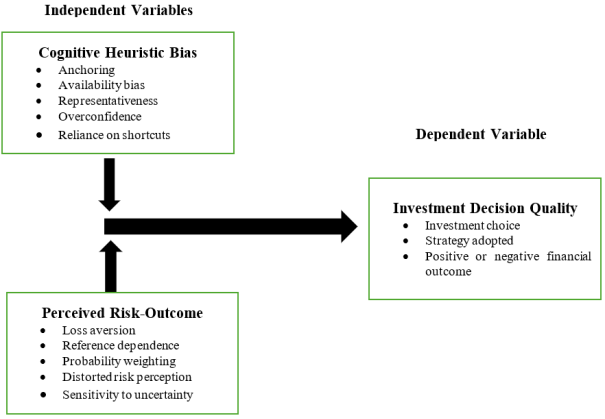
This study’s conceptual framework explains that the investment decision quality of investors is influenced by the combination of two factors such as cognitive heuristic bias and perceived risk-outcome distortion. Cognitive heuristic bias explains investors reliance on mental shortcuts during the process of making investment choices with uncertainty while perceived risk-outcome distortion explains the tendency of investors to analyze their potential losses and gains subjectively instead of objectively. In
Figure 1, the conceptual framework is provided.
Figure 1. Conceptual Framework.
The framework explains that there is a direct relationship between cognitive heuristic bias and the quality of investment decision. With investors relying on anchoring, up-to-date information, past familiar experiences, and mental shortcuts, investment strategies adopted may differ from options provided by comprehensive analysis. Also, the framework explains that there is a direct relationship between perceived risk-outcome distortion and investment decision quality. This framework is built on the Heuristic and Prospect theories.
2.5. Gaps in the Literature
This study is motivated by four major gaps, regardless of the expanding body of literature. First, most studies on behavioural finance focus on the urban regions in Nigeria, this study deviates by examining a semi-urban area like Akungba-Akoko which is clouded by heterogeneous education and divergent financial literacy knowledge. Second, although authors have linked behavioural biases to investment decisions but its translation into materialistic investment strategy adoption and outcomes have not gained significant important, especially within the institutional context. Third, many researches rely mostly on self-reported survey data, methodologically. However, this study differs by triangulating performance objectives indicators through heuristic intensity and risk-outcome distortion. Thus, heuristic and perceive risk-outcome distortions are operationalized within the periscope of a semi-urban area in Ondo state. Lastly, this study provides evidence that could guide investment banks in Nigeria that account for customers’ psychological tendencies, perceptions or risk, and information-processing are limited.
3. Research Methods and Process
3.1. Research Design and Population
This paper employed a cross-sectional survey research design which is considered most appropriate for the generating quantitative data on behavioural construct and its relationship with investment outcomes, particularly, as it influences customers of investment banks in the selected study are at a single point in time. The study’s population entails all customers of investment banks operating within Akoko South-West Local Government Area of Ondo State, specifically, those who have had stock market transactions within 2020 and 2025, signifying the temporal scope. The eligibility criteria were that respondents must possess relevant investment experience and were able to provide informed responses to the items in the questionnaire. Thus, to quality for participation, respondents were required to be active investment customers of the selected investment banks and must have undertaken, at least, one stock market transaction between the sample period, that is, 2020 and 2025.
3.2. Sample and Sampling Procedure
In this research, purposive sampling technique is employed in order to ensure that selected respondents have direct investment experience with the selected investment banks. The selection technique is believed to be appropriate because the required information is mainly from customers who have had previous investment decisions from the stock market rather than the entirety of the bank customers. This is believed to improve the validity of responses. Therefore, a total of 120 respondents were adequately achieved and this constitute 100% return rate based on proper monitoring and consistent feedback mechanism.
Selection process was done according to stages. At the initial stage, the researchers identified investment banks from the list of deposit money banks in Nigeria. Secondly, active customers of the bank who have completed investment transactions during the study period were approached. At the third stage, the eligibility criteria were used to screen each prospective respondents, and only customers who were confirmed to have had at least, one stock market transaction between 2020 and 2025 were included.
3.3. Instrument of Measurement
The data for this study were collected through a well-structure, self-administered questionnaire which was divided into three major sections. Particularly, the questionnaire was a fallout of items adaptation from the study of
| [42] | Ogunyemi, A. T., & Bello, O. J. (2024). Financial literacy and behavioural bias reduction among Nigerian investors. Journal of Economics and Sustainable Development, 15(2), 22–39. |
[42]
. Section one deals with the socio-demographic attributes of the respondents such as gender, age, educational qualification, marital status, occupation, investment experience, and types of investment products. These questions provided information that could be interpreted to explain investors’ behavioural patterns. The second section considered constructs of behavioural finance which has been operationalized using five-point Likert-scale, and particularly, capturing heuristic bias such as reliance on anchoring, availability bias, representativeness, and herding. It also considered the perceived risk-outcome distortions. The study, in order to maintain theoretical consistency, did not treat framing as a separate heuristic construct because it is better explained under the prospect theory. However, reference dependence, loss aversion, nonlinear probability weighting, and subjective risk sensitivity were items derived to explain perceived risk-outcome distortion. In the third section, an assessment of the investment decision quality of the selected respondents was considered. Items in each section were computed together into a continuous data and categorized into poor or benefiting financial decision outcome. The validity of the instrument was ensured through a review by specialists in the field of finance, psychology, and research methodology while their inputs were factored into the instrument. However, in order to validate the stated hypotheses, the continuous data were employed and linear regression technique was considered as the most appropriate statistical tool. This is because each section had more than one item that was computed into a continuous data.
3.4. Pilot Testing
The research instrument, before it was used as the major method for the collection of data, underwent some pilot testing involving the selection of 22 investment bank customers within the campus of Adekunle Ajasin University Akungba-Akoko. The rationale for this is that the customers have a likely similar demographic and investment attributes like those of the targeted respondents. However, in the final analysis, these piloted data were excluded so as to avoid duplication and contamination of the major sample collected. The aim of the pilot test was to assess the clarity of the research instrument and its ability to comprehensively measure the variable constructs. The researchers used the feedback from the pilot testing to simplify technical expressions, discover and expunge ambiguity, and improve the instrument’s logical sequence. The study found Cronbach alpha value of 0.72 from the preliminary internal consistency assessment. Thus, items in the instrument were reviewed, reworded, or expunged before the administration of the questionnaire.
Table 1. Reliability Test Result for Pilot Testing.
Instrument | Cronbach Alpha Value |
heuristic | 0.80 |
Prospect | 0.50 |
Investment decision | 0.84 |
Source: Researchers’ Computation, 2026.
Table 2. Reliability Test Result for the Main Study.
Instrument | Cronbach Alpha Value |
Cognitive heuristic bias | 0.79 |
Perceived risk-outcome distortion | 0.63 |
Investment decision quality | 0.82 |
Source: Researchers’ Computation, 2026.
In the bid to validate the research instrument employed for the main test, that is, the 120 respondents, the adapted 8 items were used to measure cognitive heuristic bias and they produced a Cronbach Alpha value of 0.79. Part of the statement item include;
1) My past history influences my present investment decisions extra efforts.
2) Thinking hard and for a long time about something gives me little satisfaction.
3) I sell my investment (stock) only if it reaches a certain price.
Perceived risk-outcome distortion, as adapted, used 3 statement items and its reliability result produced a Cronbach Alpha value of 0.63. Its statement items were;
1) I intend to sell my investments immediately it goes back to the acquisition price.
2) Assume I bought a movie ticket for ₦2,000. When getting to the theatre, I realized I have lost the ticket. I will definitely buy another since I have extra money to do that.
3) I prefer to hold on to a profitable investment due to the fear of not participating in the future gain of the stock.
The quality of investment decision, as adapted, includes 5 statement items with a reliability value of 0.82. As part of its statement items are;
1) My investment reports better results than expected.
2) My investment in stocks has demonstrated increased cash flow growth in past 5 years.
3) My investment in stocks has a lower risk compared to the market in general.
3.5. Method of Data Collection
Researchers obtained approval from the management of the investment banks before questionnaires were administered to qualified respondents. However, before the administration, potential identified respondents were approached and their approval, sought. The researchers, by themselves, screened the identified respondents and confirmed that they were active stock market customers of the selected banks and between the selected period. Although participation was voluntary, researchers, where needed, put respondents through on aspects of the instrument. It was unequivocally explained that the data collected were solely for the purpose of the research and anonymity was declared as no personal detail such as name, account numbers, or other personal financial information were requested. Completed questionnaire were collected immediately and each was checked that they were adequately completed before the respondent left. Thus, a total of 120 copies of the questionnaire were administered, completed, and retrieved from the respondent and that formed the basis for the 100% retrieval score.
3.6. Validity of the Research Instrument
This research employs statement items as adapted from the study of
| [42] | Ogunyemi, A. T., & Bello, O. J. (2024). Financial literacy and behavioural bias reduction among Nigerian investors. Journal of Economics and Sustainable Development, 15(2), 22–39. |
[42]
. In order to validate the statement items as reported, a pilot study was conducted as reported in
Table 1. However,
| [42] | Ogunyemi, A. T., & Bello, O. J. (2024). Financial literacy and behavioural bias reduction among Nigerian investors. Journal of Economics and Sustainable Development, 15(2), 22–39. |
[42]
study had a descriptive reporting of the items but were not validated. Consequently, due to the result of the reliability test from the pilot study, the statement items were validated. Unlike the usage of the statement items in the study of
| [42] | Ogunyemi, A. T., & Bello, O. J. (2024). Financial literacy and behavioural bias reduction among Nigerian investors. Journal of Economics and Sustainable Development, 15(2), 22–39. |
[42]
which was purely descriptive, this study went further to validate the statement items by conducting reliability test for each category.
3.7. Method of Data Analysis
The data obtained from respondent in this study were analyzed using three analytical procedures of descriptive, chi-square, and ordinary least square technique. These techniques employed Analysis of Variance (ANOVA) F-test as a validation tool and estimate of the magnitude of each construct’s impact on the investment decision-making of customers of the selected investment banks in Nigeria.
4. Data Analysis and Discussion
4.1. Respondents’ Socio-Demographic Characteristics
The attributes of the respondents with regard to their socio-demography is discussed first before econometric analyses are considered.
Table 3 provides a summary of the socio-demographic attribute of the 120 respondents. It explains that there are more male respondents (57.5%) than their female counterpart. The Table also shows that most respondents are between the 26 to 40-year bracket (85.0%) and this implies that the investment bank customers are predominantly in the working-class population. The predominance of first-degree/HND holders (67.5%) indicates that the average customer base is expose to engage with the bank’s investment products, however, might have limited exposure to financial planning and portfolio management. The almost equal split between single and married respondents, 52.5% and 47.5% respectively is noteworthy. Grable (2000) opined that marital status is linked with risk tolerance and liquidity preferences in behavioural finance.
Table 3. Socio-Demographic Profile of Respondents (N = 120).
Variable | Category | Frequency | Percentage (%) |
Gender | Male | 69 | 57.5 |
| Female | 51 | 42.5 |
Age | 20–25 years | 6 | 5.0 |
| 26–30 years | 51 | 42.5 |
| 31–40 years | 51 | 42.5 |
| 41–50 years | 9 | 7.5 |
| Above 50 years | 3 | 2.5 |
Education | Primary School | 3 | 2.5 |
| O'Level / WAEC | 15 | 12.5 |
| ND / NCE | 12 | 10.0 |
| HND / First Degree | 81 | 67.5 |
| Postgraduate | 9 | 7.5 |
Marital Status | Single | 63 | 52.5 |
| Married | 57 | 47.5 |
Total | | 120 | 100.0 |
Source: Researchers’ Computation, 2026.
4.2. Cognitive Heuristic Bias and Investment Decision Quality
In
Table 4, the chi-square result summary for the various cognitive heuristic bias levels against their respective investment decision quality is visualized. The result explains that 71.4% of those categorized under the low heuristic bias made poor investment decisions while those classified in the moderate heuristic bias had 56.5% of them with poor investment decisions. However, all respondents under the category of high heuristic bias made beneficial investment decisions. The Table presented a high overall chi-square value (χ
2 = 34.173, df = 2, p < 0.001), asserting that there is a strong and statistically significant association between heuristic intensity and investment decision quality.
Table 4. Cross-Tabulation: Cognitive Heuristic Bias and Investment Decision Quality.
Heuristic Bias Level | Poor Decision F (%) | Beneficial Decision F (%) | Total F (%) | χ² | df | p-value |
Low | 15 (71.4) | 6 (28.6) | 21 (100.0) | 34.173*** | 2 | < 0.001 |
Moderate | 39 (56.5) | 30 (43.5) | 69 (100.0) | | | |
High | 0 (0.0) | 30 (100.0) | 30 (100.0) | | | |
Total | 54 (45.0) | 66 (55.0) | 120 (100.0) | | | |
4.3. Perceived Risk-Outcome Distortion and Investment Decision Quality
The study also measures the perceived risk-outcome distortion and how it impacts the quality of investment decision made by the respondents.
Table 5 provides a summary and it shows that about 85.7% of those in the low distortion levels made poor decisions while 45.7% among the moderate distortion group made poor decisions. This percentage was reduced to 11.1% with those with high distortion. The chi-square value, once again, presented a high and significant value (χ2 = 26.614, df = 2, p < 0.001), and this confirms that the risk-outcome distortion intensity has a significant relationship with the quality of investment decision.
Table 5. Cross-Tabulation: Perceived Risk-Outcome Distortion and Investment Decision Quality.
Risk-Outcome Distortion Level | Poor Decision F (%) | Beneficial Decision F (%) | Total F (%) | χ² | df | p-value |
Low | 18 (85.7) | 3 (14.3) | 21 (100.0) | 26.614*** | 2 | < 0.001 |
Moderate | 33 (45.8) | 39 (54.2) | 72 (100.0) | | | |
High | 3 (11.1) | 24 (88.9) | 27 (100.0) | | | |
Total | 54 (45.0) | 66 (55.0) | 120 (100.0) | | | |
4.4. Test of Hypotheses
Hypothesis 1: Cognitive heuristic bias has no significant influence on investment decision quality.
The regression analysis is employed to test the first hypothesis of the study. In
Table 6, a summary of the regression output is presented and it is reported that cognitive heuristic bias has a positive (0.54) and strongly significant (p < 0.001) influence on the investment decision quality of customers of investment banks in the selected study area. The stated model was found to account for about 29% of the total variation experienced in investment decision quality (R2 = 0.29), and the ANOVA test for the joint influence and model significance (F(1, 118) = 49.149, p < 0.001), shows that the result is statistically significant. Consequently, Hypothesis 1 is rejected. Thus, cognitive heuristic bias has a positive and significant influence on investment decision quality among customers of investment banks in Nigeria.
Table 6. OLS Regression: Cognitive Heuristic Bias Predicting Investment Decision Quality.
Predictor | B | SE B | β | t | p | 95% CI | R | R² | Adj. R² | F |
Cognitive Heuristic Bias | 0.41 | 0.06 | 0.54 | 7.01 | < 0.001 | [0.29, 0.52] | 0.54 | 0.29 | 0.29 | 49.15*** |
Note: *** p < 0.001; B = Unstandardised beta; β = Standardised beta; SE B = Standard error of B. |
Hypothesis 2: Perceived risk-outcome distortion has no significant influence on investment decision quality.
Table 7 presents the regression results for Hypothesis 2. Perceived risk-outcome distortion was also a positive and highly significant predictor of investment decision quality (β = 0.59, t = 7.84, p < 0.001; 95% CI [0.69, 1.15]), explaining 34% of variance in the outcome variable (R² = 0.34; F(1, 118) = 61.528, p < 0.001). Hypothesis 2 is therefore also rejected. The result indicates that the larger effect size for perceived risk-outcome distortion (β = 0.59) in comparison with cognitive heuristic bias (β = 0.54) implies that subjective risk framing might produce a marginally stronger effect on the quality of investment decision more than reliance on cognitive shortcuts.
Table 7. OLS Regression: Perceived Risk-Outcome Distortion Predicting Investment Decision Quality (N = 120).
Predictor | B | SE B | β | t | p | 95% CI | R | R² | Adj. R² | F |
Perceived Risk-Outcome Distortion | 0.92 | 0.12 | 0.59 | 7.84 | < 0.001 | [0.69, 1.15] | 0.59 | 0.34 | 0.34 | 61.53*** |
Note: *** p < 0.001; B = Unstandardised beta; β = Standardised beta; SE B = Standard error of B. |
4.5. Discussion of Findings
The positive and significant relationship between cognitive heuristic bias and beneficial investment outcomes (β = 0.54, p < 0.001; R² = 0.29) represents perhaps the most theoretically provocative finding of this study. Classical and neoclassical finance theory, grounded in the EMH and expected utility maximization, would predict that heavier reliance on heuristics should be associated with worse, not better, investment outcomes, since heuristics by definition depart from fully rational information processing. The evidence presented here challenges this prediction and aligns instead with the adaptive markets’ hypothesis
, which argues that the survival value of behavioural heuristics depends on the environment in which they are deployed. In information-rich, liquid, and professionally intermediated markets, heuristics such as anchoring and availability bias may indeed produce suboptimal outcomes by generating anchoring errors and availability-driven overreactions. However, within the context of a semi-urban region like Akoko South West in Ondo State, which is characterized by limited financial literacy, reduced information symmetry, especially between banks and their customers, and an informal social network for the transmission of investment intelligence, heuristics may be considered as the most significantly effective information processing tactic.
The findings of this study are considered to be in line with the findings of
| [56] | Statman, M. (2019). Behavioural finance: The second generation. CFA Institute Research Foundation. |
| [60] | Yang, C. L., Bauer, K., Li, X., & Hinz, O. (2026). My advisor, her AI, and me: Evidence from a field experiment on human-AI collaboration and investment decisions. Management Science, 72(1), 242–264.
https://doi.org/10.1287/mnsc.2022.03918 |
[56, 60]
who acknowledged that heuristics are legitimate ways to solve complex decisions in real-world contexts. This also corroborates the evidence from sub-Saharan Africa that the investment heuristics based on experience and peers perform better than formally developed strategies for investors with low financial literacy
| [1] | Adeoye, O. V., Auta, M. S., & Olateju, D. J. (2024). An assessment of banking behaviour of rural dwellers in Nigeria. International Journal of Financial Research and Business Development, 15(1), 45–62.
https://doi.org/10.1234/ijfrbd.2024.001 |
| [29] | Kovács, T., Ko, A., & Asemi, A. (2021). Exploration of the investment patterns of potential retail banking customers using two-stage cluster analysis. Journal of Big Data, 8, 141. |
[1, 29]
. From a practical perspective, this finding implies that investment banks in semi-urban Nigeria should not seek to eliminate heuristic-based decision-making, but rather, design their advisory services and product communications in a way that aligns with and reinforces their clients’ existing heuristic models.
The finding that perceived risk-outcome distortion positively predicts investment decision quality (β = 0.59, p < 0.001; R² = 0.34) is equally counter-intuitive from a classical finance perspective but theoretically coherent within the behavioural finance framework. Prospect Theory predicts that risk-outcome distortions are universal features of human choice under uncertainty, not pathological deviations
. The key insight is that the impact of distortion on outcomes depends critically on its direction and magnitude.
In this study, it is discovered that investors who have a higher perceived risk-outcome bias, that is, those who systematically overestimate the probability of negative outcomes relative to objective evidence, seem to make more advantageous investment decisions. This can be plausibly explained by a precautionary deliberation effect which makes investors more sensitive to risk and therefore more rigorous in their evaluation of investment alternatives and less prone to impulsive entry into speculative positions and more inclined to prefer capital preservation strategies. Capital preservation is not irrational in volatile inflation-prone environments like Nigeria. Thus, it is often the dominant performance criterion over short- and medium-term investment horizons
| [7] | Bello, A. A., & Salisu, A. A. (2024). Financial inclusion, trust, and economic stability in emerging markets: Evidence from Nigeria. Journal of African Business, 24(2), 233–251.
https://doi.org/10.1080/15228916.2023.2023456 |
[7]
.
This finding also has important implications for risk communication strategies of investment banks. The standard financial advice in developed markets is to overcome loss aversion and to convince customers to take on higher risks for higher expected returns. In semi-urban Nigeria, this approach can backfire as risk-aware investors there may do well precisely because their heightened awareness of risk fosters the caution needed in volatile market phases. Investment banks should therefore develop risk communication strategies that foster rather than dampen risk awareness and adjust their product offerings to the risk-aware investment strategies of their customers in semi-urban Nigeria.

 ,
Wale Henry Agbaje,
James Adeniyi Demehin,
Foluso Ololade Oluwole,
Toyin Waliu Otapo
,
Wale Henry Agbaje,
James Adeniyi Demehin,
Foluso Ololade Oluwole,
Toyin Waliu Otapo



 Share This Article
 Twitter
 Linked In
 Facebook
 Copy
Copy Download