Abstract
Background: Scheduled intermittent Foley balloon tugging (30 seconds of forceful traction every 3 hours during a planned 12-hour placement) has been proposed to shorten induction of labor. We synthesized the randomized evidence on this question. Methods: We searched MEDLINE/PubMed, EMBASE, CENTRAL, Web of Science, and Scopus from inception to June 2026 for randomized controlled trials (RCTs) comparing 3-hourly Foley tugging with standard passive care. Primary outcomes were induction-to-birth interval and cesarean delivery. Risk of bias was assessed with RoB 2 and certainty of evidence with GRADE. Mean differences (MD) and risk ratios (RR) were pooled using DerSimonian–Laird random-effects models, with fixed-effect, Hartung–Knapp, leave-one-out, and substituted-estimate sensitivity analyses. The protocol was registered on the Open Science Framework (10.17605/OSF.IO/S37DZ). Results: Three RCTs including 610 women (305 per arm) were eligible. Tugging did not significantly shorten the induction-to-birth interval (MD −1.36 hours, 95% CI −3.21 to 0.50, I² = 0%) or reduce cesarean delivery (RR 0.91, 95% CI 0.72 to 1.14, I² = 37%). Additional cervical ripening (two trials, 484 women) did not differ significantly (RR 0.94, 95% CI 0.80 to 1.11). Maternal satisfaction and neonatal acidemia did not differ significantly between arms. Findings were unchanged in all sensitivity analyses. Certainty of evidence was moderate for induction-to-birth interval and low for the remaining outcomes. Conclusion: Current randomized evidence does not show that scheduled 3-hourly Foley tugging shortens induction or lowers cesarean delivery, although it appears safe and acceptable and a modest benefit is not excluded. Routine adoption cannot be recommended, larger multicenter trials are needed.
Keywords
Foley Balloon Catheter, Cervical Ripening, Labor Induction, Catheter Traction, Cesarean Delivery, Induction-to-birth Interval, Randomized Controlled Trial, Meta-analysis
1. Key Points
Question: Does scheduled 3-hourly Foley balloon tugging shorten labor induction or reduce cesarean delivery?
Findings: In three RCTs (610 women), tugging did not significantly change induction-to-birth time (MD −1.36 h; 95% CI −3.21 to 0.50) or cesarean delivery (RR 0.91; 95% CI 0.72 to 1.14).
Meaning: Tugging is low-cost and well tolerated but is not yet proven to improve outcomes.
2. Key Messages
What is already known on this topic?
Foley balloon catheterization is an established mechanical method of cervical ripening for induction of labor, particularly when an unfavorable cervix is present
| [1] | World Health Organization. WHO recommendations for induction of labour. Geneva: World Health Organization; 2011. |
| [2] | Jozwiak M, Bloemenkamp KW, Kelly AJ, Mol BW, Irion O, Boulvain M. Mechanical methods for induction of labour. Cochrane Database Syst Rev. 2012;(3): CD001233.
https://doi.org/10.1002/14651858.CD001233.pub2 |
[1, 2]
. Its effectiveness can be influenced by factors such as balloon duration, volume, and timing of subsequent induction interventions
. Scheduled intermittent Foley balloon tugging has been proposed to facilitate earlier balloon displacement and recognition of cervical ripening, potentially allowing earlier amniotomy and oxytocin administration
| [3] | Yunesh K, Adlan ASA, Wong TY, Gan F, Hamdan M, Tan PC. Tugging the Foley catheter balloon every three hours in induction of labor after one previous cesarean: a randomized controlled trial. Am J Obstet Gynecol MFM. 2024; 6(7): 101579. https://doi.org/10.1016/j.ajogmf.2024.101579 |
| [4] | Azman MAA, Hamdan M, Wong TY, Gan F, Saaid R, Tan PC. Tugging the Foley catheter balloon every 3 h in nulliparous induction of labor: a randomized controlled trial. Int J Gynaecol Obstet. 2026; 168(2): 415-423.
https://doi.org/10.1002/ijgo.70920 |
| [5] | Zin NF, Omar SZ, Hamdan M, Wong TY, Gan F, Tan PC. Tugging the Foley catheter balloon 3-hourly in multiparous induction of labor: a randomized controlled trial. Int J Gynaecol Obstet. 2026; 168(3): 510-518. https://doi.org/10.1002/ijgo.71210 |
[3-5]
.
What this study adds?
This systematic review and meta-analysis synthesized data from three RCTs involving 610 women undergoing labor induction. Scheduled 3-hourly Foley balloon tugging did not result in a statistically significant reduction in induction-to-birth interval (MD −1.36 hours, 95% CI −3.21 to 0.50; p = 0.15; I² = 0%) or cesarean delivery rate (RR 0.91, 95% CI 0.72 to 1.14; p = 0.39; I² = 37%) compared with standard passive Foley care. Maternal satisfaction scores and neonatal acidemia rates did not differ significantly between arms.
How this study might affect research, practice, or policy?
Current randomized evidence does not support routine adoption of scheduled 3-hourly Foley balloon tugging to accelerate labor induction or reduce cesarean delivery. However, given that the intervention is safe, inexpensive, and well tolerated, clinicians may consider its use based on clinical preference while recognizing that proven efficacy is lacking.
3. Introduction
Induction of labor is among the most frequently performed obstetric interventions, and its rate continues to rise globally
| [1] | World Health Organization. WHO recommendations for induction of labour. Geneva: World Health Organization; 2011. |
| [2] | Jozwiak M, Bloemenkamp KW, Kelly AJ, Mol BW, Irion O, Boulvain M. Mechanical methods for induction of labour. Cochrane Database Syst Rev. 2012;(3): CD001233.
https://doi.org/10.1002/14651858.CD001233.pub2 |
[1, 2].
When the cervix is unfavorable, cervical ripening is required before amniotomy or oxytocin can be used effectively
| [3] | Yunesh K, Adlan ASA, Wong TY, Gan F, Hamdan M, Tan PC. Tugging the Foley catheter balloon every three hours in induction of labor after one previous cesarean: a randomized controlled trial. Am J Obstet Gynecol MFM. 2024; 6(7): 101579. https://doi.org/10.1016/j.ajogmf.2024.101579 |
[3]
. The Foley balloon catheter is a widely used mechanical method because it is inexpensive, easy to store, simple to insert, and associated with a low risk of uterine tachysystole compared with pharmacological cervical-ripening agents such as prostaglandins
| [4] | Azman MAA, Hamdan M, Wong TY, Gan F, Saaid R, Tan PC. Tugging the Foley catheter balloon every 3 h in nulliparous induction of labor: a randomized controlled trial. Int J Gynaecol Obstet. 2026; 168(2): 415-423.
https://doi.org/10.1002/ijgo.70920 |
| [5] | Zin NF, Omar SZ, Hamdan M, Wong TY, Gan F, Tan PC. Tugging the Foley catheter balloon 3-hourly in multiparous induction of labor: a randomized controlled trial. Int J Gynaecol Obstet. 2026; 168(3): 510-518. https://doi.org/10.1002/ijgo.71210 |
[4, 5].
Its effect is primarily mechanical through direct dilation of the internal os and extra-amniotic membrane separation, which promotes local release of endogenous prostaglandins and facilitates cervical remodeling
| [6] | Page MJ, McKenzie JE, Bossuyt PM, et al. The PRISMA 2020 statement: an updated guideline for reporting systematic reviews. BMJ. 2021; 372: n71. https://doi.org/10.1136/bmj.n71 |
[6].
Foley balloon ripening is therefore particularly attractive in settings where prostaglandins are contraindicated or unavailable, or where a low-cost, readily accessible method of cervical preparation is desirable
Despite its widespread use, the optimal management of a Foley balloon after insertion remains uncertain. Conventional practice generally involves leaving the catheter in place passively for up to 12 hours until spontaneous expulsion or scheduled removal
| [10] | Higgins JPT, Thompson SG, Deeks JJ, Altman DG. Measuring inconsistency in meta-analyses. BMJ. 2003; 327(7414): 557-560. https://doi.org/10.1136/bmj.327.7414.557 |
| [11] | IntHout J, Ioannidis JPA, Borm GF. The Hartung-Knapp-Sidik-Jonkman method for random effects meta-analysis is straightforward and considerably outperforms the standard DerSimonian-Laird method. BMC Med Res Methodol. 2014; 14: 25. https://doi.org/10.1186/1471-2288-14-25 |
| [12] | Guyatt GH, Oxman AD, Vist GE, et al. GRADE: an emerging consensus on rating quality of evidence and strength of recommendations. BMJ. 2008; 336(7650): 924-926.
https://doi.org/10.1136/bmj.39489.470347.AD |
[10-12].
However, the balloon may traverse the cervix and become displaced into the vagina hours before the planned removal time, creating an interval during which cervical ripening has occurred but subsequent labor interventions are delayed
| [13] | Higgins JPT, Thomas J, Chandler J, et al., editors. Cochrane Handbook for Systematic Reviews of Interventions. Version 6.4. Cochrane; 2023. |
| [14] | Dos Santos F, Drymiotou S, Antequera Martin A, et al. Development of a core outcome set for trials on induction of labour: an international multistakeholder Delphi study. BJOG. 2018; 125(13): 1673-1680. https://doi.org/10.1111/1471-0528.15273 |
[13, 14].
Scheduled mechanical tugging—consisting of approximately 30 seconds of forceful traction every 3 hours during a planned 12-hour placement—has been proposed to assess balloon position and promote earlier balloon retrieval
Although mechanically plausible, whether scheduled tugging translates into clinically meaningful reductions in labor duration or cesarean delivery remains unsettled
| [17] | Ten Eikelder M, Rengerink KO, Jozwiak M, et al. Induction of labour at term with a Foley catheter of misoprostol (PROPACT): a randomized controlled trial. BJOG. 2016; 123(7): 1149-1158. https://doi.org/10.1111/1471-0528.13886 |
| [18] | Middleton P, Shepherd E, Morris J, et al. Traction on Foley catheter for cervical ripening in labor induction: a Cochrane systematic review perspective. Cochrane Database Syst Rev. 2025; 5: CD013500.
https://doi.org/10.1002/14651858.CD013500.pub2 |
[17, 18].
We conducted this systematic review and meta-analysis to quantitatively synthesize the randomized evidence evaluating 3-hourly Foley balloon tugging compared with standard passive care.
4. Methods
4.1. Protocol and Registration
This review was conducted and reported according to the PRISMA 2020 statement and the Cochrane Handbook for Systematic Reviews of Interventions. The protocol was prospectively registered on the Open Science Framework (https://doi.org/10.17605/OSF.IO/S37DZ).
4.2. Eligibility Criteria
Eligibility was defined using the PICOS framework:
1) Population: Pregnant women undergoing labor induction with an unfavorable cervix.
2) Intervention: Scheduled 30 seconds of forceful Foley balloon tugging every 3 hours during a planned 12-hour placement.
3) Comparator: Standard passive care (Foley balloon left in place without scheduled tugging).
4) Outcomes: Primary outcomes were induction-to-birth interval (hours) and cesarean delivery. Secondary outcomes included additional cervical ripening, maternal satisfaction, and neonatal acidemia (cord arterial pH ≤ 7.10), selected with reference to, but not fully covering, the core outcome set for labor induction trials
5) Study Design: Peer-reviewed randomized controlled trials (RCTs).
4.3. Information Sources and Search Strategy
MEDLINE/PubMed, EMBASE, the Cochrane Central Register of Controlled Trials (CENTRAL), Web of Science, and Scopus were searched from inception to June 2026 using Medical Subject Headings (MeSH) and free-text terms including 'Foley catheter', 'cervical ripening', 'induction of labor', 'traction', and 'tugging'. Reference lists of included trials were manually searched. The complete search strategy for MEDLINE/PubMed is presented in Appendix A.
4.4. Study Selection and Data Extraction
Two reviewers (HFA and an independent investigator) independently screened titles and abstracts, evaluated full-text articles against eligibility criteria, and extracted data using a standardized form. Any discrepancies were resolved by consensus or consultation with a third senior researcher. Extracted data included trial setting, participant characteristics, intervention details, primary and secondary outcomes, and statistical parameters.
4.5. Risk of Bias and Certainty of Evidence
Risk of bias was evaluated independently by two reviewers using the Cochrane Risk of Bias 2 (RoB 2) tool across five domains. The certainty of evidence for main outcomes was rated using the GRADE approach.
4.6. Statistical Analysis
Continuous outcomes were pooled as mean differences (MD) and binary outcomes as risk ratios (RR), each with 95% confidence intervals (CI), using the DerSimonian–Laird random-effects model. Heterogeneity was quantified using Cochran's Q test and the I² statistic. Between-study variance τ² was estimated and reported consistently to two decimal places. When trials reported medians and interquartile ranges, means and standard deviations were calculated using Wan's method.
4.7. Sensitivity and Subgroup Analyses
Pre-specified sensitivity analyses included: (i) fixed-effect meta-analysis; (ii) Hartung–Knapp–Sidik–Jonkman adjustment; (iii) leave-one-out sensitivity analyses; and (iv) substituting reported mean differences for estimated means Statistical analyses were performed in Python using SciPy and Statsmodels.
5. Results
5.1. Characteristics of Included Trials
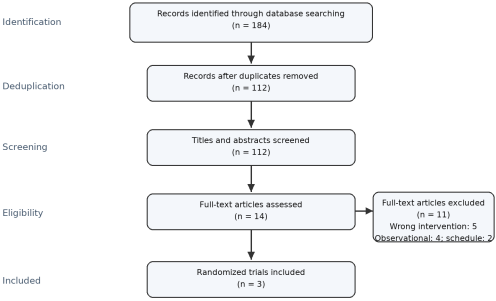
The electronic database search yielded 184 records. After removing duplicates (n = 72) and screening 112 titles and abstracts, 14 full-text articles were evaluated. Eleven articles were excluded with documented reasons (wrong intervention/passive traction n=5, observational study design n=4, non-standard tugging schedule n=2). Three RCTs enrolling 610 women (305 tugging, 305 control) met all inclusion criteria
| [3] | Yunesh K, Adlan ASA, Wong TY, Gan F, Hamdan M, Tan PC. Tugging the Foley catheter balloon every three hours in induction of labor after one previous cesarean: a randomized controlled trial. Am J Obstet Gynecol MFM. 2024; 6(7): 101579. https://doi.org/10.1016/j.ajogmf.2024.101579 |
| [4] | Azman MAA, Hamdan M, Wong TY, Gan F, Saaid R, Tan PC. Tugging the Foley catheter balloon every 3 h in nulliparous induction of labor: a randomized controlled trial. Int J Gynaecol Obstet. 2026; 168(2): 415-423.
https://doi.org/10.1002/ijgo.70920 |
| [5] | Zin NF, Omar SZ, Hamdan M, Wong TY, Gan F, Tan PC. Tugging the Foley catheter balloon 3-hourly in multiparous induction of labor: a randomized controlled trial. Int J Gynaecol Obstet. 2026; 168(3): 510-518. https://doi.org/10.1002/ijgo.71210 |
[3-5]
. The study selection process is illustrated in
Figure 1 (PRISMA 2020 Flow Diagram). Trial characteristics are summarized in
Table 1.
Figure 1. PRISMA 2020 Flow Diagram detailing database search (n=184), duplicate removal (n=72), title/abstract screening (n=112), full-text assessment (n=14), exclusions (n=11), and final included RCTs (n=3).
Table 1. Characteristics of the included randomized controlled trials.
Trial | Population | n (T / C) | Intervention and Comparator | Induction-to-Birth Interval |
Yunesh 2024 | [3] | Yunesh K, Adlan ASA, Wong TY, Gan F, Hamdan M, Tan PC. Tugging the Foley catheter balloon every three hours in induction of labor after one previous cesarean: a randomized controlled trial. Am J Obstet Gynecol MFM. 2024; 6(7): 101579. https://doi.org/10.1016/j.ajogmf.2024.101579 |
[3] | Previous cesarean | 63 / 63 | 30s tug 3-hourly vs passive | 29.7 ± 9.6 vs 29.8 ± 9.1 h (p=0.95) |
Azman 2026 | [4] | Azman MAA, Hamdan M, Wong TY, Gan F, Saaid R, Tan PC. Tugging the Foley catheter balloon every 3 h in nulliparous induction of labor: a randomized controlled trial. Int J Gynaecol Obstet. 2026; 168(2): 415-423.
https://doi.org/10.1002/ijgo.70920 |
[4] | Nulliparous | 132 / 132 | 30s tug 3-hourly vs passive | Median 33.2 vs 37.2 h (p=0.058) |
Zin 2026 | [5] | Zin NF, Omar SZ, Hamdan M, Wong TY, Gan F, Tan PC. Tugging the Foley catheter balloon 3-hourly in multiparous induction of labor: a randomized controlled trial. Int J Gynaecol Obstet. 2026; 168(3): 510-518. https://doi.org/10.1002/ijgo.71210 |
[5] | Multiparous | 110 / 110 | 30s tug 3-hourly vs passive | 27.4 ± 12.3 vs 28.4 ± 11.3 h (p=0.52) |
5.2. Risk of Bias Assessment
All three trials were open-label due to the nature of the physical intervention. However, objectiveness of primary outcomes (induction-to-birth interval and mode of delivery) minimized performance and detection bias. Risk of bias overall was judged as low to moderate across domains.
5.3. Primary Outcomes: Induction-to-Birth Interval and Cesarean Delivery
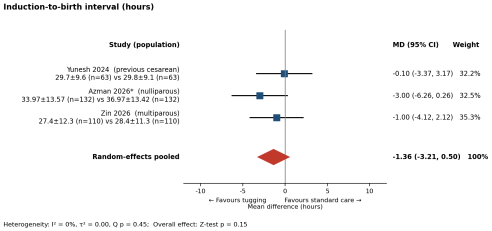
All three trials (610 participants) evaluated induction-to-birth interval. Pooled random-effects meta-analysis showed a mean difference of −1.36 hours in favor of tugging, which was not statistically significant (MD −1.36 hours, 95% CI −3.21 to 0.50; p = 0.15; I² = 0%, τ² = 0.00;
Figure 2,
Table 2).
Figure 2. Forest plot of induction-to-birth interval (hours) comparing 3-hourly Foley tugging with standard care.
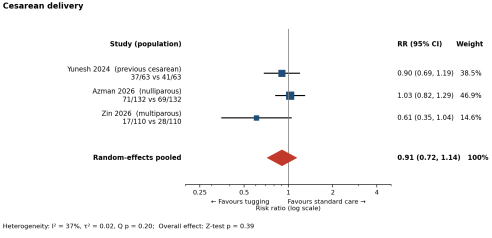
Cesarean delivery occurred in 125 of 305 women (41.0%) in the tugging arm and 138 of 305 (45.2%) in the control arm. The pooled risk ratio was 0.91 (95% CI 0.72 to 1.14; p = 0.39; I² = 37%, τ² = 0.02;
Figure 3,
Table 2).
Figure 3. Forest plot of cesarean delivery comparing 3-hourly Foley tugging with standard care.
5.4. Secondary Outcomes
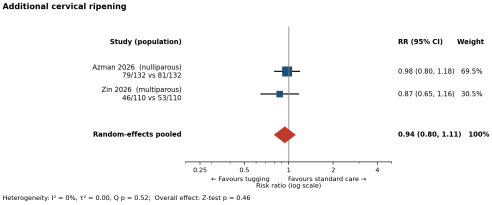
Additional cervical ripening (available from two trials, 484 women) was required in 125/242 (51.7%) in the tugging group versus 134/242 (55.4%) in the control group (RR 0.94, 95% CI 0.80 to 1.11; p = 0.46; I² = 0%, τ² = 0.00;
Figure 4,
Table 2). Maternal satisfaction scores did not differ significantly between arms across all three trials (Yunesh 2024: median 8 vs 8; Azman 2026: median 9 vs 9, p = 0.437; Zin 2026: p = 0.057). Neonatal acidemia (cord arterial pH ≤ 7.10) did not differ significantly between arms (RR 0.67, 95% CI 0.11 to 3.95)
| [4] | Azman MAA, Hamdan M, Wong TY, Gan F, Saaid R, Tan PC. Tugging the Foley catheter balloon every 3 h in nulliparous induction of labor: a randomized controlled trial. Int J Gynaecol Obstet. 2026; 168(2): 415-423.
https://doi.org/10.1002/ijgo.70920 |
[4]
.
Figure 4. Forest plot of additional cervical ripening comparing 3-hourly Foley tugging with standard care.
Table 2. Summary of primary and secondary outcome effects and certainty of evidence.
Outcome | Trials (n) | Pooled Effect (95% CI) | p-value | Certainty (GRADE) |
Induction-to-birth interval (h) | 3 (610) | MD −1.36 (−3.21 to 0.50) | 0.15 | Moderate |
Cesarean delivery | 3 (610) | RR 0.91 (0.72 to 1.14) | 0.39 | Low |
Additional cervical ripening | 2 (484) | RR 0.94 (0.80 to 1.11) | 0.46 | Low |
5.5. Sensitivity Analyses
All sensitivity analyses (fixed-effect, Hartung–Knapp adjustment, leave-one-out, and substituted MD) yielded consistent non-significant pooled effect estimates, confirming the robustness of the primary findings (
Table 3). Certainty of evidence assessments are summarized in
Table 4.
Table 3. Sensitivity analyses for induction-to-birth interval and cesarean delivery.
Analysis Method | Induction-to-Birth MD (95% CI) | Cesarean Delivery RR (95% CI) |
Primary: Random Effects (DL) | −1.36 (−3.21 to 0.50) | 0.91 (0.72 to 1.14) |
Fixed Effect | −1.36 (−3.21 to 0.50) | 0.93 (0.79 to 1.10) |
Hartung–Knapp Adjustment | −1.36 (−5.43 to 2.71) | 0.91 (0.53 to 1.55) |
Omitting Yunesh 2024 | −1.96 (−4.21 to 0.30) | 0.84 (0.51 to 1.39) |
Omitting Azman 2026 | −0.57 (−2.83 to 1.69) | 0.80 (0.55 to 1.14) |
Omitting Zin 2026 | −1.55 (−4.40 to 1.29) | 0.98 (0.82 to 1.16) |
Azman Published MD Substituted | −1.23 (−3.08 to 0.63) | N/A |
Table 4. GRADE certainty-of-evidence assessments.
Outcome | Trials (n) | Reasons for GRADE Rating | Certainty |
Induction-to-birth interval | 3 (610) | Open-label design (no downgrade); imprecision: 95% CI spans from no effect to a reduction of 3.2 h (downgraded 1 level) | Moderate |
Cesarean delivery | 3 (610) | Imprecision and moderate heterogeneity (downgraded 2 levels) | Low |
Additional cervical ripening | 2 (484) | Imprecision and data from 2 of 3 trials (downgraded 2 levels) | Low |
6. Discussion
This systematic review and meta-analysis evaluated the efficacy and safety of scheduled 3-hourly Foley balloon tugging during labor induction across three RCTs (610 participants). The main finding is that 3-hourly tugging did not produce a statistically significant reduction in induction-to-birth interval (MD −1.36 hours) or cesarean delivery rates (RR 0.91). Maternal satisfaction did not differ significantly between arms across studies, and neonatal outcomes were comparable.
The biomechanical hypothesis that periodic traction promotes faster balloon passage and earlier initiation of amniotomy/oxytocin was partially supported by process data (e.g., fewer balloons retained for 12 hours).. However, earlier balloon removal did not translate into significant reductions in total labor duration. Subsequent clinical management steps, uterine responsiveness to oxytocin, and intrapartum progress remain major determinants of total induction duration.
Several limitations warrant discussion. First, the total body of randomized evidence comprises three single-center trials conducted by an overlapping research group in Malaysia. While these trials were well-executed, this geographic concentration may limit the direct generalizability of the findings to different healthcare systems and diverse geographic regions, including sub-Saharan Africa where resource constraints, staffing models, and labor management protocols differ. Second, open-label design was unavoidable due to the nature of the physical intervention. Third, participant-level data were unavailable to conduct subgroup analyses based on baseline Bishop score or balloon volume.
7. Conclusion
Current randomized evidence does not demonstrate that scheduled 3-hourly Foley balloon tugging significantly shortens induction-to-birth interval or reduces cesarean delivery compared with standard passive Foley care. The intervention is safe, low-cost, and acceptable to women, but routine clinical adoption cannot be recommended based on present evidence.
8. Recommendations
1) Clinical Practice: Routine institutional protocols do not need to be updated to mandate 3-hourly Foley tugging. Where clinicians or patients prefer intermittent tugging, it can be safely utilized as an adjunct.
2) Future Research: Multi-center, adequately powered RCTs across diverse obstetric settings (including low-resource environments) are recommended. Future trials should evaluate parity-specific responses, standardized balloon volumes, and cost-effectiveness.
Abbreviations
CI | Confidence Interval |
GRADE | Grading of Recommendations Assessment, Development and Evaluation |
MD | Mean Difference |
RCT | Randomized Controlled Trial |
RoB 2 | Risk of Bias 2 |
RR | Risk Ratio |
SD | Standard Deviation |
Acknowledgments
The author thanks the clinical staff of Worabe Comprehensive & Specialized Hospital for administrative support.
Author Contributions
Habtamu Fekadu Andeta: Conceptualization, Data curation, Formal Analysis, Investigation, Methodology, Project administration, Software, Validation, Visualization, Writing – original draft, Writing – review & editing
Conflicts of Interest
The author declares no conflicts of interest.
Appendix
Complete MEDLINE/PubMed Search Strategy
Search Query: (('Foley catheter'[MeSH Terms] OR 'Foley balloon'[Title/Abstract] OR 'balloon catheter'[Title/Abstract]) AND ('cervical ripening'[MeSH Terms] OR 'labor induction'[MeSH Terms] OR 'induction of labor'[Title/Abstract]) AND ('traction'[Title/Abstract] OR 'tugging'[Title/Abstract] OR 'tension'[Title/Abstract])) AND (randomized controlled trial[pt] OR controlled clinical trial[pt] OR randomized[tiab] OR trial[tiab])
Limits: Humans, Inception to June 2026.
References
| [1] |
World Health Organization. WHO recommendations for induction of labour. Geneva: World Health Organization; 2011.
|
| [2] |
Jozwiak M, Bloemenkamp KW, Kelly AJ, Mol BW, Irion O, Boulvain M. Mechanical methods for induction of labour. Cochrane Database Syst Rev. 2012;(3): CD001233.
https://doi.org/10.1002/14651858.CD001233.pub2
|
| [3] |
Yunesh K, Adlan ASA, Wong TY, Gan F, Hamdan M, Tan PC. Tugging the Foley catheter balloon every three hours in induction of labor after one previous cesarean: a randomized controlled trial. Am J Obstet Gynecol MFM. 2024; 6(7): 101579.
https://doi.org/10.1016/j.ajogmf.2024.101579
|
| [4] |
Azman MAA, Hamdan M, Wong TY, Gan F, Saaid R, Tan PC. Tugging the Foley catheter balloon every 3 h in nulliparous induction of labor: a randomized controlled trial. Int J Gynaecol Obstet. 2026; 168(2): 415-423.
https://doi.org/10.1002/ijgo.70920
|
| [5] |
Zin NF, Omar SZ, Hamdan M, Wong TY, Gan F, Tan PC. Tugging the Foley catheter balloon 3-hourly in multiparous induction of labor: a randomized controlled trial. Int J Gynaecol Obstet. 2026; 168(3): 510-518.
https://doi.org/10.1002/ijgo.71210
|
| [6] |
Page MJ, McKenzie JE, Bossuyt PM, et al. The PRISMA 2020 statement: an updated guideline for reporting systematic reviews. BMJ. 2021; 372: n71.
https://doi.org/10.1136/bmj.n71
|
| [7] |
Sterne JAC, Savović J, Page MJ, et al. RoB 2: a revised tool for assessing risk of bias in randomised trials. BMJ. 2019; 366: l4898.
https://doi.org/10.1136/bmj.l4898
|
| [8] |
Wan X, Wang W, Liu J, Tong T. Estimating the sample mean and standard deviation from the sample size, median, range and/or interquartile range. BMC Med Res Methodol. 2014; 14: 135.
https://doi.org/10.1186/1471-2288-14-135
|
| [9] |
DerSimonian R, Laird N. Meta-analysis in clinical trials. Control Clin Trials. 1986; 7(3): 177-188.
https://doi.org/10.1016/0197-2456(86)90046-2
|
| [10] |
Higgins JPT, Thompson SG, Deeks JJ, Altman DG. Measuring inconsistency in meta-analyses. BMJ. 2003; 327(7414): 557-560.
https://doi.org/10.1136/bmj.327.7414.557
|
| [11] |
IntHout J, Ioannidis JPA, Borm GF. The Hartung-Knapp-Sidik-Jonkman method for random effects meta-analysis is straightforward and considerably outperforms the standard DerSimonian-Laird method. BMC Med Res Methodol. 2014; 14: 25.
https://doi.org/10.1186/1471-2288-14-25
|
| [12] |
Guyatt GH, Oxman AD, Vist GE, et al. GRADE: an emerging consensus on rating quality of evidence and strength of recommendations. BMJ. 2008; 336(7650): 924-926.
https://doi.org/10.1136/bmj.39489.470347.AD
|
| [13] |
Higgins JPT, Thomas J, Chandler J, et al., editors. Cochrane Handbook for Systematic Reviews of Interventions. Version 6.4. Cochrane; 2023.
|
| [14] |
Dos Santos F, Drymiotou S, Antequera Martin A, et al. Development of a core outcome set for trials on induction of labour: an international multistakeholder Delphi study. BJOG. 2018; 125(13): 1673-1680.
https://doi.org/10.1111/1471-0528.15273
|
| [15] |
ACOG Practice Bulletin No. 207: Induction of Labor. Obstet Gynecol. 2019; 134(2): e14-e31.
https://doi.org/10.1097/AOG.0000000000003358
|
| [16] |
Chen W, Xue J, Gao L, et al. Foley catheter versus double balloon catheter for cervical ripening in labor induction: a systematic review and meta-analysis. Arch Gynecol Obstet. 2023; 307(4): 1125-1136.
https://doi.org/10.1007/s00404-022-06789-x
|
| [17] |
Ten Eikelder M, Rengerink KO, Jozwiak M, et al. Induction of labour at term with a Foley catheter of misoprostol (PROPACT): a randomized controlled trial. BJOG. 2016; 123(7): 1149-1158.
https://doi.org/10.1111/1471-0528.13886
|
| [18] |
Middleton P, Shepherd E, Morris J, et al. Traction on Foley catheter for cervical ripening in labor induction: a Cochrane systematic review perspective. Cochrane Database Syst Rev. 2025; 5: CD013500.
https://doi.org/10.1002/14651858.CD013500.pub2
|
Cite This Article
-
APA Style
Andeta, H. F. (2026). 3-Hourly Foley Balloon Tugging for Cervical Ripening:
A Systematic Review and Meta-Analysis of Randomized Controlled Trials. International Journal of Biomedical Engineering and Clinical Science, 12(3), 33-39. https://doi.org/10.11648/j.ijbecs.20261203.11
 Copy
|
 Download
ACS Style
Andeta, H. F. 3-Hourly Foley Balloon Tugging for Cervical Ripening:
A Systematic Review and Meta-Analysis of Randomized Controlled Trials. Int. J. Biomed. Eng. Clin. Sci. 2026, 12(3), 33-39. doi: 10.11648/j.ijbecs.20261203.11
Copy
|
Download
AMA Style
Andeta HF. 3-Hourly Foley Balloon Tugging for Cervical Ripening:
A Systematic Review and Meta-Analysis of Randomized Controlled Trials. Int J Biomed Eng Clin Sci. 2026;12(3):33-39. doi: 10.11648/j.ijbecs.20261203.11
Copy
|
Download
-
@article{10.11648/j.ijbecs.20261203.11,
  author = {Habtamu Fekadu Andeta},
  title = {3-Hourly Foley Balloon Tugging for Cervical Ripening:
A Systematic Review and Meta-Analysis of Randomized Controlled Trials},
  journal = {International Journal of Biomedical Engineering and Clinical Science},
  volume = {12},
  number = {3},
  pages = {33-39},
  doi = {10.11648/j.ijbecs.20261203.11},
  url = {https://doi.org/10.11648/j.ijbecs.20261203.11},
  eprint = {https://article.sciencepublishinggroup.com/pdf/10.11648.j.ijbecs.20261203.11},
  abstract = {Background: Scheduled intermittent Foley balloon tugging (30 seconds of forceful traction every 3 hours during a planned 12-hour placement) has been proposed to shorten induction of labor. We synthesized the randomized evidence on this question. Methods: We searched MEDLINE/PubMed, EMBASE, CENTRAL, Web of Science, and Scopus from inception to June 2026 for randomized controlled trials (RCTs) comparing 3-hourly Foley tugging with standard passive care. Primary outcomes were induction-to-birth interval and cesarean delivery. Risk of bias was assessed with RoB 2 and certainty of evidence with GRADE. Mean differences (MD) and risk ratios (RR) were pooled using DerSimonian–Laird random-effects models, with fixed-effect, Hartung–Knapp, leave-one-out, and substituted-estimate sensitivity analyses. The protocol was registered on the Open Science Framework (10.17605/OSF.IO/S37DZ). Results: Three RCTs including 610 women (305 per arm) were eligible. Tugging did not significantly shorten the induction-to-birth interval (MD −1.36 hours, 95% CI −3.21 to 0.50, I² = 0%) or reduce cesarean delivery (RR 0.91, 95% CI 0.72 to 1.14, I² = 37%). Additional cervical ripening (two trials, 484 women) did not differ significantly (RR 0.94, 95% CI 0.80 to 1.11). Maternal satisfaction and neonatal acidemia did not differ significantly between arms. Findings were unchanged in all sensitivity analyses. Certainty of evidence was moderate for induction-to-birth interval and low for the remaining outcomes. Conclusion: Current randomized evidence does not show that scheduled 3-hourly Foley tugging shortens induction or lowers cesarean delivery, although it appears safe and acceptable and a modest benefit is not excluded. Routine adoption cannot be recommended, larger multicenter trials are needed.},
 year = {2026}
}
Copy
|
Download
-
TY  - JOUR
T1  - 3-Hourly Foley Balloon Tugging for Cervical Ripening:
A Systematic Review and Meta-Analysis of Randomized Controlled Trials
AU  - Habtamu Fekadu Andeta
Y1  - 2026/11/12
PY  - 2026
N1  - https://doi.org/10.11648/j.ijbecs.20261203.11
DO  - 10.11648/j.ijbecs.20261203.11
T2  - International Journal of Biomedical Engineering and Clinical Science
JF  - International Journal of Biomedical Engineering and Clinical Science
JO  - International Journal of Biomedical Engineering and Clinical Science
SP  - 33
EP  - 39
PB  - Science Publishing Group
SN  - 2472-1301
UR  - https://doi.org/10.11648/j.ijbecs.20261203.11
AB  - Background: Scheduled intermittent Foley balloon tugging (30 seconds of forceful traction every 3 hours during a planned 12-hour placement) has been proposed to shorten induction of labor. We synthesized the randomized evidence on this question. Methods: We searched MEDLINE/PubMed, EMBASE, CENTRAL, Web of Science, and Scopus from inception to June 2026 for randomized controlled trials (RCTs) comparing 3-hourly Foley tugging with standard passive care. Primary outcomes were induction-to-birth interval and cesarean delivery. Risk of bias was assessed with RoB 2 and certainty of evidence with GRADE. Mean differences (MD) and risk ratios (RR) were pooled using DerSimonian–Laird random-effects models, with fixed-effect, Hartung–Knapp, leave-one-out, and substituted-estimate sensitivity analyses. The protocol was registered on the Open Science Framework (10.17605/OSF.IO/S37DZ). Results: Three RCTs including 610 women (305 per arm) were eligible. Tugging did not significantly shorten the induction-to-birth interval (MD −1.36 hours, 95% CI −3.21 to 0.50, I² = 0%) or reduce cesarean delivery (RR 0.91, 95% CI 0.72 to 1.14, I² = 37%). Additional cervical ripening (two trials, 484 women) did not differ significantly (RR 0.94, 95% CI 0.80 to 1.11). Maternal satisfaction and neonatal acidemia did not differ significantly between arms. Findings were unchanged in all sensitivity analyses. Certainty of evidence was moderate for induction-to-birth interval and low for the remaining outcomes. Conclusion: Current randomized evidence does not show that scheduled 3-hourly Foley tugging shortens induction or lowers cesarean delivery, although it appears safe and acceptable and a modest benefit is not excluded. Routine adoption cannot be recommended, larger multicenter trials are needed.
VL  - 12
IS  - 3
ER  -
Copy
|
Download





 Share This Article
 Twitter
 Linked In
 Facebook
