
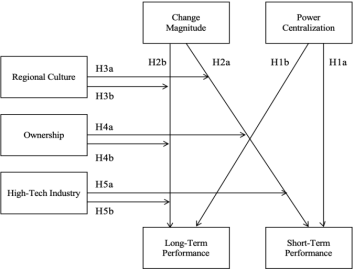
This study aims to systematically examine how Top Management Team (TMT) power structure influences firm performance within China's high-power-distance cultural context, and to critically reexamine the cultural contingency of Structural Adaptation Theory by investigating the dual effects of power centralization and the performance consequences of structural change. Drawing on institutional theory and Structural Adaptation Theory, we conduct a longitudinal analysis of Chinese A-share listed companies from 2019 to 2023. Our analysis reveals that power centralization exerts a dual effect on firm performance: it significantly enhances short-term operational efficiency, while simultaneously suppressing long-term market valuation. More importantly, we identify a pronounced stability preference effect—regardless of whether power structure adjusts toward centralization or decentralization, greater change magnitude consistently generates negative performance consequences. This finding challenges the assumption of Structural Adaptation Theory that decentralization represents a natural "entropy-increasing" process. In the Chinese context, maintaining the status quo becomes the organization's spontaneous "natural state," while any structural adjustment, irrespective of direction, becomes an "entropy-decreasing" process requiring substantial organizational energy. These effects are significantly moderated by regional culture, ownership type, and industry sector, with northern regions, state-owned enterprises, and non-high-tech industries exhibiting weaker negative effects of power structure change. This study provides a novel theoretical contribution by revealing that the directional definition of "entropy increase" versus "entropy decrease" is itself a cultural construction. It demonstrates how, within China's cultural context, the logic of Structural Adaptation Theory undergoes a critical reversal. By identifying "stability preference" as a key boundary condition, this research extends the theory's applicability and offers a more culturally inclusive analytical framework. The study also achieves cross-level theoretical integration, linking macro-level institutional factors, meso-level contextual factors, and micro-level governance mechanisms.
| Published in | International Journal of Economic Behavior and Organization (Volume 14, Issue 3) |
| DOI | 10.11648/j.ijebo.20261403.12 |
| Page(s) | 79-90 |
| Creative Commons |
This is an Open Access article, distributed under the terms of the Creative Commons Attribution 4.0 International License (http://creativecommons.org/licenses/by/4.0/), which permits unrestricted use, distribution and reproduction in any medium or format, provided the original work is properly cited. |
| Copyright |
Copyright © The Author(s), 2026. Published by Science Publishing Group |
China Context, Cultural Construction of Entropy, Institutional Theory, Stability Preference, Structural Adaptation Theory, TMT Power Structure
OCR | Market Value | |||
|---|---|---|---|---|
Variables | Model1 | Model2 | Model3 | Model4 |
Control Variables | Included | Included | Included | Included |
Centralization | .008***(.003) | .023**(.010) | ||
Constant | .603***(.051) | .593***(.052) | 10.170*** (.216) | 10.327***(.209) |
Observations | 19,194 | 19,194 | 19,194 | 19,194 |
Adjusted R2 | 30.1% | 30.2% | 72.0% | 72.4% |
F-Value | 614.97*** | 596.79*** | 3298.84*** | 3809.84*** |
OCR | ROIC | |||
|---|---|---|---|---|
Variables | Model5 | Model6 | Model7 | Model8 |
Control Variables | Included | Included | Included | Included |
Change_Magnitude | .032** (.016) | -.886*** (.071) | ||
Constant | .434*** (.050) | .640*** (.060) | .149 (.212) | .827*** (.280) |
Observations | 14,680 | 14,680 | 14,680 | 14,680 |
Adjusted R2 | 24.7% | 26.6% | 21.9% | 36.7% |
F-Value | 648.66*** | 477.99*** | 398.73*** | 559.91*** |
OCR | Operating Cost Ratio |
ROIC | Return on Invested Capital |
SOE | State Owned Enterprise |
TMT | Top Management Team |
| [1] | Adana, S., Manuj, I., Herburger, M., et al. (2024), "Linking decentralization in decision-making to resilience outcomes: a supply chain orientation perspective", The International Journal of Logistics Management, Vol. 35 No. 1, pp. 256-280. |
| [2] | Agarwal, R., Braguinsky, S. and Ohyama, A. (2020), "Centers of gravity: the effect of stable shared leadership in top management teams on firm growth and industry evolution", Strategic Management Journal, Vol. 41 No. 3, pp. 467-498. |
| [3] | Altamimi, H., Liu, Q. and Jimenez, B. (2023), "Not too much, not too little: centralization, decentralization, and organizational change", Journal of Public Administration Research and Theory, Vol. 33 No. 1, pp. 170-185. |
| [4] | Baer, M., Leenders, R. T. A. J., Oldham, G. R., et al. (2010), "Win or lose the battle for creativity: the power and perils of intergroup competition", Academy of Management Journal, Vol. 53 No. 4, pp. 827-845. |
| [5] | Bartuseviciene, I., Rakauskiene, O. G. and Valackiene, A. (2023), "Assessing the resilience of organizations in the context of uncertainty", Measuring Business Excellence, Vol. 27 No. 2, pp. 211-226. |
| [6] | Baum, J. R. and Wally, S. (2003), "Strategic decision speed and firm performance", Strategic Management Journal, Vol. 24 No. 11, pp. 1107-1129. |
| [7] | Bertram, S. and Sharma, R. R. (2024), "Does it pay to be angry in intercultural negotiations: depends on the power and personality orientation of the counterpart", Cross Cultural & Strategic Management, Vol. 31 No. 4, pp. 708-724. |
| [8] | Boone, C., Lokshin, B., Guenter, H., et al. (2019), "Top management team nationality diversity, corporate entrepreneurship, and innovation in multinational firms", Strategic Management Journal, Vol. 40 No. 2, pp. 277-302. |
| [9] | Boustanifar, H., Zajac, E. J. and Zilja, F. (2022), "Taking chances? The effect of CEO risk propensity on firms' risky internationalization decisions", Journal of International Business Studies, Vol. 53 No. 2, pp. 302-325. |
| [10] | Boyd, B. (1990), "Corporate linkages and organizational environment: a test of the resource dependence model", Strategic Management Journal, Vol. 11 No. 6, pp. 419-430. |
| [11] | Brahma, S. and Economou, F. (2024), "CEO power and corporate strategies: a review of the literature", Review of Quantitative Finance and Accounting, Vol. 62 No. 3, pp. 1069-1143. |
| [12] | Caniago, A. (2024), "Analysis of organizational structure and integrated coordination on organizational growth", Asian Journal of Management, Entrepreneurship and Social Science, Vol. 4 No. 3, pp. 1387-1400. |
| [13] | Cao, Z. (2018), "Centralization and decentralization of power structure: a theory of ruling risks and empirical evidence from Chinese history", Chinese Journal of Sociology, Vol. 4 No. 4, pp. 506-564. |
| [14] | Carpenter, M. A., Geletkanycz, M. A. and Sanders, W. G. (2004), "Upper echelons research revisited: antecedents, elements, and consequences of top management team composition", Journal of Management, Vol. 30 No. 6, pp. 749-778. |
| [15] | Chirkov, V., Ryan, R. M., Kim, Y., et al. (2003), "Differentiating autonomy from individualism and independence: a self-determination theory perspective on internalization of cultural orientations and well-being", Journal of Personality and Social Psychology, Vol. 84 No. 1, pp. 97-110. |
| [16] | Chowdhury, S. K. and Endres, M. L. (2021), "The influence of regional economy-and industry-level environmental munificence on young firm growth", Journal of Business Research, Vol. 134, pp. 29-36. |
| [17] | Deutsch, M. (1949), "A theory of co-operation and competition", Human Relations, Vol. 2 No. 2, pp. 129-152. |
| [18] | DiMaggio, P. J. and Powell, W. W. (1983), "The iron cage revisited: institutional isomorphism and collective rationality in organizational fields", American Sociological Review, Vol. 48 No. 2, pp. 147-160. Available at: |
| [19] | Duan, J., Bao, C., Huang, C., et al. (2018), "Authoritarian leadership and employee silence in China", Journal of Management & Organization, Vol. 24 No. 1, pp. 62-80. |
| [20] | Duan, M. and Dong, T. (2024), "Leadership structure and firm performance: evidence from China", Applied Economics Letters, Vol. 31 No. 4, pp. 300-306. |
| [21] | Fainshmidt, S., Nair, A. and Mallon, M. R. (2017), "MNE performance during a crisis: an evolutionary perspective on the role of dynamic managerial capabilities and industry context", International Business Review, Vol. 26 No. 6, pp. 1088-1099. |
| [22] | Fan, J. P. H., Wong, T. J. and Zhang, T. (2007), "Politically connected CEOs, corporate governance, and post-IPO performance of China's newly partially privatized firms", Journal of Financial Economics, Vol. 84 No. 2, pp. 330-357. |
| [23] | Farh, J. L., Hackett, R. D. and Liang, J. (2007), "Individual-level cultural values as moderators of perceived organizational support–employee outcome relationships in China: comparing the effects of power distance and traditionality", Academy of Management Journal, Vol. 50 No. 3, pp. 715-729. |
| [24] | Ge, Y., Kong, X., Dadilabang, G., et al. (2023), "The effect of Confucian culture on household risky asset holdings: using categorical principal component analysis", International Journal of Finance & Economics, Vol. 28 No. 1, pp. 839-857. |
| [25] | Guo, W., Chen, X. R. and Liu, H. C. (2022), "Decision-making under uncertainty: how easterners and westerners think differently", Behavioral Sciences, Vol. 12 No. 4, p. 92. |
| [26] | Haleblian, J. and Finkelstein, S. (1993), "Top management team size, CEO dominance, and firm performance: the moderating roles of environmental turbulence and discretion", Academy of Management Journal, Vol. 36 No. 4, pp. 844-863. |
| [27] | Helwig, C. C. (2006), "The development of personal autonomy throughout cultures", Cognitive Development, Vol. 21 No. 4, pp. 458-473. |
| [28] | Hendricks, B., Howell, T. and Bingham, C. (2019), "How much do top management teams matter in founder-led firms?", Strategic Management Journal, Vol. 40 No. 6, pp. 959-986. |
| [29] | Heugens, P. P. and Lander, M. W. (2009), "Structure! Agency! (and other quarrels): a meta-analysis of institutional theories of organization", Academy of Management Journal, Vol. 52 No. 1, pp. 61-85. |
| [30] | Hill, A. D., Recendes, T. and Yang, Y. (2023), "Precarious situations: a prelude to hiring more hubristic chief executive officers", Strategic Management Journal, Vol. 44 No. 3, pp. 812-828. |
| [31] |
Hofstede, G. (1984), Culture's consequences: international differences in work-related values, Sage, Beverly Hills, CA.
https://books.google.com.hk/books/about/Culture_s_Consequences.html?id=Cayp_Um4O9gC&redir_esc=y |
| [32] | Hofstede, G. (2011), "Dimensionalizing cultures: the Hofstede model in context", Online Readings in Psychology and Culture, Vol. 2 No. 1, p. 8. |
| [33] | Hollenbeck, J. R., Ellis, A. P. J., Humphrey, S. E., et al. (2011), "Asymmetry in structural adaptation: the differential impact of centralizing versus decentralizing team decision-making structures", Organizational Behavior and Human Decision Processes, Vol. 114 No. 1, pp. 64-74. |
| [34] | Huang, K. G., Jing, R., Xia, J., et al. (2024), "Coevolution of SOEs and the Chinese economy: the roles of SOE heterogeneity from the institutional, strategic, and organizational perspectives", Management and Organization Review, Vol. 20 No. 5, pp. 704-715. |
| [35] | Johnson, M. D., Hollenbeck, J. R., Humphrey, S. E., et al. (2006), "Cutthroat cooperation: asymmetrical adaptation to changes in team reward structures", Academy of Management Journal, Vol. 49 No. 1, pp. 103-119. |
| [36] | Johnson, M. D., Hollenbeck, J. R., DeRue, D. S., et al. (2013), "Functional versus dysfunctional team change: problem diagnosis and structural feedback for self-managed teams", Organizational Behavior and Human Decision Processes, Vol. 122 No. 1, pp. 1-11. |
| [37] | Jones, L. and Zou, Y. (2017), "Rethinking the role of state-owned enterprises in China's rise", New Political Economy, Vol. 22 No. 6, pp. 743-760. |
| [38] | Ke, B., Mao, X., Wang, B., et al. (2021), "Top management team power in China: measurement and validation", Management Science, Vol. 67 No. 10, pp. 6602-6627. |
| [39] | Kirkman, B. L., Chen, G., Farh, J. L., et al. (2009), "Individual power distance orientation and follower reactions to transformational leaders: a cross-level, cross-cultural examination", Academy of Management Journal, Vol. 52 No. 4, pp. 744-764. |
| [40] | Krause, R., Filatotchev, I. and Bruton, G. D. (2016), "When in Rome, look like Caesar? Investigating the link between demand-side cultural power distance and CEO power", Academy of Management Journal, Vol. 59 No. 4, pp. 1361-1384. |
| [41] | Krishnan, R., Cook, K. S., Kozhikode, R. K., et al. (2021), "An interaction ritual theory of social resource exchange: evidence from a Silicon Valley accelerator", Administrative Science Quarterly, Vol. 66 No. 3, pp. 659-710. |
| [42] | Lawless, M. W. and Finch, L. K. (1989), "Choice and determinism: a test of Hrebiniak and Joyce's framework on strategy-environment fit", Strategic Management Journal, Vol. 10 No. 4, pp. 351-365. |
| [43] | Lawrence, P. R. and Lorsch, J. W. (1967), "Differentiation and integration in complex organizations", Administrative Science Quarterly, Vol. 12 No. 1, pp. 1-47. |
| [44] | Lee, J. Y., Choi, B. C., Ghauri, P. N., et al. (2021), "Knowledge centralization and international R&D team performance: unpacking the moderating roles of team-specific characteristics", Journal of Business Research, Vol. 128, pp. 627-640. |
| [45] | Levin, I. P., Huneke, M. E. and Jasper, J. D. (2000), "Information processing at successive stages of decision making: need for cognition and inclusion–exclusion effects", Organizational Behavior and Human Decision Processes, Vol. 82 No. 2, pp. 171-193. |
| [46] | Li, H., Chang, Y., Wang, X., et al. (2024), "Institutional complexity and corporate environmental investments: evidence from China's mixed-ownership reform of state-owned enterprises", Management and Organization Review, Vol. 20 No. 5, pp. 716-747. |
| [47] | Li, J. and Harrison, J. R. (2008), "National culture and the composition and leadership structure of boards of directors", Corporate Governance: An International Review, Vol. 16 No. 5, pp. 375-385. |
| [48] | Li, J., Chen, X., Wang, C., et al. (2025), "Centralization or decentralization? The effect of managerial ability on supply chain concentration", Annals of Operations Research, pp. 1-22. |
| [49] | Li, Y., Wang, X., Gong, T., et al. (2023), "Breaking out of the pandemic: how can firms match internal competence with external resources to shape operational resilience?", Journal of Operations Management, Vol. 69 No. 3, pp. 384-403. |
| [50] | Liang, D., Shen, H., Sun, J., et al. (2025), "The impact of top management team power centralization on firm performance under varying industry conditions: evidence from Chinese listed firms", Cross Cultural & Strategic Management, Vol. 32 No. 4, pp. 691-720. |
| [51] | Liu, Y., Chen, S., Bell, C., et al. (2020), "How do power and status differ in predicting unethical decisions? A cross-national comparison of China and Canada", Journal of Business Ethics, Vol. 167 No. 4, pp. 745-760. |
| [52] | Luo, S. and Tong, D. Y. K. (2024), "Centralization or decentralization? Power allocation in team innovation management", PLoS ONE, Vol. 19 No. 10, e0310719. |
| [53] | Ma, P., Li, C., & Ni, Z. (2025), "The Confucian constraint: does conservative culture inhibit strategic aggressiveness? Evidence from China", Cross Cultural & Strategic Management, Vol. 32 No. 4, pp. 721-744. |
| [54] | Malhotra, S. and Harrison, J. S. (2022), "A blessing and a curse: how chief executive officer cognitive complexity influences firm performance under varying industry conditions", Strategic Management Journal, Vol. 43 No. 13, pp. 2809-2828. |
| [55] | Mehra, A., Smith, B. R., Dixon, A. L., et al. (2006), "Distributed leadership in teams: the network of leadership perceptions and team performance", The Leadership Quarterly, Vol. 17 No. 3, pp. 232-245. |
| [56] | Meyer, J. W. and Rowan, B. (1977), "Institutionalized organizations: formal structure as myth and ceremony", American Journal of Sociology, Vol. 83 No. 2, pp. 340-363. |
| [57] | Miles, R. E., Snow, C. C., Meyer, A. D., et al. (1978), "Organizational strategy, structure, and process", Academy of Management Review, Vol. 3 No. 3, pp. 546-562. |
| [58] | Moon, H., Hollenbeck, J. R., Humphrey, S. E., et al. (2004), "Asymmetric adaptability: dynamic team structures as one-way streets", Academy of Management Journal, Vol. 47 No. 5, pp. 681-695. |
| [59] | Nadkarni, S. and Narayanan, V. K. (2007), "Strategic schemas, strategic flexibility, and firm performance: the moderating role of industry clockspeed", Strategic Management Journal, Vol. 28 No. 3, pp. 243-270. |
| [60] | Oliver, C. (1991), "Strategic responses to institutional processes", Academy of Management Review, Vol. 16 No. 1, pp. 145-179. |
| [61] |
Oliver, C. (1997), "Sustainable competitive advantage: combining institutional and resource-based views", Strategic Management Journal, Vol. 18 No. 9, pp. 697-713.
https://doi.org/10.1002/(SICI)1097-0266(199710)18:9<697::AID-SMJ909>3.0.CO;2-C |
| [62] | Ozgen, S., Mooney, A. and Zhou, Y. (2025), "CEO power: a review, critique, and future research directions", Journal of Management, Vol. 51 No. 1, pp. 132-171. |
| [63] | Peng, T., Christensen, T., Yihong, L., et al. (2024), "Power structure, issue priorities and attention dynamics of leaders from 2001 to 2017 in China", Public Organization Review, Vol. 24 No. 1, pp. 351-368. |
| [64] | Pennycook, A. (2014). Cultural alternatives and autonomy. In Autonomy and independence in language learning (pp. 35-53). Routledge. |
| [65] | Sahaym, A., Cho, S. Y., Kim, S. K., et al. (2016), "Mixed blessings: how top management team heterogeneity and governance structure influence the use of corporate venture capital by post-IPO firms", Journal of Business Research, Vol. 69 No. 3, pp. 1208-1218. |
| [66] | Tan, J. and Peng, M. W. (2003), "Organizational slack and firm performance during economic transitions: two studies from an emerging economy", Strategic Management Journal, Vol. 24 No. 13, pp. 1249-1263. |
| [67] | Tang, J. (2020), "Hamstrung CEOs: the perils and boundary conditions", Long Range Planning, Vol. 53 No. 3, p. 101924. |
| [68] | Wang, D., Cui, L., Vu, T., et al. (2022), "Political capital and MNE responses to institutional voids: the case of Chinese state-owned enterprises in Africa", Organization Studies, Vol. 43 No. 1, pp. 105-126. |
| [69] | Wang, L., Gao, Q. and Wu, C. (2022), "The effect of succession on corporate governance reform under the Chinese clan culture context", Cross Cultural & Strategic Management, Vol. 29 No. 4, pp. 761-797. |
| [70] | Watson, M. K., Winchester, C. C., Luciano, M. M., et al. (2025), "Categorizing the complexity: a scoping review of structures within organizations", Journal of Management, Vol. 51 No. 1, pp. 309-343. |
| [71] | Wong, E. M., Ormiston, M. E. and Tetlock, P. E. (2011), "The effects of top management team integrative complexity and decentralized decision making on corporate social performance", Academy of Management Journal, Vol. 54 No. 6, pp. 1207-1228. |
| [72] | Yang, R., Ramsaran, R. and Wibowo, S. (2022), "The effects of risk aversion and uncertainty avoidance on information search and brand preference: evidence from the Chinese dairy market", Journal of Food Products Marketing, Vol. 28 No. 6, pp. 257-275. |
| [73] | Zhang, Y., Waldman, D. A., Han, Y. L., et al. (2015), "Paradoxical leader behaviors in people management: antecedents and consequences", Academy of Management Journal, Vol. 58 No. 2, pp. 538-566. |
| [74] | Zhou, D. (2022), "Risk preference and religious beliefs: a case in China", Religions, Vol. 13 No. 11, p. 1072. |
| [75] | Zucker, L. G. (1977), "The role of institutionalization in cultural persistence", American Sociological Review, Vol. 42 No. 5, pp. 726-743. |
APA Style
Liang, D., Shen, H. (2026). How TMT Power Adjustments and Stability Preferences Influence Firm Performance in the Chinese Corporate Context. International Journal of Economic Behavior and Organization, 14(3), 79-90. https://doi.org/10.11648/j.ijebo.20261403.12
ACS Style
Liang, D.; Shen, H. How TMT Power Adjustments and Stability Preferences Influence Firm Performance in the Chinese Corporate Context. Int. J. Econ. Behav. Organ. 2026, 14(3), 79-90. doi: 10.11648/j.ijebo.20261403.12
@article{10.11648/j.ijebo.20261403.12,
  author = {Dapeng Liang and Hengyi Shen},
  title = {How TMT Power Adjustments and Stability Preferences Influence Firm Performance in the Chinese Corporate Context},
  journal = {International Journal of Economic Behavior and Organization},
  volume = {14},
  number = {3},
  pages = {79-90},
  doi = {10.11648/j.ijebo.20261403.12},
  url = {https://doi.org/10.11648/j.ijebo.20261403.12},
  eprint = {https://article.sciencepublishinggroup.com/pdf/10.11648.j.ijebo.20261403.12},
  abstract = {This study aims to systematically examine how Top Management Team (TMT) power structure influences firm performance within China's high-power-distance cultural context, and to critically reexamine the cultural contingency of Structural Adaptation Theory by investigating the dual effects of power centralization and the performance consequences of structural change. Drawing on institutional theory and Structural Adaptation Theory, we conduct a longitudinal analysis of Chinese A-share listed companies from 2019 to 2023. Our analysis reveals that power centralization exerts a dual effect on firm performance: it significantly enhances short-term operational efficiency, while simultaneously suppressing long-term market valuation. More importantly, we identify a pronounced stability preference effect—regardless of whether power structure adjusts toward centralization or decentralization, greater change magnitude consistently generates negative performance consequences. This finding challenges the assumption of Structural Adaptation Theory that decentralization represents a natural "entropy-increasing" process. In the Chinese context, maintaining the status quo becomes the organization's spontaneous "natural state," while any structural adjustment, irrespective of direction, becomes an "entropy-decreasing" process requiring substantial organizational energy. These effects are significantly moderated by regional culture, ownership type, and industry sector, with northern regions, state-owned enterprises, and non-high-tech industries exhibiting weaker negative effects of power structure change. This study provides a novel theoretical contribution by revealing that the directional definition of "entropy increase" versus "entropy decrease" is itself a cultural construction. It demonstrates how, within China's cultural context, the logic of Structural Adaptation Theory undergoes a critical reversal. By identifying "stability preference" as a key boundary condition, this research extends the theory's applicability and offers a more culturally inclusive analytical framework. The study also achieves cross-level theoretical integration, linking macro-level institutional factors, meso-level contextual factors, and micro-level governance mechanisms.},
 year = {2026}
}
TY  - JOUR
T1  - How TMT Power Adjustments and Stability Preferences Influence Firm Performance in the Chinese Corporate Context
AU  - Dapeng Liang
AU  - Hengyi Shen
Y1  - 2026/09/04
PY  - 2026
N1  - https://doi.org/10.11648/j.ijebo.20261403.12
DO  - 10.11648/j.ijebo.20261403.12
T2  - International Journal of Economic Behavior and Organization
JF  - International Journal of Economic Behavior and Organization
JO  - International Journal of Economic Behavior and Organization
SP  - 79
EP  - 90
PB  - Science Publishing Group
SN  - 2328-7616
UR  - https://doi.org/10.11648/j.ijebo.20261403.12
AB  - This study aims to systematically examine how Top Management Team (TMT) power structure influences firm performance within China's high-power-distance cultural context, and to critically reexamine the cultural contingency of Structural Adaptation Theory by investigating the dual effects of power centralization and the performance consequences of structural change. Drawing on institutional theory and Structural Adaptation Theory, we conduct a longitudinal analysis of Chinese A-share listed companies from 2019 to 2023. Our analysis reveals that power centralization exerts a dual effect on firm performance: it significantly enhances short-term operational efficiency, while simultaneously suppressing long-term market valuation. More importantly, we identify a pronounced stability preference effect—regardless of whether power structure adjusts toward centralization or decentralization, greater change magnitude consistently generates negative performance consequences. This finding challenges the assumption of Structural Adaptation Theory that decentralization represents a natural "entropy-increasing" process. In the Chinese context, maintaining the status quo becomes the organization's spontaneous "natural state," while any structural adjustment, irrespective of direction, becomes an "entropy-decreasing" process requiring substantial organizational energy. These effects are significantly moderated by regional culture, ownership type, and industry sector, with northern regions, state-owned enterprises, and non-high-tech industries exhibiting weaker negative effects of power structure change. This study provides a novel theoretical contribution by revealing that the directional definition of "entropy increase" versus "entropy decrease" is itself a cultural construction. It demonstrates how, within China's cultural context, the logic of Structural Adaptation Theory undergoes a critical reversal. By identifying "stability preference" as a key boundary condition, this research extends the theory's applicability and offers a more culturally inclusive analytical framework. The study also achieves cross-level theoretical integration, linking macro-level institutional factors, meso-level contextual factors, and micro-level governance mechanisms.
VL  - 14
IS  - 3
ER  -
School of Management, Harbin Institute of Technology, Harbin, China
School of Management, Harbin Institute of Technology, Harbin, China

Information



 Share This Article
 Twitter
 Linked In
 Facebook
 Copy
Copy Download