The increase in plastic production towards the end of the Second World War, combined with inadequate plastic waste management, has contributed to the contamination of marine ecosystems. The ingestion of plastic particles measuring less than 5 mm, known as microplastics, by marine organisms has been documented. The aim of this study was to demonstrate that plastic particles can ultimately enter the human food supply. To achieve this objective, two fish species, pike and whiting, were sampled from commercial catches obtained from local fishers. Both species were sampled at the Kodjoviakope and Aneho sites. For each species, fifty (50) specimens were purchased. The fish were then dissected, and their stomach contents were examined using an Olympus C011 binocular stereomicroscope. In pike, 14% of the fish had ingested a plastic particle, whereas no plastic particles were detected in whiting. These findings highlight the need for consumers and other stakeholders to make greater efforts towards effective plastic waste management, as microplastics can act as vectors for micropollutants and chemical additives that may pose risks to human health. The findings also serve as a warning to stakeholders in the education and health sectors, who are encouraged to raise awareness among learners about the harmful effects of plastic waste, appropriate waste-management practices, and, ultimately, opportunities for its recovery and valorisation.
This is an Open Access article, distributed under the terms of the Creative Commons Attribution 4.0 International License (http://creativecommons.org/licenses/by/4.0/), which permits unrestricted use, distribution and reproduction in any medium or format, provided the original work is properly cited.
Plastic is a macromolecule produced through the polymerisation of several identical molecules, known as monomers, and which, upon heating, can be moulded into either flexible or rigid forms
[5]
Carrega, M., Verney, V., 2012. *Plastics: Properties, Processing and Industrial Applications of Polymer Materials*. 3rd ed. Paris: Dunod, The New Factory. ISBN 978-2-10-055997-8.
[5]
. Plastic materials have become increasingly ubiquitous in everyday life because of their versatility and wide range of applications. They are used in packaging, household appliances, clothing, construction, agriculture, the automotive industry, telecommunications and leisure products. Consequently, plastics have become an integral part of modern society.
However, their intensive use, combined with inadequate waste management systems, including inefficient collection and recovery at the end of their service life, has resulted in the massive accumulation of plastic waste in the environment, particularly in marine environments. Plastics are estimated to account for 50–80% of marine litter and may constitute up to 100% of floating debris in some areas
[11]
Galgani, F., Bruzaud, S., Duflos, G., Fabre, P., Gastaldi, E., Ghiglione, J., Grimaud, R., George, M., Huvet, A., Lagarde, F., Paul-Pont, I. and Ter Halle, A., 2020. Plastic and microplastic pollution in the oceans. Techniques de l’Ingénieur, BIO9300.
. This accumulation of plastic waste is largely associated with the continuous growth of the global population and increasing consumption, which have contributed to a substantial increase in plastic waste generation.
Once released into the marine environment, plastic debris undergoes physical and environmental degradation, resulting in progressive fragmentation into smaller particles. These particles can become available to aquatic organisms and may enter food webs through ingestion.
[3]
Browne, M., Dissanayake, A., Galloway, T., Lowe, D., Thompson, R., 2008. Ingested microscopic plastic translocates to the circulatory system of mussel, Mytilus edulis. Environmental Science Technology 42, 5026-5031.
showed that small plastic particles can be ingested by marine organisms, thereby highlighting the potential incorporation of plastic debris into aquatic food webs. Plastic ingestion has subsequently been documented in organisms occupying different trophic levels, including zooplankton and fish
[6]
Cole, M., Lindeque, P., Fileman, E., Halsband, C., Goodhead, R., Moger, J., Galloway, T. S., 2013. Microplastic ingestion by zooplankton. Environ. Sci. Technol. 47, 6646-6655.
Setälä, O., Fleming-Lehtinen, V., & Lehtiniemi, M. (2014). Ingestion and transfer of microplastics in the planktonic food web. Environmental Pollution, 185, 77–83.
Fish may ingest plastic particles directly from the surrounding environment or indirectly through the consumption of contaminated prey. This pathway is particularly relevant for predatory fish, for which feeding behaviour may contribute to the transfer of plastic particles through aquatic food webs
[16]
Zhang, F., Wang, X., Xu, J., Zhu, L., Peng, G., Xu, P., & Li, D. (2019). Food-web transfer of microplastics between wild caught fish and crustaceans in East China Sea. Marine Pollution Bulletin, 146, 173–182.
.. The ingestion of plastic particles by fish is therefore of particular ecological concern because fish occupy different trophic positions and constitute an important component of aquatic ecosystems and human food resources.
In Togo, plastic waste has been reported along the coastal environment, including the areas of Kodjoviakope and Aneho, where plastic debris undergoes progressive fragmentation in the marine environment
[15]
Sizing, B., Koledzi, E. K., Krou, N. M., & Sema, A.-I. M. (2023). Physico-chemical characterisation of plastic waste in the Togolese marine environment with a view to recovery. Journal of Chemical, Biological and Physical Sciences, Section D: Environmental Sciences, 13(1), 163–165.
. However, information on the occurrence of plastic particles in fish from these environments remains limited. Therefore, the present study was undertaken to investigate the occurrence and ingestion of plastic particles in two fish species collected from Aneho and Kodjoviakope, with particular attention to their presence in stomach contents.
2. Materials and Methods
2.1. Study Area
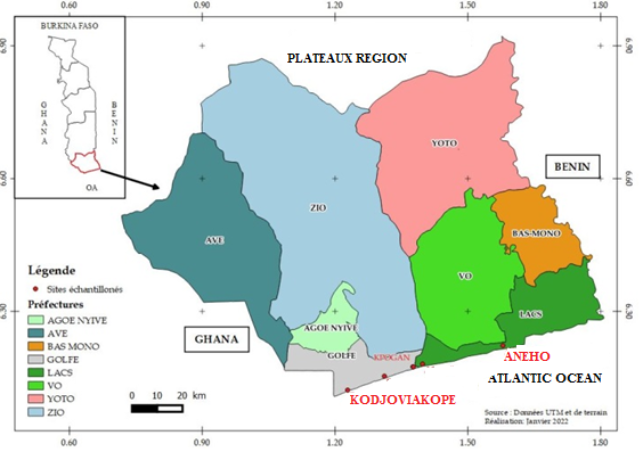
The study was conducted in the Maritime Region, located in the southern part of Togo along the Atlantic Ocean. The region is bordered by the Plateaux Region to the north, Benin to the east, and Ghana to the west. It extends between 6°00′ and 6°50′ N latitude and 0°25′ and 2°00′ E longitude. The Maritime Region covers an area of 6,395 km2, representing 11.30% of the national territory.
As with other coastal areas of West African countries, the Maritime Region is characterised by a high rate of population growth (3.16%). The region is home to approximately 42% of the national population, accounting for nearly half of Togo's total population
[9]
Directorate-General of Statistics and National Accounts (DGSCN). (2010). Fourth General Population and Housing Census (RGPH-4): Final Results. Lomé, Togo.
[9]
.
2.2. Sampling Sites
The study was conducted at two sampling sites: Kodjoviakope and Aneho. At each site, two fish species, namely pike and whiting, were purchased immediately after capture. These two species are commonly sold in local markets. For each species, fifty (50) specimens were sampled. The sampling areas were defined at each site within the Maritime Region, and the corresponding geographical coordinates were recorded using a Global Positioning System (GPS).
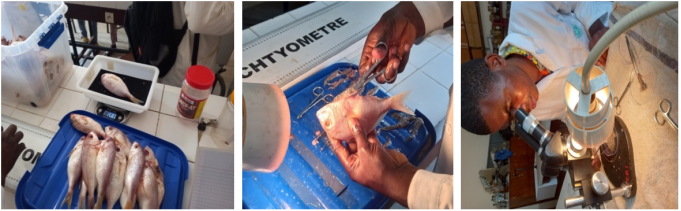
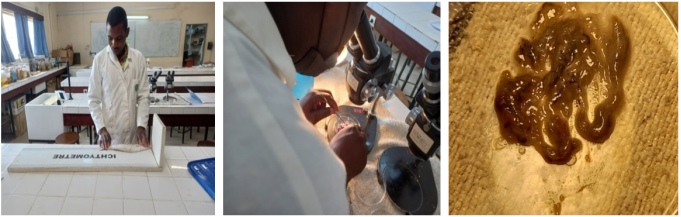
In the laboratory, each fish specimen was measured, and the following parameters were recorded: body weight (g), total length (cm), and sex (male or female). The fish were then dissected, and their stomachs were carefully removed and preserved separately by species in 5% diluted formalin solution. Each stomach was weighed and subsequently opened, after which the stomach contents were also weighed and examined under a binocular dissecting microscope (Olympus C011)
[2]
Boerger, M. C., Lattin, L. G., Moore, L. S., Moore, J. C., 2010. Plastic ingestion by planktivorous fishes in the North Pacific Central Gyre. Marine Pollution Bulletin 60, 2275-2278.
Figure 3. a. Pike measurement b. Observation c. Observed stomach contents.
3. Results and Discussion
3.1. Dissection of Whiting
For the whiting specimens collected from the Aneho site, the mean body weight was 121.9 ± 0.05 g, while the mean total length was 22.5 ± 0.05 cm. No plastic particles were detected in the stomach contents of the whiting specimens. However, shrimp remains and fish remains were observed in the stomach contents. This observation may be related to the feeding habits of the species and the composition of its natural diet.
The absence of plastic particles in the stomach contents does not necessarily mean that the whiting did not ingest plastic. Indeed,
[8]
De Souza, M. T. V., da Silva, G. S., Pinto, I. A., Manzato, L., & Val, A. L. (2025). Occurrence of microplastics in the gastrointestinal tract of Amazonian fish species with different feeding habits. Anais da Academia Brasileira de Ciências, 97(Suppl. 3), e20241204.
reported that, among the microplastics detected in the gastrointestinal tract of Amazonian fish, 91.5% were found in the intestine, compared with only 8.5% in the stomach. These results show that plastic particles may be distributed differently throughout the gastrointestinal tract. Thus, the absence of plastic particles observed in the stomach contents of the whiting could be explained by their possible presence in other parts of the digestive system.
3.2. Dissection of Pike
For the pike specimens collected from the Kodjoviakope site, the mean body weight was 330.05 g ± 0.05 g and the mean length was 39.25 cm ± 0.05 cm. Plastic fragments were found in the stomach contents of 14% of the fish examined. The presence of these fragments indicates that a proportion of the pike examined had ingested plastic particles present in the environment.
The pike is a powerful, aggressive and opportunistic predator characterised by relatively non-selective feeding behaviour. This behaviour may favour the accidental ingestion of plastic particles present in the environment or associated with prey. Given the size of the particles observed, their presence in the stomach contents could result from indirect ingestion through prey–predator interactions. This possibility is consistent with studies showing that plastic particles can be transferred between organisms occupying different trophic levels [4, 14].
[16]
Zhang, F., Wang, X., Xu, J., Zhu, L., Peng, G., Xu, P., & Li, D. (2019). Food-web transfer of microplastics between wild caught fish and crustaceans in East China Sea. Marine Pollution Bulletin, 146, 173–182.
also highlighted the potential transfer of microplastics through predator–prey relationships in aquatic food webs.
Several studies have shown that ingested plastics commonly occur in the form of fragments, fibres and films [2, 7]. In the present study, plastic fragments were also the predominant form observed in the stomach contents of pike. Most of the particles were black in colour. This predominance may be related to the characteristics of plastic waste present in the Togolese coastal environment.
[15]
Sizing, B., Koledzi, E. K., Krou, N. M., & Sema, A.-I. M. (2023). Physico-chemical characterisation of plastic waste in the Togolese marine environment with a view to recovery. Journal of Chemical, Biological and Physical Sciences, Section D: Environmental Sciences, 13(1), 163–165.
reported a substantial presence of plastic waste along the Togolese coast, particularly at the Kodjoviakope and Aneho sites, and showed that these wastes undergo progressive fragmentation in the marine environment, potentially leading to the formation of smaller plastic particles.
The black colour of the particles observed could also favour their ingestion when they are mistaken for food resources present in the environment. Plankton, in particular, constitutes an important food resource for many aquatic organisms.
[6]
Cole, M., Lindeque, P., Fileman, E., Halsband, C., Goodhead, R., Moger, J., Galloway, T. S., 2013. Microplastic ingestion by zooplankton. Environ. Sci. Technol. 47, 6646-6655.
showed that 13 of the 15 zooplankton taxa examined had ingested microplastics. The ingestion of plastic particles by organisms at lower trophic levels may therefore facilitate their transfer to predatory fish through feeding relationships. Such trophic transfer has also been documented in aquatic food webs, suggesting that plastic particles ingested by organisms at lower trophic levels may become available to higher trophic-level consumers
[4]
Bucci, K., Tulio, M., & Rochman, C. M. (2020). What is known and unknown about the effects of plastic pollution: A meta-analysis and systematic review. Ecological Applications, 30(2), e02044.
Setälä, O., Fleming-Lehtinen, V., & Lehtiniemi, M. (2014). Ingestion and transfer of microplastics in the planktonic food web. Environmental Pollution, 185, 77–83.
The accumulation of non-nutritive materials in the digestive tract may also reduce the amount of food available to fish and interfere with their feeding. In cases of substantial accumulation, the presence of plastic debris may contribute to reduced food intake and affect the nutritional condition of aquatic organisms.
The results obtained in the present study therefore show a difference between the two species examined: no plastic particles were observed in the stomach contents of the whiting collected at Aneho, whereas plastic fragments were found in 14% of the pike collected at Kodjoviakope. This difference may be related to the feeding habits and trophic behaviour of the species, but also to the characteristics of the environments in which they were sampled. The predatory and opportunistic behaviour of pike may particularly favour their exposure to plastic particles through their prey.
Plastics, whether present as large or small fragments, therefore constitute an important environmental problem in marine ecosystems, with ecological and health consequences
[12]
Moore, C. J., 2008. Synthetic polymers in the marine environment: A rapidly increasing long term threat. Environmental Research, 108, 131-139.
. Large plastic debris may cause severe effects in marine organisms through ingestion or entanglement, while smaller particles may be ingested by various organisms and circulate within aquatic food webs.
The transformation of petroleum into plastic materials involves several stages, including refining and the conversion of hydrocarbons into smaller molecules. These molecules, commonly referred to as monomers, are subsequently assembled into longer molecular chains through polymerisation processes under the influence of heat, pressure and various chemical agents. In order to confer specific properties on plastic materials, such as strength, lightness, rigidity, colour and shock-absorption capacity, various additives are incorporated into the polymer matrix.
Because some of these additives are not chemically bound to the polymer matrix, they can gradually be released into the marine environment through leaching. This release contributes to the presence of plastic-associated chemical substances in aquatic ecosystems and may therefore represent an additional source of exposure for marine organisms and, consequently, for organisms occupying higher trophic levels
[10]
Engler, R. E., 2012. The complex interaction between marine debris and toxic chemicals in the ocean. Environmental Science and Technology 46(22), 12302-12315.
Among these substances are phthalates, which are used as plasticisers and are recognised for their endocrine-disrupting properties. Following their ingestion by aquatic organisms, some plastic-associated compounds may be metabolised and give rise to different metabolites capable of interacting with biological systems
[1]
Benjamin, S., Masai, E., Kamimura, N., Takahashi, K., Anderson, R. C., Faisal, P. A., 2017. Phthalates impact human health: Epidemiological evidences and plausible mechanism of action. J. Hazard. Mater 340, 360-383.
. These compounds may affect the functioning of the endocrine system and may be associated with various adverse health effects.
Several studies have reported associations between exposure to certain phthalates and various biological disturbances, including alterations in sexual differentiation, precocious puberty, fertility disorders, certain cancers, allergies, asthma and obesity
[13]
Pak, V. M., McCauley, L. A., & Pinto-Martin, J. (2011). Phthalate exposures and human health concerns: A review and implications for practice. AAOHN Journal, 59(5), 228–233.
. In women, the presence of a higher proportion of adipose tissue may also favour the accumulation of certain lipophilic chemical substances, such as phthalates. Pregnancy, lactation, puberty and menopause are also periods of particular sensitivity to endocrine disruption.
During pregnancy, phthalates can cross the placental barrier and reach the foetus, potentially affecting different stages of intrauterine development. Exposure to these compounds may be associated with developmental effects and the subsequent occurrence of certain pathologies. In addition, some phthalates may influence epigenetic mechanisms by altering DNA methylation patterns
[1]
Benjamin, S., Masai, E., Kamimura, N., Takahashi, K., Anderson, R. C., Faisal, P. A., 2017. Phthalates impact human health: Epidemiological evidences and plausible mechanism of action. J. Hazard. Mater 340, 360-383.
. These modifications may contribute to various biological processes associated with tumour development and metabolic disorders.
4. Conclusion
The present study highlights the occurrence of plastic particles in fish from the studied aquatic environment. No plastic particles were detected in the stomach contents of the whiting examined at Aneho, whereas plastic fragments were found in 14% of the pike examined at Kodjoviakope. These findings demonstrate the occurrence of plastic debris in the aquatic environment and its ingestion by fish.
The detection of plastic fragments in pike, a predatory species, particularly highlights the importance of feeding relationships in the distribution and transfer of plastics within aquatic food webs. The presence of plastic particles in fish also raises concerns about their potential movement through aquatic food webs and their implications for organisms at higher trophic levels. Further studies are needed to better understand the occurrence and transfer of plastic particles within aquatic ecosystems, their effects on fish health and life cycle, and possible measures to protect aquatic organisms from plastic pollution.
Abbreviations
CERViDA-DOUNEDON
Regional Centre of Excellence on Sustainable Cities in Africa
GTVD
Waste Management, Treatment and Recovery Laboratory
Acknowledgments
I would like to thank the Waste Management, Treatment and Recovery Laboratory (GTVD), and the Ecology and Ecotoxicology Laboratory, Faculty of Science at the University of Lome.
Author Contributions
Badjagoma Sizing: Conceptualization, Data curation, Formal Analysis, Investigation, Methodology, Validation, Visualization, Writing – original draft, Writing – review & editing
Benjamin, S., Masai, E., Kamimura, N., Takahashi, K., Anderson, R. C., Faisal, P. A., 2017. Phthalates impact human health: Epidemiological evidences and plausible mechanism of action. J. Hazard. Mater 340, 360-383.
Boerger, M. C., Lattin, L. G., Moore, L. S., Moore, J. C., 2010. Plastic ingestion by planktivorous fishes in the North Pacific Central Gyre. Marine Pollution Bulletin 60, 2275-2278.
Browne, M., Dissanayake, A., Galloway, T., Lowe, D., Thompson, R., 2008. Ingested microscopic plastic translocates to the circulatory system of mussel, Mytilus edulis. Environmental Science Technology 42, 5026-5031.
Bucci, K., Tulio, M., & Rochman, C. M. (2020). What is known and unknown about the effects of plastic pollution: A meta-analysis and systematic review. Ecological Applications, 30(2), e02044.
Carrega, M., Verney, V., 2012. *Plastics: Properties, Processing and Industrial Applications of Polymer Materials*. 3rd ed. Paris: Dunod, The New Factory. ISBN 978-2-10-055997-8.
[6]
Cole, M., Lindeque, P., Fileman, E., Halsband, C., Goodhead, R., Moger, J., Galloway, T. S., 2013. Microplastic ingestion by zooplankton. Environ. Sci. Technol. 47, 6646-6655.
Collard, F., Gasperi, J., Gilbert, B., Eppe, G., Azimi, S., Rocher, V., Tassin, B., 2017. Presence of anthropogenic particles in the stomach contents and liver of a freshwater fish, the chub. PIREN-Seine Phase VII – 2017 Report.
De Souza, M. T. V., da Silva, G. S., Pinto, I. A., Manzato, L., & Val, A. L. (2025). Occurrence of microplastics in the gastrointestinal tract of Amazonian fish species with different feeding habits. Anais da Academia Brasileira de Ciências, 97(Suppl. 3), e20241204.
Directorate-General of Statistics and National Accounts (DGSCN). (2010). Fourth General Population and Housing Census (RGPH-4): Final Results. Lomé, Togo.
[10]
Engler, R. E., 2012. The complex interaction between marine debris and toxic chemicals in the ocean. Environmental Science and Technology 46(22), 12302-12315.
Galgani, F., Bruzaud, S., Duflos, G., Fabre, P., Gastaldi, E., Ghiglione, J., Grimaud, R., George, M., Huvet, A., Lagarde, F., Paul-Pont, I. and Ter Halle, A., 2020. Plastic and microplastic pollution in the oceans. Techniques de l’Ingénieur, BIO9300.
Pak, V. M., McCauley, L. A., & Pinto-Martin, J. (2011). Phthalate exposures and human health concerns: A review and implications for practice. AAOHN Journal, 59(5), 228–233.
Setälä, O., Fleming-Lehtinen, V., & Lehtiniemi, M. (2014). Ingestion and transfer of microplastics in the planktonic food web. Environmental Pollution, 185, 77–83.
Sizing, B., Koledzi, E. K., Krou, N. M., & Sema, A.-I. M. (2023). Physico-chemical characterisation of plastic waste in the Togolese marine environment with a view to recovery. Journal of Chemical, Biological and Physical Sciences, Section D: Environmental Sciences, 13(1), 163–165.
Zhang, F., Wang, X., Xu, J., Zhu, L., Peng, G., Xu, P., & Li, D. (2019). Food-web transfer of microplastics between wild caught fish and crustaceans in East China Sea. Marine Pollution Bulletin, 146, 173–182.
Sizing, B., Nadjombe, P., Gnimassoun, J. B. G., Adje, K., Krou, N. M., et al. (2026). Occurrence and Ingestion of Plastic Particles in Marine Fish from Togolese Coast. International Journal of Ecotoxicology and Ecobiology, 11(3), 45-50. https://doi.org/10.11648/j.ijee.20261103.11
Sizing, B.; Nadjombe, P.; Gnimassoun, J. B. G.; Adje, K.; Krou, N. M., et al. Occurrence and Ingestion of Plastic Particles in Marine Fish from Togolese Coast. Int. J. Ecotoxicol. Ecobiol.2026, 11(3), 45-50. doi: 10.11648/j.ijee.20261103.11
Sizing B, Nadjombe P, Gnimassoun JBG, Adje K, Krou NM, et al. Occurrence and Ingestion of Plastic Particles in Marine Fish from Togolese Coast. Int J Ecotoxicol Ecobiol. 2026;11(3):45-50. doi: 10.11648/j.ijee.20261103.11
@article{10.11648/j.ijee.20261103.11,
  author = {Badjagoma Sizing and Pondikpa Nadjombe and Jean Baptiste Gbêssi Gnimassoun and Koudjo Adje and Nitale M'Balikine Krou and Kokou Semeho Hundjoe and Alaki-Massimpatom Sema and Edem Komi Koledzi},
  title = {Occurrence and Ingestion of Plastic Particles in Marine Fish from Togolese Coast},
  journal = {International Journal of Ecotoxicology and Ecobiology},
  volume = {11},
  number = {3},
  pages = {45-50},
  doi = {10.11648/j.ijee.20261103.11},
  url = {https://doi.org/10.11648/j.ijee.20261103.11},
  eprint = {https://article.sciencepublishinggroup.com/pdf/10.11648.j.ijee.20261103.11},
  abstract = {The increase in plastic production towards the end of the Second World War, combined with inadequate plastic waste management, has contributed to the contamination of marine ecosystems. The ingestion of plastic particles measuring less than 5 mm, known as microplastics, by marine organisms has been documented. The aim of this study was to demonstrate that plastic particles can ultimately enter the human food supply. To achieve this objective, two fish species, pike and whiting, were sampled from commercial catches obtained from local fishers. Both species were sampled at the Kodjoviakope and Aneho sites. For each species, fifty (50) specimens were purchased. The fish were then dissected, and their stomach contents were examined using an Olympus C011 binocular stereomicroscope. In pike, 14% of the fish had ingested a plastic particle, whereas no plastic particles were detected in whiting. These findings highlight the need for consumers and other stakeholders to make greater efforts towards effective plastic waste management, as microplastics can act as vectors for micropollutants and chemical additives that may pose risks to human health. The findings also serve as a warning to stakeholders in the education and health sectors, who are encouraged to raise awareness among learners about the harmful effects of plastic waste, appropriate waste-management practices, and, ultimately, opportunities for its recovery and valorisation.},
 year = {2026}
}
TY  - JOUR
T1  - Occurrence and Ingestion of Plastic Particles in Marine Fish from Togolese Coast
AU  - Badjagoma Sizing
AU  - Pondikpa Nadjombe
AU  - Jean Baptiste Gbêssi Gnimassoun
AU  - Koudjo Adje
AU  - Nitale M'Balikine Krou
AU  - Kokou Semeho Hundjoe
AU  - Alaki-Massimpatom Sema
AU  - Edem Komi Koledzi
Y1  - 2026/10/15
PY  - 2026
N1  - https://doi.org/10.11648/j.ijee.20261103.11
DO  - 10.11648/j.ijee.20261103.11
T2  - International Journal of Ecotoxicology and Ecobiology
JF  - International Journal of Ecotoxicology and Ecobiology
JO  - International Journal of Ecotoxicology and Ecobiology
SP  - 45
EP  - 50
PB  - Science Publishing Group
SN  - 2575-1735
UR  - https://doi.org/10.11648/j.ijee.20261103.11
AB  - The increase in plastic production towards the end of the Second World War, combined with inadequate plastic waste management, has contributed to the contamination of marine ecosystems. The ingestion of plastic particles measuring less than 5 mm, known as microplastics, by marine organisms has been documented. The aim of this study was to demonstrate that plastic particles can ultimately enter the human food supply. To achieve this objective, two fish species, pike and whiting, were sampled from commercial catches obtained from local fishers. Both species were sampled at the Kodjoviakope and Aneho sites. For each species, fifty (50) specimens were purchased. The fish were then dissected, and their stomach contents were examined using an Olympus C011 binocular stereomicroscope. In pike, 14% of the fish had ingested a plastic particle, whereas no plastic particles were detected in whiting. These findings highlight the need for consumers and other stakeholders to make greater efforts towards effective plastic waste management, as microplastics can act as vectors for micropollutants and chemical additives that may pose risks to human health. The findings also serve as a warning to stakeholders in the education and health sectors, who are encouraged to raise awareness among learners about the harmful effects of plastic waste, appropriate waste-management practices, and, ultimately, opportunities for its recovery and valorisation.
VL  - 11
IS  - 3
ER  -
Department of Chemistry, Laboratory for Waste Management, Treatment and Recovery (GTVD), University of Lome, Lome, Togo;Department of Physics and Chemistry, Higher Teacher Training College of Atakpame, Atakpame, Togo
Department of Botany and Plant Ecology, University of Lome, Lome, Togo;Department of Physics and Chemistry, Higher Teacher Training College of Atakpame, Atakpame, Togo
Jean Baptiste Gbêssi Gnimassoun
Department of Zoology and Animal Biology, Laboratory of Ecology and Ecotoxicology, University of Lome, Lome, Togo
Koudjo Adje
Department of Chemistry, Laboratory for Waste Management, Treatment and Recovery (GTVD), University of Lome, Lome, Togo;Department of Physics and Chemistry, Higher Teacher Training College of Atakpame, Atakpame, Togo
Nitale M'Balikine Krou
Department of Chemistry Laboratory of Organic Chemistry and Environmental Science, University of Kara, Kara, Togo
Kokou Semeho Hundjoe
Department of Chemistry, Laboratory for Waste Management, Treatment and Recovery (GTVD), University of Lome, Lome, Togo
Alaki-Massimpatom Sema
Department of Chemistry, Laboratory for Waste Management, Treatment and Recovery (GTVD), University of Lome, Lome, Togo
Edem Komi Koledzi
Department of Chemistry, Laboratory for Waste Management, Treatment and Recovery (GTVD), University of Lome, Lome, Togo;Regional Centre of Excellence on Sustainable Cities in Africa (CERViDA-DOUNEDON), University of Lome, Lome, Togo
Sizing, B., Nadjombe, P., Gnimassoun, J. B. G., Adje, K., Krou, N. M., et al. (2026). Occurrence and Ingestion of Plastic Particles in Marine Fish from Togolese Coast. International Journal of Ecotoxicology and Ecobiology, 11(3), 45-50. https://doi.org/10.11648/j.ijee.20261103.11
Sizing, B.; Nadjombe, P.; Gnimassoun, J. B. G.; Adje, K.; Krou, N. M., et al. Occurrence and Ingestion of Plastic Particles in Marine Fish from Togolese Coast. Int. J. Ecotoxicol. Ecobiol.2026, 11(3), 45-50. doi: 10.11648/j.ijee.20261103.11
Sizing B, Nadjombe P, Gnimassoun JBG, Adje K, Krou NM, et al. Occurrence and Ingestion of Plastic Particles in Marine Fish from Togolese Coast. Int J Ecotoxicol Ecobiol. 2026;11(3):45-50. doi: 10.11648/j.ijee.20261103.11
@article{10.11648/j.ijee.20261103.11,
  author = {Badjagoma Sizing and Pondikpa Nadjombe and Jean Baptiste Gbêssi Gnimassoun and Koudjo Adje and Nitale M'Balikine Krou and Kokou Semeho Hundjoe and Alaki-Massimpatom Sema and Edem Komi Koledzi},
  title = {Occurrence and Ingestion of Plastic Particles in Marine Fish from Togolese Coast},
  journal = {International Journal of Ecotoxicology and Ecobiology},
  volume = {11},
  number = {3},
  pages = {45-50},
  doi = {10.11648/j.ijee.20261103.11},
  url = {https://doi.org/10.11648/j.ijee.20261103.11},
  eprint = {https://article.sciencepublishinggroup.com/pdf/10.11648.j.ijee.20261103.11},
  abstract = {The increase in plastic production towards the end of the Second World War, combined with inadequate plastic waste management, has contributed to the contamination of marine ecosystems. The ingestion of plastic particles measuring less than 5 mm, known as microplastics, by marine organisms has been documented. The aim of this study was to demonstrate that plastic particles can ultimately enter the human food supply. To achieve this objective, two fish species, pike and whiting, were sampled from commercial catches obtained from local fishers. Both species were sampled at the Kodjoviakope and Aneho sites. For each species, fifty (50) specimens were purchased. The fish were then dissected, and their stomach contents were examined using an Olympus C011 binocular stereomicroscope. In pike, 14% of the fish had ingested a plastic particle, whereas no plastic particles were detected in whiting. These findings highlight the need for consumers and other stakeholders to make greater efforts towards effective plastic waste management, as microplastics can act as vectors for micropollutants and chemical additives that may pose risks to human health. The findings also serve as a warning to stakeholders in the education and health sectors, who are encouraged to raise awareness among learners about the harmful effects of plastic waste, appropriate waste-management practices, and, ultimately, opportunities for its recovery and valorisation.},
 year = {2026}
}
TY  - JOUR
T1  - Occurrence and Ingestion of Plastic Particles in Marine Fish from Togolese Coast
AU  - Badjagoma Sizing
AU  - Pondikpa Nadjombe
AU  - Jean Baptiste Gbêssi Gnimassoun
AU  - Koudjo Adje
AU  - Nitale M'Balikine Krou
AU  - Kokou Semeho Hundjoe
AU  - Alaki-Massimpatom Sema
AU  - Edem Komi Koledzi
Y1  - 2026/10/15
PY  - 2026
N1  - https://doi.org/10.11648/j.ijee.20261103.11
DO  - 10.11648/j.ijee.20261103.11
T2  - International Journal of Ecotoxicology and Ecobiology
JF  - International Journal of Ecotoxicology and Ecobiology
JO  - International Journal of Ecotoxicology and Ecobiology
SP  - 45
EP  - 50
PB  - Science Publishing Group
SN  - 2575-1735
UR  - https://doi.org/10.11648/j.ijee.20261103.11
AB  - The increase in plastic production towards the end of the Second World War, combined with inadequate plastic waste management, has contributed to the contamination of marine ecosystems. The ingestion of plastic particles measuring less than 5 mm, known as microplastics, by marine organisms has been documented. The aim of this study was to demonstrate that plastic particles can ultimately enter the human food supply. To achieve this objective, two fish species, pike and whiting, were sampled from commercial catches obtained from local fishers. Both species were sampled at the Kodjoviakope and Aneho sites. For each species, fifty (50) specimens were purchased. The fish were then dissected, and their stomach contents were examined using an Olympus C011 binocular stereomicroscope. In pike, 14% of the fish had ingested a plastic particle, whereas no plastic particles were detected in whiting. These findings highlight the need for consumers and other stakeholders to make greater efforts towards effective plastic waste management, as microplastics can act as vectors for micropollutants and chemical additives that may pose risks to human health. The findings also serve as a warning to stakeholders in the education and health sectors, who are encouraged to raise awareness among learners about the harmful effects of plastic waste, appropriate waste-management practices, and, ultimately, opportunities for its recovery and valorisation.
VL  - 11
IS  - 3
ER  -





 Share This Article
 Twitter
 Linked In
 Facebook
 Copy
Copy Download