1. Introduction
To promote the green and low-carbon transformation of China’s automotive industry, the new energy electric vehicle (NEV) sector has expanded rapidly in recent years, with both the in-use fleet and annual sales exhibiting sustained high growth. In 2024, newly registered NEVs reached 11.25 million units, accounting for 41.83% of all newly registered vehicles, representing a year-on-year increase of 51.49% compared with 2023 and indicating strong momentum in China’s NEV market
the core component of NEVs, power batteries generated 168,000 tonnes of retired batteries in China in 2023, an increase of 78.3% year-on-year
| [2] | Zong Y, Yao P, Zhang X, et al (2023) Material flow analysis on the critical resources from spent power lithium-ion batteries under the framework of China’s recycling policies. Waste Management 171: 463-472.
https://doi.org/10.1016/j.wasman.2023.09.039 |
[2]
. According to data released by the China NEV Power Battery Recycling Industry Collaborative Development Alliance, the annual volume of retired power batteries is projected to reach 600,000 tonnes by 2025
| [3] | Liu B, Han J, Liang X (2025) Assessment of the potential of retired new energy vehicle batteries for renewable energy storage in China based on CNN-BiLSTM. Sustainable Energy Technologies and Assessments 83: 104637.
https://doi.org/10.1016/j.seta.2025.104637 |
[3]
. Ternary lithium-ion batteries account for the majority of retired lithium-ion batteries not only in China but also globally
. Although lithium iron phosphate (LFP) batteries are widely deployed, their critical resource content is generally lower than that of ternary batteries, and they are often prioritized for cascade utilization after retirement
; consequently, LFP recycling pathways differ fundamentally from those for ternary batteries
| [6] | Ordoñez J, Gago EJ, Girard A (2016) Processes and technologies for the recycling and recovery of spent lithium-ion batteries. Renewable and Sustainable Energy Reviews 60: 195-205. https://doi.org/10.1016/j.rser.2015.12.363 |
[6]
. The future retirement volume of ternary lithium-ion batteries is expected to be substantial
. Battery retirement comprises both direct and indirect retirement: direct retirement refers to batteries exiting service immediately upon vehicle scrappage, whereas indirect retirement occurs when vehicles remain in use but batteries are retired due to performance degradation
| [8] | Wilson N, Meiklejohn E, Overton B, et al (2021) A physical allocation method for comparative life cycle assessment: A case study of repurposing Australian electric vehicle batteries. Resources, Conservation and Recycling 174: 105759.
https://doi.org/10.1016/j.resconrec.2021.105759 |
| [9] | Shafique M, Rafiq M, Azam A, Luo X (2022) Material flow analysis for end-of-life lithium-ion batteries from battery electric vehicles in the USA and China. Resources, Conservation and Recycling 178: 106061.
https://doi.org/10.1016/j.resconrec.2021.106061 |
[8, 9]
. To systematically evaluate retirement-related impacts based on market-level statistics, this study assumes that the average mass of a ternary battery pack in battery electric vehicles (BEVs) is approximately 350 kg, an estimate derived from battery pack weights across multiple vehicle models
| [10] | Mu N, Wang Y, Chen Z-S, et al (2023) Multi-objective combinatorial optimization analysis of the recycling of retired new energy electric vehicle power batteries in a sustainable dynamic reverse logistics network. Environ Sci Pollut Res 30: 47580-47601. https://doi.org/10.1007/s11356-023-25573-w |
[10]
. Based on an assumed battery lifetime of eight years, two scenarios are defined: (i) a 100% recycling and treatment rate scenario and (ii) an 80% recycling and treatment rate scenario.
The recycling of retired power batteries has become an urgent environmental and resource challenge
| [11] | Sun B, Su X, Wang D, et al (2020) Economic analysis of lithium-ion batteries recycled from electric vehicles for secondary use in power load peak shaving in China. Journal of Cleaner Production 276: 123327.
https://doi.org/10.1016/j.jclepro.2020.123327 |
| [12] | VOLA P (2025) End-of-life strategies for EV Li-ion batteries: a chemistry-informed system dynamics approach in the EU circular economy framework.
https://doi.org/10.1016/j.est.2025.115689 |
[11, 12]
. Among recycling technologies for ternary lithium-ion batteries, hydrometallurgy has attracted extensive attention domestically and internationally due to its relatively high metal recovery efficiency and comparatively low energy consumption
,
| [14] | Liu F, Peng C, Ma Q, et al (2021) Selective lithium recovery and integrated preparation of high-purity lithium hydroxide products from spent lithium-ion batteries. Separation and Purification Technology 259: 118181.
https://doi.org/10.1016/j.seppur.2020.118181 |
[14]
. However, hydrometallurgical processing may generate substantial wastewater and hazardous gas emissions, thereby posing non-negligible environmental risks
| [15] | Xu X, Hu W, Liu W, et al (2021) Study on the economic benefits of retired electric vehicle batteries participating in the electricity markets. Journal of Cleaner Production 286: 125414. https://doi.org/10.1016/j.jclepro.2020.125414 |
[15]
. To address these concerns, combined pyrometallurgical-hydrometallurgical processes have emerged in recent years
. In this integrated route, battery materials are first thermally treated via high-temperature pyrometallurgical decomposition, followed by hydrometallurgical leaching and metal recovery
. This approach enhances overall metal recovery and, relative to stand-alone pyrometallurgical recycling, can reduce wastewater and exhaust-gas emissions
| [19] | Wang K, Huang Q, Feng R, et al (2024) Energy-economy-environment assessment of key feedstock production for ternary lithium-ion batteries via hydrometallurgical recycling and natural exploitation. Journal of Cleaner Production 468: 143088. https://doi.org/10.1016/j.jclepro.2024.143088 |
[19]
. Richa et al. applied material flow analysis (MFA) to project retired power battery volumes in the United States, estimating that the cumulative retired battery amount would reach 4 million tonnes by 2040. Shafique et al.
| [9] | Shafique M, Rafiq M, Azam A, Luo X (2022) Material flow analysis for end-of-life lithium-ion batteries from battery electric vehicles in the USA and China. Resources, Conservation and Recycling 178: 106061.
https://doi.org/10.1016/j.resconrec.2021.106061 |
[9]
used MFA to quantify the recycling potential of power battery resources in the United States and China, reporting that China’s recycling potential exceeds that of the United States. As battery recycling expands globally, some studies conducted at the regional level in California have examined electric vehicle battery supply scenarios and the impact of recycling and reuse on battery demand and greenhouse gas emission savings
| [20] | Wesselkämper J, Hendrickson TP, Lux S, von Delft S (2025) Recycling or second use? Supply potentials and climate effects of end-of-life electric vehicle batteries. Environ Sci Technol 59: 15751-15765. https://doi.org/10.1021/acs.est.5c01823 |
[20]
. Analyzed the provincial (autonomous regions and municipalities) distribution of retired power batteries from July 2020 to June 2021 and found a pronounced spatial imbalance; however, the study period was relatively early, and the analysis did not link retirement volumes to environmental impacts. Meng Wei projected the 2023 retired power battery volumes for nine cities within the Shanghai metropolitan area, but the scope was limited to a small regional scale. Research on battery recycling has been confined to a limited number of prefecture-level cities
. Therefore, two key gaps remain in the literature: (1) retirement forecasting is often presented at the national level in terms of aggregate totals, with insufficient attention to inter-provincial heterogeneity; and (2) environmental impact assessment is frequently confined to process-based results per unit battery, without integration with the anticipated scale of future retirement surges.
In response, this study develops an integrated framework that links “spatiotemporal retirement distribution—environmental burdens of recycling processes—regional disparities in environmental impacts.” First, based on provincial BEV stock and an assumed retirement lifetime, the retirement scale of ternary lithium-ion batteries from 2025 to 2031 is projected. Second, using the combined pyrometallurgical-hydrometallurgical recycling process, with 1 kg of retired ternary battery cells as the functional unit, an inventory model is constructed in SimaPro, and environmental impacts are quantified using the ReCiPe 2016 Midpoint indicator set. Finally, by combining unit environmental impacts with the two scenario assumptions on recycling rates, this study reports the spatiotemporal heterogeneity of both retirement volumes and environmental impact potentials at the provincial scale, thereby providing scientific evidence to inform future planning and spatial deployment of ternary lithium-ion battery recycling systems.
2. Research Scope and Methods
2.1. Study Area and Data Sources
The study area covers 31 provincial-level administrative regions in China (including provinces, autonomous regions, and municipalities), excluding the Hong Kong and Macao Special Administrative Regions and Taiwan Province. Ternary lithium-ion batteries used to power new energy electric vehicles are selected as the specific object of analysis. The datasets employed in this study include: (1) provincial stocks of new energy electric vehicles from 2017 to 2023, used for forecasting battery retirement volumes; (2) national market shares of battery electric vehicles from 2017 to 2023, applied to calibrate provincial BEV stocks; (3) inventory data for a combined pyrometallurgical - hydrometallurgical recycling process of ternary lithium-ion batteries, disclosed by an enterprise located in Jiangsu Province and/or published in the literature, partially used for life cycle assessment (LCA) modeling; and (4) baseline geographic vector data used for provincial-scale visualization and zonal statistics, obtained from the Standard Map Service of the Ministry of Natural Resources of China.
To ensure transparency and reproducibility, data processing followed two principles. First, provincial vehicle stocks were constrained such that their national aggregates are consistent with authoritative statistical totals. Second, key parameters—including average battery mass, retirement lifetime, and recycling and treatment rates—are explicitly specified and documented.
2.2. Methods
2.2.1. Life Cycle Assessment
The simulation of the combined pyrometallurgical and hydrometallurgical process for ternary lithium batteries was conducted within the Life Cycle Assessment (LCA) framework based on the ISO 14040 series standards
| [22] | Woeste R, Drude E-S, Vrucak D, et al (2024) A techno-economic assessment of two recycling processes for black mass from end-of-life lithium-ion batteries. Applied Energy 361: 122921. https://doi.org/10.1016/j.apenergy.2024.122921 |
[22]
. SimPro software was utilized to model the combined pyrometallurgical and hydrometallurgical recycling process for lithium batteries
| [23] | Zhou Y, Cui X-D, Lin A-J, et al (2025) Environmental life cycle assessment on the recycling processes of power batteries for new energy vehicles. Journal of Cleaner Production 488: 144641. https://doi.org/10.1016/j.jclepro.2024.144641 |
[23]
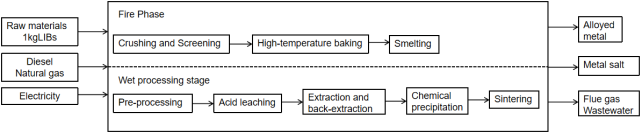
. Life Cycle Assessment considers the environmental aspects and impacts of a specific product or process by incorporating all possible inputs and outputs throughout its entire life cycle. The system boundary for this study encompasses the recycling phase of ternary lithium batteries. Based on corporate processes and existing recycling workflows, the defined system boundary is illustrated in
Figure 1. It includes both pyrometallurgical and hydrometallurgical processes, with modelling quantifying the environmental impact of the combined pyrometallurgical-hydrometallurgical process for recycling 1 kg of ternary lithium battery cells. The analysis extends to assess the potential environmental impact of the anticipated surge in battery retirement from 2025 to 2031.
Figure 1. Lithium battery recycling process system boundary.
2.2.2. Development of the Simapro Model
The recycling process model was developed using SimaPro software, with data sourced from open-access literature and from detailed operational data on ternary lithium-ion battery recycling provided by an enterprise in Jiangsu Province. Conceptually, the model consists of two units processes constructed in SimaPro. The first unit process represents the pyrometallurgical recycling stage, while the second integrates the hydrometallurgical stage, including both metal production and metal salt generation. These processes are linked via an intermediate flow (synthetic alloy). The overall process sequence is as follows: pyrometallurgical treatment → alloy transportation → hydrometallurgical chemical processing → metal and metal salt output system.
The modelling of pyrometallurgical treatment for 1 kg of retired ternary lithium-ion battery cells primarily simulates the extraction process from spent cells to metallic alloy. Model inputs include 1 kg of retired ternary lithium-ion battery cells, as well as the energy and auxiliary materials consumed during smelting. Transportation-related environmental impacts are explicitly incorporated into the model, including 130 km of truck transport for conveying spent cells from collection sites to the smelting facility, 240 km of rail transport for certain materials (e.g., metal alloys) within the region, and 270 km of maritime transport for selected materials. Fuel consumption, pollutant emissions, and greenhouse gas emissions associated with these transportation modes are all accounted for.
The hydrometallurgical modelling focuses on subsequent refining and separation processes applied to the metallic alloy produced in the pyrometallurgical stage
| [24] | Kollová A, Laubertová M, Trpčevská J, Sisol M (2024) Thermodynamic Study of the Sustainable Hydrometallurgical Treatment of Copper Converter Flue Dust Based on Pb, Zn, and Sn Oxides. Materials 17. https://doi.org/10.3390/ma17235690 |
[24]
. Inputs to the hydrometallurgical process include electricity, thermal energy, and chemical reagents. Major processing stages are explicitly modelled
. The resulting life cycle inventory outputs are then subjected to characterization and normalization, with cumulative upstream and downstream carbon emissions quantified. Environmental impacts across different categories are analyzed using the ReCiPe 2016 Midpoint method to assess the environmental performance of the ternary lithium-ion battery recycling stage. The evaluated impact categories are listed in
Table 1.
Table 1. Five environmental impact assessment indicators.
Environmental impact assessment indicators | Unit | Abbreviation |
Global warming potential | kg CO2 eq | GWP |
Human toxicity | kg 1,4-DCB eq | HT |
Eutrophication potential | kg PO4 eq | EP |
Acidification potential | kg SO2 eq | AP |
Ozone layer depletion | kg CFC-11 eq | ODP |
2.2.3. Assumption of Retirement Lifetime
In the basic technical requirements for new energy vehicles issued in China in 2015, the quality requirement for power batteries stipulates a warranty period of no less than 8 years or 120,000 km. To support provincial-scale forecasting of retired battery volumes for the period 2025-2031, this study establishes a quantitative correspondence between the 8-year/120,000 km boundary and battery retirement lifetime. Accordingly, the following conversion is adopted: let the warranted mileage of a passenger vehicle's power battery be km; the corresponding average annual driving distance that matches an average lifetime of years is given by:
(1)
If the average driving range per single charge of a battery electric vehicle is assumed to be km, the cumulative number of charge-discharge cycles corresponding to an 8-year lifetime can be estimated as:
(2)
This order of magnitude is consistent with the range reported in the literature, which estimates that an 8-year or 120,000 km service life corresponds to approximately 270-400 charge-discharge cycles when assuming 300 km per charge. Therefore, this study adopts an average retirement lifetime of 8 years for ternary lithium-ion batteries used in battery electric passenger vehicles.
2.3. Combined Pyrometallurgical-Hydrometallurgical Recycling Process
The combined pyrometallurgical-hydrometallurgical recycling chain comprises four key stages: thermal treatment, formation of intermediate alloy/slag phases, hydrometallurgical leaching and separation, and product generation
| [26] | Attah-Kyei D, Sukhomlinov D, Tiljander M, et al (2023) A Crucial Step Toward Carbon Neutrality in Pyrometallurgical Reduction of Nickel Slag. J Sustain Metall 9: 1759-1776.
https://doi.org/10.1007/s40831-023-00763-5 |
[26]
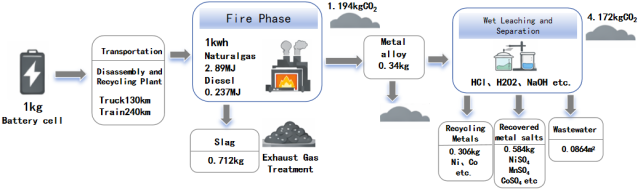
. In the pyrometallurgical stage, high-temperature treatment is applied to remove organic components and concentrate metals, producing an intermediate alloy suitable for subsequent refining, while simultaneously generating slag and off-gas treatment burdens. In the hydrometallurgical stage, metals such as Ni and Co are recovered through unit operations including acid leaching/reduction, extraction/precipitation, and crystallization, yielding metal or metal salt products; this stage is accompanied by electricity and heat consumption, chemical reagent inputs, and wastewater treatment requirements. As shown in
Figure 2, based on enterprise-specific and literature-reported inventory data, this study models the combined process as two primary unit processes and incorporates transportation and disposal processes within the system boundary.
Figure 2. Fire-wet combined recovery process.
3. Results and Discussion
3.1. Projection of Battery Retirement Volumes in China from 2025 to 2031
As shown in
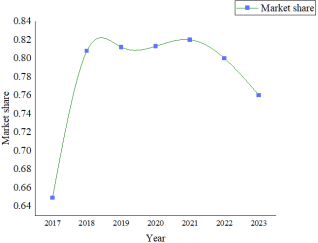
Figure 3, based on provincial stocks of battery electric vehicles and annual BEV market shares, the retirement scale of ternary lithium-ion batteries is projected to increase continuously from 2025 to 2031, exhibiting pronounced spatial heterogeneity at the provincial level. As shown in
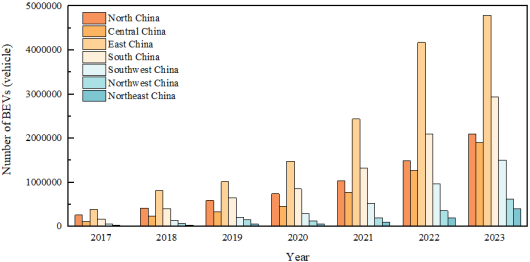
Figure 4, under the assumed battery retirement lifetime of 8 years, regions with high retirement volumes in 2025 are mainly concentrated in North China, East China, and South China, where NEV penetration rates are relatively high. As time progresses, high-retirement regions are projected to expand toward Central China by 2031, reflecting the lagged retirement effect associated with the diffusion of BEVs from coastal areas and core urban agglomerations to broader inland regions. In the comparison of recycling rate scenarios, even under the more conservative assumption of an 80% recycling and treatment rate, the mass of retired batteries entering formal recycling systems continues to increase markedly. This trend implies that future recycling capacity and environmental regulation will face concurrent and increasing pressure. These results provide a provincial-scale perspective for subsequent environmental impact assessment.
Under the scenario assuming a 100% recycling and treatment rate for ternary lithium-ion batteries, 2025 marks the onset of the large-scale battery retirement wave in China. In that year, retirement volumes were relatively high in North China, East China, and South China, with approximately 77,000 tonnes, 138,000 tonnes, and 60,000 tonnes of retired batteries generated in these regions, respectively. In contrast, retirement volumes in Northwest and Northeast China are comparatively low, at roughly 12,000 tonnes and 5,600 tonnes, respectively. Provinces with relatively small retirement volumes include Qinghai Province, the Xinjiang Uyghur Autonomous Region, and Jilin Province. By 2027, ternary lithium-ion battery retirement remains concentrated in North China, East China, and South China; although the spatial pattern of high-retirement regions is largely unchanged from 2025, the retirement volumes increase substantially, with cumulative retirement in these concentrated regions exceeding one million tonnes. By 2031, the number of regions with high retirement volumes further increases, and Central China also exhibits substantial retirement quantities, with an estimated 670,000 tonnes of retired batteries. Compared with 2025, retirement volumes in Northwest China are projected to increase by a factor of approximately 18. Overall, these results indicate that over the next decade, the advent of a large-scale retirement wave of ternary lithium-ion batteries will lead to a dramatic increase in battery retirement volumes across China.
Figure 3. The annual market share of pure electric vehicles from 2017 to 2023.
Figure 4. 31 provinces (autonomous regions, municipalities) in my country (autonomous regions, municipalities) from 2017 to 2023.
3.2. Environmental Impacts of the Combined Pyrometallurgical-Hydrometallurgical Recycling Process
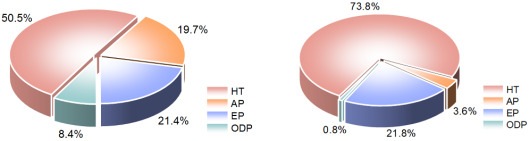
Using SimaPro, a combined pyrometallurgical-hydrometallurgical recycling model was established for 1 kg of retired ternary lithium-ion battery cells, and the environmental impacts associated with the entire process were subsequently analyzed. The modelled system comprises two major processing stages: the first is pyrometallurgical treatment, followed by hydrometallurgical processing. The combined recycling route imposes substantial burdens across multiple environmental impact categories, among which global warming potential (GWP) and human toxicity (HT) are particularly prominent. As illustrated in
Figure 5, the respective contributions of the pyrometallurgical and hydrometallurgical stages to the overall environmental impacts are presented as proportional shares.
Figure 5. The proportion of fire and wet process environment.
The pyrometallurgical stage directly generates 1.194 kg CO2, mainly attributable to process heat demand (primarily natural gas consumption) and electricity use. In addition, the introduction of washed quicklime contributes approximately 0.15 kg CO2. The pyrometallurgical process ultimately produces about 0.7 kg of inert slag, which requires landfill disposal and may pose potential risks to soil and water resources. Options such as slag heat recovery and further chemical treatment to extract valuable elements could reduce both slag volume and toxicity. Moreover, part of the slag can be utilized as a construction material or cement feedstock, thereby enabling resource valorization. The pyrometallurgical stage yields 0.209 kg of metallic alloy, which serves as the input material for subsequent hydrometallurgical processing. This intermediate product effectively reduces the demand for primary metal mining and is consistent with the principles of circular resource utilization. Transportation throughout the process also involves energy consumption and CO2 emissions, including fuel use by trucks, railways, and ships.
The hydrometallurgical stage directly generates approximately 4.172 kg CO2. The majority of greenhouse gas emissions originate from the addition of hydrogen peroxide and sulfuric acid, followed by process heat (mainly natural gas) and electricity consumption. Although hydrometallurgy enables more efficient metal recovery compared with pyrometallurgy, its reliance on energy-intensive operations results in substantially higher CO2 emissions. The final recoverable products include 0.306 kg of metals and 0.584 kg of metal salts. Nickel is one of the most critical metals in ternary lithium-ion batteries, accounting for approximately 10-20% of ternary cathode materials; in the combined recycling process, nickel exhibits a relatively high recovery rate, representing about 30-40% of the total metals recovered in the hydrometallurgical stage. Cobalt is typically recovered in the form of cobalt sulfate during hydrometallurgical processing, accounting for approximately 15-25% of the total recovered metals. Aluminium is generally present as aluminate species and is recovered through dissolution or extraction of aluminium salts.
Beyond global warming potential, the remaining environmental impact categories are ranked as follows: human toxicity (HT) > acidification potential (AP) > eutrophication potential (EP) > ozone depletion potential (ODP). The pyrometallurgical stage generates 0.765 kg 1,4-dichlorobenzene equivalents (1,4-DCB), which is substantially lower than the 3.06 kg 1,4-DCB produced during the hydrometallurgical stage. Previous studies indicate that chemical reagents used in hydrometallurgical recycling, such as sulfuric acid and chlorides, may lead to the formation of hazardous organic compounds and heavy metal ions during processing
| [27] | Qifeng W, Xiulian R, jingjing G, Yongxing C (2016) Recovery and separation of sulfuric acid and iron from dilute acidic sulfate effluent and waste sulfuric acid by solvent extraction and stripping. Journal of Hazardous Materials 304: 1-9.
https://doi.org/10.1016/j.jhazmat.2015.10.049 |
[27]
. If improperly discharged or treated, these substances can accumulate in the environment and pose long-term risks to human health. The hydrometallurgical stage emits 0.0147 kg SO
2, approximately 3.2 times higher than that of the pyrometallurgical stage, primarily due to high concentrations of sulfates and chlorides in wastewater discharges, resulting in higher terrestrial acidification potential. In contrast, although acidic gases are also generated during high-temperature pyrometallurgical treatment, effective gas capture and treatment lead to a comparatively lower overall acidification potential. The extensive use of acidic chemicals in the hydrometallurgical stage also promotes the release of eutrophying substances such as nitrogen and phosphorus, which, if not adequately treated, may enter water bodies and exacerbate eutrophication
| [28] | Fan T, Liang W, Guo W, et al (2023) Life cycle assessment of electric vehicles’ lithium-ion batteries reused for energy storage. Journal of Energy Storage 71: 108126.
https://doi.org/10.1016/j.est.2023.108126 |
[28]
. Consequently, the eutrophication potential of the hydrometallurgical stage is approximately three times that of the pyrometallurgical stage. Regarding ozone depletion potential, emissions of gases such as hydrogen fluoride and hydrogen chloride during high-temperature smelting contribute directly to ozone layer degradation, resulting in a slightly higher ODP for the pyrometallurgical stage than for the hydrometallurgical stage.
Overall, for GWP, energy-related processes constitute the dominant contribution, with the energy intensity of the hydrometallurgical stage largely determining the total magnitude. For HT, chemical use and metal-containing effluents in the hydrometallurgical stage are the primary contributors, highlighting the need to focus on solvent and metal ion control during acid leaching-reduction-separation processes and on improving wastewater treatment efficiency. For AP and EP, impacts are jointly driven by acidic inputs, their upstream production, and downstream treatment, indicating that coordinated mitigation is required across three dimensions: source reduction (optimization of reagent systems), process substitution (adoption of cleaner energy sources), and end-of-pipe control (wastewater and exhaust gas treatment). For ODP, emissions associated with high-temperature processes and gas treatment pathways may represent relatively sensitive stages.
3.3. Environmental Impact Potential Under the Battery Retirement Surge
3.3.1. Carbon Emissions from 2025 to 2031
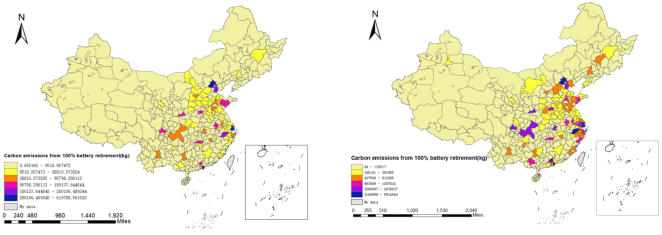
Environmental impact potential exhibits pronounced spatial heterogeneity and closely corresponds to the spatial distribution of retired battery mass. Using ArcGIS for regional-scale visualization,
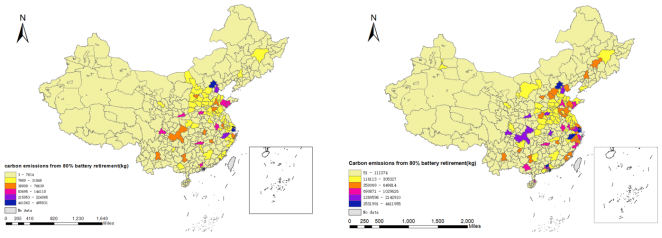
Figure 6 presents the spatial distribution of carbon emissions generated by ternary lithium-ion battery recycling in China under the 100% recycling and treatment rate scenario for the years 2025 and 2031. Under this scenario, high carbon emission regions in 2025 are primarily concentrated in East China, North China, and South China. These regions are characterized by relatively advanced economic development, high penetration rates of new energy electric vehicles, and large BEV stocks. By 2031, the spatial extent of high-emission regions expands markedly, with an evident upward trend observed in Central China and adjacent areas. Under the 80% recycling and treatment rate scenario, overall emission levels are correspondingly reduced; however, the relative ranking and spatial pattern of hotspot regions remain largely unchanged. This indicates that regional disparities are mainly driven by the scale of battery retirement and regional BEV inventories, rather than by a single scenario parameter.
Specifically, it is projected that in 2025, the number of fully retired battery electric vehicles in North China will exceed 220,000 units. Based on an average mass of 350 kg for ternary lithium-ion batteries used in passenger and commercial vehicles in recent years, the annual carbon emissions associated with recycling retired batteries in this region are estimated to reach approximately 430,000 tonnes. Provinces with relatively high carbon emissions in North China include Beijing, Tianjin, and Shanxi. In East China, annual carbon emissions are projected to exceed 770,000 tonnes, with Shanghai, Shandong, and Zhejiang being the major contributing provinces. In South China, annual carbon emissions are estimated at more than 340,000 tonnes, with Guangdong Province accounting for the largest share. Regions with intermediate carbon emission levels include the three provinces of Northeast China, while regions with relatively low emissions include the Ningxia Hui Autonomous Region, Qinghai Province, the Xinjiang Uygur Autonomous Region, and the Tibet Autonomous Region.
Figure 6. Regional distribution map of carbon emissions generated in 2025 and 2031 (100% recycling rate).
In 2028, the three regions with the highest carbon emissions are projected, in descending order, to be East China, South China, and North China. In East China, the number of fully retired battery electric vehicles is expected to exceed 1.41 million units, approximately twice the projected retirement volume in 2025, resulting in carbon emissions of about 2.79 million tonnes. In South China, fully retired battery electric vehicles are projected to reach more than 850,000 units, corresponding to carbon emissions of approximately 1.68 million tonnes. In North China, fully retired battery electric vehicles are projected to reach around 740,000 units, with carbon emissions of approximately 1.46 million tonnes.
By 2031, regions with high carbon emissions increase markedly in both number and magnitude. Carbon emissions in North China, Central China, East China, South China, and Southwest China are projected to be substantially higher than those in Northwest and Northeast China. The region with the highest emissions is expected to reach up to 12 million tonnes, while even the lowest-emitting regions are projected to reach approximately 780,000 tonnes. These results indicate that, alongside the large-scale retirement of ternary lithium-ion batteries, it will be essential to implement rational and effective measures to minimize the environmental impacts associated with battery recycling by 2031. Under the 80% recycling and treatment rate scenario, regional carbon emissions across China are illustrated in
Figure 7.
Figure 7. Regional distribution map of carbon emissions generated in 2025 and 2031 (80% recycling rate).
3.3.2. Environmental Impact Potential Analysis
Beyond GWP, the multi-indicator results further reveal differentiated regional emphases across environmental dimensions. In provinces with relatively large retirement volumes, indicators such as human toxicity (HT) and acidification potential (AP) are also more likely to exhibit high-value clustering. This suggests that these regions not only need to expand recycling capacity but must simultaneously strengthen chemical management in the hydrometallurgical stage and enhance wastewater and exhaust-gas treatment capabilities, to avoid a proportional amplification of pollution burdens driven by scale expansion.
An assessment of the environmental impact potential of retired power batteries in China during 2025-2031 indicates that, within the overall combined process, human toxicity (HT) contributes the largest share based on inventory-contribution results. The combined pyrometallurgical-hydrometallurgical route integrates high-temperature thermal treatment and hydrometallurgical processing, both of which may release hazardous emissions. In the first stage, high-temperature combustion or smelting enables the separation and recovery of hazardous constituents in lithium-ion batteries, including metals such as cobalt, nickel, and lithium; during this process, harmful emissions such as nitrogen oxides, sulfur oxides, and metal-containing particulates may be released. In the second stage, acidic or alkaline solutions are applied to treat the solid residues generated after thermal treatment, allowing further extraction of valuable metals; during hydrometallurgical operations, soluble metals and chemical substances (e.g., sulfates) may be generated and enter effluents.
Under the 100% recycling and treatment rate scenario, the annual cumulative HT impacts associated with processing retired ternary battery cells in 2025 are equivalent to emissions of 7.94×10⁴ kg 1,4-DCB in North China, 1.42×10⁵ kg 1,4-DCB in East China, and 6.21×10⁴ kg 1,4-DCB in South China. By 2031, the corresponding annual cumulative impacts in East China, Central China, and South China are equivalent to 2.18×10⁶ kg 1,4-DCB, 6.86×10⁵ kg 1,4-DCB, and 1.06×10⁶ kg 1,4-DCB, respectively. Provinces exhibiting relatively large impacts in acidification and eutrophication include Zhejiang, Guangdong, Shandong, Jiangsu, and Henan.
4. Conclusions
This study investigates the retirement surge of ternary lithium-ion batteries across 31 provincial-level administrative regions in China (provinces, autonomous regions, and municipalities) during 2025-2031, using an integrated framework linking “spatiotemporal retirement distribution—environmental burdens of recycling processes—regional disparities in environmental impacts.” The proposed approach characterizes the spatiotemporal heterogeneity of retirement scale and environmental impact potential at the provincial level and identifies dominant contributing sources within the recycling process. On this basis, corresponding recommendations are proposed for future recycling process optimization and regional planning of battery retirement and recycling in China. The main conclusions are as follows:
With the advent of the large-scale retirement wave of ternary lithium-ion batteries, China’s annual power battery retirement volume is projected to increase substantially year by year from 2025 to 2031. High-retirement regions in 2025 are expected to be concentrated in North China, East China, and South China. By 2031, Central China is projected to emerge as an additional high-retirement region, with a retirement scale comparable to that of North China. Across the seven geographic regions, the total carbon emissions of high-emission regions are estimated to reach 1.54 million tonnes in 2025 and rise to 12 million tonnes by 2031. In the subsequent development of the battery industry, managing retired batteries will become a major challenge, and associated environmental pressures will intensify. Accordingly, recycling capacity and logistics systems should be expanded and optimized in advance.
Within the combined pyrometallurgical-hydrometallurgical recycling process, environmental burdens are particularly pronounced for indicators such as GWP and HT. Energy-related processes dominate contributions to GWP, whereas inputs of key chemicals and wastewater treatment in the hydrometallurgical stage are more sensitive drivers of HT, AP, and EP. This implies that process upgrades should prioritize reducing energy intensity and optimizing the reagent system in the hydrometallurgical stage, alongside strengthening waste (wastewater, waste gas, and solid waste) treatment capacity. For the pyrometallurgical stage, waste-heat recovery systems could be deployed to reuse waste heat generated during thermal treatment, thereby reducing external energy demand and further lowering carbon emissions. For the hydrometallurgical stage, optimizing reagent selection and dosage can contribute to emission reductions, and efforts should be made to rationalize chemical use and reduce reliance on toxic solvents. Across the entire recycling chain, advanced wastewater and exhaust-gas treatment technologies should be enhanced to ensure high removal efficiencies for hazardous substances.
Provincial-scale impact potential results indicate that multi-indicator environmental impact potentials are highly consistent with the spatial distribution of retirement volumes. Provinces with large retirement quantities require not only increased processing capacity but also simultaneous improvements in pollution control capability and environmental performance management. For regions expected to experience substantial incremental retirement volumes in the future, early deployment of compliant recycling enterprises and cross-regional coordination mechanisms is recommended to reduce additional risks associated with transportation and non-compliant disposal. In light of the projected environmental impacts of battery recycling over the next eight years and information released by the Ministry of Industry and Information Technology (MIIT), as of 2024, there are 156 enterprises listed as meeting the “Industry Normative Conditions for the Comprehensive Utilization of Waste Power Batteries for New Energy Vehicles,” with most concentrated in North and East China. Increasing the number of qualified enterprises in South and Central China could reduce cross-regional transport demand and mitigate environmental impacts associated with non-standard recycling practices such as extensive dismantling.





 Share This Article
 Twitter
 Linked In
 Facebook
 Copy
Copy Download