Abstract
Against the backdrop of profound global trade restructuring and rapid digital advancement, Customs regulatory systems are transforming from traditional models to intelligent, ecosystem-based frameworks. This study investigates how smart Customs ecosystem construction drives enterprises' new quality productivity. Utilizing cross-sectional data from China's 31 provincial regions, the research constructs core indicators including AEO enterprise penetration rate and employs univariate linear regression to empirically examine multidimensional impacts across technological innovation, resource utilization, environmental management, digitalization, and economic structure. Results demonstrate that smart Customs construction significantly enhances trade digitalization index (coefficient: 0.8616, p<0.01) and shows notable effects on energy consumption intensity, industrial SO₂ emissions, and specific digital infrastructure domains. However, its influence on high-tech industries and most economic structure variables remains limited. The study identifies four core mechanisms: data connectivity, intelligent prediction, ecological collaboration, and rule optimization. These mechanisms effectively elevate enterprises' new quality productivity by reducing institutional transaction costs, accelerating cross-border innovation flows, stimulating innovation vitality, and creating new growth points. The research proposes policy recommendations including strengthening top-level design, deepening data engineering, optimizing precise services, and improving support systems. These measures aim to overcome practical challenges through institutional innovation and technology integration, providing theoretical foundations and actionable pathways for smart Customs to empower enterprise development, offering valuable insights for achieving the "smart Customs for a strong nation" strategic vision.
Keywords
Smart Customs Construction, Enterprises' New Quality Productivity, Ecological Collaboration, Data Connectivity,
Institutional Innovation
1. Introduction
Amid profound global trade restructuring and rapid digital advancement, Customs regulatory systems are undergoing a historic transformation from traditional models toward intelligent, ecosystem-based frameworks. President Xi Jinping's vision of "smart Customs, intelligent borders, and interconnected sharing" not only charts the course for Customs modernization but also serves as a core engine driving trade facilitation and industrial upgrading. As the micro-foundation of high-quality economic development, enterprises' new quality productivity depend on the synergistic advancement of technological innovation, institutional reform, and ecological optimization. Smart Customs construction establishes a data-driven regulatory ecosystem that deeply integrates Customs supervision data with enterprises' production and operation information, offering novel solutions to reduce institutional transaction costs and accelerate cross-border innovation flows
.
While existing research has yielded substantial outcomes in digital economy empowerment, ESG governance, and regulatory innovation, quantitative studies on the relationship between smart Customs construction and enterprises' new quality productivity remain limited. International experiences demonstrate significant potential: U.S. Customs leveraged AI to improve clearance efficiency by 40%, while Japan reduced trade compliance costs by 25% through intelligent solutions. However, China's smart Customs development faces bottlenecks in systemic coordination, data circulation, and service precision. Inter-departmental data barriers create regulatory gaps, the "digital divide" constrains inclusive ecosystem development for small and medium enterprises, and institutional innovation lags behind technological iteration—all diminishing smart Customs' empowerment effects.
This study systematically examines smart Customs' impact on enterprises' new quality productivity through a comprehensive framework of 15 indicators. Its theoretical value lies in revealing the intrinsic logic of technology-institution-ecology co-evolution, while its practical significance provides quantitative evidence and policy references for addressing "data silos" and "service delays." The research enriches empirical analytical frameworks in smart Customs development and offers crucial insights for cultivating new quality productivity through institutional innovation and technological integration toward the strategic goal of "building a strong Customs nation.
2. Literature Review
2.1. Research on Smart Customs Construction
Since President Xi Jinping proposed the concept of "Smart Customs, Intelligent Borders, and Shared Connectivity," research on "Smart Customs" has emerged like mushrooms after rain. Specifically, existing studies mainly focus on the following aspects:
Firstly, the application of advanced technologies in smart customs construction. For instance, large-scale model technology can be used to build a customs "smart brain," promoting the intelligent upgrading of customs
| [3] | Huang, S. J., Wu, Z. G., Li, X., et al. (2025). Exploration and Research on the Application of Large Model Technology in Smart Customs Construction. China Port Science and Technology, 7(5), 4-7. |
[3]
; in the future, integrating digital twin technology with blockchain technology, human-machine collaboration, big data language models, etc., can facilitate customs' adaptive supervision, intelligent supervision, precise supervision, and efficient supervision
| [4] | Xiao, Y., Le, H., Jiang, Y. D., et al. (2023). Application Exploration of Digital Twin in Smart Customs Logistics Supervision. China Port Science and Technology, 5(10), 71-78. |
[4]
. Secondly, the enlightenment of international experiences and lessons in smart customs construction for China. For example, U.S. Customs has enhanced trade security and customs clearance facilitation by promoting the application of disruptive technologies such as artificial intelligence in image recognition and robotic process automation
| [5] | Customs Technology Application Research Project Group, Zhang, J. Q., Wang, Y. L., et al. (2024). Application of Artificial Intelligence in US Customs and Its Enlightenment to China's Smart Customs Construction. China Customs, (9), 89-91. |
[5]
; Japan Customs focuses on four dimensions—providing intelligent solutions, information sharing, enhancing management resilience, and strengthening technical and talent support—to achieve goals in security, taxation, and trade
| [6] | Zhang, Y. J., Meng, L., Sun, X. X. (2023). International Experience Reference and Enlightenment of Smart Customs Construction. China Customs, (10), 88-89. |
[6]
. Thirdly, institutional innovation from the perspective of smart customs, such as effective connection between smart customs construction and international customs governance rules
| [7] | Meng, L. (2024). Research on Effective Connection between Smart Customs Construction and International Customs Governance Rules. Customs and Economic & Trade Research, 45(5), 46-55. |
[7]
, and smart customs facilitating the implementation of the AEO (Authorized Economic Operator) system
| [8] | Haiyan AEO Project Group, Liu, C. B., Ji, Y. (2024). Smart Customs Helps Implement AEO System: Hotspot Analysis of the 6th Global AEO Conference of the World Customs Organization (Part 2). China Customs, (7), 82-83. |
[8]
.
2.2. Research on Enterprise New Quality Productivity
Current research on enterprise new quality productivity mainly concentrates on three aspects
:
Firstly, the relationship between digital economy and enterprise new quality productivity. The rapid development of the digital economy provides a technological foundation for the transformation and development of new quality productivity across various industries. On one hand, the development of the digital economy has rapidly increased the scale of industrial digitalization to 43.8 trillion yuan
| [2] | Dong, Q., Tan, W. J., Zheng, J. Y., et al. (2025). Integration of Digital and Real Industry Technology and Enterprise New Quality Productivity: New Evidence Based on Machine Learning and Text Analysis. Journal of Shanghai University of Finance and Economics, 27(3), 18-33.
https://doi.org/10.16538/j.cnki.jsufe.2025.03.002 |
| [10] | China Academy of Information and Communications Technology. (2024). China Academy of Information and Communications Technology Releases "China Digital Economy Development Research Report (2024)" [EB/OL]. (2024-08-28) [2026-01-15]. https://www.sohu.com/a/804460895_478183 |
[2, 10]
; on the other hand, it has also shown significant effects in promoting industrial carbon reduction
| [11] | Yuan, R. X., Wang, C. Q., Masron, T. A., et al. (2024). Digital Economy Empowerment on Carbon Emission Reduction: An Analysis of Spatial Spillover Effects Based on Temporal Heterogeneity. Applied Economics, 1-15.
https://doi.org/10.1080/00036846.2024.2364924 |
[11]
. Theoretically, the integration of the digital economy and the real economy can not only help the real economy break away from traditional high-consumption, high-emission growth patterns but also give rise to new digital business forms and industrial models. Practically, the integration of China's digital economy and real economy is still in its initial stage. To further promote this integration, it is necessary to Firstly incorporate digital elements into the technological innovation process
and digitally transform traditional technologies
| [13] | Huang, X. H., Gao, Y. X. (2023). Integration of Digital and Real Industry Technology and Enterprise Total Factor Productivity: Research Based on Chinese Enterprise Patent Information. China Industrial Economy, (11), 118-136.
https://doi.org/10.19581/j.cnki.ciejournal.2023.11.019 |
[13]
, thereby achieving technological integration between digital economy industries and real economy industries. In this process, enterprises, as micro-level entities operating within the real economy, are not only practical carriers of technology integration between digital and real industries
but also the focal points for developing new quality productivity at the micro level.
Secondly, research related to ESG (Environmental, Social, and Governance). Song Jia and Zhang Jinchang
| [16] | Song, J., Zhang, J. C., Pan, Y. (2024). Research on the Impact of ESG Development on Enterprise New Quality Productivity: Empirical Evidence from China's A-share Listed Enterprises. Contemporary Economic Management, 46(6), 1-11.
https://doi.org/10.13253/j.cnki.ddjjgl.2024.06.001 |
[16]
found that ESG development can improve relationships between enterprises and stakeholders, reduce intermediate product costs and debt financing costs, and increase institutional shareholding ratios, thereby promoting the improvement of enterprise new quality productivity. Research by scholars such as Cui Hongkai
| [17] | Cui, H. K. (2024). Mechanism Analysis of ESG Investment Empowering High-Quality Development of Private Enterprises. Technology Economics and Management Research, (5), 147-152. |
[17]
indicates that ESG investment promotes productivity improvements in private enterprises by alleviating financing constraints, reducing financial risks, and enhancing enterprise innovation capabilities. Strong ESG performance not only enhances corporate innovation output but also optimizes the innovation structure and boosts innovation efficiency
. Additionally, research by scholars such as Sheng Mingquan and Li Zhijie
| [19] | Sheng, M. Q., Li, Z. J., Wang, S. (2024). ESG Information Disclosure and Enterprise Total Factor Productivity. Statistics and Information Forum, 39(8), 88-100. |
[19]
points out that ESG information disclosure can improve innovation output, enhance employee trust levels, and optimize enterprise human capital structure, thus boosting enterprise new quality productivity. Li Jinglin
| [20] | Li, J. L., Yang, Z., Chen, J. (2024). How Does ESG Performance Empower Enterprise Green Technology Innovation? Micro-evidence from Chinese Listed Companies. Journal of Management Engineering, 38(5), 1-17.
https://doi.org/10.13587/j.cnki.jieem.2024.05.001 |
[20]
further emphasizes that ESG enhances enterprise new quality productivity by strengthening environmental protection investment, improving internal control quality, and promoting green technology innovation in enterprises.
Thirdly, the relationship between government regulatory innovation and enterprise new quality productivity. The improvement of enterprise new quality productivity results from the interaction of multiple institutional factors, with the government playing an important guiding role. When the government can both guide enterprises to recognize the importance of investing in innovation activities to drive transformation and upgrading, and provide subsidies to help enterprises overcome resource constraints, government logic can lead enterprises to develop high-level new quality productivity
| [21] | Shi, D. W., Cheng, D. J., Lai, X. P. (2025). Path to Enhance Enterprise New Quality Productivity under the Framework of Institutional Complexity: Taking Specialized, Refined, Distinctive and New Small Giant Listed Enterprises as an Example. Journal of Capital University of Economics and Business, 27(2), 13-30.
https://doi.org/10.13504/j.cnki.issn1008-2700.2025.02.002 |
[21]
. Scholars such as Cui Qingbo
| [22] | Cui, Q. B., Yu, H. Y. (2024). Construction of Free Trade Pilot Zones and Development of Enterprise New Quality Productivity. Western Forum, 34(6), 1-16. |
[22]
, from the perspective of free trade zone construction, believe that it can improve employee quality, enhance production tools, expand labor objects, optimize factor allocation in enterprises, and promote the development of enterprise new quality productivity by alleviating financing constraints and reducing institutional costs through institutional innovation. Scholars such as Wu Kaiya
further point out that the construction of free trade zones can empower enterprise new quality productivity by promoting digital transformation and advancing marketization. Scholars such as Yang Zhian
| [24] | Yang, Z. A., Hou, Y. W. (2025). Fiscal Subsidies, Tax Preferences and Cultivation of Enterprise New Quality Productivity: From the Perspective of Synergistic Effect Analysis [J/OL]. Modern Finance and Economics (Journal of Tianjin University of Finance and Economics), (9), 25-40 [2025-08-31].
https://doi.org/10.19559/j.cnki.12-1387.2025.09.002 |
[24]
, from the perspective of government fiscal and tax policies, indicate that fiscal subsidies and tax incentives promote enterprise new quality productivity development by alleviating financing constraints, reducing speculative behavior, enhancing external attention, and optimizing resource allocation; moreover, their combined implementation has significant synergistic promoting effects. Scholars such as Dong Qi
found that the government can promote enterprise new quality productivity development by opening data, alleviating information asymmetry between government and enterprises, and enhancing enterprise resource acquisition capabilities.
2.3. Literature Review Comments
Current research on enterprise new quality productivity has accumulated a rich body of literature, with many studies focusing on government regulatory institutional innovation and enterprise new quality productivity, conducting rigorous quantitative analyses. Meanwhile, existing literature on smart customs construction has deeply explored practical needs and challenges of domestic customs operations from perspectives such as advanced technology applications, international experiences and lessons, and institutional innovation under the smart customs framework, proposing a series of practical policy recommendations. However, few studies have quantitatively examined the intrinsic connections between smart customs construction and enterprise new quality productivity to directly measure the effectiveness of smart customs construction. Based on this gap, this paper attempts to construct indicators related to smart customs construction, propose theoretical logic and implementation pathways for smart customs construction driving the enhancement of enterprise new quality productivity, and verify them through empirical analysis. Accordingly, it offers relevant policy recommendations to provide reference for promoting smart customs construction and the "Smart Customs and Strong Nation" initiative.
3. Mechanisms of Smart Customs Ecosystem in Empowering Enterprises' New Quality Productivity
Drawing on Coase's
| [28] | Coase, R. H. (1960). The Problem of Social Cost. Journal of Law and Economics, 3(1), 1-44. |
[28]
transaction cost theory and Akerlof's
| [29] | Akerlof, G. A. (1970). The Market for "Lemons": Quality Uncertainty and the Market Mechanism. The Quarterly Journal of Economics, 84(3), 488-500. |
[29]
information asymmetry theory, smart Customs reduces enterprises' institutional transaction costs and information search expenses through digital supervision, blockchain traceability, and multi-source data integration. This resolves the "lemons market" dilemma and enhances product premium capabilities. Combined with Arrow's
| [30] | Arrow, K. J. (1962). Economic Welfare and the Allocation of Resources for Invention. In R. R. Nelson (Ed.), The Rate and Direction of Inventive Activity: Economic and Social Factors (pp. 609-626). Princeton: Princeton University Press. |
[30]
innovation incentive model, such market premiums significantly increase expected returns on innovation activities, stimulating R&D investment and technological advancement. This mechanism propels enterprises toward a new quality productive force paradigm centered on data and knowledge, characterized by high technology, efficiency, and quality—evidenced by increased R&D personnel ratios, growth in green patents, and deepened digital transformation.
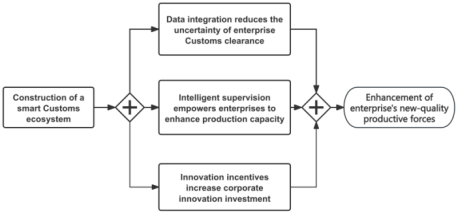
The smart Customs ecosystem functions as an integrated engineering framework rather than a standalone technical platform. Built upon efficient data element flow and supported by AI, IoT, and blockchain technologies, it optimizes Customs regulation and service logic through the organic coordination of nine landmark projects (including smart Customs business process systems, big data pools, and parameter databases). Its core empowering mechanisms include:
Firstly, data connectivity reduces Customs clearance uncertainty by breaking "information silos" and enabling interconnection between supervision data and enterprise production data. Through blockchain and IoT technologies, the ecosystem integrates heterogeneous cross-border trade data (logistics, Customs declaration, quality inspection, payment), forming high-quality, circulating data resources.
Enterprises leverage these to optimize production decisions, reduce information search costs, and redirect internal resources toward innovation activities.
Secondly, smart regulation enhances production capacity by reducing institutional transaction costs—the human, financial, material, and time resources required to fulfill foreign trade contracts. Through digital process reconstruction, AI image review, automated inspection, and paperless declaration, Customs as an institutional provider optimizes enterprise production scheduling and capacity utilization, thereby releasing innovation vitality.
Thirdly, innovation incentives increase R&D investment through blockchain traceability. Its distributed ledger and tamper-proof characteristics reduce information asymmetry in market transactions. Following Akerlof's theory, where information asymmetry drives out quality products, blockchain enables enterprises to transmit credible quality signals, allowing consumers to pay premiums for verifiable high-quality products (organic foods, advanced manufacturing). This premium mechanism directly enhances expected returns, providing economic incentives for innovation investment.
Figure 1. Mechanism of influence.
4. Empirical Analysis
4.1. Model, Variables, and Data Description
4.1.1. Model Specification
This study focuses on the impact of smart Customs construction on enterprises' new quality productivity enhancement, employing a univariate linear regression model to examine the linear relationship between a single independent variable and multiple dependent variables. Considering the research core is to identify the independent influence of smart Customs construction with cross-sectional data (31 provincial observations), the basic regression model is specified as follows:
where represents the dependent variable for province i (covering five categories of indicators reflecting enterprises' new quality productivity levels: scientific and technological innovation, resources, energy, environment, and digitalization); is the core independent variable (AEO enterprises number/goods import and export volume, hereafter referred to as "AEO enterprise penetration rate"); is the constant term; is the coefficient of the core independent variable; and ε_i is the random error term, satisfying classical assumptions.
4.1.2. Variable Definition
1) Core explanatory variable: AEO Enterprise Penetration Rate (X)
Measured as "number of provincial AEO enterprises/goods import and export volume (thousand USD)" to reflect the matching degree between regional AEO enterprise scale and foreign trade activities, denoted as "X".
2) Dependent variable system
This study selects 15 dependent variables across five dimensions to comprehensively examine the impact of AEO enterprise penetration rate (X) (smart Customs construction) on enterprises' new quality productivity. The specific classification is shown in
Table 1:
Table 1. Dependent Variable System.
Dimension | Indicator | Variable Name |
Science, Technology & Innovation | Regional authorized patents (number) | patent_count |
R&D funding of industrial enterprises above designated size (10,000 yuan) | rd_funding |
R&D personnel full-time equivalent of industrial enterprises above designated size (hours) | rd_labor |
High-tech industry business revenue (1,000 yuan) | hi_tech_income |
Energy, Resources & Environment | Energy consumption/GDP (%) | energy_intensity |
Industrial water consumption/GDP (m³/10,000 yuan) | water_intensity |
Comprehensive utilization of industrial solid waste/total generation (%) | solid_waste |
Industrial wastewater discharge/GDP (%) | waste_water |
Industrial SO2 emissions/GDP (%) | SO2_emission |
Digital Infrastructure | Optical cable line length/regional area | cable_density |
Total telecommunications business volume (100 million yuan) | telecom_revenue |
Internet broadband access ports (10,000 units) | broadband_ports |
Digital Economy Level | E-commerce sales volume/total import and export volume | digital_index |
Software business revenue (10,000 yuan) | software_revenue |
Integrated circuit output (100 million units) | ic_output |
4.1.3. Data Description
The research sample covers all 31 provincial administrative regions of China (excluding Hong Kong, Macao, and Taiwan), with data from 2021 statistics. Due to the unavailability of historical provincial AEO enterprise data (prior to 2025) on the General Administration of Customs website, 2025 data was used as a substitute for 2021 data. The scarcity of historical data on provincial AEO enterprises also resulted in a limited overall sample size. Data sources include China Statistical Yearbook, China Energy Statistical Yearbook, provincial statistical yearbooks, and the General Administration of Customs official website.
To eliminate interference from dimensional differences on regression results, all currency and scale variables (such as industrial innovation funding, trade volume) underwent standardization processing (Min-Max standardization, with values ranging between 0-1 after processing) to ensure coefficient comparability. Percentage indicators (such as emission intensity) retained their original values to directly reflect resource and environmental consumption levels per unit of GDP. The sample had minimal missing values, with extremely few missing values standardized to 0.
4.1.4. Descriptive Statistics Results
Table 2. Descriptive Statistics.
Variable | Obs | Mean | Std. dev. | Min | Max |
patent_count | 31 | 0.163 | 0.222 | 0.000 | 1.000 |
rd_funding | 31 | 0.194 | 0.249 | 0.000 | 1.000 |
rd_labor | 31 | 0.174 | 0.251 | 0.000 | 1.000 |
hi_tech_income | 31 | 0.189 | 0.222 | 0.000 | 1.000 |
energy_intensity | 30 | 0.062 | 0.043 | 0.011 | 0.175 |
water_intensity | 31 | 0.083 | 0.053 | 0.007 | 0.213 |
solid_waste | 31 | 62.774 | 22.401 | 8.904 | 100.390 |
waste_water | 31 | 0.049 | 0.041 | (0.012) | 0.184 |
SO2_emission | 31 | 0.000 | 0.000 | 0.000 | 0.000 |
cable_density | 31 | 0.169 | 0.192 | 0.000 | 1.000 |
telecom_revenue | 31 | 0.261 | 0.215 | 0.000 | 1.000 |
broadband_ports | 31 | 0.334 | 0.244 | 0.000 | 1.000 |
digital_index | 31 | 0.066 | 0.177 | 0.000 | 1.000 |
software_revenue | 31 | 0.153 | 0.246 | (0.000) | 1.000 |
ic_output | 31 | 0.098 | 0.215 | (0.000) | 1.000 |
X | 31 | 0.109 | 0.189 | 0.000 | 1.000 |
4.2. Empirical Results Analysis: Basic Regression Analysis
4.2.1. Core Variable Impact Effects
1) Economic structure and industrial development: The coefficients of AEO enterprise penetration rate on four variables including regional industrial enterprise numbers and R&D funding of industrial enterprises above designated size are all negative (-0.3228~-0.2721), but none are significant. All model constant terms are significantly positive at the 1% level (0.1923~0.2294).
2) Energy and environment: Only energy consumption intensity (0.0775, p<0.1) and industrial SO₂ emissions (0.0000, p<0.05) show significant positive impacts; the remaining three variables' coefficients are not significant; constant terms are significantly positive at the 1% level.
3) Digital infrastructure: Total telecommunications business volume (-0.4346, p<0.05) and Internet broadband access ports (-0.5327, p<0.05) show significant negative impacts; optical cable density coefficient is not significant; constant terms are significantly positive at the 1% level.
4) Digital economy level: Only trade-related indicators show significant positive impact (0.8616, p<0.01), with the largest absolute coefficient value; software industry revenue and integrated circuit production coefficients are negative and insignificant; the trade-related indicator's constant term is significantly negative at the 10% level, while the other two are significantly positive at the 1% or 5% levels.
Table 3. Basic Regression Results.
Depen Depend-ent Vari-able | Coefficient of X | Std. Err. | Constant | Constant Std. Err. | N | r2 |
patent_count | -0.272 | -0.213 | 0.192*** | -0.046 | 31 | 0.054 |
rd_funding | -0.323 | -0.238 | 0.229*** | -0.051 | 31 | 0.060 |
rd_labor | -0.298 | -0.241 | 0.206*** | -0.052 | 31 | 0.050 |
hi_tech_income | -0.313 | -0.210 | 0.223*** | -0.045 | 31 | 0.071 |
energy_intensity | 0.078* | -0.041 | 0.052*** | -0.009 | 31 | 0.112 |
water_intensity | -0.032 | -0.051 | 0.086*** | -0.011 | 31 | 0.013 |
solid_waste | -29.071 | -21.360 | 65.931*** | -4.596 | 31 | 0.060 |
waste_water | 0.005 | -0.040 | 0.049*** | -0.009 | 31 | 0.001 |
SO2_emission | 0.000** | 0.000 | 0.000*** | 0.000 | 31 | 0.158 |
cable_density | -0.259 | -0.183 | 0.197*** | -0.039 | 31 | 0.065 |
telecom_revenue | -0.435** | -0.196 | 0.308*** | -0.042 | 31 | 0.146 |
broadband_ports | -0.533** | -0.218 | 0.392*** | -0.047 | 31 | 0.170 |
digital_index | 0.862*** | -0.069 | -0.028* | -0.015 | 31 | 0.842 |
software_revenue | -0.307 | -0.236 | 0.186*** | -0.051 | 31 | 0.056 |
ic_output | -0.197 | -0.208 | 0.120** | -0.045 | 31 | 0.030 |
4.2.2. Goodness of Fit
Only the trade digitalization index shows extremely high goodness of fit (r2=0.8423); four models including industrial SO₂ emissions and total telecommunications business volume have r2_a between 0.1~0.2; the remaining ten models have r2_a below 0.1, with some negative values, indicating weak explanatory power.
4.2.3. Preliminary Conclusions
AEO enterprise penetration rate demonstrates strong positive promotion effects on the trade digitalization index, significant impacts on some energy environment and digital infrastructure variables, but insignificant effects on most economic structure and high-tech industry variables. Additionally, the model exhibits vastly different explanatory power across variables. Therefore, smart Customs construction demonstrates a positive influence on enhancing enterprises' digital new quality productivity.
5. Policy Recommendations
To effectively address the aforementioned bottlenecks and implement the smart Customs construction project, transforming it into a powerful engine that activates enterprises' new quality productivity, the following policy measures are recommended:
5.1. Strengthen Top-level Coordination and Establish an Ecosystem Collaborative Operation Mechanism Firstly, establish a Smart Customs Construction and Operation Center. At the General Administration level, coordinate the smart Customs ecosystem, unify data standards and interfaces, technical platform architecture, and evaluation systems. Clearly define the roles, tasks, and interface specifications of each engineering department within the smart Customs "ecosystem" to ensure its integrity and coordination.
Secondly, implement a "Project List Management System for Engineering Collaboration." For key tasks involving cross-engineering collaboration (such as joint Customs-enterprise risk warning systems and industrial chain visualization), establish special coordination groups that clearly designate leading projects, collaborating units, and task deadlines, promoting "mutual recognition of needs, co-construction of scenarios, and shared results."
Thirdly, develop guidelines for rights, responsibilities, and incentives for participants in the smart Customs ecosystem. Clearly define the responsibility boundaries, contribution measurement standards, and benefit-sharing mechanisms (such as data contribution points, priority access to services) for participating entities including government departments, core enterprises, industry associations, and technical service providers, stimulating the ecosystem's self-organizing vitality.
5.2. Deepen Data Engineering and Facilitate Secure Data Flow Between Customs and Enterprises
Firstly, enhance the value of Customs data elements. Relying on the "Big Data Pool" project, deeply integrate internal and external data resources, and legally explore establishing an authorized data opening list for core enterprises with new quality productivity. Under the premise of ensuring security and privacy, promote conditional sharing of enterprise supply chain logistics data, key node status data, and Customs regulatory data.
Secondly, build a digital profiling platform for enterprises with new quality productivity. Integrate enterprise compliance history, technical patents, supply chain connectivity, green credit information, and other data to construct dynamically updated enterprise profiles. Based on this foundation, provide qualified new quality productivity enterprises with personalized tariff guarantee schemes, customized control and inspection rules, and exclusive policy consultation channels.
Thirdly, establish a cross-border industrial chain risk warning and collaborative response system. Utilize big data analysis and AI simulation to provide early warnings for potential risks (supply disruptions, technology controls, trade frictions) in cross-border links of key industrial chains (such as integrated circuits, new energy vehicles), and push collaborative response recommendations to relevant enterprises and government departments.
5.3. Focus on Precise Services to Enhance Customs Clearance Convenience for Enterprises with New Quality Productivity
Firstly, launch a "new quality productivity Dedicated Channel." Establish virtual or physical "new quality channels" within the ecosystem. For certified enterprises engaged in key areas (biopharmaceutical R&D/production, advanced materials import/export, high-end equipment manufacturing maintenance) and their materials, implement a rapid Customs clearance mode featuring "one-stop" centralized processing, minimalist declaration, priority handling, and mutual recognition of results.
Secondly, promote the integration of small and medium enterprises into supply chains and networks. Through the smart Customs public service platform, aggregate high-quality Thirdly-party service resources (low-code compliance tools, inclusive SaaS applications, supply chain finance
| [27] | Economic Daily. (2020). People's Bank and Other Departments Issue Documents to Regulate Supply Chain Finance Development: Core Enterprises Must Not Crowd Out the Interests of Small and Medium-sized Micro Enterprises [EB/OL]. (2020-09-23) [2026-01-15].
https://www.gov.cn/xinwen/2020-09/23/content_5546176.htm |
[27]
) to provide "move-in ready" service packages for small and medium enterprises, reducing their threshold and costs for integrating into the smart ecosystem.
Thirdly, establish a bidirectional intelligent matching mechanism between policies and enterprise needs. Utilize AI analysis to proactively and precisely push Customs duties, inspection and quarantine, trade control policies and interpretations that align with enterprises' industries, products, and business models to enterprises with new quality productivity. Simultaneously, establish an intelligent collection, rapid response, and feedback closed-loop mechanism for enterprise needs (pain points, suggestions).
5.4. Improve Support Systems and Accelerate Talent Development and Ecosystem Evaluation System Construction | [9] | Guo, C. X., Chen, X. Y., Peng, L. (2024). Research on New Quality Productivity Boosting Modern Industrial System Construction. Journal of Xi'an Jiaotong University (Social Sciences Edition), 1-15 [2024-04-03]. |
[9]
Firstly, implement a "Smart Customs + new quality productivity" compound talent development project. In collaboration with universities, research institutions, and enterprises, cultivate specialized talent teams who are proficient in both Customs operations and cutting-edge technologies while deeply understanding the development patterns of new quality productivity industries such as high-end manufacturing, biotechnology, and digital economy. These talents should be deployed to the frontlines of smart Customs construction.
Secondly, establish a dynamic evaluation indicator system for smart Customs construction empowering enterprises' new quality productivity. Set up an evaluation system with core indicators including enterprise satisfaction (Customs clearance efficiency, compliance costs, policy adaptability), scientific and technological innovation promotion (efficiency of cross-border innovation element flows), industrial chain resilience index, and the breadth and depth of ecological cooperation. Regularly publish reports to drive continuous optimization of engineering implementation.
6. Conclusion
Based on cross-sectional data from 31 provincial administrative regions, and using the penetration rate of AEO enterprises as the core indicator, this paper empirically examines the impact and mechanism of Smart Customs ecosystem construction on corporate new-quality productivity through a simple linear regression model. The study reveals that Smart Customs development exerts a significantly differentiated driving force on corporate new-quality productivity. It demonstrates the most prominent promotion effect on the Trade Digitalization Index (coefficient: 0.8616, p<0.01), yet its enabling effects in sectors such as high-tech industries are not obvious. The four core mechanisms—particularly data integration—are the key pathways through which this empowerment occurs. This research fills a gap in related quantitative studies and provides support for the implementation of relevant strategies. However, it has limitations regarding sample size and data availability. Future research could expand the sample, extend the time cycle, refine the enabling pathways, and explore dynamic correlations.
Abbreviations
ESG | Environmental, Social, and Governance |
AEO | Authorized Economic Operator |
GDP | Gross Domestic Product |
AI | Artificial Intelligence |
SaaS | Software as a Service |
Author Contributions
Yuxiong Guo: Conceptualization, Data curation, Writing – original draft, Project administration
He Xu: Investigation, Resources
Qi Feng: Funding acquisition, Writing – review & editing
Conflicts of Interest
The authors declare no conflicts of interest.
References
| [1] |
Hefei Customs. (2024). 10 Key Words to Help You Understand Smart Customs Construction [EB/OL]. (2024-03-18) [2026-01-15].
http://gdfs.customs.gov.cn/hefei_customs/479573/479574/5754484/index.html
|
| [2] |
Dong, Q., Tan, W. J., Zheng, J. Y., et al. (2025). Integration of Digital and Real Industry Technology and Enterprise New Quality Productivity: New Evidence Based on Machine Learning and Text Analysis. Journal of Shanghai University of Finance and Economics, 27(3), 18-33.
https://doi.org/10.16538/j.cnki.jsufe.2025.03.002
|
| [3] |
Huang, S. J., Wu, Z. G., Li, X., et al. (2025). Exploration and Research on the Application of Large Model Technology in Smart Customs Construction. China Port Science and Technology, 7(5), 4-7.
|
| [4] |
Xiao, Y., Le, H., Jiang, Y. D., et al. (2023). Application Exploration of Digital Twin in Smart Customs Logistics Supervision. China Port Science and Technology, 5(10), 71-78.
|
| [5] |
Customs Technology Application Research Project Group, Zhang, J. Q., Wang, Y. L., et al. (2024). Application of Artificial Intelligence in US Customs and Its Enlightenment to China's Smart Customs Construction. China Customs, (9), 89-91.
|
| [6] |
Zhang, Y. J., Meng, L., Sun, X. X. (2023). International Experience Reference and Enlightenment of Smart Customs Construction. China Customs, (10), 88-89.
|
| [7] |
Meng, L. (2024). Research on Effective Connection between Smart Customs Construction and International Customs Governance Rules. Customs and Economic & Trade Research, 45(5), 46-55.
|
| [8] |
Haiyan AEO Project Group, Liu, C. B., Ji, Y. (2024). Smart Customs Helps Implement AEO System: Hotspot Analysis of the 6th Global AEO Conference of the World Customs Organization (Part 2). China Customs, (7), 82-83.
|
| [9] |
Guo, C. X., Chen, X. Y., Peng, L. (2024). Research on New Quality Productivity Boosting Modern Industrial System Construction. Journal of Xi'an Jiaotong University (Social Sciences Edition), 1-15 [2024-04-03].
|
| [10] |
China Academy of Information and Communications Technology. (2024). China Academy of Information and Communications Technology Releases "China Digital Economy Development Research Report (2024)" [EB/OL]. (2024-08-28) [2026-01-15].
https://www.sohu.com/a/804460895_478183
|
| [11] |
Yuan, R. X., Wang, C. Q., Masron, T. A., et al. (2024). Digital Economy Empowerment on Carbon Emission Reduction: An Analysis of Spatial Spillover Effects Based on Temporal Heterogeneity. Applied Economics, 1-15.
https://doi.org/10.1080/00036846.2024.2364924
|
| [12] |
Hong, Y. X., Ren, B. P. (2023). Connotation and Approach of Deep Integration of Digital Economy and Real Economy. China Industrial Economy, (2), 5-16.
https://doi.org/10.19581/j.cnki.ciejournal.2023.02.001
|
| [13] |
Huang, X. H., Gao, Y. X. (2023). Integration of Digital and Real Industry Technology and Enterprise Total Factor Productivity: Research Based on Chinese Enterprise Patent Information. China Industrial Economy, (11), 118-136.
https://doi.org/10.19581/j.cnki.ciejournal.2023.11.019
|
| [14] |
Yuan, C., Xiao, T. S., Geng, C. X., et al. (2021). Digital Transformation and Enterprise Division of Labor: Specialization or Vertical Integration. China Industrial Economy, (9), 137-155.
https://doi.org/10.19581/j.cnki.ciejournal.2021.09.007
|
| [15] |
Liu, H. L., Li, K. (2024). Enterprise New Quality Productivity: Literature Review. Commercial Economy, (11), 156-160.
https://doi.org/10.19905/j.cnki.syjj1982.2024.11.038
|
| [16] |
Song, J., Zhang, J. C., Pan, Y. (2024). Research on the Impact of ESG Development on Enterprise New Quality Productivity: Empirical Evidence from China's A-share Listed Enterprises. Contemporary Economic Management, 46(6), 1-11.
https://doi.org/10.13253/j.cnki.ddjjgl.2024.06.001
|
| [17] |
Cui, H. K. (2024). Mechanism Analysis of ESG Investment Empowering High-Quality Development of Private Enterprises. Technology Economics and Management Research, (5), 147-152.
|
| [18] |
Liu, X. H., Chen, Y. (2024). ESG Performance and Enterprise Innovation: Based on the Moderating Effect of Green Financial Reform. Statistics and Decision, 40(7), 183-188.
https://doi.org/10.13546/j.cnki.tjyjc.2024.07.032
|
| [19] |
Sheng, M. Q., Li, Z. J., Wang, S. (2024). ESG Information Disclosure and Enterprise Total Factor Productivity. Statistics and Information Forum, 39(8), 88-100.
|
| [20] |
Li, J. L., Yang, Z., Chen, J. (2024). How Does ESG Performance Empower Enterprise Green Technology Innovation? Micro-evidence from Chinese Listed Companies. Journal of Management Engineering, 38(5), 1-17.
https://doi.org/10.13587/j.cnki.jieem.2024.05.001
|
| [21] |
Shi, D. W., Cheng, D. J., Lai, X. P. (2025). Path to Enhance Enterprise New Quality Productivity under the Framework of Institutional Complexity: Taking Specialized, Refined, Distinctive and New Small Giant Listed Enterprises as an Example. Journal of Capital University of Economics and Business, 27(2), 13-30.
https://doi.org/10.13504/j.cnki.issn1008-2700.2025.02.002
|
| [22] |
Cui, Q. B., Yu, H. Y. (2024). Construction of Free Trade Pilot Zones and Development of Enterprise New Quality Productivity. Western Forum, 34(6), 1-16.
|
| [23] |
Wu, K. Y., Hu, J., Li, Q. Y. (2025). Research on the Impact of Institutional Openness on Enterprise New Quality Productivity [J/OL]. Scientific Research Management, 1-14 [2025-08-31].
https://link.cnki.net/urlid/11.1567.G3.20250512.1557.002
|
| [24] |
Yang, Z. A., Hou, Y. W. (2025). Fiscal Subsidies, Tax Preferences and Cultivation of Enterprise New Quality Productivity: From the Perspective of Synergistic Effect Analysis [J/OL]. Modern Finance and Economics (Journal of Tianjin University of Finance and Economics), (9), 25-40 [2025-08-31].
https://doi.org/10.19559/j.cnki.12-1387.2025.09.002
|
| [25] |
Dong, Q., Tan, W. J., Xie, J. P., et al. (2025). Government Data Opening and Development of Enterprise New Quality Productivity. Research on Economics and Management, 46(3), 3-23.
https://doi.org/10.13502/j.cnki.issn1000-7636.2025.03.001
|
| [26] |
Ningbo Customs. (2025). China Gate Times: Using Customs Intelligence to Serve and Promote Chinese-style Modernization: Scan of Excellent Projects of Smart Customs Construction in 2024 (Part 1) [EB/OL]. (2025-02-11) [2026-01-15].
http://gdfs.customs.gov.cn/ningbo_customs/470749/470750/6360475/index.html
|
| [27] |
Economic Daily. (2020). People's Bank and Other Departments Issue Documents to Regulate Supply Chain Finance Development: Core Enterprises Must Not Crowd Out the Interests of Small and Medium-sized Micro Enterprises [EB/OL]. (2020-09-23) [2026-01-15].
https://www.gov.cn/xinwen/2020-09/23/content_5546176.htm
|
| [28] |
Coase, R. H. (1960). The Problem of Social Cost. Journal of Law and Economics, 3(1), 1-44.
|
| [29] |
Akerlof, G. A. (1970). The Market for "Lemons": Quality Uncertainty and the Market Mechanism. The Quarterly Journal of Economics, 84(3), 488-500.
|
| [30] |
Arrow, K. J. (1962). Economic Welfare and the Allocation of Resources for Invention. In R. R. Nelson (Ed.), The Rate and Direction of Inventive Activity: Economic and Social Factors (pp. 609-626). Princeton: Princeton University Press.
|
Cite This Article
-
APA Style
Guo, Y., Xu, H., Feng, Q. (2026). The Significance of the Construction of a Smart Customs Ecosystem in Driving the Enhancement of New Quality Productivity for Enterprises. International Journal of Economics, Finance and Management Sciences, 14(1), 109-118. https://doi.org/10.11648/j.ijefm.20261401.19
 Copy
|
Copy
|
 Download
ACS Style
Guo, Y.; Xu, H.; Feng, Q. The Significance of the Construction of a Smart Customs Ecosystem in Driving the Enhancement of New Quality Productivity for Enterprises. Int. J. Econ. Finance Manag. Sci. 2026, 14(1), 109-118. doi: 10.11648/j.ijefm.20261401.19
Copy
|
Download
AMA Style
Guo Y, Xu H, Feng Q. The Significance of the Construction of a Smart Customs Ecosystem in Driving the Enhancement of New Quality Productivity for Enterprises. Int J Econ Finance Manag Sci. 2026;14(1):109-118. doi: 10.11648/j.ijefm.20261401.19
Copy
|
Download
-
@article{10.11648/j.ijefm.20261401.19,
  author = {Yuxiong Guo and He Xu and Qi Feng},
  title = {The Significance of the Construction of a Smart Customs Ecosystem in Driving the Enhancement of New Quality Productivity for Enterprises},
  journal = {International Journal of Economics, Finance and Management Sciences},
  volume = {14},
  number = {1},
  pages = {109-118},
  doi = {10.11648/j.ijefm.20261401.19},
  url = {https://doi.org/10.11648/j.ijefm.20261401.19},
  eprint = {https://article.sciencepublishinggroup.com/pdf/10.11648.j.ijefm.20261401.19},
  abstract = {Against the backdrop of profound global trade restructuring and rapid digital advancement, Customs regulatory systems are transforming from traditional models to intelligent, ecosystem-based frameworks. This study investigates how smart Customs ecosystem construction drives enterprises' new quality productivity. Utilizing cross-sectional data from China's 31 provincial regions, the research constructs core indicators including AEO enterprise penetration rate and employs univariate linear regression to empirically examine multidimensional impacts across technological innovation, resource utilization, environmental management, digitalization, and economic structure. Results demonstrate that smart Customs construction significantly enhances trade digitalization index (coefficient: 0.8616, p<0.01) and shows notable effects on energy consumption intensity, industrial SO₂ emissions, and specific digital infrastructure domains. However, its influence on high-tech industries and most economic structure variables remains limited. The study identifies four core mechanisms: data connectivity, intelligent prediction, ecological collaboration, and rule optimization. These mechanisms effectively elevate enterprises' new quality productivity by reducing institutional transaction costs, accelerating cross-border innovation flows, stimulating innovation vitality, and creating new growth points. The research proposes policy recommendations including strengthening top-level design, deepening data engineering, optimizing precise services, and improving support systems. These measures aim to overcome practical challenges through institutional innovation and technology integration, providing theoretical foundations and actionable pathways for smart Customs to empower enterprise development, offering valuable insights for achieving the "smart Customs for a strong nation" strategic vision.},
 year = {2026}
}
Copy
|
Download
-
TY  - JOUR
T1  - The Significance of the Construction of a Smart Customs Ecosystem in Driving the Enhancement of New Quality Productivity for Enterprises
AU  - Yuxiong Guo
AU  - He Xu
AU  - Qi Feng
Y1  - 2026/02/27
PY  - 2026
N1  - https://doi.org/10.11648/j.ijefm.20261401.19
DO  - 10.11648/j.ijefm.20261401.19
T2  - International Journal of Economics, Finance and Management Sciences
JF  - International Journal of Economics, Finance and Management Sciences
JO  - International Journal of Economics, Finance and Management Sciences
SP  - 109
EP  - 118
PB  - Science Publishing Group
SN  - 2326-9561
UR  - https://doi.org/10.11648/j.ijefm.20261401.19
AB  - Against the backdrop of profound global trade restructuring and rapid digital advancement, Customs regulatory systems are transforming from traditional models to intelligent, ecosystem-based frameworks. This study investigates how smart Customs ecosystem construction drives enterprises' new quality productivity. Utilizing cross-sectional data from China's 31 provincial regions, the research constructs core indicators including AEO enterprise penetration rate and employs univariate linear regression to empirically examine multidimensional impacts across technological innovation, resource utilization, environmental management, digitalization, and economic structure. Results demonstrate that smart Customs construction significantly enhances trade digitalization index (coefficient: 0.8616, p<0.01) and shows notable effects on energy consumption intensity, industrial SO₂ emissions, and specific digital infrastructure domains. However, its influence on high-tech industries and most economic structure variables remains limited. The study identifies four core mechanisms: data connectivity, intelligent prediction, ecological collaboration, and rule optimization. These mechanisms effectively elevate enterprises' new quality productivity by reducing institutional transaction costs, accelerating cross-border innovation flows, stimulating innovation vitality, and creating new growth points. The research proposes policy recommendations including strengthening top-level design, deepening data engineering, optimizing precise services, and improving support systems. These measures aim to overcome practical challenges through institutional innovation and technology integration, providing theoretical foundations and actionable pathways for smart Customs to empower enterprise development, offering valuable insights for achieving the "smart Customs for a strong nation" strategic vision.
VL  - 14
IS  - 1
ER  -
Copy
|
Download





 Share This Article
 Twitter
 Linked In
 Facebook