
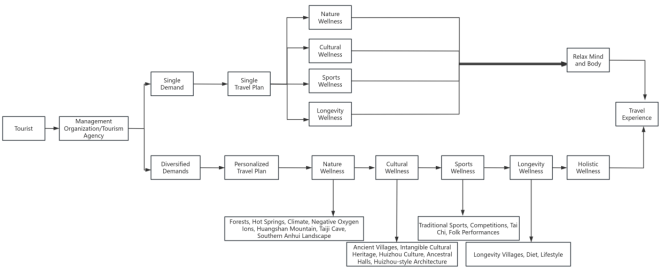
This study adopts a holistic and systematic perspective to construct a theoretical framework for the supply system of wellness tourism destinations. Based on a review of domestic and international research on wellness tourism supply, this paper summarizes the core components of the supply system and proposes the four-dimensional integrated model of Nature-Culture-Sports-Longevity (NCLS). The connotation of the NCLS model can be illustrated through the practice of Anhui Province: high-quality natural ecosystems provide the material foundation for wellness tourism development; Huizhou culture endows tourism products with profound cultural connotations and spiritual experiences; longevity-oriented wellness resources form differentiated competitiveness and attract tourists seeking health preservation; and diverse sports activities further enhance the effectiveness of wellness, promoting the physical and psychological coordination of tourists. The four dimensions interact synergistically and organically, jointly forming a destination supply system centered on comprehensive wellness experiences. This study addresses the limitations of existing research that often focus on single factors and overemphasize the demand side. It establishes a wellness tourism supply system more suitable for China’s local context, and can provide theoretical references and practical insights for the supply-side reform of wellness tourism destinations.
| Published in | International Journal of Economics, Finance and Management Sciences (Volume 14, Issue 2) |
| DOI | 10.11648/j.ijefm.20261402.11 |
| Page(s) | 119-129 |
| Creative Commons |
This is an Open Access article, distributed under the terms of the Creative Commons Attribution 4.0 International License (http://creativecommons.org/licenses/by/4.0/), which permits unrestricted use, distribution and reproduction in any medium or format, provided the original work is properly cited. |
| Copyright |
Copyright © The Author(s), 2026. Published by Science Publishing Group |
Wellness Tourism, Supply System, NCLS Model, Destination, Traditional Sports, Longevity Villages, Huizhou Culture
Dimension (First-Order Construct) | Code | Core Connotation | Anhui Practice Examples | Key Literatures |
|---|---|---|---|---|
Nature (N) | Anhui Natural Wellness | Natural capital such as negative ions, hot springs and climate comfort provides the base for "passive wellness" | High concentration of negative ions in Huangshan, water conservation, soil conservation and biodiversity in the Dabie Mountains of western Anhui and the mountainous areas of southern Anhui | Li, A., Li, Q., Yang, Y., Hu, Y., Xiao, S., Li, Z., & Zhou, B. (2024). Zhang, Y., Hu, Y., Liu, Y., Guo, H., Xue, F., Wang, Y., Hou, S., & Liu, J. (2024). Yun, J., Yao, W., Wang, X., Chen, F., & Wang, S. (2023). Tonggang, Z. (2024). Gou, R., Li, W., Yang, Y., Bai, J., Meng, Y., Wu, J., Ding, Y., Dai, Z., Shi, Q., Song, S., & Lin, G. (2020). Huang, M., Wang, Q., Yin, Q., Li, W., Zhang, G., Ke, Q., & Guo, Q. (2023). Liu, X.-Y., Liu, S.-L., Wei, H.-W., Wang, X.-W., Yu, J., Shen, S., & Zhou, L.-W. (2023). |
Culture (C) | Anhui Cultural Wellness | Regional cultural narration → emotional resonance → psychological restoration | Traditional living environment formed in the historical development of Hongcun and Xidi villages that is highly integrated with nature, Sizhou Opera and traditional martial arts culture, Huizhou culture carried by Huizhou architecture, Fish Lantern Night Tour, Xin'an Medicine | Huadong, G. (2013). Haiyan, X. (2019). Ting, X. (2013). Zheng, Y. C., & Yan, C. M. (2011). Qi Qingfu. (2009). Sang, Y., & Yang, J. (2023) |
Longevity (L) | Anhui Longevity Wellness | Centenarian communities + selenium-rich diet + slow life → demonstration effect | Shitai "selenium-rich meals + longevity village" sojournIn southern Anhui, priority is given to food that is mild, moist and easy to digest | Long, Z., Yuan, L., Hou, Y., Bañuelos, G. S., Liu, Y., Pan, L., Liu, X., & Yin, X. (2018). Li, B., Liu, X., Yu, T., Lin, K., Ma, X., Li, C., Yang, Z., Tang, Q., Zheng, G., Qin, J., & Wang, Y. (2024). Haidi, Z., Xue, M., Chenglong, W., Youhua, M., Guiyou, Z., Jing, W., & Tao, Z. (2017). Niu, J., Li, B., Zhang, Q., Chen, G., & Papadaki, A. (2024). |
Sport(S) | Anhui Sports Wellness | Integration and innovation of "sports + wellness" | Yecun Die Luohan (Stacking Arhats) in Yixian County, Chinese traditional physical and mental exercise methods such as Tai Chi and Qigong | Jahnke, R., Larkey, L., Rogers, C., Etnier, J., & Lin, F. (2010). Guo, Y., Shi, H., Yu, D., & Qiu, P. (2016). Cheng, M., Wang, Y., Wang, S., Cao, W., & Wang, X. (2023). |
NCLS | Nature-Culture-Sports-Longevity |
TCM | Traditional Chinese Medicine |
| [1] | Li, Q., Zakariya, Z., Cai, Y., & Bamiro, N. B. (2024). THE DEVELOPMENT AND CONCEPTUALIZATION OF WELLNESS TOURISM: A COMPARATIVE STUDY OF GLOBAL AND CHINESE PERSPECTIVES. Journal of Tourism, Hospitality and Environment Management, 9(37), 20–30. |
| [2] | Dini, M., & Pencarelli, T. (2021). Wellness tourism and the components of its offer system: a holistic perspective. Tourism Review, 77(2), 394–412. |
| [3] | Paraskevas, A., Madas, M., Zeimpekis, V., & Fouskas, K. (2024). Smart Ports in Industry 4.0: A Systematic Literature Review. Logistics, 8(1), 28. |
| [4] | Majiwala, H., & Kant, R. (2023). A bibliometric review of a decade’ research on industry 4.0 & supply chain management. Materials Today: Proceedings, 72, 824–833. |
| [5] | Tao, F., Xiao, B., Qi, Q., Cheng, J., & Ji, P. (2022). Digital twin modeling. Journal of Manufacturing Systems, 64, 372–389. |
| [6] | Wang, J., Behl, T., Rana, T., Sehgal, A., Wal, P., Saxena, B., Yadav, S., Mohan, S., Anwer, Md. K., Chigurupati, S., Zaheer, I., Shen, B., & Singla, R. K. (2024). Exploring the pathophysiological influence of heme oxygenase-1 on neuroinflammation and depression: A study of phytotherapeutic-based modulation. Phytomedicine, 127, 155466. |
| [7] | O’Neil, M. E., Nugent, S. M., Morasco, B. J., Freeman, M., Low, A., Kondo, K., Zakher, B., Elven, C., Motu’apuaka, M., Paynter, R., & Kansagara, D. (2017). Benefits and Harms of Plant-Based Cannabis for Posttraumatic Stress Disorder. Annals of Internal Medicine, 167(5), 332–340. |
| [8] | Lee, T. J., Han, J.-S., & Ko, T.-G. (2020). Health-Oriented Tourists and Sustainable Domestic Tourism. Sustainability, 12(12), 4988. |
| [9] | Kay Smith, M., & Diekmann, A. (2017). Tourism and wellbeing. Annals of Tourism Research, 66, 1–13. |
| [10] | Liao, C., Zuo, Y., Xu, S., Law, R., & Zhang, M. (2023). Dimensions of the health benefits of wellness tourism: A review. Frontiers in Psychology, 13. |
| [11] | Kongtaveesawas, N., Prasarnphanich, P., Sinthupinyo, S., & Ashton, A. S. (2022). Attribute Framework Validation for Wellness Tourism within the Context of Thailand. Sustainability, 14(10), 5953. |
| [12] | DSouza, K. J., & Shetty, A. (2024). Tourism and wellbeing: curating a new dimension for future research. Cogent Social Sciences, 10(1). |
| [13] | Wang, G., Ren, L., Qiu, H., & Yao, Y. (2022). Salient health goal, salient restoration? A transformative model of wellness tourism. Journal of Travel & Tourism Marketing, 39(7–9), 591–608. |
| [14] | Jevtić, M., Gajić, T., & Vukolić, D. (2024). Theoretical review and literature analysis of the role of the environment in health tourism. Turisticko Poslovanje, 34, 69–79. |
| [15] | Pessot, E., Spoladore, D., Zangiacomi, A., & Sacco, M. (2021). Natural Resources in Health Tourism: A Systematic Literature Review. Sustainability, 13(5), 2661. |
| [16] | Schmude, J., Pillmayer, M., Witting, M., & Corradini, P. (2021). Geography Matters, But Evolving Success Factors for Nature-Oriented Health Tourism within Selected Alpine Destinations. International Journal of Environmental Research and Public Health, 18(10), 5389. |
| [17] | Ahn, Y., & Kim, K. B. (2024). Understanding the Interplay between Wellness Motivation, Engagement, Satisfaction, and Destination Loyalty. Behavioral Sciences, 14(3), 239. |
| [18] | Jeong, H. (2024). Relationship Between Tourists’ Perceived Restorative Environment and Wellness Tourism Destinations. International Journal of Tourism Research, 26(5). |
| [19] | Liao, C., Tian, D., Law, R., Xu, S., & Zhang, M. (2023). Research on the spatial distribution and driving mechanism of the integrated development of the health tourism industry. Asia Pacific Journal of Tourism Research, 28(12), 1399–1416. |
| [20] |
Zhao, Y. (2022). Research on the Development of Traditional Chinese Medicine Health
https://doi.org/Tourism.10.0410/cata/8779c27e1316eb7584271425376a5981 |
| [21] | Yan, L. (2024). A systematic review of traditional health tourism: A priori of wellness tourism. Multidisciplinary Reviews, 7(5), 2024096. |
| [22] | Sun, S., Zhong, L., Law, R., Li, X., Deng, B., & Yang, L. (2022). Health Tourism Evolution: A Review Based on Bibliometric Analysis and the China National Knowledge Infrastructure Database. Sustainability, 14(16), 10435. |
| [23] | Peng, J., Yang, X., Fu, S., & Huan, T.-C. (T. C.). (2023). Exploring the influence of tourists’ happiness on revisit intention in the context of Traditional Chinese Medicine cultural tourism. Tourism Management, 94, 104647. |
| [24] | Figueiredo, N., Abrantes, J. L., & Costa, S. (2024). Mapping the Sustainable Development in Health Tourism: A Systematic Literature Review. Sustainability, 16(5), 1901. |
| [25] | Shokri Garjan, H., Paydar, M. M., & Divsalar, A. (2023). A sustainable supply chain for a wellness tourism center considering discount and quality of service. Expert Systems with Applications, 211, 118682. |
| [26] | Li, Y., Deng, Q., Peng, F., & He, M. (2023). Development and Verification of the Wellness Tourism Experience Scale. Journal of Travel Research, 64(1), 158–171. |
| [27] | Liu, C. Y. N., Jin, B., Choi, S., & Ren, G. (2025). The Evolving Complexity of Wellness Tourism: A Multidisciplinary Framework for Future Research. International Journal of Tourism Research, 27(6). |
| [28] | Warih Wulandari, L. (2025). Exploring The Role of the 4Es (Entertainment, Educational, Aesthetic, Escapist) in Enhancing Wellness Tourism Experiences. Asian Journal of Social and Humanities, 3(9), 1704–1716. |
| [29] | Li, Z. (Linda), & Gao, Y. (Lisa). (2023). Better Wealth, Better Health: Wellness Hotel Attributes and Consumer Preferences in China. Journal of China Tourism Research, 20(2), 333–355. |
| [30] | Linsheng, Z. (2023). Comparison and prospect of wellness tourism at home and abroad. In World Regional Studies. |
| [31] | Pan, X., Yang, Z., Han, F., Lu, Y., & Liu, Q. (2019). Evaluating Potential Areas for Mountain Wellness Tourism: A Case Study of Ili, Xinjiang Province. Sustainability, 11(20), 5668. |
| [32] | Kandan Parakkal, A., Vazhakkatte Thazhathethil, B., & George, B. (2024). The Physical, Mental, Spiritual, and Environmental (PMSE) Framework for Enhancing Wellness Tourism Experiences and Its Validation in the Context of Kerala, India. Administrative Sciences, 14(7), 140. |
| [33] | Sthapit, E., Ji, C., Li, M., Garrod, B., Ibrahim, B., & Björk, P. (2025). Memorable wellness tourism experiences: antecedents that lead to enjoyable outcomes. International Journal of Spa and Wellness, 8(2), 155–181. |
| [34] | Dahanayake, S., Wanninayake, B., & Ranasinghe, R. (2025). Memorable wellness tourism experiences: Scale development and validation. Journal of Vacation Marketing. |
| [35] | Liu, L., Zhou, Y., & Sun, X. (2023). The Impact of the Wellness Tourism Experience on Tourist Well-Being: The Mediating Role of Tourist Satisfaction. Sustainability, 15(3), 1872. |
| [36] |
Wangzhou, K. (2023). Investigating consumer’s behavioral intentions of wellness tourism hainan. In TRANSFORMATIONS IN BUSINESS & ECONOMICS.
https://doi.org/10.0410/cata/17ed6c4cf299b9d253ac1b28706e98e4 |
| [37] | Zhou, Y., Liu, L., Han, S., & Sun, X. (2023). Comparative analysis of the behavioral intention of potential wellness tourists in China and South Korea. Humanities and Social Sciences Communications, 10(1). |
| [38] | Chauhan, J. S., Sharma, A., Anuj, Sharma, A., Ahalawat, K., & Agarwal, P. (2025). AI-Driven Decision Making in Wellness Tourism: Understanding Consumer Preferences and Optimizing Tourism Strategies. 2025 First International Conference on Advances in Computer Science, Electrical, Electronics, and Communication Technologies (CE2CT), 663–669. |
| [39] | Heung, V. C. S., & Kucukusta, D. (2012). Wellness Tourism in China: Resources, Development and Marketing. International Journal of Tourism Research, 15(4), 346–359. |
| [40] | Liu, J., & Ma, Y. (2017). The Perceptual Differences among Stakeholders in the Tourism Supply of Xi’an City, China. Sustainability, 9(2), 214. |
| [41] | Dinkoksung, S., Pitakaso, R., Khonjun, S., Srichok, T., & Nanthasamroeng, N. (2023). Modeling the medical and wellness tourism supply chain for enhanced profitability: An open innovation approach. Journal of Open Innovation: Technology, Market, and Complexity, 9(3), 100137. |
| [42] | Suntararak, P., & Boonyanmethaporn, W. (2024). Building the future of rural-based wellness tourism: Infrastructure and policy considerations for rural Thailand. Journal of Infrastructure Policy and Development, 8(14), 9387. |
| [43] | Hu, X. (2025). Demand-Driven Market Segmentation and Cultural-Tourism Integration: Innovations in Elderly Wellness Tourism from Wenzhou. Journal of Education and Educational Research, 12(3), 115–120. |
| [44] | Li, L., & Chen, X. (2022). Empirical Research into the Development Mechanism of Industry Innovation of Health and Wellness Tourism in the Context of the Sharing Economy. International Journal of Environmental Research and Public Health, 19(19), 12479. |
| [45] | Wang, S. (2022). [Retracted] Route Planning of Health Care Tourism Based on Computer Deep Learning. Wireless Communications and Mobile Computing, 2022(1). |
| [46] | Piatto Clerici, A., Murphy, C., & Castanheira Almeida, N. M. (2023). The future of wellness tourism after COVID-19. European Spatial Research and Policy, 30(1), 103-122. |
| [47] | Luo, Y., Lanlung (Luke), C., Kim, E., Tang, L. R., & Song, S. M. (2017). Towards quality of life: the effects of the wellness tourism experience. Journal of Travel & Tourism Marketing, 35(4), 410-424. |
| [48] | Kucukusta, D., & Heung, V. C. S. (2012). The Problems of Developing Wellness Tourism in China: From Supply Perspective. Journal of China Tourism Research, 8(2), 146–158. |
| [49] | Hekmat, N., Marques, J., A. Quintela, J., & Ramazanova, M. (2022). Wellness tourism from consumers’ perspective – An exploratory analysis. International Conference on Tourism Research, 15(1), 554–560. |
| [50] | Pan, H., Mi, H., Chen, Y., Chen, Z., & Zhou, W. (2024). Measurement and Evaluation of the Development Level of Health and Wellness Tourism from the Perspective of High-Quality Development. Sustainability, 16(18), 8082. |
APA Style
Zhou, P., Su, Z., Song, Y. (2026). Construction of the Supply System of Wellness Tourism Destinations Based on the NCLS (Nature-Culture-Sports-Longevity) Four-dimensional Integration Model - A Case Study of Anhui Province. International Journal of Economics, Finance and Management Sciences, 14(2), 119-129. https://doi.org/10.11648/j.ijefm.20261402.11
ACS Style
Zhou, P.; Su, Z.; Song, Y. Construction of the Supply System of Wellness Tourism Destinations Based on the NCLS (Nature-Culture-Sports-Longevity) Four-dimensional Integration Model - A Case Study of Anhui Province. Int. J. Econ. Finance Manag. Sci. 2026, 14(2), 119-129. doi: 10.11648/j.ijefm.20261402.11
AMA Style
Zhou P, Su Z, Song Y. Construction of the Supply System of Wellness Tourism Destinations Based on the NCLS (Nature-Culture-Sports-Longevity) Four-dimensional Integration Model - A Case Study of Anhui Province. Int J Econ Finance Manag Sci. 2026;14(2):119-129. doi: 10.11648/j.ijefm.20261402.11
@article{10.11648/j.ijefm.20261402.11,
  author = {Peiquan Zhou and Zhaozhao Su and Ying Song},
  title = {Construction of the Supply System of Wellness Tourism Destinations Based on the NCLS
(Nature-Culture-Sports-Longevity) Four-dimensional Integration Model - A Case Study of Anhui Province},
  journal = {International Journal of Economics, Finance and Management Sciences},
  volume = {14},
  number = {2},
  pages = {119-129},
  doi = {10.11648/j.ijefm.20261402.11},
  url = {https://doi.org/10.11648/j.ijefm.20261402.11},
  eprint = {https://article.sciencepublishinggroup.com/pdf/10.11648.j.ijefm.20261402.11},
  abstract = {This study adopts a holistic and systematic perspective to construct a theoretical framework for the supply system of wellness tourism destinations. Based on a review of domestic and international research on wellness tourism supply, this paper summarizes the core components of the supply system and proposes the four-dimensional integrated model of Nature-Culture-Sports-Longevity (NCLS). The connotation of the NCLS model can be illustrated through the practice of Anhui Province: high-quality natural ecosystems provide the material foundation for wellness tourism development; Huizhou culture endows tourism products with profound cultural connotations and spiritual experiences; longevity-oriented wellness resources form differentiated competitiveness and attract tourists seeking health preservation; and diverse sports activities further enhance the effectiveness of wellness, promoting the physical and psychological coordination of tourists. The four dimensions interact synergistically and organically, jointly forming a destination supply system centered on comprehensive wellness experiences. This study addresses the limitations of existing research that often focus on single factors and overemphasize the demand side. It establishes a wellness tourism supply system more suitable for China’s local context, and can provide theoretical references and practical insights for the supply-side reform of wellness tourism destinations.},
 year = {2026}
}
TY  - JOUR
T1  - Construction of the Supply System of Wellness Tourism Destinations Based on the NCLS
(Nature-Culture-Sports-Longevity) Four-dimensional Integration Model - A Case Study of Anhui Province
AU  - Peiquan Zhou
AU  - Zhaozhao Su
AU  - Ying Song
Y1  - 2026/04/02
PY  - 2026
N1  - https://doi.org/10.11648/j.ijefm.20261402.11
DO  - 10.11648/j.ijefm.20261402.11
T2  - International Journal of Economics, Finance and Management Sciences
JF  - International Journal of Economics, Finance and Management Sciences
JO  - International Journal of Economics, Finance and Management Sciences
SP  - 119
EP  - 129
PB  - Science Publishing Group
SN  - 2326-9561
UR  - https://doi.org/10.11648/j.ijefm.20261402.11
AB  - This study adopts a holistic and systematic perspective to construct a theoretical framework for the supply system of wellness tourism destinations. Based on a review of domestic and international research on wellness tourism supply, this paper summarizes the core components of the supply system and proposes the four-dimensional integrated model of Nature-Culture-Sports-Longevity (NCLS). The connotation of the NCLS model can be illustrated through the practice of Anhui Province: high-quality natural ecosystems provide the material foundation for wellness tourism development; Huizhou culture endows tourism products with profound cultural connotations and spiritual experiences; longevity-oriented wellness resources form differentiated competitiveness and attract tourists seeking health preservation; and diverse sports activities further enhance the effectiveness of wellness, promoting the physical and psychological coordination of tourists. The four dimensions interact synergistically and organically, jointly forming a destination supply system centered on comprehensive wellness experiences. This study addresses the limitations of existing research that often focus on single factors and overemphasize the demand side. It establishes a wellness tourism supply system more suitable for China’s local context, and can provide theoretical references and practical insights for the supply-side reform of wellness tourism destinations.
VL  - 14
IS  - 2
ER  -
School of Physical Education, Huang Shan University, Huangshan, China
School of Physical Education, Huang Shan University, Huangshan, China
School of Physical Education, Huang Shan University, Huangshan, China

Information



 Share This Article
 Twitter
 Linked In
 Facebook
 Copy
Copy Download