
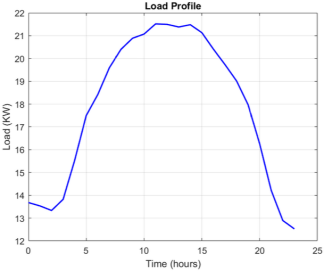
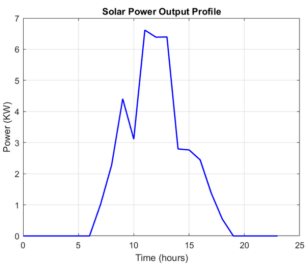
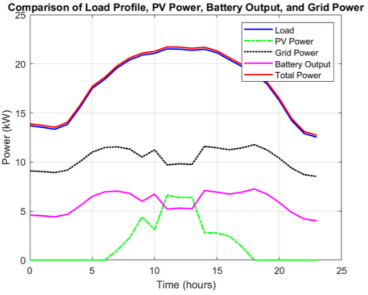
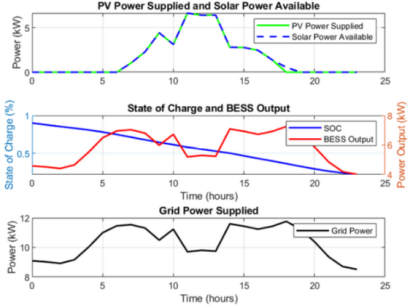
The energy industry faces a variety of challenges as a result of the growing demand for electricity. The emphasis is shifting to optimizing energy use in residential settings so as to achieve sustainable alternatives. The escalating demand for sustainable energy practices in residential environments gives rise to innovative approaches to home energy management. In order to significantly reduce home energy use and contribute to a more sustainable future, this paper proposes an optimization model for home energy management that combines Model Predictive Control (MPC) with Demand Response (DR) strategy to reduce energy consumption. The study used several types of data, such as the hourly load demand of a house and solar irradiance data. Load demand profile, derived from historical electricity usage records, provided hourly energy consumption over a 24-hour period, serving as essential input for predicting future energy needs using the MPC algorithm. Solar irradiance data and PV system specifications were utilized to model the power generated by PV panels, while information about the battery energy storage system, including its capacity, efficiency, and state of charge (SOC) limits, was essential for modelling the behavior of the battery in storing and discharging energy. The model encompasses mathematical models and optimization tools for the efficient usage of photovoltaic (PV) panels, battery energy storage systems (BESS), and grid power. With the aid of MATLAB/Simulink simulations, the study demonstrated that MPC effectively predicts energy demand and allocates power sources effectively, achieving a 41% reduction in energy costs compared to grid-only scenarios. Considering the results obtained, this paper suggests areas of further research work, such as integrating dynamic pricing models in countries like Nigeria and exploring hybrid renewable energy systems. This will build on the findings obtained in this work and further improve household energy efficiency and sustainability.
| Published in | International Journal of Energy and Power Engineering (Volume 15, Issue 3) |
| DOI | 10.11648/j.ijepe.20261503.11 |
| Page(s) | 71-80 |
| Creative Commons |
This is an Open Access article, distributed under the terms of the Creative Commons Attribution 4.0 International License (http://creativecommons.org/licenses/by/4.0/), which permits unrestricted use, distribution and reproduction in any medium or format, provided the original work is properly cited. |
| Copyright |
Copyright © The Author(s), 2026. Published by Science Publishing Group |
Model Predictive Control, Optimization, Demand Response, PV, Grid
Power Supply Used | Energy Used From The Grid (KWh) | Energy Cost Saved |
|---|---|---|
Grid Only | 427.06 | - |
Grid + PV only | 388.206 | 9.25% |
Grid + Bess only | 287.806 | 32.72% |
PV + BESS+ GRID | 248.2061 | 41.98% |
MPC | Model Predictive Control |
DR | Demand Response |
PV | Photovoltaic |
SOC | State of Charge |
| [1] | S. Shan, B. Cao, and Z. Wu, “Forecasting the Short-Term Electricity Consumption of Building Using a Novel Ensemble Model,” IEEE Access, vol. 7, pp. 88093–88106, 2019, |
| [2] | N. A. Kutty et al., “A Systematic Review of Climate Change Implications on Building Energy Consumption: Impacts and Adaptation Measures in Hot Urban Desert Climates,” Build., vol. 14, no. 1, pp. 1–34, Dec. 2023, |
| [3] | B. A. Gyamfi, T. S. Adebayo, D. Q. Agozie, F. V. Bekun, and A. Koy, “Is sustainable energy consumption, technological advancement and urbanization fast addressing south Asia’s green energy expansion deficits?,” Environ. Dev. Sustain. 2024 278, vol. 27, no. 8, pp. 19969–19998, Mar. 2024, |
| [4] | A. Das, S. Gupta, S. Bhattacharya, S. Johri, P. Selvakumar, and P. Satyanarayana, “Urbanization and Energy: The Nexus of Global Challenges,” in Geopolitical Landscapes of Renewable Energy and Urban Growth, IGI Global Scientific Publishing, 1AD, pp. 453–478. |
| [5] | H. M. Saleh and A. I. Hassan, “The challenges of sustainable energy transition: A focus on renewable energy,” Appl. Chem. Eng., vol. 7, no. 2, pp. 1–24, 2024, |
| [6] | F. Oluwadamilare, Usman, A. Adewnmi, K. Andrew, C. E. Okoli, and G. S. Usiagu, “Sustainable energy solutions and climate change: A policy review of emerging trends and global responses,” World J. Adv. Res. Rev., vol. 21, no. 2, pp. 408–420, Feb. 2023, |
| [7] |
B. Zohuri, “Navigating the Global Energy Landscape Balancing Growth, Demand, and Sustainability,” J. Mater. Sci. Appl. Eng., pp. 1–7, 2023, Accessed: Nov. 27, 2025. Available:
https://mkscienceset.com/articles_file/659-_article1747049165.pdf |
| [8] |
M. Sadiq, J. P. Ou, K. D. Duong, L. Van, T. Q. Ngo, and T. X. Bui, “The influence of economic factors on the sustainable energy consumption: evidence from China,” Econ. Res. Istraz., vol. 36, no. 1, pp. 1751–1773, 2023,
https://doi.org/10.1080/1331677X.2022.2093244;WGROUP:STRING:PUBLICATION |
| [9] | E. Veldman, M. Gibescu, H. J. G. Slootweg, and W. L. Kling, “Scenario-based modelling of future residential electricity demands and assessing their impact on distribution grids,” Energy Policy, vol. 56, pp. 233–247, May 2013, |
| [10] | B. Han, Y. Zahraoui, M. Mubin, S. Mekhilef, M. Seyedmahmoudian, and A. Stojcevski, “Home Energy Management Systems: A Review of the Concept, Architecture, and Scheduling Strategies,” IEEE Access, vol. 11, pp. 19999–20025, 2023, |
| [11] | Z. Bradac, V. Kaczmarczyk, and P. Fiedler, “Optimal scheduling of domestic appliances via MILP,” Energies, vol. 8, no. 1, pp. 217–232, 2015, |
| [12] | R. Godina, E. M. G. Rodrigues, E. Pouresmaeil, J. C. O. Matias, and J. P. S. Catalão, “Model Predictive Control home energy management and optimization strategy with demand response,” Appl. Sci., vol. 8, no. 3, 2018, |
| [13] | A. Al-Adaileh and S. Khaddaj, “Reduction of energy consumption using smart home techniques in the household sector,” in ICSEMEE 2020: XIV. International Conference on Smart Energy Management and Energy Efficiency - Paris - France, Aug. 2020, pp. 371–383. Accessed: Nov. 27, 2025. Available: |
| [14] | A. Shahee, M. Abdoos, A. Aslani, and R. Zahedi, “Reducing the energy consumption of buildings by implementing insulation scenarios and using renewable energies,” Energy Informatics, vol. 7, no. 18, pp. 1–29, 2024, Accessed: Nov. 27, 2025. Available: |
| [15] | P. Michailidis et al., “Model Predictive Control for Smart Buildings: Applications and Innovations in Energy Management,” Build., vol. 15, no. 18, pp. 1–49, Sep. 2025, |
| [16] | L. Hern, “A review of strategies for building energy management system : Model predictive control, demand side management, optimization, and fault detect & diagnosis,” vol. 33, no. March 2020, 2021, |
| [17] | I. Benrabia and D. Soffker, “Energy management of residential buildings based on model predictive control across varied prediction horizons, price models, and storage configurations,” 2024 IEEE Int. Conf. Commun. Control. Comput. Technol. Smart Grids, SmartGridComm 2024, pp. 123–128, 2024, |
| [18] | O. E. Dragomir and F. Dragomir, “Application of Scheduling Techniques for Load-Shifting in Smart Homes with Renewable-Energy-Sources Integration,” Build., vol. 13, no. 1, pp. 1–14, Jan. 2023, |
| [19] | M. S. Javadi, M. Gough, M. Lotfi, A. Esmaeel Nezhad, S. F. Santos, and J. P. S. Catalão, “Optimal self-scheduling of home energy management system in the presence of photovoltaic power generation and batteries,” Energy, vol. 210, p. 118568, Nov. 2020, |
| [20] | J. Liu et al., “Virtual Power Plant with Renewable Energy Sources and Energy Storage Systems for Sustainable Power Grid-Formation, Control Techniques and Demand Response,” Energies, vol. 16, no. 9, Apr. 2023, |
| [21] | M. S. Javadi et al., “Self-scheduling model for home energy management systems considering the end-users discomfort index within price-based demand response programs,” Sustain. Cities Soc., vol. 68, p. 102792, May 2021, |
| [22] | S. A. Mansouri, A. Ahmarinejad, E. Nematbakhsh, M. S. Javadi, A. Esmaeel Nezhad, and J. P. S. Catalão, “A sustainable framework for multi-microgrids energy management in automated distribution network by considering smart homes and high penetration of renewable energy resources,” Energy, vol. 245, p. 123228, Apr. 2022, |
| [23] | B. Chatuanramtharnghaka et al., “Reviewing Demand Response for Energy Management with Consideration of Renewable Energy Sources and Electric Vehicles,” World Electr. Veh. J., vol. 15, no. 9, pp. 1–24, Sep. 2024, |
| [24] | O. A. Alimi and K. Ouahada, “Smart home appliances scheduling to manage energy usage,” in IEEE International Conference on Adaptive Science and Technology, ICAST, IEEE Computer Society, Oct. 2018, pp. 1–5. |
| [25] | A. U. Rehman et al., “An Optimal Power Usage Scheduling in Smart Grid Integrated with Renewable Energy Sources for Energy Management,” IEEE Access, vol. 9, pp. 84619–84638, 2021, |
| [26] | A. Katal, S. Dahiya, and T. Choudhury, “Energy efficiency in cloud computing data centers: a survey on software technologies,” Cluster Comput., vol. 26, no. 3, pp. 1845–1875, Aug. 2022, |
| [27] | C. Liu, S. Sharples, H. Mohammadpourkarbasi, C. Liu, S. Sharples, and H. Mohammadpourkarbasi, “A Review of Building Energy Retrofit Measures, Passive Design Strategies and Building Regulation for the Low Carbon Development of Existing Dwellings in the Hot Summer–Cold Winter Region of China,” Energies, vol. 16, no. 10, pp. 1–25, May 2023, |
| [28] | U. G. D. Madushika et al., “Energy Retrofitting Technologies of Buildings: A Review-Based Assessment,” Energies, vol. 16, no. 13, pp. 1–16, Jun. 2023, |
| [29] | Z. Donglin, Y. Lijun, and W. Lizhen, “Research on Large-Scale Building Energy Efficiency Retrofit Based on Energy Consumption Investigation and Energy-Saving Potential Analysis,” J. Energy Eng., vol. 145, no. 6, p. 4019024, Dec. 2019, |
| [30] |
A. Burton, “Introduction To Passive Design - Green Choice Consulting,” Greenchoice Consulting. Accessed: Dec. 11, 2025. Available:
https://greenchoiceconsulting.com.au/introduction-to-passive-design/ |
| [31] | M. Hu, K. Zhang, Q. Nguyen, and T. Tasdizen, “The effects of passive design on indoor thermal comfort and energy savings for residential buildings in hot climates: A systematic review,” Urban Clim., vol. 49, p. 101466, May 2023, |
| [32] | Ifechukwu Gil-Ozoudeh, Obinna Iwuanyanwu, Azubuike Chukwudi Okwandu, and Chidiebere Somadina Ike, “The role of passive design strategies in enhancing energy efficiency in green buildings,” Eng. Sci. Technol. J., vol. 3, no. 2, pp. 71–91, Dec. 2022, |
| [33] | A. O. Akinola and F. E. Amadhe, “Assessment of Passive Design Strategies for Enhancing Users’ Comfort in Academic Libraries Across Delta State, Nigeria,” Civ. Eng. Archit., vol. 13, no. 3A, pp. 2750–2768, 2025, Accessed: Dec. 11, 2025. Available: |
| [34] | X. Liang, Y. Wang, and T. Roskilly, “Reduce Household Energy Consumption Using Passive Methods,” in The 7th International Conference on Applied Energy – ICAE2015 - Energy Procedia, Elsevier, Aug. 2015, pp. 1335–1340. |
| [35] | O. Stojanovski, G. Leslie, F. Wolak, J. Huerta-Wong, and M. Thurber, “Promoting Energy Efficiency in Emerging Economies Through Consumer Education: Results From a Field Experiment in Mexico,” SSRN Electron. J., Jan. 2018, |
| [36] | L. Cerović, A. Malnar, D. Sinčić, L. Cerović, A. Malnar, and D. Sinčić, “Energy Literacy of Economics Students in Rijeka: Knowledge, Attitudes, and Behavioral Approach,” Energies, vol. 17, no. 8, pp. 1–31, Apr. 2024, |
| [37] | O. S. Santillán, K. G. Cedano, O. S. Santillán, and K. G. Cedano, “Energy Literacy: A Systematic Review of the Scientific Literature,” Energies, vol. 16, no. 21, pp. 1–19, Oct. 2023, |
| [38] | K. L. van den Broek, “Household energy literacy: A critical review and a conceptual typology,” Energy Res. Soc. Sci., vol. 57, p. 101256, Nov. 2019, |
| [39] | Y. Zhang, “Energy Consumption Prediction in Smart Homes Using QIO-Enhanced Regression Models,” Informatica, vol. 49, no. 33, pp. 375–396, Aug. 2025, |
| [40] | H. Pombeiro, J. Santos, P. Carreira, and C. Silva, “Displaying data is not enough: Incorporating User Behavior Transformation in domestic reporting systems,” Sustain. Cities Soc., vol. 48, p. 101451, Jul. 2019, |
| [41] | L. Marchi and J. Gaspari, “Energy Conservation at Home: A Critical Review on the Role of End-User Behavior,” Energies, vol. 16, no. 22, pp. 1–22, Nov. 2023, |
| [42] | B. Gajdzik et al., “Impact of Economic Awareness on Sustainable Energy Consumption: Results of Research in a Segment of Polish Households,” Energies, vol. 17, no. 11, pp. 1–31, May 2024, |
| [43] | M. M. Alomari, H. EL-Kanj, A. Topal, and N. I. Alshdaifat, “Exploring the impact of the COVID-19 pandemic on energy literacy and conservation behavior in academic buildings of Kuwait,” Heliyon, vol. 9, no. 11, pp. 1–21, Nov. 2023, |
| [44] | J. I. De Larauze, “Assessing the Role of Benchmarking Requirements in Measuring and Driving Building Energy Performance for Multifamily Buildings in Greater Boston,” 2025. Accessed: Dec. 11, 2025. Available: |
| [45] | G. Bekele, A. Lake, D. Habtu, and A. Assefa, “Energy Literacy for the Energy Transition: Forming the Next Generation of Energy Practitioners in Ethiopia,” in Community Energy and Sustainable Energy Transitions, Springer Nature, 2024, pp. 171–194. |
| [46] | A. Erdoğdu et al., “Innovative Solutions for Combating Climate Change: Advancing Sustainable Energy and Consumption Practices for a Greener Future,” Sustainability, vol. 17, no. 6, pp. 1–39, Mar. 2025, |
| [47] | T. S. Force and O. M. Longe, “Impact of Energy Literacy on Energy Consumption, Expenditure and Management,” Proc. 2022 IEEE Niger. 4th Int. Conf. Disruptive Technol. Sustain. Dev. NIGERCON 2022, pp. 1–5, 2022, |
| [48] | R. Fonteijn, M. Babar, and R. Kamphuis, An assesment of the influence of demand response on demand elasticity in electricity retail market. 2015. |
| [49] | L. Montuori, M. Alcázar-Ortega, and C. Álvarez-Bel, “Methodology for the evaluation of demand response strategies for the management of natural gas systems,” Energy, vol. 234, p. 121283, Nov. 2021, |
| [50] |
M. A. Khan, T. Khan, M. Waseem, A. M. Saleh, N. Qamar, and H. A. Muqeet, “Investigation and analysis of demand response approaches, bottlenecks, and future potential capabilities for IoT-enabled smart grid,” IET Renew. Power Gener., vol. 18, no. 15, pp. 3509–3535, Nov. 2024,
https://doi.org/10.1049/RPG2.13011;WGROUP:STRING:PUBLICATION |
| [51] | M. J. B. Kabeyi and O. A. Olanrewaju, “Smart grid technologies and application in the sustainable energy transition: a review,” Int. J. Sustain. Energy, vol. 42, no. 1, pp. 685–758, Dec. 2023, |
| [52] | A. Gharbi, M. Ayari, and A. E. Yahya, “Demand-Response Control in Smart Grids,” Appl. Sci., vol. 13, no. 4, pp. 1–24, Feb. 2023, |
| [53] | B. Zhu, L. Xu, and Y. Chen, “A Strategy for Demand Response of Households Based on Communities,” 2020 Asia Energy Electr. Eng. Symp., pp. 983–987, 2020. |
| [54] | X. Yan, Y. Ozturk, Z. Hu, and Y. Song, “A review on price-driven residential demand response,” Renew. Sustain. Energy Rev., vol. 96, pp. 411–419, Nov. 2018, |
| [55] | F. Ahmed, A. Arshad, A. U. Rehman, M. H. Alqahtani, and K. Mahmoud, “Effective incentive based demand response with voltage support capability via reinforcement learning based multi-agent framework,” Energy Reports, vol. 12, pp. 568–578, Dec. 2024, |
| [56] | I. O. Essiet and Y. Sun, “Demand response modeling with solar PV as a panacea to the Nigerian electricity distribution conundrum: A case study of Sierra Leone,” Energy Reports, vol. 8, pp. 374–380, Nov. 2022, |
| [57] | L. Malehmirchegini and H. Farzaneh, “Incentive-based demand response modeling in a day-ahead wholesale electricity market in Japan, considering the impact of customer satisfaction on social welfare and profitability,” Sustain. Energy, Grids Networks, vol. 34, p. 101044, Jun. 2023, |
| [58] | H. Mao, Q. Deng, Z. Zhang, and X. Yang, “Optimized economic scheduling of demand response in integrated energy systems considering dynamic energy efficiency and dynamic carbon trading,” Sci. Reports 2025 161, vol. 16, no. 1, pp. 1–27, Jan. 2026, |
APA Style
Omeje, O., Orakwe, G., Idoko, L. (2026). Optimization Model for Home Energy Management Using Demand Response Strategy. International Journal of Energy and Power Engineering, 15(3), 71-80. https://doi.org/10.11648/j.ijepe.20261503.11
ACS Style
Omeje, O.; Orakwe, G.; Idoko, L. Optimization Model for Home Energy Management Using Demand Response Strategy. Int. J. Energy Power Eng. 2026, 15(3), 71-80. doi: 10.11648/j.ijepe.20261503.11
@article{10.11648/j.ijepe.20261503.11,
  author = {Osita Omeje and Goziechi Orakwe and Linus Idoko},
  title = {Optimization Model for Home Energy Management Using Demand Response Strategy},
  journal = {International Journal of Energy and Power Engineering},
  volume = {15},
  number = {3},
  pages = {71-80},
  doi = {10.11648/j.ijepe.20261503.11},
  url = {https://doi.org/10.11648/j.ijepe.20261503.11},
  eprint = {https://article.sciencepublishinggroup.com/pdf/10.11648.j.ijepe.20261503.11},
  abstract = {The energy industry faces a variety of challenges as a result of the growing demand for electricity. The emphasis is shifting to optimizing energy use in residential settings so as to achieve sustainable alternatives. The escalating demand for sustainable energy practices in residential environments gives rise to innovative approaches to home energy management. In order to significantly reduce home energy use and contribute to a more sustainable future, this paper proposes an optimization model for home energy management that combines Model Predictive Control (MPC) with Demand Response (DR) strategy to reduce energy consumption. The study used several types of data, such as the hourly load demand of a house and solar irradiance data. Load demand profile, derived from historical electricity usage records, provided hourly energy consumption over a 24-hour period, serving as essential input for predicting future energy needs using the MPC algorithm. Solar irradiance data and PV system specifications were utilized to model the power generated by PV panels, while information about the battery energy storage system, including its capacity, efficiency, and state of charge (SOC) limits, was essential for modelling the behavior of the battery in storing and discharging energy. The model encompasses mathematical models and optimization tools for the efficient usage of photovoltaic (PV) panels, battery energy storage systems (BESS), and grid power. With the aid of MATLAB/Simulink simulations, the study demonstrated that MPC effectively predicts energy demand and allocates power sources effectively, achieving a 41% reduction in energy costs compared to grid-only scenarios. Considering the results obtained, this paper suggests areas of further research work, such as integrating dynamic pricing models in countries like Nigeria and exploring hybrid renewable energy systems. This will build on the findings obtained in this work and further improve household energy efficiency and sustainability.},
 year = {2026}
}
TY  - JOUR
T1  - Optimization Model for Home Energy Management Using Demand Response Strategy
AU  - Osita Omeje
AU  - Goziechi Orakwe
AU  - Linus Idoko
Y1  - 2026/06/04
PY  - 2026
N1  - https://doi.org/10.11648/j.ijepe.20261503.11
DO  - 10.11648/j.ijepe.20261503.11
T2  - International Journal of Energy and Power Engineering
JF  - International Journal of Energy and Power Engineering
JO  - International Journal of Energy and Power Engineering
SP  - 71
EP  - 80
PB  - Science Publishing Group
SN  - 2326-960X
UR  - https://doi.org/10.11648/j.ijepe.20261503.11
AB  - The energy industry faces a variety of challenges as a result of the growing demand for electricity. The emphasis is shifting to optimizing energy use in residential settings so as to achieve sustainable alternatives. The escalating demand for sustainable energy practices in residential environments gives rise to innovative approaches to home energy management. In order to significantly reduce home energy use and contribute to a more sustainable future, this paper proposes an optimization model for home energy management that combines Model Predictive Control (MPC) with Demand Response (DR) strategy to reduce energy consumption. The study used several types of data, such as the hourly load demand of a house and solar irradiance data. Load demand profile, derived from historical electricity usage records, provided hourly energy consumption over a 24-hour period, serving as essential input for predicting future energy needs using the MPC algorithm. Solar irradiance data and PV system specifications were utilized to model the power generated by PV panels, while information about the battery energy storage system, including its capacity, efficiency, and state of charge (SOC) limits, was essential for modelling the behavior of the battery in storing and discharging energy. The model encompasses mathematical models and optimization tools for the efficient usage of photovoltaic (PV) panels, battery energy storage systems (BESS), and grid power. With the aid of MATLAB/Simulink simulations, the study demonstrated that MPC effectively predicts energy demand and allocates power sources effectively, achieving a 41% reduction in energy costs compared to grid-only scenarios. Considering the results obtained, this paper suggests areas of further research work, such as integrating dynamic pricing models in countries like Nigeria and exploring hybrid renewable energy systems. This will build on the findings obtained in this work and further improve household energy efficiency and sustainability.
VL  - 15
IS  - 3
ER  -
Department of Electrical & Electronics Engineering, University of Lagos, Yaba, Nigeria
Department of Electrical Engineering, Nigeria Maritime University, Okerenkoko, Nigeria

Information



 Share This Article
 Twitter
 Linked In
 Facebook
 Copy
Copy Download