
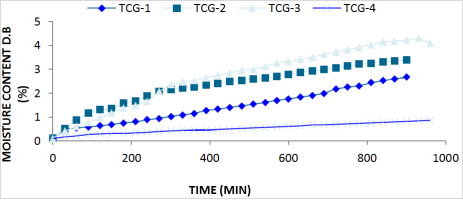
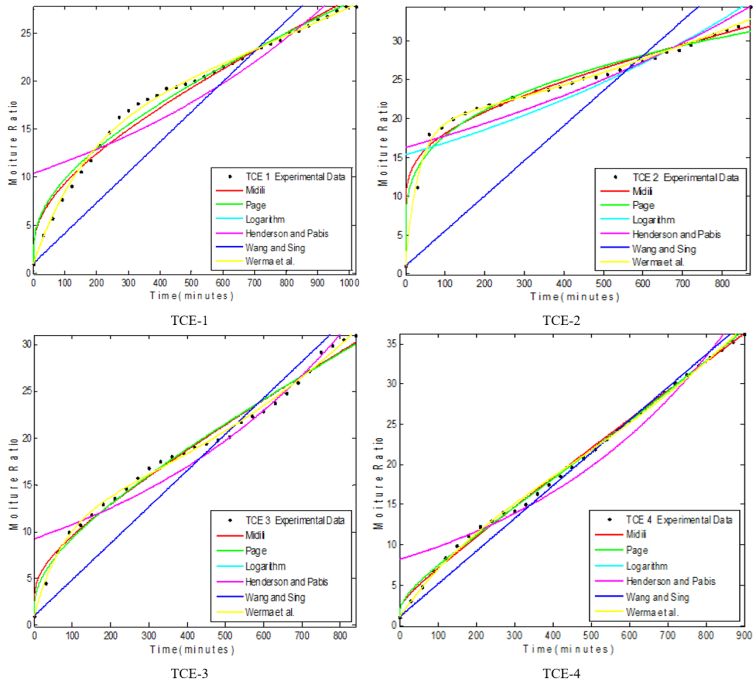
The hydration kinetics of four different jack bean cultivars were systematically investigated to understand their water absorption behavior under controlled soaking conditions. The samples were immersed in water for soaking periods ranging from 10 to 40 minutes, while the soaking temperature varied between 31.68 and 53.3°C. These conditions were selected to simulate typical processing environments and to evaluate the influence of temperature and time on hydration behavior. To analyze the experimental data, five established mathematical model equations were applied to describe the water absorption process of the jack bean cultivars. The performance of the models was assessed using two statistical parameters: the coefficient of determination (R²) and the root mean square error (RMSE). A higher R² value combined with a lower RMSE indicated a stronger agreement between the experimental and predicted water absorption values. Among the models tested, the Page model demonstrated the best fitting performance based on these statistical criteria, effectively capturing the hydration characteristics of the jack bean samples. The effective moisture diffusivity values increased from 3.067 × 10⁻10m²/s to 9.40 × 10⁻10m²/s with increasing soaking time and temperature, reflecting enhanced diffusion rates under warmer conditions. This increase is attributed to reduced water viscosity and structural softening of the bean matrix. Additionally, the moisture ratio curves revealed a consistent decrease with rising temperature across all cultivars, confirming the significant role of temperature in accelerating water absorption during soaking.
| Published in | International Journal of Food Engineering and Technology (Volume 10, Issue 1) |
| DOI | 10.11648/j.ijfet.20261001.13 |
| Page(s) | 17-22 |
| Creative Commons |
This is an Open Access article, distributed under the terms of the Creative Commons Attribution 4.0 International License (http://creativecommons.org/licenses/by/4.0/), which permits unrestricted use, distribution and reproduction in any medium or format, provided the original work is properly cited. |
| Copyright |
Copyright © The Author(s), 2026. Published by Science Publishing Group |
Jack Beans, Water Absorption, Modelling, Diffusivity
Model Name | Empirical Expression |
|---|---|
Wang and Singh |
|
Henderson and Pabis |
|
Page |
|
Logarithmic |
|
Werma |
|
Seed | Samples | Temperature | R2 | Deff (10-10) (m2/s) |
|---|---|---|---|---|
Jack bean | TCE-1 | 54 | 0.759 | 3.216 |
TCE-2 | 55 | 0.801 | 6.45 | |
TCE-3 | 55 | 0.878 | 6.297 | |
TCE-4 | 54 | 0. 646 | 5.779 |
Models | TCE-1 | TCE-2 | TCE-3 | TCE-4 | ||||
|---|---|---|---|---|---|---|---|---|
R2 | RMSE | R2 | RMSE | R2 | RMSE | R2 | RMSE | |
Midilli | 0.9763 | 2.1762 | 0.9734 | 1.1237 | 0.9644 | 1.5415 | 0.9954 | 0.7265 |
Henderson and Pabis | 0.8318 | 2.9618 | 0.7443 | 3.3579 | 0.9187 | 2.2409 | 0.9444 | 2.4382 |
Page | 0.9810 | 0.9965 | 0.9686 | 1.1775 | 0.9869 | 0.9001 | 0.9979 | 0.1201 |
Logarithmic | 0.9115 | 2.1823 | 0.7838 | 0.1442 | 0.9634 | 1.5326 | 0.9951 | 0.7380 |
Wang and Singh | 0.9536 | 1.5564 | 0.4551 | 4.9017 | 0.9324 | 2.0430 | 0.9921 | 0.9191 |
Werma | 0.9974 | 0.3737 | 0.9947 | 0.4921 | 0.9963 | 0.4878 | 0.9975 | 0.5283 |
WAC | Water Absorption Capacity |
RMSE | Root Mean Square Error |
R2 | Coefficient of Determination |
DEFF | Moisture Diffusivity Coefficient |
| [1] | Aline, A. P. Paulo,, C. C. Fernanda,, M. B. Sérgio, M. LD. Mayra,, D. M. S. D. Rafael, L. F. S., and Ciências, A. l. Modeling the hydration process of bean grains coated with carnauba wax. 2017, suplemento 38(4): 2515-2530, 2017. |
| [2] | Bello, M., Tolaba, M. P. and Suarez., C.. Factors affecting water uptake of rice grain during soaking. Lebensmittel Wissenschaft und Technologie. 2004, 37(8): 811–816. |
| [3] |
Walshaw, S. Plant Resources of Tropical Africa 2. Vegetables Economic Botany. 2005. 59(4): 401-402.
https://doi.org/10.1663/0013-0001(2005)059[0401:DFABRE]2.0.CO;2 |
| [4] | Botelho, F. M., Correa P. C. Goneli, A. L. D. Martins M. A. and Baptestini. F. M., Análise da hidratação do arroz na parboilização (Analysis of rice hydration in parboiling). Ciência Tecnologia de Alimentos, Campinas, 2010. 30(3): 713-718. |
| [5] | Cox, S., Gupta, S., and Abu-Ghannam N. Effect of different rehydration temperatures on the moisture, content of phenolic compounds, antioxidant capacity and textural properties of edible Irish brown seaweed. LWT-Food Science and Technology. 2012, 47(2): 300-307. |
| [6] | Ekanayake, S. Jansz, E. R. and Nair,, B. M Literature Review of an Underutilized Legume: Canavalia gladiata L. Plant Foods for Human Nutrition. 2000, 55(4): 305–321. |
| [7] | Fagbohun, A. Ak, Abayomi, T. O., Oladele, E. O., Oshodi, A. Al Physico-chemical properties and functional characteristics of Jack beans (Canavalia ensiformis) starch.. World Journal of Biology Pharmacy and Health Sciences. 2020, 03(02), 012–022. |
| [8] | Fraccasso, A. F., Perussello, C. A., Haminiuk C. W. I. Jorge, L. M. M. and Jorge, R. M. M,. Hydration kinetics of soybeans: transgenic and conventional cultivars. Journal of Cereal Science, Londres, 2014. 60(3): 584-588. |
| [9] | Kang, S.. and Delwiche, S. R. Moisture diffusion coefficients of single wheat kernels with assumed simplified geometries: analytical approach. Transactions of the American Society of Agricultural Engineering. 2000, 43: 1653–1659. |
| [10] | Lisboa, J. F., Silva, J. N., Cavalcanti, M. T. and Silva, M. C. Goncalves, Análise da hidratação de grãos de alpiste. Bra sileira de Engenharia Agrícola e Ambiental, Campina Grande, 2015, 19(3), 218-223. |
| [11] | Osuigwe, D. I., Obiekezie,, A. I., and Onuoha, G. C,, Effects of Jackbean seed meal on the intestinal mucosa of juvenile Heter obranelius longifilis. African Journal of Biotechnology. 2006, 5(13): 1294 – 1298. |
| [12] | Resende, O. and Corr P. C. ea,, Modelagem matemática do processo de hidratação de sementes de feijão. Acta Scientiarum. Agronomy, Maringá, 2007, 29, (3). 373-378. |
| [13] | Resio, A. N. C., Aguerre, R. J., and Suarez,, C.. Analysis of simultaneous water absorption and water–starch reaction during soaking of amaranth grain. Journal of Food Engineering, 2005, 68, 265–270. |
| [14] | Sayar, S. Turhan, M. and Gunasekaran,, S. Analysis of chickpea soaking by simultaneous water transfer and water-starch reaction. Journal of Food science, 2001, 50: 91-98. |
| [15] | Seyed, M. S., and Amin, A. M. Studying and modelling of hydration kinetics in chickpea seeds (Cicer arietinum L.). Agricultural communications. 2014, 2 (2): 15-21. |
| [16] | Shafaei, S. M., and Masoumi,, A, A.. Evaluation of Khazaei model in predicting of water absorption of chickpea during soaking. Agricultural Advances. 2014. 1-8. |
| [17] | Shafaei, S. M., and Masoumi, A. A., Estimating moisture absorption kinetics of beans during soaking using mathematical models. Agricultural Engineering International: CIGR Journal. 2014 16: 3. |
| [18] | Andriati, N., Anggrahini, S., Setyaningsih, W., Sofiana, I., Pusparasi, D. A. and Mossberg, F. Physicochemical characterization of jack bean (Canavalia ensiformis) tempeh. Food Research, 2018., 2(5): 481–485. |
| [19] | Okomoda, V. T., Tiamiyu, L. O. and Uma, S. G. Effects of hydrothermal processing on nutritional value of Canavalia ensiformis and its utilization by Clarias gariepinus (Burchell, 1822) fingerlings. 2016. Aquaculture Reports, 3, 214–219. |
| [20] | Solomon, S. G., Okomoda, V. T. and Oguche, O. Nutritional value of raw Canavalia ensiformis and its utilization as partial replacement for soybean meal in the diet of Clarias gariepinus (Burchell, 1822) fingerlings. Food Science and Nutrition, 2018. 6(1), 207 213. |
| [21] | Sutedja, A. M., Ito, A., Yanase, E., Batubara, I., Fardiaz, D. and Lioe, H. N. Influence of jack bean (Canavalia ensiformis (L) DC) milk processing on bioactive compounds and its antioxidant activity. Food Science and Technology. 2022,, 42, e11521. |
| [22] | Sutedja, A. M., Yanase, E., Batubara, I., Fardiaz, D., and Lio, H. N. (2020). Identification and Characterization of α-Glucosidase Inhibition Flavonol Glycosides from Jack Bean (Canavalia ensiformis (L.) DC. Molecules. 25(11), 2481. |
APA Style
Awotona, E. (2026). Modelling Water Absorption of Four Varieties of Jack Beans During Soaking. International Journal of Food Engineering and Technology, 10(1), 17-22. https://doi.org/10.11648/j.ijfet.20261001.13
ACS Style
Awotona, E. Modelling Water Absorption of Four Varieties of Jack Beans During Soaking. Int. J. Food Eng. Technol. 2026, 10(1), 17-22. doi: 10.11648/j.ijfet.20261001.13
@article{10.11648/j.ijfet.20261001.13,
  author = {Esther Awotona},
  title = {Modelling Water Absorption of Four Varieties of Jack Beans During Soaking},
  journal = {International Journal of Food Engineering and Technology},
  volume = {10},
  number = {1},
  pages = {17-22},
  doi = {10.11648/j.ijfet.20261001.13},
  url = {https://doi.org/10.11648/j.ijfet.20261001.13},
  eprint = {https://article.sciencepublishinggroup.com/pdf/10.11648.j.ijfet.20261001.13},
  abstract = {The hydration kinetics of four different jack bean cultivars were systematically investigated to understand their water absorption behavior under controlled soaking conditions. The samples were immersed in water for soaking periods ranging from 10 to 40 minutes, while the soaking temperature varied between 31.68 and 53.3°C. These conditions were selected to simulate typical processing environments and to evaluate the influence of temperature and time on hydration behavior. To analyze the experimental data, five established mathematical model equations were applied to describe the water absorption process of the jack bean cultivars. The performance of the models was assessed using two statistical parameters: the coefficient of determination (R²) and the root mean square error (RMSE). A higher R² value combined with a lower RMSE indicated a stronger agreement between the experimental and predicted water absorption values. Among the models tested, the Page model demonstrated the best fitting performance based on these statistical criteria, effectively capturing the hydration characteristics of the jack bean samples. The effective moisture diffusivity values increased from 3.067 × 10⁻10m²/s to 9.40 × 10⁻10m²/s with increasing soaking time and temperature, reflecting enhanced diffusion rates under warmer conditions. This increase is attributed to reduced water viscosity and structural softening of the bean matrix. Additionally, the moisture ratio curves revealed a consistent decrease with rising temperature across all cultivars, confirming the significant role of temperature in accelerating water absorption during soaking.},
 year = {2026}
}
TY  - JOUR
T1  - Modelling Water Absorption of Four Varieties of Jack Beans During Soaking
AU  - Esther Awotona
Y1  - 2026/04/23
PY  - 2026
N1  - https://doi.org/10.11648/j.ijfet.20261001.13
DO  - 10.11648/j.ijfet.20261001.13
T2  - International Journal of Food Engineering and Technology
JF  - International Journal of Food Engineering and Technology
JO  - International Journal of Food Engineering and Technology
SP  - 17
EP  - 22
PB  - Science Publishing Group
SN  - 2640-1584
UR  - https://doi.org/10.11648/j.ijfet.20261001.13
AB  - The hydration kinetics of four different jack bean cultivars were systematically investigated to understand their water absorption behavior under controlled soaking conditions. The samples were immersed in water for soaking periods ranging from 10 to 40 minutes, while the soaking temperature varied between 31.68 and 53.3°C. These conditions were selected to simulate typical processing environments and to evaluate the influence of temperature and time on hydration behavior. To analyze the experimental data, five established mathematical model equations were applied to describe the water absorption process of the jack bean cultivars. The performance of the models was assessed using two statistical parameters: the coefficient of determination (R²) and the root mean square error (RMSE). A higher R² value combined with a lower RMSE indicated a stronger agreement between the experimental and predicted water absorption values. Among the models tested, the Page model demonstrated the best fitting performance based on these statistical criteria, effectively capturing the hydration characteristics of the jack bean samples. The effective moisture diffusivity values increased from 3.067 × 10⁻10m²/s to 9.40 × 10⁻10m²/s with increasing soaking time and temperature, reflecting enhanced diffusion rates under warmer conditions. This increase is attributed to reduced water viscosity and structural softening of the bean matrix. Additionally, the moisture ratio curves revealed a consistent decrease with rising temperature across all cultivars, confirming the significant role of temperature in accelerating water absorption during soaking.
VL  - 10
IS  - 1
ER  -
Department of Chemical Engineering, Ladoke Akintola University of Technology, Ogbomoso, Nigeria
Biography: Esther Awotona is currently a lecturer in the Department of Industrial Chemistry, at Hallmark University, Ijebu-Itele, Ogun State, Nigeria. She is also presently pursuing a Ph.D. in Chemical Engineering at Ladoke Akintola University of Technology Ogbomoso, Oyo state, Nigeria. She had her Bachelor’s degree and Masters degree in chemical Engineering from the same institution
Research Fields: Dehydration of Agricultural produce, Hydration of Agricultural produce, Wastewater treatment, Coagulation- flocculation process, Mathematical Modelling and Separation Process


Information



 Share This Article
 Twitter
 Linked In
 Facebook
 Copy
Copy Download