Abstract
Susceptibility is a fundamental concept in homoeopathy that explains an individual's capacity to respond to environmental influences, disease-producing agents, and therapeutic interventions. According to Samuel Hahnemann, disease develops only when the organism possesses the necessary susceptibility, making it a central determinant of health, illness, and recovery. Rather than representing merely a physical predisposition, susceptibility reflects the dynamic interplay of mental, emotional, and constitutional factors that influence an individual's response to internal and external stimuli, thereby forming the basis of individualized case-taking and remedy selection in classical homoeopathy. Recent advances in trauma psychology and epigenetics have provided compelling evidence that adverse life experiences, particularly emotional trauma during early developmental stages, can induce long-lasting biological changes through epigenetic mechanisms that alter gene expression without modifying the DNA sequence, thereby influencing stress responses, immune function, emotional regulation, and vulnerability to chronic diseases. Concurrently, the Enneagram of Personality offers a psychological framework for understanding enduring personality patterns that emerge from early childhood experiences and adaptive coping strategies, shaping emotional responses, behavioural tendencies, resilience, and potentially an individual's susceptibility to illness and response to treatment. This conceptual review explores the interrelationship between emotional trauma, epigenetic modifications, Enneagram personality patterns, and the homoeopathic concept of susceptibility in the light of Hahnemann's teachings in the Organon of Medicine. By integrating insights from classical homoeopathic philosophy with contemporary developments in trauma psychology, personality theory, and epigenetics, the review proposes a broader and more comprehensive understanding of susceptibility that may enhance individualized patient assessment and remedy selection, reinforce the holistic foundations of homoeopathy, promote patient-centred clinical practice, and demonstrate the continuing relevance of homoeopathic principles within contemporary integrative and personalized healthcare.
Keywords
Susceptibility, Trauma, Epigenetics, Enneagram, Homoeopathy, Individualization
1. Introduction
Homoeopathy is based on the principle of individualization, recognizing that each patient manifests disease in a unique manner. One of the most important concepts underlying this principle is susceptibility
| [1] | Samuel Hahnemann. Organon of Medicine. 6th ed. New Delhi: B Jain Publishers. |
[1]
. Susceptibility determines whether an individual will develop disease when exposed to environmental or internal disturbances.
The concept was extensively discussed by Samuel Hahnemann in the Organon of Medicine, where disease is described as a dynamic disturbance of the vital force rather than merely a structural or material pathology
| [1] | Samuel Hahnemann. Organon of Medicine. 6th ed. New Delhi: B Jain Publishers. |
[1]
. According to this philosophy, disease develops only when the organism is susceptible to a particular influence.
Modern scientific disciplines have provided additional insights into susceptibility. Trauma research demonstrates that emotional experiences significantly influence long-term health outcomes
| [3] | van der Kolk B. The Body Keeps the Score. New York: Viking; 2014. |
| [4] | McEwen BS. Stress, adaptation and disease. Ann N Y Acad Sci. 1998. |
| [5] | Meaney MJ. Epigenetics and the biological definition of gene–environment interactions. Child Dev. 2010. |
| [6] | Yehuda R, et al. Epigenetic biomarkers of trauma. Nat Rev Neurosci. 2015. |
[3-6]
. Similarly, epigenetics has revealed how environmental factors may alter gene expression without modifying the underlying genetic code
| [5] | Meaney MJ. Epigenetics and the biological definition of gene–environment interactions. Child Dev. 2010. |
| [6] | Yehuda R, et al. Epigenetic biomarkers of trauma. Nat Rev Neurosci. 2015. |
| [7] | Siegel DJ. The Developing Mind. New York: Guilford Press; 2012. |
| [8] | Lipton BH. The Biology of Belief. Hay House; 2005. |
| [9] | McGowan PO, et al. Epigenetic regulation in childhood abuse. Nat Neurosci. 2009. |
[5-9]
.
Personality psychology also contributes to understanding susceptibility. The Enneagram of Personality describes nine personality archetypes that reflect characteristic emotional coping strategies developed in response to early life experiences
| [2] | Riso DR, Hudson R. The Wisdom of the Enneagram. New York: Bantam; 1999. |
[2]
. These patterns may influence physiological responses to stress and therefore contribute to disease susceptibility.
This article explores the relationship between trauma, epigenetic regulation, personality structure, and homoeopathic susceptibility in order to provide a more comprehensive understanding of disease development.
2. Susceptibility in Homoeopathic Philosophy
The concept of susceptibility occupies a central position in homoeopathic philosophy. According to Hahnemann, disease-producing influences cannot affect every individual equally. Instead, their action depends upon the internal state of the organism.
In the
Organon of Medicine, several aphorisms emphasize this principle. Aphorism 30 explains that the human organism is capable of being affected by morbific influences only when it possesses the appropriate susceptibility
| [1] | Samuel Hahnemann. Organon of Medicine. 6th ed. New Delhi: B Jain Publishers. |
[1]
. Aphorism 31 states that disease-producing agents cannot affect every individual under all circumstances, because their action depends upon the receptivity of the organism. Aphorism 32 further clarifies that disease arises when external influences disturb the dynamic equilibrium of the vital force in a susceptible individual
| [1] | Samuel Hahnemann. Organon of Medicine. 6th ed. New Delhi: B Jain Publishers. |
[1]
.
Thus, susceptibility represents the interaction between the internal constitution of the organism and external influences such as environmental conditions, emotional experiences, and lifestyle factors
| [10] | Sankaran R. The Soul of Remedies. Mumbai: Homoeopathic Medical Publishers. |
[10]
.
3. Trauma and Its Influence on Susceptibility
Psychological trauma is increasingly recognized as a major factor influencing long-term health outcomes. Traumatic experiences such as loss, abuse, neglect, humiliation, or prolonged stress can profoundly affect emotional development and physiological regulation
| [3] | van der Kolk B. The Body Keeps the Score. New York: Viking; 2014. |
| [4] | McEwen BS. Stress, adaptation and disease. Ann N Y Acad Sci. 1998. |
| [11] | Vithoulkas G. The Science of Homoeopathy. New Delhi: B Jain Publishers. |
[3, 4, 11]
.
Trauma has been shown to alter several biological systems, including:
1) the neuroendocrine stress response
2) immune system functioning
3) emotional regulation mechanisms
4) neural development and cognitive processing
Individuals exposed to early life trauma often exhibit heightened stress reactivity and increased vulnerability to chronic diseases such as cardiovascular disorders, autoimmune diseases, depression, and anxiety disorders
| [3] | van der Kolk B. The Body Keeps the Score. New York: Viking; 2014. |
| [6] | Yehuda R, et al. Epigenetic biomarkers of trauma. Nat Rev Neurosci. 2015. |
[3, 6]
.
In homoeopathic case-taking, emotional shocks and significant life events often provide important clues for understanding the patient's susceptibility and the origin of chronic illness.
4. Epigenetics: A Biological Perspective on Susceptibility
Epigenetics refers to modifications in gene expression that occur without changes in the DNA sequence. Environmental factors such as nutrition, toxins, psychological stress, and lifestyle can influence epigenetic mechanisms.
Research has demonstrated that trauma and chronic stress can produce epigenetic alterations affecting immune regulation, inflammatory responses, and neuroendocrine function. These changes may increase susceptibility to various physical and psychological disorders.
From a homoeopathic perspective, epigenetics may offer a modern biological explanation for the inherited predispositions and chronic disease tendencies described in classical miasmatic theory.
Epigenetics is the branch of biology that studies heritable and reversible changes in gene expression that occur without altering the underlying DNA sequence. In other words, while the genetic code (DNA) remains unchanged, epigenetic mechanisms determine which genes are switched "on" or "off," when they are expressed, and to what extent. These changes influence normal growth, development, adaptation to and lifestyle factors. Some epigenetic changes can even be transmitted across generations, contributing to inherited the environment, and susceptibility to disease.
Unlike genetic mutations, which permanently alter the DNA sequence, epigenetic modifications are dynamic and can be influenced throughout life by environmental exposures and lifestyle factors. Some epigenetic changes can even be transmitted across generations, contributing to inherited patterns of disease susceptibility.
Mechanisms of Epigenetic Regulation
Epigenetic regulation primarily occurs through three major mechanisms:
(1). DNA Methylation
DNA methylation involves the addition of methyl groups (–CH₃) to specific regions of DNA, usually at cytosine bases within CpG islands.
1) Increased methylation generally suppresses gene expression.
2) Decreased methylation allows genes to become more active.
3) DNA methylation plays a critical role in embryonic development, cell differentiation, immune regulation, and aging.
For example, excessive methylation of tumor suppressor genes may contribute to cancer development.
(2). Histone Modification
DNA is wrapped around proteins called histones, forming chromatin.
Chemical modifications of histones—such as acetylation, methylation, phosphorylation, and ubiquitination—change how tightly DNA is packaged.
1) Loosely packed chromatin allows genes to be actively transcribed.
2) Tightly packed chromatin silences gene expression.
Histone modifications help regulate immune responses, neuronal function, metabolism, and inflammation.
(3). Non-coding RNAs
Certain RNA molecules, especially microRNAs (miRNAs) and long non-coding RNAs (lncRNAs), regulate gene expression without producing proteins.
These molecules can:
1) inhibit protein synthesis,
2) degrade messenger RNA,
3) regulate inflammatory pathways,
4) influence immune responses,
5) affect cellular repair mechanisms.
Environmental Factors Influencing Epigenetics
Epigenetic patterns are continuously shaped by environmental influences throughout life.
Nutrition
Diet provides nutrients necessary for methylation reactions.
Examples include:
1) Folate
2) Vitamin B12
3) Choline
4) Methionine
Nutritional deficiencies or excessive intake can alter gene expression and influence susceptibility to metabolic diseases.
Environmental Toxins
Exposure to harmful substances can induce abnormal epigenetic changes.
Examples include:
1) tobacco smoke,
2) air pollution,
3) heavy metals (lead, mercury, cadmium),
4) pesticides,
5) industrial chemicals.
These alterations may contribute to:
1) cancer,
2) autoimmune diseases,
3) neurological disorders,
4) reproductive disorders.
Psychological Stress
Chronic emotional stress is among the strongest environmental modifiers of epigenetic regulation.
Research demonstrates that prolonged stress alters genes involved in:
1) cortisol regulation,
2) inflammatory responses,
3) neurotransmitter function,
4) immune activity.
These changes may persist long after the stressful event has ended.
Lifestyle Factors
Healthy lifestyle practices positively influence epigenetic regulation.
Important factors include:
1) regular physical exercise,
2) adequate sleep,
3) balanced nutrition,
4) stress management,
5) avoidance of smoking,
6) moderate alcohol consumption.
Many epigenetic changes associated with unhealthy lifestyles are potentially reversible.
Trauma and Epigenetic Alterations
A growing body of research shows that traumatic experiences—particularly during childhood—can produce long-lasting epigenetic modifications.
Examples of traumatic exposures include:
1) childhood abuse,
2) neglect,
3) domestic violence,
4) war,
5) natural disasters,
6) chronic psychological stress.
These experiences can alter genes regulating the hypothalamic–pituitary–adrenal (HPA) axis, leading to abnormal cortisol secretion and impaired stress responses.
As a result, affected individuals may develop:
1) anxiety disorders,
2) depression,
3) post-traumatic stress disorder (PTSD),
4) chronic pain,
5) cardiovascular disease,
6) autoimmune disorders.
Some studies also suggest that certain stress-related epigenetic patterns may be detectable in subsequent generations, although the extent and mechanisms of transgenerational inheritance in humans remain an active area of research.
Epigenetics and Immune Regulation
Epigenetic modifications play a central role in immune system function.
They regulate:
1) differentiation of immune cells,
2) cytokine production,
3) inflammatory pathways,
4) immune tolerance.
Disrupted epigenetic regulation may contribute to:
1) rheumatoid arthritis,
2) systemic lupus erythematosus,
3) inflammatory bowel disease,
4) asthma,
5) allergies.
Persistent inflammation caused by altered gene expression is now recognized as a major contributor to many chronic diseases.
Epigenetics and Neuroendocrine Function
The neuroendocrine system coordinates communication between the nervous and endocrine systems.
Stress-induced epigenetic alterations affect:
1) cortisol secretion,
2) autonomic nervous system activity,
3) neurotransmitter balance,
4) circadian rhythm.
Consequently, individuals may experience:
1) fatigue,
2) sleep disturbances,
3) anxiety,
4) depression,
5) impaired cognitive function,
6) metabolic dysfunction.
Disease Susceptibility
Epigenetic changes do not directly cause every disease but can increase an individual's susceptibility by altering the way genes respond to environmental challenges.
Conditions associated with epigenetic dysregulation include:
1) cardiovascular disease,
2) diabetes mellitus,
3) obesity,
4) cancer,
5) autoimmune disorders,
6) Alzheimer's disease,
7) Parkinson's disease,
8) depression,
9) schizophrenia,
10) asthma.
Thus, disease often results from an interaction between genetic predisposition and environmentally induced epigenetic modifications.
5. The Enneagram Personality Model
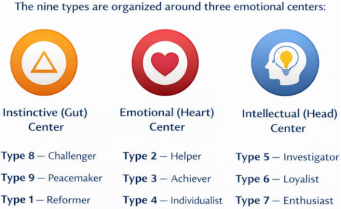
The Enneagram of Personality Describes Nine Fundamental Personality Types Organized into Three Emotional Centers:
1) Instinctive Centre
2) Emotional Centre
3) Intellectual Centre
Figure 1. The enneagram model-nine types & three emotional centres.
Each personality type represents a distinct pattern of emotional motivation, defense mechanisms, and coping strategies developed in response to life experiences. These personality patterns may influence how individuals respond to stress and illness.
6. Conceptual Relationship Between Enneagram Types and Remedy Themes
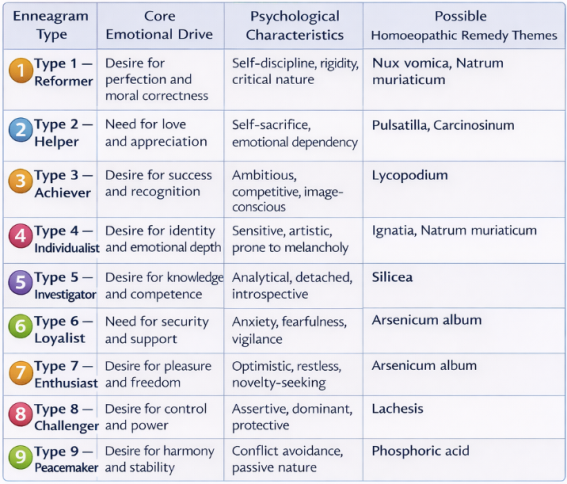
The Enneagram of Personality provides a systematic model describing nine fundamental personality archetypes. Each type represents a characteristic way of perceiving the world, responding to stress, and managing emotional conflicts.
In clinical practice, these personality patterns may help practitioners identify underlying emotional themes that correspond with remedy pictures described in classical homoeopathic literature.
Understanding personality patterns may assist the homoeopathic physician in:
| [12] | Hering C. Guiding Symptoms of Our Materia Medica. |
| [13] | Kent JT. Lectures on Homoeopathic Philosophy. |
[12, 13]
.
1) identifying recurring emotional patterns
2) understanding the patient’s coping mechanisms
3) recognizing underlying psychological conflicts
4) refining remedy selection through mental and emotional characteristics
For instance, a patient displaying the anxiety-driven vigilance typical of Enneagram Type 6 may correspond to remedy pictures characterized by fear and insecurity, such as Arsenicum album. Similarly, individuals exhibiting strong perfectionistic tendencies characteristic of Type 1 may reflect remedy pictures involving rigidity and self-discipline.
Integrating personality models with classical homoeopathic case-taking may therefore enrich the process of individualization while maintaining the fundamental principles of the discipline.
Figure 2. Enneagram personality types & possible homoeopathic remedy themes.
7. Trauma-Induced Miasmatic Activation
The theory of chronic miasms proposed by Hahnemann suggests that deep-seated disease predispositions may remain latent within the organism until activated by external influences. Traumatic experiences may act as triggers that disturb the equilibrium of the vital force, thereby activating latent miasmatic tendencies. This hypothesis proposes three stages:
1) latent constitutional predisposition
2) environmental or emotional trigger
3) manifestation of chronic disease
Such a model aligns with the homoeopathic principle that disease results from the interaction between external influences and internal susceptibility.
8. Integrated Model of Susceptibility
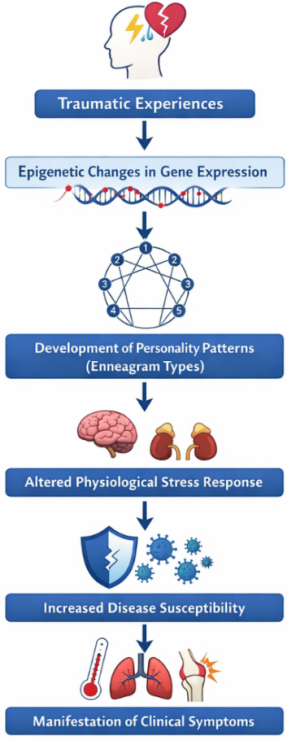
An integrative framework can be proposed to explain the relationship between trauma, epigenetics, personality, and disease susceptibility.
Figure 3. Integrative model of susceptibility.
9. Implications for Homoeopathic Practice
Integrating trauma history, personality analysis, and biological susceptibility into homoeopathic case-taking may provide several benefits:
1) deeper understanding of emotional causation
2) improved individualization of remedies
3) enhanced management of chronic disease
4) stronger physician-patient relationships
Such interdisciplinary perspectives reinforce the holistic principles of homoeopathy.
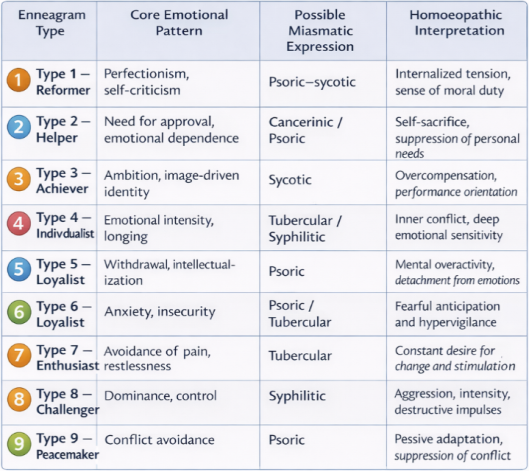
10. Conceptual Relationship Between Enneagram Types and Miasmatic Tendencies
Figure 4. Conceptual relationship between enneagram types & miasmatic tendencies.
11. Clinical Implications for Homoeopathic Case-Taking
The integration of personality typology and miasmatic theory may provide deeper insights into the psychological dimension of susceptibility. During case-taking, homoeopathic physicians often encounter recurring emotional patterns that correspond to both personality tendencies and miasmatic expressions.
For example:
1) Individuals displaying Type 6 anxiety patterns may reveal psoric or tubercular susceptibility characterized by fear and insecurity.
2) Type 8 personalities exhibiting strong control tendencies may correspond to syphilitic intensity and destructive emotional expression.
3) Type 2 individuals who suppress their own needs for the sake of others may reflect cancerinic tendencies associated with self-sacrifice and perfectionism.
Recognizing these patterns may assist practitioners in understanding deeper constitutional states that influence remedy selection.
12. Integrating Personality and Miasmatic Analysis
In homoeopathic practice, the goal of case-taking is to perceive the totality of the patient’s symptoms, including mental, emotional, and physical characteristics. Personality frameworks such as the Enneagram may help clinicians recognize recurring psychological themes, while miasmatic analysis provides insight into the deeper constitutional background of chronic disease.
By integrating these perspectives, practitioners may develop a more comprehensive understanding of the patient’s susceptibility and disease expression.
Such interdisciplinary exploration supports the holistic philosophy of homoeopathy, which emphasizes the unity of mind, body, and environment in the development of health and disease.
13. Discussion
The integration of trauma research, epigenetics, and personality psychology with homoeopathic philosophy provides a multidimensional understanding of susceptibility. While classical homoeopathic theory emphasizes the dynamic disturbance of the vital force, modern scientific discoveries offer complementary explanations for how life experiences influence biological functioning.
Personality frameworks such as the Enneagram may help practitioners recognize recurring emotional patterns that influence disease expression. When combined with careful case-taking and individualized remedy selection, these perspectives may improve therapeutic outcomes.
Further interdisciplinary research is needed to explore the relationships between trauma, personality patterns, and therapeutic responses in homoeopathic practice.
14. Conclusion
Susceptibility remains a central concept in homoeopathic philosophy and continues to provide valuable insights into the nature of disease. The teachings of Hahnemann emphasize that disease develops only when the organism possesses the necessary susceptibility.
Modern research in trauma psychology and epigenetics offers scientific perspectives that complement these classical ideas. The integration of personality frameworks such as the Enneagram with homoeopathic philosophy may further enhance understanding of individual susceptibility and disease manifestation.
Such interdisciplinary integration strengthens the holistic approach that lies at the heart of homoeopathy and highlights its continued relevance in contemporary healthcare.
Author Contributions
Ekta Tiwary: Conceptualization, Resources, Data curation, Methodology
Conflicts of Interest
The author declares no conflicts of interest.
References
| [1] |
Samuel Hahnemann. Organon of Medicine. 6th ed. New Delhi: B Jain Publishers.
|
| [2] |
Riso DR, Hudson R. The Wisdom of the Enneagram. New York: Bantam; 1999.
|
| [3] |
van der Kolk B. The Body Keeps the Score. New York: Viking; 2014.
|
| [4] |
McEwen BS. Stress, adaptation and disease. Ann N Y Acad Sci. 1998.
|
| [5] |
Meaney MJ. Epigenetics and the biological definition of gene–environment interactions. Child Dev. 2010.
|
| [6] |
Yehuda R, et al. Epigenetic biomarkers of trauma. Nat Rev Neurosci. 2015.
|
| [7] |
Siegel DJ. The Developing Mind. New York: Guilford Press; 2012.
|
| [8] |
Lipton BH. The Biology of Belief. Hay House; 2005.
|
| [9] |
McGowan PO, et al. Epigenetic regulation in childhood abuse. Nat Neurosci. 2009.
|
| [10] |
Sankaran R. The Soul of Remedies. Mumbai: Homoeopathic Medical Publishers.
|
| [11] |
Vithoulkas G. The Science of Homoeopathy. New Delhi: B Jain Publishers.
|
| [12] |
Hering C. Guiding Symptoms of Our Materia Medica.
|
| [13] |
Kent JT. Lectures on Homoeopathic Philosophy.
|
Cite This Article
-
APA Style
Tiwary, E. (2026). Understanding Susceptibility Through Trauma, Personality Types and Epigenetics - A Conceptual Review Integrating the Enneagram Model with Homoeopathic Philosophy. International Journal of Homeopathy & Natural Medicines, 12(1), 10-17. https://doi.org/10.11648/j.ijhnm.20261201.12
 Copy
|
Copy
|
 Download
ACS Style
Tiwary, E. Understanding Susceptibility Through Trauma, Personality Types and Epigenetics - A Conceptual Review Integrating the Enneagram Model with Homoeopathic Philosophy. Int. J. Homeopathy Nat. Med. 2026, 12(1), 10-17. doi: 10.11648/j.ijhnm.20261201.12
Copy
|
Download
AMA Style
Tiwary E. Understanding Susceptibility Through Trauma, Personality Types and Epigenetics - A Conceptual Review Integrating the Enneagram Model with Homoeopathic Philosophy. Int J Homeopathy Nat Med. 2026;12(1):10-17. doi: 10.11648/j.ijhnm.20261201.12
Copy
|
Download
-
@article{10.11648/j.ijhnm.20261201.12,
  author = {Ekta Tiwary},
  title = {Understanding Susceptibility Through Trauma, Personality Types and Epigenetics - A Conceptual Review Integrating the Enneagram Model with Homoeopathic Philosophy},
  journal = {International Journal of Homeopathy & Natural Medicines},
  volume = {12},
  number = {1},
  pages = {10-17},
  doi = {10.11648/j.ijhnm.20261201.12},
  url = {https://doi.org/10.11648/j.ijhnm.20261201.12},
  eprint = {https://article.sciencepublishinggroup.com/pdf/10.11648.j.ijhnm.20261201.12},
  abstract = {Susceptibility is a fundamental concept in homoeopathy that explains an individual's capacity to respond to environmental influences, disease-producing agents, and therapeutic interventions. According to Samuel Hahnemann, disease develops only when the organism possesses the necessary susceptibility, making it a central determinant of health, illness, and recovery. Rather than representing merely a physical predisposition, susceptibility reflects the dynamic interplay of mental, emotional, and constitutional factors that influence an individual's response to internal and external stimuli, thereby forming the basis of individualized case-taking and remedy selection in classical homoeopathy. Recent advances in trauma psychology and epigenetics have provided compelling evidence that adverse life experiences, particularly emotional trauma during early developmental stages, can induce long-lasting biological changes through epigenetic mechanisms that alter gene expression without modifying the DNA sequence, thereby influencing stress responses, immune function, emotional regulation, and vulnerability to chronic diseases. Concurrently, the Enneagram of Personality offers a psychological framework for understanding enduring personality patterns that emerge from early childhood experiences and adaptive coping strategies, shaping emotional responses, behavioural tendencies, resilience, and potentially an individual's susceptibility to illness and response to treatment. This conceptual review explores the interrelationship between emotional trauma, epigenetic modifications, Enneagram personality patterns, and the homoeopathic concept of susceptibility in the light of Hahnemann's teachings in the Organon of Medicine. By integrating insights from classical homoeopathic philosophy with contemporary developments in trauma psychology, personality theory, and epigenetics, the review proposes a broader and more comprehensive understanding of susceptibility that may enhance individualized patient assessment and remedy selection, reinforce the holistic foundations of homoeopathy, promote patient-centred clinical practice, and demonstrate the continuing relevance of homoeopathic principles within contemporary integrative and personalized healthcare.},
 year = {2026}
}
Copy
|
Download
-
TY  - JOUR
T1  - Understanding Susceptibility Through Trauma, Personality Types and Epigenetics - A Conceptual Review Integrating the Enneagram Model with Homoeopathic Philosophy
AU  - Ekta Tiwary
Y1  - 2026/08/18
PY  - 2026
N1  - https://doi.org/10.11648/j.ijhnm.20261201.12
DO  - 10.11648/j.ijhnm.20261201.12
T2  - International Journal of Homeopathy & Natural Medicines
JF  - International Journal of Homeopathy & Natural Medicines
JO  - International Journal of Homeopathy & Natural Medicines
SP  - 10
EP  - 17
PB  - Science Publishing Group
SN  - 2472-2316
UR  - https://doi.org/10.11648/j.ijhnm.20261201.12
AB  - Susceptibility is a fundamental concept in homoeopathy that explains an individual's capacity to respond to environmental influences, disease-producing agents, and therapeutic interventions. According to Samuel Hahnemann, disease develops only when the organism possesses the necessary susceptibility, making it a central determinant of health, illness, and recovery. Rather than representing merely a physical predisposition, susceptibility reflects the dynamic interplay of mental, emotional, and constitutional factors that influence an individual's response to internal and external stimuli, thereby forming the basis of individualized case-taking and remedy selection in classical homoeopathy. Recent advances in trauma psychology and epigenetics have provided compelling evidence that adverse life experiences, particularly emotional trauma during early developmental stages, can induce long-lasting biological changes through epigenetic mechanisms that alter gene expression without modifying the DNA sequence, thereby influencing stress responses, immune function, emotional regulation, and vulnerability to chronic diseases. Concurrently, the Enneagram of Personality offers a psychological framework for understanding enduring personality patterns that emerge from early childhood experiences and adaptive coping strategies, shaping emotional responses, behavioural tendencies, resilience, and potentially an individual's susceptibility to illness and response to treatment. This conceptual review explores the interrelationship between emotional trauma, epigenetic modifications, Enneagram personality patterns, and the homoeopathic concept of susceptibility in the light of Hahnemann's teachings in the Organon of Medicine. By integrating insights from classical homoeopathic philosophy with contemporary developments in trauma psychology, personality theory, and epigenetics, the review proposes a broader and more comprehensive understanding of susceptibility that may enhance individualized patient assessment and remedy selection, reinforce the holistic foundations of homoeopathy, promote patient-centred clinical practice, and demonstrate the continuing relevance of homoeopathic principles within contemporary integrative and personalized healthcare.
VL  - 12
IS  - 1
ER  -
Copy
|
Download





 Share This Article
 Twitter
 Linked In
 Facebook