
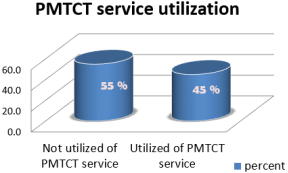
Background: Mother-to-child transmission (MTCT) of HIV remains the primary source of HIV infection among children under 15 years. Despite efforts to prevent MTCT, it remains a major public health problem in Ethiopia. This study assessed the utilization of Prevention of Mother-to-Child Transmission (PMTCT) of HIV services and nutritional interventions among pregnant women in Hadiya Zone, Southern Nations, Nationalities, and Peoples’ Region (SNNPR), Ethiopia. Methods: A community-based cross-sectional study was conducted among pregnant women in Hadiya Zone, SNNPR, Ethiopia, from March 1 to May 2, 2019. Participants were selected using systematic sampling. Data were collected using a pretested, structured, interviewer-administered questionnaire. Multivariable logistic regression identified predictors of PMTCT service utilization. Statistical significance was set at p < 0.05, with adjusted odds ratios (AORs) and 95% confidence intervals (CIs). Results: Among 613 participants, the response rate was 97.3%. PMTCT service utilization was 45% (95% CI: 41.1–48.8). Women with primary education or higher were five times more likely to utilize PMTCT services than those without formal education (AOR = 5.00; 95% CI: 3.08–8.16). Women attending two or more antenatal care (ANC) visits (AOR = 4.25; 95% CI: 2.41–7.51), living closer to a health facility (AOR = 1.93; 95% CI: 1.24–3.01), and having male partner involvement (AOR = 1.88; 95% CI: 1.31–2.69) were also more likely to utilize PMTCT services. Conclusion: PMTCT service utilization among pregnant women remains low. Higher education, two or more ANC visits, living within 60 minutes of a health facility, and male partner involvement were associated with greater utilization. Stakeholders should prioritize expanding PMTCT service coverage and addressing these factors to improve utilization among pregnant women.
| Published in | International Journal of HIV/AIDS Prevention, Education and Behavioural Science (Volume 12, Issue 2) |
| DOI | 10.11648/j.ijhpebs.20261202.11 |
| Page(s) | 21-27 |
| Creative Commons |
This is an Open Access article, distributed under the terms of the Creative Commons Attribution 4.0 International License (http://creativecommons.org/licenses/by/4.0/), which permits unrestricted use, distribution and reproduction in any medium or format, provided the original work is properly cited. |
| Copyright |
Copyright © The Author(s), 2026. Published by Science Publishing Group |
PMTCT, HIV, Pregnant Women, Infectious Disease Transmission, Vertical
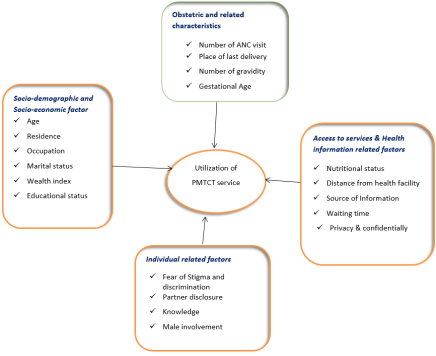
Variable | Response categories | PMTCT of HIV service | OR (95% CI) | AOR (95% CI) | P-value | |
|---|---|---|---|---|---|---|
Utilized N (%) | Not-Utilized N (%) | |||||
Residence | Rural* | 195(42.6) | 263(57.4) | 1 | ||
Urban | 81(52.2) | 74(47.8) | 1.48(1.02-2.13) | |||
Educational status of pregnant women | No formal education * | 57(31.5) | 124(68.5) | 1 | 1 | |
Primary education (1-8) | 115(41.5) | 162(58.5) | 1.54(1.04-2.29) | 1.79(1.18-2.73) | 0.01 | |
Secondary & above | 104(67.1) | 51(32.9) | 4.44(2.8 -7.02) | 5.01(3.08 -8.16) | 0.004 | |
Marital status | In union | 245(48.6) | 259(51.4) | 1.32(0.87-2.01) | ||
not in union* | 31(28.4) | 78(7.6) | 1 | |||
Gestation age | First trimester* | 38(38) | 62(62) | 1 | ||
Second trimester | 121(41.3) | 172(58.7) | 1.15(0.72-1.83) | |||
Third trimester | 117(53.2) | 103(46.8) | 1.85(1.14-3) | |||
Number of ANC visits | One* | 28(27.5) | 74(72.5) | 1 | 1 | |
Two | 74(38.5) | 118(61.5) | 1.66(0.98-2.79 | 1.81(1.04-3.18) | 0.023 | |
Three | 72(50.3) | 71(49.7) | 2.68(1.56-4.62) | 3.22(1.79-5.77) | 0.001 | |
Four and above | 102(58) | 74(42) | 3.64(2.15-6.18) | 4.25(2.41-7.51) | 0.002 | |
Distance from health facility | <60 minute | 233(53.8) | 200(46.2) | 1.78(1.18-2.68) | 1.93(1.24-3.01) | 0.003 |
>60 minute* | 76(42.2) | 104(57.8) | 1 | 1 | ||
Partner involvement | Yes | 172(47.1) | 193(52.9) | 1.68(1.21-2.33) | 1.88(1.31-2.69) | 0.001 |
No* | 104(41.9) | 144(58.1) | 1 | 1 | ||
Privacy during ANC visits & HIV test | Yes | 221(46.7) | 252(53.3) | 1.36(0.92-1.99) | ||
No* | 55(39.7) | 85(60.3) | 1 | |||
Variables | Characteristics | Frequency (No) | Percentage (%) |
|---|---|---|---|
Age of respondents | 15-24 | 208 | 33.9 |
25-34 | 268 | 43.7 | |
=>35 | 137 | 22.4 | |
Residence of mother | Rural | 458 | 74.7 |
Urban | 155 | 25.3 | |
Religion | Protestant | 459 | 74.9 |
Orthodox | 123 | 20.1 | |
Others* | 31 | 5 | |
Ethnicity | Hadiya | 514 | 83.8 |
Gurage | 67 | 10.9 | |
Others** | 32 | 5.3 | |
Educational status | No formal education | 181 | 29.5 |
Primary education (1-8) | 277 | 45.2 | |
Secondary & above (9-12)+ | 155 | 25.3 | |
Mothers occupation | House wife | 537 | 87.6 |
Merchant | 21 | 3.4 | |
Government employee | 37 | 6.0 | |
Others*** | 18 | 2.9 | |
Marital status | currently in marital union | 504 | 82.2 |
currently not in marital union | 109 | 17.8 | |
Husband occupation | Farmer | 497 | 81 |
Government employee | 85 | 13.9 | |
Others*** | 31 | 5.1 | |
Household wealth index | Lowest | 122 | 19.9 |
Second | 123 | 20.1 | |
Middle | 125 | 20.4 | |
Fourth | 121 | 19.7 | |
Highest | 122 | 19.9 |
ANC | Antenatal Care |
AOR | Adjusted Odds Ratio |
ART | Antiretroviral Therapy |
EDHS | Ethiopian Demographic Health Survey |
HIV | Human Immune Virus |
OR | Odds Ratio |
PMTCT | Prevention of Mother to Child Transmission |
SDG | Sustainable Development Goal |
UNICEF | United Nation International Children’s Emergency Fund |
WHO | World Health Organization |
| [1] | World Health Organization. Prevention of Mother-to-Child Transmission (PMTCT): Briefing Note. World Health Organization, Geneva, Switzerland. 2007. |
| [2] | World Health Organization. Prevention of Mother-to-Child Transmission (PMTCT) of HIV: Guidelines. World Health Organization, Geneva, Switzerland. 2017. |
| [3] | U.S. President’s Emergency Plan for AIDS Relief (PEPFAR) and/or World Health Organization. The Global HIV/AIDS Epidemic in 2018. Global Health Policy. 2021. |
| [4] | U.S. President’s Emergency Plan for AIDS Relief (PEPFAR). Ethiopia Country/Regional Operational Plan (COP/ROP): Strategic Direction Summary. Washington, DC, USA. 2017. |
| [5] | Central Statistical Agency (CSA) [Ethiopia], ICF. Ethiopia Demographic and Health Survey 2016. Central Statistical Agency and ICF, Addis Ababa, Ethiopia, and Rockville, Maryland, USA. 2016. |
| [6] | Shewasinad, S., Negash, S. Assessment of Factors Affecting PMTCT Service Utilization among Pregnant Women Attending Antenatal Care at Public Health Facilities in Mizan-Aman Town, Bench Maji Zone. EC Paediatrics. 2018. |
| [7] | Joint United Nations Programme on HIV/AIDS (UNAIDS). Getting to Zero: 2011–2015 Strategy. UNAIDS, Geneva, Switzerland. 2011. |
| [8] | Merga, H., Woldemichael, K., Dube, L. Utilization of Prevention of Mother-to-Child Transmission of HIV Services and Associated Factors among Antenatal Care-Attending Mothers in Sebeta Town, Central Ethiopia. Advances in Public Health. 2016. |
| [9] | Gebremedhin, K. B., Tian, B., Tang, C., Zhang, X., Yisma, E., Wang, H. Factors Associated with Acceptance of Provider-Initiated HIV Testing and Counseling among Pregnant Women in Ethiopia. Patient Preference and Adherence. 2018. Volume (22). |
| [10] | Feleke, B. E., Wasie, B. Challenges of PMTCT Service Utilization in Amhara Region: A Comparative Cross-Sectional Study. Ethiopian Journal of Health Sciences. 2018. Volume, issue, page range, and DOI require verification. World Health Organization. Report on Primary health care implementation in the Eastern Mediterranean Region. USA Washington DC. 2019. |
| [11] | World Health Organization. Report on Primary Health Care Implementation in the Eastern Mediterranean Region. World Health Organization. 2019. Publication details and publisher location require verification. |
| [12] | Mustapha, M., Musiime, V., Kitaka, S. B., Rujumba, J., Barungi, N. N. Utilization of Prevention of Mother-to-Child Transmission of HIV Services by Adolescent and Young Mothers in Mulago Hospital, Uganda. BMC Infectious Diseases. 2018. |
| [13] | Mekibib, T. K., Askal, T. K., Eleni, T. T., Kaleab, T. T., Fikadu, Y. A. Service Utilization of Prevention of Mother-to-Child HIV Transmission and Associated Factors among Antenatal Care Clients in Dera Woreda Health Institutions, South Gondar, Ethiopia. International Journal of Caring Sciences. 2018. 17(2). |
| [14] | Akal, C. G., Afework, D. T. Status of Prevention of Mother-to-Child Transmission (PMTCT) Services Utilization and Factors Affecting PMTCT Service Uptake by Pregnant Women Attending Antenatal Care Clinics in Selected Health Facilities of Afar Regional State, Ethiopia. Journal of Environmental and Public Health. 2018. 18(2). |
| [15] | Feyera, A., Megerssa, B., Legesse, D., Hailemichael, F. Prevention of Mother-to-Child Transmission of HIV/AIDS: Service Utilization and Associated Factors among Selected Public Health Facilities in Ethiopia. Medical Practice and Review. 2017. 19(1). |
| [16] | Otieno, A. J. W., Karanja, S. M., Kagira, J. Socio-Cultural Factors Influencing Utilization of Prevention of Mother-to-Child Transmission of HIV among Women Attending Antenatal Care Clinics in Rachuonyo North Sub-County, Homa Bay County, Kenya. Information and Knowledge Management. 2018. 18(3). |
| [17] | Abajobir, A. A., Zeleke, A. B. Knowledge, Attitude, Practice, and Factors Associated with Prevention of Mother-to-Child Transmission of HIV/AIDS among Pregnant Mothers Attending the Antenatal Clinic at Hawassa Referral Hospital, South Ethiopia. Journal of AIDS & Clinical Research. 2013. Volume 24(2). |
| [18] | Zegeye, E. A., Mbonigaba, J., Dimbuene, Z. T. Factors Associated with the Utilization of Antenatal Care and Prevention of Mother-to-Child HIV Transmission Services in Ethiopia: Applying a Count Regression Model. BMC Women's Health. 2018. Volume, article number, and DOI require verification. |
| [19] | Awungafac, G., Njuken, P. A., Ndas, J. A., Mbuagba, L. T. Prevention of Mother-to-Child Transmission of the Human Immunodeficiency Virus: Investigating the Uptake and Utilization of Maternal and Child Health Services in Tiko Health District, Cameroon. Pan African Medical Journal. 2015. Volume 12. |
APA Style
Teklehaimanot, A. N., Duna, A. (2026). Utilization of Prevention of Mother to Child Transmission of HIV and Nutritional Intervention Among Pregnant Women in Hadiya Zone, SNNPR Ethiopia. International Journal of HIV/AIDS Prevention, Education and Behavioural Science, 12(2), 21-27. https://doi.org/10.11648/j.ijhpebs.20261202.11
ACS Style
Teklehaimanot, A. N.; Duna, A. Utilization of Prevention of Mother to Child Transmission of HIV and Nutritional Intervention Among Pregnant Women in Hadiya Zone, SNNPR Ethiopia. Int. J. HIV/AIDS Prev. Educ. Behav. Sci. 2026, 12(2), 21-27. doi: 10.11648/j.ijhpebs.20261202.11
AMA Style
Teklehaimanot AN, Duna A. Utilization of Prevention of Mother to Child Transmission of HIV and Nutritional Intervention Among Pregnant Women in Hadiya Zone, SNNPR Ethiopia. Int J HIV/AIDS Prev Educ Behav Sci. 2026;12(2):21-27. doi: 10.11648/j.ijhpebs.20261202.11
@article{10.11648/j.ijhpebs.20261202.11,
  author = {Aderajew Nigusse Teklehaimanot and Abebe Duna},
  title = {Utilization of Prevention of Mother to Child Transmission of HIV and Nutritional Intervention Among Pregnant Women in Hadiya Zone, SNNPR Ethiopia},
  journal = {International Journal of HIV/AIDS Prevention, Education and Behavioural Science},
  volume = {12},
  number = {2},
  pages = {21-27},
  doi = {10.11648/j.ijhpebs.20261202.11},
  url = {https://doi.org/10.11648/j.ijhpebs.20261202.11},
  eprint = {https://article.sciencepublishinggroup.com/pdf/10.11648.j.ijhpebs.20261202.11},
  abstract = {Background: Mother-to-child transmission (MTCT) of HIV remains the primary source of HIV infection among children under 15 years. Despite efforts to prevent MTCT, it remains a major public health problem in Ethiopia. This study assessed the utilization of Prevention of Mother-to-Child Transmission (PMTCT) of HIV services and nutritional interventions among pregnant women in Hadiya Zone, Southern Nations, Nationalities, and Peoples’ Region (SNNPR), Ethiopia. Methods: A community-based cross-sectional study was conducted among pregnant women in Hadiya Zone, SNNPR, Ethiopia, from March 1 to May 2, 2019. Participants were selected using systematic sampling. Data were collected using a pretested, structured, interviewer-administered questionnaire. Multivariable logistic regression identified predictors of PMTCT service utilization. Statistical significance was set at p < 0.05, with adjusted odds ratios (AORs) and 95% confidence intervals (CIs). Results: Among 613 participants, the response rate was 97.3%. PMTCT service utilization was 45% (95% CI: 41.1–48.8). Women with primary education or higher were five times more likely to utilize PMTCT services than those without formal education (AOR = 5.00; 95% CI: 3.08–8.16). Women attending two or more antenatal care (ANC) visits (AOR = 4.25; 95% CI: 2.41–7.51), living closer to a health facility (AOR = 1.93; 95% CI: 1.24–3.01), and having male partner involvement (AOR = 1.88; 95% CI: 1.31–2.69) were also more likely to utilize PMTCT services. Conclusion: PMTCT service utilization among pregnant women remains low. Higher education, two or more ANC visits, living within 60 minutes of a health facility, and male partner involvement were associated with greater utilization. Stakeholders should prioritize expanding PMTCT service coverage and addressing these factors to improve utilization among pregnant women.},
 year = {2026}
}
TY  - JOUR
T1  - Utilization of Prevention of Mother to Child Transmission of HIV and Nutritional Intervention Among Pregnant Women in Hadiya Zone, SNNPR Ethiopia
AU  - Aderajew Nigusse Teklehaimanot
AU  - Abebe Duna
Y1  - 2026/11/16
PY  - 2026
N1  - https://doi.org/10.11648/j.ijhpebs.20261202.11
DO  - 10.11648/j.ijhpebs.20261202.11
T2  - International Journal of HIV/AIDS Prevention, Education and Behavioural Science
JF  - International Journal of HIV/AIDS Prevention, Education and Behavioural Science
JO  - International Journal of HIV/AIDS Prevention, Education and Behavioural Science
SP  - 21
EP  - 27
PB  - Science Publishing Group
SN  - 2575-5765
UR  - https://doi.org/10.11648/j.ijhpebs.20261202.11
AB  - Background: Mother-to-child transmission (MTCT) of HIV remains the primary source of HIV infection among children under 15 years. Despite efforts to prevent MTCT, it remains a major public health problem in Ethiopia. This study assessed the utilization of Prevention of Mother-to-Child Transmission (PMTCT) of HIV services and nutritional interventions among pregnant women in Hadiya Zone, Southern Nations, Nationalities, and Peoples’ Region (SNNPR), Ethiopia. Methods: A community-based cross-sectional study was conducted among pregnant women in Hadiya Zone, SNNPR, Ethiopia, from March 1 to May 2, 2019. Participants were selected using systematic sampling. Data were collected using a pretested, structured, interviewer-administered questionnaire. Multivariable logistic regression identified predictors of PMTCT service utilization. Statistical significance was set at p < 0.05, with adjusted odds ratios (AORs) and 95% confidence intervals (CIs). Results: Among 613 participants, the response rate was 97.3%. PMTCT service utilization was 45% (95% CI: 41.1–48.8). Women with primary education or higher were five times more likely to utilize PMTCT services than those without formal education (AOR = 5.00; 95% CI: 3.08–8.16). Women attending two or more antenatal care (ANC) visits (AOR = 4.25; 95% CI: 2.41–7.51), living closer to a health facility (AOR = 1.93; 95% CI: 1.24–3.01), and having male partner involvement (AOR = 1.88; 95% CI: 1.31–2.69) were also more likely to utilize PMTCT services. Conclusion: PMTCT service utilization among pregnant women remains low. Higher education, two or more ANC visits, living within 60 minutes of a health facility, and male partner involvement were associated with greater utilization. Stakeholders should prioritize expanding PMTCT service coverage and addressing these factors to improve utilization among pregnant women.
VL  - 12
IS  - 2
ER  -
Department of Nutrition and Dietetics, Jimma University, Jimma, Ethiopia
Hadiya Zone Health Office, Hossana, Ethiopia

Information



 Share This Article
 Twitter
 Linked In
 Facebook

 Copy
 Download