
 ,
Mohamed Adama Diakite,
Fatoumata Dembele,
Christiane Dembele,
Martin Dakouo,
Cheick Abou Kounta Sidibe,
Boubacar Madio Dit Aladiogo Maiga,
Mamadou Niang,
Enrico Savegnago,
Alice Fusaro,
Amadou Kone,
Isabella Monne,
Antoine Dara
,
Mohamed Adama Diakite,
Fatoumata Dembele,
Christiane Dembele,
Martin Dakouo,
Cheick Abou Kounta Sidibe,
Boubacar Madio Dit Aladiogo Maiga,
Mamadou Niang,
Enrico Savegnago,
Alice Fusaro,
Amadou Kone,
Isabella Monne,
Antoine Dara
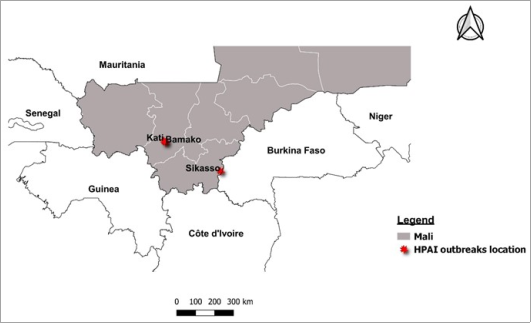
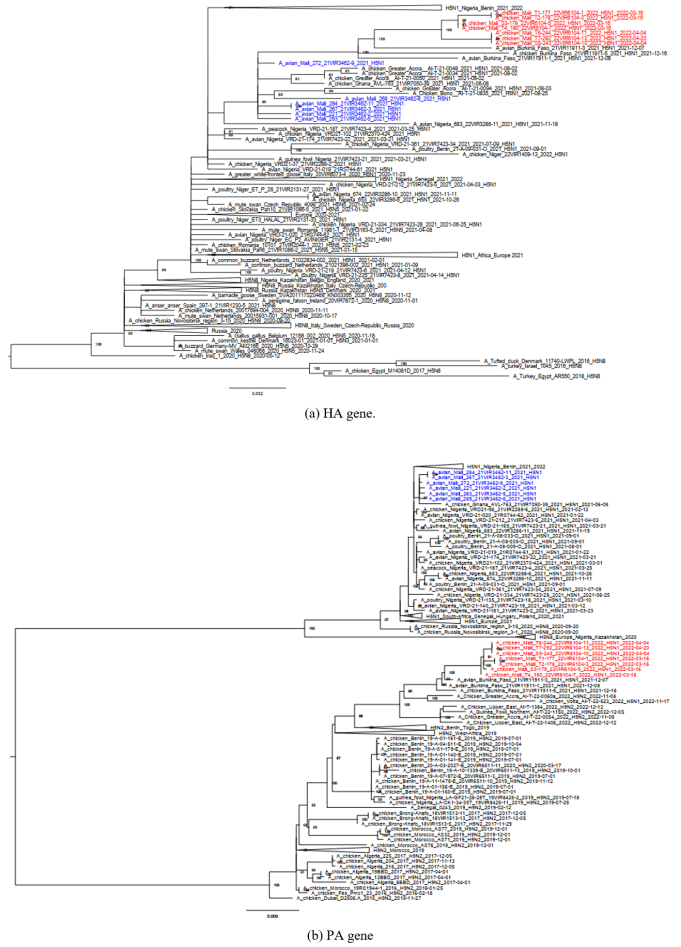
Highly pathogenic avian influenza (HPAI) H5N1 continues to pose a significant threat to animal health, poultry production, and public health worldwide. Mali experienced two outbreaks of Highly Pathogenic Avian Influenza (HPAI) H5N1 in 2021 and 2022, raising concerns about viral evolution and potential public health risks in West Africa. Suspected samples (Tissue and swab) collected from sick and dead birds during these outbreaks were analyzed at the Central Veterinary Laboratory of Bamako using quantitative real-time PCR. Whole-genome sequencing was performed on thirteen H5N1-positive samples using the Illumina MiSeq platform with a paired-end sequencing approach. Phylogenetic analyses were conducted using the maximum-likelihood method implemented in IQ-TREE v1.6.6. Phylogenetic analysis of the hemagglutinin (HA) gene revealed that all detected viruses belonged to clade 2.3.4.4b and clustered closely with strains previously reported in West Africa. In-depth analysis of the whole genome phylogenetic topology revealed the emergence of an H9N2/H5N1 reassortant strain during the 2022 outbreak. Molecular characterization of all eight genomic segments identified several mutations associated with host specificity, including markers linked to adaptation in gallinaceous poultry and mutations potentially associated with increased zoonotic potential. These findings demonstrate the continued genetic evolution of H5N1 viruses circulating in Mali and emphasize the importance of sustained genomic surveillance. Strengthening hygiene practices and biosecurity measures in poultry farms, live bird markets, and slaughterhouses is essential to reduce the risks posed to both animal and public health.
| Published in | International Journal of Microbiology and Biotechnology (Volume 11, Issue 3) |
| DOI | 10.11648/j.ijmb.20261103.12 |
| Page(s) | 106-114 |
| Creative Commons |
This is an Open Access article, distributed under the terms of the Creative Commons Attribution 4.0 International License (http://creativecommons.org/licenses/by/4.0/), which permits unrestricted use, distribution and reproduction in any medium or format, provided the original work is properly cited. |
| Copyright |
Copyright © The Author(s), 2026. Published by Science Publishing Group |
HPAI, H5N1, Phylogenetics, Molecular Characterization, Mali
Marker | Effects | H5N1 viruses from Mali | Citation |
|---|---|---|---|
PB2 gene | |||
V598T | Increased virulence in mice; Increased polymerase activity in mammalian cells; Increased replication in mammalian cells | All | Hu M. et al., (2017); Suttie A. et al., (2019) |
S715N | Decreased virulence in mice | All | Sun H. et al., (2015); Suttie A. et al., (2019) |
L89V; G309D; T339K; R477G; I495V; K627E; A676T | Increased polymerase activity in mammalian cells; Increased virulence in mice | All but: Mali/221_21VIR3462-2/2021. Mali/263_21VIR3462-5/2021 | Li J. et al., (2009); Suttie A. et al., (2019) |
L89V; G309D | Increased polymerase activity in mammalian cells; Increased virulence in mice | All but: Mali/221_21VIR3462-2/2021 | Li J. et al., (2009); Suttie A. et al., (2019) |
K526R | Increased polymerase activity in mammalian cells | Only 2022 | Song W. et al., (2014); Suttie A. et al., (2019) |
K389R | Increased polymerase activity in mammalian cells; Increased replication in mammalian cells | All but: Mali/221_21VIR3462-2/2021 | Hu M. et al., (2017); Suttie A. et al., (2019) |
E627K | Increased virulence in mice; Decreased replication in avian cells; Enhanced polymerase activity; Decreases virulence in chickens; Decreased polymerase activity in avian cells; Contributes to contact transmission in guinea pigs; Contributes to airborne pathogenicity in ferrets | Only: Mali/263_21VIR3462-5/2021 | Fornek J. L. et al., (2009); Herfst S. et al., (2012); Le Q. M. et al., (2005); Hatta M. et al., (2007); Bortz E. et al., (2011); Hatta H. et al., (2001); Richard M. et al., (2017); Shinya K. et al., (2004); Manzoor R. et al., (2009); Chen H. et al., (2007); Mase M. et al., (2006); Bogs J. et al., (2011); Kim J. H. et al., (2010); Long J. S. et al., (2013); Suttie A. et al., (2019) |
PB1 gene | |||
N66S | Enhanced replication in mice; Enhanced virulence in mice; Enhanced antiviral response in mice | All | Conenello G. M. et al., (2007); Schmolke M. et al., (2011); Suttie A. et al., (2019) |
D622G | Increased polymerase activity in mice; Increased virulence in mice | All | Feng X. et al., (2016); Suttie A. et al., (2019) |
D3V | Increased polymerase activity in avian cells; Increased replication in avian cells; Increased polymerase activity in mammalian cells; Increased replication in mammalian cells | All | Elgendy E. M. et al., (2017); Suttie A. et al., (2019) |
PA gene | |||
S37A | Increased polymerase activity in mammalian cells | All | Yamayoshi S. et al., (2014); Suttie A. et al., (2019) |
Q400P | Decreased virulence in mice | Only 2022 | DesRochers B. L. et al., (2016); Suttie A. et al., (2019) |
P190S | Decreased virulence in mice | All | DesRochers B. L. et al., (2016); Suttie A. et al., (2019) |
N409S | Increased polymerase activity in mammalian cells; Increased replication in mammalian cells | Only 2021 | Yamayoshi S. et al., (2014); Suttie A. et al., (2019) |
N383D | Increased polymerase activity in mammalian cells; Increased polymerase activity in avian cells | All | Song J. et al., (2015); Song J. et al., (2011); Suttie A. et al., (2019) |
HA gene | |||
Marker H5 Numbering | |||
K64E | Increased pH of fusion; Decreased HA stability; Decreased virulence in mice | All | Sun X. et al., (2019); Suttie A. et al., (2019) |
V182N | Increased virus binding to α2-6; Decreased virus binding to α2-3 | All | Lu X. et al., (2013); Suttie A. et al., (2019) |
S154N | Increased virus binding to α2-6 | All | Wang W. et al., (2010); Suttie A. et al., (2019) |
S133A | Increased pseudovirus binding to α2-6 | All | Yang Z. Y. et al., (2007); Suttie A. et al., (2019) |
S107R; T108I | Increased virulence in chickens; Increased virulence in mice; Increased pH of fusion | All | Wessels U. et al., (2018); Suttie A. et al., (2019) |
K218Q; S223R | Increased virus binding to α2-3; Increased virus binding to α2-6 | Allk | Guo H. et al., (2017); Suttie A. et al., (2019) |
NP gene | |||
M105V | Increased virulence in chickens | All | Tada T. et al., (2011); Tada T. et al., (2011); Suttie A. et al., (2019) |
A184K | Increased replication in avian cells; Increased virulence in chickens; Enhanced interferon response | All | Wasilenko J. L. et al., (2009); Suttie A. et al., (2019) |
MP gene | |||
T215A | Increased virulence in mice | All | Fan S. et al., (2009); Suttie A. et al., (2019) |
N30D | Increased virulence in mice | All | Fan S. et al., (2009); Suttie A. et al., (2019) |
I43M | Increased virulence in chickens; Increased virulence in ducks; Increased virulence in mice | All | Nao N. et al., (2015); Suttie A. et al., (2019) |
NS gene | |||
V149A | Increased virulence in chickens; Decreased interferon response in chickens | All | Li Z. et al., (2006); Suttie A. et al., (2019) |
P42S | Increased virulence in mice; Decreased antiviral response in mice | All | Jiao P. et al., (2008); Suttie A. et al., (2019) |
L103F; I106M | Increased virulence in mice | All | Kuo R. L. et al., (2009); Spesock A. et al., (2011); Suttie A. et al., (2019) |
I106M | Increased viral replication in mammalian cells; Increased virulence in mice | All | Ayllon J. et al., (2014); Suttie A. et al., (2019) |
C138F; K55E; K66E | Enhanced replication in mammalian cells; Decreased interferon response | All | Li J. et al., (2018); Suttie A. et al., (2019) |
C138F | Increased viral replication in mammalian cells; Decreased interferon response | All | Li J. et al., (2018); Suttie A. et al., (2019) |
AI | Avian Influenza |
BWA | Burrows-Wheeler Aligner |
CT | Cycle Threshold |
CVL | Central Veterinary Laboratory |
DNA | Deoxyribonucleic Acid |
DNSV | National Directorate of Veterinary Services |
DNPIA | National Directorate of Productions and Animal Industries |
ECTAD | Emergency Center for Transboundary Animal Diseases |
FAO-UN | United Nations -Food and Agriculture Organizations |
FAO | Food and Agriculture Organization |
GATK | Genome Analysis Toolkit |
GISAID | Global Initiative on Sharing All Influenza Data |
HA | Hemagglutinin Gene |
HPAI | Highly Pathogenic Avian Influenza |
M gene | Matrix Gene |
MAFFT | Multiple Alignment Using Fast Fourier Transform |
ML | Maximum Likelihood |
ND | Newcastle Disease |
PA | Polymerase Acidic |
PCR | Polymerase Chain Reaction |
PE | Paired-end |
qRT-PCR | Quantitative Reverse Transcription Pol Ymerase Chain Reaction |
RAF | Regional Office for Africa |
RNA | Ribonucleic Acid |
RT-PCR | Reverse Transcription Polymerase Chain Reaction |
WOAH | World Organization for Animal Health |
| [1] | A. Fusaro et al., “Disentangling the role of Africa in the global spread of H5 highly pathogenic avian influenza,” Nat. Commun., vol. 10, no. 1, p. 5310, Nov. 2019, |
| [2] | Y.-R. Seo et al., “Evolution and Spread of Highly Pathogenic Avian Influenza A (H5N1) Clade 2.3.4.4b Virus in Wild Birds, South Korea, 2022-2023,” Emerg. Infect. Dis., vol. 30, no. 2, p. 299, Feb. 2024, |
| [3] | E. F. S. Authority (EFSA) et al., “Drivers for a pandemic due to avian influenza and options for One Health mitigation measures,” EFSA J., vol. 22, no. 4, p. e8735, 2024, |
| [4] | F. O. Fasina, S. P. R. Bisschop, T. M. Joannis, L. H. Lombin, and C. Abolnik, “Molecular characterization and epidemiology of the highly pathogenic avian influenza H5N1 in Nigeria,” Epidemiol. Infect., vol. 137, no. 4, pp. 456-463, Apr. 2009, |
| [5] | A. Fusaro et al., “Evolutionary dynamics of multiple sublineages of H5N1 influenza viruses in Nigeria from 2006 to 2008,” J. Virol., vol. 84, no. 7, pp. 3239-3247, Apr. 2010, |
| [6] | E. Spackman et al., “Development of a real-time reverse transcriptase PCR assay for type A influenza virus and the avian H5 and H7 hemagglutinin subtypes,” J. Clin. Microbiol., vol. 40, no. 9, pp. 3256-3260, Sep. 2002, |
| [7] | M. J. Slomka et al., “Validated H5 Eurasian real-time reverse transcriptase-polymerase chain reaction and its application in H5N1 outbreaks in 2005-2006,” Avian Dis., vol. 51, no. 1 Suppl, pp. 373-377, Mar. 2007, |
| [8] | G. A. Van der Auwera et al., “From FastQ data to high confidence variant calls: the Genome Analysis Toolkit best practices pipeline,” Curr. Protoc. Bioinforma., vol. 43, no. 1110, p. 11.10.1-11.10.33, 2013, |
| [9] | A. Wilm et al., “LoFreq: a sequence-quality aware, ultra-sensitive variant caller for uncovering cell-population heterogeneity from high-throughput sequencing datasets,” Nucleic Acids Res., vol. 40, no. 22, pp. 11189-11201, Dec. 2012, |
| [10] | K. Katoh and D. M. Standley, “MAFFT multiple sequence alignment software version 7: improvements in performance and usability,” Mol. Biol. Evol., vol. 30, no. 4, pp. 772-780, Apr. 2013, |
| [11] | D. T. Hoang, O. Chernomor, A. von Haeseler, B. Q. Minh, and L. S. Vinh, “UFBoot2: Improving the Ultrafast Bootstrap Approximation,” Mol. Biol. Evol., vol. 35, no. 2, pp. 518-522, Feb. 2018, |
| [12] | S. Kalyaanamoorthy, B. Q. Minh, T. K. F. Wong, A. von Haeseler, and L. S. Jermiin, “ModelFinder: fast model selection for accurate phylogenetic estimates,” Nat. Methods, vol. 14, no. 6, pp. 587-589, Jun. 2017, |
| [13] | L.-T. Nguyen, H. A. Schmidt, A. von Haeseler, and B. Q. Minh, “IQ-TREE: a fast and effective stochastic algorithm for estimating maximum-likelihood phylogenies,” Mol. Biol. Evol., vol. 32, no. 1, pp. 268-274, Jan. 2015, |
| [14] | Z.-Y. Yang et al., “Immunization by Avian H5 Influenza Hemagglutinin Mutants with Altered Receptor Binding Specificity,” Science, vol. 317, no. 5839, pp. 825-828, Aug. 2007, |
| [15] | F. T. Lo et al., “Intercontinental Spread of Eurasian Highly Pathogenic Avian Influenza A (H5N1) to Senegal,” Emerg. Infect. Dis., vol. 28, no. 1, pp. 234-237, Jan. 2022, |
| [16] | L. B. Ouoba et al., “Emergence of a Reassortant 2.3.4.4b Highly Pathogenic H5N1 Avian Influenza Virus Containing H9N2 PA Gene in Burkina Faso, West Africa, in 2021,” Viruses, vol. 14, no. 9, p. 1901, Aug. 2022, |
| [17] | I. N. Sanogo et al., “Genetic insights of H9N2 avian influenza viruses circulating in Mali and phylogeographic patterns in Northern and Western Africa,” Virus Evol., vol. 10, no. 1, p. veae011, 2024, |
| [18] | M. S et al., “Live bird markets characterization and trading network analysis in Mali: Implications for the surveillance and control of avian influenza and Newcastle disease,” Acta Trop., vol. 155, Mar. 2016, |
| [19] | I. N. Sanogo et al., “Highly Pathogenic Avian Influenza A (H5N1) Clade 2.3.4.4b Virus in Poultry, Benin, 2021,” Emerg. Infect. Dis., vol. 28, no. 12, pp. 2534-2537, Dec. 2022, |
| [20] | J. Cappelle et al., “Circulation of avian influenza viruses in wild birds in Inner Niger Delta, Mali,” Influenza Other Respir. Viruses, vol. 6, no. 4, pp. 240-244, Jul. 2012, |
| [21] | C. Adlhoch, F. Baldinelli, A. Fusaro, and C. Terregino, “Avian influenza, a new threat to public health in Europe?,” Clin. Microbiol. Infect. Off. Publ. Eur. Soc. Clin. Microbiol. Infect. Dis., vol. 28, no. 2, pp. 149-151, Feb. 2022, |
| [22] | Y. Feng et al., “Emergence of triple-subtype reassortants of fatal human H5N6 avian influenza virus in Yunnan, China,” J. Infect., vol. 72, no. 6, pp. 753-756, Jun. 2016, |
| [23] | J. Huang et al., “The Biological Characteristics of Novel H5N6 Highly Pathogenic Avian Influenza Virus and Its Pathogenesis in Ducks,” Front. Microbiol., vol. 12, p. 628545, 2021, |
| [24] | N. M. Hagag et al., “Isolation of a Novel Reassortant Highly Pathogenic Avian Influenza (H5N2) Virus in Egypt,” Viruses, vol. 11, no. 6, p. 565, Jun. 2019, |
| [25] | W. Zhu et al., “Epidemiologic, Clinical, and Genetic Characteristics of Human Infections with Influenza A (H5N6) Viruses, China,” Emerg. Infect. Dis., vol. 28, no. 7, pp. 1332-1344, Jul. 2022, |
| [26] | F. Yang et al., “Genetic analysis and biological characteristics of novel clade 2.3.4.4 reassortment H5N6 avian influenza viruses from poultry in eastern China in 2016,” Int. J. Infect. Dis. IJID Off. Publ. Int. Soc. Infect. Dis., vol. 110, pp. 436-448, Sep. 2021, |
APA Style
Diakite, A., Diakite, M. A., Dembele, F., Samake, K., Dembele, C., et al. (2026). Molecular and Phylogenetic Analysis of the Highly Pathogenic Avian Influenza Virus H5N1 Detected in Mali During the 2021 and 2022 Outbreaks. International Journal of Microbiology and Biotechnology, 11(3), 106-114. https://doi.org/10.11648/j.ijmb.20261103.12
ACS Style
Diakite, A.; Diakite, M. A.; Dembele, F.; Samake, K.; Dembele, C., et al. Molecular and Phylogenetic Analysis of the Highly Pathogenic Avian Influenza Virus H5N1 Detected in Mali During the 2021 and 2022 Outbreaks. Int. J. Microbiol. Biotechnol. 2026, 11(3), 106-114. doi: 10.11648/j.ijmb.20261103.12
AMA Style
Diakite A, Diakite MA, Dembele F, Samake K, Dembele C, et al. Molecular and Phylogenetic Analysis of the Highly Pathogenic Avian Influenza Virus H5N1 Detected in Mali During the 2021 and 2022 Outbreaks. Int J Microbiol Biotechnol. 2026;11(3):106-114. doi: 10.11648/j.ijmb.20261103.12
@article{10.11648/j.ijmb.20261103.12,
  author = {Adama Diakite and Mohamed Adama Diakite and Fatoumata Dembele and Kassoum Samake and Christiane Dembele and Martin Dakouo and Cheick Abou Kounta Sidibe and Boubacar Madio Dit Aladiogo Maiga and Mamadou Niang and Lassina Ouattara and Angelique Angot and Enrico Savegnago and Alice Fusaro and Amadou Kone and Isabella Monne and Antoine Dara},
  title = {Molecular and Phylogenetic Analysis of the Highly Pathogenic Avian Influenza Virus H5N1 Detected in Mali During the 2021 and 2022 Outbreaks},
  journal = {International Journal of Microbiology and Biotechnology},
  volume = {11},
  number = {3},
  pages = {106-114},
  doi = {10.11648/j.ijmb.20261103.12},
  url = {https://doi.org/10.11648/j.ijmb.20261103.12},
  eprint = {https://article.sciencepublishinggroup.com/pdf/10.11648.j.ijmb.20261103.12},
  abstract = {Highly pathogenic avian influenza (HPAI) H5N1 continues to pose a significant threat to animal health, poultry production, and public health worldwide. Mali experienced two outbreaks of Highly Pathogenic Avian Influenza (HPAI) H5N1 in 2021 and 2022, raising concerns about viral evolution and potential public health risks in West Africa. Suspected samples (Tissue and swab) collected from sick and dead birds during these outbreaks were analyzed at the Central Veterinary Laboratory of Bamako using quantitative real-time PCR. Whole-genome sequencing was performed on thirteen H5N1-positive samples using the Illumina MiSeq platform with a paired-end sequencing approach. Phylogenetic analyses were conducted using the maximum-likelihood method implemented in IQ-TREE v1.6.6. Phylogenetic analysis of the hemagglutinin (HA) gene revealed that all detected viruses belonged to clade 2.3.4.4b and clustered closely with strains previously reported in West Africa. In-depth analysis of the whole genome phylogenetic topology revealed the emergence of an H9N2/H5N1 reassortant strain during the 2022 outbreak. Molecular characterization of all eight genomic segments identified several mutations associated with host specificity, including markers linked to adaptation in gallinaceous poultry and mutations potentially associated with increased zoonotic potential. These findings demonstrate the continued genetic evolution of H5N1 viruses circulating in Mali and emphasize the importance of sustained genomic surveillance. Strengthening hygiene practices and biosecurity measures in poultry farms, live bird markets, and slaughterhouses is essential to reduce the risks posed to both animal and public health.},
 year = {2026}
}
TY  - JOUR
T1  - Molecular and Phylogenetic Analysis of the Highly Pathogenic Avian Influenza Virus H5N1 Detected in Mali During the 2021 and 2022 Outbreaks
AU  - Adama Diakite
AU  - Mohamed Adama Diakite
AU  - Fatoumata Dembele
AU  - Kassoum Samake
AU  - Christiane Dembele
AU  - Martin Dakouo
AU  - Cheick Abou Kounta Sidibe
AU  - Boubacar Madio Dit Aladiogo Maiga
AU  - Mamadou Niang
AU  - Lassina Ouattara
AU  - Angelique Angot
AU  - Enrico Savegnago
AU  - Alice Fusaro
AU  - Amadou Kone
AU  - Isabella Monne
AU  - Antoine Dara
Y1  - 2026/07/24
PY  - 2026
N1  - https://doi.org/10.11648/j.ijmb.20261103.12
DO  - 10.11648/j.ijmb.20261103.12
T2  - International Journal of Microbiology and Biotechnology
JF  - International Journal of Microbiology and Biotechnology
JO  - International Journal of Microbiology and Biotechnology
SP  - 106
EP  - 114
PB  - Science Publishing Group
SN  - 2578-9686
UR  - https://doi.org/10.11648/j.ijmb.20261103.12
AB  - Highly pathogenic avian influenza (HPAI) H5N1 continues to pose a significant threat to animal health, poultry production, and public health worldwide. Mali experienced two outbreaks of Highly Pathogenic Avian Influenza (HPAI) H5N1 in 2021 and 2022, raising concerns about viral evolution and potential public health risks in West Africa. Suspected samples (Tissue and swab) collected from sick and dead birds during these outbreaks were analyzed at the Central Veterinary Laboratory of Bamako using quantitative real-time PCR. Whole-genome sequencing was performed on thirteen H5N1-positive samples using the Illumina MiSeq platform with a paired-end sequencing approach. Phylogenetic analyses were conducted using the maximum-likelihood method implemented in IQ-TREE v1.6.6. Phylogenetic analysis of the hemagglutinin (HA) gene revealed that all detected viruses belonged to clade 2.3.4.4b and clustered closely with strains previously reported in West Africa. In-depth analysis of the whole genome phylogenetic topology revealed the emergence of an H9N2/H5N1 reassortant strain during the 2022 outbreak. Molecular characterization of all eight genomic segments identified several mutations associated with host specificity, including markers linked to adaptation in gallinaceous poultry and mutations potentially associated with increased zoonotic potential. These findings demonstrate the continued genetic evolution of H5N1 viruses circulating in Mali and emphasize the importance of sustained genomic surveillance. Strengthening hygiene practices and biosecurity measures in poultry farms, live bird markets, and slaughterhouses is essential to reduce the risks posed to both animal and public health.
VL  - 11
IS  - 3
ER  -
Department of Diagnostic and Research, Central Veterinary Laboratory (CVL), Bamako, Mali
Department of Diagnostic and Research, Central Veterinary Laboratory (CVL), Bamako, Mali
Department of Diagnostic and Research, Central Veterinary Laboratory (CVL), Bamako, Mali
Department of Diagnostic and Research, Central Veterinary Laboratory (CVL), Bamako, Mali
Department of Diagnostic and Research, Central Veterinary Laboratory (CVL), Bamako, Mali
Department of Diagnostic and Research, Central Veterinary Laboratory (CVL), Bamako, Mali
Department of Diagnostic and Research, Central Veterinary Laboratory (CVL), Bamako, Mali
Emergency Center for Transboundary Animal Diseases (ECTAD), Regional Office for Africa (RAF), United Nations -Food and Agriculture Organizations (FAO-UN), Accra, Ghana
Division of Comparative Biomedical Sciences, Istituto Zooprofilattico Sperimentale delle Venezie, 35020 Legnaro, Italy
Division of Comparative Biomedical Sciences, Istituto Zooprofilattico Sperimentale delle Venezie, 35020 Legnaro, Italy
Department of Biology,University of Science, Techniques and Technology, Bamako, Mali
Division of Comparative Biomedical Sciences, Istituto Zooprofilattico Sperimentale delle Venezie, 35020 Legnaro, Italy
Department of Biology,University of Science, Techniques and Technology, Bamako, Mali

Information


 Share This Article
 Twitter
 Linked In
 Facebook
 Copy
Copy Download