Abstract
Ilmenite (FeTiO₃) is an economically valuable associated mineral in tin deposits and an important source of titanium. Its recovery from tin-processing tailings can increase the utilization value of mineral resources. This study evaluated the effects of particle size and splitter opening on ilmenite grade and recovery using an Induced Roll Magnetic Separator (IRMS). The experiment used air-table tailings from PT Timah Tbk. The feed was classified into three particle-size fractions, namely −50# +80# (177–300 µm), −80# +100# (149–177 µm), and −100# (<149 µm), and processed at splitter openings of 100%, 60%, and 20%. Feed characterization was performed using X-Ray Fluorescence (XRF) and Grain Counting Analysis (GCA). Each treatment combination was tested twice. The experimental results showed that ilmenite grade increased after magnetic separation for all particle-size fractions. The highest grade of 85.92% was obtained from the −80# +100# fraction at a 20% splitter opening, whereas the highest recovery of 59.19% was obtained from the −50# +80# fraction at a 100% splitter opening. Two-Way ANOVA showed that particle size, splitter opening, and their interaction significantly affected both grade and recovery (p < 0.05). Particle size was the dominant factor for grade, while splitter opening had the greater effect on recovery. Quadratic regression of particle size against ilmenite grade produced R2 = 0.953 and an optimum coded particle size of 1.687, corresponding more closely to the −80# +100# fraction. The results demonstrate that particle size and splitter opening should be considered simultaneously in optimizing ilmenite separation using IRMS.
Keywords
Ilmenite, Induced Roll Magnetic Separator, Particle Size, Splitter Opening, Grade, Recovery
1. Introduction
Indonesia is one of the major tin-producing countries, and tin deposits commonly contain associated minerals with economic value, including ilmenite (FeTiO₃), monazite, zircon, and xenotime. Ilmenite is an important titanium-bearing mineral that is widely used as a raw material for titanium dioxide and titanium products. Therefore, recovering ilmenite from tin-processing residues can increase the utilization value of mineral resources and support the optimization of associated-mineral processing
| [1] | B. A. Wills and J. A. Finch, Wills’ Mineral Processing Technology: An Introduction to the Practical Aspects of Ore Treatment and Mineral Recovery, 8th ed. Elsevier, 2016,
https://doi.org/10.1016/C2010-0-65478-2 |
| [10] | A. H. J. Sampath, D. W. Nadeera, and M. D. Rohini, “Methods of extracting TiO₂ and other related compounds from ilmenite,” Minerals, 2023, https://doi.org/10.3390/min13050662 |
| [15] | B. A. Wills, Wills’ Mineral Processing Technology, 7th ed. Elsevier, 2006,
https://doi.org/10.1016/B978-0-7506-4450-1.X5000-0 |
| [19] | H. Wang, X. Zhang, R. Qu, L. Zhang, and W. Li, “Recent technology developments in beneficiation and enrichment of ilmenite: A review,” Minerals Engineering, vol. 219, Art. no. 109084, 2024, https://doi.org/10.1016/j.mineng.2024.109084 |
[1, 10, 15, 19]
.
PT Timah Tbk has developed mineral-processing activities involving physical separation methods, including gravity, magnetic, and electrostatic separation. One of the important processes for ilmenite recovery is high-intensity magnetic separation using an Induced Roll Magnetic Separator (IRMS). The separation is based on differences in magnetic susceptibility between minerals. Ilmenite is paramagnetic and can therefore be attracted by a high-intensity magnetic field, whereas minerals with weak or diamagnetic responses follow different trajectories during separation
| [1] | B. A. Wills and J. A. Finch, Wills’ Mineral Processing Technology: An Introduction to the Practical Aspects of Ore Treatment and Mineral Recovery, 8th ed. Elsevier, 2016,
https://doi.org/10.1016/C2010-0-65478-2 |
| [2] | J. Svoboda, Magnetic Techniques for the Treatment of Materials. Springer, 2004,
https://doi.org/10.1007/1-4020-2107-0 |
| [16] | S. K. Tripathy and N. Suresh, “Influence of particle size on dry high-intensity magnetic separation of paramagnetic mineral,” Advanced Powder Technology, vol. 28, no. 3, pp. 1092–1102, 2017, https://doi.org/10.1016/j.apt.2017.01.018 |
| [19] | H. Wang, X. Zhang, R. Qu, L. Zhang, and W. Li, “Recent technology developments in beneficiation and enrichment of ilmenite: A review,” Minerals Engineering, vol. 219, Art. no. 109084, 2024, https://doi.org/10.1016/j.mineng.2024.109084 |
[1, 2, 16, 19]
.
The performance of magnetic separation is strongly influenced by feed characteristics. Particle size is particularly important because it affects mineral liberation and the balance between magnetic, gravitational, centrifugal, and frictional forces acting on particles. Coarse particles may contain locked valuable minerals and impurities, while excessively fine particles can experience entrainment and other fine-particle effects that reduce selectivity. Consequently, an appropriate particle-size range is required to obtain effective and selective separation
| [3] | A. Gupta and D. Yan, Mineral Processing Design and Operations: An Introduction. Elsevier, 2016,
https://doi.org/10.1016/C2014-0-01236-1 |
| [4] | S. K. Tripathy, P. K. Banerjee, N. Suresh, and Y. R. Murthy, “Influence of particle size and magnetic field strength on dry high intensity magnetic separation of paramagnetic minerals,” Powder Technology, vol. 269, pp. 112–120, 2015,
https://doi.org/10.1016/j.apt.2017.01.018 |
| [5] | X. Zheng, Z. Luo, and Y. Chen, “Separation characteristics of ilmenite from mineral sands using High Intensity Magnetic Separator,” Minerals Engineering, vol. 122, pp. 28–35, 2018. |
| [16] | S. K. Tripathy and N. Suresh, “Influence of particle size on dry high-intensity magnetic separation of paramagnetic mineral,” Advanced Powder Technology, vol. 28, no. 3, pp. 1092–1102, 2017, https://doi.org/10.1016/j.apt.2017.01.018 |
| [17] | J. Zeng, L. Chen, R. Yang, X. Tong, P. Ren, and Y. Zheng, “Centrifugal high gradient magnetic separation of fine ilmenite,” International Journal of Mineral Processing, vol. 168, pp. 48–54, 2017, https://doi.org/10.1016/j.minpro.2017.09.005 |
| [20] | X. Zheng, L. Du, and Y. Wang, “Effect of particle size on capture and separation of refractory weakly magnetic minerals in high gradient magnetic separation coupling with magnetic fluid,” Journal of Environmental Chemical Engineering, vol. 13, no. 2, Art. no. 115918, 2025,
https://doi.org/10.1016/j.jece.2025.115918 |
[3-5, 16, 17, 20]
.
In addition to particle size, splitter position is an important operating parameter in an IRMS. The splitter determines the cut point between magnetic, middling, and nonmagnetic products. Changes in splitter opening alter particle collection trajectories and therefore affect both product grade and recovery. A narrower opening can improve selectivity and increase grade, but may also cause more valuable particles to report to middling or tailing, resulting in lower recovery. Conversely, a wider opening may increase recovery while allowing more gangue minerals to enter the concentrate
| [3] | A. Gupta and D. Yan, Mineral Processing Design and Operations: An Introduction. Elsevier, 2016,
https://doi.org/10.1016/C2014-0-01236-1 |
| [5] | X. Zheng, Z. Luo, and Y. Chen, “Separation characteristics of ilmenite from mineral sands using High Intensity Magnetic Separator,” Minerals Engineering, vol. 122, pp. 28–35, 2018. |
| [16] | S. K. Tripathy and N. Suresh, “Influence of particle size on dry high-intensity magnetic separation of paramagnetic mineral,” Advanced Powder Technology, vol. 28, no. 3, pp. 1092–1102, 2017, https://doi.org/10.1016/j.apt.2017.01.018 |
[3, 5, 16]
.
The air-table tailings processed at PT Timah Tbk contain residual valuable minerals that can potentially be recovered by further concentration. However, studies evaluating the combined effects of particle size and splitter opening on ilmenite separation from air-table tailings using IRMS remain limited. Previous work has shown that particle size and operating variables, including splitter position, can jointly influence the performance of induced-roll magnetic separation
| [6] | W. Dhani et al., “Induced Roll Magnetic Separator applied for high grade ilmenite separation from mining tailing,” SINERGI, vol. 27, no. 2, pp. 271–280, 2023,
https://doi.org/10.22441/sinergi.2023.2.015 |
| [7] | N. T. Ayu, P. Janiar, and Guskarnali, “Induced Roll Magnetic Separator (IRMS),” Jurnal Teknik Pertambangan, vol. 24, no. 2, pp. 92–97, 2024, https://doi.org/10.36873/jtp.v24i2.14851 |
| [11] | D. C. Montgomery, Design and Analysis of Experiments, 10th ed. John Wiley & Sons, 2019. |
| [16] | S. K. Tripathy and N. Suresh, “Influence of particle size on dry high-intensity magnetic separation of paramagnetic mineral,” Advanced Powder Technology, vol. 28, no. 3, pp. 1092–1102, 2017, https://doi.org/10.1016/j.apt.2017.01.018 |
[6, 7, 11, 16]
. The interaction between these two parameters is therefore important because the effect of splitter position may vary with particle size
.
Therefore, this study investigated the effects of particle size and splitter opening on ilmenite grade and recovery using an IRMS. The study also aimed to identify the particle-size fraction that provides the most favorable separation performance based on experimental results and statistical analysis.
2. Materials and Methods
2.1. Materials and Feed Characterization
The research was conducted at the Processing and Refinery Division of PT Timah Tbk, Muntok, West Bangka. The study was carried out from March 9 to May 9, 2026. The material used was air-table tailings obtained from the mineral-processing operation.
The feed was cleaned and classified by screening into three particle-size fractions:
1) −50# +80# (177–300 µm);
2) −80# +100# (149–177 µm);
3) −100# (<149 µm).
The feed masses for the −50# +80#, −80# +100#, and −100# particle-size fractions were 413 kg, 304 kg, and 135 kg, respectively. The corresponding initial ilmenite contents were 154.37 kg, 117.31 kg, and 37.30 kg, respectively.
X-Ray Fluorescence (XRF) analysis was conducted to characterize the elemental composition of the initial feed, while Grain Counting Analysis (GCA) was used to determine the initial ilmenite grade for each particle-size fraction. The initial ilmenite grades were 37.35% for the −50# +80# fraction, 38.59% for the −80# +100# fraction, and 27.63% for the −100# fraction
| [9] | T. Prihatin and P. Aprilia, “Kajian mineral cassiterite dan mineral ikutan pada bijih timah dengan metode Grain Counting Analysis di Bidang Pengolahan Mineral Unit Metalurgi Muntok PT Timah Tbk,” Jurnal Ilmiah Teknik dan Sains, vol. 1, no. 1, pp. 41–44, 2023, https://doi.org/10.62278/jits.v1i1.8 |
[9]
.
Table 1. Initial feed characteristics for each particle-size fraction.
Particle Size Fraction | Feed Mass (kg) | Initial Ilmenite Content (kg) | Initial Ilmenite Grade (%) |
-50# +80# | 413 | 154,37 | 37,35 |
-80# +100# | 304 | 117,31 | 38,59 |
-100# | 135 | 37,30 | 27,63 |
The XRF analysis of the initial air-table tailings identified Fe and Ti concentrations of 10.37% and 9.04%, respectively. Other detected elements included Si, Zr, Sn, and Ba.
2.2. Induced Roll Magnetic Separator
The separation experiments were conducted using a Reading Induced Roll Magnetic Separator manufactured by Mineral Technologies Pty Ltd., Australia. The equipment is an IRMS 2×2×1000×160 Dia + Scalper, configured as a two-start, two-stage high-intensity electromagnetic induced-roll magnetic separator for dry magnetic separation. The specified feed-size range is >45 µm–3 mm
| [14] | Mineral Technologies, Induced Roll Magnetic Separator IRM 2×2×1000×160 Dia + Scalper. Australia: Mineral Technologies Pty Ltd., 2013. |
[14]
.
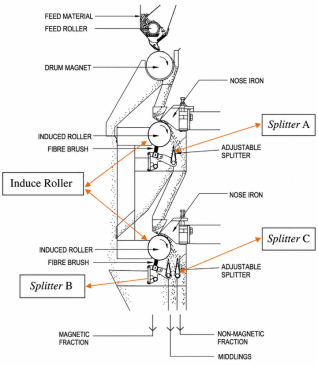
The feed was introduced through the feed roller toward the magnetic drum and subsequently processed through the first and second induced rolls. Splitter 1 and splitter 2 controlled the separation trajectories, while fibre brushes removed particles adhering to the rolls. The final products consisted of magnetic, middling, and nonmagnetic fractions.
The main components and separation path of the IRMS used in this study are illustrated in
Figure 1.
Figure 1. Schematic configuration and separation path of the Induced Roll Magnetic Separator.
The independent variables were particle size and splitter opening. Splitter openings of 100%, 60%, and 20% were applied to each particle-size fraction. Each treatment combination was tested twice.
2.3. Grade and Recovery Determination
After separation, samples from each treatment were prepared for GCA. For GCA, approximately 250 g of sample was prepared and classified using a sieve shaker. For XRF analysis, approximately 25 g of sample was ground to obtain a fine and homogeneous material.
Ilmenite grade was determined from the GCA results. Recovery was calculated from feed mass, concentrate mass, feed grade, and concentrate grade according to (
1).
Where R is ilmenite recovery (%), K is concentrate mass (kg), k is concentrate grade (%), F is feed mass (kg), and f is feed grade (%).
Material distribution and losses were evaluated using metallurgical balance. The products from each separation test were weighed, and the difference between feed and total product mass was used to evaluate losses.
2.4. Statistical Analysis
The experimental data were processed using Microsoft Excel and IBM SPSS Statistics. Descriptive statistics, Shapiro–Wilk residual normality testing, Levene's test, Two-Way ANOVA, and Tukey HSD were used to evaluate the effects of particle size and splitter opening. Quadratic regression was subsequently applied to estimate the optimum particle-size code for ilmenite grade
| [12] | A. Field, Discovering Statistics Using IBM SPSS Statistics, 5th ed. SAGE Publications, 2018. |
| [13] | I. Ghozali, Aplikasi Analisis Multivariate dengan Program IBM SPSS 26, 10th ed. Badan Penerbit Universitas Diponegoro, 2021. |
[12, 13]
.
The experimental design consisted of three particle-size levels, three splitter-opening levels, and two replications for each combination, resulting in a balanced factorial design with 18 observations.
3. Results
3.1. Feed Characterization
The XRF analysis showed that the air-table tailings contained 10.37% Fe and 9.04% Ti, indicating the presence of Fe- and Ti-bearing minerals. Grain Counting Analysis (GCA) showed that the initial ilmenite grades were 37.35% for the −50# +80# fraction, 38.59% for the −80# +100# fraction, and 27.63% for the −100# fraction. The −80# +100# fraction had the highest initial ilmenite grade among the investigated particle-size fractions.
Table 2. Initial Feed Elements Based on XRF Results.
Feed | Unsur | PPM |
Tailing Air table | Si | 5,64% |
Ti | 9,04% |
Fe | 10,37% |
Zr | 0,87% |
Sn | 3,54% |
Ba | 1,40% |
Le | 64,71% |
-50# +80# | Si | 2,49% |
Ti | 10,26% |
Fe | 9,26% |
Zr | 4,11% |
Sn | 2,7% |
Ba | 4,45% |
Le | 62,99% |
-80# +100# | Si | 2,54% |
Ti | 10,64% |
Fe | 11,65% |
Zr | 6,65% |
Sn | 2,85% |
Ba | 2,85% |
Le | 58,82% |
-100# | Si | 1,24% |
Ti | 9,27% |
Fe | 9,80% |
Zr | 12,43% |
Sn | 4,06% |
Ba | 3,34% |
Le | 53,54% |
The GCA results showed that the −80# +100# fraction had the highest initial ilmenite grade at 38.59%, followed by −50# +80# at 37.35%, while the −100# fraction had the lowest initial grade at 27.63%. The variation indicates that ilmenite was not uniformly distributed among the particle-size fractions.
Table 3. Composition and Mineral Grade of the Initial Feed Based on GCA Analysis Before the Separation Process.
Feed | Mineral | Kadar |
Tailing Air table | Cassiterite | 2,51% |
Ilmenite | 31,61% |
Monazite | 6,17% |
Pyrit | 5,57% |
Zircon | 9,11% |
Tourmaline | 2,31% |
Quartz | 20,66% |
-50# +80# | Cassiterite | 1,74% |
Ilmenite | 37,35% |
Monazite | 8,24% |
Pyrit | 14,73% |
Zircon | 9,43% |
Tourmaline | 1,63% |
Quartz | 25,79% |
-80# +100# | Cassiterite | 2,07% |
Ilmenite | 38,59% |
Monazite | 15,15% |
Pyrit | 7,06% |
Zircon | 16,93% |
Tourmaline | 0,88% |
Quartz | 18,22% |
-100# | Cassiterite | 3,32% |
Ilmenite | 27,63% |
Monazite | 1,81% |
Pyrit | 19,03% |
Zircon | 31,80% |
Tourmaline | 0,77% |
Quartz | 14,60% |
The relatively high initial ilmenite content in the −80# +100# fraction indicates its potential for further concentration. Conversely, the lower ilmenite content in the −100# fraction was accompanied by relatively higher proportions of zircon and pyrite.
3.2. Metallurgical Balance and Losses
The separation products consisted of magnetic, middling, and nonmagnetic fractions. Material losses ranged from 1.65% to 6.75% across the experimental conditions. The highest loss, 6.75%, occurred for the −100# fraction at a 60% splitter opening.
The higher losses observed in the finer fraction may be associated with the greater tendency of fine particles to adhere to equipment surfaces, become dispersed during handling, or remain incompletely collected during processing.
3.3. Ilmenite Grade and Recovery
The separation experiments were conducted using three particle-size fractions and three splitter openings. The resulting ilmenite grades and recoveries are presented in
Table 4.
Table 4. Results of the Nine Treatment Combinations Based on Feed Size and Splitter Setting.
Feed Particle Size | Splitter Opening (%) | Ilmenite Grade (%) | Ilmenite Recovery (%) |
-50# +80# | 100 | 72,46 | 59,19 |
60 | 76,63 | 54,56 |
20 | 81,20 | 51,65 |
-80# +100# | 100 | 79,90 | 53,05 |
60 | 84,14 | 51,41 |
20 | 85,92 | 47,70 |
-100# | 100 | 53,21 | 56,26 |
60 | 55,08 | 52,65 |
20 | 56,28 | 51,14 |
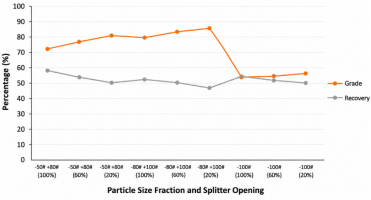
The effect of particle size and splitter opening on ilmenite grade and recovery is illustrated in
Figure 2.
Figure 2. Effect of Particle Size and Splitter Opening on Ilmenite Grade and Recovery.
The IRMS increased ilmenite grade for all particle-size fractions. For −50# +80#, grade increased from 37.35% in the feed to 72.46–81.20%. For −80# +100#, grade increased from 38.59% to 79.90–85.92%, while the −100# fraction increased from 27.63% to 53.21–56.28%.
The highest grade, 85.92%, was obtained from −80# +100# at a 20% splitter opening. In contrast, the highest recovery, 59.19%, was obtained from −50# +80# at a 100% splitter opening. These results indicate a trade-off between grade and recovery.
4. Discussion
4.1. Effect of Particle Size and Splitter Opening on Grade
Two-Way ANOVA showed that particle size significantly affected ilmenite grade, with F = 1857.799 and p < 0.001. Splitter opening also had a significant effect, with F = 74.371 and p < 0.001. The interaction between particle size and splitter opening was also significant (F = 6.083, p = 0.012).
The substantially higher F-value for particle size indicates that particle size was the dominant factor affecting grade in the statistical model. This result can be related to particle liberation and particle response to the magnetic field. The −80# +100# fraction produced the highest mean grade, 83.3200%, in the Tukey analysis, followed by −50# +80# at 76.7633% and −100# at 54.8567%. All particle-size pairs differed significantly in grade.
The high performance of the −80# +100# fraction suggests that this size range provided a favorable balance between liberation and particle response during magnetic separation. The −50# +80# particles were relatively coarser and may contain more locked particles, whereas the −100# fraction was finer and exhibited lower grade. The latter may be associated with the greater influence of fine-particle behavior and the higher proportion of non-ilmenite minerals observed in the initial GCA results. Similar studies of high-intensity magnetic separation have demonstrated that particle size and competing physical forces can substantially affect separation selectivity and recovery
| [16] | S. K. Tripathy and N. Suresh, “Influence of particle size on dry high-intensity magnetic separation of paramagnetic mineral,” Advanced Powder Technology, vol. 28, no. 3, pp. 1092–1102, 2017, https://doi.org/10.1016/j.apt.2017.01.018 |
| [17] | J. Zeng, L. Chen, R. Yang, X. Tong, P. Ren, and Y. Zheng, “Centrifugal high gradient magnetic separation of fine ilmenite,” International Journal of Mineral Processing, vol. 168, pp. 48–54, 2017, https://doi.org/10.1016/j.minpro.2017.09.005 |
| [18] | L. Han, Z. Cheng, and D. Lu, “Separation Analysis of New Magnetic Separator for Pre-Concentration of Ilmenite Particles,” Minerals, vol. 12, no. 7, Art. no. 837, 2022,
https://doi.org/10.3390/min12070837 |
| [20] | X. Zheng, L. Du, and Y. Wang, “Effect of particle size on capture and separation of refractory weakly magnetic minerals in high gradient magnetic separation coupling with magnetic fluid,” Journal of Environmental Chemical Engineering, vol. 13, no. 2, Art. no. 115918, 2025,
https://doi.org/10.1016/j.jece.2025.115918 |
[16-18, 20]
.
Splitter opening also affected grade because it controlled the cut point between product streams. The 20% opening produced the highest grade for the −80# +100# fraction. The narrower opening increased selectivity and reduced the amount of non-ilmenite material entering the high-grade product, consistent with the role of splitter position as an important operating variable in IRMS
| [6] | W. Dhani et al., “Induced Roll Magnetic Separator applied for high grade ilmenite separation from mining tailing,” SINERGI, vol. 27, no. 2, pp. 271–280, 2023,
https://doi.org/10.22441/sinergi.2023.2.015 |
| [11] | D. C. Montgomery, Design and Analysis of Experiments, 10th ed. John Wiley & Sons, 2019. |
| [16] | S. K. Tripathy and N. Suresh, “Influence of particle size on dry high-intensity magnetic separation of paramagnetic mineral,” Advanced Powder Technology, vol. 28, no. 3, pp. 1092–1102, 2017, https://doi.org/10.1016/j.apt.2017.01.018 |
[6, 11, 16]
.
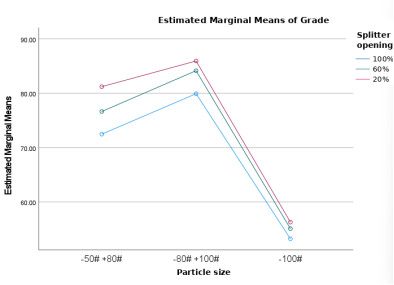
The significant interaction indicates that the effect of splitter opening cannot be interpreted independently of particle size. The profile plot showed nonparallel trends between the treatment levels, confirming that the response to splitter adjustment differed among particle-size fractions.
4.2. Effect on Recovery
Particle size significantly affected recovery (F = 116.829, p < 0.001), while splitter opening had an even greater effect (F = 214.471, p < 0.001). The interaction between particle size and splitter opening was also significant (F = 7.073, p = 0.007).
The higher F-value for splitter opening indicates that splitter position was the dominant factor affecting recovery in the statistical model. This is consistent with the function of the splitter as a cut-point control that determines how many particles report to the concentrate and other product fractions. Previous IRMS research also identified splitter position as a major process variable influencing magnetic-product characteristics
| [16] | S. K. Tripathy and N. Suresh, “Influence of particle size on dry high-intensity magnetic separation of paramagnetic mineral,” Advanced Powder Technology, vol. 28, no. 3, pp. 1092–1102, 2017, https://doi.org/10.1016/j.apt.2017.01.018 |
[16]
.
The highest recovery of 59.19% was obtained at −50# +80# and 100% splitter opening. However, this condition did not produce the highest grade. This confirms that maximizing recovery does not necessarily maximize product quality. A wider collection window can retain more ilmenite but may also allow more gangue minerals to enter the product, reflecting the general trade-off between concentrate grade and recovery in mineral separation
| [1] | B. A. Wills and J. A. Finch, Wills’ Mineral Processing Technology: An Introduction to the Practical Aspects of Ore Treatment and Mineral Recovery, 8th ed. Elsevier, 2016,
https://doi.org/10.1016/C2010-0-65478-2 |
| [17] | J. Zeng, L. Chen, R. Yang, X. Tong, P. Ren, and Y. Zheng, “Centrifugal high gradient magnetic separation of fine ilmenite,” International Journal of Mineral Processing, vol. 168, pp. 48–54, 2017, https://doi.org/10.1016/j.minpro.2017.09.005 |
[1, 17]
.
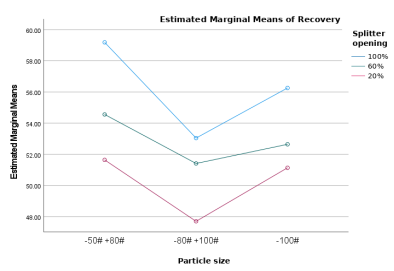
The interaction effect further indicates that splitter adjustment must be considered together with particle size. The profile plot showed nonparallel response trends, consistent with the significant interaction obtained from ANOVA.
4.3. Grade–Recovery Relationship
The experimental results demonstrate a clear grade–recovery trade-off. The highest grade of 85.92% was achieved at −80# +100# and 20% splitter opening, whereas the highest recovery of 59.19% was achieved at −50# +80# and 100% splitter opening.
This difference indicates that the optimum operating condition depends on the performance criterion. A narrower splitter opening can improve selectivity and increase grade, while a wider opening can increase the amount of valuable mineral recovered. Therefore, selecting an operating condition requires consideration of both product quality and mineral recovery rather than relying on only one response.
4.4. Optimum Particle Size
Quadratic regression was used to evaluate the relationship between particle-size code and ilmenite grade. The model produced R = 0.976, R2 = 0.953, and adjusted R2 = 0.947. The regression model was significant with F = 153.053 and p < 0.001.
The resulting equation was:
(2)
where Y represents ilmenite grade and X is the particle-size code.
Because the quadratic coefficient was negative, the model formed a downward-opening parabola. The optimum coded particle size was:
(3)
The optimum value lies between code 1 (−50# +80#) and code 2 (−80# +100#), but is closer to code 2. Therefore, the −80# +100# fraction was identified as the most suitable particle-size fraction for achieving high ilmenite grade.
The regression result is consistent with the ANOVA and Tukey results, where the −80# +100# fraction had the highest mean grade. Thus, although the maximum recovery occurred at a different condition, the −80# +100# fraction provides the strongest statistical basis for selecting the optimum particle-size range.
Figure 3. Interaction profile plot of particle size and splitter opening on ilmenite grade.
Figure 4. Interaction profile plot of particle size and splitter opening on ilmenite recovery.
The profile plots provide a visual interpretation of the interaction effects obtained from the Two-Way ANOVA. For ilmenite grade, all three splitter settings show a similar overall pattern: the estimated marginal mean increases from −50# +80# to −80# +100# and then decreases at −100#. The 20% splitter opening consistently gives the highest estimated marginal mean grade, followed by 60% and 100%. The lines are not parallel, indicating that the magnitude of the splitter effect varies with particle size. The −80# +100# fraction shows the highest estimated marginal mean grade at all splitter settings, confirming its favorable response under the investigated conditions.
For ilmenite recovery, the profile plot shows a different response pattern. The 100% splitter opening gives the highest estimated marginal mean recovery at all particle-size levels, whereas the 20% opening gives the lowest. Recovery decreases from −50# +80# to −80# +100# and then increases again at −100#. The nonparallel lines indicate that the effect of splitter opening on recovery changes with particle size. This visual pattern supports the statistically significant interaction between particle size and splitter opening for recovery (p = 0.007). Therefore, the profile plots confirm that the two operating factors should be evaluated jointly rather than interpreted independently.
5. Conclusion
The air-table tailings from PT Timah Tbk contained recoverable ilmenite, with initial GCA grades of 37.35%, 38.59%, and 27.63% for the −50# +80#, −80# +100#, and −100# fractions, respectively.
Particle size and splitter opening significantly affected both ilmenite grade and recovery, and their interaction was also significant. Particle size was the dominant factor affecting grade, whereas splitter opening had the greater effect on recovery.
The highest ilmenite grade of 85.92% was obtained from the −80# +100# fraction at a 20% splitter opening, while the highest recovery of 59.19% was obtained from the −50# +80# fraction at a 100% splitter opening. These results demonstrate a trade-off between grade and recovery.
Quadratic regression produced R2 = 0.953, with an optimum particle-size code of 1.687, which was closer to the −80# +100# fraction. Therefore, −80# +100# was identified as the optimum particle-size fraction for the investigated IRMS separation conditions. The detailed experimental results and statistical analysis are presented in Appendix 1.
Abbreviations
GCA | Grain Counting Analysis |
IRMS | Induced Roll Magnetic Separator |
XRF | X-Ray Fluorescence |
ANOVA | Analysis of Variance |
Acknowledgments
The authors would like to express their sincere gratitude to PT Timah Tbk for providing the research materials and supporting the implementation of this study. The authors also gratefully acknowledge the assistance and support provided during the experimental activities, sample preparation, and data collection. Special thanks are extended to the supervisors and all parties who contributed to the completion of this research.
Author Contributions
Dela Citra: Conceptualization, Data curation, Formal Analysis, Investigation, Methodology, Visualization, Writing – original draft
Taufik Arief: Conceptualization, Investigation, Methodology, Supervision, Validation, Writing – review & editing, Writing – original draft
Data Availability Statement
The data supporting the outcome of this research work has been reported in this manuscript.
Conflicts of Interest
The authors declare no conflicts of interest.
Appendix: Detailed Experimental Results and Statistical Analysis
Appendix 1 presents the detailed experimental results for the nine treatment combinations and the principal statistical results used to interpret the effects of particle size and splitter opening.
Table A1 reports the results of duplicate tests together with their corresponding mean values, consistent with the experimental design reported in the manuscript.
Table A1. Mean ilmenite grade and recovery for each treatment combination.
Particle size fraction | Splitter opening (%) | Ilmenite grade (%) | Ilmenite recovery (%) |
−50# +80# (177–300 µm) | 100 | 73,31% | 59,09% |
71,61% | 59,28% |
60 | 77,54% | 54,38% |
75,72% | 54,74% |
20 | 81,98% | 51,26% |
80,42% | 52,03% |
−80# +100# (149–177 µm) | 100 | 80,14% | 52,72% |
79,67% | 53,37% |
60 | 84,15% | 51,04% |
84,12% | 51,79% |
20 | 86,52% | 47,00% |
85,32% | 48,41% |
−100# (<149 µm) | 100 | 53,55% | 56,08% |
52,87% | 56,44% |
60 | 55,75% | 52,36% |
54,41% | 52,93% |
20 | 56,58% | 50,84% |
55,98% | 51,44% |
Table A2. Summary of Two-Way ANOVA results.
Response | Factor | F-value | Sig. (p-value) | Interpretation |
Grade | Particle size | 1857.799 | <0.001 | Significant |
Grade | Splitter opening | 74.371 | <0.001 | Significant |
Grade | Particle size × splitter | 6.083 | 0.012 | Significant |
Recovery | Particle size | 116.829 | <0.001 | Significant |
Recovery | Splitter opening | 214.471 | <0.001 | Significant |
Recovery | Particle size × splitter | 7.073 | 0.007 | Significant |
Table A3. Summary of quadratic regression for particle size and ilmenite grade.
Regression statistic | Value |
Multiple correlation coefficient (R) | 0.976 |
Coefficient of determination (R2) | 0.953 |
Adjusted R2 | 0.947 |
ANOVA F-value | 153.053 |
Significance (p-value) | <0.001 |
Optimum coded particle size | 1.687 |
Corresponding particle-size fraction | −80# +100# (149–177 µm) |
References
| [1] |
B. A. Wills and J. A. Finch, Wills’ Mineral Processing Technology: An Introduction to the Practical Aspects of Ore Treatment and Mineral Recovery, 8th ed. Elsevier, 2016,
https://doi.org/10.1016/C2010-0-65478-2
|
| [2] |
J. Svoboda, Magnetic Techniques for the Treatment of Materials. Springer, 2004,
https://doi.org/10.1007/1-4020-2107-0
|
| [3] |
A. Gupta and D. Yan, Mineral Processing Design and Operations: An Introduction. Elsevier, 2016,
https://doi.org/10.1016/C2014-0-01236-1
|
| [4] |
S. K. Tripathy, P. K. Banerjee, N. Suresh, and Y. R. Murthy, “Influence of particle size and magnetic field strength on dry high intensity magnetic separation of paramagnetic minerals,” Powder Technology, vol. 269, pp. 112–120, 2015,
https://doi.org/10.1016/j.apt.2017.01.018
|
| [5] |
X. Zheng, Z. Luo, and Y. Chen, “Separation characteristics of ilmenite from mineral sands using High Intensity Magnetic Separator,” Minerals Engineering, vol. 122, pp. 28–35, 2018.
|
| [6] |
W. Dhani et al., “Induced Roll Magnetic Separator applied for high grade ilmenite separation from mining tailing,” SINERGI, vol. 27, no. 2, pp. 271–280, 2023,
https://doi.org/10.22441/sinergi.2023.2.015
|
| [7] |
N. T. Ayu, P. Janiar, and Guskarnali, “Induced Roll Magnetic Separator (IRMS),” Jurnal Teknik Pertambangan, vol. 24, no. 2, pp. 92–97, 2024,
https://doi.org/10.36873/jtp.v24i2.14851
|
| [8] |
M. R. Virgiawan and J. Pitulima, “Optimization of ilmenite ore processing using induced roll magnetic separator,” IOP Conference Series: Earth and Environmental Science, 2021,
https://doi.org/10.1088/1755-1315/926/1/012106
|
| [9] |
T. Prihatin and P. Aprilia, “Kajian mineral cassiterite dan mineral ikutan pada bijih timah dengan metode Grain Counting Analysis di Bidang Pengolahan Mineral Unit Metalurgi Muntok PT Timah Tbk,” Jurnal Ilmiah Teknik dan Sains, vol. 1, no. 1, pp. 41–44, 2023,
https://doi.org/10.62278/jits.v1i1.8
|
| [10] |
A. H. J. Sampath, D. W. Nadeera, and M. D. Rohini, “Methods of extracting TiO₂ and other related compounds from ilmenite,” Minerals, 2023,
https://doi.org/10.3390/min13050662
|
| [11] |
D. C. Montgomery, Design and Analysis of Experiments, 10th ed. John Wiley & Sons, 2019.
|
| [12] |
A. Field, Discovering Statistics Using IBM SPSS Statistics, 5th ed. SAGE Publications, 2018.
|
| [13] |
I. Ghozali, Aplikasi Analisis Multivariate dengan Program IBM SPSS 26, 10th ed. Badan Penerbit Universitas Diponegoro, 2021.
|
| [14] |
Mineral Technologies, Induced Roll Magnetic Separator IRM 2×2×1000×160 Dia + Scalper. Australia: Mineral Technologies Pty Ltd., 2013.
|
| [15] |
B. A. Wills, Wills’ Mineral Processing Technology, 7th ed. Elsevier, 2006,
https://doi.org/10.1016/B978-0-7506-4450-1.X5000-0
|
| [16] |
S. K. Tripathy and N. Suresh, “Influence of particle size on dry high-intensity magnetic separation of paramagnetic mineral,” Advanced Powder Technology, vol. 28, no. 3, pp. 1092–1102, 2017,
https://doi.org/10.1016/j.apt.2017.01.018
|
| [17] |
J. Zeng, L. Chen, R. Yang, X. Tong, P. Ren, and Y. Zheng, “Centrifugal high gradient magnetic separation of fine ilmenite,” International Journal of Mineral Processing, vol. 168, pp. 48–54, 2017,
https://doi.org/10.1016/j.minpro.2017.09.005
|
| [18] |
L. Han, Z. Cheng, and D. Lu, “Separation Analysis of New Magnetic Separator for Pre-Concentration of Ilmenite Particles,” Minerals, vol. 12, no. 7, Art. no. 837, 2022,
https://doi.org/10.3390/min12070837
|
| [19] |
H. Wang, X. Zhang, R. Qu, L. Zhang, and W. Li, “Recent technology developments in beneficiation and enrichment of ilmenite: A review,” Minerals Engineering, vol. 219, Art. no. 109084, 2024,
https://doi.org/10.1016/j.mineng.2024.109084
|
| [20] |
X. Zheng, L. Du, and Y. Wang, “Effect of particle size on capture and separation of refractory weakly magnetic minerals in high gradient magnetic separation coupling with magnetic fluid,” Journal of Environmental Chemical Engineering, vol. 13, no. 2, Art. no. 115918, 2025,
https://doi.org/10.1016/j.jece.2025.115918
|
Cite This Article
-
APA Style
Arief, T., Citra, D. (2026). Effect of Particle Size and Splitter Opening on Ilmenite Separation Using an Induced Roll Magnetic Separator. International Journal of Mineral Processing and Extractive Metallurgy, 11(4), 75-84. https://doi.org/10.11648/j.ijmpem.20261104.11
 Copy
|
Copy
|
 Download
ACS Style
Arief, T.; Citra, D. Effect of Particle Size and Splitter Opening on Ilmenite Separation Using an Induced Roll Magnetic Separator. Int. J. Miner. Process. Extr. Metall. 2026, 11(4), 75-84. doi: 10.11648/j.ijmpem.20261104.11
Copy
|
Download
AMA Style
Arief T, Citra D. Effect of Particle Size and Splitter Opening on Ilmenite Separation Using an Induced Roll Magnetic Separator. Int J Miner Process Extr Metall. 2026;11(4):75-84. doi: 10.11648/j.ijmpem.20261104.11
Copy
|
Download
-
@article{10.11648/j.ijmpem.20261104.11,
  author = {Taufik Arief and Dela Citra},
  title = {Effect of Particle Size and Splitter Opening on Ilmenite Separation Using an Induced Roll Magnetic Separator},
  journal = {International Journal of Mineral Processing and Extractive Metallurgy},
  volume = {11},
  number = {4},
  pages = {75-84},
  doi = {10.11648/j.ijmpem.20261104.11},
  url = {https://doi.org/10.11648/j.ijmpem.20261104.11},
  eprint = {https://article.sciencepublishinggroup.com/pdf/10.11648.j.ijmpem.20261104.11},
  abstract = {Ilmenite (FeTiO₃) is an economically valuable associated mineral in tin deposits and an important source of titanium. Its recovery from tin-processing tailings can increase the utilization value of mineral resources. This study evaluated the effects of particle size and splitter opening on ilmenite grade and recovery using an Induced Roll Magnetic Separator (IRMS). The experiment used air-table tailings from PT Timah Tbk. The feed was classified into three particle-size fractions, namely −50# +80# (177–300 µm), −80# +100# (149–177 µm), and −100# (2 = 0.953 and an optimum coded particle size of 1.687, corresponding more closely to the −80# +100# fraction. The results demonstrate that particle size and splitter opening should be considered simultaneously in optimizing ilmenite separation using IRMS.},
 year = {2026}
}
Copy
|
Download
-
TY  - JOUR
T1  - Effect of Particle Size and Splitter Opening on Ilmenite Separation Using an Induced Roll Magnetic Separator
AU  - Taufik Arief
AU  - Dela Citra
Y1  - 2026/10/14
PY  - 2026
N1  - https://doi.org/10.11648/j.ijmpem.20261104.11
DO  - 10.11648/j.ijmpem.20261104.11
T2  - International Journal of Mineral Processing and Extractive Metallurgy
JF  - International Journal of Mineral Processing and Extractive Metallurgy
JO  - International Journal of Mineral Processing and Extractive Metallurgy
SP  - 75
EP  - 84
PB  - Science Publishing Group
SN  - 2575-1859
UR  - https://doi.org/10.11648/j.ijmpem.20261104.11
AB  - Ilmenite (FeTiO₃) is an economically valuable associated mineral in tin deposits and an important source of titanium. Its recovery from tin-processing tailings can increase the utilization value of mineral resources. This study evaluated the effects of particle size and splitter opening on ilmenite grade and recovery using an Induced Roll Magnetic Separator (IRMS). The experiment used air-table tailings from PT Timah Tbk. The feed was classified into three particle-size fractions, namely −50# +80# (177–300 µm), −80# +100# (149–177 µm), and −100# (2 = 0.953 and an optimum coded particle size of 1.687, corresponding more closely to the −80# +100# fraction. The results demonstrate that particle size and splitter opening should be considered simultaneously in optimizing ilmenite separation using IRMS.
VL  - 11
IS  - 4
ER  -
Copy
|
Download







 Share This Article
 Twitter
 Linked In
 Facebook