Abstract
Anatomy education forms the foundation of medical training, providing essential knowledge for clinical practice and biomedical sciences. This study explored the experiences, teaching practices, and perceived challenges of anatomy educators across Ugandan medical schools. A cross-sectional mixed-methods survey was conducted among anatomy educators from accredited public and private medical schools. Data were collected using a structured online questionnaire comprising both closed-ended and open-ended questions. A total of 46 educators participated, representing approximately 59% of the estimated national population of 78 anatomy educators. Respondents reported a range of teaching approaches, including traditional lectures, cadaveric dissection, and the use of online learning platforms. The most frequently reported challenges were limited opportunities for staff development (71.4%), overcrowding in dissection rooms (71.4%), cadaver shortages (57.1%), poor cadaver quality or inadequate dissection facilities (50.0%), understaffing (50.0%), and inadequate remuneration (42.9%). Qualitative findings highlighted concerns regarding career progression, infrastructure limitations, cadaver acquisition, and the need for stronger institutional and governmental support. Participants also emphasized the importance of professional associations, collaborative research, and faculty development initiatives in strengthening anatomy education. Despite these challenges, anatomy educators demonstrated commitment to delivering quality education and adapting to evolving teaching environments. The findings suggest a need for investments in faculty development, infrastructure improvement, ethical and sustainable cadaver acquisition systems, staffing, and research capacity. Strengthening these areas may enhance the quality and sustainability of anatomy education and contribute to the training of competent healthcare professionals in Uganda.
Keywords
Anatomy Education, Anatomy Educators, Cadaveric Dissection, Faculty Development, Anatomy Education Challenges, Uganda
1. Introduction
Human anatomy remains a foundational pillar of medical education, underpinning clinical reasoning, diagnostic acumen, and surgical competence across health professions. Its mastery is essential for understanding the structure-function relationships of the human body, and for developing the spatial awareness required in clinical practice
| [1] | Adamović, Dragan, Zoran Čepić, Savka Adamović, Milena Stošić, Boris Obrovski, Slobodan Morača, and Mirjana Vojinović Miloradov. "Occupational Exposure to Formaldehyde and Cancer Risk Assessment in an Anatomy Laboratory." International journal of environmental research and public health 18, no. 21 (2021): 11198.
https://doi.org/10.3390/ijerph182111198 |
| [2] | Arráez-Aybar, L. A., G. Castaño-Collado, and M. I. Casado-Morales. "Dissection as a Modulator of Emotional Attitudes and Reactions of Future Health Professionals." Med Educ 42, no. 6 (Jun 2008): 563-71.
https://doi.org/10.1111/j.1365-2923.2008.03079.x |
[1, 2]
. Globally, cadaveric dissection has long been considered the gold standard for anatomy instruction, offering tactile, visual, and emotional engagement that fosters professional identity and empathy
| [3] | Atupele Mwabaleke, Joseph, Ibe Michael Usman, Andrew Emmanuel Tito, Kebe Edet Obeten, Mikail Umar Isyaku, Ekom Monday Etukudo, and Victor Adolf Fischer. "Perceptions and Challenges Faced by Undergraduate Medical Students in Studying Anatomy: A Case Study at Kampala International University–Western Campus, Uganda." Advances in Medical Education and Practice (2023): 1129-35.
https://doi.org/10.2147/AMEP.S427136 |
| [4] | Aziz, M. A., J. C. McKenzie, J. S. Wilson, R. J. Cowie, S. A. Ayeni, and B. K. Dunn. "The Human Cadaver in the Age of Biomedical Informatics." Anat Rec 269, no. 1 (Feb 15 2002): 20-32. https://doi.org/10.1002/ar.10046 |
[3, 4]
.
In Uganda, anatomy education is delivered across a growing number of public and private medical institutions, including Makerere University, amongst others. However, the quality and consistency of instruction vary widely due to disparities in institutional capacity, resource availability, and faculty development
| [5] | Billings, Brendon K., Beverley Kramer, Tanya N. Augustine, Desiré Brits, Erin F. Hutchinson, Elena Libhaber, and Goran Štrkalj. "Leading the Transition to Ethical Human Body Sourcing in Africa: The South African Experience." Annals of Anatomy-Anatomischer Anzeiger 254 (2024): 152263.
https://doi.org/10.1016/j.aanat.2024.152263 |
[5]
. Many institutions face infrastructural limitations such as overcrowded dissection rooms, inadequate cadaver supply, and poor preservation techniques, which compromise the fidelity and integrity of experiential learning
| [6] | Byrne, David. "A Worked Example of Braun and Clarke’s Approach to Reflexive Thematic Analysis." Quality & quantity 56, no. 3 (2022): 1391-412. |
| [7] | Drake, R. L., J. M. McBride, N. Lachman, and W. Pawlina. "Medical Education in the Anatomical Sciences: The Winds of Change Continue to Blow." Anat Sci Educ 2, no. 6 (Nov-Dec 2009): 253-9. https://doi.org/10.1002/ase.117 |
[6, 7]
.
Cultural attitudes toward cadaveric dissection further complicate anatomy education in Uganda. The absence of a formal body donation policy has led to reliance on unclaimed bodies, often of poor tissue and microbial integrity, raising ethical and pedagogical concerns
| [8] | Estai, Mohamed, and Stuart Bunt. "Best Teaching Practices in Anatomy Education: A Critical Review." Annals of Anatomy - Anatomischer Anzeiger 208 (2016/11/01/ 2016): 151-57.
https://doi.org/10.1016/j.aanat.2016.02.010 |
[8]
. Students and educators alike report emotional discomfort, spiritual conflict, and societal stigma surrounding dissection practices, which hinder engagement and learning outcomes
| [3] | Atupele Mwabaleke, Joseph, Ibe Michael Usman, Andrew Emmanuel Tito, Kebe Edet Obeten, Mikail Umar Isyaku, Ekom Monday Etukudo, and Victor Adolf Fischer. "Perceptions and Challenges Faced by Undergraduate Medical Students in Studying Anatomy: A Case Study at Kampala International University–Western Campus, Uganda." Advances in Medical Education and Practice (2023): 1129-35.
https://doi.org/10.2147/AMEP.S427136 |
[3]
.
Pedagogically, Ugandan anatomy educators are increasingly adopting hybrid approaches that blend traditional lectures with digital resources, including YouTube videos and virtual simulations. Yet, access to these tools is constrained by poor internet connectivity, limited institutional investment, and lack of training in modern educational technologies
| [9] | Gangata, H., P. Ntaba, P. Akol, and G. Louw. "The Reliance on Unclaimed Cadavers for Anatomical Teaching by Medical Schools in Africa." Anat Sci Educ 3, no. 4 (Jul-Aug 2010): 174-83. https://doi.org/10.1002/ase.157 |
[9]
. The shift toward learner-centered methods is further challenged by high student-to-teacher ratios, limited time for revision, and information overload, factors that contribute to student disengagement and academic stress
| [5] | Billings, Brendon K., Beverley Kramer, Tanya N. Augustine, Desiré Brits, Erin F. Hutchinson, Elena Libhaber, and Goran Štrkalj. "Leading the Transition to Ethical Human Body Sourcing in Africa: The South African Experience." Annals of Anatomy-Anatomischer Anzeiger 254 (2024): 152263.
https://doi.org/10.1016/j.aanat.2024.152263 |
[5]
.
This study presents findings from a national survey of anatomy educators, aiming to document professional realities, identify common constraints, and inform policy and pedagogical reforms that can enhance the quality, sustainability and effectiveness of anatomy teaching in Uganda.
2. Methodology
2.1. Study Design
This study employed a cross-sectional descriptive survey design to explore the experiences, teaching practices, and perceived challenges of anatomy educators in Ugandan medical schools. A convergent mixed-methods approach was adopted, whereby quantitative and qualitative data were collected concurrently using a single questionnaire, analyzed separately, and integrated during interpretation. This approach enabled the study to capture both numerical trends and contextual perspectives from participants.
2.2. Study Setting and Population
The study targeted anatomy educators teaching in accredited Ugandan medical schools. Eligible participants included individuals involved in undergraduate or postgraduate anatomy instruction, regardless of their academic qualifications in anatomy. Both full-time and part-time educators were eligible to participate.
Based on records from professional networks and institutional contacts, the estimated population of anatomy educators in Uganda was 78 at the time of the study. A total of 46 educators participated, representing approximately 59.0% of the estimated national population.
2.3. Sampling and Recruitment
Participants were recruited through purposive sampling using professional networks, institutional contacts, and anatomy educators’ WhatsApp groups. Given the relatively small number of anatomy educators in Uganda, all accessible eligible educators were invited to participate. No formal sample size calculation was performed because the study sought to maximize participation from the available national population.
The survey was conducted between 13th and 25th September 2025 and included educators from both public and private medical schools.
2.4. Questionnaire Development and Data Collection
Data were collected using a self-administered online questionnaire developed in Google Forms. The questionnaire contained both closed-ended and open-ended questions.
Questionnaire items were developed following a review of literature on anatomy education, cadaveric teaching, faculty development, and challenges facing anatomy educators. The draft instrument was reviewed by experienced anatomy educators to assess content relevance, clarity, and comprehensiveness. A pilot test was subsequently conducted among a small group of anatomy educators, and minor revisions were made to improve wording and usability.
The closed-ended section collected information on demographic characteristics, teaching roles, and challenges encountered in anatomy education. The open-ended section explored participants’ experiences, perceptions, and recommendations regarding anatomy teaching and professional practice.
The survey link contained both the participant information sheet and consent form and was distributed through email, professional WhatsApp groups, and direct communication with department heads.
2.5. Data Management
Survey responses were exported from Google Forms into password-protected databases accessible only to the research team. No personal identifiers were collected, and all responses were anonymized before analysis to ensure confidentiality and data security.
2.6. Data Analysis
Quantitative data were analyzed using STATA 17 (2021). Descriptive statistics, including frequencies and percentages, were used to summarize participant characteristics, teaching practices, and reported challenges.
Qualitative responses were analyzed using inductive thematic analysis
| [10] | Gunderman, Richard B., and Philip K. Wilson. "Exploring the Human Interior: The Roles of Cadaver Dissection and Radiologic Imaging in Teaching Anatomy." Academic Medicine 80, no. 8 (2005): 745-49.
https://doi.org/10.1097/00001888-200508000-00008 |
[10]
. Responses were read repeatedly to achieve familiarity with the data, manually coded, and grouped into themes based on recurring patterns and meanings. Themes were reviewed against the original responses to ensure consistency and accurate representation of participants’ views.
The qualitative component was exploratory and intended to identify recurring perspectives rather than achieve thematic saturation. Integration of quantitative and qualitative findings occurred during interpretation, allowing comparison between reported trends and participants’ narratives.
2.7. Reflexivity
The researchers are anatomy educators and members of the Anatomical Association of Uganda (AAU). This professional background provided familiarity with the study context and facilitated access to participants. However, the researchers acknowledged that their experiences and professional perspectives could influence data interpretation. To minimize potential bias, reflexive notes were maintained throughout the analysis process, and emphasis was placed on ensuring that findings remained grounded in participants’ responses rather than researchers’ assumptions.
2.8. Ethical Considerations
Ethical approval was obtained from the Anatomical Association of Uganda Research and Ethics Committee. The study adhered to the principles of the Declaration of Helsinki.
Participation was voluntary, and informed electronic consent was obtained before participants could access the questionnaire. Individuals who declined consent were automatically excluded from participation. No personal identifiers were collected, and all responses were anonymized and securely stored to protect participant confidentiality.
2.9. Reporting Standards
The quantitative component of the study was reported in accordance with the Strengthening the Reporting of Observational Studies in Epidemiology (STROBE) guidelines, while the qualitative findings were reported using established principles of thematic analysis.
3. Results
3.1. Demographic and Academic Profile
The survey captured responses from anatomy educators across 14 medical schools in Uganda. Participants ranged in age from 25 to 60 years, with the majority (61%) falling within the 31–50 age bracket. Gender distribution was predominantly male (78%), and most respondents were Ugandan nationals (94%).
3.2. Experience of the Anatomy Teachers
The study involved 46 participants drawn from diverse professional and experiential backgrounds as indicated in
Table 1. below. In terms of work experience, the majority had 2–5 years of practice (40%, n=18), followed by those with less than 2 years (26.7%, n=12). A smaller proportion reported over 15 years of experience (20%, n=9), while only 6.7% (n=3) each fell within the 6–10 years and 11–15 years categories. This distribution suggests that the cohort was largely composed of early-career professionals, with a notable minority bringing long-term expertise.
Table 1. The work experiences of the participants.
S/No | Experience in Years | Percentage | No. of Participants |
1 | < 2 years | 26.7% | 12 |
2 | 2–5 years | 40% | 18 |
3 | 6–10 years | 6.7% | 3 |
4 | 11–15 years | 6.7% | 3 |
5 | > 15 years | 20% | 9 |
| Total | 100% | 46 |
3.3. Professional Background of Participants
Professionally, among the 46 participants, the largest group had a background in Human Anatomy The least were other Biological Sciences (5%, n=2) which added further diversity in the teaching.
This table summarizes the distribution of participants across professional categories. The largest group specialized in Human Anatomy (36.3%, n = 17), followed by Medical Education (26.1%, n = 12). Clinical disciplines were represented by Surgery (13%, n = 6) and Nursing (10.9%, n = 5), while smaller groups included MBChB graduates (7%, n = 3) and Other Biological Sciences (5%, n = 2). This distribution highlights a multidisciplinary cohort, with anatomy and education forming the backbone, complemented by clinical and allied health perspectives.
Table 2. Professional category of Anatomy Educator.
S/No | Professional Category | Percentage | No. of Participants |
1 | Human Anatomy | 36.3% | 17 |
2 | MBChB | 7% | 3 |
3 | Other Biological Sciences | 5% | 2 |
4 | Medical Education | 26.1% | 12 |
5 | Surgery | 13% | 6 |
6 | Nursing | 10.9% | 5 |
| Total | 100% | 46 |
3.4. Practices of Anatomy Educators
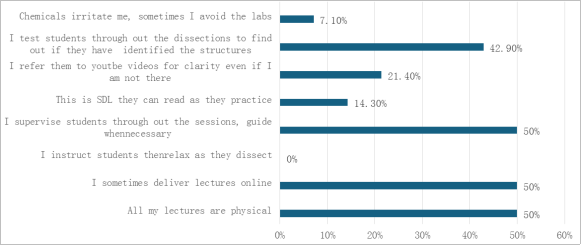
Figure 1 below illustrates the practices of anatomy teachers in medical schools in Uganda. 50% conducted physical lectures, 50% used online platforms, 50% supervised dissections, 42% assessed students during dissections, 21% referred students to YouTube, 14% viewed dissection as an SDL, and 7% avoided dissection rooms due to formalin irritation.
Figure 1. Challenges experienced by Anatomy Educators.
Survey findings revealed a range of instructional, infrastructural, and professional challenges encountered by anatomy educators. The most frequently reported issues were limited opportunities for staff development and overcrowding in dissection rooms, indicating widespread concern about both faculty growth and physical learning environments as indicated in
Table 3 below.
Table 3. The challenges of teaching anatomy.
Challenge | % of Respondents | No. of Participants |
Limited opportunity for staff development | 71.4% | 33 |
Crowding in the dissection room | 71.4% | 33 |
Cadaver shortages | 57.1% | 26 |
Poor cadaver quality / unfit dissection rooms | 50.0% | 23 |
Understaffing | 50.0% | 23 |
Inadequate remuneration | 42.9% | 20 |
Poor student attitude toward cadaver dissection | 28.6% | 13 |
3.5. Reflections from Study Participants
Open-ended responses revealed a shared desire for institutional and national support to strengthen anatomy education in Uganda. Educators articulated a vision for reform that encompasses policy, professional development, collaboration, and scholarly engagement. Four key themes emerged:
3.5.1. Theme 1. Government Support for Cadaver Acquisition and Regulatory Frameworks
Educators consistently emphasized the need for a formalized, ethical, and accessible cadaver acquisition system. The absence of a national body donation policy and reliance on unclaimed bodies were cited as major impediments to effective dissection-based learning.
“Government should help private universities and institutions to acquire cadavers easily and possibly with no costs.” (Participant 4)
“There is a need for a national policy on body donation so that institutions can access cadavers legally and ethically.” (Participant 11)
“Cadaver shortages greatly affect practical learning. A coordinated national framework would help address this challenge.” (Participant 23)
Others pointed out the importance of logistical and financial support, such as preservation facilities and transport systems, to ensure cadavers are accessible across institutions.
Taken together, these reflections show educators calling for regulatory clarity, financial investment, and logistical mechanisms. Their voices converge on the idea that government led frameworks including body donation policies, are essential for sustainable and ethical anatomy education in Uganda.
3.5.2. Theme 2. Structured Career Development Pathways and Occupational Allowances
Many educators voiced frustration about the lack of clear career progression and recognition in their work. They felt that without proper promotion structures, fair pay, and allowances for the risks they face, motivation suffers and retention becomes difficult.
One participant explained,
“I would like to have a clear career development path, standard remuneration for my service, and occupational allowance where possible.” (Participant 7).
Another added,
“There should be structured promotion criteria specifically for anatomy educators.” (Participant 15).
Others highlighted the risks of their work:
“The work we do involves handling chemicals and cadavers, yet there is no occupational risk allowance.” (Participant 21).
For some, the issue was about recognition and morale:
“Better welfare and recognition would motivate more professionals to remain in anatomy teaching.” (Participant 30).
Together, these reflections paint a picture of educators who are deeply committed to their field but feel undervalued. They are asking for policies that acknowledge their unique contributions, provide fair compensation, and create clear pathways for growth changes that could make anatomy teaching a more attractive and sustainable career.
3.5.3. Theme 3. Engagement with Professional Associations
Several educators advocated for stronger ties with national and international professional bodies, such as the Association of Anatomists of Uganda (AAU) and the International Federation of Associations of Anatomists (IFAA). These affiliations were viewed as avenues for networking, advocacy, and professional growth.
One participant put it simply:
“The need to embrace the professional associations is crucial; AAU and IFAA.” (Participant 9).
Another emphasized the mentoring role:
“Professional associations provide opportunities for mentorship and sharing of best practices.” (Participant 17).
Others highlighted the global dimension:
“Membership in international bodies would expose Ugandan anatomists to global developments in anatomy education.” (Participant 25).
At the same time, there was a call to strengthen local structures:
“AAU should be strengthened to advocate for the interests of anatomy educators nationally.” (Participant 32).
This theme highlights the importance of collective identity and institutional legitimacy in advancing the discipline of anatomy.
3.5.4. Theme 4. Collaborative Research Opportunities and Scholarly Platforms
Respondents called for increased support for research in anatomy education, including joint grant applications, inter-institutional collaborations, and the creation of a national journal to showcase Ugandan scholarship.
One participant explained,
“I think to improve peer collaboration e.g., joint research ventures with anatomists in different Ugandan institutions, creation of research grant opportunities, and perhaps creation of a journal by Ugandan anatomists.” (Participant 12).
Another stressed the urgency of funding:
“Research funding opportunities specifically targeting anatomy education are urgently needed.” (Participant 20).
Others highlighted the benefits of collaboration: “Collaboration between universities would enhance publication output and research quality.” (Participant 27).
There was also a strong call for a national platform:
“A national anatomy journal would provide a platform to showcase local innovations and research findings.” (Participant 34).
These vision reflects a desire to elevate anatomy education through evidence-based practice and scholarly dissemination.
Together, these reflections underscore the educators’ commitment to reform and their aspiration for a more sustainable, equitable, and professionally rewarding anatomy education system. The voices offer a compelling foundation for policy advocacy, institutional investment, and collaborative transformation.
4. Discussion
This study explored the demographic characteristics, teaching practices, perceived challenges, and professional perspectives of anatomy educators across Ugandan medical schools. The findings provide valuable insight into the experiences of anatomy educators working in diverse institutional settings and identify areas that participants perceived as priorities for strengthening anatomy education. Because the study relied on self-administered questionnaires, the findings should be interpreted as participants' perceptions and experiences rather than objectively verified institutional conditions. Consequently, observations relating to cadaver availability, staffing, infrastructure, and governance reflect educators' reported experiences rather than national institutional indicators.
The demographic profile indicates that anatomy education in Uganda is delivered predominantly by educators aged between 31 and 50 years, with males constituting the majority of respondents. This finding suggests that the discipline is supported by a relatively experienced workforce. However, the marked gender imbalance mirrors broader trends in biomedical sciences and academic medicine, where women remain underrepresented in senior academic positions despite increasing enrolment in health professional education. Promoting gender equity through mentorship, recruitment, and leadership opportunities may strengthen diversity within anatomy education and enrich teaching perspectives.
The teaching practices reported by participants illustrate a discipline undergoing gradual pedagogical transformation. Half of the respondents reported delivering face-to-face lectures, supervising cadaveric dissections, and using online teaching platforms. These findings suggest that Ugandan anatomy educators are increasingly adopting blended approaches that combine conventional teaching with digital technologies, consistent with international trends following the COVID-19 pandemic
| [11] | Habicht, J. L., C. Kiessling, and A. Winkelmann. "Bodies for Anatomy Education in Medical Schools: An Overview of the Sources of Cadavers Worldwide." Acad Med 93, no. 9 (Sep 2018): 1293-300. https://doi.org/10.1097/acm.0000000000002227 |
| [12] | International Federation of Associations of, Anatomists. "Recommendations of Good Practice for the Donation and Study of Human Bodies and Tissues for Anatomical Examination." Plexus: Newsletter of the Ifaa (2012): 4-5. |
[11, 12]
. Nevertheless, relatively few respondents reported referring students to online educational resources such as YouTube or encouraging self-directed learning through dissection, indicating that technology has largely been adopted as a complementary rather than replacement strategy for traditional anatomy teaching.
Cadaveric dissection continues to occupy a central position in anatomy education because of its unique contribution to understanding three-dimensional anatomical relationships, anatomical variation, and clinical reasoning. Beyond cognitive learning, dissection also contributes to professional identity formation, empathy, teamwork, and respect for the human body
| [13] | Iwanaga, Joe, Marios Loukas, Aaron S. Dumont, and R. Shane Tubbs. "A Review of Anatomy Education During and after the Covid‐19 Pandemic: Revisiting Traditional and Modern Methods to Achieve Future Innovation." Clinical anatomy 34, no. 1 (2021): 108-14. https://doi.org/10.1002/ca.23655 |
| [14] | Kasozi, Abdu Basajjabaka Kawalya. The National Council for Higher Education and the Growth of the University Sub-Sector in Uganda, 2002-2012. CODESRIA, 2017. |
[13, 14]
. Although this study did not evaluate educational outcomes, participants' continued reliance on dissection suggests that they regard it as an indispensable component of medical education despite increasing availability of digital teaching tools. This observation is consistent with recommendations advocating integration of traditional and modern teaching methods rather than replacement of cadaveric learning
| [15] | Kwon, Young Gyu, Myeong Namgung, Song Hee Park, Mi Kyung Kim, Chan Woong Kim, and Hyo Hyun Yoo. "Honoring Donors: Medical Students’ Reflections on Cadaveric Dissection." BMC Medical Education 25, no. 1 (2025/01/23 2025): 116. https://doi.org/10.1186/s12909-025-06674-1 |
[15]
.
Participants consistently identified limited opportunities for staff development and overcrowding in dissection rooms as the most important challenges affecting anatomy education. More than 70% of respondents reported these concerns, suggesting widespread perceptions that increasing student enrolment has not been matched by proportional investment in faculty development or teaching infrastructure. Faculty development remains fundamental for improving pedagogical competence, curriculum innovation, educational leadership, and adaptation to emerging instructional technologies
| [11] | Habicht, J. L., C. Kiessling, and A. Winkelmann. "Bodies for Anatomy Education in Medical Schools: An Overview of the Sources of Cadavers Worldwide." Acad Med 93, no. 9 (Sep 2018): 1293-300. https://doi.org/10.1097/acm.0000000000002227 |
[11]
. Similarly, overcrowded dissection laboratories reduce opportunities for individualized supervision, limit hands-on learning experiences, and may compromise the quality of anatomy instruction
. These findings are consistent with reports from many resource-constrained medical schools where expansion of student numbers has exceeded infrastructural growth.
More than half of the respondents also perceived cadaver shortages and poor specimen quality as major barriers to effective anatomy teaching. These perceptions were not independently verified through institutional audits or cadaver inventories and should therefore be interpreted as educators' experiences rather than objective measures of national cadaver availability. Nevertheless, similar challenges have been reported throughout Africa, where many medical schools continue to rely predominantly on unclaimed bodies because formal body donation systems remain underdeveloped
| [17] | Nabirye, Peruth, Lukiza B Paul, and Erisa S Mwaka. "Attitudes and Usage of Visual-Aids in Graduate Student Learning of Gross Anatomy at Makerere University." African Health Sciences 23, no. 1 (04/11 2023): 631-7.
https://doi.org/10.4314/ahs.v23i1.67 |
[17]
. Internationally, ethical body donation programs supported by clear legislative frameworks have become the preferred model for sustainable cadaver acquisition, emphasizing informed consent, dignity, and transparency
| [18] | Ndyamuhakyi, Elisa, Usman Michael, and Victor Fischer. "Support for Whole-Body Donation among Educational Staff in Southwestern Ugandan Medical Education." Annals of Anatomy - Anatomischer Anzeiger 257 (08/29 2024).
https://doi.org/10.1016/j.aanat.2024.152327 |
| [19] | Ndyamuhakyi, Elisa, Ibe Michael Usman, Jackim Nabona, Victor Adolf Fischer, Emeka Anyanwu, Elna Owembabazi, Wusa Makena, and Ekom Monday Etukudo. "Profiles, Tissue and Microbial Integrity of Cadavers Used in Medical Faculties in South-Western Uganda: Implication in Anatomical Education." Anatomy & Cell Biology 10 (2024). |
| [20] | Oloya, Johnson Nyeko, Micheal Okello, and Ian Guyton Munabi. "Social Norms and Medical Students’ Engagement with Cadaveric Dissection: A Qualitative Study and Integrated Model of Cadaveric Engagement (Imce Model)." Journal of medical education and curricular development 12 (2025): 23821205251378866. https://doi.org/10.1177/23821205251378866 |
[18-20]
. More recently, experiences from South Africa have demonstrated that transitioning from reliance on unclaimed bodies to voluntary body donation is achievable through legal reform, institutional commitment, and public engagement
| [21] | Protano, C., G. Buomprisco, V. Cammalleri, R. N. Pocino, D. Marotta, S. Simonazzi, F. Cardoni, et al. "The Carcinogenic Effects of Formaldehyde Occupational Exposure: A Systematic Review." Cancers (Basel) 14, no. 1 (Dec 29 2021).
https://doi.org/10.3390/cancers14010165 |
[21]
. Likewise, emerging evidence from Uganda suggests increasing support for whole-body donation among anatomy educators, indicating potential readiness for similar reforms
| [22] | Susai, S., M. Chandrupatla, and R. Motwani. "Anatomy Acts Concerning Body and Organ Donations across the Globe: Past, Present and Future with a Special Emphasis on the Indian Scenario." Anat Cell Biol 56, no. 1 (Mar 31 2023): 1-8.
https://doi.org/10.5115/acb.22.166 |
| [23] | Turney, Ben W. "Anatomy in a Modern Medical Curriculum." The Annals of The Royal College of Surgeons of England 89, no. 2 (2007): 104-07.
https://doi.org/10.1308/003588407X168244 |
[22, 23]
.
Half of the respondents perceived anatomy departments to be understaffed, while nearly half reported inadequate remuneration. Although staffing levels and salary structures were not objectively assessed, these findings suggest concerns regarding educator workload, motivation, and workforce sustainability. Anatomy education requires intensive supervision during laboratory sessions, preparation of teaching specimens, curriculum development, and student assessment. Persistent understaffing may therefore reduce opportunities for individualized instruction and increase the risk of educator burnout. Similar concerns regarding recruitment and retention of anatomy educators have been reported internationally, where limited career progression and declining academic interest have threatened the sustainability of anatomical sciences
| [14] | Kasozi, Abdu Basajjabaka Kawalya. The National Council for Higher Education and the Growth of the University Sub-Sector in Uganda, 2002-2012. CODESRIA, 2017. |
| [24] | Johnson Nyeko Oloya, G. M., Esther Apio, WebLog Journal of Anatomy Perceptions and Barriers to Cadaveric Dissection: A Qualitative Study of Medical Students at Makerere University. 2025. |
[14, 24]
.
A minority of respondents reported avoiding dissection rooms because of irritation associated with formalin exposure. Although occupational exposure was not measured in this study, these finding highlights important occupational health concerns within anatomy laboratories. Formaldehyde is classified as a human carcinogen, and prolonged exposure has been associated with respiratory irritation, mucosal inflammation, and increased cancer risk among anatomy personnel
| [25] | Arráez-Aybar, L. A., Evolving Anatomy Education: Bridging Dissection, Traditional Methods, and Technological Innovation for Clinical Excellence. Anatomia, 2025. 4: p. 9. |
| [26] | Jones, D., et al., IFAA Recommendations for good practice for the donation and anatomical study of human remains (revised 2026). Anatomical Sciences Education, 2026: p. n/a-n/a. |
[25, 26]
. Improving laboratory ventilation, strengthening occupational health policies, providing appropriate personal protective equipment, and exploring alternative preservation techniques may contribute to safer learning environments for educators and students.
The qualitative findings complemented the quantitative results by providing greater insight into educators' professional aspirations. Participants emphasized the need for stronger governmental support, structured career progression pathways, improved remuneration, ethical cadaver acquisition systems, greater engagement with professional associations, and enhanced opportunities for collaborative research. These views represent participants' recommendations rather than objectively evaluated institutional gaps. Nevertheless, they are consistent with broader international efforts to strengthen anatomy education through faculty development, professional networking, educational scholarship, and institutional collaboration
| [12] | International Federation of Associations of, Anatomists. "Recommendations of Good Practice for the Donation and Study of Human Bodies and Tissues for Anatomical Examination." Plexus: Newsletter of the Ifaa (2012): 4-5. |
[12]
.
Participants also highlighted the importance of professional associations such as the Association of Anatomists of Uganda and the International Federation of Associations of Anatomists in promoting advocacy, mentorship, continuing professional development, and research collaboration. Professional organizations have increasingly been recognized as important mechanisms for strengthening educational standards, promoting ethical practice, and facilitating exchange of knowledge across institutions
| [19] | Ndyamuhakyi, Elisa, Ibe Michael Usman, Jackim Nabona, Victor Adolf Fischer, Emeka Anyanwu, Elna Owembabazi, Wusa Makena, and Ekom Monday Etukudo. "Profiles, Tissue and Microbial Integrity of Cadavers Used in Medical Faculties in South-Western Uganda: Implication in Anatomical Education." Anatomy & Cell Biology 10 (2024). |
[19]
. Expanding opportunities for collaborative research and scholarly dissemination may further strengthen evidence-based anatomy education in Uganda and contribute to locally relevant educational innovations.
The findings of this study have several implications for anatomy education in Uganda. Investment in faculty development programs could strengthen pedagogical competence and facilitate adoption of evidence-based teaching approaches. Expansion of anatomy laboratories and improved learning infrastructure may alleviate overcrowding and enhance practical teaching experiences. Furthermore, exploration of ethical and sustainable body donation systems, strengthened institutional support, and improved collaboration between universities, professional associations, and government agencies may contribute to the long-term sustainability of anatomy education. These implications should be interpreted as participant-informed priorities rather than direct policy recommendations arising solely from the survey findings.
This study possesses several strengths. It represents one of the first multi-institutional surveys describing the experiences of anatomy educators across Ugandan medical schools and combines quantitative and qualitative data to provide a broader understanding of anatomy education within the country. However, several limitations should also be acknowledged. The study relied on self-reported questionnaire data and is therefore subject to recall bias and social desirability bias. Recruitment through professional networks and WhatsApp platforms may have introduced selection bias by excluding educators who were less active within these forums. Additionally, the study included 46 participants, representing approximately 59% of the estimated national anatomy educator population, and therefore may not have captured all institutional perspectives. Finally, institutional data such as cadaver inventories, student-to-cadaver ratios, staffing establishments, laboratory capacity, and educational outcomes were not independently verified. Consequently, the findings should be interpreted as educators' perceptions rather than objectively measured institutional indicators.
Inconclusion, this study portrays a committed community of anatomy educators who continue to deliver anatomy education despite perceived institutional, professional, and infrastructural challenges. Although the findings represent participants' experiences rather than objective institutional assessments, they provide important baseline evidence for understanding anatomy education in Uganda. Future research incorporating institutional audits, observational studies, qualitative interviews, and longitudinal designs would complement these findings and generate stronger evidence to inform educational policy, workforce planning, and curriculum development.
5. Recommendations
Based on the challenges identified among anatomy educators including inadequate professional recognition, limited career progression, shortages of cadaveric resources, infrastructure constraints, evolving educational needs, and limited research capacity coordinated actions are required to strengthen anatomy education in Uganda. These actions should involve the Ministry of Education and Sports, the Ministry of Health, the Ministry of Public Service, regulatory authorities, professional associations, and academic institutions.
First, a statutory regulatory framework for anatomical practice should be established to provide legal recognition, professional oversight, and ethical standards for anatomists and related professionals. This would strengthen professional identity, promote accountability, and ensure adherence to both national and international standards, including those of the International Federation of Associations of Anatomists (IFAA).
Second, a National Cadaver Donation and Acquisition Policy should be developed to govern body donation, acquisition, preservation, and equitable distribution of human remains for medical education and research. Such a policy would improve cadaver availability, enhance ethical governance, and build public confidence in body donation programs.
Third, structured career pathways for anatomists must be created to address professional stagnation and retention challenges. This framework should define clear academic ranks, transparent promotion criteria, mentorship programs, occupational health protections, and allowances for risks associated with cadaver handling. Providing protected time for professional development, research, and curriculum innovation would further enhance motivation and attract young professionals into the discipline.
Fourth, modernization of anatomy education requires integration of digital technologies and student centered learning approaches. Investment in virtual anatomy platforms, three dimensional models, and digital dissection resources should be complemented by faculty training in blended learning and instructional design. Strengthening digital infrastructure and promoting structured self directed learning would ensure resilience against cadaver shortages and overcrowded laboratories, while complementing traditional cadaver based teaching.
Finally, research capacity and scholarly dissemination in anatomy must be strengthened. Establishing multicentre research networks, supporting interdisciplinary studies, and creating competitive grant mechanisms would promote innovation. A national peer reviewed journal dedicated to anatomical sciences and medical education would provide a platform for Ugandan scholarship, enhance visibility, and support mentorship of early career researchers.
Together, these recommendations provide a comprehensive roadmap for reforming anatomy education in Uganda, ensuring professional recognition, modernized teaching, improved career pathways, and stronger research capacity, all aimed at producing competent graduates and safeguarding patient care.
Abbreviations
AAU | Association of Anatomists of Uganda |
IFAA | International Federation of Associations of Anatomists |
MoE | Ministry of Education |
SDL | Self Directed Learning |
NCHE | National Council of Higher Education |
Author Contributions
Johnson Nyeko Oloya: Conceptualization, Methodology, Project administration, Writing – original draft, Writing – review & editing
Fred Gendi: Conceptualization, Methodology, Supervision, Validation
Frida Chebet: Investigation, Writing – original draft, Writing – review & editing
Rogers Muhozi: Data curation, Formal Analysis, Validation
John Kukiriza: Supervision, Writing – review & editing
Godfrey Mwarisi Masilili: Conceptualization, Project administration
Conflicts of Interest
There is no conflict of interest among the authors.
References
| [1] |
Adamović, Dragan, Zoran Čepić, Savka Adamović, Milena Stošić, Boris Obrovski, Slobodan Morača, and Mirjana Vojinović Miloradov. "Occupational Exposure to Formaldehyde and Cancer Risk Assessment in an Anatomy Laboratory." International journal of environmental research and public health 18, no. 21 (2021): 11198.
https://doi.org/10.3390/ijerph182111198
|
| [2] |
Arráez-Aybar, L. A., G. Castaño-Collado, and M. I. Casado-Morales. "Dissection as a Modulator of Emotional Attitudes and Reactions of Future Health Professionals." Med Educ 42, no. 6 (Jun 2008): 563-71.
https://doi.org/10.1111/j.1365-2923.2008.03079.x
|
| [3] |
Atupele Mwabaleke, Joseph, Ibe Michael Usman, Andrew Emmanuel Tito, Kebe Edet Obeten, Mikail Umar Isyaku, Ekom Monday Etukudo, and Victor Adolf Fischer. "Perceptions and Challenges Faced by Undergraduate Medical Students in Studying Anatomy: A Case Study at Kampala International University–Western Campus, Uganda." Advances in Medical Education and Practice (2023): 1129-35.
https://doi.org/10.2147/AMEP.S427136
|
| [4] |
Aziz, M. A., J. C. McKenzie, J. S. Wilson, R. J. Cowie, S. A. Ayeni, and B. K. Dunn. "The Human Cadaver in the Age of Biomedical Informatics." Anat Rec 269, no. 1 (Feb 15 2002): 20-32.
https://doi.org/10.1002/ar.10046
|
| [5] |
Billings, Brendon K., Beverley Kramer, Tanya N. Augustine, Desiré Brits, Erin F. Hutchinson, Elena Libhaber, and Goran Štrkalj. "Leading the Transition to Ethical Human Body Sourcing in Africa: The South African Experience." Annals of Anatomy-Anatomischer Anzeiger 254 (2024): 152263.
https://doi.org/10.1016/j.aanat.2024.152263
|
| [6] |
Byrne, David. "A Worked Example of Braun and Clarke’s Approach to Reflexive Thematic Analysis." Quality & quantity 56, no. 3 (2022): 1391-412.
|
| [7] |
Drake, R. L., J. M. McBride, N. Lachman, and W. Pawlina. "Medical Education in the Anatomical Sciences: The Winds of Change Continue to Blow." Anat Sci Educ 2, no. 6 (Nov-Dec 2009): 253-9.
https://doi.org/10.1002/ase.117
|
| [8] |
Estai, Mohamed, and Stuart Bunt. "Best Teaching Practices in Anatomy Education: A Critical Review." Annals of Anatomy - Anatomischer Anzeiger 208 (2016/11/01/ 2016): 151-57.
https://doi.org/10.1016/j.aanat.2016.02.010
|
| [9] |
Gangata, H., P. Ntaba, P. Akol, and G. Louw. "The Reliance on Unclaimed Cadavers for Anatomical Teaching by Medical Schools in Africa." Anat Sci Educ 3, no. 4 (Jul-Aug 2010): 174-83.
https://doi.org/10.1002/ase.157
|
| [10] |
Gunderman, Richard B., and Philip K. Wilson. "Exploring the Human Interior: The Roles of Cadaver Dissection and Radiologic Imaging in Teaching Anatomy." Academic Medicine 80, no. 8 (2005): 745-49.
https://doi.org/10.1097/00001888-200508000-00008
|
| [11] |
Habicht, J. L., C. Kiessling, and A. Winkelmann. "Bodies for Anatomy Education in Medical Schools: An Overview of the Sources of Cadavers Worldwide." Acad Med 93, no. 9 (Sep 2018): 1293-300.
https://doi.org/10.1097/acm.0000000000002227
|
| [12] |
International Federation of Associations of, Anatomists. "Recommendations of Good Practice for the Donation and Study of Human Bodies and Tissues for Anatomical Examination." Plexus: Newsletter of the Ifaa (2012): 4-5.
|
| [13] |
Iwanaga, Joe, Marios Loukas, Aaron S. Dumont, and R. Shane Tubbs. "A Review of Anatomy Education During and after the Covid‐19 Pandemic: Revisiting Traditional and Modern Methods to Achieve Future Innovation." Clinical anatomy 34, no. 1 (2021): 108-14.
https://doi.org/10.1002/ca.23655
|
| [14] |
Kasozi, Abdu Basajjabaka Kawalya. The National Council for Higher Education and the Growth of the University Sub-Sector in Uganda, 2002-2012. CODESRIA, 2017.
|
| [15] |
Kwon, Young Gyu, Myeong Namgung, Song Hee Park, Mi Kyung Kim, Chan Woong Kim, and Hyo Hyun Yoo. "Honoring Donors: Medical Students’ Reflections on Cadaveric Dissection." BMC Medical Education 25, no. 1 (2025/01/23 2025): 116.
https://doi.org/10.1186/s12909-025-06674-1
|
| [16] |
McLachlan, J. C., and D. Patten. "Anatomy Teaching: Ghosts of the Past, Present and Future." Med Educ 40, no. 3 (Mar 2006): 243-53.
https://doi.org/10.1111/j.1365-2929.2006.02401.x
|
| [17] |
Nabirye, Peruth, Lukiza B Paul, and Erisa S Mwaka. "Attitudes and Usage of Visual-Aids in Graduate Student Learning of Gross Anatomy at Makerere University." African Health Sciences 23, no. 1 (04/11 2023): 631-7.
https://doi.org/10.4314/ahs.v23i1.67
|
| [18] |
Ndyamuhakyi, Elisa, Usman Michael, and Victor Fischer. "Support for Whole-Body Donation among Educational Staff in Southwestern Ugandan Medical Education." Annals of Anatomy - Anatomischer Anzeiger 257 (08/29 2024).
https://doi.org/10.1016/j.aanat.2024.152327
|
| [19] |
Ndyamuhakyi, Elisa, Ibe Michael Usman, Jackim Nabona, Victor Adolf Fischer, Emeka Anyanwu, Elna Owembabazi, Wusa Makena, and Ekom Monday Etukudo. "Profiles, Tissue and Microbial Integrity of Cadavers Used in Medical Faculties in South-Western Uganda: Implication in Anatomical Education." Anatomy & Cell Biology 10 (2024).
|
| [20] |
Oloya, Johnson Nyeko, Micheal Okello, and Ian Guyton Munabi. "Social Norms and Medical Students’ Engagement with Cadaveric Dissection: A Qualitative Study and Integrated Model of Cadaveric Engagement (Imce Model)." Journal of medical education and curricular development 12 (2025): 23821205251378866.
https://doi.org/10.1177/23821205251378866
|
| [21] |
Protano, C., G. Buomprisco, V. Cammalleri, R. N. Pocino, D. Marotta, S. Simonazzi, F. Cardoni, et al. "The Carcinogenic Effects of Formaldehyde Occupational Exposure: A Systematic Review." Cancers (Basel) 14, no. 1 (Dec 29 2021).
https://doi.org/10.3390/cancers14010165
|
| [22] |
Susai, S., M. Chandrupatla, and R. Motwani. "Anatomy Acts Concerning Body and Organ Donations across the Globe: Past, Present and Future with a Special Emphasis on the Indian Scenario." Anat Cell Biol 56, no. 1 (Mar 31 2023): 1-8.
https://doi.org/10.5115/acb.22.166
|
| [23] |
Turney, Ben W. "Anatomy in a Modern Medical Curriculum." The Annals of The Royal College of Surgeons of England 89, no. 2 (2007): 104-07.
https://doi.org/10.1308/003588407X168244
|
| [24] |
Johnson Nyeko Oloya, G. M., Esther Apio, WebLog Journal of Anatomy Perceptions and Barriers to Cadaveric Dissection: A Qualitative Study of Medical Students at Makerere University. 2025.
|
| [25] |
Arráez-Aybar, L. A., Evolving Anatomy Education: Bridging Dissection, Traditional Methods, and Technological Innovation for Clinical Excellence. Anatomia, 2025. 4: p. 9.
|
| [26] |
Jones, D., et al., IFAA Recommendations for good practice for the donation and anatomical study of human remains (revised 2026). Anatomical Sciences Education, 2026: p. n/a-n/a.
|
Cite This Article
-
APA Style
Oloya, J. N., Gendi, F., Chebet, F., Muhozi, R., Kukiriza, J., et al. (2026). Challenges in Teaching Anatomy in Uganda: A National Survey of Educator Experiences. International Journal of Medical Research and Innovation, 2(3), 41-50. https://doi.org/10.11648/j.ijmri.20260203.11
 Copy
|
Copy
|
 Download
ACS Style
Oloya, J. N.; Gendi, F.; Chebet, F.; Muhozi, R.; Kukiriza, J., et al. Challenges in Teaching Anatomy in Uganda: A National Survey of Educator Experiences. Int. J. Med. Res. Innovation 2026, 2(3), 41-50. doi: 10.11648/j.ijmri.20260203.11
Copy
|
Download
AMA Style
Oloya JN, Gendi F, Chebet F, Muhozi R, Kukiriza J, et al. Challenges in Teaching Anatomy in Uganda: A National Survey of Educator Experiences. Int J Med Res Innovation. 2026;2(3):41-50. doi: 10.11648/j.ijmri.20260203.11
Copy
|
Download
-
@article{10.11648/j.ijmri.20260203.11,
  author = {Johnson Nyeko Oloya and Fred Gendi and Frida Chebet and Rogers Muhozi and John Kukiriza and Godfrey Mwarisi Masilili},
  title = {Challenges in Teaching Anatomy in Uganda: A National Survey of Educator Experiences},
  journal = {International Journal of Medical Research and Innovation},
  volume = {2},
  number = {3},
  pages = {41-50},
  doi = {10.11648/j.ijmri.20260203.11},
  url = {https://doi.org/10.11648/j.ijmri.20260203.11},
  eprint = {https://article.sciencepublishinggroup.com/pdf/10.11648.j.ijmri.20260203.11},
  abstract = {Anatomy education forms the foundation of medical training, providing essential knowledge for clinical practice and biomedical sciences. This study explored the experiences, teaching practices, and perceived challenges of anatomy educators across Ugandan medical schools. A cross-sectional mixed-methods survey was conducted among anatomy educators from accredited public and private medical schools. Data were collected using a structured online questionnaire comprising both closed-ended and open-ended questions. A total of 46 educators participated, representing approximately 59% of the estimated national population of 78 anatomy educators. Respondents reported a range of teaching approaches, including traditional lectures, cadaveric dissection, and the use of online learning platforms. The most frequently reported challenges were limited opportunities for staff development (71.4%), overcrowding in dissection rooms (71.4%), cadaver shortages (57.1%), poor cadaver quality or inadequate dissection facilities (50.0%), understaffing (50.0%), and inadequate remuneration (42.9%). Qualitative findings highlighted concerns regarding career progression, infrastructure limitations, cadaver acquisition, and the need for stronger institutional and governmental support. Participants also emphasized the importance of professional associations, collaborative research, and faculty development initiatives in strengthening anatomy education. Despite these challenges, anatomy educators demonstrated commitment to delivering quality education and adapting to evolving teaching environments. The findings suggest a need for investments in faculty development, infrastructure improvement, ethical and sustainable cadaver acquisition systems, staffing, and research capacity. Strengthening these areas may enhance the quality and sustainability of anatomy education and contribute to the training of competent healthcare professionals in Uganda.},
 year = {2026}
}
Copy
|
Download
-
TY  - JOUR
T1  - Challenges in Teaching Anatomy in Uganda: A National Survey of Educator Experiences
AU  - Johnson Nyeko Oloya
AU  - Fred Gendi
AU  - Frida Chebet
AU  - Rogers Muhozi
AU  - John Kukiriza
AU  - Godfrey Mwarisi Masilili
Y1  - 2026/07/24
PY  - 2026
N1  - https://doi.org/10.11648/j.ijmri.20260203.11
DO  - 10.11648/j.ijmri.20260203.11
T2  - International Journal of Medical Research and Innovation
JF  - International Journal of Medical Research and Innovation
JO  - International Journal of Medical Research and Innovation
SP  - 41
EP  - 50
PB  - Science Publishing Group
SN  - 3070-6319
UR  - https://doi.org/10.11648/j.ijmri.20260203.11
AB  - Anatomy education forms the foundation of medical training, providing essential knowledge for clinical practice and biomedical sciences. This study explored the experiences, teaching practices, and perceived challenges of anatomy educators across Ugandan medical schools. A cross-sectional mixed-methods survey was conducted among anatomy educators from accredited public and private medical schools. Data were collected using a structured online questionnaire comprising both closed-ended and open-ended questions. A total of 46 educators participated, representing approximately 59% of the estimated national population of 78 anatomy educators. Respondents reported a range of teaching approaches, including traditional lectures, cadaveric dissection, and the use of online learning platforms. The most frequently reported challenges were limited opportunities for staff development (71.4%), overcrowding in dissection rooms (71.4%), cadaver shortages (57.1%), poor cadaver quality or inadequate dissection facilities (50.0%), understaffing (50.0%), and inadequate remuneration (42.9%). Qualitative findings highlighted concerns regarding career progression, infrastructure limitations, cadaver acquisition, and the need for stronger institutional and governmental support. Participants also emphasized the importance of professional associations, collaborative research, and faculty development initiatives in strengthening anatomy education. Despite these challenges, anatomy educators demonstrated commitment to delivering quality education and adapting to evolving teaching environments. The findings suggest a need for investments in faculty development, infrastructure improvement, ethical and sustainable cadaver acquisition systems, staffing, and research capacity. Strengthening these areas may enhance the quality and sustainability of anatomy education and contribute to the training of competent healthcare professionals in Uganda.
VL  - 2
IS  - 3
ER  -
Copy
|
Download





 Share This Article
 Twitter
 Linked In
 Facebook