
The continuous growth in electricity demand imposes increasing constraints on power transmission and distribution infrastructures, particularly in developing electrical networks. Among the key components of these systems, power transformers play a central role, while simultaneously contributing to reactive power consumption that affects voltage regulation and network efficiency. This study focuses on the compensation of reactive power absorbed by the power transformer of the Mamou electrical substation in Guinea. The investigated transformer is an oil-immersed unit rated at 15 MVA with a voltage level of 110 kV/30 kV. An analytical approach based on transformer operating characteristics is adopted to evaluate the reactive power requirements associated with magnetizing and leakage reactances. Using these formulations, the required rating of a shunt capacitor bank is determined in order to fully compensate the reactive energy consumed by the transformer. The results indicate that a capacitor bank rated at 2422.5 kVAr allows a significant reduction in apparent power and line current on the high-voltage side. Consequently, copper losses, Joule losses in the transmission line, and associated greenhouse gas emissions are reduced, leading to an annual energy saving of approximately 36,104 kWh. The findings highlight the technical and economic relevance of reactive power compensation for improving the operational performance of substations in emerging power systems.
| Published in | International Journal of Sustainable and Green Energy (Volume 15, Issue 1) |
| DOI | 10.11648/j.ijsge.20261501.13 |
| Page(s) | 23-30 |
| Creative Commons |
This is an Open Access article, distributed under the terms of the Creative Commons Attribution 4.0 International License (http://creativecommons.org/licenses/by/4.0/), which permits unrestricted use, distribution and reproduction in any medium or format, provided the original work is properly cited. |
| Copyright |
Copyright © The Author(s), 2026. Published by Science Publishing Group |
Transformer, Reactive Power Compensation, Mamou Substation
Sizes | Without compensation | With Compensation |
|---|---|---|
Rated voltages [kV] | 110/30 | 110/30 |
Active power P HV [kW] | 11186.07 | 11186.07 |
Reactive power QHV [kVAr] | 2000 | 4422.5 |
Apparent power SHV [kVA] | 11363.46 | 12028.58 |
The current I HV [A] | 60.76 | 64.32 |
Active loss in the Linsan-Mamou line [KW] | 72354, 46 | 81072,76 |
HV | High Voltage |
EDG | Electricity of Guinea |
ONAN | Oil Natural Circulation with Air Naturally Circulated for Cooling, |
ONAF | Oil Natural Air Forced Cooling |
| [1] | Kosobudzki, G. ; Dusza, D. ; Ciurys, M. P. ; Leicht, A. Reactive Power Compensation for Single-Phase AC Motors Using Integral Power Theory. Energies 2025, 18, 2641. |
| [2] | Jean Ouere TOUPOUVOGUI, Ansoumane SAKOUVOGUI, Mohamed Ansoumane CAMARA and Mamby KEITA, “Optimization of the Reactive Energy Compensation of the Guinea Brewerie Company Plant (SOBRAGUI)” International Journal of Progressive Sciences and Technologies (IJPSAT) Vol. 32 No. 2 May 2022, p. 159-167. |
| [3] | Jean Ouere TOUPOUVOGUI, Mohamed Ansoumane CAMARA, Ansoumane SAKOUVOGUI, Mamby KEITA. “Optimal Sizing of Capacitor Bank for Increasing Substation Capacity of Mamou” World Journal of Engineering and Technology, 11, 217-233. |
| [4] | General Population and Housing Census – Guinea 2018. National Institute of Statistics – Guinea 2018. |
| [5] | Benjamin Kolie, Ayman Elshkaki, Geoffrey Sunahara, Mohamed Lamine Diakite, Mamoudou Sangare, Energy and water infrastructures management under energy transition pressure in mineral extraction urban and rural areas: A case study of the Republic of Guinea. The Extractive Industries and Society 17(2024) 101433. |
| [6] | J. Dixon, L. Moran, J. Rodriguez, R. Domke, "Reactive Power Compensation Technologies: State-of-the-Art Review," Proceeding of the IEEE, Vol. 93, No. 12, pp. 2144-2164, Dec. 2005. |
| [7] | Gojko Joksimovic, Transformer Reactive Power Compensation – Fixed Capacitor Bank Calculation. |
| [8] | SR Abbott and DJ Morrow, "Investigation of transformer's reactive power consumption for different operational voltages," 2011 46th International Universities' Power Engineering Conference (UPEC), Soest, Germany, 2011, pp. 1-5. |
| [9] | AA Ademola, X. Li, D. Yang, MJ Till, Y. Liu, Comparative Study of the Reactive Power Consumption of a Dominion Energy Virginia Autotransformer due to Geomagnetically-induced Current, October 2021. |
| [10] | Michal Kolcun, Anna Gawlak, Miroslaw Kornatka, Zsolt Čonka, Active and Reactive Power Losses in Distribution Transformers. Acta Polytechnica Hungarica Vol. 17, No. 1, 2020. |
| [11] | Felix Ignacio Perez Cicala, Ignacio Alvarez Iberlucea, Miguel Angel Torrero Rionegro, Alvaro Benito Oliva, Methodology for the power factor resolution algorithm, September, 2023. |
| [12] | Xingchen Mu, Electrical power systems energy saving and consumption reduction through transformer capacity and operation scheme. 6th International Conference on Energy Science and Applied Technology. Earth and Environmental Science 804(2021) 032047, |
| [13] | A. Aguila Tellez, G. Lopez, I. Isaac, J. W. Gonzalez. Optimal reactive power compensation in electrical distribution systems with distributed resources. Review. Heliyon 4(2018) e00746. |
| [14] | Mhamed Darwish, Gareth Taylor and Ioana Pisica, Control Configurations for Reactive Power Compensation t the Secondary Side of the Low Voltage Substation by sing Hybrid Transformer. Energies 2021, 14(3), 620; |
| [15] | Elhadj Ousmane CAMARA, Ansoumane SAKOUVOGUI, Mohamed Ansoumane CAMARA and Mamby KEITA. Contribution to the identification and evaluation of the hydroelectric potential of developable waterfalls in middle Guinea. |
| [16] | Akram N. Tovboyev, Islom B. Tog’ayev, Islombek Q. Uzoqov, and G’ulom Y. Nodirov, Use of reactive power sources in improving the quality of electricity . E3S Web of Conferences 417, 03001 (2023. |
| [17] | G. Kishore Kumar, Nithin Kalyan Kumar and R.K.Kumar; Study of Reactive Power Consumption for Different Core Material of Distribution Transformers. 978-1-5386-7576-2/19/$31.00 ©2019 IEEE |
| [18] | Shantanu Gupta, Graduate Student Member, IEEE, and Sudip K. Mazumder, Fellow, IEEE. Reactive-Power Compensation in a Single-Stage Differential-Mode Solid-State Transformer. IEEE TRANSACTIONS ON POWER ELECTRONICS, VOL. 40, NO. 7, JULY 2025. |
APA Style
Toupouvogui, J. O., Sakouvogui, A., Camara, M. A., Faye, R. M. (2026). Compensation of the Reactive Power Consumed by the Transformer of the Mamou Electrical Substation. International Journal of Sustainable and Green Energy, 15(1), 23-30. https://doi.org/10.11648/j.ijsge.20261501.13
ACS Style
Toupouvogui, J. O.; Sakouvogui, A.; Camara, M. A.; Faye, R. M. Compensation of the Reactive Power Consumed by the Transformer of the Mamou Electrical Substation. Int. J. Sustain. Green Energy 2026, 15(1), 23-30. doi: 10.11648/j.ijsge.20261501.13
@article{10.11648/j.ijsge.20261501.13,
  author = {Jean Ouere Toupouvogui and Ansoumane Sakouvogui and Mohamed Ansoumane Camara and Roger Marcelin Faye},
  title = {Compensation of the Reactive Power Consumed by the Transformer of the Mamou Electrical Substation},
  journal = {International Journal of Sustainable and Green Energy},
  volume = {15},
  number = {1},
  pages = {23-30},
  doi = {10.11648/j.ijsge.20261501.13},
  url = {https://doi.org/10.11648/j.ijsge.20261501.13},
  eprint = {https://article.sciencepublishinggroup.com/pdf/10.11648.j.ijsge.20261501.13},
  abstract = {The continuous growth in electricity demand imposes increasing constraints on power transmission and distribution infrastructures, particularly in developing electrical networks. Among the key components of these systems, power transformers play a central role, while simultaneously contributing to reactive power consumption that affects voltage regulation and network efficiency. This study focuses on the compensation of reactive power absorbed by the power transformer of the Mamou electrical substation in Guinea. The investigated transformer is an oil-immersed unit rated at 15 MVA with a voltage level of 110 kV/30 kV. An analytical approach based on transformer operating characteristics is adopted to evaluate the reactive power requirements associated with magnetizing and leakage reactances. Using these formulations, the required rating of a shunt capacitor bank is determined in order to fully compensate the reactive energy consumed by the transformer. The results indicate that a capacitor bank rated at 2422.5 kVAr allows a significant reduction in apparent power and line current on the high-voltage side. Consequently, copper losses, Joule losses in the transmission line, and associated greenhouse gas emissions are reduced, leading to an annual energy saving of approximately 36,104 kWh. The findings highlight the technical and economic relevance of reactive power compensation for improving the operational performance of substations in emerging power systems.},
 year = {2026}
}
TY  - JOUR
T1  - Compensation of the Reactive Power Consumed by the Transformer of the Mamou Electrical Substation
AU  - Jean Ouere Toupouvogui
AU  - Ansoumane Sakouvogui
AU  - Mohamed Ansoumane Camara
AU  - Roger Marcelin Faye
Y1  - 2026/01/29
PY  - 2026
N1  - https://doi.org/10.11648/j.ijsge.20261501.13
DO  - 10.11648/j.ijsge.20261501.13
T2  - International Journal of Sustainable and Green Energy
JF  - International Journal of Sustainable and Green Energy
JO  - International Journal of Sustainable and Green Energy
SP  - 23
EP  - 30
PB  - Science Publishing Group
SN  - 2575-1549
UR  - https://doi.org/10.11648/j.ijsge.20261501.13
AB  - The continuous growth in electricity demand imposes increasing constraints on power transmission and distribution infrastructures, particularly in developing electrical networks. Among the key components of these systems, power transformers play a central role, while simultaneously contributing to reactive power consumption that affects voltage regulation and network efficiency. This study focuses on the compensation of reactive power absorbed by the power transformer of the Mamou electrical substation in Guinea. The investigated transformer is an oil-immersed unit rated at 15 MVA with a voltage level of 110 kV/30 kV. An analytical approach based on transformer operating characteristics is adopted to evaluate the reactive power requirements associated with magnetizing and leakage reactances. Using these formulations, the required rating of a shunt capacitor bank is determined in order to fully compensate the reactive energy consumed by the transformer. The results indicate that a capacitor bank rated at 2422.5 kVAr allows a significant reduction in apparent power and line current on the high-voltage side. Consequently, copper losses, Joule losses in the transmission line, and associated greenhouse gas emissions are reduced, leading to an annual energy saving of approximately 36,104 kWh. The findings highlight the technical and economic relevance of reactive power compensation for improving the operational performance of substations in emerging power systems.
VL  - 15
IS  - 1
ER  -
Instrumentation and Physicals Measurements Department, Higher Institute of Technology, Mamou, Guinea
Energy Department, Higher Institute of Technology, Mamou, Guinea
Electrical Engineering Department of the Polytechnic Institute, Gamal Abdel Nasser University, Conakry, Guinea
Higher School of Engineering Sciences and Techniques, Amadou Mahtar Mbow University, Dakar, Senegal
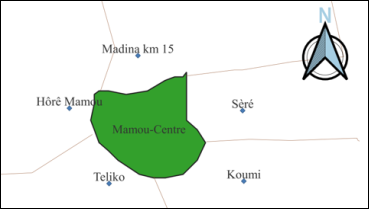
Figure 1. Map of the commune of Mamou.
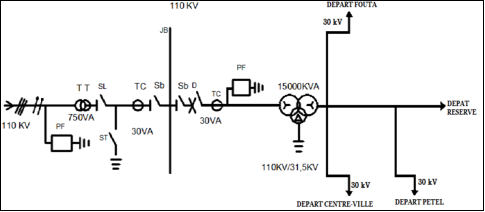
Figure 2. Single-line configuration of the Mamou substation.
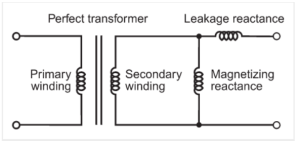
Figure 3. Schematic diagram of reactance per phase of a transformer.
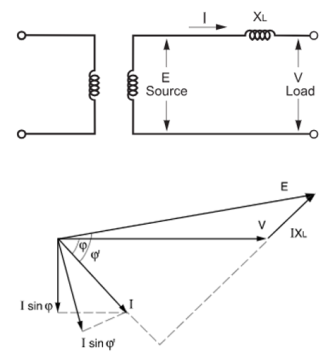
Figure 4. Reactive power dissipated by the series leakage inductance of a transformer.
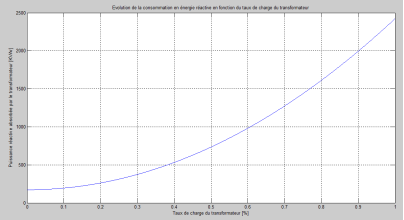
Figure 5. Evolution of transformer consumption as a function of load rate.
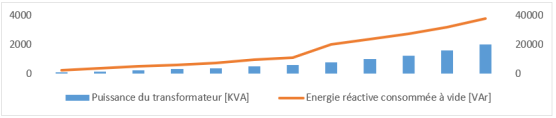
Figure 6. Evolution of reactive energy consumed at no load as a function of transformer power.
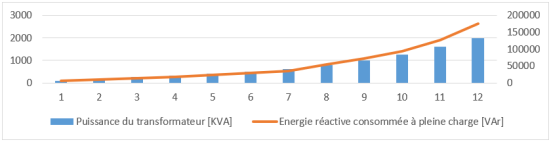
Figure 7. Evolution of reactive energy consumed at full load as a function of transformer power.

Information



 Share This Article
 Twitter
 Linked In
 Facebook
 Copy
Copy Download