Abstract
Rice production plays a vital role in enhancing food security and livelihoods in Kenya, yet regional disparities in productivity and profitability persist. This study explores a comparative socio-economic and cost-benefit analysis of rice production in Mwea (Eastern Kenya) and West Kano (Western Kenya) Irrigation Schemes to evaluate differences in production efficiency, input use, and economic returns among smallholder farmers. Despite irrigation accounting for 80% of rice cultivation, productivity remains low. This study analyzed the socioeconomic characteristics of rice farmers and conducted a cost-benefit analysis (CBA) of rice production in Western Kenya (West Kano) and Eastern Kenya (Mwea) irrigation schemes to inform policy recommendations for increased productivity and reduced imports. A proportional probability sampling method was employed to select 116 and 120 households from Mwea and West Kano, respectively. Data collection was conducted using semi-structured questionnaires. Findings indicate that rice farming is predominantly undertaken by elderly farmers over 50 years, with Mwea having a higher proportion of college-educated farmers compared to West Kano, where most attained secondary education. Established extension services and research linkages in Mwea enhance technology transfer. Farm sizes in West Kano (6 acres) are double those in Mwea (3 acres), possibly due to population pressure and land availability constraints. Market dynamics significantly influence farmers' planting decisions, with over 80% responding to demand. Mwea farmers earn KESs 39/kg, while West Kano farmers earn KESs 28/kg, reflecting better market structures in Mwea. Despite 95.6% of farmers selling to middlemen and 73.8% to cooperatives, dissatisfaction with pricing and delayed payments is widespread. The cost-benefit ratios (CBRs) for Mwea (2.88) and West Kano (3.9) indicate profitability. The findings provide critical insights for policymakers and stakeholders to design region-specific interventions that enhance resource use efficiency, improve profitability and promote sustainable rice production across Kenya’s major irrigation schemes.
Keywords
Comparative Socio-Economic, Irrigation Scheme, Cost Benefit Analysis, Smallholder Rice Farmers, Production in Kenya
1. Introduction
Kenya's Gross Domestic Product (GDP), which is largely derived from the agriculture sector, is above 33% and is the foundation of the economy. According to
| [1] | Woldemichael, A., Salami, A., Mukasa, A., Simpasa, A., & Shimeles, A. (2017). Transforming Africa’s agriculture through agro-industrialization. Africa Economic Brief, 8(7), 1-12. |
[1]
. More than 40% of the workforce and 70% of the rural population are employed in the agricultural industry. However, recent years have seen a fall in agricultural productivity.
Amidst rising food demand brought on by, among other factors, climate change and a rapid population growth rate (averaging about 3% annually), there has been a fall in the production of important food staples, including rice, maize, wheat and sugar
| [2] | de Jong, M. V., et al. "An Overview of the Kenyan Food System: Outcomes, Drivers and Activities." (2024): 3-3. 0. |
[2]
. The nation continues to rely on imports of important food items to cover the deficit. For instance, to close the growing gap between production and demand, enormous amounts of wheat and rice were imported
. The gradual shift in Kenya’s eating habits, particularly in more urban areas, is driving the country's yearly rice consumption up by nearly 12%, which is driving up the demand for grain. Additionally, the expected yearly production of 181,000 metric tons of rice is less than the estimated national consumption of 949,000 metric tons
| [4] | Owino, C. N. (2021). Assessment of Greenhouse Gases Emission in Smallholder Rice Paddies Converted from Anyiko Wetland, Western Kenya (Doctoral dissertation, Egerton University). https://doi.org/10.3389/fenvs.2020.00080 |
[4]
.
After maize and wheat, rice is currently the third-most significant cereal crop in Kenya. It is primarily cultivated as a commercial and food crop by small-scale farmers
. While the Mwea Irrigation Scheme produces more than 60% of the rice farmed in Kenya, around 80% of it comes from irrigation schemes built by the government. Only 20% of the crop is produced when it rains
| [6] | Evans, A. A., Florence, N. O., & Eucabeth, B. M. (2018). Production and marketing of rice in Kenya: Challenges and opportunities. Journal of Development and Agricultural Economics, 10(3), 64-70. https://doi.org/10.5897/JDAE2017.088 |
[6]
. The National Irrigation Board (NIB) schemes, the highly concentrated integrated large farm chain, and the traditional retail value chain of non-NIB irrigated production and rain-fed producers make up Kenya's three primary value chains for rice. The integrated large farm chain is comprised of integrated large farms that work together to produce rice.
Farmers now have access to a number of different rice cultivars that are suitable for growing in both dryland and irrigated environments
| [7] | Orr, A., & Muange, E. (2022). Hedgehog or fox? Theories of change for dryland cereals in Eastern Africa. Journal of International Development, 34(3), 532-549.
https://doi.org/10.1002/jid.3612 |
[7]
. The irrigated fragrant rice variety known as Basmati 270 is currently the most popular type of rice grown in Kenya
. Komboka, IR, Sindano, ITA310 and BW196 are examples of some additional cultivars of irrigated rice that are grown by farmers. In the late 1990s, an upgraded variety known as Basmati 370 was distributed to farmers across the country in the capacity of an irrigated aromatic variety. To encourage the cultivation of upland rice in Kenya, the African Development Bank (ADB) provided funding for a project that was given the acronym WKRRDP (West Kenya Rain-fed Rice Development Program). Between the years of 1989 and 2000, the Lake Basin Development Authority (LBDA) oversaw the implementation of the program in the Lake Victoria Basin Region. The WKRRDP program had a number of diverse components, such as the provision of financing and extension services to rice farmers, the construction of a rice mill, and adaptive research
| [9] | Lake Basin Development Authority. (2011). West Kenya Rain-fed Rice Development Program (WKRRDP) Report. (Government/institutional report on rice development in Kenya)/
http://www.lbda.co.ke/ |
[9]
.
The African Rice Center (ARC) developed the New Rice for Africa (NERICA) using the inter-specific hybridization method. These cultivars merged the tenacity of the African rice with the productivity of the Asian rice to create NERICA, which has opened a door of possibility for reducing hunger in SSA. In 2004, the ARC sent cultivars from the NERICA project to Kenya to conduct adaptation tests. Out of the eighteen NERICA cultivars that were evaluated, only four (NERICA1, NERICA4, NERICA10, and NERICA11) were deemed fit for use by farmers and were distributed to them in the year 2008.
The NERICA had yields that ranged from 3.5 to 5.0 t/ha, on average. The National Irrigation Board (NIB) and Lake Basin Development Company (LBDC) worked with Bayer East Africa to test the performance of the hybrid rice cultivars Arize Tej Gold and Arize 6444 Gold during the 2014–2015 growing season in the Bunyala and West Kano irrigation schemes. They found that these hybrid rice varieties showed promise in transforming the rice sub-sector because of their excellent yields of 8–10 tons per plant and great tillering capability of 20–35 tillers per plant.
Farmer and farm characteristics have an impact on Kenyan rice farmers' capacity to adopt new agricultural technologies
| [10] | Mgendi, G., Shiping, M., & Xiang, C. (2019). A review of agricultural technology transfer in Africa: Lessons from Japan and China case projects in Tanzania and Kenya. Sustainability, 11(23), 1-19. https://doi.org/10.3390/su13031527 |
[10]
. Examples of such factors include the age and size of the household of the rice farmer, education level and the total number of years of schooling, total acreage used for rice production, the distance between farms and farmer's home, and managerial skills or prior experience in rice farming. Others include off-farm employment, excursions to distant locations, and the advantages of a credit facility. Farmers' capacity to implement innovative farming methods and efficiently mobilize and utilize production inputs is hampered by high illiteracy rates. Input expenses for rice growers are also high (fertilizer, insecticides, and machinery costs), and they lack incentives.
It is significant to highlight that rice plays a significant role in the diets of Kenya's majority of urban residents. Compared to wheat and maize, which are the main staple foods, its annual consumption is expected to be rising at a pace of 12% annually
. The gradual alterations in eating patterns are to blame for this.
According to statistics, Kenyans consume 949,000 metric tons of rice annually, compared to 180,000 metric tons of production
. The gap is filled by imports, which in 2021 were worth KES 25 billion. The improvement of food security, raising the income of smallholder farmers, creating jobs in rural regions, and lowering the cost of rice imports are all goals of the promotion of rice production. The country has the ability to produce rice on around 540,000 hectares of irrigated land and 1.0 million hectares of rain-fed land
. The existing irrigation potential can be extended by another 800,000 ha to 1.3 million hectares with improved water collecting, storage, subterranean water resource exploitation, and novel management technologies
| [14] | Ndung’u, J. M. (2021). The Effect of adoption of agricultural sustainable intensification practices on the Mwea rice farmers’ yields and income in Mwea Irrigation Scheme (Doctoral dissertation, Strathmore University). https://sufis.strathmore.edu |
[14]
.
1.1. Rice Milling
Large, medium and small-scale rice millers are actively run in Mwea and Kano. One of the main factors in the development of the rice-milling industry in Mwea is the integration of varied-scale rice millers. The scale must be huge to reap the benefits of such a scale, but there is also a need for a lower proportion of milling. At the Mwea Irrigation Scheme, large and small-scale millers carry out rice milling. It is either in a multi-step or single-step operation (single pass). In a multi-step operation, the by-products identified and recovered separately are rice hulls, coarse rice bran, fine rice bran, coarse broken rice, and fine broken rice (locally known as “chicken feed”). Except for rice hulls, all the others are used as animal feeds. Fine rice bran (rice polishing) is the most widely used by-product. The single pass milling process yields a combined by-product referred to as Special coarse bran (SCB). The nutritional value of SCB had hitherto not been studied or established and formed the basis of the current research work. The single-pass millers are less efficient and have a mean rice recovery of about 65%, 35% being milling by-products with an enormous turnover each season
| [15] | Kiarie, A. W. (2003). Efficiency and By-products of Rice Milling in the Mwea Irrigation Scheme. Assessment of Crop-Livestock Interactions and Production of Rice Based Feed Resources in Mwea Irrigation Scheme, Kirinyaga District, Central Province, Kenya [Master's thesis, University of Nairobi]. http://erepository.uonbi.ac.ke |
[15]
. The mills have a relatively low installation cost (KES. 170,000), are well distributed, and offer better terms to small-scale farmers.
Middle-scale rice millers are comparatively preferred in the two regions. Since the equipment's investment expenses are still within reach, this kind of equipment is beneficial for quality enhancement. However, due to a lack of available methods for system development and a modest investment budget for quality improvement, small-scale rice millers are finding it challenging to increase the quality of their current rice-milling system. Despite the fact that the global average recovery rate for rice milling is between 60 and 65 percent, the West Kano in Kisumu has an average recovery rate of only 55 percent. The German-made rice milling machine can process 3.5 metric tons of paddy per hour. They mill 1,600 MT of paddy annually, 400 MT of which are aromatic cultivars and 1,200 MT are non-aromatic varieties. Due to difficulties in milling, a lot of small millers use subpar milling equipment and have inadequate handling and storage facilities, which causes a lot of broken grains and an increase in the foreign matter in milled rice. One of the impediments to competition in Kenya is the existence of numerous tiny, privately owned mills that produce low-quality rice.
1.2. Marketing
In the instance of West Kano, between 15 and 20% of the total milled rice is delivered to the central area for the NIA's public rice distribution, such as to schools, companies, universities, hospitals, prisons, etc. Through the distribution network of NIA, nearly 10% of the production in MRM is also marketed to these institutions. Since there is no rice mill at the NCPB's Kisumu Storage Station, aggregated paddy rice is sold to the LBDC for milling. To be sent to supermarkets, Pishori's milled rice is packaged in quantities of 1 kg, 2 kg, 5 kg, and 25 kg.
Due to the high demand for rice in Uganda, it is necessary to expand production by increasing unit yield and planting area, focusing on increasing paddy production because paddy collectors in Uganda are not concerned with quality. Additionally, it is anticipated that existing rice millers' milling prices will drop as a result of increased milling efficiency, prompting Ugandan traders to purchase milled rice in the western region rather than paying for transportation.
1.3. Challenges in the Rice Sub-sector
According to
| [6] | Evans, A. A., Florence, N. O., & Eucabeth, B. M. (2018). Production and marketing of rice in Kenya: Challenges and opportunities. Journal of Development and Agricultural Economics, 10(3), 64-70. https://doi.org/10.5897/JDAE2017.088 |
[6]
, some of the major challenges faced in the production of rice include unfavorable weather, a lack of water for irrigation, an unacceptable variety, low and declining land productivity, high input costs, poor infrastructure, a lack of machines and equipment, issues with transboundary/regional trade, and restrictions on human and institutional capacity, with the rain-fed rice system experiencing the greatest performance decline. The absence of the creation of high-yield rice cultivars whose grain quality is not only acceptable to most customers but also resilient to local pests in both rain-fed and irrigated ecosystems is the most important of the issues mentioned. The low-quality production is also a result of farmers' poor post-harvest procedures, which include reusing seeds for planting. High post-harvest losses, which include between 15 and 50 percent of the market value of production, are another significant issue that rice farmers must deal with.
1.4. Rice Farm Innovations
The majority of farmers, processors, and other agricultural mechanization end users in Kenya currently do not utilize enough of these technologies in their farming and processing activities to have a significant impact on the country's production. As a result, the Kenyan rice value chain is labor-intensive and uncompetitive. Low productivity is the result of the majority of operations in the rice subsector being labor-intensive when done manually. Numerous factors contribute to this low production, many of which are correlated with the underuse of mechanization. As a result, there is a chance to advance mechanization in the rice value chain thanks to ending users who have demonstrated a willingness to adopt economically advantageous technologies nationwide, fabricators who can produce affordable low-cost equipment
The national rice consumption is estimated at 575,000 metric tons compared to an annual production of 181,000 metric tonnes
. The deficit is met through imports which were valued at KESs 26billion
| [17] | Economic Survey (2019) Kenya National Bureau of Statistics. (2019). |
[17]
. The improvement of food security, raising the income of smallholder farmers, creating jobs in rural regions, and lowering the cost of rice imports are all goals of the promotion of rice production. A total of 1 million hectares of rain-fed land and around 540,000 hectares of irrigable land are available for the production of rice in the nation. The existing irrigation potential can be expanded by an additional 800,000 ha to 1.3 million hectares with innovative management technologies, and better water harvesting, storage, and resource utilization
. This study was aimed at determining the baseline rice production cost-benefit analysis in the Mwea and West Kano Irrigation Scheme as well as the socio-economic features of rice farmers and offering policy recommendations based on the observations.
2. Methodology
2.1. Study Area
The Mwea Irrigation Scheme is located in Kenya's Kirinyaga county. About 100 km northeast of Nairobi is where the scheme is located. Rice has been the main crop in the program since 1956. In this scheme, irrigation water has been used to develop a total of 16,000 acres for the cultivation of rice. Land tenure is based on the tenancy. The National Irrigation Board (NIB) and farmers' groups, namely the Water Users Association (WUA), are currently in charge of running the program. WUA is in charge of managing the water, while NIB is in charge of the complete primary irrigation infrastructure. Farmers are free to choose where to market their produce.
The West-Kano Irrigation Scheme is located at the shores of Lake Victoria in Kisumu County. The scheme is situated on the Kano plains between the Nandi escarpment and the Nyabondo plateau. The scheme was developed in the year 1974, and it began to take effect in the year 1976. The 837 farmers in the scheme use a gross area of 4396 acres. The total farmland area is 2230 acres, with each farmer owning 2-4 acres. The water from Lake Victoria is pumped for the irrigation system's water supply systems, and the latter is pumped back to the lake. A population of 30,000 people depends on the scheme. The scheme is situated on the Kano Plains between the latitudes of 00°04' South and 00°20' North and the longitudes of 34°48' East and 35°02' East along the shores of Lake Victoria
| [18] | Too, G., Kollongei, J. K., Onyando, J. O., & Kipkorir, E. C. (2020). Comparative Study of Rice Yield Production for Conventional Paddy Rice and Systems of Rice Intensification. American Journal of Water Science and Engineering, 6(2), 70-75. https://doi.org/10.11648/j.ajwse.20200602.13 |
[18]
. The average yearly rainfall in the area is 1100 mm, while the average daily temperature is 23°C.
2.2. Sampling Design
The West Kano Irrigation Scheme in Kisumu Couty and Mwea in Kirinyaga County served as the study's locations. The study households were found using a three-phase screening test. To choose the study locations and the household sample frame in the first two stages, key local and lead farmers participated. Actual household data collection was done in the third phase. The unit of sample for this study was households. The two irrigation schemes that were the subject of this study were sampled using proportional probability sampling based on the list frame of households created from the two schemes. In Mwea, a total of 160 households and 120 households in the West Kano Irrigation Scheme were sampled. A semi-structured questionnaire was developed for this survey and data collection. The field assistant enumerators (from the respective local community) were trained on the administration of the questionnaire. A pretest of the tool was done before the survey in the study villages, although the results were not included in this study. Key Informants were also interviewed, which involved the few known rice millers from the different irrigation schemes and the paddy rice buyers.
3. Results and Discussion
3.1. Rice Farmers' Socio-economic Characteristics
There was a statistically significant variance between the socio-economic attributes of the rice farmers in West Kano and Mwea irrigation schemes at a one percent significance level specified by one-way ANOVA (
F (14,3) = 28.26,
p = 0.009). The majority of the farmers interviewed in both the Irrigation Schemes were females; however, Mwea Irrigation Scheme had slightly more female farmers than West Kano (
Table 1). Overall, in the two irrigation schemes, older farmers above 40 years are seen to participate more in rice farming than the youth of 18 to 35 years of age. Mwea Irrigation Scheme has the majority of their farmers with college-level of education compared to their counterparts whose majority have secondary level education level.
The irrigation schemes are however the main source of household income for the households since over 80% of them are involved and depend on farming as their main source of livelihood.
Table 1 indicates the percentage distribution of socio-economic attributes of the rice farmers in West Kano and Mwea irrigation schemes.
Table 1. Percentage Distribution of Socio-Economic Attributes of the Rice Farmers.
| | West Kano | Mwea | |
| | Overall n=129 | Overall n=116 | ANOVA p-value |
Sex | Male | 58(45) | 27(24) | 0.009 |
| Female | 71(55) | 89(76) | |
Age | <18 | 10(7.8) | 0 | |
| 19-29 | 9(7) | 35(30) | |
| 30-39 | 31(24) | 24(26.7) | |
| 40-49 | 31(24) | 28(24) | |
| 50-59 | 18(14) | 23(19.8) | |
| >60 | 30(23.3) | 5(5.2) | |
Education Level | No Education | 10(7.8) | 12(10) | |
| Primary | 10(7.8) | 10(8) | |
| Secondary | 61(47.3) | 64(55) | |
| College | 42(32.6) | 22(19) | |
| University | 6(4.7) | 8(7) | |
Source of Household Income | casual labour | 16(12.4) | 2(2) | |
| Salaried employed | 12(9.3) | 8(7) | |
| Business person | 1(0.8) | 22(19) | |
| Farming | 98(75.9) | 82(71) | |
| Others | 2(1.6) | 2(2) | |
The figures in parentheses show the percentages corresponding to the numbers
3.2. Farm Production
The results in
table 2 indicate that there was statistically significant variance between the farm production in West Kano and Mwea irrigation schemes at a five percent significance level specified by one-way ANOVA (
F(4,1) = 622.501,
p = 0.013). West Kano has double household size (6) on average compared to Mwea (3). This could be attributed to the need for dependency on family labour as the main source of labor. The majority of household members are engaged in rice production. Men participate in harvesting and threshing, women in weeding and winnowing, and children are mostly involved in transplanting and bird care. Therefore, the average sizes of 6 and 4 persons in imply that family labour is available to perform these activities. Furthermore, this could be due to the high number of orphans in the area who have come to offer labour as a source of livelihood. The higher household size levels up the high number of members contributing to the overall household income. The farm size in June – December season is higher than that of Jan to May as the farmers in West Kano see June – December as their main growing season, thus allocating a bigger size of their land to rice production. Mwea farmers have a constant farmer size in both growing seasons.
Table 2: indicates the Percentage Distribution of discrete and continuous Socio-Economic Attributes of the Rice Farmers in West kano and Mwea irrigation schemes.
Table 2. Percentage Distribution of Discrete and Continuous Socio-Economic Attributes of the Rice Farmers.
| West Kano | Mwea | |
Variables | Overall Mean(n=129) | Overall Mean(n=116) | ANOVA p-value |
HH Size | 6(2.46) | 3(3.4) | 0.013 |
Number of Members contributing to Hh Income | 2(0.8) | 1(2.2) | |
Size under Rice JUN/DEC 2021 | 1.5(0.8) | 1(1.5) | |
Size under Rice JAN/MAY 2022 | 1.1(0.99) | 1(2.2) | |
The numbers in parentheses show the std. deviation of the corresponding the numbers
3.3. Comparative Analysis of the Economic Status of Rice Farmers in West Kano and Mwea Irrigation Schemes
There was a statistically significant variance between the economic status in West Kano and Mwea irrigation schemes at a five percent significance level specified by one-way ANOVA (
F (1, 2) = 73.59,
p = 0.030). Consequently, casuals in West Kano get paid much higher than their counterparts in Mwea, with higher household sizes that can offer free labour in West Kano, it is so difficult to access casual labour, thus explaining the higher pay to casuals. In Mwea, casuals are available and freely accessible hence flooding the market and shifting the demand, thus low monthly income. The salaried in Mwea get a higher income than those in West Kano because of the proximity to Kirinyaga town. Mwea Scheme has also farmers who are business people, because of the proximity to the main business town, earn much higher than those in West Kano. The income from the sale of crops and livestock is much higher for the rice farmers in Mwea Irrigation Scheme Kirinyaga County as the area favors the growing and keeping of the diverse number of species of crops and livestock, which directly contributes to their income.
Table 3 indicates the comparative analysis of economic status results for West Kano and Mwea irrigation schemes.
Table 3. Comparative analysis of economic status results for West Kano and Mwea irrigation schemes.
| West Kano | Mwea | |
Variables | Mean | Std. Deviation | Mean | Std. Deviation | ANOVA p-value |
Casual | 13868.42 | 38542.54 | 9,000.00 | 4,000.00 | 0.03 |
Salary | 4896.7 | 23550.18 | 30,000.00 | 32,000.00 | |
Business | 10845.36 | 34001.02 | 10,000.00 | 33,000.00 | |
Sale of Crop | 73627.94 | 36466.04 | 130,000.00 | 63,000.00 | |
Sale of Livestock | 3134.07 | 10883.58 | 30,000.00 | 2,200.00 | |
Others | 265.96 | 2578.55 | 3,000.00 | 2,500.00 | |
3.4. Rice Marketing
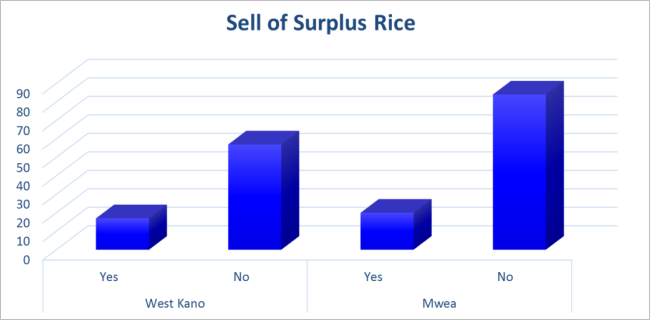
The West Kano reported that they received a return of an average of Kes 28.05/kg, and for the Mwea farmers, the respondents indicated having sold their rice at Kes 39.30/kg. in Mwea Irrigation Scheme the majority of the farmers, that is 95.6% of the respondents, reported having sold their rice to local middlemen, while 4.4% said they sold to local retailers. For the West Kano farmers, in contrast to the remaining respondents (26%) who had no issues with the board, 73.8% of those polled stated their displeasure with the rice-marketing route used to bring their produce to the cereals board.
Most of the farmers sell their paddy rice to brokers and therefore has no bargaining power with the traders. This affects the prices offered for paddy rice in the market and, subsequently, the income that farmers receive. At local marketplaces, paddy rice is mostly bought by brokers, dealers, and small-scale millers, who then aggregate and sell to rice millers and exporters. To fulfill their immediate financial needs, the majority of small-scale farmers sell their crop as soon as it is harvested at the market price in their area.
Figure 1. Sell of surplus rice results for West Kano and Mwea irrigation schemes.
3.5. Land Tenure
The results in
Table 4 indicate that there was no statistically significant variance in land tenure between West Kano and Mwea irrigation schemes at a five per cent significance level specified by one-way ANOVA (F (5, 2) = 1.257,
p = 0.499). West Kano has a higher number of owned lands in both seasons compared to Mwea irrigation Scheme. Renting of land is higher in farmers in Mwea Irrigation Scheme compared to West Kano, apart from farming, the farmers have other well-paying hence they would prefer renting part or all of the land. Family land is high in West Kano than in Mwea Scheme.
Table 3 indicates the land tenure results for West Kano and Mwea irrigation schemes.
Table 4. Land tenure results for West Kano and Mwea irrigation schemes.
| West Kano | Mwea | | |
Variables | Mean | Std. Deviation | Mean | Std. Deviation | ANOVA p-value |
Land Owned Jun/Dec 2020 | 1.74 | 1.12 | 1.1 | 1.10 | 0.499 |
Land Owned Jan/May 2020 | 1.81 | 1.02 | 1.5 | 1.02 | |
Land Rented Jun/Dec 2020 | 0.35 | 0.80 | 1.0 | 0.60 | |
Land Rented Jan/May 2020 | 0.29 | 0.77 | 1 | 0.47 | |
Land Rented In in Jun/Dec 2020 | 0.33 | 0.70 | 1.1 | 0.40 | |
Land Rented Out in Jan/May 2020 | 0.34 | 0.72 | 0.25 | 0.32 | |
Family Land Jun/Dec 2020 | 1.72 | 0.99 | 1.6 | 0.29 | |
Family Land Jan/May 2020 | 1.78 | 0.97 | 1.4 | 0.57 | |
3.6. Production
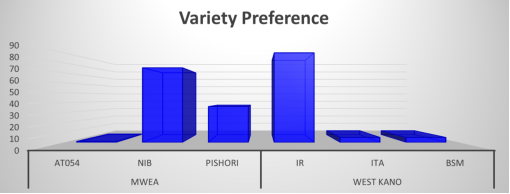
The NIB variety is highly preferred in Mwea followed by the famous Pishori, AT054 is list preferred. West Kano farmers prefer IR over the other varieties.
Figure 2. Rice Production results for West Kano and Mwea irrigation schemes.
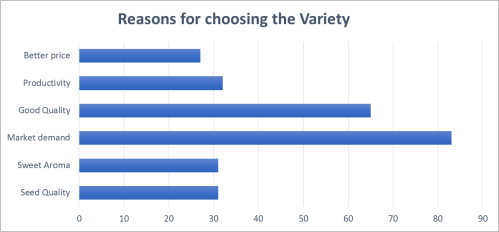
The overall reasons for choosing the varieties from the two irrigation schemes are is indicated in
Figure 3.
The cost of production in Mwea is higher, could be because of higher input prices? This could be so because of higher transportation and labour costs. The market demand drives the whole farming activity (
Figure 3).
Table 5 indicates the cost of production per acre in West Kano and Mwea irrigation schemes.
Table 5. Cost of Production per Acre in West Kano and Mwea Irrigation Schemes.
| Cost of Production/ Acre | |
Irrigation Schemes | Mean | Std. Deviation | Minimum | Maximum |
West Kano | 45697.48 | 11994.741 | 4000.00 | 80000.00 |
Mwea | 72,345.00 | 12,000.00 | 2,035.00 | 120,322.00 |
Table 6 indicate Detailed Costs of Production of Rice in Mwea and West Kano Schemes.
Table 6. Detailed Costs of Production of Rice in Mwea and West Kano Schemes.
Activities and Particulars did by the farmer | West Kano | Mwea | |
Costs/Acre | Costs/Acre | ANOVA p-value |
Land preparation | 1st clearing | 1070.59 | 1,500.00 | 0.00 |
| Ploughing | 3315.97 | 3,500.00 | |
| Harrowing | 3079.83 | 3,000.00 | |
Operation maintenance (OM) | | | | |
Nursery | Seeds | 112.44 | 250.00 | |
| 910.92 | 1,000.00 | | |
| Fertilizer | 317.94 | 250.00 | |
| Bird scaring | 715.49 | 750.00 | |
| Insecticide | 279.75 | 300.00 | |
| Fungicide | 298.73 | 350.00 | |
| Folia | 226.67 | 300.00 | |
| Spraying labour | 255.87 | 300.00 | |
Planting | 2nd clearing | 1067.8 | 1,200.00 | |
| Land levelling | | | |
| Uprooting seedlings | 457.16 | 500.00 | |
| Transport | 371.17 | 420.00 | |
| Transplanting labour | 907.14 | 1,200.00 | |
| Fertilizer | 2951.71 | 3,500.00 | |
| Water paid NIA | 3412.27 | 4,000.00 | |
Bird scaring after planting | | 664.41 | 700.00 | |
1st Urea Application | Urea | 2848.07 | 3,200.00 | |
| Transport | 191.99 | 250.00 | |
| Labour | 656.94 | 750.00 | |
1st Weeding | Labour | 2032.48 | 2,050.00 | |
2nd Urea application | Urea | 2924.39 | 3,200.00 | |
| Labour | 287.39 | 320.00 | |
Agrochemicals | Insecticide | 844.56 | 1,000.00 | |
| Fungicide | 1409.83 | 1,500.00 | |
| Folia | 549.22 | 600.00 | |
| Labour | 232.69 | 500.00 | |
| Hiring of equipment | 192.37 | 250.00 | |
2nd Weeding | Labour | 1340.09 | 1,500.00 | |
Bird scaring at the flowering stage | | 3405.98 | 3,600.00 | |
Harvesting | Labour | 6879.32 | 7,200.00 | |
| Loading | 80.27 | 100.00 | |
| Drying | 67.67 | 100.00 | |
| Packaging bags | 51.87 | 80.00 | |
Porting cost from the farm to the main road | 12835.71 | 15,000.00 | |
Total costs | | 57,246.70 | 64,220.00 | |
The results in
Table 6 indicate that there was no statistically significant variance in costs of production of rice in Mwea and West Kano irrigation Schemes at a one percent significance level specified by one-way ANOVA (
F (22,14) = 10314.785,
p = 0.00).
3.7. Cost Benefit Analysis
The technique of the tabular presentation was used in this paper to assess the costs and returns of paddy rice in Mwea and West Kano Schemes. This analysis used the two growing seasons of 2020 as the reference period and included planting to harvesting and farm-gate price determination. The costs used are the averages used in an acre of rice production.
Table 7 indicates the cost-benefit analysis results for rice production in Mwea and West Kano Schemes.
Table 7. Cost Benefit Analysis results for the Mwea and West Kano Schemes' rice production.
| Per Acre | Quantity (90Kg Bag) | Kgs/Acre | Price per Kg | Revenue |
West Kano | Rice | 28.632 | 2574 | 39.24 | 101003.76 |
Rice Straws/Kg | 45 | 4050 | 12 | 48600 |
Rice Bran | 12.00 | 1,080.00 | 10 | 10800 |
Husks | 5 | 450 | 10 | 4500 |
| TOTAL BENEFITS | | | | 164903.76 |
Mwea | Rice | 42 | 3780 | 42 | 158760 |
Rice Straws/Kg | 54 | 4860 | 15 | 72900 |
Rice Bran | 18 | 1620 | 8 | 12960 |
Husks | 8 | 720 | 8 | 5760 |
| TOTAL BENEFITS | | | | 250380.00 |
| | | | | |
West Kano | TOTAL COSTS | | | | 57,246.70 |
Mwea | TOTAL COSTS | | | | 64,220.00 |
West Kano | Cost Benefit ratio (CBR) | | | | 2.88 |
Mwea | CBR | | | | 3.90 |
This is the ratio of the discounted stream of project benefits to the discounted stream of project costs
. A benefit /cost ration greater than one implies a potentially viable project and the such project could be chosen. The main reason for discounting is to account for the time value of money. This is because a shilling available now can be invested to earn interest and would be worth more than a shilling in future. With an interest rate of r, a shilling invested for t years will increase to (1+r) t. Therefore, the amount of money that would have to be deposited now so that it would grow to be one-shilling t years in the future is (1+r)-t. This is called the discounted value or present value of a shilling available t years in the future. Summarized results on running costs and benefits for rice production in the two irrigation schemes are presented in
Table 7. The benefits and costs are in the constant value of shillings and therefore the discount rate used must be the real interest rate. The results show that the benefits out way the costs in all the irrigation schemes. (2.88 and 3.9 respectively). However, the cost of production in Mwea is slightly higher than those of the West Kano irrigation scheme. This may be attributed to the location of Mwea and its proximity to Kiambu and Nairobi counties.
4. Conclusions
The adoption of non-monetary inputs such as timely planting, maintaining an optimal plant population, timely irrigation, efficient fertilizer usage, need-based plant protection measures, and timely crop harvesting should be emphasized to farmers. The Policymakers are aware that in order to increase rice yield per unit area, they must adopt an intense land use strategy by raising crop intensity, which will help them maintain production in order to fulfill the rising demand for rice.
5. Recommendations
1) Institutionalize market information systems within the rice value chain. Government agencies, farmer organizations and millers should collaborate to establish standardized record-keeping and market information systems that capture seasonal paddy volumes, prices, and procurement trends. Such systems would improve market efficiency, reduce information asymmetry, and support evidence-based planning across the rice value chain.
2) Promote participatory validation and scaling of rice innovations. Researchers, extension agencies, and development partners should prioritize multi-location participatory validation of emerging rice technologies and value-added products before large-scale dissemination. This approach would enhance farmers' confidence in the innovations, ensure their adaptability to local conditions, and increase the likelihood of sustained adoption.
3) To increase rice productivity, counties need to assist farmers and millers in locating, branding and marketing premium locally produced rice varieties on national, regional and international markets.
4) There is a need for rice stakeholders to strengthen research and development, more agricultural extension and providing sufficient funding for research which can also aid in addressing some of the issues in this sub-sector.
5) In order to increase rice production, the rain-fed rice system needs to receive more serious consideration. Therefore, it will be simpler to address the limited applications and defects in the rice subsector with a complete and cogent policy, plan, and program.
6) Western Kenya can help in reducing rice imports since they have more fertile soils, more water and less intensification and need to do more innovations like in Mwea.
Abbreviations
WKRRDP | West Kenya Rain-fed Rice Development Program |
CBA | Cost Benefit Analysis |
ARC | Africa Rice Centre |
GDP | Gross Domestic Product |
SSA | Sub Saharan Africa |
MOA | Ministry Of Agriculture |
SCB | Special Coarse Bran |
MT | Metric Tones |
LBDA | Lake Basin Development Authority |
NIB | National Irrigation Board |
NCPB | National Cereal and Produce Board |
NERICA | New Rice For Africa |
Author Contributions
Hillary Chelal: Conceptualization, Methodology, Formal analysis, Investigation, Writing – original draft, Writing – review & editing
Paul Kimurto: Conceptualization, Methodology, Supervision, Writing – review & editing
Anthony Mugambi: Funding, Conceptualization, Supervision
Andrew Cheboi: Funding, Conceptualization, Supervision
Benjamin Mutai: Conceptualization, Methodology
Raphael Gitau: Conceptualization, Supervision
Acknowledgments
The Reduce-Reuse-Recycle Rice Initiative for Climate Smart Agriculture Phase Two (R4iCSA-II) project by Kilimo Trust Organization focusing in regenerative and cyclic agriculture, who provided funding to conduct this research which the authors gratefully acknowledge. We also appreciate the help of farmers, facilitators especially National Irrigation Authority and enumerators
Data Availability Statement
Data associated with this study will be made available upon reasonable request.
Funding
This study was funded by Kilimo Trust, R4iCSA Phase one- 2022.
Conflicts of Interest
The authors have no relevant financial or non-financial interests to disclose.
References
| [1] |
Woldemichael, A., Salami, A., Mukasa, A., Simpasa, A., & Shimeles, A. (2017). Transforming Africa’s agriculture through agro-industrialization. Africa Economic Brief, 8(7), 1-12.
|
| [2] |
de Jong, M. V., et al. "An Overview of the Kenyan Food System: Outcomes, Drivers and Activities." (2024): 3-3. 0.
|
| [3] |
Ndirangu, S. N., & Oyange, W. A. (2019). Analaysis of Millers in Kenya’s Rice Value Chain. IOSR J. Agric. Vet. Sci.(IOSR-JAVS), 12, 38-47.
https://doi.org/10.9790/2380-1201010819
|
| [4] |
Owino, C. N. (2021). Assessment of Greenhouse Gases Emission in Smallholder Rice Paddies Converted from Anyiko Wetland, Western Kenya (Doctoral dissertation, Egerton University).
https://doi.org/10.3389/fenvs.2020.00080
|
| [5] |
Were, M. A. (2021). A Critical Analysis of Food Security and Policy in Eastern Africa: The Case Study of the Maize Sub-Sector in Kenya (Doctoral dissertation, University of Nairobi):
https://erepository.uonbi.ac.ke/handle/11295/160483
|
| [6] |
Evans, A. A., Florence, N. O., & Eucabeth, B. M. (2018). Production and marketing of rice in Kenya: Challenges and opportunities. Journal of Development and Agricultural Economics, 10(3), 64-70.
https://doi.org/10.5897/JDAE2017.088
|
| [7] |
Orr, A., & Muange, E. (2022). Hedgehog or fox? Theories of change for dryland cereals in Eastern Africa. Journal of International Development, 34(3), 532-549.
https://doi.org/10.1002/jid.3612
|
| [8] |
Denis, B. E. (2020). Assessment of yield, grain quality and combining ability of selected rice cultivars in Kenya (Doctoral dissertation, University of Nairobi).
https://doi.org/10.11648/j.ajpb.20200504.17
|
| [9] |
Lake Basin Development Authority. (2011). West Kenya Rain-fed Rice Development Program (WKRRDP) Report. (Government/institutional report on rice development in Kenya)/
http://www.lbda.co.ke/
|
| [10] |
Mgendi, G., Shiping, M., & Xiang, C. (2019). A review of agricultural technology transfer in Africa: Lessons from Japan and China case projects in Tanzania and Kenya. Sustainability, 11(23), 1-19.
https://doi.org/10.3390/su13031527
|
| [11] |
MOA (2019) Ministry of Agriculture, Livestock, Fisheries and Cooperatives (MOA), Kenya. (2019)
https://kilimo.go.ke/publications
|
| [12] |
NJORA, B., & YILMAZ, H. (2021). Analysis of The Impact of Agricultural Policies on Food Security in Kenya. Eurasian Journal of Agricultural Research, 5(2), 66-83.
https://www.researchgate.net/publication/357375807_Analysis_of_The_Impact_of_Agricultural_Policies_on_Food_Security_in_Kenya
|
| [13] |
MOA (2021) Ministry of Agriculture, Livestock, Fisheries and Cooperatives (MOA), Kenya. (2021)
https://kilimo.go.ke/publications
|
| [14] |
Ndung’u, J. M. (2021). The Effect of adoption of agricultural sustainable intensification practices on the Mwea rice farmers’ yields and income in Mwea Irrigation Scheme (Doctoral dissertation, Strathmore University).
https://sufis.strathmore.edu
|
| [15] |
Kiarie, A. W. (2003). Efficiency and By-products of Rice Milling in the Mwea Irrigation Scheme. Assessment of Crop-Livestock Interactions and Production of Rice Based Feed Resources in Mwea Irrigation Scheme, Kirinyaga District, Central Province, Kenya [Master's thesis, University of Nairobi].
http://erepository.uonbi.ac.ke
|
| [16] |
NRDS-2 (2019–2030) National Rice Development Strategy-2 (2019–2030).
https://kilimo.go.ke/wp-content/uploads/2021/01/NRDS-2-2019-2020-14-July.pdf
|
| [17] |
Economic Survey (2019) Kenya National Bureau of Statistics. (2019).
|
| [18] |
Too, G., Kollongei, J. K., Onyando, J. O., & Kipkorir, E. C. (2020). Comparative Study of Rice Yield Production for Conventional Paddy Rice and Systems of Rice Intensification. American Journal of Water Science and Engineering, 6(2), 70-75.
https://doi.org/10.11648/j.ajwse.20200602.13
|
| [19] |
Mishan, E. J., & Quah, E. (2020). Cost-benefit analysis. Routledge.
https://doi.org/10.4324/9781351029780
|
Cite This Article
-
APA Style
Chelal, H., Kimurto, P., Mugambi, A., Cheboi, A., Mutai, B., et al. (2026). A Comparative Socio-Economic and Cost-Benefit Analysis of Rice Production in Western and Eastern Kenya: A Case Study of West Kano and Mwea Irrigation Schemes. International Journal of Sustainability Management and Information Technologies, 12(2), 41-52. https://doi.org/10.11648/j.ijsmit.20261202.11
 Copy
|
Copy
|
 Download
ACS Style
Chelal, H.; Kimurto, P.; Mugambi, A.; Cheboi, A.; Mutai, B., et al. A Comparative Socio-Economic and Cost-Benefit Analysis of Rice Production in Western and Eastern Kenya: A Case Study of West Kano and Mwea Irrigation Schemes. Int. J. Sustain. Manag. Inf. Technol. 2026, 12(2), 41-52. doi: 10.11648/j.ijsmit.20261202.11
Copy
|
Download
AMA Style
Chelal H, Kimurto P, Mugambi A, Cheboi A, Mutai B, et al. A Comparative Socio-Economic and Cost-Benefit Analysis of Rice Production in Western and Eastern Kenya: A Case Study of West Kano and Mwea Irrigation Schemes. Int J Sustain Manag Inf Technol. 2026;12(2):41-52. doi: 10.11648/j.ijsmit.20261202.11
Copy
|
Download
-
@article{10.11648/j.ijsmit.20261202.11,
  author = {Hillary Chelal and Paul Kimurto and Anthony Mugambi and Andrew Cheboi and Benjamin Mutai and Raphael Gitau},
  title = {A Comparative Socio-Economic and Cost-Benefit Analysis of Rice Production in Western and Eastern Kenya: A Case Study of West Kano and Mwea Irrigation Schemes},
  journal = {International Journal of Sustainability Management and Information Technologies},
  volume = {12},
  number = {2},
  pages = {41-52},
  doi = {10.11648/j.ijsmit.20261202.11},
  url = {https://doi.org/10.11648/j.ijsmit.20261202.11},
  eprint = {https://article.sciencepublishinggroup.com/pdf/10.11648.j.ijsmit.20261202.11},
  abstract = {Rice production plays a vital role in enhancing food security and livelihoods in Kenya, yet regional disparities in productivity and profitability persist. This study explores a comparative socio-economic and cost-benefit analysis of rice production in Mwea (Eastern Kenya) and West Kano (Western Kenya) Irrigation Schemes to evaluate differences in production efficiency, input use, and economic returns among smallholder farmers. Despite irrigation accounting for 80% of rice cultivation, productivity remains low. This study analyzed the socioeconomic characteristics of rice farmers and conducted a cost-benefit analysis (CBA) of rice production in Western Kenya (West Kano) and Eastern Kenya (Mwea) irrigation schemes to inform policy recommendations for increased productivity and reduced imports. A proportional probability sampling method was employed to select 116 and 120 households from Mwea and West Kano, respectively. Data collection was conducted using semi-structured questionnaires. Findings indicate that rice farming is predominantly undertaken by elderly farmers over 50 years, with Mwea having a higher proportion of college-educated farmers compared to West Kano, where most attained secondary education. Established extension services and research linkages in Mwea enhance technology transfer. Farm sizes in West Kano (6 acres) are double those in Mwea (3 acres), possibly due to population pressure and land availability constraints. Market dynamics significantly influence farmers' planting decisions, with over 80% responding to demand. Mwea farmers earn KESs 39/kg, while West Kano farmers earn KESs 28/kg, reflecting better market structures in Mwea. Despite 95.6% of farmers selling to middlemen and 73.8% to cooperatives, dissatisfaction with pricing and delayed payments is widespread. The cost-benefit ratios (CBRs) for Mwea (2.88) and West Kano (3.9) indicate profitability. The findings provide critical insights for policymakers and stakeholders to design region-specific interventions that enhance resource use efficiency, improve profitability and promote sustainable rice production across Kenya’s major irrigation schemes.},
 year = {2026}
}
Copy
|
Download
-
TY  - JOUR
T1  - A Comparative Socio-Economic and Cost-Benefit Analysis of Rice Production in Western and Eastern Kenya: A Case Study of West Kano and Mwea Irrigation Schemes
AU  - Hillary Chelal
AU  - Paul Kimurto
AU  - Anthony Mugambi
AU  - Andrew Cheboi
AU  - Benjamin Mutai
AU  - Raphael Gitau
Y1  - 2026/08/11
PY  - 2026
N1  - https://doi.org/10.11648/j.ijsmit.20261202.11
DO  - 10.11648/j.ijsmit.20261202.11
T2  - International Journal of Sustainability Management and Information Technologies
JF  - International Journal of Sustainability Management and Information Technologies
JO  - International Journal of Sustainability Management and Information Technologies
SP  - 41
EP  - 52
PB  - Science Publishing Group
SN  - 2575-5110
UR  - https://doi.org/10.11648/j.ijsmit.20261202.11
AB  - Rice production plays a vital role in enhancing food security and livelihoods in Kenya, yet regional disparities in productivity and profitability persist. This study explores a comparative socio-economic and cost-benefit analysis of rice production in Mwea (Eastern Kenya) and West Kano (Western Kenya) Irrigation Schemes to evaluate differences in production efficiency, input use, and economic returns among smallholder farmers. Despite irrigation accounting for 80% of rice cultivation, productivity remains low. This study analyzed the socioeconomic characteristics of rice farmers and conducted a cost-benefit analysis (CBA) of rice production in Western Kenya (West Kano) and Eastern Kenya (Mwea) irrigation schemes to inform policy recommendations for increased productivity and reduced imports. A proportional probability sampling method was employed to select 116 and 120 households from Mwea and West Kano, respectively. Data collection was conducted using semi-structured questionnaires. Findings indicate that rice farming is predominantly undertaken by elderly farmers over 50 years, with Mwea having a higher proportion of college-educated farmers compared to West Kano, where most attained secondary education. Established extension services and research linkages in Mwea enhance technology transfer. Farm sizes in West Kano (6 acres) are double those in Mwea (3 acres), possibly due to population pressure and land availability constraints. Market dynamics significantly influence farmers' planting decisions, with over 80% responding to demand. Mwea farmers earn KESs 39/kg, while West Kano farmers earn KESs 28/kg, reflecting better market structures in Mwea. Despite 95.6% of farmers selling to middlemen and 73.8% to cooperatives, dissatisfaction with pricing and delayed payments is widespread. The cost-benefit ratios (CBRs) for Mwea (2.88) and West Kano (3.9) indicate profitability. The findings provide critical insights for policymakers and stakeholders to design region-specific interventions that enhance resource use efficiency, improve profitability and promote sustainable rice production across Kenya’s major irrigation schemes.
VL  - 12
IS  - 2
ER  -
Copy
|
Download





 Share This Article
 Twitter
 Linked In
 Facebook