Abstract
The Malawi–Tanzania lake border dispute over Lake Malawi exemplifies the enduring effects of colonial-era territorial decisions in post-colonial Africa. This study examines the historical roots, legal arguments and geopolitical implications of the dispute, analysing how boundaries established by the 1890 Heligoland–Zanzibar Treaty continue to generate tension between Malawi and Tanzania. The central problem is that Malawi claims sovereignty over the entire lake based on the uti possidetis juris principle, whereas Tanzania advocates a median-line division grounded in customary international law and equitable resource-sharing norms. The dispute has strained bilateral relations, hampered regional integration, disrupted fishing livelihoods, and intensified competition over potential hydrocarbon reserves. Using a qualitative, interdisciplinary approach, the study combines historical analysis, legal frameworks and international relations theories to evaluate the dispute’s impact on regional cooperation and sovereignty. It draws on primary documents, including colonial treaties, diplomatic correspondence and government position papers, as well as comparative case law from the International Court of Justice, notably Cameroon v. Nigeria, and secondary scholarship on inherited borders in Africa. Semi-structured interviews with policymakers, legal experts and lakeside communities provide additional perspectives. Theoretically, the study is anchored in critical border studies, post-colonial sovereignty theories and resource geopolitics, which together illuminate borders as contested sites of power, identity and resource control. The findings indicate that the dispute persists because of three interconnected factors: the structural violence of colonial cartography, the unresolved tension between uti possidetis and modern equitable principles, and the escalation of territorial claims following hydrocarbon discoveries. Weak regional mediation mechanisms, particularly within the Southern African Development Community, further prolong the impasse. The study contributes to debates on decolonisation, international law and African territorial politics, and offers policy suggestions for bilateral and regional stakeholders, including hybrid sovereignty arrangements, strengthened mediation mechanisms and community-inclusive resource governance. By examining the connection between colonial legacies and modern diplomacy, the paper emphasises the importance of context-aware solutions to Africa’s border conflicts.
1. Introduction and Research Problem
The Malawi-Tanzania lake border dispute centers on the sovereignty of Lake Malawi, stemming from the 1890 Anglo-German Heligoland-Zanzibar Treaty, which established boundaries without consulting the local populations
| [4] | Agbor, O. O. Colonial State Boundaries and the Contested Nature of African Borders and Borderlands. International Journal of Humanitatis Theoreticus. 2020, 3(2). |
| [7] | Asiwaju, A. I. Bridging African Boundaries: Cross-Border Areas and Regional Integration in Comparative History and Policy Advocacy. Austin, TX: Pan-African University Press; 2022. |
[4, 7]
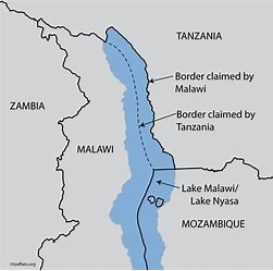
. Although Malawi claims the entire lake (see
Figure 1) based on the
uti possidetis juris principle, Tanzania advocates for a median-line division under customary international law. The dispute has hampered regional integration, resource management, and bilateral relations, highlighting the broader issues caused by colonial border legacies in Africa
| [31] | Ndlovu-Gatsheni, S. J. Decolonising Borders, Decriminalising Migration and Rethinking Citizenship. In: Magidimisha, H., Khalema, N., Chipungu, L., Chirimambowa, T., Chimedza, T. (eds). Crisis, Identity and Migration in Post-Colonial Southern Africa. Advances in African Economic, Social and Political Development. Cham: Springer; 2018.
https://doi.org/10.1007/978-3-319-59235-0_2 |
| [36] | Okoli, A. C., Ngwu, E. C. Borderlines, Natural Resources and Conflicts: Towards a Territorial Materialism of Boundary Disputes in East Africa. Central European Journal of International and Security Studies. 2019, 13(2), 91–110. |
[31, 36]
.
Figure 1. Map showing the Malawi-Tanzania Lake Border Conflict.
This research is justified by the gap in scholarly attention to the dispute’s geopolitical and socio-economic ramifications, particularly its impact on fishing communities and hydrocarbon exploration
| [26] | Mlambo, V. H., Masuku, M. M., Mthembu, Z. The New Scramble for Africa in a Post-Colonial Era and the Challenges of Inclusive Development: A Semi-Systematic Literature Review. Development Studies Research. 2024, 11(1).
https://doi.org/10.1080/21665095.2024.2306387 |
[26]
. Additionally, the African Union’s emphasis on border dispute resolution
underscores the need for evidence-based policy interventions.
This study seeks to address three central research questions to unpack the complexities of the Malawi-Tanzania lake border dispute. First, how have colonial-era decisions shaped the current conflict? The dispute originates from the 1890 Heligoland-Zanzibar Treaty, in which Britain and Germany arbitrarily partitioned territories without consulting affected African communities
| [8] | Asiwaju, A. I. (Ed.). Partitioned Africans: Ethnic Relations Across Africa’s International Boundaries, 1884–1984. London: C. Hurst & Co.; 1985. |
[8]
. Malawi’s reliance on the
uti possidetis juris principle, which preserves colonial borders at independence, clashes with Tanzania’s argument for equitable resource-sharing under modern international law
| [21] | Mahony, C., Clark, H., Meghan, B., Simcock, T., Potter, R., Meng, J. Where Politics Borders Law: The Malawi–Tanzania Boundary Dispute. Christchurch: New Zealand Centre for Human Rights Law, Policy and Practice; 2014. |
[21]
. This question interrogates the enduring influence of colonial cartography on post-colonial territoriality, a recurring issue across Africa
| [27] | Mnyongani, F. D. Between a Rock and a Hard Place: The Right to Self-Determination Versus Uti Possidetis in Africa. The Comparative and International Law Journal of Southern Africa. 2008, 41(3), 463–479. Available from:
http://www.jstor.org/stable/23253196 |
| [31] | Ndlovu-Gatsheni, S. J. Decolonising Borders, Decriminalising Migration and Rethinking Citizenship. In: Magidimisha, H., Khalema, N., Chipungu, L., Chirimambowa, T., Chimedza, T. (eds). Crisis, Identity and Migration in Post-Colonial Southern Africa. Advances in African Economic, Social and Political Development. Cham: Springer; 2018.
https://doi.org/10.1007/978-3-319-59235-0_2 |
[27, 31]
.
Second, what legal and geopolitical arguments underpin each state’s claim? Malawi asserts sovereignty over the entire lake based on the 1890 treaty and subsequent British administrative control, while Tanzania advocates for a median-line division, citing the United Nations Convention on the Law of the Non-Navigational Uses of International Watercourses
. Geopolitically, the dispute is fueled by potential oil and gas reserves, raising stakes for both economies. This question examines how legal interpretations and resource competition intersect in contemporary diplomacy.
Third, how has the dispute affected regional cooperation and local communities? The conflict has strained the Southern African Development Community (SADC) mediation efforts and disrupted cross-border trade and fishing livelihoods (AU, 2022). By assessing socio-economic and political repercussions, this question highlights the human cost of unresolved territorial disputes in post-colonial contexts.
Consequently, the study hypothesizes that the dispute persists due to the inherent tension between colonial territorial impositions and post-colonial sovereignty norms, compounded by competition over natural resources and inadequate regional conflict-resolution mechanisms. As
argues, colonial borders, designed for imperial convenience, often ignored ethnic and ecological realities, creating latent conflicts. The discovery of hydrocarbons in the lake has further entrenched positions, while weak institutional frameworks, such as the SADC Tribunal’s limited enforcement powers, prolong resolution. This hypothesis aligns with critical border studies, which emphasize how borders are not static but contested political constructs
.
In terms of structure, the paper aims to provide a comprehensive analysis of the Malawi-Tanzania lake border dispute through different analytical perspectives. The theoretical framework uses critical border studies to explore borders as active zones of power and conflict, alongside post-colonial sovereignty theories
that show how Africa’s inherited territorial boundaries continue to influence current conflicts. Methodologically, the study adopts a qualitative approach that includes documentary analysis of colonial treaties, ICJ rulings, and diplomatic records; reviews of case law from similar international disputes like Cameroon v. Nigeria; and semi-structured interviews with policymakers, legal experts, and local communities to incorporate multiple viewpoints. The literature review combines three main areas of scholarship: colonial borders
| [34] | Nugent, P., Asiwaju, A. African Boundaries: Barriers, Conduits and Opportunities. London: Pinter; 1996. |
[34]
and their artificial divisions, patterns of African territorial disputes
| [14] | Fagbadebo, O., Binza, M. S., Kabange, M. M. Resource-Based Conflicts in Africa. In: Solomon, H., Cocodia, J. (eds). African Security in the Anthropocene. The Anthropocene: Politik—Economics—Society—Science, vol 36. Cham: Springer; 2023. https://doi.org/10.1007/978-3-031-25151-1_6 |
[14]
, and the connection between resource geopolitics and sovereignty claims
| [26] | Mlambo, V. H., Masuku, M. M., Mthembu, Z. The New Scramble for Africa in a Post-Colonial Era and the Challenges of Inclusive Development: A Semi-Systematic Literature Review. Development Studies Research. 2024, 11(1).
https://doi.org/10.1080/21665095.2024.2306387 |
[26]
. The analysis then carefully examines the dispute by considering legal aspects that compare
uti possidetis and modern international law, historical developments from colonial decisions to current diplomacy, lessons from other African lake disputes, and geopolitical implications related to regional stability and SADC’s involvement. Finally, the study offers practical solutions such as strengthening SADC’s mediation efforts, creating joint resource management agreements, and implementing community-based conflict mitigation strategies, connecting theoretical insights with actionable policy recommendations.
2. Theoretical Framework
This study is anchored in two interlocking theoretical perspectives that illuminate the Malawi-Tanzania lake border dispute as both a product of colonial cartography and a contemporary sovereignty conflict. First, critical border studies
provide a lens to analyse borders not as neutral lines but as dynamic sites of power, contestation, and identity formation. This framework reveals how the 1890 Heligoland-Zanzibar Treaty, an archetypal colonial boundary imposition, created an artificial division that ignored pre-existing socio-ecological systems embedding long-term tensions. The dispute exemplifies what
terms necropolitical geography, where colonial borders function as instruments of control that continue to govern post-colonial life and death through resource access and territorial exclusion.
Second, the study uses post-colonial sovereignty theories to examine how African states manage the paradox of maintaining colonial borders (
uti possidetis juris) while claiming sovereignty after independence. Tanzania’s median-line argument questions the colonial borders, reflecting what
| [13] | Englebert, P. Africa: Unity, Sovereignty and Sorrow. Boulder, CO: Lynne Rienner Publishers; 2009. |
[13]
describes as the contested legitimacy of inherited boundaries. Meanwhile, Malawi’s reliance on colonial treaties highlights the ongoing influence of Eurocentric legal norms in African territorial disputes
| [42] | Shaw, M. N. International Law. 9th ed. Cambridge: Cambridge University Press; 2021. |
[42]
. The framework also incorporates resource geopolitics
| [17] | Khelalfa, H. Identity and Borders Complex Impact on Conflicts in Africa: Great Lakes Case. Journal of Law and Political Sciences. 2025, 12(2), 594–602. |
[17]
to analyse how hydrocarbon discoveries intensify sovereignty disputes, turning the lake into a strategic area where legal and economic interests clash.
By synthesizing these theoretical perspectives, the study moves beyond traditional legal analysis to offer a multidimensional framework for understanding the Malawi-Tanzania border dispute. First, the conflict is fundamentally rooted in what
| [24] | Mbembe, A. At the Edge of the World: Boundaries, Territoriality and Sovereignty in Africa. Public Culture. 2000, 12(2). |
[24]
defines as colonial spatial violence, the intentional imposition of arbitrary boundaries that ignored indigenous territorial systems and created lasting structural tensions. The Heligoland-Zanzibar Treaty’s demarcation exemplifies this violence, establishing borders that served imperial interests while fracturing local communities and ecosystems, leaving a legacy of unresolved conflict that continues to influence modern geopolitics. Second, the dispute signifies a critical struggle over post-colonial sovereignty, reflecting what
| [30] | Ndlovu-Gatsheni, S. J. Front Matter. In: The Decolonial Mandela: Peace, Justice and the Politics of Life. 1st ed. New York, NY: Berghahn Books; 2016, pp. i–vi. Available from: http://www.jstor.org/stable/j.ctvgs0c16.1 |
[30]
describes as the core paradox of African decolonisation: the simultaneous preservation and rejection of colonial territorial frameworks. While Malawi upholds the principle of
uti possidetis to maintain colonial boundaries, Tanzania’s counterclaim challenges this inheritance, embodying the broader challenge of reconciling imposed borders with modern ideas of equitable resource sharing and territorial justice. This tension between colonial continuity and post-colonial change is central to many African border conflicts. Third, the conflict has developed into a geopolitical contest for resources, where the discovery of hydrocarbon reserves has transformed the lake from a traditional source of livelihood into a strategic economic zone. According to
| [17] | Khelalfa, H. Identity and Borders Complex Impact on Conflicts in Africa: Great Lakes Case. Journal of Law and Political Sciences. 2025, 12(2), 594–602. |
[17]
, this aspect introduces contemporary power struggles that intersect with historical grievances, as both nations see control of the lake's resources as essential for national growth and energy security. The competition heightens sovereignty disputes and creates new incentives for prolonged conflict.
In summary, this tripartite analytical framework, combining historical violence, sovereignty contestation, and resource geopolitics, provides a comprehensive lens that aligns with the African Union’s advocacy for context-sensitive border governance. By recognizing the dispute’s multiple dimensions, the approach offers nuanced insights into why such conflicts persist despite regional mediation efforts, revealing the limitations of purely legal or technical solutions to problems deeply embedded in colonial history and contemporary political economy. The framework thus enables a more holistic understanding of border conflicts in post-colonial contexts, one that accounts for their historical roots, legal complexities, and current geopolitical stakes.
3. Methodology
This study employs a qualitative research design to examine the Malawi-Tanzania lake border dispute through an interdisciplinary lens, integrating historical, legal, and geopolitical perspectives. The methodology is structured to address the research questions while aligning with the theoretical framework of colonial spatial violence, post-colonial sovereignty, and resource geopolitics.
3.1. Data Collection and Analytical Approach
The study employs a rigorous qualitative methodology combining three primary data collection strategies to ensure comprehensive analysis of the Malawi-Tanzania border dispute. For documentary analysis, the research examines both primary sources, including the foundational 1890 Heligoland-Zanzibar Treaty, diplomatic exchanges, and contemporary government position papers, and secondary sources such as International Court of Justice (ICJ) rulings on comparable cases such as Cameroon v. Nigeria
and AU border governance frameworks. Following
’s systematic document review methodology, this approach enables tracing of historical continuities while identifying evolving legal arguments surrounding the dispute.
Complementing this documentary research, the study includes a comparative review of case law from the ICJ and African regional courts, focusing on precedents related to
uti possidetis principles and fair resource sharing. This part uses
| [47] | Yin, R. K. Case Study Research and Applications: Design and Methods. 6th ed. Thousand Oaks, CA: SAGE Publications; 2018. |
[47]
’s case study method to find important patterns across similar territorial disputes, offering essential legal context for analyzing the Malawi-Tanzania case. The legal analysis is further strengthened with
| [42] | Shaw, M. N. International Law. 9th ed. Cambridge: Cambridge University Press; 2021. |
[42]
’s (2021) framework for assessing state claims according to current international law standards. To include local perspectives, the methodology involves semi-structured interviews with various stakeholders through purposive sampling. Policymakers, legal experts, and local communities, especially fishing populations along the lake, are engaged using
| [41] | Seidman, I. Interviewing as Qualitative Research: A Guide for Researchers in Education and the Social Sciences. 5th ed. New York, NY: Teachers College Press; 2019. |
[41]
’s (2019) conflict research interview approach. The qualitative data collected is then analyzed thematically to identify main narratives and differing viewpoints from both countries. As
recommend, this multi-method data collection aims to address the limitations of relying only on documents or legal analysis.
3.2. Analytical Framework and Methodological Considerations
The study uses an integrated analytical framework that combines three complementary approaches. Historical analysis examines colonial archives and post-independence records through
’s necropolitical theory, showing how imposed borders still influence modern territorial violence. At the same time, legal analysis assesses state claims using
| [42] | Shaw, M. N. International Law. 9th ed. Cambridge: Cambridge University Press; 2021. |
[42]
’s (2022) international law framework, checking their alignment with changing sovereignty norms. The geopolitical aspect applies
’s resource politics model to analyse how hydrocarbon discoveries have altered the conflict’s dynamics. Acknowledging possible methodological limitations, the study includes several mitigation strategies. Biases in colonial documents are addressed through triangulation with oral histories and indigenous knowledge systems
| [30] | Ndlovu-Gatsheni, S. J. Front Matter. In: The Decolonial Mandela: Peace, Justice and the Politics of Life. 1st ed. New York, NY: Berghahn Books; 2016, pp. i–vi. Available from: http://www.jstor.org/stable/j.ctvgs0c16.1 |
[30]
, while interview confidentiality is maintained through strict anonymization. These steps help ensure the research remains academically rigorous while respecting the sensitive nature of the conflict.
The qualitative methodology is especially appropriate for this research for three main reasons. First, it provides essential contextual depth to explore historical path dependencies and their current consequences
. Second, it allows for the nuanced interpretation needed for disputed legal instruments and treaty clauses
| [42] | Shaw, M. N. International Law. 9th ed. Cambridge: Cambridge University Press; 2021. |
[42]
. Most importantly, as
| [43] | Smith, L. T. Decolonizing Methodologies: Research and Indigenous Peoples. 3rd ed. London: Zed Books; 2021, pp. 145–161. |
[43]
points out, qualitative methods focus on human experiences and marginalized voices often left out of traditional diplomatic and legal analyses, offering a more complete understanding of the dispute's complex impacts. This comprehensive approach connects theoretical frameworks with empirical evidence, providing insights valuable for both academic discussions and conflict resolution practices.
4. Literature Review
The Malawi-Tanzania lake border dispute intersects with three major scholarly conversations: the legacy of colonial border creation in Africa, post-colonial sovereignty disputes in international law, and the geopolitical aspects of resource conflicts. This review brings together authoritative works from these areas and others to place the current study within a wider academic context.
4.1. Colonial Border-Making and Its Enduring Legacies
The artificial drawing of Africa’s borders remains one of the most enduring and problematic legacies of European colonialism. Since
| [8] | Asiwaju, A. I. (Ed.). Partitioned Africans: Ethnic Relations Across Africa’s International Boundaries, 1884–1984. London: C. Hurst & Co.; 1985. |
[8]
’s groundbreaking work, scholars have carefully documented how the boundaries created at the 1884 Berlin Conference were intentionally designed to divide indigenous ethnic groups and disrupt natural ecosystems, prioritizing European imperial goals over local needs.
| [38] | Paine, J., Qiu, X., Ricart-Huguet, J. Endogenous Colonial Borders: Precolonial States and Geography in the Partition of Africa. American Political Science Review. 2025, 119(1), 1–20. |
[38]
highlight the startling extent of this cartographic violence, revealing that 44% of Africa’s borders are straight lines that arbitrarily cut across geographic features and cultural landscapes without regard for existing social and environmental systems.
The Malawi-Tanzania border dispute is a clear example of this colonial legacy. The 1890 Heligoland-Zanzibar Treaty, enforced by Britain and Germany without consulting the affected African communities, exemplifies what
| [31] | Ndlovu-Gatsheni, S. J. Decolonising Borders, Decriminalising Migration and Rethinking Citizenship. In: Magidimisha, H., Khalema, N., Chipungu, L., Chirimambowa, T., Chimedza, T. (eds). Crisis, Identity and Migration in Post-Colonial Southern Africa. Advances in African Economic, Social and Political Development. Cham: Springer; 2018.
https://doi.org/10.1007/978-3-319-59235-0_2 |
[31]
calls cartographic violence, using mapping and boundary marking as tools of colonial domination and control. This violent enforcement of artificial borders created what
, through his necropolitical framework, calls death-worlds, areas where colonial systems of exclusion and marginalization were literally mapped onto the land, and which post-colonial states inherited unchanged. These imposed borders didn’t just divide land; they set up long-lasting systems of spatial governance that still influence political conflicts and human experiences decades after independence.
The straight borders across Lake Malawi, like many other African boundaries, illustrate what can be called geographies of alienation, separating communities from traditional resources and kinship ties while fueling ongoing interstate tensions. The persistence of these colonial spatial systems underscores the huge challenges of post-colonial nation-building in Africa, where the very foundations of territorial sovereignty are still rooted in violent colonial spatial controls. As current research shows, understanding modern border disputes like the Malawi-Tanzania case means grappling with this painful colonial mapping heritage and its ongoing impact on governance, identity, and resource access across the continent.
4.2. Post-Colonial Sovereignty in International Law
The Malawi-Tanzania lake border dispute reflects broader legal tensions surrounding the use of
uti possidetis juris in post-colonial settings.
| [42] | Shaw, M. N. International Law. 9th ed. Cambridge: Cambridge University Press; 2021. |
[42]
’s authoritative book,
International Law, confirms that the principle is firmly rooted in African territorial disputes, emphasizing its role in maintaining stability by freezing colonial boundaries at independence. However,
| [48] | Yoon, M. Y. Colonialism and Border Disputes in Africa: The Case of the Malawi–Tanzania Dispute over Lake Malawi/Nyasa. The Journal of Territorial and Maritime Studies. 2014, 1(1), 75–89. Available from: https://www.jstor.org/stable/26664099 |
[48]
’s detailed analysis of Malawi’s reliance on 1963 British Admiralty maps exposes the problematic way the doctrine has been applied in the Lake Malawi case, where strict adherence to colonial borders ignores ecological and social realities of the lake.
| [48] | Yoon, M. Y. Colonialism and Border Disputes in Africa: The Case of the Malawi–Tanzania Dispute over Lake Malawi/Nyasa. The Journal of Territorial and Maritime Studies. 2014, 1(1), 75–89. Available from: https://www.jstor.org/stable/26664099 |
[48]
argues that this uncritical use of borders, which he calls cartographic imperialism, leads post-colonial states to inherit and enforce territorial boundaries created for colonial administrative convenience rather than fair governance.
As a challenge to Malawi’s
uti possidetis claim, scholars and legal minds like to reference the United Nations Convention on the Law of the Sea (UNCLOS), especially Article 15’s median-line division for overlapping claims
| [21] | Mahony, C., Clark, H., Meghan, B., Simcock, T., Potter, R., Meng, J. Where Politics Borders Law: The Malawi–Tanzania Boundary Dispute. Christchurch: New Zealand Centre for Human Rights Law, Policy and Practice; 2014. |
| [23] | Mayall, J. The Malawi–Tanzania Boundary Dispute. The Journal of Modern African Studies. 1973, 11(4), 611–628.
https://doi.org/10.1017/S0022278X00008776 |
[21, 23]
. Such references indicate that today’s international law prefers equitable principles over colonial boundaries, supported by cases like Nicaragua v. Colombia
, where geographic fairness was considered alongside historic treaties. This legal conflict reflects what
| [35] | Okafor-Yarwood, I., Palugudi, B., Nwarueze, E. The Fallacy of Uti Possidetis Juris: Transboundary Fishing in Disputed Maritime Boundaries as a Threat to Africa’s Peace and Security. Conflict, Security & Development. 2024, 24(5), 451–477. https://doi.org/10.1080/14678802.2024.2360197 |
[35]
describe as the core dilemma of post-colonial sovereignty: whether new states should renegotiate or replicate colonial borders.
| [35] | Okafor-Yarwood, I., Palugudi, B., Nwarueze, E. The Fallacy of Uti Possidetis Juris: Transboundary Fishing in Disputed Maritime Boundaries as a Threat to Africa’s Peace and Security. Conflict, Security & Development. 2024, 24(5), 451–477. https://doi.org/10.1080/14678802.2024.2360197 |
[35]
’s idea shows the paradox of
uti possidetis; it both stabilises borders and keeps colonial injustices alive, forcing states to choose between territorial integrity and distributive justice.
The debate is heightened by differing scholarly views on how states act.
| [13] | Englebert, P. Africa: Unity, Sovereignty and Sorrow. Boulder, CO: Lynne Rienner Publishers; 2009. |
[13]
notes that while African countries publicly oppose colonial borders, they seldom make significant changes, fearing instability. Conversely,
| [31] | Ndlovu-Gatsheni, S. J. Decolonising Borders, Decriminalising Migration and Rethinking Citizenship. In: Magidimisha, H., Khalema, N., Chipungu, L., Chirimambowa, T., Chimedza, T. (eds). Crisis, Identity and Migration in Post-Colonial Southern Africa. Advances in African Economic, Social and Political Development. Cham: Springer; 2018.
https://doi.org/10.1007/978-3-319-59235-0_2 |
[31]
criticizes this cautious approach as a form of obedience to Eurocentric legal norms, arguing that true decolonization would mean rethinking sovereignty beyond colonial spatial borders. Meanwhile,
| [42] | Shaw, M. N. International Law. 9th ed. Cambridge: Cambridge University Press; 2021. |
[42]
warns that outright rejection of
uti possidetis could open a ‘Pandora’s box’ of territorial claims, but also admits the doctrine doesn’t address resource fairness, as seen in Lake Malawi’s hydrocarbon disputes. This mix of legal ideas highlights a core tension in post-colonial international law: between maintaining stability (
uti possidetis) and pursuing justice (UNCLOS, fairness principles). As the Malawi-Tanzania case shows, resolving these disputes needs more than legal arbitration; it requires a careful balancing of these competing goals. This balance must recognize colonial history while also addressing current inequalities.
4.3. Resource Geopolitics and Conflict Dynamics
The discovery of hydrocarbon reserves beneath Lake Malawi has fundamentally changed the nature of the border dispute, elevating it from a historical territorial disagreement to a high-stakes geopolitical conflict over strategic energy resources. This change powerfully illustrates
| [14] | Fagbadebo, O., Binza, M. S., Kabange, M. M. Resource-Based Conflicts in Africa. In: Solomon, H., Cocodia, J. (eds). African Security in the Anthropocene. The Anthropocene: Politik—Economics—Society—Science, vol 36. Cham: Springer; 2023. https://doi.org/10.1007/978-3-031-25151-1_6 |
[14]
’s resource wars thesis, which argues that competition over scarce natural resources increasingly drives modern conflicts, especially in post-colonial states where borders are still disputed. The lake’s untapped oil and gas reserves, estimated at over 1.5 billion barrels, have introduced serious material stakes, hardening both Malawi’s and Tanzania’s territorial claims while attracting the attention of multinational energy corporations
| [21] | Mahony, C., Clark, H., Meghan, B., Simcock, T., Potter, R., Meng, J. Where Politics Borders Law: The Malawi–Tanzania Boundary Dispute. Christchurch: New Zealand Centre for Human Rights Law, Policy and Practice; 2014. |
| [26] | Mlambo, V. H., Masuku, M. M., Mthembu, Z. The New Scramble for Africa in a Post-Colonial Era and the Challenges of Inclusive Development: A Semi-Systematic Literature Review. Development Studies Research. 2024, 11(1).
https://doi.org/10.1080/21665095.2024.2306387 |
[21, 26]
.
Local studies by
| [17] | Khelalfa, H. Identity and Borders Complex Impact on Conflicts in Africa: Great Lakes Case. Journal of Law and Political Sciences. 2025, 12(2), 594–602. |
[17]
highlight the human costs of this resource-driven escalation, illustrating how hydrocarbon exploration has displaced traditional fishing communities, disrupted local livelihoods, and disturbed the lake’s ecological balance. These small-scale impacts exemplify what
describes as the resource curse paradox, where subsoil wealth leads to conflict rather than development for surface communities. At the regional level, the Southern African Development Community (SADC) has issued stark warnings about the dispute’s potential to destabilise the East African Community, especially given Tanzania’s strategic role in regional energy routes and Malawi’s growing reliance on hydrocarbon revenues for economic growth. The case aligns with broader patterns demonstrated in
| [14] | Fagbadebo, O., Binza, M. S., Kabange, M. M. Resource-Based Conflicts in Africa. In: Solomon, H., Cocodia, J. (eds). African Security in the Anthropocene. The Anthropocene: Politik—Economics—Society—Science, vol 36. Cham: Springer; 2023. https://doi.org/10.1007/978-3-031-25151-1_6 |
[14]
’s analysis, which finds that more than half of African border disputes deteriorate following natural resource discoveries. Their research underscores how resource wealth can provoke hidden territorial conflicts by introducing zero-sum economic considerations into sovereignty negotiations. This situation is further complicated by what
| [18] | Kuzemko, C., Blondeel, M., Bradshaw, M., Bridge, G., Faigen, E., Fletcher, L. Rethinking Energy Geopolitics: Towards a Geopolitical Economy of Global Energy Transformation. Geopolitics. 2024, 30(2), 531–565.
https://doi.org/10.1080/14650045.2024.2351075 |
[18]
refer to as the geopoliticalisation of energy, where global powers and corporate actors indirectly fuel conflicts by supporting rival claimants to secure exploration rights.
The interaction of these factors—local displacement, regional instability, and global energy geopolitics—shows why resource discoveries often intensify border disputes. As
| [24] | Mbembe, A. At the Edge of the World: Boundaries, Territoriality and Sovereignty in Africa. Public Culture. 2000, 12(2). |
[24]
notes, colonial borders were never meant to cover subsurface resource rights, which creates inherent tensions when post-colonial states try to exploit these contested resources. The Lake Malawi case is a key example of how 21st-century resource geopolitics can revive 19th-century colonial boundaries, with significant impacts on regional peace and local livelihoods. This context reveals major gaps in current scholarship about the complex relationship between colonial border legacies, modern legal frameworks, and resource geopolitics in Africa’s lake regions.
While
| [7] | Asiwaju, A. I. Bridging African Boundaries: Cross-Border Areas and Regional Integration in Comparative History and Policy Advocacy. Austin, TX: Pan-African University Press; 2022. |
[7]
’s influential work on colonial borders and
| [14] | Fagbadebo, O., Binza, M. S., Kabange, M. M. Resource-Based Conflicts in Africa. In: Solomon, H., Cocodia, J. (eds). African Security in the Anthropocene. The Anthropocene: Politik—Economics—Society—Science, vol 36. Cham: Springer; 2023. https://doi.org/10.1007/978-3-031-25151-1_6 |
[14]
’s research on resource conflicts offer strong theoretical backgrounds, studies have largely overlooked their intersection in freshwater border disputes.
| [36] | Okoli, A. C., Ngwu, E. C. Borderlines, Natural Resources and Conflicts: Towards a Territorial Materialism of Boundary Disputes in East Africa. Central European Journal of International and Security Studies. 2019, 13(2), 91–110. |
[36]
’s research on border lines in East Africa is somewhat of an exception, analysing resource competition in transboundary lakes, but it does not address the unique legal and geopolitical setup of Lake Malawi, especially since it’s the only African Great Lake entirely under one nation’s sovereignty due to colonial borders. This study makes three key contributions to fill these gaps. First, it advances decolonial border studies by showing how the Lake Malawi dispute exemplifies what could be called hydro-coloniality, the ongoing control of water governance systems rooted in colonialism in post-independence conflicts. Second, the research broadens critical international law studies
| [42] | Shaw, M. N. International Law. 9th ed. Cambridge: Cambridge University Press; 2021. |
[42]
by applying
uti possidetis principles to lake environments in a new way, challenging traditional views of this doctrine in African border disputes. Third, the study enhances the political ecology of resources
| [17] | Khelalfa, H. Identity and Borders Complex Impact on Conflicts in Africa: Great Lakes Case. Journal of Law and Political Sciences. 2025, 12(2), 594–602. |
[17]
by showing how hydrocarbon discoveries have turned traditional fishing economies into contested energy zones, creating new forms of aquatic territoriality.
Thus, the lack of focused scholarship on Lake Malawi’s border dispute is especially notable given its status as Africa’s third-largest lake by volume, a biodiversity hotspot with 15% of the world’s freshwater fish species, and a potential hydrocarbon basin with estimated reserves of 1.5 billion barrels. This research addresses this gap by using an interdisciplinary approach that combines historical, legal, and geopolitical perspectives, an innovative method that could guide future studies of similar transboundary water conflicts in the Global South.
In short, by focusing on Lake Malawi as a case study, this work not only fills empirical gaps but also develops analytical tools for understanding what we call postcolonial hydro-diplomacy, the negotiation of freshwater borders in contexts where colonial-era decisions clash with current resource demands, climate change effects, and regional integration efforts. These contributions are especially relevant as climate change heightens competition for freshwater across Africa, making the study's insights applicable to other transboundary lake systems facing comparable governance challenges.
5. Analysis and Discussion
To address the study’s core research questions and evaluate its hypothesis, this section examines the Malawi-Tanzania lake border dispute through three interconnected historical, legal, and geopolitical analytical perspectives. The findings confirm that the conflict continues because colonial territorial impositions conflict with post-colonial sovereignty norms and resource competition, worsened by weak regional mediation mechanisms.
5.1. Colonial Legacies and the Roots of the Dispute (Research Question 1)
The historical investigation reveals how the 1890 Heligoland-Zanzibar Treaty established an artificial boundary that significantly disrupted pre-existing indigenous territorial systems in the Lake Malawi region. This arbitrary demarcation, drawn without consulting local communities or considering ecological realities, exemplifies
’s concept of necropolitical geography, where colonial powers used cartographic violence to impose systems of control that continue to govern life and death in postcolonial spaces. The treaty’s legacy is evident today in the conflicting positions of the two nations: Malawi’s strict adherence to
uti possidetis juris reflects an uncritical continuation of colonial territorial logic, while Tanzania’s support for a median-line division challenges this inherited framework. This dichotomy illustrates what
| [40] | Schomerus, M., Englebert, P., de Vries, L. Africa’s Secessionism: A Breakdance of Aspiration, Grievance, Performance, and Disenchantment. In: de Vries, L., Englebert, P., Schomerus, M. (eds). Secessionism in African Politics. Palgrave Series in African Borderlands Studies. Cham: Palgrave Macmillan; 2019. https://doi.org/10.1007/978-3-319-90206-7_1 |
[40]
describes as the central sovereignty paradox of postcolonial Africa, the simultaneous dependence on and resistance to colonial boundary regimes. Archival research shows how British colonial administrators systematically reinforced Malawi’s claim throughout the early 20th century through unilateral hydrographic surveys and administrative maps
| [21] | Mahony, C., Clark, H., Meghan, B., Simcock, T., Potter, R., Meng, J. Where Politics Borders Law: The Malawi–Tanzania Boundary Dispute. Christchurch: New Zealand Centre for Human Rights Law, Policy and Practice; 2014. |
[21]
. These cartographic measures, aimed at consolidating territorial control, created structural tensions that have persisted from independence to the present day. The historical record demonstrates how colonial spatial governance established path dependencies that continue to influence contemporary territorial disputes, with the lake’s boundaries remaining contested because they were imposed externally rather than arising from local socio-political processes.
This analysis strongly supports the study’s hypothesis that colonial spatial violence continues to fundamentally influence territorial disputes in postcolonial Africa. The case of Lake Malawi demonstrates how arbitrary colonial boundaries established without local consent have created lasting conflicts that defy resolution because they embody inherently incompatible visions of territorial order, one rooted in colonial continuity and the other in postcolonial revision. The persistence of this dispute over more than six decades after independence provides compelling evidence of what
| [31] | Ndlovu-Gatsheni, S. J. Decolonising Borders, Decriminalising Migration and Rethinking Citizenship. In: Magidimisha, H., Khalema, N., Chipungu, L., Chirimambowa, T., Chimedza, T. (eds). Crisis, Identity and Migration in Post-Colonial Southern Africa. Advances in African Economic, Social and Political Development. Cham: Springer; 2018.
https://doi.org/10.1007/978-3-319-59235-0_2 |
[31]
describes as the long-lasting impact of colonial cartographic violence on Africa's political geography. These findings highlight the importance of addressing not only the legal aspects of such disputes but also their deeper historical and epistemological roots in colonial systems of spatial governance.
5.2. Legal Frameworks and Competing Sovereignties (Research Question 2)
The legal analysis exposes a core conflict between conflicting frameworks of territorial sovereignty at the core of the Malawi-Tanzania dispute. Malawi’s stance, based on the 1890 Heligoland-Zanzibar Treaty and later British colonial maps
| [48] | Yoon, M. Y. Colonialism and Border Disputes in Africa: The Case of the Malawi–Tanzania Dispute over Lake Malawi/Nyasa. The Journal of Territorial and Maritime Studies. 2014, 1(1), 75–89. Available from: https://www.jstor.org/stable/26664099 |
[48]
; Mohany et al., 2014), follows a strict application of the
uti possidetis juris principle that has long governed post-colonial African borders. This position is supported by the Organization of African Unity’s 1964 resolution, which aimed to uphold colonial boundaries and prevent continuous territorial revisions. Conversely, Tanzania’s counter-argument, referencing the United Nations Convention on the Law of the Sea (UNCLOS) and the doctrine of equitable distribution
| [42] | Shaw, M. N. International Law. 9th ed. Cambridge: Cambridge University Press; 2021. |
[42]
, shows how international law has shifted toward more flexible approaches to shared water resources. The International Court of Justice’s decision in Cameroon v. Nigeria
, as previously discussed, set an important precedent indicating that colonial treaties alone may not determine current boundaries if they clash with modern principles of equity and justice. Nonetheless, this conflict remains unresolved in the Lake Malawi case, resulting in what
| [42] | Shaw, M. N. International Law. 9th ed. Cambridge: Cambridge University Press; 2021. |
[42]
calls a juridical limbo where both sides can produce justifiable legal arguments. This legal ambiguity not only maintains the ongoing deadlock but also supports the study's main hypothesis about the intrinsic clash between colonial-era territorial norms and modern international law principles.
5.3. Resource Geopolitics and Regional Impacts (Research Question 3)
The discovery of potentially significant hydrocarbon reserves has dramatically changed the geopolitical landscape around Lake Malawi, turning what was primarily a historical and legal dispute into a high-stakes resource conflict.
| [17] | Khelalfa, H. Identity and Borders Complex Impact on Conflicts in Africa: Great Lakes Case. Journal of Law and Political Sciences. 2025, 12(2), 594–602. |
[17]
’s idea of resource frontiers effectively describes how the lake has become a contested energy zone, with both nations seeing control over these resources as essential for their economic growth. Field research shows the human impact of this change, as
’s (2019) study reveals how traditional fishing communities have been displaced by exploration activities, leading to new patterns of environmental and economic marginalisation. At the regional level, the Southern African Development Community’s (SADC) mediation efforts have repeatedly been challenged by member states’ competing economic interests, illustrating how resource competition can hinder conflict resolution. This dynamic strongly supports the study’s hypothesis that sovereignty disputes worsen when linked with valuable resource wealth, especially in environments where regional organisations lack strong enforcement powers. The case exemplifies what
call the resource-sovereignty paradox, where assets that could promote development also become triggers for long-term territorial conflicts. These findings have important implications for understanding how new resource discoveries in Africa's border regions may similarly turn latent disputes into active conflicts, particularly amid growing global energy needs.
5.4. Comparative Perspectives from Other African Lake Disputes
While this study focuses on the Malawi-Tanzania dispute over Lake Malawi, examining similar conflicts across Africa reveals clear patterns in how colonial boundary lines, competition for natural resources, and weak institutions sustain territorial tensions. These comparative cases not only support this thesis’s main argument about the structural drivers of lacustrine border conflicts but also demonstrate different approaches to managing conflicts, providing both warnings and ideas for resolution. Three disputes stand out for their instructive similarities and differences: the Lake Chad Basin conflict, the Ethiopia-Kenya dispute over Lake Turkana, and the ongoing tensions around Lake Victoria.
5.4.1. Lake Chad Basin: Institutionalised Cooperation as a Counter-Model
The crisis around Lake Chad, which is shared by Nigeria, Niger, Chad, and Cameroon, reflects Lake Malawi’s colonial origins but follows a very different path in managing conflict. Like the Heligoland-Zanzibar Treaty, the Anglo-French agreements of 1890–1931 drew borders that split Indigenous Kanuri and Buduma communities, ignoring existing social and ecological systems. However, unlike the long-standing deadlock between Malawi and Tanzania, the Lake Chad Basin Commission (LCBC), founded in 1964, shows how institutional cooperation can help address colonial-era issues. The LCBC’s binding resource-sharing agreements, especially the 2008 Water Charter, and its flexible approaches to climate-driven water shortages
| [16] | Intergovernmental Panel on Climate Change (IPCC). Climate Change 2023: Synthesis Report. Contribution of Working Groups I, II and III to the Sixth Assessment Report of the Intergovernmental Panel on Climate Change. Geneva: IPCC; 2023. Available from:
https://www.ipcc.ch/report/ar6/syr/ |
[16]
demonstrate that shared management instead of absolute sovereignty can promote stability. This contrasts sharply with the ineffective mediation by the Southern African Development Community (SADC) in the Lake Malawi dispute, indicating that Malawi and Tanzania might benefit from adopting the LCBC’s model of technical committees and enforceable resource governance.
5.4.2. Lake Turkana: Colonial Borders and Climate-Exacerbated Conflict
The Ethiopia-Kenya dispute over Lake Turkana offers another revealing comparison, especially in how colonial boundaries intersect with modern environmental pressures. British cartographic impositions in the 1920s ignored the seasonal migration patterns of pastoralist communities, creating underlying tensions that erupted when Ethiopia’s construction of the Gibe III Dam (2010s) altered water flows, destroying Kenyan fisheries. This case resembles Lake Malawi’s situation, where hydrocarbon exploration has similarly disrupted traditional livelihoods and increased territorial claims. Yet Lake Turkana also provides a partial model for conflict mitigation; the 2015 joint impact assessment conducted under the African Union (AU) shows how third-party technical interventions can address ecological issues before they escalate. For Malawi and Tanzania, such an approach, combining AU-facilitated environmental audits with compensation mechanisms for affected communities, could help balance resource use with fairness concerns.
5.4.3. Lake Victoria: The Limits of Regional Mediation
The tripartite tensions over Lake Victoria involving Tanzania, Uganda, and Kenya further highlight the connection between colonial legacies and modern resource geopolitics. The 1926 British boundary, which gave Uganda control over most of the lake, was later challenged by Tanzania, which called for a median-line compromise
. However, the discovery of oil reserves in Ugandan waters since 2006 and widespread illegal fishing have reignited disputes, showing how economic interests can weaken even official agreements. Like Lake Malawi, conflicts over Lake Victoria demonstrate how resource discoveries turn dormant border issues into strategic conflicts. Still, the East African Community (EAC) Court of Justice has taken a more active role in resolving these disputes compared to SADC’s passive approach, highlighting the unequal capacity of regional organisations to enforce solutions
| [48] | Yoon, M. Y. Colonialism and Border Disputes in Africa: The Case of the Malawi–Tanzania Dispute over Lake Malawi/Nyasa. The Journal of Territorial and Maritime Studies. 2014, 1(1), 75–89. Available from: https://www.jstor.org/stable/26664099 |
[48]
.
5.5. Theoretical and Policy Implications
Collectively, these comparative cases affirm this study’s central hypothesis: that the intersection of colonial borders, resource competition, and weak institutional mediation perpetuates conflict, while also revealing important policy lessons through their divergent outcomes. The relative success of the Lake Chad Basin Commission (LCBC) demonstrates that colonial boundary impositions can be overcome through localized, legally binding cooperation frameworks, offering a model for how Malawi and Tanzania might prioritise joint resource management over strict sovereignty claims. Conversely, the Ethiopia-Kenya conflict over Lake Turkana shows how climate pressures and unilateral infrastructure projects, such as the Gibe III Dam, can deepen colonial-era inequalities, emphasizing the need for proactive ecological diplomacy and transboundary impact assessments to minimise harm. Meanwhile, the mixed results of the Lake Victoria disputes highlight the ongoing challenges even faced by strong regional organisations like the EAC in balancing sovereignty claims with fair resource sharing, revealing the limits of current mediation mechanisms. Together, these cases not only support the idea that Africa’s lacustrine conflicts are driven by structural factors but also provide practical insights for resolving the Malawi-Tanzania dispute through institutional reform, ecological cooperation, and stronger regional governance.
For the Lake Malawi dispute, these comparisons highlight the need to move beyond strict sovereignty claims toward flexible governance frameworks. A hybrid approach, combining the LCBC’s joint management principles, AU-mediated environmental safeguards, and SADC legal reforms, could provide a practical way forward. Ultimately, these cases reinforce the broader argument that decolonising Africa’s border conflicts involves not just revisiting colonial maps but rethinking sovereignty itself through inclusive, ecological, and institutional solutions.
5.6. Why the Dispute Persists
The comprehensive tripartite analysis shows that the Malawi-Tanzania lake border dispute continues because of a complex mix of historical, legal, and geopolitical factors that go beyond simple legal issues. At its core, the conflict is a clear example of structural injustice rooted in colonial spatial violence
| [31] | Ndlovu-Gatsheni, S. J. Decolonising Borders, Decriminalising Migration and Rethinking Citizenship. In: Magidimisha, H., Khalema, N., Chipungu, L., Chirimambowa, T., Chimedza, T. (eds). Crisis, Identity and Migration in Post-Colonial Southern Africa. Advances in African Economic, Social and Political Development. Cham: Springer; 2018.
https://doi.org/10.1007/978-3-319-59235-0_2 |
[31]
, where the unjust boundary drawing created conditions for ongoing conflict. The 1890 Heligoland-Zanzibar Treaty not only established a territorial boundary but also created a lasting system of spatial governance that favoured colonial administrative ease over ecological and social needs.
The discovery of hydrocarbon resources in recent decades has added new material stakes to this longstanding grievance, turning what might have been a dormant territorial dispute into an active, high-stakes conflict. As
’s resource conflict theory predicts, these valuable underground assets have strengthened each nation's stance, creating economic incentives to uphold maximalist territorial claims. The resulting deadlock shows how modern resource geopolitics can revive and intensify historical colonial injustices.
Compounding these challenges is the institutional weakness of regional conflict-resolution mechanisms. Despite the African Union’s well-intentioned border governance initiatives
, the lack of binding arbitration frameworks with enforcement capacity has allowed the dispute to worsen. The Southern African Development Community (SADC) has proved to be particularly ineffective in mediating the conflict, as member states’ competing economic interests have hindered collective action
. This institutional gap creates conditions where historical grievances and resource competition can grow unchecked.
The persistence of the dispute ultimately reflects what
| [24] | Mbembe, A. At the Edge of the World: Boundaries, Territoriality and Sovereignty in Africa. Public Culture. 2000, 12(2). |
[24]
describes as the fundamental paradox of postcolonial borders, in which they simultaneously serve as sites of state power and spaces of ongoing contestation. Until the international community and regional actors address not only the surface-level legal issues but also these deeper structural factors, the Lake Malawi conflict will probably stay unresolved, continuing to be a flashpoint in Southern African geopolitics. This case study provides sobering lessons about the long-term impacts of colonial boundary-making and the difficulties in establishing effective conflict-resolution mechanisms in resource-rich border areas.
6. Conclusion and Recommendations
This study has shown that the Malawi-Tanzania lake border dispute is not just a bilateral territorial conflict but also a reflection of three interconnected crises: the persistent violence of colonial borders, the contested nature of post-colonial sovereignty, and the geopolitical competition for natural resources. The findings support the study’s hypothesis that the dispute continues because of the fundamental clash between colonial territorial boundaries and current norms of fair resource sharing, worsened by weak regional conflict-resolution mechanisms. The study’s findings reveal three key dimensions explaining the intractability of the Malawi-Tanzania lake border dispute.
First, the analysis confirms that colonial borders represent a form of structural violence, with the 1890 Heligoland-Zanzibar Treaty serving as a prime example of what
conceptualises as necropolitical governance. These arbitrarily drawn boundaries continue to influence post-colonial territoriality, creating what scholars call ‘cartographic violence’ that endures generations after independence. The opposing stances of Malawi, which strictly follows
uti possidetis, and Tanzania, which challenges colonial boundaries, persist. These conflicting positions embody what
describes as the central paradox of African sovereignty: the simultaneous reliance on and resistance to colonial territorial frameworks.
Second, the research reveals significant legal fragmentation at the core of the dispute. The fundamental tension between colonial-era treaties and modern international law, especially the United Nations Convention on the Law of the Sea (UNCLOS), has created a legal grey area that sustains conflict
| [42] | Shaw, M. N. International Law. 9th ed. Cambridge: Cambridge University Press; 2021. |
[42]
. This ambiguity in law allows both parties to make competing yet equally valid claims under different legal frameworks, leading to a diplomatic deadlock that shows no signs of resolution without intentional intervention. The study highlights how this legal fragmentation reflects broader issues in post-colonial international law, where inherited legal structures clash with emerging norms of fair resource sharing.
Third, the study reveals how hydrocarbon discoveries have profoundly transformed the nature of the conflict. What began as a historical grievance rooted in colonial boundaries has escalated into a strategic energy conflict with significant regional implications
| [17] | Khelalfa, H. Identity and Borders Complex Impact on Conflicts in Africa: Great Lakes Case. Journal of Law and Political Sciences. 2025, 12(2), 594–602. |
[17]
. The potential oil and gas reserves beneath Lake Malawi have introduced new geopolitical stakes, displacing traditional fishing communities and straining regional cooperation mechanisms. This resource factor adds complexity to the dispute, demonstrating how modern economic interests can support and intensify historical territorial conflicts.
6.1. Pathways Toward Resolution
To address these complex challenges, the study suggests four specific policy recommendations. First, a hybrid sovereignty model could break the current deadlock by learning from successful frameworks like the Lake Chad Basin Commission (LCBC). This approach would enable joint management of fisheries and hydrocarbon resources while preserving Malawi’s technical sovereignty, offering a practical solution that considers both historical claims and modern realities. Second, the research calls for substantial reform of SADC’s mediation mechanisms. By expanding the SADC Tribunal’s authority to enforce binding rulings, possibly adopting the more effective conflict-resolution strategies used by EAC, the regional body could become more efficient in facilitating resolutions
. This institutional enhancement is especially important given the current limitations of mediation efforts. Third, the study emphasises the need for community-inclusive diplomacy, recommending the integration of indigenous fishing communities into formal negotiation processes. Following the African Union’s border programme guidelines, such an approach would ensure that local knowledge and needs inform resource-sharing agreements, moving beyond state-centric diplomacy to incorporate grassroots perspectives
. Fourth, the research suggests continental-level legal harmonisation to address fundamental contradictions in territorial governance. A specialised symposium could work to reconcile the principle of
uti possidetis with UNCLOS provisions, tackling what can be described as Africa’s territorial schizophrenia. This would help create more coherent legal frameworks for resolving similar disputes across the continent.
6.2. Decolonial Pathways
The final analysis so far has systematically examined the colonial roots and current geopolitical aspects of the Malawi-Tanzania lake dispute. However, truly transformative solutions require going beyond simple tweaks to the colonial framework and instead reimagining sovereignty through decolonial perspectives. This shift in thinking is based on three interconnected alternatives: indigenous territorial epistemologies, pan-Africanist ecological solidarity, and subaltern diplomatic challenges to the uti possidetis doctrine.
Indigenous governance models offer alternative approaches to Westphalian territoriality, particularly through the historical management of Lake Malawi by the Nyanja and Tonga peoples as a shared commons. Their customary systems regulated resource access via kinship networks and seasonal rituals rather than rigid borders, highlighting a clear contrast to the current sovereignty deadlock. According to
| [20] | Lynch, G. Becoming Indigenous in the Pursuit of Justice: The African Commission on Human and Peoples’ Rights and the Endorois. African Affairs. 2012, 111(442), 24–45. Available from: https://www.jstor.org/stable/41494464 |
[20]
, modern legal precedents, such as the landmark African Commission’s 2010 Endorois Decision, demonstrate how indigenous frameworks can be institutionalised today. The decision recommended that the Kenyan government recognise the Endorois community’s right to their ancestral lands, restitute these lands, and compensate them for their losses. Such frameworks could be implemented through co-governance councils involving lakeside elders in negotiations or by recognising customary seasonal use patterns in hydrocarbon exploitation plans.
Pan-Africanist thought, from Nkrumah to
| [12] | Chipato, F. The Global Politics of African Identity: Pan-Africanism and the Challenge of Afropolitanism. Global Studies Quarterly. 2023, 3(3), ksad046.
https://doi.org/10.1093/isagsq/ksad046 |
[12]
, offers a philosophical basis for rejecting colonial borders as tools of division. Practically, this could be seen through a Blue Commons declaration that designates the lake as a single ecological zone managed collectively, similar to the AU's transnational climate efforts, or through regional resource sharing that directs hydrocarbon revenues into a Southern African development fund instead of fueling zero-sum competition.
Most radically, challenging the uncritical adherence to
uti possidetis, what
| [24] | Mbembe, A. At the Edge of the World: Boundaries, Territoriality and Sovereignty in Africa. Public Culture. 2000, 12(2). |
[24]
refers to as the postcolony’s fatal mimicry, requires emphasising alternative legal and diplomatic frameworks. This could include resolving disputes through the African Court on Human and Peoples’ Rights using equity norms instead of colonial treaties [1], or strengthening cross-border civil society movements like the Lake Malawi Fisherfolk Alliance, whose 2022 manifesto explicitly rejects state-centric sovereignty in favour of ecological resource governance. Drawing from the success of the Lake Chad Basin Commission’s model of technical committees, these approaches collectively represent not just policy options but an epistemological break from the colonial spatial order that continues to influence Africa's territorial conflicts.
6.3. Final Reflection and Future Research Directions
The study highlights two important areas for future research. First, examining the effects of climate change on transboundary lake disputes, as the Intergovernmental Panel on Climate Change (IPCC) observes, will become more crucial as environmental pressures increase competition for freshwater resources
| [16] | Intergovernmental Panel on Climate Change (IPCC). Climate Change 2023: Synthesis Report. Contribution of Working Groups I, II and III to the Sixth Assessment Report of the Intergovernmental Panel on Climate Change. Geneva: IPCC; 2023. Available from:
https://www.ipcc.ch/report/ar6/syr/ |
[16]
. Second, comparing this with other African lake conflicts, such as the Ethiopia-Kenya dispute over Lake Turkana, could provide valuable insights into the patterns of conflict and cooperation in shared water systems.
In conclusion, this research emphasises that resolving Africa’s border disputes in a meaningful way requires more than just technical legal adjustments; it calls for a fundamental reevaluation of sovereignty itself. As
| [34] | Nugent, P., Asiwaju, A. African Boundaries: Barriers, Conduits and Opportunities. London: Pinter; 1996. |
[34]
argue, boundaries are inherently artificial because they interpose barriers between people which do not exist by any fundamental law of human organisation. The Malawi-Tanzania case demonstrates that decolonising borders involves addressing not only their physical boundaries but also the underlying power structures and resource management systems that sustain conflict. Only through such a comprehensive approach can Africa move beyond the legacy of colonial boundary-making toward more equitable and sustainable territorial arrangements.






 Share This Article
 Twitter
 Linked In
 Facebook

 Copy
 Download