Abstract
Project Management Offices (PMOs) have become increasingly important in strengthening project governance and delivery within Ethiopia’s public construction sector. Despite their growing adoption, many PMOs remain insufficiently integrated into organizational governance structures, and challenges in project performance persist. This study examines the effectiveness of PMO practices in public building construction projects, with particular attention to their influence on project performance and institutional coordination. An exploratory and explanatory multiple-case study design was employed, using a qualitative-dominant mixed-methods approach. Data were collected from three major public institutions in Addis Ababa-namely the Mega Projects Construction Office (MPCO), the Commercial Bank of Ethiopia (CBE), and the Ethiopian Electric Utility (EEU). Evidence was drawn from 21 semi-structured interviews, 33 structured questionnaire responses, and a review of relevant organizational documents. The data were analyzed using thematic and content analysis supported by descriptive statistical techniques. The findings indicate that PMOs contribute positively to improving cost control and schedule performance. However, their overall effectiveness is constrained by fragmented governance structures, limited cross-departmental coordination, weak risk management practices, and low stakeholder engagement. In addition, capacity gaps persist due to the absence of structured recruitment frameworks, limited professional certification, and inconsistent training opportunities. The study recommends phased institutional reforms aimed at strengthening governance integration, promoting competency-based staffing, and aligning PMO practices with internationally recognized standards. By providing empirical evidence from Ethiopia’s public construction sector, this study contributes to a better understanding of PMO effectiveness and offers practical insights for improving project governance in developing-country contexts.
Keywords
Project Management Office (PMO), Public Building Construction, Project-based Organizations, Project Governance,
Project Management Practices, Construction Project Performance
1. Introduction
The construction sector is vital to Ethiopia's socioeconomic development, contributing significantly to GDP, job creation, and public infrastructure delivery
| [1] | MUDC, “Construction Industry Development Policy.” Ministry of Urban Development and Construction, 2013. |
[1]
. National policy instruments, including the Growth and Transformation Plans I and II (2010-2020) and the Ten-Year Development Plan (2021-2030), have emphasized infrastructure-led development as a key pillar of economic transformation
| [2] | MoPD, “Vision 2030: The Pathway to Prosperity Ten Years Perspective Development Plan,” Ministry of Planning and Development, 2021. |
[2]
.
Despite these ambitions, Ethiopia's construction industry has long been criticized for systemic inefficiencies and poor project outcomes
| [3] | Solomon Sertse, “The Management of Construction Processes in Developing Countries: A Case Study of the Ethiopian Roads Authority,” Unpublished Doctoral Dissertation, University of Cape Town, Cape Town, 2015. |
[3]
. These inefficiencies stem largely from institutional fragmentation, weak coordination mechanisms, and inadequate project management capacity
| [4] | Desalegn Girma and Mahesh, G., “Challenges in Developing the Ethiopian Construction Industry,” African Journal of Science, Technology, Innovation and Development, Vol. 12, No. 4, 2021. |
[4]
. Moreover, the absence of standardized governance systems and consistent project management practices has further contributed to poor delivery performance
| [5] | Wubishet Jekale, “Performances for Public Construction Projects in (Least) Developing Countries, Federal Road and Educational Building Projects in Ethiopia,” Unpublished Doctoral Dissertation, University of NTNU, Trondheim, 2004. |
[5]
.
In response to the above shortcomings, public-sector institutions are increasingly establishing Project Management Offices (PMOs) as centralized units to improve project oversight, coordination, and governance. Research indicates that PMOs can enhance project success through strategic alignment, methodological standardization, and institutional learning
| [6] | Mijić, D. R., “Development of Project Management Offices (PMO) in Organizational Project Management,” 2015 23rd Telecommunications Forum Telfor (TELFOR), Belgrade, Serbia, 2015, pp. 37-40, IEEE.
https://doi.org/10.1109/TELFOR.2015.7377389 |
| [7] | Santos, V., & Varajão, J., “PMO as a Key Ingredient of Public Sector Projects’ Success-Position Paper,” Procedia Computer Science, Vol. 64, 2015, pp. 1190-1199.
https://doi.org/10.1016/j.procs.2015.08.546 |
[6, 7]
.
However, within the Ethiopian context, the implementation of PMOs remains inconsistent. Preliminary findings show wide variation in PMO mandates, authority levels, integration within organizational structures, and resource allocation. In many institutions, PMOs serve primarily as administrative or monitoring units, with little influence over strategic decisions. In other cases, they are integrated into larger governance frameworks but face coordination and implementation challenges.
This inconsistency reveals underlying structural and governance constraints, such as insufficient policy enforcement, a lack of standardized project delivery frameworks, and low professional standards. These difficulties are exacerbated by a lack of empirical research on PMO practices in Ethiopia's construction sector. Existing literature focuses on general project management issues rather than the internal configuration, operational maturity, or strategic contribution of PMOs in public institutions.
This study addresses this gap by investigating PMO practices at three public organizations involved in construction projects: the Mega Projects Construction Office (MPCO), the Commercial Bank of Ethiopia (CBE), and the Ethiopian Electric Utility. The study explores how PMOs are structured, the extent of their integration into institutional governance, and the effectiveness of their practices in improving project outcomes. It also benchmarks local PMO operations against globally recognized project governance standards, frameworks, and best practices- ‘accepted practices’-to assess alignment and propose context-specific improvements.
1.1. Evolution and Theoretical Framework of PMOs
Prior to the 1990s, PMOs were primarily limited to the defense and aerospace industries, where customer relationship management (CRM) was a critical focus. However, after the 1990s, the adoption of PMOs expanded across various industries, including construction. PMOs began to take on broader responsibilities, including governance, capacity development, and performance measurement
| [8] | Solomon Sertse, David Root, and C. J. Diederichs, “The Practice of Project Management Office (PMO) Concept within the German Architect, Engineer, Contractor (AEC) Sector,” Journal of Engineering, Design and Technology, Vol. 4, No. 1, 2006, pp. 46-59. https://doi.org/10.1108/17260530610818642 |
[8]
.
Early project management theories were based on the
‘Iron Triangle’ of cost, time, and quality
| [9] | Atkinson, R., “Project management: cost, time, and quality, two best guesses and a phenomenon; it's time to accept other success criteria,” International Journal of Project Management, Vol. 17, No. 6, 1999 pp. 337–342.
https://doi.org/10.1016/S0263-7863(98)00069-6 |
[9]
. However, contemporary frameworks prioritize broader success metrics such as stakeholder satisfaction, strategic alignment, and institutional learning
| [10] | Serrador, P., & Turner, R., “The relationship between project success and project efficiency,” Project Management Journal, Vol. 46, No. 1, 2015, pp. 30–39. https://doi.org/10.1002/pmj.21468 |
[10]
. This evolution facilitates the strategic repositioning of PMOs from administrative support roles to governance-focused entities. One of the most significant changes in PMO evolution has been the adoption of standardized project management methodologies, tools, and templates
| [8] | Solomon Sertse, David Root, and C. J. Diederichs, “The Practice of Project Management Office (PMO) Concept within the German Architect, Engineer, Contractor (AEC) Sector,” Journal of Engineering, Design and Technology, Vol. 4, No. 1, 2006, pp. 46-59. https://doi.org/10.1108/17260530610818642 |
[8]
. Modern project management offices contribute to project governance by defining roles, implementing monitoring mechanisms, and establishing accountability frameworks that improve transparency and control.
1.2. Organizational Project Management Maturity Models (OPM3)
Maturity models are diagnostic tools that enable organizations to assess their project management capabilities, identify gaps, and implement strategic improvements that are aligned with organizational goals
| [8] | Solomon Sertse, David Root, and C. J. Diederichs, “The Practice of Project Management Office (PMO) Concept within the German Architect, Engineer, Contractor (AEC) Sector,” Journal of Engineering, Design and Technology, Vol. 4, No. 1, 2006, pp. 46-59. https://doi.org/10.1108/17260530610818642 |
[8]
. It is an iterative process that involves evaluating and improving existing processes to ensure they are consistent with industry best practices. Several maturity models have been developed to improve organizational project management maturity; with each offering unique frameworks tailored to different organizational contexts.
Several widely recognized project management maturity models include the SMART Project-Based Maturity Model (University of Calgary), the Capability Maturity Model (CMM) developed by the Software Engineering Institute (SEI), Kerzner's Project Management Maturity Model (PMMM), and the Project Management Institute's Organizational Project Management Maturity Model (OPM3). At higher levels of maturity, PMOs serve as Centers of Excellence, enabling continuous improvement and portfolio-level decision-making
| [8] | Solomon Sertse, David Root, and C. J. Diederichs, “The Practice of Project Management Office (PMO) Concept within the German Architect, Engineer, Contractor (AEC) Sector,” Journal of Engineering, Design and Technology, Vol. 4, No. 1, 2006, pp. 46-59. https://doi.org/10.1108/17260530610818642 |
[8]
.
1.3. PMO Structures and Functions
PMOs typically operate at three levels within organizations
| [11] | PMI, “A Guide to the Project Management Body of Knowledge (PMBOK® Guide)–Fifth Edition and The Standard for Project Management,” Project Management Institute, 2013.
https://doi.org/10.1002/pmj.21345 |
[11]
:
1) Project Level: Providing tools, mentoring, and support.
2) Enterprise Level: Promoting methodologies and project management maturity.
3) Portfolio Level: Ensuring strategic alignment and integrated oversight.
PMOs can be categorized as supportive, controlling, or directive, depending on their authority over projects. As organizations mature, their PMOs tend to evolve from supportive entities to directive ones, fostering greater integration and transformation. Mature PMOs serve as Centers of Excellence (CoE), facilitating continuous improvement and portfolio-level decision-making
| [8] | Solomon Sertse, David Root, and C. J. Diederichs, “The Practice of Project Management Office (PMO) Concept within the German Architect, Engineer, Contractor (AEC) Sector,” Journal of Engineering, Design and Technology, Vol. 4, No. 1, 2006, pp. 46-59. https://doi.org/10.1108/17260530610818642 |
[8]
.
2. Methodology
2.1. Preliminary Study
A preliminary exploratory study was conducted at four major public institutions before the formal research design: Mega Projects Construction Office (MPCO), Commercial Bank of Ethiopia (CBE), Ethiopian Electric Utility (EEU), and Ethiopian Telecommunications (Ethio Telecom). The purpose of this phase of the study was to gain contextual insights into the institutional setups, governance frameworks, and operational dynamics of PMO practices in public construction organizations.
The preliminary findings informed the research problem, guided the development of data collection instruments, and supported the methodological approach. It was particularly useful in identifying relevant thematic dimensions, defining organizational diversity for case selection, and validating the suitability of a qualitative-dominant, mixed-methods approach.
2.2. Research Design and Strategy
This study employs a qualitative-dominant, mixed-methods approach, integrating exploratory, descriptive, and explanatory components. The research strategy is based on a multiple-case study design
| [12] | Yin, R. K., “Case study research: Design and methods,” Sage Publication, Vol. 5, 2009. |
[12]
, which enables an in-depth, contextualized investigation into the practices of PMOs within three selected public sector organizations.
The exploratory component addresses empirical gaps in the literature on PMO practices in the Ethiopian construction industry. The descriptive phase builds on these exploratory findings by documenting PMO practices in three strategically selected public organizations: one project-based organization (the Mega Projects Construction Office, MPCO) and two with embedded PMOs within broader operational institutions (the Commercial Bank of Ethiopia, CBE, and the Ethiopian Electric Utility, EEU).
The explanatory component explored the underlying institutional and operational variables that influence PMO effectiveness, benchmarking them against globally recognized standards, frameworks, and best practices- ‘accepted practices’. This layered approach improved the depth and breadth of analysis, allowing for meaningful cross-case comparisons.
2.3. Case Selection
Case organizations were selected using purposive sampling, based on four criteria: (1) engagement in public building construction, (2) existence of a formal PMO structure, (3) availability of knowledgeable personnel, and (4) diversity in organizational structure, distinguishing project-based from non-project-based entities.
The study applied replication logic in line with Yin’s
| [12] | Yin, R. K., “Case study research: Design and methods,” Sage Publication, Vol. 5, 2009. |
[12]
case study methodology, emphasizing theoretical replication rather than statistical generalization. Literal replication was used in contexts where similar institutional conditions were expected to produce comparable PMO patterns, while theoretical replication was applied to capture variations arising from differing organizational settings.
2.4. Data Collection Methods
A triangulated data collection strategy was employed to enhance validity and reduce single-source bias. Three primary methods were used:
1) Document review: analyzing organizational documents, such as strategic plans, mandates, and organizational charts, provided a solid foundation for understanding PMO structure, governance, and institutional context.
2) Semi-structured interviews: conducted with 21 key informants, including PMO managers, senior technical personnel, and administrative staff. This method allowed for the collection of comprehensive insights and organization-specific experiences while maintaining thematic consistency across cases.
3) Structured Surveys: distributed via Google Forms to PMO-affiliated personnel in the selected organizations. Despite a low response rate, the surveys provided quantitative data that corroborated qualitative findings.
Thus, the combination of these multiple sources enabled comprehensive triangulation and strengthened the credibility of the empirical analysis.
2.5. Data Analysis and Interpretation
Qualitative data from interviews and document reviews were analyzed using Reflexive Thematic Analysis (RTA) as described by Braun and Clarke
and Content analysis following Bowen
. Thematic categories emerged iteratively, guided by the conceptual framework and refined through continuous engagement with the data.
The analysis followed a phased approach. The descriptive phase mapped current PMO practices and institutional contexts. The explanatory phase explored causal relationships and operational challenges. Ultimately, the prescriptive phase formulated actionable recommendations aligned with ‘accepted practices’ in global project governance literature.
2.6. Measures to Ascertain Research Quality
To ensure methodological rigor, the study followed Yin's
| [12] | Yin, R. K., “Case study research: Design and methods,” Sage Publication, Vol. 5, 2009. |
[12]
four case study quality criteria:
1) Construct validity: established through triangulation across documents, interviews, and surveys.
2) Internal validity: ensured via pattern matching and theory-driven explanation building.
3) External validity: achieved through replication logic in the selection of multiple, contrasting case organizations.
4) Reliability: enhanced through the development and use of a standardized case study protocol, which guided data collection and ensured consistency across research sites.
In general, the methodological approach combines empirical robustness with theoretical rigor. The use of a multiple-case design, triangulated data sources, and established analytical frameworks ensures a comprehensive and credible investigation of PMO practices in Ethiopia’s public construction sector.
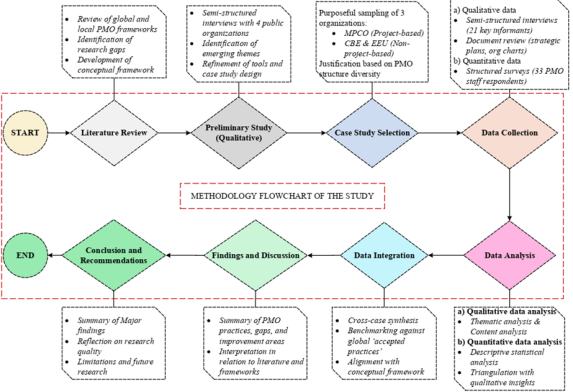
Figure 1 presents the methodological flowchart that illustrates the sequential and iterative phases of the research design. The diagram shows the logical progression from the preliminary exploratory study to the final data analysis and interpretation phase.
Figure 1. Methodology flowchart of the study.
3. Results and Discussion
This section analyzes PMO practices in three Ethiopian public sector organizations: MPCO, CBE, and EEU, using a thematic approach based on Yin's
| [12] | Yin, R. K., “Case study research: Design and methods,” Sage Publication, Vol. 5, 2009. |
[12]
multiple-case study. These findings are then benchmarked against globally recognized project management standards, frameworks, and best practices-
‘accepted practice’-to identify performance gaps and inform actionable recommendations. The themes discussed below were derived from the study’s conceptual framework and are aligned with the primary research questions, focusing on how governance, staffing, capacity building, institutional maturity, and knowledge management systems influence PMO effectiveness.
Governance and strategic alignment
The effectiveness of PMOs is significantly influenced by governance structures. Despite MPCO's two-tier governance structure, leadership instability and the absence of formal project charters threaten organizational continuity. CBE's PMO is part of a technical department, so its ability to influence enterprise-level decisions is limited. In contrast, the PMO at EEU, despite its strategic location, struggles with interdepartmental coordination. These findings are consistent with ISO 21502, which emphasizes the importance of leadership continuity and cross-functional integration.
Staffing and professional competency
The three organizations have different staffing approaches. MPCO prioritizes work experience over formal certifications, which leads to skill gaps. CBE emphasizes technical skills but lacks globally recognized certifications such as PMP. EEU has a high staff turnover, which limits knowledge retention and consistency. None of the organizations have implemented structured recruitment based on competency frameworks like the PMI Talent Triangle, which could improve staffing efficiency and project execution.
Table 1. Comparison of PMO Practices across Thematic Areas.
Theme | MPCO | CBE | EEU |
Governance and Positioning | Two-tier departmental PMO with leadership instability, and lack of formal project charters. | PMO embedded in technical department, with bureaucratic approvals. | PMO within Project Portfolio Management Directorate; struggles with interdepartmental coordination. |
Staffing and Certification | Experience-based hiring; no structured competency framework or formal certification system. | Prioritizes technical qualifications; lacks globally recognized certifications (e.g., PMP). | High staff turnover, recruitment from various technical backgrounds; lacks consistent competency frameworks. |
Training and Capacity Building | Irregular, budget-constrained training; mostly non-technical. | Offers both technical and leadership training, but no post-training evaluation. | Emphasis on training, but lacks regular, structured programs and follow-up. |
Risk Management and Stakeholder Engagement | No dedicated risk management team; informal engagement; no standardized processes. | No proactive risk planning; reactive approach. Informal engagement; slow approval process. | Inconsistent risk management; informal and fragmented engagement; lacks structured communication protocols. |
Operational Challenges | Excessive workload, lack of signed project charters, and limited stakeholder collaboration. | Bureaucratic rigidity, economic volatility, and ineffective risk frameworks. | High staff turnover, fragmented communication, and cultural resistance to change. |
As shown in
Table 1, the three PMOs exhibit partial institutionalization of project management practices, corresponding to Level 3 of the OPM3 model. However, they face common challenges such as weak governance integration, a lack of certification-based staffing, inadequate stakeholder management, and inconsistency in capacity-building systems. These findings suggest that phased institutional reforms aligned with global
‘accepted practices’ are required to improve strategic alignment and long-term effectiveness.
Capacity building and training
Training programs in all organizations are fragmented and misaligned with practical needs. MPCO training is more focused on leadership than technical project management. CBE offers both technical and leadership training, but there are no formal certification paths. EEU emphasizes training, but it lacks follow-up assessments and structured development programs. As a result, implementing competency-based, certification-oriented training programs in accordance with PMBOK and ISO standards would enhance capacity development and PMO maturity.
Operational challenges and effectiveness
Although the three institutions face similar operational challenges, each has issues that are specific to its organization.
Table 2. PMO Performance Ratings across Organizations (5-Point Likert Scale).
PMO | Overall Mean Score |
Challenges | Effectiveness | Contribution |
MPCO | 3.44-Frequent challenges including leadership turnover, excessive workload, and poor documentation. | 4.00-Generally, quite effective, with significant cost and time savings. | 3.92-Considerable contribution, but limited by governance and communication gaps. |
CBE | 3.24-Frequent operational difficulties due to bureaucratic rigidity and limited risk planning | 4.73-Highly effective; strong in coordination and resource optimization. | 4.25-Significant contribution to project execution despite structural constraints. |
EEU | 3.36-High staff turnover and fragmented communication. | 4.00-Quite effective in planning and budgeting; execution constrained. | 4.13-Considerable contribution, particularly in cost control and delivery timeliness. |
1) MPCO: High workload, lack of signed project charters, and limited stakeholder collaboration.
2) CBE: Bureaucratic rigidity, economic volatility, and ineffective risk frameworks.
3) EEU: High staff turnover, fragmented communication, and cultural resistance to change.
Despite these challenges, all PMOs are perceived to add significant value, particularly in terms of cost control, schedule adherence, and project coordination.
Table 2 presents the comparative summarizes of perceived PMO performance based on Likert-scale ratings collected via survey. Although there were moderately frequent challenges reported (avg. 3.24 - 3.44), all PMOs received high ratings for effectiveness (avg.4.00 - 4.73) and contribution (avg. 3.92 - 4.25). Despite structural constraints, CBE's PMO was rated the most effective overall. These ratings show that, despite institutional constraints, PMOs in the public sector have a measurable operational impact, highlighting the potential for increased maturity through targeted governance, risk management, and capacity-building initiatives.
4. Conclusion and Recommendations
4.1. Conclusion
This study assessed PMO efficacies in the Ethiopian public building construction sector. According to the findings, while PMOs have improved project control and coordination, their effectiveness is constrained by governance fragmentation, inconsistent staffing practices, and insufficient capacity development. Governance mechanisms are inconsistently applied, with staffing practices primarily based on experience rather than competency frameworks. Training programs lack systematic structure and are not in accordance with globally ‘accepted practices’.
Furthermore, risk management is primarily reactive, with stakeholder engagement frameworks and institutional learning processes either fragmented or completely absent. The organizations under study exhibit characteristics consistent with OPM3 Level 3 maturity, indicating standardized practices across core PMBOK knowledge areas. However, they continue to face challenges in areas such as strategic alignment, stakeholder integration, risk management, and knowledge management.
4.2. Recommendations
Several recommendations are made in light of the study's findings to improve PMO practices in Ethiopia's public construction sector.
Governance and structure: Implement ISO 21502-compliant governance systems to ensure leadership continuity and clearly defined mandates.
Staffing and certification: Follow the PMI Talent Triangle's recommendations for competency-based recruitment and professional certifications (e.g., PMP, PMO-CP).
Training and capacity building: Invest in structured training programs that cover procurement, contract management, and risk assessment, as outlined in PMBOK and P3O guidelines.
Risk and stakeholder management: Adopt ISO 31000 for proactive risk management and formalize stakeholder engagement processes in accordance with the PMBOK.
Institutional learning: Establish centralized knowledge management systems and formalize lesson-learning processes to enhance organizational learning.
Addressing these challenges would enable public-sector PMOs to evolve from operational support units to strategic governance platforms, thereby improving project oversight, execution, and contribution to national development goals.
PMOs in Ethiopia's public sector have a solid foundation, but they are constrained by structural, procedural, and institutional barriers. This study highlights the need for targeted reforms to improve PMO maturity. A shift toward structured governance, certification-driven staffing, and continuous learning will not only improve project delivery but will also contribute to the broader goals of public sector modernization and infrastructure development.
Abbreviations
CBE | Commercial Bank of Ethiopia |
CHs | Challenges |
CoE | Center of Excellence |
CONTs | Contributions |
CMM | Capability Maturity Model |
CRM | Customer Relationship Management |
Ethio Telecom | Ethiopian Telecommunication |
EEU | Ethiopian Electric Utility |
EFFs | Effectiveness |
GDP | Gross Domestic Products |
ISO | International Standardization Organization |
MPCO | Mega Projects Construction Office |
OPM | Organizational Project Management |
OPM3 | Organizational Project Management Maturity Model |
PMBOK | Project Management Body of Knowledge |
PMI | Project Management Institute |
PMO | Project Management Office |
PMO-CP | Project Management Office-Certified Practioner |
PMP | Project Management Professional |
PMMM | Project Management Maturity Model |
P3O | Project, Program, Portfolio Office |
RTA | Reflexive Thematic Analysis |
SEI | Software Engineering Institute |
Acknowledgments
The authors gratefully acknowledge the invaluable cooperation of the organizations that participated in the surveys and interviews, whose insights and experiences were critical to the success of this study.
Conflicts of Interest
The authors declare that there are no known conflicts of interest.
Appendix: Constructs/Variables and Agreement Scale
This appendix provides additional information on constructs/variables: PMO Challenges (CHs), PMO Contribution (CONTs), and PMO Effectiveness (EFFs), and the range of scale used for interpretation on 5-point Likert scale.
Table A1. 5-Point Likert Scale Result Interpretation [CHs].
Likert Scale | Interval | Difference | Interpretation |
1 | 1.00-1.79 | 0.79 | Never |
2 | 1.80-2.59 | 0.79 | Rarely |
3 | 2.60-3.39 | 0.79 | Sometimes |
4 | 3.40-4.19 | 0.79 | Often |
5 | 4.20-5.00 | 0.79 | Very Often |
Table A2. 5-Point Likert Scale Result Interpretation [CONTs].
Likert Scale | Interval | Difference | Interpretation |
1 | 1.00-1.79 | 0.79 | No Contribution |
2 | 1.80-2.59 | 0.79 | Little Contribution |
3 | 2.60-3.39 | 0.79 | Some Contribution |
4 | 3.40-4.19 | 0.79 | Considerable Contribution |
5 | 4.20-5.00 | 0.79 | Significant Contribution |
Table A3. 5-Point Likert Scale Result Interpretation [EFFs].
Likert Scale | Interval | Difference | Interpretation |
1 | 1.00-1.79 | 0.79 | Not Effective |
2 | 1.80-2.59 | 0.79 | Less Effective |
3 | 2.60-3.39 | 0.79 | Moderately Effective |
4 | 3.40-4.19 | 0.79 | Quite Effective |
5 | 4.20-5.00 | 0.79 | Highly Effective |
References
| [1] |
MUDC, “Construction Industry Development Policy.” Ministry of Urban Development and Construction, 2013.
|
| [2] |
MoPD, “Vision 2030: The Pathway to Prosperity Ten Years Perspective Development Plan,” Ministry of Planning and Development, 2021.
|
| [3] |
Solomon Sertse, “The Management of Construction Processes in Developing Countries: A Case Study of the Ethiopian Roads Authority,” Unpublished Doctoral Dissertation, University of Cape Town, Cape Town, 2015.
|
| [4] |
Desalegn Girma and Mahesh, G., “Challenges in Developing the Ethiopian Construction Industry,” African Journal of Science, Technology, Innovation and Development, Vol. 12, No. 4, 2021.
|
| [5] |
Wubishet Jekale, “Performances for Public Construction Projects in (Least) Developing Countries, Federal Road and Educational Building Projects in Ethiopia,” Unpublished Doctoral Dissertation, University of NTNU, Trondheim, 2004.
|
| [6] |
Mijić, D. R., “Development of Project Management Offices (PMO) in Organizational Project Management,” 2015 23rd Telecommunications Forum Telfor (TELFOR), Belgrade, Serbia, 2015, pp. 37-40, IEEE.
https://doi.org/10.1109/TELFOR.2015.7377389
|
| [7] |
Santos, V., & Varajão, J., “PMO as a Key Ingredient of Public Sector Projects’ Success-Position Paper,” Procedia Computer Science, Vol. 64, 2015, pp. 1190-1199.
https://doi.org/10.1016/j.procs.2015.08.546
|
| [8] |
Solomon Sertse, David Root, and C. J. Diederichs, “The Practice of Project Management Office (PMO) Concept within the German Architect, Engineer, Contractor (AEC) Sector,” Journal of Engineering, Design and Technology, Vol. 4, No. 1, 2006, pp. 46-59.
https://doi.org/10.1108/17260530610818642
|
| [9] |
Atkinson, R., “Project management: cost, time, and quality, two best guesses and a phenomenon; it's time to accept other success criteria,” International Journal of Project Management, Vol. 17, No. 6, 1999 pp. 337–342.
https://doi.org/10.1016/S0263-7863(98)00069-6
|
| [10] |
Serrador, P., & Turner, R., “The relationship between project success and project efficiency,” Project Management Journal, Vol. 46, No. 1, 2015, pp. 30–39.
https://doi.org/10.1002/pmj.21468
|
| [11] |
PMI, “A Guide to the Project Management Body of Knowledge (PMBOK® Guide)–Fifth Edition and The Standard for Project Management,” Project Management Institute, 2013.
https://doi.org/10.1002/pmj.21345
|
| [12] |
Yin, R. K., “Case study research: Design and methods,” Sage Publication, Vol. 5, 2009.
|
| [13] |
Braun, V., & Clarke, V., “Using thematic analysis in psychology,” Qualitative Research in Psychology, Vol. 3, No. 2, 2006, pp. 77–101.
https://doi.org/10.1191/1478088706qp063oa
|
| [14] |
Bowen, G. A., “Document analysis as a qualitative research method,” Qualitative Research Journal, Vol. 9, No. 2, 2009, pp. 27–40.
https://doi.org/10.3316/QRJ0902027
|
Cite This Article
-
APA Style
Dame, M. W., Tsehayae, A. A. (2026). Efficacy of Project Management Offices in Public Building Construction Projects in Ethiopia. Journal of Civil, Construction and Environmental Engineering, 11(1), 14-21. https://doi.org/10.11648/j.jccee.20261101.12
 Copy
|
Copy
|
 Download
ACS Style
Dame, M. W.; Tsehayae, A. A. Efficacy of Project Management Offices in Public Building Construction Projects in Ethiopia. J. Civ. Constr. Environ. Eng. 2026, 11(1), 14-21. doi: 10.11648/j.jccee.20261101.12
Copy
|
Download
AMA Style
Dame MW, Tsehayae AA. Efficacy of Project Management Offices in Public Building Construction Projects in Ethiopia. J Civ Constr Environ Eng. 2026;11(1):14-21. doi: 10.11648/j.jccee.20261101.12
Copy
|
Download
-
@article{10.11648/j.jccee.20261101.12,
  author = {Marsimoyi Weyuma Dame and Abraham Assefa Tsehayae},
  title = {Efficacy of Project Management Offices in Public Building Construction Projects in Ethiopia},
  journal = {Journal of Civil, Construction and Environmental Engineering},
  volume = {11},
  number = {1},
  pages = {14-21},
  doi = {10.11648/j.jccee.20261101.12},
  url = {https://doi.org/10.11648/j.jccee.20261101.12},
  eprint = {https://article.sciencepublishinggroup.com/pdf/10.11648.j.jccee.20261101.12},
  abstract = {Project Management Offices (PMOs) have become increasingly important in strengthening project governance and delivery within Ethiopia’s public construction sector. Despite their growing adoption, many PMOs remain insufficiently integrated into organizational governance structures, and challenges in project performance persist. This study examines the effectiveness of PMO practices in public building construction projects, with particular attention to their influence on project performance and institutional coordination. An exploratory and explanatory multiple-case study design was employed, using a qualitative-dominant mixed-methods approach. Data were collected from three major public institutions in Addis Ababa-namely the Mega Projects Construction Office (MPCO), the Commercial Bank of Ethiopia (CBE), and the Ethiopian Electric Utility (EEU). Evidence was drawn from 21 semi-structured interviews, 33 structured questionnaire responses, and a review of relevant organizational documents. The data were analyzed using thematic and content analysis supported by descriptive statistical techniques. The findings indicate that PMOs contribute positively to improving cost control and schedule performance. However, their overall effectiveness is constrained by fragmented governance structures, limited cross-departmental coordination, weak risk management practices, and low stakeholder engagement. In addition, capacity gaps persist due to the absence of structured recruitment frameworks, limited professional certification, and inconsistent training opportunities. The study recommends phased institutional reforms aimed at strengthening governance integration, promoting competency-based staffing, and aligning PMO practices with internationally recognized standards. By providing empirical evidence from Ethiopia’s public construction sector, this study contributes to a better understanding of PMO effectiveness and offers practical insights for improving project governance in developing-country contexts.},
 year = {2026}
}
Copy
|
Download
-
TY  - JOUR
T1  - Efficacy of Project Management Offices in Public Building Construction Projects in Ethiopia
AU  - Marsimoyi Weyuma Dame
AU  - Abraham Assefa Tsehayae
Y1  - 2026/01/23
PY  - 2026
N1  - https://doi.org/10.11648/j.jccee.20261101.12
DO  - 10.11648/j.jccee.20261101.12
T2  - Journal of Civil, Construction and Environmental Engineering
JF  - Journal of Civil, Construction and Environmental Engineering
JO  - Journal of Civil, Construction and Environmental Engineering
SP  - 14
EP  - 21
PB  - Science Publishing Group
SN  - 2637-3890
UR  - https://doi.org/10.11648/j.jccee.20261101.12
AB  - Project Management Offices (PMOs) have become increasingly important in strengthening project governance and delivery within Ethiopia’s public construction sector. Despite their growing adoption, many PMOs remain insufficiently integrated into organizational governance structures, and challenges in project performance persist. This study examines the effectiveness of PMO practices in public building construction projects, with particular attention to their influence on project performance and institutional coordination. An exploratory and explanatory multiple-case study design was employed, using a qualitative-dominant mixed-methods approach. Data were collected from three major public institutions in Addis Ababa-namely the Mega Projects Construction Office (MPCO), the Commercial Bank of Ethiopia (CBE), and the Ethiopian Electric Utility (EEU). Evidence was drawn from 21 semi-structured interviews, 33 structured questionnaire responses, and a review of relevant organizational documents. The data were analyzed using thematic and content analysis supported by descriptive statistical techniques. The findings indicate that PMOs contribute positively to improving cost control and schedule performance. However, their overall effectiveness is constrained by fragmented governance structures, limited cross-departmental coordination, weak risk management practices, and low stakeholder engagement. In addition, capacity gaps persist due to the absence of structured recruitment frameworks, limited professional certification, and inconsistent training opportunities. The study recommends phased institutional reforms aimed at strengthening governance integration, promoting competency-based staffing, and aligning PMO practices with internationally recognized standards. By providing empirical evidence from Ethiopia’s public construction sector, this study contributes to a better understanding of PMO effectiveness and offers practical insights for improving project governance in developing-country contexts.
VL  - 11
IS  - 1
ER  -
Copy
|
Download





 Share This Article
 Twitter
 Linked In
 Facebook