
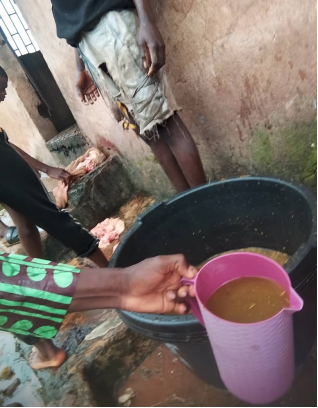
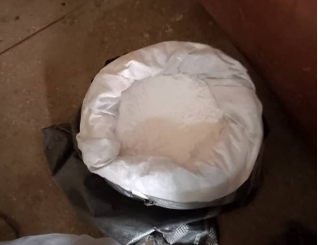
The discharge of untreated abattoir wastewater poses a significant environmental and public health challenge due to its high concentrations of organic matter, suspended solids, nutrients, and other pollutants. Conventional treatment methods are often expensive and difficult to sustain in developing countries, creating the need for affordable and environmentally friendly alternatives. This study investigated the effectiveness of blended activated charcoal and calcium carbonate (AC–CaCO3) as a low-cost adsorbent for the treatment of abattoir effluent. Wastewater samples were collected from the Warake Road abattoir in Auchi, Edo State, Nigeria, and treated using AC–CaCO3 blends prepared in ratios of 1:1, 1:2 and 2:1. The treatment performance was evaluated by analysing physicochemical parameters, including pH, temperature, total suspended solids (TSS), total dissolved solids (TDS), turbidity, biochemical oxygen demand (BOD), chemical oxygen demand (COD), dissolved oxygen (DO), nitrate, phosphate, and selected heavy metals. The results showed that the adsorption efficiency depended on the blending ratio, with the 1:2 (AC–CaCO3) blend exhibiting the best overall performance. This blend achieved removal efficiencies of 81% for BOD, 83% for COD, 82% for TSS, 72% for nitrate, and 68% for phosphate. Furthermore, the pH of the treated effluent was stabilised within the range of 6.7–7.7, while dissolved oxygen increased significantly from 0.8 to 4.3 mg/L, indicating substantial improvement in water quality. The treated effluent approached the permissible limits specified by the World Health Organization (WHO) and the Nigerian Industrial Standards (NIS) for wastewater discharge. The findings demonstrate that blended AC–CaCO3 is an effective, economical, and environmentally sustainable adsorbent for the treatment of abattoir wastewater and offers a promising solution for improving wastewater management in resource-constrained settings.
| Published in | Journal of Energy, Environmental & Chemical Engineering (Volume 11, Issue 2) |
| DOI | 10.11648/j.jeece.20261102.12 |
| Page(s) | 55-60 |
| Creative Commons |
This is an Open Access article, distributed under the terms of the Creative Commons Attribution 4.0 International License (http://creativecommons.org/licenses/by/4.0/), which permits unrestricted use, distribution and reproduction in any medium or format, provided the original work is properly cited. |
| Copyright |
Copyright © The Author(s), 2026. Published by Science Publishing Group |
Abattoir Wastewater, Activated Charcoal, Calcium Carbonate, Adsorption, Effluent Treatment, Water Quality, Sustainable Engineering
Parameter | Method | Reference |
|---|---|---|
pH, Temperature | Electrometric | APHA (2017) |
TSS, TDS | Gravimetric | APHA (2017) |
BOD | Winkler method | APHA (2017) |
COD | Dichromate oxidation | APHA (2017) |
Nitrates/Phosphates | Spectrophotometric | APHA (2017) |
Heavy Metals | AAS | ISO 8288 (1986) |
Parameter | Observed Value | WHO/NIS Limit | Remarks |
|---|---|---|---|
pH | 6.7 | 6.0–9.0 | Slightly acidic |
Temperature (°C) | 28 | < 30 | Within range |
BOD (mg/L) | 360 | < 30 | Excessively high |
COD (mg/L) | 1050 | < 250 | Excessive organic load |
TSS (mg/L) | 500 | < 30 | Poor clarity |
TDS (mg/L) | 650 | < 500 | High dissolved solids |
Nitrate (mg/L) | 24 | < 10 | Above limit |
Phosphate (mg/L) | 19 | < 5 | Above limit |
DO (mg/L) | 0.8 | > 4.0 | Oxygen deficient |
Parameter | Raw | 1:1 | 1:2 | 2:1 | WHO Limit |
|---|---|---|---|---|---|
BOD (mg/L) | 360 | 310 | 68 | 300 | <30 |
COD (mg/L) | 1050 | 920 | 180 | 880 | <250 |
DO (mg/L) | 0.8 | 1.2 | 4.3 | 2.0 | >4.0 |
Parameter | Raw (mg/L) | Treated (1:2) (mg/L) | Removal Efficiency (%) |
|---|---|---|---|
TSS | 500 | 90 | 82 |
TDS | 650 | 195 | 70 |
Turbidity (NTU) | 118 | 20 | 83 |
Parameter | Raw (mg/L) | Treated (mg/L) | Removal Efficiency (%) |
|---|---|---|---|
Nitrate (NO₃⁻) | 24 | 6.7 | 72 |
Phosphate (PO₄³⁻) | 19 | 6.1 | 68 |
Lead (Pb) | 0.33 | 0.07 | 79 |
Zinc (Zn) | 0.42 | 0.13 | 70 |
Copper (Cu) | 0.31 | 0.08 | 73 |
Chromium (Cr) | 0.27 | 0.10 | 63 |
Cadmium (Cd) | 0.15 | 0.05 | 65 |
Parameter | Removal Efficiency (%) |
|---|---|
BOD | 81 |
COD | 83 |
TSS | 82 |
TDS | 70 |
Nitrate | 72 |
Phosphate | 68 |
Pb | 79 |
Cu | 73 |
Zn | 70 |
Cd | 65 |
Cr | 63 |
Coliforms | 85 |
BOD | Biochemical Oxygen Demand |
COD | Chemical Oxygen Demand |
| [1] | A. A. Ogundipe, I. A. Bello, and C. O. Akinbile, “Pollution load assessment of abattoir effluent on surface water quality,” Environmental Monitoring and Assessment, vol. 190, pp. 680, 2018. |
| [2] | C. O. Akinbile, T. O. Ogunbode, and O. A. Oladeji, “Characterization and treatment of abattoir effluent in Nigeria: A review,” Environmental Technology & Innovation, vol. 22, pp. 101440, 2021. |
| [3] | M. S. Ahmed, K. Nwankwo, and A. Bello, “Performance of blended adsorbents in industrial effluent management,” Water Science & Technology, vol. 81, no. 9, pp. 1889–1901, 2020. |
| [4] | R. Singh, D. Kumar, and P. Mehta, “Activation and modification of calcium carbonate for enhanced adsorption,” Applied Water Science, vol. 9, p. 192, 2019. |
| [5] | A. O. Adesola, A. O. Ogunbayo, and O. P. Ajayi, “Low-cost adsorbents for wastewater treatment: A review,” Environmental Engineering Research, vol. 27, no. 5, pp 220046, 2022. |
| [6] | A. A. Mahmoud, D. O. Nwude, and C. O. Ikeh, “Enhancing pollutant adsorption using mineral–carbon blends,” Applied Water Science, vol. 10, p. 245, 2020. |
| [7] | APHA, Standard Methods for the Examination of Water and Wastewater, 23rd ed., Washington, DC: American Public Health Association, 2017. |
| [8] | M. Ali, R. Hussain, and A. Malik, “Characterization and treatment of abattoir wastewater: A case study,” Journal of Environmental Protection, vol. 12, pp. 210–225, 2021. |
| [9] | W. Nafarnda, O. Okolocha, and E. Inyang, “Microbial contamination of abattoir effluent and environmental impact,” African Journal of Environmental Science, vol. 14, pp. 101–110, 2020. |
| [10] | J. Vymazal, “Constructed wetlands for wastewater treatment: Five decades of experience,” Environmental Science and Policy, vol. 106, pp. 36–44, 2020. |
| [11] | Chukwu, O. (2008). Analysis of groundwater pollution from abattoir waste in Minna, Nigeria. Research Journal of Dairy Sciences, 2(4), 74–77. |
| [12] | Metcalf & Eddy, Inc. (2014). Wastewater engineering: Treatment and resource recovery (5th ed.). McGraw-Hill Education. |
| [13] | Adeyemo, O. K. (2002). Unhygienic operation of a city abattoir in South Western Nigeria: Environmental implication. African Journal of Environmental Assessment and Management, 4(1), 23–28. |
| [14] | Foo, K. Y., & Hameed, B. H. (2010). Insights into the modeling of adsorption isotherm systems. Chemical Engineering Journal, 156(1), 2–10. |
| [15] | Bhatnagar, A., Vilar, V. J. P., Botelho, C. M. S., & Boaventura, R. A. R. (2011). A review of the use of red mud as adsorbent for the removal of toxic pollutants from water and wastewater. Environmental Technology, 32(3), 231–249. |
APA Style
Oshiobugie, E. L., John, W., Olayinka, I. A., Joseph, S. (2026). Performance Evaluation of Blended Activated Charcoal–Calcium Carbonate Adsorbent in the Treatment of Abattoir Wastewater. Journal of Energy, Environmental & Chemical Engineering, 11(2), 55-60. https://doi.org/10.11648/j.jeece.20261102.12
ACS Style
Oshiobugie, E. L.; John, W.; Olayinka, I. A.; Joseph, S. Performance Evaluation of Blended Activated Charcoal–Calcium Carbonate Adsorbent in the Treatment of Abattoir Wastewater. J. Energy Environ. Chem. Eng. 2026, 11(2), 55-60. doi: 10.11648/j.jeece.20261102.12
@article{10.11648/j.jeece.20261102.12,
  author = {Eshiole Lucky Oshiobugie and Wasiu John and Ibrahim Abdulrazaq Olayinka and Sule Joseph},
  title = {Performance Evaluation of Blended Activated
Charcoal–Calcium Carbonate Adsorbent in the Treatment of Abattoir Wastewater},
  journal = {Journal of Energy, Environmental & Chemical Engineering},
  volume = {11},
  number = {2},
  pages = {55-60},
  doi = {10.11648/j.jeece.20261102.12},
  url = {https://doi.org/10.11648/j.jeece.20261102.12},
  eprint = {https://article.sciencepublishinggroup.com/pdf/10.11648.j.jeece.20261102.12},
  abstract = {The discharge of untreated abattoir wastewater poses a significant environmental and public health challenge due to its high concentrations of organic matter, suspended solids, nutrients, and other pollutants. Conventional treatment methods are often expensive and difficult to sustain in developing countries, creating the need for affordable and environmentally friendly alternatives. This study investigated the effectiveness of blended activated charcoal and calcium carbonate (AC–CaCO3) as a low-cost adsorbent for the treatment of abattoir effluent. Wastewater samples were collected from the Warake Road abattoir in Auchi, Edo State, Nigeria, and treated using AC–CaCO3 blends prepared in ratios of 1:1, 1:2 and 2:1. The treatment performance was evaluated by analysing physicochemical parameters, including pH, temperature, total suspended solids (TSS), total dissolved solids (TDS), turbidity, biochemical oxygen demand (BOD), chemical oxygen demand (COD), dissolved oxygen (DO), nitrate, phosphate, and selected heavy metals. The results showed that the adsorption efficiency depended on the blending ratio, with the 1:2 (AC–CaCO3) blend exhibiting the best overall performance. This blend achieved removal efficiencies of 81% for BOD, 83% for COD, 82% for TSS, 72% for nitrate, and 68% for phosphate. Furthermore, the pH of the treated effluent was stabilised within the range of 6.7–7.7, while dissolved oxygen increased significantly from 0.8 to 4.3 mg/L, indicating substantial improvement in water quality. The treated effluent approached the permissible limits specified by the World Health Organization (WHO) and the Nigerian Industrial Standards (NIS) for wastewater discharge. The findings demonstrate that blended AC–CaCO3 is an effective, economical, and environmentally sustainable adsorbent for the treatment of abattoir wastewater and offers a promising solution for improving wastewater management in resource-constrained settings.},
 year = {2026}
}
TY  - JOUR
T1  - Performance Evaluation of Blended Activated
Charcoal–Calcium Carbonate Adsorbent in the Treatment of Abattoir Wastewater
AU  - Eshiole Lucky Oshiobugie
AU  - Wasiu John
AU  - Ibrahim Abdulrazaq Olayinka
AU  - Sule Joseph
Y1  - 2026/08/10
PY  - 2026
N1  - https://doi.org/10.11648/j.jeece.20261102.12
DO  - 10.11648/j.jeece.20261102.12
T2  - Journal of Energy, Environmental & Chemical Engineering
JF  - Journal of Energy, Environmental & Chemical Engineering
JO  - Journal of Energy, Environmental & Chemical Engineering
SP  - 55
EP  - 60
PB  - Science Publishing Group
SN  - 2637-434X
UR  - https://doi.org/10.11648/j.jeece.20261102.12
AB  - The discharge of untreated abattoir wastewater poses a significant environmental and public health challenge due to its high concentrations of organic matter, suspended solids, nutrients, and other pollutants. Conventional treatment methods are often expensive and difficult to sustain in developing countries, creating the need for affordable and environmentally friendly alternatives. This study investigated the effectiveness of blended activated charcoal and calcium carbonate (AC–CaCO3) as a low-cost adsorbent for the treatment of abattoir effluent. Wastewater samples were collected from the Warake Road abattoir in Auchi, Edo State, Nigeria, and treated using AC–CaCO3 blends prepared in ratios of 1:1, 1:2 and 2:1. The treatment performance was evaluated by analysing physicochemical parameters, including pH, temperature, total suspended solids (TSS), total dissolved solids (TDS), turbidity, biochemical oxygen demand (BOD), chemical oxygen demand (COD), dissolved oxygen (DO), nitrate, phosphate, and selected heavy metals. The results showed that the adsorption efficiency depended on the blending ratio, with the 1:2 (AC–CaCO3) blend exhibiting the best overall performance. This blend achieved removal efficiencies of 81% for BOD, 83% for COD, 82% for TSS, 72% for nitrate, and 68% for phosphate. Furthermore, the pH of the treated effluent was stabilised within the range of 6.7–7.7, while dissolved oxygen increased significantly from 0.8 to 4.3 mg/L, indicating substantial improvement in water quality. The treated effluent approached the permissible limits specified by the World Health Organization (WHO) and the Nigerian Industrial Standards (NIS) for wastewater discharge. The findings demonstrate that blended AC–CaCO3 is an effective, economical, and environmentally sustainable adsorbent for the treatment of abattoir wastewater and offers a promising solution for improving wastewater management in resource-constrained settings.
VL  - 11
IS  - 2
ER  -
Department of Civil Engineering, Edo State University, Iyamho, Nigeria
Department of Civil Engineering, Edo State University, Iyamho, Nigeria
Department of Civil Engineering, Edo State University, Iyamho, Nigeria

Information



 Share This Article
 Twitter
 Linked In
 Facebook
 Copy
Copy Download