
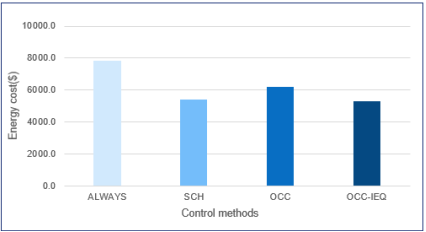
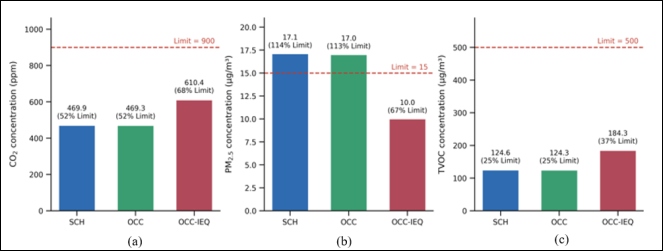
Balancing energy consumption and indoor air quality (IAQ) in single‑family houses is challenging because cooking‑generated PM2.5 and volatile organic compounds (VOCs) are episodic and occupancy‑dependent, and prescriptive ventilation rates cannot follow these transient loads. The ASHRAE 62.1 Indoor Air Quality Procedure (IAQP) offers a performance‑based alternative that permits reduced ventilation when contaminant levels remain within limits, but a validated residential strategy that combines real‑time occupancy with continuous CO2, PM2.5, and VOC sensing has not been demonstrated. This study proposes an occupancy–indoor environmental quality (OCC‑IEQ) strategy and evaluates it alongside fixed‑thermostat, schedule‑based (SCH), and occupancy‑triggered (OCC) controls using a co‑simulation of a multi‑zone house. The strategies are assessed against IAQ limits of PM2.5 ≤ 15 µg/m3, CO2 ≤ 900 ppm, and TVOC ≤ 500 µg/m3, with a minimum energy saving target of 15%. The OCC‑IEQ strategy achieves a 33.3 % reduction in annual HVAC energy cost, and maintains all three pollutants within limits. The schedule‑based and occupancy‑triggered strategies failed to control PM2.5, and the occupancy‑triggered strategy yielded limited energy savings due to overnight temperature drift. By treating permissible concentration bands as an operational resource, OCC‑IEQ dynamically modulates the outdoor air fraction to balance energy efficiency and indoor air quality protection. These findings demonstrate that a performance‑based multi‑pollutant ventilation strategy guided by the IAQP can achieve substantial energy savings and comprehensive IAQ compliance in dwellings.
| Published in | Journal of Energy, Environmental & Chemical Engineering (Volume 11, Issue 3) |
| DOI | 10.11648/j.jeece.20261103.12 |
| Page(s) | 76-83 |
| Creative Commons |
This is an Open Access article, distributed under the terms of the Creative Commons Attribution 4.0 International License (http://creativecommons.org/licenses/by/4.0/), which permits unrestricted use, distribution and reproduction in any medium or format, provided the original work is properly cited. |
| Copyright |
Copyright © The Author(s), 2026. Published by Science Publishing Group |
Residential Ventilation, Indoor Air Quality, Co-simulation, IEQ Sensing
IEQ | Indoor Environment Quality |
VOCs | Volatile Organic Compounds |
PM2.5 | Particulate Matter Within 2.5 μm Diameter |
TVOC | Total Volatile Organic Compounds |
CO2 | Carbon Dioxide |
HVAC | Heating, Ventilation, and Air Conditioning |
DCV | Demand-Controlled Ventilation |
IAQP | Indoor Air Quality Procedure |
OCC | Occupancy-Driven Control |
SCH | Schedule-Based Control |
EPA | Environmental Protection Agency |
ASHRAE | American Society of Heating, Refrigerating and Air-Conditioning Engineers |
| [1] | Guyot, G., Sherman, M. H. and Walker, I. S. Smart ventilation energy and indoor air quality performance in residential buildings: A review. Energy & Buildings. 2018, 165(4), 416-430. |
| [2] | Persily, A., de Jonge, L. Carbon dioxide generation rates for building occupants. Indoor Air. 2017, 27(5), 868–879. |
| [3] | Poirier, B., Guyot, G., Geoffroy, H., Woloszyn, M., & Gonze, E. Pollutants emission scenarios for residential ventilation performance assessment. a review. Journal of Building Engineering. 2021, 42, 102488. |
| [4] | Jode, M. D. Long term monitoring of CO2 levels and ventilation rates in a naturally ventilated residential apartment. Indoor Environments. 2024, 1(3), 100030. |
| [5] | Buonanno, G., Morawska, L., Stabile, L. Particle emission factors during cooking activities. Atmospheric Environment. 2009, 43(19), 3235–3242. |
| [6] | Sofowote, U. M., Dabek-Zlotorzynska, E., Yassine, M. M., Mooibroek, D., Siu, M., & Celo, V., et al. Combined-phase source apportionment of ambient PM2.5, PAHs and VOCs from an industrialized environment: consequences of photochemical initial concentrations. Atmospheric Environment, 2025, 340(1), 120894. |
| [7] | Wang, H., Zhang, R., Kong, H., Wang, K., Sun, L, & Yu, X., et al. Long-term emission characteristics of vocs from building materials. Journal of hazardous materials. 2024 (12), 480. |
| [8] | Majumder, A. K., Hossain, M. M., Rahman, M., Sobnam, M., Patoary, M. N. A. Spatial Distribution of Air Quality in Moulvibazar District Town, Bangladesh: A Wintertime Observation. Journal of Energy, Environmental & Chemical Engineering. 2025, 10(1), 12-25. |
| [9] | Chen, H., & Markusson, C. Demand controlled ventilation in residential buildings, In Cold Climate HVAC 2018: Sustainable Buildings in Cold Climates, Kiruna, Sweden, March 12-15 (2018), 111-122. |
| [10] | Hesaraki, A., Myhren, J. A., & Holmberg, S. Multi-zone demand-controlled ventilation in residential buildings: an experimental case study. Engineering Environmental Science. 2014, 1, 32860684. |
| [11] | Taylor, S. T. Demand-controlled ventilation: CO2-based DCV using 62.1-2004. ASHRAE Journal. 2006, 48(5), 67-75. |
| [12] | ASHRAE. ANSI/ASHRAE Standard 62.1-2025, Ventilation and Acceptable Indoor Air Quality. Peachtree Corners, GA: ASHRAE; 2025. |
| [13] | Burley, B. What's new in ASHRAE standard 62.1-2025. ASHRAE Journal. 2026, 68(4), 12. |
| [14] | Liang, W., Yu, X., & Yang, X. The ASHRAE indoor air quality procedure (IAQP): introduction of method and discussion on practical implementation. Building and Environment, 2026, 288, 114004. |
| [15] | Bill McQuade, P. E., CDP, F. A., & LEED, A. Healthy Buildings: Designing for Life. ASHRAE Transactions. 2026, 132, XXI-XXIII. |
| [16] | Wolkoff, P., Nielsen, G. D. Organic compounds in indoor air—their relevance for perceived indoor air quality? Atmospheric Environment. 2001, 35(26), 4407–4417. |
| [17] | Dols, W. S., Emmerich, S. J., Polidoro, B. J. Coupling the multizone airflow and contaminant transport software CONTAM with EnergyPlus using co-simulation. Building Simulation. 2016, 9(4), 469–479. |
| [18] | Bureau of Labor Statistics. American Time Use Survey Home Page. Available from: |
| [19] | U. S. Environmental Protection Agency. Air Quality System (AQS). Available from: |
| [20] | ASHRAE. Standard 62.1 User's Manual: Based on ANSI/ ASHRAE Standard 62.1-2019, Ventilation for Acceptable Indoor Air Quality. Peachtree Corners, GA: ASHRAE; 2021. |
| [21] | Liu, Q., Son, Y. J., Li, L., Wood, N., Senerat, A. M., Pantelic, J. Healthy home interventions: Distribution of PM2.5 emitted during cooking in residential settings. Building and Environment. 2022, 207, 108448. |
| [22] | Shanghai Research Institute of Building Sciences Group Co., Ltd. Indoor Environment and Material Emission Data Platform, |
| [23] | Chen, C., Zhao, Y., Zhao, B. Emission Rates of Multiple Air Pollutants Generated from Chinese Residential Cooking. Environmental Science & Technology. 2018, 52(3), 1081-1089. |
| [24] | Cheng, H., Raftery, P., Wendler, P. Re-optimizing Optimal Start and Morning Warmup. ASHRAE Journal. 2024, 66(8), 46. |
| [25] | Lu, T., Lu, X., & Viljanen, M. A novel and dynamic demand-controlled ventilation strategy for CO2 control and energy saving in buildings. Energy and Buildings. 2011, 43(9), 2499-2508. |
| [26] | Jiang, Q. W., Liu, J. L., Yang, X. Optimization of Indoor Quality and Thermal Comfort for University Classrooms Using Data-Based Machine Learning. E3S Web of Conferences. 2024, 546, 02011. |
| [27] | Ma, Z., Huang, J., Wang, X., Wei, Y., Huang, L. Estimation of infiltration efficiency of ambient PM2.5 in urban residences of Beijing during winter. Journal of Building Engineering. 2023, 76, 107307. |
| [28] | Stephens, B., Siegel, J. A. Penetration of ambient submicron particles into single-family residences and associations with building characteristics. Indoor Air. 2012, 22(6), 501–513. |
| [29] | Farmer, D. K., Vance, M. E., Abbatt, J. P. D., Abeleira, A., Alves, M. R., Arata, C., Boedicker, E., Bourne, S., Cardoso-Saldaña, F., Cirtog, M., et al. Overview of HOMEChem: House Observations of Microbial and Environmental Chemistry. Environmental Science: Processes & Impacts. 2019, 21, 1280–1300. |
| [30] | Gentile, V., Medina, L., Rubio Henriquez, M. J., Siegel, J. A., Tronville, P. Using low-cost particle sensors in HVAC ducts. Aerosol Science and Technology. 2025, 59(10), 1221–1238. |
APA Style
Jiang, Q. (2026). A Multi‑pollutant Ventilation Strategy Under the Indoor Air Quality Procedure for Single‑family Houses. Journal of Energy, Environmental & Chemical Engineering, 11(3), 76-83. https://doi.org/10.11648/j.jeece.20261103.12
ACS Style
Jiang, Q. A Multi‑pollutant Ventilation Strategy Under the Indoor Air Quality Procedure for Single‑family Houses. J. Energy Environ. Chem. Eng. 2026, 11(3), 76-83. doi: 10.11648/j.jeece.20261103.12
AMA Style
Jiang Q. A Multi‑pollutant Ventilation Strategy Under the Indoor Air Quality Procedure for Single‑family Houses. J Energy Environ Chem Eng. 2026;11(3):76-83. doi: 10.11648/j.jeece.20261103.12
@article{10.11648/j.jeece.20261103.12,
  author = {Qiwen Jiang},
  title = {A Multi‑pollutant Ventilation Strategy Under the Indoor Air Quality Procedure for Single‑family Houses},
  journal = {Journal of Energy, Environmental & Chemical Engineering},
  volume = {11},
  number = {3},
  pages = {76-83},
  doi = {10.11648/j.jeece.20261103.12},
  url = {https://doi.org/10.11648/j.jeece.20261103.12},
  eprint = {https://article.sciencepublishinggroup.com/pdf/10.11648.j.jeece.20261103.12},
  abstract = {Balancing energy consumption and indoor air quality (IAQ) in single‑family houses is challenging because cooking‑generated PM2.5 and volatile organic compounds (VOCs) are episodic and occupancy‑dependent, and prescriptive ventilation rates cannot follow these transient loads. The ASHRAE 62.1 Indoor Air Quality Procedure (IAQP) offers a performance‑based alternative that permits reduced ventilation when contaminant levels remain within limits, but a validated residential strategy that combines real‑time occupancy with continuous CO2, PM2.5, and VOC sensing has not been demonstrated. This study proposes an occupancy–indoor environmental quality (OCC‑IEQ) strategy and evaluates it alongside fixed‑thermostat, schedule‑based (SCH), and occupancy‑triggered (OCC) controls using a co‑simulation of a multi‑zone house. The strategies are assessed against IAQ limits of PM2.5 ≤ 15 µg/m3, CO2 ≤ 900 ppm, and TVOC ≤ 500 µg/m3, with a minimum energy saving target of 15%. The OCC‑IEQ strategy achieves a 33.3 % reduction in annual HVAC energy cost, and maintains all three pollutants within limits. The schedule‑based and occupancy‑triggered strategies failed to control PM2.5, and the occupancy‑triggered strategy yielded limited energy savings due to overnight temperature drift. By treating permissible concentration bands as an operational resource, OCC‑IEQ dynamically modulates the outdoor air fraction to balance energy efficiency and indoor air quality protection. These findings demonstrate that a performance‑based multi‑pollutant ventilation strategy guided by the IAQP can achieve substantial energy savings and comprehensive IAQ compliance in dwellings.},
 year = {2026}
}
TY  - JOUR
T1  - A Multi‑pollutant Ventilation Strategy Under the Indoor Air Quality Procedure for Single‑family Houses
AU  - Qiwen Jiang
Y1  - 2026/09/08
PY  - 2026
N1  - https://doi.org/10.11648/j.jeece.20261103.12
DO  - 10.11648/j.jeece.20261103.12
T2  - Journal of Energy, Environmental & Chemical Engineering
JF  - Journal of Energy, Environmental & Chemical Engineering
JO  - Journal of Energy, Environmental & Chemical Engineering
SP  - 76
EP  - 83
PB  - Science Publishing Group
SN  - 2637-434X
UR  - https://doi.org/10.11648/j.jeece.20261103.12
AB  - Balancing energy consumption and indoor air quality (IAQ) in single‑family houses is challenging because cooking‑generated PM2.5 and volatile organic compounds (VOCs) are episodic and occupancy‑dependent, and prescriptive ventilation rates cannot follow these transient loads. The ASHRAE 62.1 Indoor Air Quality Procedure (IAQP) offers a performance‑based alternative that permits reduced ventilation when contaminant levels remain within limits, but a validated residential strategy that combines real‑time occupancy with continuous CO2, PM2.5, and VOC sensing has not been demonstrated. This study proposes an occupancy–indoor environmental quality (OCC‑IEQ) strategy and evaluates it alongside fixed‑thermostat, schedule‑based (SCH), and occupancy‑triggered (OCC) controls using a co‑simulation of a multi‑zone house. The strategies are assessed against IAQ limits of PM2.5 ≤ 15 µg/m3, CO2 ≤ 900 ppm, and TVOC ≤ 500 µg/m3, with a minimum energy saving target of 15%. The OCC‑IEQ strategy achieves a 33.3 % reduction in annual HVAC energy cost, and maintains all three pollutants within limits. The schedule‑based and occupancy‑triggered strategies failed to control PM2.5, and the occupancy‑triggered strategy yielded limited energy savings due to overnight temperature drift. By treating permissible concentration bands as an operational resource, OCC‑IEQ dynamically modulates the outdoor air fraction to balance energy efficiency and indoor air quality protection. These findings demonstrate that a performance‑based multi‑pollutant ventilation strategy guided by the IAQP can achieve substantial energy savings and comprehensive IAQ compliance in dwellings.
VL  - 11
IS  - 3
ER  -
Advanced System Department, Carrier Research and Development Centre, Shanghai, China

Information



 Share This Article
 Twitter
 Linked In
 Facebook
 Copy
Copy Download