Abstract
In light of the rapidly increasing global demand for energy, accurately forecasting short-term electricity consumption has become a critical yet challenging task for modern power system operation and planning, as traditional methods often struggle to handle the variability and uncertainty of load demand. To address these limitations, this study proposes an integrated and data-driven framework that combines an Alternating Current Optimal Power Flow (ACOPF) model with a Long Short-Term Memory (LSTM) recurrent neural network in order to simultaneously enhance forecasting accuracy and operational efficiency. The LSTM model, trained on historical load data, is used to generate reliable 24-hour ahead electricity demand forecasts, which are then dynamically incorporated into the MATPOWER simulation environment using the IEEE 30-bus test system. The results demonstrate that the proposed approach achieves a high level of predictive performance, with a root mean square error (RMSE) of 0.3794, indicating its effectiveness in capturing temporal load patterns. More importantly, the integration of these forecasts into the ACOPF framework enables more proactive and informed decision-making in power system operations, leading to a significant improvement in economic dispatch by reducing the hourly generation cost from $576.89/h under conventional approaches to $490.91/h, corresponding to an approximate cost reduction of 14.9%. Overall, this study highlights the strong synergy between deep learning techniques and optimization models for smart grid management, showing that the proposed framework not only improves forecasting precision but also enhances system efficiency, reduces operational costs, and supports more reliable, flexible, and cost-effective power system operations.
Keywords
Deep Learning, LSTM, Optimal Power Flow (OPF), MATPOWER, IEEE 30-bus, Forecasting
1. Introduction
Modern power grid management faces growing challenges related to rising energy demand, the liberalization of electricity markets, and the large-scale integration of intermittent renewable energy sources
| [28] | Vannet, “Distributed intelligence and heterarchical approach of distributed balancing markets in smart grids,” 2016. |
[28]
. In this context, short-term load forecasting (STLF) plays a fundamental role in ensuring operational reliability, grid stability, and cost-effective planning of electricity generation
| [1] | H. Sehovac and K. Grolinger, “Deep learning for load forecasting: Sequence-to-sequence recurrent neural networks with attention,” IEEE Access, vol. 8, pp. 36411–36426, 2020.
https://doi.org/10.1109/ACCESS.2020.2975738 |
[1]
. Indeed, even a relatively small error in demand forecasting can lead to significant operational costs, poor generator dispatch planning, or a deterioration in the overall performance of the power system.
Traditionally, the optimization of power grid operations is performed using Optimal Power Flow (OPF), which aims to determine the optimal dispatching of generators while adhering to the system’s technical constraints. Conventional OPF methods generally rely on deterministic models using fixed loads or linear demand estimates
| [5] | M. B. Cain, R. P. O’Neill, and A. Castillo, “History of optimal power flow computations,” Federal Energy Regulatory Commission, Staff Paper, 2012. |
[5]
. However, the highly nonlinear, dynamic, and stochastic nature of modern electricity demand limits the performance of these traditional approaches, particularly in smart grids where load variations can be rapid and unpredictable
| [29] | Rajulapati, “AI-driven load forecasting and dynamic pricing in smart grids,” 2025. |
[29]
.
With recent advances in artificial intelligence, deep learning techniques have demonstrated considerable potential for analyzing energy time series
| [30] | Tzelepi, “Deep learning for energy time-series analysis and forecasting,” 2023. |
[30]
. Among these techniques, Long Short-Term Memory (LSTM) neural networks have proven particularly effective for forecasting electricity demand. Thanks to their advanced recurrent architecture, LSTM networks are capable of capturing the long-term temporal dependencies present in historical electricity consumption data. Unlike traditional neural networks, LSTMs also overcome the vanishing gradient problem, which significantly improves the accuracy of models for time series forecasting tasks
| [3] | A. S. Ahmad et al., “A review on applications of ANN and SVM for building electrical energy consumption forecasting,” Renew. Sustain. Energy Rev., vol. 33, pp. 102–109, 2014.
https://doi.org/10.1016/j.rser.2014.01.069 |
| [4] | K. Greff, R. K. Srivastava, J. Koutník, B. Steunebrink, and J. Schmidhuber, “LSTM: A search space odyssey,” IEEE Trans. Neural Netw. Learn. Syst., vol. 28, no. 10, pp. 2222–2232, Oct. 2017.
https://doi.org/10.1109/TNNLS.2016.2582924 |
[3, 4]
.
In this context, several recent studies have explored the use of deep learning models to improve the accuracy of load forecasts
| [31] | Wen and Liao, “Deep learning-driven hybrid model for short-term load forecasting,” 2024. |
[31]
. However, only a limited number of studies have actually integrated these forecasts into a power system optimization framework, such as the calculation of optimal power flow
| [32] | Agarwal and Pileggi, “Integrating forecasting models within steady-state analysis,” 2025. |
[32]
. Yet, the direct integration of forecast results into optimization algorithms could significantly improve the economic and operational performance of modern power grids
| [33] | Li, “Economic dispatch model based on uncertainty constraints,” 2025. |
[33]
.
In this work, we propose an integrated approach that combines load forecasting based on a Deep LSTM network with AC Optimal Power Flow (ACOPF) optimization. The forecasting model is trained using historical electricity load data to predict hourly demand for the next 24 hours. These forecasts are then used to dynamically adjust the system load in the OPF calculation.
To evaluate the effectiveness of the proposed approach, simulations are performed using the MATPOWER platform, which is widely used for the analysis and optimization of power systems
| [2] | R. D. Zimmerman, C. E. Murillo-Sánchez, and R. J. Thomas, “MATPOWER: Steady-state operations, planning, and analysis tools for power systems research and education,” IEEE Trans. Power Syst., vol. 26, no. 1, pp. 12–19, Feb. 2011.
https://doi.org/10.1109/TPWRS.2010.2051168 |
[2]
. The test system considered is the IEEE 30-bus network, which serves as a classic benchmark for studying optimization problems in power systems
| [34] | Ali and Hassan, “Optimal power flow using composite differential evolution,” (paper). |
[34]
.
The experimental results show that integrating LSTM forecasts into the optimization process improves generator dispatch planning and significantly reduces the operational costs of the power system.
The main contributions of this work can be summarized as follows:
1) Development of a Deep LSTM model for short-term (24-hour) load forecasting.
2) Direct integration of load forecasts into an AC Optimal Power Flow optimization framework.
3) Evaluation of the proposed approach on the IEEE 30-bus test system using the MATPOWER environment.
4) Analysis of the economic impact of load forecasting on reducing power generation costs in the power system.
The remainder of this paper is organized as follows. Section II presents the Deep LSTM-based forecasting model and the data preparation process. Section III describes the mathematical formulation of the optimal power flow problem applied to the IEEE 30-bus system. Section IV presents the simulation results and the analysis of the system’s economic performance. Finally, Section V concludes the paper and proposes several avenues for future research.
2. Literature Review
2.1. The Problem of Optimal Power Flow
The problem with AC OPF is to minimize the total cost of production
| [15] | H. W. Dommel and W. F. Tinney, “Optimal power flow solutions,” IEEE Trans. Power App. Syst., vol. PAS-87, no. 10, pp. 1866–1876, Oct. 1968. |
| [35] | Chamanbaz, “Algorithms for optimal AC power flow,” 2018. |
[15, 35]
:
Subject:
1) AC power flow equations
2) Generator limits
3) Voltage amplitude limits
4) Thermal limits of power lines
Where denotes the active power delivered by generator i.
The problem of optimal power flow aims to minimize the total cost of generation in an electrical power system. When considering only the objective function, this is an unconstrained optimization problem. When using power flow equations, this is an optimization problem with equality constraints
| [13] | K. Widarsono, F. D. Murdianto, M. Nur, and A. Mustofa, “Optimal power flow using particle swarm optimization for IEEE 30-bus system,” J. Phys. Conf. Ser., vol. 1595, no. 1, p. 012033, Jul. 2020. |
| [36] | Pandya, “MOGNDO algorithm for OPF problems,” 2022. |
| [37] | Barati, “Global solution algorithm for AC OPF,” 2024. |
[13, 36, 37]
. When including power limits, this is an optimization problem with both equality and inequality constraints.
| [16] | G. A. Maria and J. A. Findlay, “A Newton optimal power flow program for Ontario Hydro EMS,” IEEE Trans. Power Syst., vol. 2, no. 3, pp. 576–584, Aug. 1987. |
| [17] | Souza, Romero, Pereira, Saraiva, Artificial immune algorithm applied to distribution system reconfiguration with variable demand, 2016. |
| [20] | J. Zhu, Optimization of Power System Operation, 2nd ed. Hoboken, NJ, USA: Wiley-IEEE Press, 2015. |
| [24] | D. Saad et al., “Power Flow Optimization by a Metaheuristic Method (Bee Technique),” 2012. |
| [25] | M. Kadjoudj et al., “Power Flow Optimization in a Deregulated Environment,” 2015. |
[16, 17, 20, 24, 25]
.
min F(x) (objective function)
However,
(x) = 0; i = 1, 2, …, n (equality constraints)
And,
(x) ≤ 0; j = 1, 2, …, m (inequality constraints)
Objective function:
This function takes into account the need to minimize the total cost of active power generation
| [21] | A. Gómez-Expósito, A. J. Conejo, and C. Cañizares, Electric Energy Systems: Analysis and Operation. Boca Raton, FL, USA: CRC Press, 2009. |
| [22] | A. J. Wood, B. F. Wollenberg, and G. B. Sheblé, Power Generation, Operation, and Control. Hoboken, NJ, USA: Wiley-IEEE Press, 2014. |
| [23] | T. F. Rasolofonirina, “Power Flow Optimization in Electrical Networks Using the AIRS Method,” 2025.
http://dx.doi.org/10.52155/ijpsat.v52.1.7394 |
| [35] | Chamanbaz, “Algorithms for optimal AC power flow,” 2018. |
[21-23, 35]
. It is assumed that the individual cost of each generation plant depends solely on active power generation
| [14] | M. Sasson, “Nonlinear programming solutions for load flow, minimum loss, and economic dispatching problems,” IEEE Trans., vol. PAS-88, no. 4, pp. 399–409, Apr. 1969. |
| [18] | T. K. Nagasarkar and M. S. Sukhija, Power System Analysis, 2nd ed. Oxford, U.K.: Oxford Univ. Press, 2014. |
| [19] | J. C. Das, Power System Handbook, Vol. 2: Load Flow Optimization and Optimal Power Flow. Boca Raton, FL, USA: CRC Press, 2018. |
| [20] | J. Zhu, Optimization of Power System Operation, 2nd ed. Hoboken, NJ, USA: Wiley-IEEE Press, 2015. |
| [22] | A. J. Wood, B. F. Wollenberg, and G. B. Sheblé, Power Generation, Operation, and Control. Hoboken, NJ, USA: Wiley-IEEE Press, 2014. |
[14, 18-20, 22]
.
2.2. IEEE 30-Bus Test System
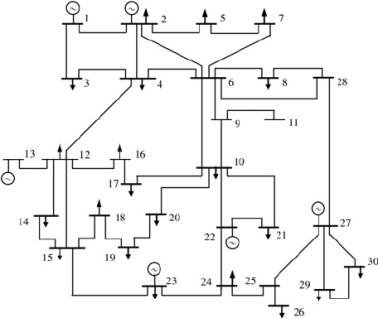
The 30-node IEEE network serves as a benchmark; it includes multiple generators, transmission constraints, and nonlinear power flow characteristics.
The study was conducted on the standard 30-node IEEE network, which is widely used as a test case for evaluating power flow optimization algorithms. The data file includes several matrices representing the various components of the power grid, which are necessary for formulating the OPF problem
| [26] | Chen arXiv (Cornell University) Optimal Power Flow in Renewable-Integrated Power Systems: A Comprehensive Review 2024. |
| [27] | E. R. and T. F. R., “AIS-assisted AC optimal power flow under short-term load smoothing via EWMA,” (conference/paper). |
[26, 27]
.
The main data structures extracted are described below:
Matpower Case (mpc): This is the main structure containing all the network information, in accordance with the Matpower format.
mpc.bus: This matrix describes the characteristics of each node (bus) in the network. Each row corresponds to a node and includes:
1) The bus type (1 = load, 2 = PV, 3 = slack)
2) Active and reactive demand (Pd, Qd),
3) Voltage limits (Vmin, Vmax),
4) The phase angle and magnitude of the voltage (θ, V)
mpc.gen: This matrix contains data relating to generators, including:
1) The injection node,
2) The active and reactive power generated (Pg, Qg),
3) The upper and lower limits (Pmax, Pmin, Qmax, Qmin),
4) Terminal voltage.
mpc.branch: This matrix details the characteristics of the transmission lines, including:
1) Origin and destination nodes,
2) Impedance (resistance R, reactance X) and susceptance,
3) Maximum thermal capacity (rateA).
mpc.gencost: This matrix contains the coefficients of the quadratic cost functions associated with each generator. It is used in the objective function to minimize the total cost of production.
This data is used as input for solving the OPF problem, where the main objective is to minimize generation costs while respecting the physical and operational constraints of the power grid (power balance, voltage limits, line capacity, etc.). The file also includes simulation results, such as power distribution, line losses, and the final state of each bus after optimization
| [27] | E. R. and T. F. R., “AIS-assisted AC optimal power flow under short-term load smoothing via EWMA,” (conference/paper). |
[27]
.
3. Theoretical and Methodological Context
Short-term load forecasting is an essential component of the operational management of modern power systems
| [39] | Akhtar, “Short-term load forecasting models: A review,” 2023. |
[39]
. An accurate estimate of demand improves generator dispatch planning, reduces operating costs, and increases the reliability of the power grid
| [40] | Gochhait and Sharma, “Regression-based short-term load forecasting,” 2023. |
[40]
. Among the various approaches proposed in the literature, deep learning-based methods have demonstrated remarkable performance in modeling complex energy time series
| [10] | S. Hochreiter and J. Schmidhuber, “Long short-term memory,” Neural Comput., vol. 9, no. 8, pp. 1735–1780, 1997.
https://doi.org/10.1162/neco.1997.9.8.1735 |
| [11] | Y. Kong, Z. Y. Dong, D. J. Hill, F. Luo, and Y. Xu, “Short-term residential load forecasting based on LSTM recurrent neural network,” IEEE Trans. Smart Grid, 2019.
https://doi.org/10.1109/TSG.2017.2753802 |
[10, 11]
.
In this work, a forecasting model based on a Long Short-Term Memory (LSTM) recurrent neural network is developed to predict hourly electricity demand for the next 24 hours.
3.1. Description of the Dataset
The forecasting model is developed using the AEP Hourly Load Dataset, which provides hourly electricity demand measurements in megawatts. In this study, 90 days of data (2160 observations) are used, offering sufficient temporal resolution to capture daily load patterns while maintaining computational efficiency. The dataset is split into 80% for training and 20% for testing to ensure proper generalization. Prior to training, the data are standardized to improve convergence and numerical stability. To model temporal dependencies, a sliding window approach is adopted, where the previous 24 hours are used to predict the next 24 hours, enabling effective multi-step forecasting of daily load cycles. The proposed deep learning model consists of a two-layer LSTM architecture (128 and 64 units) with dropout regularization, followed by fully connected layers. The network is trained using the Adam optimizer with 60 epochs, a batch size of 32, and a learning rate of 0.001. Model performance is evaluated using the RMSE metric, yielding a value of 0.3794, which indicates good forecasting accuracy. The predicted 24-hour load profile is subsequently integrated into the AC optimal power flow framework to assess its impact on generation cost optimization
| [10] | S. Hochreiter and J. Schmidhuber, “Long short-term memory,” Neural Comput., vol. 9, no. 8, pp. 1735–1780, 1997.
https://doi.org/10.1162/neco.1997.9.8.1735 |
| [11] | Y. Kong, Z. Y. Dong, D. J. Hill, F. Luo, and Y. Xu, “Short-term residential load forecasting based on LSTM recurrent neural network,” IEEE Trans. Smart Grid, 2019.
https://doi.org/10.1109/TSG.2017.2753802 |
| [41] | Miah and Sulaiman, “Deep learning approach for smart grid forecasting,” 2023. |
| [42] | “AEP hourly energy consumption dataset,” Kaggle. [Online]. Available:
https://www.kaggle.com/datasets/robikscube/hourly-energy-consumption |
| [43] | Hammad, Artificial Neural Network and Deep Learning: Fundamentals and Theory, 2024. |
[10, 11, 41-43]
.
3.2. Deep LSTM Network Architecture
The network comprises two stacked LSTM layers (128 and 64 units) with dropout (0.2), followed by a fully connected layer and a ReLU activation.
3.3. Model Training Process
The model is trained using the Adam (Adaptive Moment Estimation) optimization algorithm, which is widely used in deep neural networks due to its ability to accelerate convergence and stabilize learning
| [11] | Y. Kong, Z. Y. Dong, D. J. Hill, F. Luo, and Y. Xu, “Short-term residential load forecasting based on LSTM recurrent neural network,” IEEE Trans. Smart Grid, 2019.
https://doi.org/10.1109/TSG.2017.2753802 |
[11]
. The main training parameters are as follows:
Table 1. Training Parameters.
Parameter | Value |
Optimizer | Adam |
Number of epochs | 60 |
Mini-batch size | 32 |
Initial learning rate | 0.001 |
During training, the network adjusts its parameters to minimize the error between the predicted values and the actual load values.
3.4. Evaluation of Forecasting Performance
The model’s accuracy is evaluated using the Root Mean Square Error (RMSE) metric, which is widely used in studies of electricity load forecasting
| [11] | Y. Kong, Z. Y. Dong, D. J. Hill, F. Luo, and Y. Xu, “Short-term residential load forecasting based on LSTM recurrent neural network,” IEEE Trans. Smart Grid, 2019.
https://doi.org/10.1109/TSG.2017.2753802 |
[11]
.
The experimental results obtained in this study show that the proposed model achieves a root mean square error (RMSE) of 0.3794, indicating good generalization ability for short-term electricity load forecasting.
The forecasts obtained for the next 24 hours are then used as input in the AC Optimal Power Flow optimization model to analyze their impact on the power system’s generation costs.
4. Results
To evaluate the performance of the proposed approach, several simulations were conducted by combining load forecasting based on a Deep LSTM network with an AC Optimal Power Flow (ACOPF) optimization model. The experiments were carried out in the MATLAB environment, using the MATPOWER platform, which is widely used for the analysis and optimization of power systems
| [9] | R. D. Zimmerman, C. E. Murillo-Sanchez, and R. J. Thomas, ´ “MATPOWER’s extensible optimal power flow architecture,” in Proc. IEEE Power and Energy Soc. General Meeting, 2009, Jul. 26–30 2009. |
[9]
.
The test system used is the IEEE 30-bus network, which serves as a classic benchmark for studying optimization problems in power systems
| [6] | P. Kundur, Power System Stability and Control. New York, NY, USA: McGraw-Hill, 1994. |
[6]
.
4.1. Historical Load
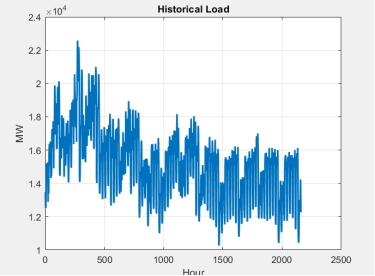
This figure shows the historical electrical load used to train the model.
Figure 2. Historical Electricity Load.
The figure shows the time series of electricity demand over approximately 2,200 hours. The load varies approximately between:
1) 10 000 MW
2) 23 000 MW
Several important characteristics can be observed:
4.1.1. Load Variability
Demand exhibits:
1) Significant short-term fluctuations
2) Stochastic variability
This corresponds to the actual behavior of power grids.
4.1.2. Presence of Cycles
The following are observed:
1) Daily cycles
2) Seasonal or weekly variations
These patterns are typical of consumption profiles.
4.1.3. Importance for Forecasting
The high variability indicates that:
Load forecasting is necessary to improve OPF optimization.
Without forecasting:
1) The system must manage uncertainty
2) Which can increase operating costs
The historical load profile exhibits significant stochastic fluctuations, ranging from approximately 10,000 MW to 23,000 MW over the observed horizon. Such variability underscores the need for accurate short-term load forecasts to enable optimal energy flow calculations.
4.2. Training the LSTM Model
LSTM Forecast RMSE = 0.3794
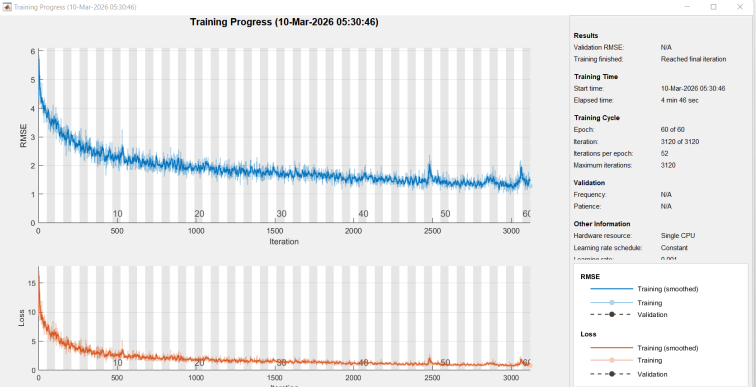
The figure below shows the training of the LSTM model.
Two indicators are displayed:
1) RMSE
2) Loss
Figure 3. Training Progress.
The training curve shows a steady decrease in RMSE, confirming effective learning of temporal dependencies by the LSTM model. The rapid convergence during early epochs indicates efficient parameter optimization, while the stabilization phase suggests that the model has reached a near-optimal solution. However, the absence of a validation curve prevents a complete assessment of generalization capability. Despite this limitation, the low RMSE value aligns with the observed reduction in OPF cost, demonstrating the effectiveness of the proposed approach.
This means that:
1) The LSTM effectively captures temporal dynamics
2) The model can be used for load forecasting.
4.3. Performance of the LSTM Load Forecasting Model
The first step is to evaluate the Deep LSTM model’s ability to predict electricity demand for the next 24 hours. The model is trained using historical electricity load data from the AEP Hourly Load dataset, as described in the previous section.
Forecast accuracy is measured using the Root Mean Square Error (RMSE) metric, commonly used in energy forecasting studies
| [11] | Y. Kong, Z. Y. Dong, D. J. Hill, F. Luo, and Y. Xu, “Short-term residential load forecasting based on LSTM recurrent neural network,” IEEE Trans. Smart Grid, 2019.
https://doi.org/10.1109/TSG.2017.2753802 |
[11]
.
The results show that the model achieves a forecast error of:
This low RMSE value indicates that the LSTM model is capable of effectively capturing the temporal dependencies present in the electricity consumption data.
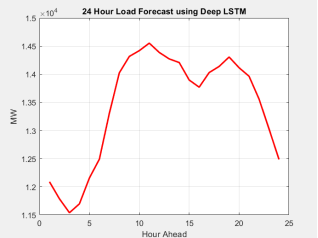
Figure 4 illustrates the load forecast obtained for the next 24 hours.
Figure 4. 24 Hours Load Forecast.
It can be observed that the load exhibits dynamic behavior typical of electrical systems, characterized by a gradual increase during the day followed by a decrease during periods of low consumption. This type of daily variation is well captured by the LSTM model, confirming its ability to model complex energy time series
.
4.4. Analysis of Costs Associated with Optimal Power Flow
Once the future load is estimated, the resulting forecasts are integrated into the AC Optimal Power Flow model to determine the optimal dispatching of generators for each hour of the day.
First, a standard AC Optimal Power Flow is solved using the average system load:
Next, the load predicted by the LSTM model is used to dynamically adjust the system demand for each hour. The OPF is then recalculated for each hourly period.
The resulting average cost is:
These results show that integrating load forecasts into the optimization process significantly reduces the operational cost of the power system.
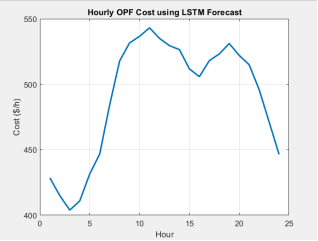
Figure 5 shows the hourly evolution of the OPF cost calculated using LSTM forecasts.
It can be observed that variations in generation costs directly follow fluctuations in the forecasted load. Periods of high demand lead to an increase in generation costs, while periods of low demand result in a reduction in operating costs.
Figure 5. Hourly OPF cost using LSTM forecasts.
4.5. Economic Impact of the Proposed Approach
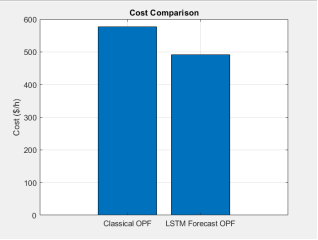
To assess the economic impact of the proposed method, a direct comparison is made between the cost obtained using the conventional OPF and the cost obtained by integrating the LSTM forecast.
The results are summarized in the following table:
Table 2. Generation cost results.
Method | Generation Cost ($/h) |
Classical OPF | 576.89 |
LSTM-based OPF | 490.91 |
The relative reduction in generation cost is calculated as follows:
Substituting the values:
This significant reduction demonstrates that the use of deep learning-based load forecasting can considerably improve the economic planning of generator dispatch.
These results also confirm the findings reported in several recent studies, which indicate that integrating deep learning methods into energy management systems can improve the operational efficiency of modern power grids
| [7] | A. J. Conejo, M. Carrión, and J. M. Morales, Decision Making Under Uncertainty in Electricity Markets. New York, NY, USA: Springer, 2010. |
| [8] | H. L. Willis, Power Distribution Planning Reference Book. Boca Raton, FL, USA: CRC Press, 2004. |
[7, 8]
.
Figure 6. Cost comparaison.
4.6. Analysis of Generator Commissioning
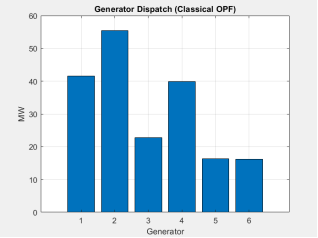
Power flow optimization also makes it possible to determine the active power generated by each generator in the system.
Figure 7 illustrates the distribution of power generation among the various generators in the IEEE 30-bus network in the case of conventional OPF.
Figure 7. Generator Dispatch.
It is observed that the power generated varies from one generator to another depending on their economic and technical characteristics. Generators with lower marginal costs are generally given priority, in accordance with the principles of economic dispatch optimization
| [12] | J. Carpentier, “Contribution to the economic dispatch problem,” Bull. Soc. French Electricians 1962. |
[12]
.
5. Discussion
The results clearly demonstrate the value of integrating AI-based forecasting models into power system optimization tools.
The use of a Deep LSTM model effectively captures temporal variations in electricity demand, while integrating these forecasts into the ACOPF model improves generator dispatch planning and reduces generation costs.
However, certain limitations should be noted. First, the study is conducted on a standard test system (IEEE 30-bus), which does not fully reflect the complexity of real-world power grids. Second, the uncertainties associated with load forecasts are not explicitly accounted for in the optimization model.
Future work could thus explore the integration of robust or stochastic optimization methods to account for the uncertainty in load forecasts and renewable energy sources
| [7] | A. J. Conejo, M. Carrión, and J. M. Morales, Decision Making Under Uncertainty in Electricity Markets. New York, NY, USA: Springer, 2010. |
[7]
.
6. Conclusion
This paper presents a data-driven approach for electricity load forecasting and power flow optimization using deep LSTM (Long Short-Term Memory) networks. The proposed method leverages the ability of LSTM models to capture temporal dependencies in time series of load data, thereby enabling accurate short-term load forecasting. These forecasts can contribute to more efficient operation and planning of power grids.
The results demonstrate that the LSTM-based model offers reliable forecasting performance and can help improve decision-making in power grid operations. By integrating data-driven forecasting techniques with power flow analysis, the proposed approach offers a promising framework for improving the efficiency and reliability of modern power grids.
Future work will focus on integrating additional influencing factors, such as meteorological variables, and on validating the approach on larger-scale power grids to further confirm its scalability and robustness.
Abbreviations
STLF | Short-term Load Forecasting |
ACOPF | Alternating Current Optimal Power Flow |
AC | Alternating Current |
IEEE | Institute of Electrical and Electronics Engineers |
AEP | American Electric Power |
LSTM | Long Short-Term Memory |
RelU | Rectified Linear Unit |
ADAM | Adaptive Moment Estimation |
RMSE | Root Mean Square Error |
Author Contributions
Randriamora Edmond: Conceptualization, Investigation, Methodology, Resources, Writing – original draft, Writing – review & editing
Rasolofonirina Tokiniaina Francky: Data curation, Investigation, Methodology, Software, Writing – original draft, Writing – review & editing
Randriamaroson Mahandrisoa Rivo: Conceptualization, Project administration, Resources, Supervision, Validation, Writing – review & editing
Conflicts of Interest
The authors declare no competing interests.
Appendix
Pseudocode
Start
Initialize MATPOWER
Define electrical constants
Configure OPF options
Read CSV file
Extract actual load (MW)
Select 90 days (2160 hours)
Calculate mean μ
Calculate standard deviation σ
Normalize the data:
data_norm = (data - μ) / σ
For i = 1 to N:
X[i] = 24-hour sequence (input)
Y[i] = forecast for the next 24 hours (output)
End For
Split data:
80% → training
20% → testing
Define network:
Input layer
LSTM (128 neurons)
Dropout
LSTM (64 neurons)
Dense layer + ReLU
Output layer (24 values)
Configure parameters:
Optimizer = Adam
Epochs = 60
Batch = 32
Train the network
Take the last 24 values
Predict the next 24 hours
Normalize the results
Predict on test data
Calculate RMSE:
RMSE = √(mean of squared errors)
Load the IEEE 30-bus system
Run OPF with average load
Obtain conventional cost
For each hour h = 1 to 24, do the following:
Calculate factor α:
α = predicted_load / average_load
Adjust network loads:
PD = base_PD × α
QD = base_QD × α
Run OPF
Store hourly cost
End For
Calculate average LSTM-OPF cost
Compare:
Conventional cost
LSTM-OPF cost
Plot:
Historical load
LSTM forecast
OPF hourly cost
Cost comparison
References
| [1] |
H. Sehovac and K. Grolinger, “Deep learning for load forecasting: Sequence-to-sequence recurrent neural networks with attention,” IEEE Access, vol. 8, pp. 36411–36426, 2020.
https://doi.org/10.1109/ACCESS.2020.2975738
|
| [2] |
R. D. Zimmerman, C. E. Murillo-Sánchez, and R. J. Thomas, “MATPOWER: Steady-state operations, planning, and analysis tools for power systems research and education,” IEEE Trans. Power Syst., vol. 26, no. 1, pp. 12–19, Feb. 2011.
https://doi.org/10.1109/TPWRS.2010.2051168
|
| [3] |
A. S. Ahmad et al., “A review on applications of ANN and SVM for building electrical energy consumption forecasting,” Renew. Sustain. Energy Rev., vol. 33, pp. 102–109, 2014.
https://doi.org/10.1016/j.rser.2014.01.069
|
| [4] |
K. Greff, R. K. Srivastava, J. Koutník, B. Steunebrink, and J. Schmidhuber, “LSTM: A search space odyssey,” IEEE Trans. Neural Netw. Learn. Syst., vol. 28, no. 10, pp. 2222–2232, Oct. 2017.
https://doi.org/10.1109/TNNLS.2016.2582924
|
| [5] |
M. B. Cain, R. P. O’Neill, and A. Castillo, “History of optimal power flow computations,” Federal Energy Regulatory Commission, Staff Paper, 2012.
|
| [6] |
P. Kundur, Power System Stability and Control. New York, NY, USA: McGraw-Hill, 1994.
|
| [7] |
A. J. Conejo, M. Carrión, and J. M. Morales, Decision Making Under Uncertainty in Electricity Markets. New York, NY, USA: Springer, 2010.
|
| [8] |
H. L. Willis, Power Distribution Planning Reference Book. Boca Raton, FL, USA: CRC Press, 2004.
|
| [9] |
R. D. Zimmerman, C. E. Murillo-Sanchez, and R. J. Thomas, ´ “MATPOWER’s extensible optimal power flow architecture,” in Proc. IEEE Power and Energy Soc. General Meeting, 2009, Jul. 26–30 2009.
|
| [10] |
S. Hochreiter and J. Schmidhuber, “Long short-term memory,” Neural Comput., vol. 9, no. 8, pp. 1735–1780, 1997.
https://doi.org/10.1162/neco.1997.9.8.1735
|
| [11] |
Y. Kong, Z. Y. Dong, D. J. Hill, F. Luo, and Y. Xu, “Short-term residential load forecasting based on LSTM recurrent neural network,” IEEE Trans. Smart Grid, 2019.
https://doi.org/10.1109/TSG.2017.2753802
|
| [12] |
J. Carpentier, “Contribution to the economic dispatch problem,” Bull. Soc. French Electricians 1962.
|
| [13] |
K. Widarsono, F. D. Murdianto, M. Nur, and A. Mustofa, “Optimal power flow using particle swarm optimization for IEEE 30-bus system,” J. Phys. Conf. Ser., vol. 1595, no. 1, p. 012033, Jul. 2020.
|
| [14] |
M. Sasson, “Nonlinear programming solutions for load flow, minimum loss, and economic dispatching problems,” IEEE Trans., vol. PAS-88, no. 4, pp. 399–409, Apr. 1969.
|
| [15] |
H. W. Dommel and W. F. Tinney, “Optimal power flow solutions,” IEEE Trans. Power App. Syst., vol. PAS-87, no. 10, pp. 1866–1876, Oct. 1968.
|
| [16] |
G. A. Maria and J. A. Findlay, “A Newton optimal power flow program for Ontario Hydro EMS,” IEEE Trans. Power Syst., vol. 2, no. 3, pp. 576–584, Aug. 1987.
|
| [17] |
Souza, Romero, Pereira, Saraiva, Artificial immune algorithm applied to distribution system reconfiguration with variable demand, 2016.
|
| [18] |
T. K. Nagasarkar and M. S. Sukhija, Power System Analysis, 2nd ed. Oxford, U.K.: Oxford Univ. Press, 2014.
|
| [19] |
J. C. Das, Power System Handbook, Vol. 2: Load Flow Optimization and Optimal Power Flow. Boca Raton, FL, USA: CRC Press, 2018.
|
| [20] |
J. Zhu, Optimization of Power System Operation, 2nd ed. Hoboken, NJ, USA: Wiley-IEEE Press, 2015.
|
| [21] |
A. Gómez-Expósito, A. J. Conejo, and C. Cañizares, Electric Energy Systems: Analysis and Operation. Boca Raton, FL, USA: CRC Press, 2009.
|
| [22] |
A. J. Wood, B. F. Wollenberg, and G. B. Sheblé, Power Generation, Operation, and Control. Hoboken, NJ, USA: Wiley-IEEE Press, 2014.
|
| [23] |
T. F. Rasolofonirina, “Power Flow Optimization in Electrical Networks Using the AIRS Method,” 2025.
http://dx.doi.org/10.52155/ijpsat.v52.1.7394
|
| [24] |
D. Saad et al., “Power Flow Optimization by a Metaheuristic Method (Bee Technique),” 2012.
|
| [25] |
M. Kadjoudj et al., “Power Flow Optimization in a Deregulated Environment,” 2015.
|
| [26] |
Chen arXiv (Cornell University) Optimal Power Flow in Renewable-Integrated Power Systems: A Comprehensive Review 2024.
|
| [27] |
E. R. and T. F. R., “AIS-assisted AC optimal power flow under short-term load smoothing via EWMA,” (conference/paper).
|
| [28] |
Vannet, “Distributed intelligence and heterarchical approach of distributed balancing markets in smart grids,” 2016.
|
| [29] |
Rajulapati, “AI-driven load forecasting and dynamic pricing in smart grids,” 2025.
|
| [30] |
Tzelepi, “Deep learning for energy time-series analysis and forecasting,” 2023.
|
| [31] |
Wen and Liao, “Deep learning-driven hybrid model for short-term load forecasting,” 2024.
|
| [32] |
Agarwal and Pileggi, “Integrating forecasting models within steady-state analysis,” 2025.
|
| [33] |
Li, “Economic dispatch model based on uncertainty constraints,” 2025.
|
| [34] |
Ali and Hassan, “Optimal power flow using composite differential evolution,” (paper).
|
| [35] |
Chamanbaz, “Algorithms for optimal AC power flow,” 2018.
|
| [36] |
Pandya, “MOGNDO algorithm for OPF problems,” 2022.
|
| [37] |
Barati, “Global solution algorithm for AC OPF,” 2024.
|
| [38] |
R. D. Zimmerman and C. Murillo-Sanchez, M ´ ATPOWER User’s Manual. [Online]. Available:
http://www.pserc.cornell.edu/matpower/
|
| [39] |
Akhtar, “Short-term load forecasting models: A review,” 2023.
|
| [40] |
Gochhait and Sharma, “Regression-based short-term load forecasting,” 2023.
|
| [41] |
Miah and Sulaiman, “Deep learning approach for smart grid forecasting,” 2023.
|
| [42] |
“AEP hourly energy consumption dataset,” Kaggle. [Online]. Available:
https://www.kaggle.com/datasets/robikscube/hourly-energy-consumption
|
| [43] |
Hammad, Artificial Neural Network and Deep Learning: Fundamentals and Theory, 2024.
|
| [44] |
“MATLAB implementation,” GitHub. [Online]. Available:
https://github.com/9slfb/LSTM-ARTICLE-3-TOKINIAINA-FRANCKY
|
Cite This Article
-
APA Style
Edmond, R., Francky, R. T., Rivo, R. M. (2026). Data-Driven Load Forecasting and Power Flow Optimization Using Deep LSTM Networks. Journal of Electrical and Electronic Engineering, 14(3), 143-151. https://doi.org/10.11648/j.jeee.20261403.13
 Copy
|
Copy
|
 Download
ACS Style
Edmond, R.; Francky, R. T.; Rivo, R. M. Data-Driven Load Forecasting and Power Flow Optimization Using Deep LSTM Networks. J. Electr. Electron. Eng. 2026, 14(3), 143-151. doi: 10.11648/j.jeee.20261403.13
Copy
|
Download
AMA Style
Edmond R, Francky RT, Rivo RM. Data-Driven Load Forecasting and Power Flow Optimization Using Deep LSTM Networks. J Electr Electron Eng. 2026;14(3):143-151. doi: 10.11648/j.jeee.20261403.13
Copy
|
Download
-
@article{10.11648/j.jeee.20261403.13,
  author = {Randriamora Edmond and Rasolofonirina Tokiniaina Francky and Randriamaroson Mahandrisoa Rivo},
  title = {Data-Driven Load Forecasting and Power Flow Optimization Using Deep LSTM Networks},
  journal = {Journal of Electrical and Electronic Engineering},
  volume = {14},
  number = {3},
  pages = {143-151},
  doi = {10.11648/j.jeee.20261403.13},
  url = {https://doi.org/10.11648/j.jeee.20261403.13},
  eprint = {https://article.sciencepublishinggroup.com/pdf/10.11648.j.jeee.20261403.13},
  abstract = {In light of the rapidly increasing global demand for energy, accurately forecasting short-term electricity consumption has become a critical yet challenging task for modern power system operation and planning, as traditional methods often struggle to handle the variability and uncertainty of load demand. To address these limitations, this study proposes an integrated and data-driven framework that combines an Alternating Current Optimal Power Flow (ACOPF) model with a Long Short-Term Memory (LSTM) recurrent neural network in order to simultaneously enhance forecasting accuracy and operational efficiency. The LSTM model, trained on historical load data, is used to generate reliable 24-hour ahead electricity demand forecasts, which are then dynamically incorporated into the MATPOWER simulation environment using the IEEE 30-bus test system. The results demonstrate that the proposed approach achieves a high level of predictive performance, with a root mean square error (RMSE) of 0.3794, indicating its effectiveness in capturing temporal load patterns. More importantly, the integration of these forecasts into the ACOPF framework enables more proactive and informed decision-making in power system operations, leading to a significant improvement in economic dispatch by reducing the hourly generation cost from $576.89/h under conventional approaches to $490.91/h, corresponding to an approximate cost reduction of 14.9%. Overall, this study highlights the strong synergy between deep learning techniques and optimization models for smart grid management, showing that the proposed framework not only improves forecasting precision but also enhances system efficiency, reduces operational costs, and supports more reliable, flexible, and cost-effective power system operations.},
 year = {2026}
}
Copy
|
Download
-
TY  - JOUR
T1  - Data-Driven Load Forecasting and Power Flow Optimization Using Deep LSTM Networks
AU  - Randriamora Edmond
AU  - Rasolofonirina Tokiniaina Francky
AU  - Randriamaroson Mahandrisoa Rivo
Y1  - 2026/05/16
PY  - 2026
N1  - https://doi.org/10.11648/j.jeee.20261403.13
DO  - 10.11648/j.jeee.20261403.13
T2  - Journal of Electrical and Electronic Engineering
JF  - Journal of Electrical and Electronic Engineering
JO  - Journal of Electrical and Electronic Engineering
SP  - 143
EP  - 151
PB  - Science Publishing Group
SN  - 2329-1605
UR  - https://doi.org/10.11648/j.jeee.20261403.13
AB  - In light of the rapidly increasing global demand for energy, accurately forecasting short-term electricity consumption has become a critical yet challenging task for modern power system operation and planning, as traditional methods often struggle to handle the variability and uncertainty of load demand. To address these limitations, this study proposes an integrated and data-driven framework that combines an Alternating Current Optimal Power Flow (ACOPF) model with a Long Short-Term Memory (LSTM) recurrent neural network in order to simultaneously enhance forecasting accuracy and operational efficiency. The LSTM model, trained on historical load data, is used to generate reliable 24-hour ahead electricity demand forecasts, which are then dynamically incorporated into the MATPOWER simulation environment using the IEEE 30-bus test system. The results demonstrate that the proposed approach achieves a high level of predictive performance, with a root mean square error (RMSE) of 0.3794, indicating its effectiveness in capturing temporal load patterns. More importantly, the integration of these forecasts into the ACOPF framework enables more proactive and informed decision-making in power system operations, leading to a significant improvement in economic dispatch by reducing the hourly generation cost from $576.89/h under conventional approaches to $490.91/h, corresponding to an approximate cost reduction of 14.9%. Overall, this study highlights the strong synergy between deep learning techniques and optimization models for smart grid management, showing that the proposed framework not only improves forecasting precision but also enhances system efficiency, reduces operational costs, and supports more reliable, flexible, and cost-effective power system operations.
VL  - 14
IS  - 3
ER  -
Copy
|
Download




 Share This Article
 Twitter
 Linked In
 Facebook