Abstract
The relevance of the study is associated with the transition from separate recording of individual transformer diagnostic parameters to an integrated damage assessment followed by operating-mode control. The aim was to develop and experimentally verify a diagnostic control approach for an oil-immersed power transformer based on the combined effects of switching-induced mechanical loading, vibration fatigue, and thermal insulation ageing. The study was carried out on a 20 MVA, 110/6 kV oil-immersed transformer operating at a substation of a mining and metallurgical enterprise. Continuous monitoring of vibration acceleration, hottest-spot temperature, currents, and protection operation events was combined with cumulative-damage calculation, Fisher's adequacy criterion, and reliability indices. Diagnostic control reduced protection clearing time from 80 to 50 ms, annual switching-related damage from 8.75 to 4.862%, vibration-related damage from 4.0 to 1.6%, and thermal degradation from 3.28 to 0.30%. Total annual cumulative damage decreased from 16.0 to 6.8%, the equivalent failure rate from 0.16 to 0.068 year-1, while one-year reliability increased from 0.8521 to 0.9343. The results demonstrate that a physically interpretable combination of electrical, mechanical, and thermal degradation factors can provide a basis for real-time operating-mode control and improved transformer reliability.
Keywords
Oil-immersed Power Transformer, Diagnostics, Cumulative Damage, Vibration Acceleration, Hottest-spot Temperature, Reliability, Operating-mode Control
1. Introduction
Power transformers are among the most capital-intensive and critical assets in electrical power systems. Modern diagnostics is developing toward continuous monitoring, multi-factor technical-condition assessment, and remaining-life prediction. Electrical methods, sensor systems, and intelligent data processing solve different parts of the same problem and therefore require coordination within a unified operational logic
| [1] | Mwinisin P, Mingotti A, Peretto L, Tinarelli R, Tefferi M. Electrical Diagnosis Techniques for Power Transformers: A Comprehensive Review of Methods, Instrumentation, and Research Challenges. Sensors. 2025; 25(7): 1968.
https://doi.org/10.3390/s25071968 |
| [2] | Beheshti Asl M, Fofana I, Meghnefi F. Review of Various Sensor Technologies in Monitoring the Condition of Power Transformers. Energies. 2024; 17(14): 3533.
https://doi.org/10.3390/en17143533 |
[1, 2]
.
Recent studies show that transformer health indices and service-life forecasts are increasingly derived from multiparameter data. Machine learning and digital twins expand predictive capabilities
| [3] | Zahra ST, Imdad SK, Khan S, Khalid S, Baig NA. Power Transformer Health Index and Life Span Assessment: A Comprehensive Review of Conventional and Machine Learning Based Approaches. Engineering Applications of Artificial Intelligence. 2025; 139(A): 109474.
https://doi.org/10.1016/j.engappai.2024.109474 |
| [4] | El-Rashidy N, Sultan YA, Ali ZH. Predicting Power Transformer Health Index and Life Expectation Based on Digital Twins and Multitask LSTM-GRU Model. Scientific Reports. 2025; 15: 1359. https://doi.org/10.1038/s41598-024-83220-x |
[3, 4]
; however, for real-time operating-mode control, not only classification accuracy but also the physical interpretability of damage mechanisms is important. This is especially relevant for industrial substations where current overloads, short-term electrodynamic forces, vibration, and accelerated thermal ageing of insulation act simultaneously.
The mechanical condition of transformer windings can be assessed from vibration responses, including transient events and short-circuit conditions
| [5] | Aciu AM, Nitu MC, Nicola CI, Nicola M. Determining the Remaining Functional Life of Power Transformers Using Multiple Methods of Diagnosing the Operating Condition Based on SVM Classification Algorithms. Machines. 2024; 12(1): 37.
https://doi.org/10.3390/machines12010037 |
| [6] | Yuan Y, Zhao J, Hong K, Wang N, Zheng J. Assessment of the Winding Mechanical Condition Based on Transformer Vibration during Transient Processes. Electronics. 2024; 13(13): 2519. https://doi.org/10.3390/electronics13132519 |
[5, 6]
. Hottest-spot temperature and relative ageing-rate models are widely used to evaluate paper-oil insulation degradation; the corresponding principles are included in loading guides for oil-immersed transformers
| [7] | IEEE Std C57.91-2025. IEEE Guide for Loading Mineral-Oil-Immersed Transformers and Step-Voltage Regulators. IEEE; 2026. |
| [8] | IEC 60076-7: 2018. Power Transformers - Part 7: Loading Guide for Mineral-Oil-Immersed Power Transformers. Geneva: International Electrotechnical Commission; 2018. |
[7, 8]
. Nevertheless, using these indicators separately makes it difficult to obtain a unified quantitative estimate of operational risk.
Previous author studies addressed remaining-life diagnostics based on primary parameters, the influence of mechanical stress caused by differential protection, and transformer temperature characteristics
| [9] | Togaymurodov SZ, Ataullayev AO, Rasulova BI. Diagnosis of the remaining service life of oil-immersed transformers based on primary parameters. O'zbekiston konchilik xabarnomasi. 2025;(3). https://doi.org/10.54073/GV.2025.3.102.021 |
| [10] | Togaymurodov SZ, Ataullayev AO. Calculation of the influence of mechanical stress caused by transformer differential protection on transformer service life. Scientific and Technical Journal of Fergana State Technical University. 2025;(6). |
| [11] | Togaymurodov SZ. Analysis of transformer temperature characteristics during operation. Fan va texnologiyalar taraqqiyoti. 2025;(5).International Organization for Standardization. (1995). ISO 9459-2: 1995, Solar heating—Domestic water heating systems—Part 2: Outdoor test methods for system performance characterization. Geneva, Switzerland: ISO. |
[9-11]
. In the present work, these directions are integrated into a unified approach in which total cumulative damage is treated as an integral condition indicator, while the diagnostic system not only detects parameter deviations but also generates control actions that modify the transformer operating mode.
The aim of this study is to develop and experimentally verify a diagnostic operating-mode control method for an oil-immersed power transformer in which switching-related mechanical damage, vibration fatigue, and thermal insulation degradation are considered jointly and converted into reliability indicators. The scientific novelty consists in integrating three physically different degradation mechanisms into a single calculation-and-control framework and validating the framework using annual operating data.
2. Materials and Methods
The experimental study was carried out during 2025 at Substation No. 7 of Hydrometallurgical Plant No. 1 of Navoi Mining and Metallurgical Company JSC. The investigated object was a 20 MVA, 110/6 kV step-down oil-immersed power transformer. The calculations used the actual design parameters of the transformer: short-circuit voltage of 11.6%, 220 turns for the considered winding, a calculated winding radius of 0.25 m, and a winding height of 0.50 m.
The diagnostic loop registered phase currents, voltage, loading factor, oil temperature and calculated hottest-spot temperature, vibration acceleration, and protection-operation events. Measured values were compared with predefined thresholds. The intervention threshold for vibration acceleration was 1.5 m/s2. For thermal condition monitoring, a hottest-spot temperature of 98°C was taken as the boundary of intensified thermal control. When a parameter exceeded the corresponding limit, partial damage was calculated and a control command was generated: load correction, intensified cooling, or a reduction in protection clearing time during an emergency event.
For short-term electrodynamic impact, an equivalent short-circuit current was determined from the squared phase currents. The resulting mechanical stress was compared with the mechanical strength limit of the winding material, while the effect of repeated protection operations was accumulated using the partial-damage summation principle. Five single-phase short circuits that initiated protection operation were recorded during the experiment.
The vibration component was evaluated only when the adopted threshold was exceeded. For each month, vibration-acceleration amplitude and exposure duration were taken into account. In simplified form, the relation used in the study is written as:
Dvib = Σ Kvib·Δtj· [max (0, aj − 1.5)]2,(1)
where Kvib = 0.03 is the normalization coefficient, Δtj is the duration of the operating condition in the j-th month, and aj is the measured vibration acceleration, m/s2. This expression prevents vibration damage from accumulating below the threshold and reflects the nonlinear increase in damage after the threshold is exceeded.
The thermal component was determined from the hottest-spot temperature represented as the sum of ambient temperature, maximum top-oil temperature rise, and winding temperature rise. The relative ageing rate of insulation was calculated using an Arrhenius-type exponential dependence. An activation energy of 120 kJ/mol and a universal gas constant of 8.314 J/(mol*K) were used. The approach is consistent with the general principle of estimating accelerated insulation ageing from hottest-spot temperature
| [7] | IEEE Std C57.91-2025. IEEE Guide for Loading Mineral-Oil-Immersed Transformers and Step-Voltage Regulators. IEEE; 2026. |
| [8] | IEC 60076-7: 2018. Power Transformers - Part 7: Loading Guide for Mineral-Oil-Immersed Power Transformers. Geneva: International Electrotechnical Commission; 2018. |
[7, 8]
.
The integral indicator was formed as the sum of the three components:
DΣ = Dsw + Dvib + Dth,(2)
where Dsw is the accumulated switching-related mechanical damage, Dvib is vibration-related damage, and Dth is thermal insulation degradation. DΣ was used to derive an equivalent annual failure rate λ and to estimate reliability using the exponential model:
R(t) = exp(−λt), Q(t) = 1 - R(t).(3)
The adequacy of the integrated mathematical model was checked using 29 experimental observations that included monthly thermal-vibration changes and switching events. With three independent parameters, the number of degrees of freedom was 26 for the adequacy variance and 28 for the experimental variance. The obtained values were Sad2 = 12.45 and Sexp2 = 5.12; the calculated Fisher criterion F = 2.4316 was lower than the tabulated value F = 2.50 at P = 0.99 (α = 0.01), satisfying the adopted model-adequacy condition.
The experiment was organized as a comparison of two states of the same object: a baseline operating mode without diagnostic control action and an operating mode with diagnostic control. This design makes it possible to compare changes in damage and reliability while retaining the same transformer construction; however, it does not fully eliminate the influence of seasonal and technological factors. This limitation is considered in the discussion of applicability.
Table 1. Main parameters of the experimental transformer.
Parameter | Value | Meaning |
Rated power | 20 MVA | Investigated power transformer |
Voltage | 110/6 kV | High-voltage / low-voltage sides |
Short-circuit voltage | 11.6% | Transformer impedance parameter |
Vibration-acceleration threshold | 1.5 m/s2 | Condition for calculating Dvib |
Hottest-spot temperature threshold | 98°C | Condition for intensified thermal control |
Observation period | 2025 | Continuous operational observation |
3. Diagnostic Control Algorithm
The algorithm operates cyclically. After initialization of the rated data, the system reads phase currents, voltage, hottest-spot temperature, vibration acceleration, and loading factor. Before damage calculation, signal validity is checked: signal loss, values outside physically admissible limits, or inconsistency between related parameters are treated as diagnostic errors and block automatic control action.
For valid data, the ratio of actual current to rated current is calculated and two principal operating boundaries are checked: the hottest-spot temperature should not enter the region of accelerated ageing, and vibration acceleration should not exceed 1.5 m/s2. Differential-protection operation is processed independently because winding mechanical damage under short-circuit conditions is impulsive and depends on the equivalent current and clearing time.
If all parameters remain within the admissible region, the system stores the measurements and continues monitoring without changing the operating mode. If at least one condition is violated, Dsw, Dvib, and Dth are calculated and DΣ is updated. The control action is selected according to the dominant factor: intensified cooling and/or load reduction for thermal limitation; load reduction and a maintenance signal for persistent vibration exceedance; and the shortest permissible protection clearing time for a short circuit.
After the control command is executed, the measurements are repeated. A control action is considered effective only if the controlled parameter returns to the admissible region and the calculated damage-accumulation rate decreases. This closed-loop procedure separates fault detection from confirmed operational effect and reduces the probability of acting on an isolated measurement outlier.
Table 2. Diagnostic control logic.
Controlled event | Criterion | Control action | Verification |
Overheating | Ths >= 98°C | Intensified cooling; load correction | Repeated Ths measurement |
Elevated vibration | a >= 1.5 m/s2 | Load reduction; diagnostic warning | Check a and Dvib trend |
Short circuit | Protection operation; Ieq | Reduce clearing time within permissible limits | Record clearing time and Dsw |
Sensor failure | Missing / invalid signal | Automatic control is blocked | Operator warning; channel inspection |
4. Results
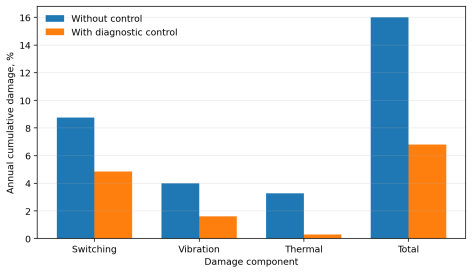
At the first stage, the influence of repeated protection operations was evaluated. In the baseline mode, the clearing time was 80 ms. With five recorded single-phase short circuits, the total annual switching-related damage reached 8.75%. After implementation of diagnostic control, the clearing time was reduced to 50 ms and the calculated annual switching-related damage decreased to 4.862%. The absolute reduction for this damage group was therefore 3.888 percentage points.
Vibration monitoring showed that, under the baseline operating trajectory, vibration acceleration exceeded 1.5 m/s2 in several months. Calculation using the actual exposure duration for each operating state yielded 4.0% annual vibration-related damage. After diagnostic load correction, this value decreased to 1.6%. In June-August, controlled vibration-acceleration values were below or close to the threshold region, making the contribution of these months to cumulative vibration damage minimal.
The most intensive thermal ageing in the baseline condition was observed during summer. Hottest-spot temperature reached 102.9°C in June, 112.1°C in July, and 106.0°C in August. After intensified cooling and operating-mode correction, the corresponding values were reduced to 92.0, 100.0, and 96.0°C. The annual estimate of thermal degradation consequently decreased from 3.28 to 0.30%.
The combined effect of the three control mechanisms reduced total annual cumulative damage from 16.0 to 6.8%, i.e., by 9.2 percentage points or 57.5% relative to the baseline level. The corresponding equivalent failure rate decreased from 0.16 to 0.068 year-1. According to the exponential model, one-year reliability increased from 0.8521 to 0.9343, while the probability of failure decreased from approximately 0.148 to 0.0657.
Table 3. Comparison of results before and after diagnostic control.
Indicator | Without control | With diagnostic control | Change |
Protection clearing time, ms | 80 | 50 | -37.5% |
Switching-related damage, % | 8.75 | 4.862 | -44.4% |
Vibration-related damage, % | 4.00 | 1.60 | -60.0% |
Thermal degradation, % | 3.28 | 0.30 | -90.9% |
Total cumulative damage, % | 16.00 | 6.80 | -57.5% |
Equivalent failure rate, year-1 | 0.160 | 0.068 | -57.5% |
One-year reliability R (1) | 0.8521 | 0.9343 | +0.0822 |
Technical condition index, % | 84.0 | 93.2 | +9.2 p.p. |
Figure 1. Annual cumulative-damage components before and after diagnostic control.
For additional interpretation, the result was converted into a technical condition index using 100·(1 − DΣ): for DΣ = 0.16, the index equals 84%, whereas for DΣ = 0.068 it equals 93.2%. This transformation is convenient for operational visualization; however, it is not treated in this study as an independent diagnostic method. The primary quantities remain the physically based damage components and their measured variables.
The techno-economic assessment was performed through the change in expected annual loss proportional to the equivalent failure rate and transformer cost. At an adopted transformer cost of 2,380,425,000 UZS, the expected annual loss decreased from 380,868,000 to 161,868,900 UZS. The difference was 218,999,100 UZS/year. The cost of the developed diagnostic-control device was estimated at 13,710,000 UZS; therefore, the calculated net first-year effect amounted to 205,289,100 UZS, while the payback period was approximately 0.063 year, i.e., about one month.
4.1. Seasonal Dynamics of the Thermal State
A separate analysis of the thermal state showed that three summer months made the principal contribution to thermal degradation. In the baseline mode, the hottest-spot temperature exceeded 98°C in June, July, and August, with the maximum value of 112.1°C recorded in July. After diagnostic control was enabled, the temperature fell below the threshold in June and August and was reduced to 100.0°C in July. This substantially decreased the exponentially increasing contribution of high-temperature intervals to the integral insulation-ageing rate.
Importantly, the thermal effect was achieved not by changing the calculation model but by changing the actual operating condition of the transformer. The diagnostic loop detected entry into the critical temperature region, after which cooling was intensified and the load was corrected. Thus, the degradation function was used as a decision criterion rather than solely as a post-event analytical tool.
Table 4. Summer hottest-spot temperature.
Month | Without control,°C | With control,°C | Reduction,°C |
June | 102.9 | 92.0 | 10.9 |
July | 112.1 | 100.0 | 12.1 |
August | 106.0 | 96.0 | 10.0 |
4.2. Verification of Control Responses
Functional verification covered normal operation, vibration exceedance, overheating, short-circuit conditions, and loss of a sensor signal. At a vibration acceleration of 1.9 m/s2, the loading factor was reduced from 0.95 to 0.86; at a temperature of 112°C, additional cooling was activated and the temperature decreased to 100°C; at an equivalent short-circuit current of 16 kA, the protection clearing time was reduced from 80 to 50 ms. When a sensor signal was lost, the system generated a diagnostic warning instead of automatic control action. This logic limits the risk of inappropriate control when source data are unreliable.
5. Discussion
The results confirm the feasibility of combining physical degradation mechanisms that are usually considered separately in transformer diagnostic systems. Modern reviews of electrical diagnostic methods and sensor technologies emphasize the need for multi-source monitoring and reliable interpretation of measured signals
| [1] | Mwinisin P, Mingotti A, Peretto L, Tinarelli R, Tefferi M. Electrical Diagnosis Techniques for Power Transformers: A Comprehensive Review of Methods, Instrumentation, and Research Challenges. Sensors. 2025; 25(7): 1968.
https://doi.org/10.3390/s25071968 |
| [2] | Beheshti Asl M, Fofana I, Meghnefi F. Review of Various Sensor Technologies in Monitoring the Condition of Power Transformers. Energies. 2024; 17(14): 3533.
https://doi.org/10.3390/en17143533 |
[1, 2]
. The proposed approach extends this logic by converting parameter deviations into a common cumulative-damage measure and then using that measure to initiate targeted operating-mode control.
The vibration component differs fundamentally from a simple amplitude-threshold alarm. Studies of transient transformer vibration indicate that winding mechanical changes are reflected in the dynamics of spectral and modal characteristics and are particularly informative during short circuits and switching processes
| [5] | Aciu AM, Nitu MC, Nicola CI, Nicola M. Determining the Remaining Functional Life of Power Transformers Using Multiple Methods of Diagnosing the Operating Condition Based on SVM Classification Algorithms. Machines. 2024; 12(1): 37.
https://doi.org/10.3390/machines12010037 |
| [6] | Yuan Y, Zhao J, Hong K, Wang N, Zheng J. Assessment of the Winding Mechanical Condition Based on Transformer Vibration during Transient Processes. Electronics. 2024; 13(13): 2519. https://doi.org/10.3390/electronics13132519 |
[5, 6]
. In the present study, this concept is adapted to operational use by accounting for both threshold exceedance and exposure duration; therefore, a short peak and a long-duration event of the same amplitude are not treated as equivalent.
The thermal component is associated with the exponential nature of cellulose-insulation ageing. Unlike a linear temperature indicator, an Arrhenius-type dependence gives substantially greater weight to high-temperature episodes. The reduction in summer hottest-spot temperature after the control action explains the decrease in calculated thermal degradation from 3.28 to 0.30%. This is consistent with the principles of current transformer-loading guides, in which hottest-spot temperature is a key parameter for estimating loss of insulation life
| [7] | IEEE Std C57.91-2025. IEEE Guide for Loading Mineral-Oil-Immersed Transformers and Step-Voltage Regulators. IEEE; 2026. |
| [8] | IEC 60076-7: 2018. Power Transformers - Part 7: Loading Guide for Mineral-Oil-Immersed Power Transformers. Geneva: International Electrotechnical Commission; 2018. |
[7, 8]
.
Compared with approaches based mainly on machine learning or digital twins
| [3] | Zahra ST, Imdad SK, Khan S, Khalid S, Baig NA. Power Transformer Health Index and Life Span Assessment: A Comprehensive Review of Conventional and Machine Learning Based Approaches. Engineering Applications of Artificial Intelligence. 2025; 139(A): 109474.
https://doi.org/10.1016/j.engappai.2024.109474 |
| [4] | El-Rashidy N, Sultan YA, Ali ZH. Predicting Power Transformer Health Index and Life Expectation Based on Digital Twins and Multitask LSTM-GRU Model. Scientific Reports. 2025; 15: 1359. https://doi.org/10.1038/s41598-024-83220-x |
[3, 4]
, an advantage of the developed method is the transparent cause-and-effect relationship between the measured degradation factor and the control action. This does not exclude future use of artificial intelligence but makes the model applicable even when the training dataset is limited, which is typical for a single industrial transformer.
The numerical effects should be interpreted within the limitations of the study. The experiment was performed on one 20 MVA transformer over one calendar year; therefore, the obtained damage coefficients cannot be transferred automatically to transformers of other designs, cooling systems, and load profiles. Inter-object application requires recalibration of thresholds and coefficients using the historical data of each transformer and validation over a longer failure-history period. In addition, the annual equivalent failure rate used in this model is a calculated integral risk indicator rather than a statistical failure frequency derived from a large population.
The practical value of the approach is that it can be placed between the monitoring level and the operational-control level. Under normal conditions, the system performs observation; when a threshold is exceeded, it calculates partial and total cumulative damage and then forms a limited action affecting load, cooling, or protection clearing time. This principle reduces the gap between condition monitoring and an actual operational decision.
6. Conclusion
1. A physically interpretable diagnostic-control framework was developed that integrates switching-related mechanical damage, vibration fatigue, and thermal degradation of paper-oil insulation into a single cumulative-damage indicator.
2. A one-year industrial experiment on a 20 MVA, 110/6 kV transformer showed a decrease in switching-related damage from 8.75 to 4.862%, vibration-related damage from 4.0 to 1.6%, and thermal degradation from 3.28 to 0.30%. Total cumulative damage decreased from 16.0 to 6.8%, corresponding to a 57.5% reduction.
3. The equivalent failure rate decreased from 0.16 to 0.068 year-1, while the calculated one-year reliability increased from 0.8521 to 0.9343. Model verification using Fisher's criterion yielded Fcalc = 2.4316 < Ftab = 2.50 at a confidence level of 0.99.
4. Broader applicability requires validation on transformers of other ratings and designs with recalibration of model coefficients. A promising further direction is to combine the proposed physical model with time-series forecasting while preserving physically interpretable decision criteria.
Abbreviations
Dvib | Vibration-related Damage |
Author Contributions
San'at Zafar Ugli Togaymurodov: Conceptualization, Data curation, Formal Analysis, Investigation, Methodology, Project administration, Resources, Software, Supervision, Validation, Visualization, Writing – original draft, Writing – review & editing
Conflicts of Interest
The author declares no conflicts of interest.
References
| [1] |
Mwinisin P, Mingotti A, Peretto L, Tinarelli R, Tefferi M. Electrical Diagnosis Techniques for Power Transformers: A Comprehensive Review of Methods, Instrumentation, and Research Challenges. Sensors. 2025; 25(7): 1968.
https://doi.org/10.3390/s25071968
|
| [2] |
Beheshti Asl M, Fofana I, Meghnefi F. Review of Various Sensor Technologies in Monitoring the Condition of Power Transformers. Energies. 2024; 17(14): 3533.
https://doi.org/10.3390/en17143533
|
| [3] |
Zahra ST, Imdad SK, Khan S, Khalid S, Baig NA. Power Transformer Health Index and Life Span Assessment: A Comprehensive Review of Conventional and Machine Learning Based Approaches. Engineering Applications of Artificial Intelligence. 2025; 139(A): 109474.
https://doi.org/10.1016/j.engappai.2024.109474
|
| [4] |
El-Rashidy N, Sultan YA, Ali ZH. Predicting Power Transformer Health Index and Life Expectation Based on Digital Twins and Multitask LSTM-GRU Model. Scientific Reports. 2025; 15: 1359.
https://doi.org/10.1038/s41598-024-83220-x
|
| [5] |
Aciu AM, Nitu MC, Nicola CI, Nicola M. Determining the Remaining Functional Life of Power Transformers Using Multiple Methods of Diagnosing the Operating Condition Based on SVM Classification Algorithms. Machines. 2024; 12(1): 37.
https://doi.org/10.3390/machines12010037
|
| [6] |
Yuan Y, Zhao J, Hong K, Wang N, Zheng J. Assessment of the Winding Mechanical Condition Based on Transformer Vibration during Transient Processes. Electronics. 2024; 13(13): 2519.
https://doi.org/10.3390/electronics13132519
|
| [7] |
IEEE Std C57.91-2025. IEEE Guide for Loading Mineral-Oil-Immersed Transformers and Step-Voltage Regulators. IEEE; 2026.
|
| [8] |
IEC 60076-7: 2018. Power Transformers - Part 7: Loading Guide for Mineral-Oil-Immersed Power Transformers. Geneva: International Electrotechnical Commission; 2018.
|
| [9] |
Togaymurodov SZ, Ataullayev AO, Rasulova BI. Diagnosis of the remaining service life of oil-immersed transformers based on primary parameters. O'zbekiston konchilik xabarnomasi. 2025;(3).
https://doi.org/10.54073/GV.2025.3.102.021
|
| [10] |
Togaymurodov SZ, Ataullayev AO. Calculation of the influence of mechanical stress caused by transformer differential protection on transformer service life. Scientific and Technical Journal of Fergana State Technical University. 2025;(6).
|
| [11] |
Togaymurodov SZ. Analysis of transformer temperature characteristics during operation. Fan va texnologiyalar taraqqiyoti. 2025;(5).International Organization for Standardization. (1995). ISO 9459-2: 1995, Solar heating—Domestic water heating systems—Part 2: Outdoor test methods for system performance characterization. Geneva, Switzerland: ISO.
|
Cite This Article
-
APA Style
Togaymurodov, S. Z. U. (2026). Diagnostic Operating-mode Control of an Oil-immersed Power Transformer Based on Cumulative Damage. Journal of Electrical and Electronic Engineering, 14(5), 239-244. https://doi.org/10.11648/j.jeee.20261405.13
 Copy
|
 Download
ACS Style
Togaymurodov, S. Z. U. Diagnostic Operating-mode Control of an Oil-immersed Power Transformer Based on Cumulative Damage. J. Electr. Electron. Eng. 2026, 14(5), 239-244. doi: 10.11648/j.jeee.20261405.13
Copy
|
Download
AMA Style
Togaymurodov SZU. Diagnostic Operating-mode Control of an Oil-immersed Power Transformer Based on Cumulative Damage. J Electr Electron Eng. 2026;14(5):239-244. doi: 10.11648/j.jeee.20261405.13
Copy
|
Download
-
@article{10.11648/j.jeee.20261405.13,
  author = {San'at Zafar Ugli Togaymurodov},
  title = {Diagnostic Operating-mode Control of an Oil-immersed Power Transformer Based on Cumulative Damage},
  journal = {Journal of Electrical and Electronic Engineering},
  volume = {14},
  number = {5},
  pages = {239-244},
  doi = {10.11648/j.jeee.20261405.13},
  url = {https://doi.org/10.11648/j.jeee.20261405.13},
  eprint = {https://article.sciencepublishinggroup.com/pdf/10.11648.j.jeee.20261405.13},
  abstract = {The relevance of the study is associated with the transition from separate recording of individual transformer diagnostic parameters to an integrated damage assessment followed by operating-mode control. The aim was to develop and experimentally verify a diagnostic control approach for an oil-immersed power transformer based on the combined effects of switching-induced mechanical loading, vibration fatigue, and thermal insulation ageing. The study was carried out on a 20 MVA, 110/6 kV oil-immersed transformer operating at a substation of a mining and metallurgical enterprise. Continuous monitoring of vibration acceleration, hottest-spot temperature, currents, and protection operation events was combined with cumulative-damage calculation, Fisher's adequacy criterion, and reliability indices. Diagnostic control reduced protection clearing time from 80 to 50 ms, annual switching-related damage from 8.75 to 4.862%, vibration-related damage from 4.0 to 1.6%, and thermal degradation from 3.28 to 0.30%. Total annual cumulative damage decreased from 16.0 to 6.8%, the equivalent failure rate from 0.16 to 0.068 year-1, while one-year reliability increased from 0.8521 to 0.9343. The results demonstrate that a physically interpretable combination of electrical, mechanical, and thermal degradation factors can provide a basis for real-time operating-mode control and improved transformer reliability.},
 year = {2026}
}
Copy
|
Download
-
TY  - JOUR
T1  - Diagnostic Operating-mode Control of an Oil-immersed Power Transformer Based on Cumulative Damage
AU  - San'at Zafar Ugli Togaymurodov
Y1  - 2026/10/31
PY  - 2026
N1  - https://doi.org/10.11648/j.jeee.20261405.13
DO  - 10.11648/j.jeee.20261405.13
T2  - Journal of Electrical and Electronic Engineering
JF  - Journal of Electrical and Electronic Engineering
JO  - Journal of Electrical and Electronic Engineering
SP  - 239
EP  - 244
PB  - Science Publishing Group
SN  - 2329-1605
UR  - https://doi.org/10.11648/j.jeee.20261405.13
AB  - The relevance of the study is associated with the transition from separate recording of individual transformer diagnostic parameters to an integrated damage assessment followed by operating-mode control. The aim was to develop and experimentally verify a diagnostic control approach for an oil-immersed power transformer based on the combined effects of switching-induced mechanical loading, vibration fatigue, and thermal insulation ageing. The study was carried out on a 20 MVA, 110/6 kV oil-immersed transformer operating at a substation of a mining and metallurgical enterprise. Continuous monitoring of vibration acceleration, hottest-spot temperature, currents, and protection operation events was combined with cumulative-damage calculation, Fisher's adequacy criterion, and reliability indices. Diagnostic control reduced protection clearing time from 80 to 50 ms, annual switching-related damage from 8.75 to 4.862%, vibration-related damage from 4.0 to 1.6%, and thermal degradation from 3.28 to 0.30%. Total annual cumulative damage decreased from 16.0 to 6.8%, the equivalent failure rate from 0.16 to 0.068 year-1, while one-year reliability increased from 0.8521 to 0.9343. The results demonstrate that a physically interpretable combination of electrical, mechanical, and thermal degradation factors can provide a basis for real-time operating-mode control and improved transformer reliability.
VL  - 14
IS  - 5
ER  -
Copy
|
Download






 Share This Article
 Twitter
 Linked In
 Facebook