Research Article | | Peer-Reviewed

Regulatory Quality and Banking Efficiency in Franc Zone Countries: An Analysis Based on the Data Envelopment Analysis Model

Received: 11 September 2026     Accepted: 9 October 2026     Published: 11 November 2026
Views:       Downloads:
Abstract

This study examines whether the quality of the regulatory environment affects the technical efficiency of banking systems in the Franc Zone, where two monetary unions (WAEMU and CEMAC) share a common currency arrangement and supranational banking supervision but differ in the quality of their national regulatory environments. Using a panel of the fifteen Franc Zone countries over 2000-2023, the technical efficiency of each national banking system is first estimated with an input-oriented Data Envelopment Analysis (DEA) model under variable returns to scale, and its determinants are then analysed with a fractional logit model with country fixed effects, suited to scores bounded between 0 and 1. Regulatory quality is measured by the World Bank's Worldwide Governance Indicators. Franc Zone banking systems operate on average at 68% of the best-practice frontier, which implies that the same outputs could be produced with about 32% fewer inputs. Regulatory quality has a positive average marginal effect on efficiency (0.125, p = 0.049), with diminishing returns: the effect is largest in countries with the weakest regulatory environments and fades as regulatory quality improves. This effect is moderate and loses significance in some robustness checks. Trade openness is associated with higher efficiency, whereas investment and human capital show weakly significant negative effects. The results suggest that improving the quality and credibility of the regulatory environment, rather than deregulation, can raise banking efficiency in the Franc Zone countries where regulation is weakest.

Published in Journal of Finance and Accounting (Volume 14, Issue 5)
DOI 10.11648/j.jfa.20261405.12
Page(s) 226-237
Creative Commons

This is an Open Access article, distributed under the terms of the Creative Commons Attribution 4.0 International License (http://creativecommons.org/licenses/by/4.0/), which permits unrestricted use, distribution and reproduction in any medium or format, provided the original work is properly cited.

Copyright

Copyright © The Author(s), 2026. Published by Science Publishing Group

Keywords

Banking Efficiency, Regulatory Quality, Data Envelopment Analysis, Franc Zone, Fractional Regression, Technical Efficiency

1. Introduction
The banking sector remains an essential pillar of economic development by mobilizing savings, allocating credit, and facilitating payments. In the Franc Zone, as in most developing countries, banks represent the main channel of financial intermediation, making their efficiency critical for macroeconomic stability and inclusive growth. Banking efficiency is defined as the capacity of institutions to optimally use their resources to produce financial services, minimizing costs while maximizing output, analyzed through comparison with a best-practice production frontier, that is, the frontier formed by the best-performing banks in the sample rather than a theoretical optimum . Understanding what happens inside the "black box" of financial institutions helps explain performance disparities across establishments . Performance is also influenced by the degree of diversification of banking activities .
Banking regulation occupies a central place in this dynamic. Effective prudential regulation can strengthen banking system stability by reducing insolvency risks and fostering depositor confidence, but overly constraining regulation may increase compliance costs and reduce the operational flexibility of banks, potentially affecting their efficiency. Prior work has shown contrasting results on the role of regulation: some studies show efficiency gains through increased discipline , while others find that excessive regulation hinders innovation and raises costs .
Recent empirical literature points to several important trends. In Sub-Saharan Africa, banks appear broadly cost-efficient, but non-performing loans weigh on their efficiency, which suggests that improving the regulatory and credit environment could raise banking performance . In emerging economies, more stringent macroprudential policies have been found to increase bank efficiency, with effects that differ across bank types . In addition, digitalization constitutes a key structural determinant of banking efficiency: FinTech development improves banks' cost efficiency , and two-stage DEA studies that include digitalization variables find a non-linear, U-shaped relationship between digitalization and bank efficiency .
In the Franc Zone, the banking regulatory framework is characterized by strong institutional harmonization, resting on two principal monetary and supervisory authorities (BCEAO and the WAMU Banking Commission for WAEMU , and BEAC/COBAC for CEMAC ). Recent prudential reforms, including progressive increases in minimum capital requirements and risk-based supervision, aim to strengthen banking soundness while raising efficiency concerns, particularly for small and medium-sized banks. Despite regulatory harmonization, Franc Zone banking systems remain characterized by marked heterogeneity in capitalization, asset quality (non-performing loans), sovereign exposure, and digitalization. The Franc Zone therefore offers a distinctive setting for studying regulation and bank efficiency. Its member countries share a fixed exchange-rate arrangement with the euro and supranational monetary and supervisory institutions, so that monetary policy and prudential rules are largely common within each union. Yet the quality of national regulatory environments, that is, the way governments design and enforce rules affecting private-sector activity, varies widely across member countries. This combination makes it possible to examine how the broader regulatory environment affects bank efficiency while the monetary regime and the prudential rulebook are held largely constant.
Although several studies have measured banking efficiency in Franc Zone countries using DEA, they rarely integrate simultaneously prudential variables and structural factors. The closest antecedent, Triki et al. , relates detailed regulatory indices to bank efficiency in 42 African countries and shows that the effect of regulation depends on bank size and risk; it does not focus on the specific institutional arrangement of the Franc Zone, nor does it allow the effect of regulatory quality to be non-linear. This gap justifies the approach of the present study. The study's primary contribution is to jointly model the effect of regulatory quality (proxied by the WGI Regulatory Quality indicator) and structural control variables on DEA-estimated technical efficiency, using a fractional logistic regression approach appropriate for bounded dependent variables, and to allow for a non-linear effect of regulatory quality. The remainder of the paper is organized as follows. Section 2 reviews the institutional setting and the literature, Section 3 presents the data and methods, Section 4 reports the results, Section 5 discusses them, and Section 6 concludes and outlines the limitations of the study.
2. Literature Review
Banking regulation is a central pillar of modern financial systems. It primarily aims to ensure financial stability, protect depositors, and limit opportunistic behavior by banks . Regulatory quality refers not only to the existence of prudential rules but also to their clarity, coherence, credibility, and effectiveness of implementation. This concept is operationalized through the Regulatory Quality indicator from the World Bank's Worldwide Governance Indicators (WGI) , which measures public authorities' capacity to design and implement effective regulations favoring private sector functioning, a particularly relevant proxy in Franc Zone countries where the effectiveness of prudential mechanisms depends closely on institutional quality.
2.1. Institutional Setting of the Franc Zone
The Franc Zone brings together fourteen Sub-Saharan African countries organized in two monetary unions, together with the Comoros. The West African Economic and Monetary Union (WAEMU) comprises Benin, Burkina Faso, Côte d'Ivoire, Guinea-Bissau, Mali, Niger, Senegal and Togo, with the Central Bank of West African States (BCEAO) as common central bank and the WAMU Banking Commission as supervisor . The Central African Economic and Monetary Community (CEMAC) comprises Cameroon, the Central African Republic, Chad, the Republic of Congo, Equatorial Guinea and Gabon, with the Bank of Central African States (BEAC) as central bank and the Central African Banking Commission (COBAC) as supervisor . Both CFA francs are pegged to the euro at a fixed parity, with convertibility guaranteed by the French Treasury.
Three features of this setting matter for the relationship between regulation and bank efficiency. First, prudential regulation is supranational: banking rules are set and enforced at the level of each union, and both unions moved towards Basel II/III-inspired frameworks during the study period (from January 2018 in WAEMU, and through the revised COBAC prudential regulations adopted in 2016 and phased in thereafter in CEMAC). Second, the fixed exchange-rate regime and the common monetary policy remove national monetary policy as a source of cross-country variation in banking conditions within each union. Third, despite this harmonization, the national institutional environment in which banks operate (contract enforcement, business regulation, predictability of public action) differs markedly across member countries, as reflected in large differences in governance indicators. In this context, regulatory quality measured at the country level captures the environment in which common prudential rules are implemented rather than the prudential rules themselves. This distinction motivates the empirical focus of the present study and conditions the interpretation of its results.
2.2. Regulatory Quality and Improved Banking Efficiency
A first strand of the literature argues that banking regulation reduces information asymmetry between banks, depositors, and supervisory authorities, while limiting excessive risk-taking behaviors that could destabilize the banking system . Effective regulation reinforces market discipline and improves transparency of financial institutions, contributing to better banking governance . These mechanisms promote banking system stability and incentivize banks to adopt more prudent and efficient management practices .
In transition and developing economies, efficiency improvements are often correlated with deep structural and regulatory reforms . Ben Naceur and Omran show, for Middle East and North African countries, that bank capitalization and the regulatory and institutional environment shape bank margins, cost efficiency and profitability. Using two-stage DEA on an international sample, Pasiouras finds that regulations that strengthen market discipline and official supervisory powers are associated with higher technical efficiency. Kamarudin et al. analyze the link between country governance and bank productivity using a DEA-based Malmquist index for 167 banks in four Southeast Asian countries, and find that regulatory quality and the rule of law significantly affect the productivity of conventional banks.
2.3. Negative and Ambiguous Effects of Regulation on Banking Efficiency
Several empirical studies also show negative or ambiguous effects of regulation, particularly when regulation is excessive, rigid, or ill-adapted to the institutional context. In the African context, Triki et al. find that transparency rules and price controls mainly burden small banks and that exit restrictions reduce their efficiency, whereas stricter capital requirements benefit mainly large and low-risk banks; they conclude that regulation should be adapted to the size and risk of the regulated institutions. Demirgüç-Kunt et al. show that tighter restrictions on bank entry and activities raise the cost of financial intermediation, although these effects fade once broader institutional quality is controlled for. Bonin, Hasan and Wachtel show that performance and efficiency depend strongly on ownership structure and bank size, while Thakor shows that risk-based capital requirements may lead banks to reduce lending in favor of safer but less productive assets.
2.4. Non-Linearities, Institutional Context and Franc Zone Specificities
Recent literature shows that the impact of regulation on banking efficiency depends strongly on institutional context and level of economic development. Barth et al. , using 4,050 bank observations from 72 countries, find that the effect depends on the design of regulation: activity restrictions reduce efficiency, whereas capital stringency, independent supervision and transparency enhance it. Chortareas et al. obtain similar results for the European Union and show that the benefits of capital requirements and supervisory powers are larger in countries with higher-quality institutions, which suggests that the effect of regulation may be non-linear in institutional quality. In monetary unions such as the Franc Zone, where supervision is centralized and standardized, banks may also prioritize formal regulatory compliance over operational efficiency when the national institutional environment is weak. Taken together, the literature suggests that regulation's impact on banking efficiency depends on its intensity, quality, and institutional context, and that the Franc Zone's specific characteristics call for a dedicated empirical analysis. These arguments motivate the inclusion of a quadratic term in regulatory quality in the empirical model.
3. Materials and Methods
3.1. Data and Sample
This study adopts a quantitative approach based on a country-level panel of the fifteen Franc Zone countries: the eight WAEMU countries (Benin, Burkina Faso, Côte d'Ivoire, Guinea-Bissau, Mali, Niger, Senegal, Togo), the six CEMAC countries (Cameroon, Central African Republic, Chad, Republic of Congo, Equatorial Guinea, Gabon) and the Comoros. The decision-making units are the national banking systems, observed annually over 2000-2023, which gives a balanced panel of 360 country-year observations. A country-level (macro) approach is used because consistent bank-level financial statements are not available for all Franc Zone countries over a long period, whereas aggregate banking indicators are published by the supervisory authorities and international databases for all of them. The period 2000-2023 is the longest span for which all variables are available; it covers the post-2000 restructuring of Franc Zone banking systems, the 2014-2016 oil-price shock in CEMAC and the move of both unions to Basel II/III-inspired prudential frameworks. Two observations (Republic of Congo, 2000 and 2001) are excluded from the estimation sample because the inflation values recorded for them (514% and 360%) are inconsistent with the inflation history of the Republic of Congo and appear to be data-entry errors; the estimation sample therefore contains 358 observations. Results on the full sample of 360 observations are reported as a robustness check.
3.2. Data Envelopment Analysis (DEA)
Banking efficiency is measured using the Data Envelopment Analysis (DEA) method. This non-parametric approach is well-suited for evaluating operational performance in the banking sector as it does not require prior specification of the functional form of the frontier . The DEA model is estimated under variable returns to scale (VRS) with an input orientation, and a best-practice frontier is constructed for each year with DEAP 2.1 . The frontier is formed by the national banking systems that use the smallest amounts of inputs for their level of outputs in a given year; it is therefore an empirical benchmark defined by observed best practice rather than a theoretical optimum. Following the intermediation approach, the inputs are bank deposits (% of GDP), operating costs (% of total assets) and the non-performing loan ratio, and the outputs are domestic credit to the private sector by banks (% of GDP) and the return on assets. Bank-level aggregates are drawn from the reports of the WAMU Banking Commission and COBAC, and from the World Bank's financial development indicators. The scores were computed by the authors.
Technical efficiency scores (TE_VRS) are bounded in (0, 1], where a score of 1 indicates that the banking system lies on the frontier. In the input-oriented model, a score of 0.68 means that the same outputs could be produced with 68% of the inputs actually used, that is, with an input reduction of about 32% (1 − 0.68).
3.3. Fractional Regression Model
The estimation of technical efficiency determinants uses the Fractional Logistic Regression model (fracreg logit), recommended by Papke and Wooldridge for proportional response variables. This model is preferred over Ordinary Least Squares (OLS) as it models the conditional mean through a logistic link function, ensuring coherent predictions bounded in (0, 1):
E[TE_VRS | X] = G(β0+β1RQ +β2RQ2+γ'Z)(1)
where G(·) is the logistic function, RQ denotes regulatory quality, RQ2 its square (to capture non-linearity), and Z is the vector of control variables. Estimation is performed by Quasi-Maximum Likelihood Estimation (QMLE) with cluster-robust standard errors clustered at the country level, and country fixed effects are included to correct for heteroscedasticity and autocorrelation.
Because RQ enters the model both linearly and squared, its marginal effect cannot be read from separate coefficients. For country i in year t, it is
∂E[TE_VRS | X]/∂RQ = g(Xitβ)·(β1+ 2β2RQit)(2)
where g(·) = G(·) [1 − G(·)] is the logistic density. The average marginal effect (AME) of RQ is the sample average of expression (2), computed jointly for the linear and quadratic terms (margins with factor-variable notation c.RQ##c.RQ in Stata). The slope changes sign at the turning point
RQ* = −β1/(2β2)(3)
whose standard error is obtained by the delta method. Marginal effects of RQ are also evaluated at selected values of RQ within its observed range. For the other regressors, which enter linearly, the AME is the sample average of g(Xitβ)·γk. Inference relies on 15 country clusters; because cluster-robust standard errors can be imprecise with few clusters , results are interpreted with caution and complemented by several robustness checks.
3.4. Variables
The dependent variable TE_VRS is the DEA-estimated technical efficiency score. The main explanatory variable is Regulatory Quality (RQ), derived from the World Bank's WGI, measuring public authorities' capacity to design and implement effective regulations. Its square (RQ2) is included to test for non-linearity. The definitions and sources of all variables are given in Table 1; English mnemonics are used throughout. For 2001, when the WGI were not published, the 2000 value is used.
The WGI Regulatory Quality indicator has limitations that must be borne in mind. It is a composite indicator that aggregates, through an unobserved components model, the perceptions of firms, households, experts and non-governmental organizations drawn from a large number of underlying sources . It therefore measures perceptions rather than the content or enforcement of specific rules, its estimates are subject to margins of error that are large relative to cross-country differences, and its construction makes year-to-year changes difficult to interpret . Moreover, it refers to regulation affecting private-sector activity in general rather than banking regulation in particular. In the present study, RQ is therefore interpreted as a measure of the quality of the national regulatory environment in which supranational prudential rules are implemented.
The control variables were selected according to three criteria: (i) their use as determinants of bank efficiency in the empirical literature, (ii) their availability for all Franc Zone countries over 2000-2023, and (iii) the absence of severe collinearity with RQ (Section 3.6). They capture the level of economic development (LogGDPpc), which conditions the demand for banking services , investment and trade activity (LogGFCF, LogOPEN), the price environment (INF), which affects margins and overhead costs , and the human capital of the labor force (HC). Average bank size (SIZE), which conditions the effect of regulation on efficiency , is added in a robustness check because it is missing for one observation. Country fixed effects capture time-invariant national characteristics, such as membership of WAEMU or CEMAC, legal origin or the structure of the banking market. An interest-rate variable used in an earlier version of this study was dropped because the series could not be verified against official sources for all countries.
Table 1. Definition of variables.

Variable

Definition

Source

Expected sign

TE_VRS

Input-oriented DEA technical efficiency score of the national banking system, variable returns to scale, (0, 1]

Authors' computation (DEAP 2.1)

Dependent

RQ

WGI Regulatory Quality estimate (approx. −2.5 to 2.5)

World Bank WGI

+ / non-linear

LogGDPpc

Logarithm of GDP per capita

World Bank WDI

+

LogGFCF

Logarithm of gross fixed capital formation

World Bank WDI

+/−

LogOPEN

Logarithm of trade openness ((exports + imports)/GDP)

World Bank WDI

+

INF

Inflation, consumer prices (annual%)

World Bank WDI

−

HC

Human capital indicator (education)

Authors' compilation

+/−

SIZE

Average size of banks (total assets, billions of CFA francs)

BCEAO, BEAC

+/−

Source: Authors' compilation.
3.5. Descriptive Statistics
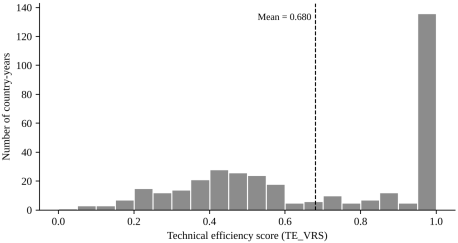
Table 2 presents descriptive statistics for all variables used in the analysis, computed on the estimation sample of 358 country-year observations. The mean efficiency score is 0.680: on average, Franc Zone banking systems could produce the same outputs with about 32% fewer inputs. Scores are widely dispersed (standard deviation 0.296), and 35.5% of the observations lie on the annual frontier (Figure 1). One score (Guinea-Bissau, 2002) is reported as 0.000 by DEAP after rounding. Regulatory quality is negative throughout the sample (mean −0.807), which reflects the weak regulatory environments of Franc Zone countries relative to the world average.
Table 2. Descriptive statistics of variables.

Variable

Mean

Std. Dev.

Min

Max

TE_VRS (Technical efficiency)

0.6795

0.2963

0.0000

1.0000

RQ (Regulatory quality)

−0.8070

0.4169

−1.6767

−0.0478

LogGDPpc (log GDP per capita)

3.4594

0.3871

2.9152

4.6154

LogGFCF (log gross fixed capital formation)

1.2966

0.1869

0.6724

1.8915

LogOPEN (log trade openness)

1.7895

0.1645

1.4824

2.1955

INF (Inflation,%)

2.6168

4.0740

−8.9747

31.5226

HC (Human capital)

7.9982

7.4316

0.2694

40.5960

SIZE (Average bank size)

3.2840

2.1485

0.1400

9.2900

Source: Authors' calculations from Stata 16. N = 358 (357 for SIZE). The two Republic of Congo observations for 2000-2001 are excluded (Section 3.1).
Figure 1. Distribution of technical efficiency scores (TE_VRS), 358 country-year observations. Source: Authors' calculations.
3.6. Multicollinearity Test
Variance Inflation Factors (VIF) were computed to verify the absence of severe multicollinearity (Table 3).
Table 3. Variance Inflation Factors (VIF).

Variable

VIF

1/VIF

LogGDPpc

2.01

0.4983

LogOPEN

1.97

0.5069

SIZE

1.88

0.5320

RQ

1.35

0.7398

LogGFCF

1.25

0.8022

INF

1.19

0.8371

HC

1.01

0.9864

Mean VIF

1.52

Source: Authors' calculations from Stata 16. All VIF values are well below the critical threshold of 5, confirming the absence of severe multicollinearity.
3.7. Unit-Root Tests
Fisher-type panel unit-root tests (ADF) were conducted on all variables to determine their order of integration and guide the estimation specification (Table 4).
Table 4. Panel unit-root test results (Fisher-type ADF).

Variable

P (χ2)

p-val

Z (normal)

p-val

L* (logit)

p-val

Pm (χ2)

p-val

Integration

TE_VRS

28.11

0.458

0.107

0.543

−0.073

0.529

0.015

0.494

I (1)

RQ

94.14

0.000

−4.635

0.000

5.821

0.000

8.280

0.000

I (0)

INF

119.07

0.000

−6.599

0.000

8.039

0.000

11.499

0.000

I (0)

LogGDPpc

21.19

0.882

1.840

0.967

−1.735

0.957

−1.138

0.872

I (1)

LogGFCF

41.27

0.083

−1.285

0.099

1.365

0.088

1.455

0.073

I (1)

LogOPEN

34.95

0.244

−0.659

0.255

0.738

0.231

0.639

0.261

I (1)

HC

56.00

0.003

−1.055

0.146

1.901

0.031

3.356

0.000

I (0)

Source: Authors' calculations. Fisher-type tests combining country-level ADF regressions with a constant and one lag. H0: all panels contain a unit root. TE_VRS is bounded in (0, 1] and cannot follow a unit-root process in the strict sense; the non-rejection for TE_VRS and some controls is more likely to reflect the low power of these tests in panels of moderate length. The fractional logit model is therefore estimated in levels with country fixed effects (Tables 5-7), and the unit-root results are reported for transparency.
4. Results
Table 5 presents the results of the fractional logistic regression estimating the determinants of banking technical efficiency, and Table 6 reports the corresponding average marginal effects. The model includes country fixed effects and is estimated on 358 observations from 15 countries, with standard errors clustered by country. The pseudo-R2 is 0.289 and the log pseudolikelihood −159.65. The Wald statistic for the joint significance of all regressors is not reported because, with country fixed effects, the number of parameters exceeds the number of clusters, which makes this statistic unreliable.
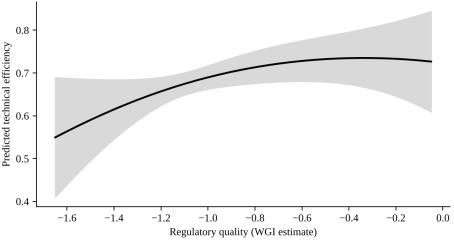
The individual coefficients of RQ (−0.457, p = 0.650) and RQ2 (−0.675, p = 0.254) are not significant, and their joint significance is not established at conventional levels (χ2(2) = 3.86, p = 0.145). However, the average marginal effect of RQ, which combines both terms as in Equation (2), is positive and significant at the 5% level (AME = 0.1250, standard error 0.0635, p = 0.049): a 0.1-point improvement in the WGI regulatory quality estimate is associated with an increase of about 1.2 percentage points in technical efficiency. The negative quadratic term implies diminishing returns. The marginal effect is largest in the countries with the weakest regulatory environments (0.277 at RQ = −1.6, p = 0.098; 0.187 at RQ = −1.2, p = 0.071), declines as regulatory quality improves, and is close to zero and not significant above RQ = −0.4 (Table 6, Figure 2). The implied turning point (RQ* = −0.338) is imprecisely estimated (standard error 0.483).
Among the control variables, trade openness has a positive and significant effect on efficiency (AME = 0.4733, p = 0.029). Gross fixed capital formation (AME = −0.2723, p = 0.053) and human capital (AME = −0.0031, p = 0.073) have negative effects that are significant only at the 10% level. GDP per capita and inflation have no significant effect once country fixed effects are included.
Table 5. Fractional logistic regression results (fracreg logit).

Variable

Coefficient

Std. Error

P > |z|

RQ (Regulatory quality)

−0.457

1.006

0.650

RQ2 (Regulatory quality squared)

−0.675

0.592

0.254

LogGDPpc

−1.596

1.186

0.179

LogGFCF

−1.820

0.971

0.061*

LogOPEN

3.164

1.474

0.032**

INF (Inflation)

0.0001

0.019

0.998

HC (Human capital)

−0.021

0.012

0.075*

Constant

18.872

5.680

0.000***

Country fixed effects

Yes

Turning point RQ* = −β1/(2β2)

−0.338

0.483

0.484

Joint test RQ = RQ2 = 0: χ2(2)

3.86

0.145

Observations (country-years)

358

Countries (clusters)

15

Pseudo-R2

0.2890

Log pseudolikelihood

−159.65

Source: Authors' estimates from Stata 16. *** p < 0.01; ** p < 0.05; * p < 0.10. Standard errors clustered by country (15 clusters). Estimation method: QMLE. Country fixed effects included (coefficients not reported). The turning point is RQ* = −β1/(2β2), with a delta-method standard error.
Table 6. Average Marginal Effects (AME).

Variable

dy/dx (AME)

Std. Error

p-value

Direction

RQ (combined linear + quadratic)

0.1250

0.0635

0.049**

Positive, diminishing

RQ effect at RQ = −1.6

0.2769

0.1675

0.098*

Positive

RQ effect at RQ = −1.2

0.1872

0.1037

0.071*

Positive

RQ effect at RQ = −0.8

0.0954

0.0589

0.105

Not significant

RQ effect at RQ = −0.4

0.0124

0.0881

0.888

Not significant

RQ effect at RQ = −0.1

−0.0482

0.1370

0.725

Not significant

LogGDPpc

−0.2387

0.1770

0.178

Not significant

LogGFCF

−0.2723

0.1409

0.053*

Negative

LogOPEN

0.4733

0.2169

0.029**

Positive

INF (Inflation)

0.0000

0.0028

0.998

Not significant

HC (Human capital)

−0.0031

0.0018

0.073*

Negative

Source: Authors' estimates from Stata 16. *** p < 0.01; ** p < 0.05; * p < 0.10. The AME of RQ combines the linear and quadratic terms Equation (2). Conditional effects are evaluated at the stated value of RQ, averaging over the other covariates.
Figure 2. Predicted technical efficiency across the observed range of regulatory quality, with 95% confidence interval (other covariates at their observed values). Source: Authors' calculations based on Table 5.
Robustness Checks
Table 7 reports five robustness checks. The positive average marginal effect of RQ is similar when the two Congo observations are retained (column 2) and when a fractional probit link is used instead of the logit (column 5). It becomes smaller and loses significance when average bank size is added (column 3, p = 0.204) or when RQ enters linearly (column 4, p = 0.122). Without country fixed effects (column 6), the effect of RQ is much larger and highly significant, which indicates that a large part of the raw association between regulatory quality and efficiency reflects permanent cross-country differences. The positive effect of trade openness is stable across specifications with fixed effects. Overall, the evidence points to a positive but moderate effect of regulatory quality, concentrated in weak regulatory environments and sensitive to the specification.
Table 7. Robustness checks: average marginal effects.

(1) Baseline

(2) N = 360

(3) + SIZE

(4) Linear RQ

(5) Probit

(6) No FE

AME of RQ

0.1250** (0.0635)

0.1270** (0.0627)

0.1117 (0.0880)

0.0959 (0.0620)

0.1268** (0.0643)

0.4548*** (0.0648)

Joint test RQ, RQ2 (p)

0.145

0.130

0.186

—

0.142

0.000

AME of LogOPEN

0.4733** (0.2169)

0.4677** (0.2158)

0.4457** (0.2227)

0.4950** (0.2461)

0.4855** (0.2110)

0.1590 (0.2752)

AME of HC

−0.0031* (0.0018)

−0.0032* (0.0017)

−0.0034* (0.0018)

−0.0028 (0.0017)

−0.0035* (0.0018)

−0.0053** (0.0027)

Country fixed effects

Yes

Yes

Yes

Yes

Yes

No

Observations

358

360

357

358

358

358

Pseudo-R2

0.289

0.291

0.288

0.288

0.290

0.156

Source: Authors' estimates. Standard errors (in parentheses) clustered by country. (1) Baseline (Table 5); (2) full sample including Republic of Congo 2000-2001; (3) baseline plus average bank size; (4) RQ entered linearly; (5) fractional probit; (6) baseline without country fixed effects. *** p < 0.01; ** p < 0.05; * p < 0.10.
5. Discussion
5.1. Regulatory Quality (Main Variable of Interest)
The results indicate that better regulatory quality is associated with higher technical efficiency of Franc Zone banking systems, but with diminishing returns: the effect is strongest where the regulatory environment is weakest and fades as regulatory quality improves. This pattern is consistent with Pasiouras and Chortareas et al. , who find that a sound regulatory and supervisory framework improves bank efficiency, and with Barth et al. , who show that the effect of regulation depends on its design. A plausible interpretation is that, in countries with very weak regulatory environments, basic improvements in the predictability of rules and their enforcement reduce information and contracting frictions that otherwise lead banks to hold idle resources and ration credit. Once a minimum standard is reached, further improvements of the general regulatory environment matter less for banking efficiency than bank-specific prudential and market factors. This interpretation is also consistent with the heterogeneous effects of regulation reported for African countries by Triki et al. . Three qualifications apply. First, the individual and joint tests on RQ and RQ2 are not significant, and the effect loses significance when bank size is controlled for, so the evidence is moderate. Second, the comparison with the specification without fixed effects shows that most of the cross-country correlation between regulatory quality and efficiency reflects permanent national characteristics rather than changes in regulatory quality over time. Third, RQ measures the general regulatory environment rather than banking regulation itself.
5.2. Control Variables
Trade openness is associated with higher efficiency, which may reflect the greater demand for trade finance and payment services and the stronger competitive pressure in more open economies. The negative, weakly significant effect of gross fixed capital formation may indicate that periods of strong investment are financed partly outside the domestic banking system or are accompanied by riskier lending, which raises non-performing loans, an input of the DEA model. The negative effect of human capital (p < 0.10) is difficult to interpret at the country level; it may reflect, as noted by Casu and Molyneux , a mismatch between the cost of skilled labor and its immediate productivity, but given its weak significance this interpretation remains tentative. Inflation has no significant effect once the erroneous Congo observations are excluded and country fixed effects are included, in contrast with the evidence that inflation raises bank margins and overhead costs ; in the Franc Zone, the fixed exchange-rate regime has kept inflation low and stable for most countries, which leaves little variation to identify such an effect.
6. Conclusions
This study examines the effect of regulatory quality on the technical efficiency of the banking systems of the fifteen Franc Zone countries over 2000-2023, using input-oriented DEA scores and a fractional logit model with country fixed effects. The mean efficiency score of 0.680 implies that Franc Zone banking systems could produce the same outputs with about 32% fewer inputs. Regulatory quality has a positive average marginal effect on efficiency, with diminishing returns: the gains are largest in countries with the weakest regulatory environments. For policymakers, this suggests that the priority should be to raise the quality, clarity and credibility of the regulatory environment in the countries where it is weakest, rather than to deregulate, while recognizing that beyond a minimum standard other factors, such as trade integration, matter more for banking efficiency.
The study has several limitations. First, regulatory quality is measured by a perception-based, country-level composite indicator that does not capture the content of banking regulation itself; future work could use bank-regulation-specific indicators such as the World Bank's Bank Regulation and Supervision Survey. Second, the analysis is conducted at the level of national banking systems, which masks heterogeneity across banks; a bank-level analysis would allow the effects of regulation to differ by bank size and ownership. Third, DEA scores are sensitive to the choice of inputs and outputs and to outliers, and two-stage estimates may be affected by the serial correlation of DEA scores; bootstrap-corrected scores would provide a useful check. Fourth, inference relies on only 15 clusters, the evidence on regulatory quality is moderate and sensitive to the specification, and the estimates describe associations that should not be interpreted as causal effects. Finally, an interest-rate variable could not be included because a verified series was not available for all countries and years.
Abbreviations

AME

Average Marginal Effects

BCEAO

Central Bank of West African States (Banque Centrale Des États De l'Afrique De l'Ouest)

BEAC

Bank of Central African States (Banque Des États De l'Afrique Centrale)

CEMAC

Central African Economic and Monetary Community

COBAC

Central African Banking Commission

DEA

Data Envelopment Analysis

QMLE

Quasi-Maximum Likelihood Estimation

RQ

Regulatory Quality

TE_VRS

Technical Efficiency Under Variable Returns to Scale

WAEMU

West African Economic and Monetary Union (WAEMU)

VIF

Variance Inflation Factor

WGI

Worldwide Governance Indicators

WAMU

West African Monetary Union

WDI

World Development Indicators

Acknowledgments
The authors thank the anonymous reviewers for their constructive comments. The authors also acknowledge the World Bank for making the WGI and WDI databases freely accessible, and the BCEAO and BEAC for their published statistical reports.
Author Contributions
Aime Rodrigue Moatsa Endamane: Conceptualization, Data curation, Investigation, Writing – original draft
Charles Alain Bita: Supervision, Validation, Writing – review & editing
Hamidou Cephas Atirbi: Formal Analysis, Methodology, Project administration, Writing – review & editing
Data Availability Statement
The dataset was compiled from the World Bank WGI and WDI databases (https://databank.worldbank.org) & from BCEAO & BEAC annual reports. All source databases are publicly available. The compiled country–level dataset & the Stata code used to estimate the models are available from the corresponding author upon reasonable request.
Conflicts of Interest
The authors declare no conflicts of interest.
References
[1] Berger, A. N., Humphrey, D. B. Efficiency of financial institutions: International survey and directions for future research. European Journal of Operational Research. 1997, 98(2), 175-212.
[2] Berger, A. N., Mester, L. J. Inside the black box: What explains differences in the efficiencies of financial institutions? Journal of Banking & Finance. 1997, 21(7), 895-947.
[3] Goddard, J., McKillop, D., Wilson, J. O. S. The diversification and financial performance of US credit unions. Journal of Banking & Finance. 2008, 32(9), 1836-1849.
[4] Beck, T., Demirgüç-Kunt, A., Merrouche, O. Islamic vs. conventional banking: Business model, efficiency and stability. Journal of Banking & Finance. 2013, 37(2), 433-447.
[5] Kumar, S., Gulati, R. Deregulation and Efficiency of Indian Banks. New Delhi: Springer; 2014.
[6] Kablan, S. Banking Efficiency and Financial Development in Sub-Saharan Africa (IMF Working Paper No. 10/136). Washington, DC: International Monetary Fund; 2010. Available from:
[7] Chen, M., Kang, Q., Wu, J., Jeon, B. N. Do macroprudential policies affect bank efficiency? Evidence from emerging economies. Journal of International Financial Markets, Institutions and Money. 2022, 77, 101529.
[8] Lee, C.-C., Li, X., Yu, C.-H., Zhao, J. Does fintech innovation improve bank efficiency? Evidence from China's banking industry. International Review of Economics & Finance. 2021, 74, 468-483.
[9] Le, T., Ngo, T., Ho, T. H., Do, T. T. M. Digitalisation and bank efficiency: Evidence from an emerging market. Asian Academy of Management Journal of Accounting and Finance. 2025, 21(2), 29-65.
[10] BCEAO. Report on the Situation of the Banking System in the WAMU [in French: Rapport sur la situation du système bancaire dans l'UMOA]. Dakar: Central Bank of West African States; 2025.
[11] BEAC. Annual Activity Report and Monetary Statistics of CEMAC [in French: Rapport annuel d'activité et statistiques monétaires de la CEMAC]. Yaoundé: Bank of Central African States; 2023.
[12] Triki, T., Kouki, I., Dhaou, M. B., Calice, P. Bank regulation and efficiency: What works for Africa? Research in International Business and Finance. 2017, 39(Part A), 183-205.
[13] Dewatripont, M., Tirole, J. The Prudential Regulation of Banks. Cambridge, MA: MIT Press; 1994.
[14] World Bank. Worldwide Governance Indicators: 2025 Revision. Available from:
[15] Demirgüç-Kunt, A., Detragiache, E. The determinants of banking crises in developing and developed countries. IMF Staff Papers. 1998, 45(1), 81-109.
[16] Barth, J. R., Caprio, G., Jr., Levine, R. Bank regulation and supervision: What works best? Journal of Financial Intermediation. 2004, 13(2), 205-248.
[17] Berger, A. N., Hasan, I., Zhou, M. Bank ownership and efficiency in China: What will happen in the world's largest nation? Journal of Banking & Finance. 2009, 33(1), 113-130.
[18] Čihák, M., Tieman, A. Quality of Financial Sector Regulation and Supervision Around the World (IMF Working Paper No. 08/190). Washington, DC: International Monetary Fund; 2008.
[19] Fries, S., Taci, A. Cost efficiency of banks in transition: Evidence from 289 banks in 15 post-communist countries. Journal of Banking & Finance. 2005, 29(1), 55-81.
[20] Ben Naceur, S., Omran, M. The effects of bank regulations, competition, and financial reforms on banks' performance. Emerging Markets Review. 2011, 12(1), 1-20.
[21] Pasiouras, F. International evidence on the impact of regulations and supervision on banks' technical efficiency: An application of two-stage data envelopment analysis. Review of Quantitative Finance and Accounting. 2008, 30(2), 187-223.
[22] Kamarudin, F., Mohamad Anwar, N. A., Md. Nassir, A., Sufian, F., Tan, K. M., Iqbal Hussain, H. Does country governance and bank productivity nexus matter? Journal of Islamic Marketing. 2022.
[23] Demirgüç-Kunt, A., Laeven, L., Levine, R. Regulations, market structure, institutions, and the cost of financial intermediation. Journal of Money, Credit and Banking. 2004, 36(3), 593-622.
[24] Bonin, J. P., Hasan, I., Wachtel, P. Bank performance, efficiency and ownership in transition countries. Journal of Banking & Finance. 2005, 29(1), 31-53.
[25] Thakor, A. V. Capital requirements, monetary policy, and aggregate bank lending: Theory and empirical evidence. Journal of Finance. 1996, 51(1), 279-324.
[26] Barth, J. R., Lin, C., Ma, Y., Seade, J., Song, F. M. Do bank regulation, supervision and monitoring enhance or impede bank efficiency? Journal of Banking & Finance. 2013, 37(8), 2879-2892.
[27] Chortareas, G. E., Girardone, C., Ventouri, A. Bank supervision, regulation, and efficiency: Evidence from the European Union. Journal of Financial Stability. 2012, 8(4), 292-302.
[28] Fethi, M. D., Pasiouras, F. Assessing bank efficiency and performance with operational research and artificial intelligence techniques: A survey. European Journal of Operational Research. 2010, 204(2), 189-198.
[29] Banker, R. D., Charnes, A., Cooper, W. W. Some models for estimating technical and scale inefficiencies in data envelopment analysis. Management Science. 1984, 30(9), 1078-1092.
[30] Coelli, T. J. A Guide to DEAP Version 2.1: A Data Envelopment Analysis (Computer) Program (CEPA Working Paper No. 96/08). Armidale: Centre for Efficiency and Productivity Analysis, University of New England; 1996.
[31] Papke, L. E., Wooldridge, J. M. Econometric methods for fractional response variables with an application to 401(k) plan participation rates. Journal of Applied Econometrics. 1996, 11(6), 619-632.
[32] Cameron, A. C., Gelbach, J. B., Miller, D. L. Bootstrap-based improvements for inference with clustered errors. Review of Economics and Statistics. 2008, 90(3), 414-427.
[33] Kaufmann, D., Kraay, A., Mastruzzi, M. The Worldwide Governance Indicators: Methodology and analytical issues. Hague Journal on the Rule of Law. 2011, 3(2), 220-246.
[34] Thomas, M. A. What do the Worldwide Governance Indicators measure? European Journal of Development Research. 2010, 22(1), 31-54.
[35] Casu, B., Molyneux, P. A comparative study of efficiency in European banking. Applied Economics. 2003, 35(17), 1865-1876.
Cite This Article
  • APA Style

    Endamane, A. R. M., Bita, C. A., Atirbi, H. C. (2026). Regulatory Quality and Banking Efficiency in Franc Zone Countries: An Analysis Based on the Data Envelopment Analysis Model. Journal of Finance and Accounting, 14(5), 226-237. https://doi.org/10.11648/j.jfa.20261405.12

    Copy | Download

    ACS Style

    Endamane, A. R. M.; Bita, C. A.; Atirbi, H. C. Regulatory Quality and Banking Efficiency in Franc Zone Countries: An Analysis Based on the Data Envelopment Analysis Model. J. Finance Account. 2026, 14(5), 226-237. doi: 10.11648/j.jfa.20261405.12

    Copy | Download

    AMA Style

    Endamane ARM, Bita CA, Atirbi HC. Regulatory Quality and Banking Efficiency in Franc Zone Countries: An Analysis Based on the Data Envelopment Analysis Model. J Finance Account. 2026;14(5):226-237. doi: 10.11648/j.jfa.20261405.12

    Copy | Download

  • @article{10.11648/j.jfa.20261405.12,
      author = {Aime Rodrigue Moatsa Endamane and Charles Alain Bita and Hamidou Cephas Atirbi},
      title = {Regulatory Quality and Banking Efficiency in Franc Zone Countries: An Analysis Based on the Data Envelopment Analysis Model},
      journal = {Journal of Finance and Accounting},
      volume = {14},
      number = {5},
      pages = {226-237},
      doi = {10.11648/j.jfa.20261405.12},
      url = {https://doi.org/10.11648/j.jfa.20261405.12},
      eprint = {https://article.sciencepublishinggroup.com/pdf/10.11648.j.jfa.20261405.12},
      abstract = {This study examines whether the quality of the regulatory environment affects the technical efficiency of banking systems in the Franc Zone, where two monetary unions (WAEMU and CEMAC) share a common currency arrangement and supranational banking supervision but differ in the quality of their national regulatory environments. Using a panel of the fifteen Franc Zone countries over 2000-2023, the technical efficiency of each national banking system is first estimated with an input-oriented Data Envelopment Analysis (DEA) model under variable returns to scale, and its determinants are then analysed with a fractional logit model with country fixed effects, suited to scores bounded between 0 and 1. Regulatory quality is measured by the World Bank's Worldwide Governance Indicators. Franc Zone banking systems operate on average at 68% of the best-practice frontier, which implies that the same outputs could be produced with about 32% fewer inputs. Regulatory quality has a positive average marginal effect on efficiency (0.125, p = 0.049), with diminishing returns: the effect is largest in countries with the weakest regulatory environments and fades as regulatory quality improves. This effect is moderate and loses significance in some robustness checks. Trade openness is associated with higher efficiency, whereas investment and human capital show weakly significant negative effects. The results suggest that improving the quality and credibility of the regulatory environment, rather than deregulation, can raise banking efficiency in the Franc Zone countries where regulation is weakest.},
     year = {2026}
    }
    

    Copy | Download

  • TY  - JOUR
    T1  - Regulatory Quality and Banking Efficiency in Franc Zone Countries: An Analysis Based on the Data Envelopment Analysis Model
    AU  - Aime Rodrigue Moatsa Endamane
    AU  - Charles Alain Bita
    AU  - Hamidou Cephas Atirbi
    Y1  - 2026/11/11
    PY  - 2026
    N1  - https://doi.org/10.11648/j.jfa.20261405.12
    DO  - 10.11648/j.jfa.20261405.12
    T2  - Journal of Finance and Accounting
    JF  - Journal of Finance and Accounting
    JO  - Journal of Finance and Accounting
    SP  - 226
    EP  - 237
    PB  - Science Publishing Group
    SN  - 2330-7323
    UR  - https://doi.org/10.11648/j.jfa.20261405.12
    AB  - This study examines whether the quality of the regulatory environment affects the technical efficiency of banking systems in the Franc Zone, where two monetary unions (WAEMU and CEMAC) share a common currency arrangement and supranational banking supervision but differ in the quality of their national regulatory environments. Using a panel of the fifteen Franc Zone countries over 2000-2023, the technical efficiency of each national banking system is first estimated with an input-oriented Data Envelopment Analysis (DEA) model under variable returns to scale, and its determinants are then analysed with a fractional logit model with country fixed effects, suited to scores bounded between 0 and 1. Regulatory quality is measured by the World Bank's Worldwide Governance Indicators. Franc Zone banking systems operate on average at 68% of the best-practice frontier, which implies that the same outputs could be produced with about 32% fewer inputs. Regulatory quality has a positive average marginal effect on efficiency (0.125, p = 0.049), with diminishing returns: the effect is largest in countries with the weakest regulatory environments and fades as regulatory quality improves. This effect is moderate and loses significance in some robustness checks. Trade openness is associated with higher efficiency, whereas investment and human capital show weakly significant negative effects. The results suggest that improving the quality and credibility of the regulatory environment, rather than deregulation, can raise banking efficiency in the Franc Zone countries where regulation is weakest.
    VL  - 14
    IS  - 5
    ER  - 

    Copy | Download

Author Information
  • Faculty of Economics and Management Sciences, University of Ngaoundere, Ngaoundere, Cameroon

    Biography: Aime Rodrigue Moatsa Endamane is a PhD candidate in Economics at the Faculty of Economics and Management Sciences, University of Ngaoundere, Cameroon. His research focuses on banking efficiency, financial regulation, and econometric methods applied to the financial sector in Sub-Saharan Africa.

  • Faculty of Economics and Management Sciences, University of Ngaoundere, Ngaoundere, Cameroon

    Biography: Charles Alain Bita is a Full Professor at the Faculty of Economics and Management Sciences, University of Ngaoundere, Cameroon. His research covers banking economics, financial stability, and economic development in Central Africa. He supervises Master's and doctoral research in economics at the University of Ngaoundere.

  • Faculty of Economics and Management Sciences, University of Ngaoundere, Ngaoundere, Cameroon

    Biography: Hamidou Cephas Atirbi holds a PhD in Economics from the University of Ngaoundere, Cameroon (2026), where his thesis examined the effect of mayors' human capital on municipal budgetary performance. He is a data scientist and the founder and CEO of AtiRbi, a data analytics firm based in Ngaoundere that supports universities, NGOs and municipalities. His research covers applied econometrics, public economics, banking performance and digital economics.

  • Abstract
  • Keywords
  • Document Sections

    1. 1. Introduction
    2. 2. Literature Review
    3. 3. Materials and Methods
    4. 4. Results
    5. 5. Discussion
    6. 6. Conclusions
    Show Full Outline
  • Abbreviations
  • Acknowledgments
  • Author Contributions
  • Data Availability Statement
  • Conflicts of Interest
  • References
  • Cite This Article
  • Author Information