Abstract
Surgical site infection (SSI) remains a frequent complication of caesarean section in sub-Saharan Africa, and early removal of the postoperative dressing has not by itself reduced its incidence. This trial aimed to evaluate the effect of twice-daily topical honey on SSI and wound healing after elective caesarean section managed with early dressing removal. An open-label, two-arm, parallel-group randomized controlled trial was conducted in the Department of Gynaecology-Obstetrics and Reproductive Medicine of Bogodogo University Teaching Hospital, Ouagadougou, Burkina Faso, from 1 December 2021 to 31 May 2022. Women undergoing elective (pre-labour) caesarean section with intact membranes were randomized 1:1 after informed consent. In both arms, the dressing was removed on postoperative day 1 and the wound was washed with plain water twice daily; women in the honey arm then applied a thin layer of pharmaceutical-grade honey to the incision until healing, whereas women in the control arm applied no topical agent. Follow-up visits took place on days 7, 11, 15 and 30. The primary outcome was SSI within 30 days according to the Centers for Disease Control and Prevention criteria; secondary outcomes were time to wound healing and length of hospital stay, and factors associated with SSI were explored by logistic regression. All 440 randomized women (220 per arm) completed follow-up; their mean age was 27.2 years (range 15–44). SSI occurred in 6/220 women (2.7%) in the honey arm and in 17/220 (7.7%) in the control arm (relative risk 0.35; 95% confidence interval 0.14–0.88; p = 0.030), corresponding to an absolute risk reduction of 5.0 percentage points and a number needed to treat of 20. All infections were superficial. Healing times were shifted towards shorter durations with honey (Mann–Whitney p = 0.031), with 64.8% versus 55.3% of wounds healed before day 14, whereas length of hospital stay did not differ between arms (p = 0.14). Medical history, maternal anaemia and operative duration were independently associated with SSI. Thus, after elective caesarean section with early dressing removal, twice-daily topical honey applied by the woman reduced the 30-day SSI rate by about two thirds and modestly shortened healing time. Being cheap, locally available and culturally accepted, honey is a promising adjunct to wound care in low-resource settings; confirmation in emergency caesarean sections and in an assessor-blinded multicentre trial is warranted.
|
Published in
|
Journal of Gynecology and Obstetrics (Volume 14, Issue 6)
|
|
DOI
|
10.11648/j.jgo.20261406.13
|
|
Page(s)
|
131-141 |
|
Creative Commons
|

This is an Open Access article, distributed under the terms of the Creative Commons Attribution 4.0 International License (http://creativecommons.org/licenses/by/4.0/), which permits unrestricted use, distribution and reproduction in any medium or format, provided the original work is properly cited.
|
|
Copyright
|
Copyright © The Author(s), 2026. Published by Science Publishing Group
|
Keywords
Honey, Caesarean Section, Surgical Site Infection, Wound Healing, Early Dressing Removal, Randomized Controlled Trial, Burkina Faso
1. Introduction
Caesarean section is the most frequently performed major operation in women worldwide. About one birth in five is now by caesarean section, and global rates continue to rise
| [1] | Betran AP, Ye J, Moller AB, Souza JP, Zhang J. Trends and projections of caesarean section rates: global and regional estimates. BMJ Glob Health. 2021; 6(6): e005671. |
| [2] | Boerma T, Ronsmans C, Melesse DY, Barros AJD, Barros FC, Juan L, et al. Global epidemiology of use of and disparities in caesarean sections. Lancet. 2018; 392(10155): 1341-8. |
[1, 2]
. In Burkina Faso, caesarean section accounted for about one third of hospital deliveries in 2019, although the population-based rate remained close to 2.6%
| [3] | Ministry of Health, Directorate General for Sectoral Studies and Statistics (DGESS). 2019 Statistical Yearbook. Ouagadougou: Ministry of Health; 2020. |
[3]
. When performed for a medical indication, the operation saves maternal and neonatal lives
| [4] | Mpogoro FJ, Mshana SE, Mirambo MM, Kidenya BR, Gumodoka B, Imirzalioglu C. Incidence and predictors of surgical site infections following caesarean sections at Bugando Medical Centre, Mwanza, Tanzania. Antimicrob Resist Infect Control. 2014; 3: 25. |
[4]
. Its benefits, however, depend on the quality of postoperative care.
Surgical site infection (SSI) is the most common complication of caesarean section. In sub-Saharan Africa, reported SSI rates after caesarean section frequently exceed 10%, several times higher than in high-income countries
| [5] | Sway A, Nthumba P, Solomkin J, Tarchini G, Gibbs R, Ren Y, et al. Burden of surgical site infection following cesarean section in sub-Saharan Africa: a narrative review. Int J Womens Health. 2019; 11: 309-18. |
| [6] | Mangram AJ, Horan TC, Pearson ML, Silver LC, Jarvis WR. Guideline for prevention of surgical site infection, 1999. Infect Control Hosp Epidemiol. 1999; 20(4): 250-78. |
[5, 6]
. SSI prolongs hospital stay, increases the cost of care, delays the return of the mother to her newborn and family, and remains a cause of maternal morbidity and death
| [5] | Sway A, Nthumba P, Solomkin J, Tarchini G, Gibbs R, Ren Y, et al. Burden of surgical site infection following cesarean section in sub-Saharan Africa: a narrative review. Int J Womens Health. 2019; 11: 309-18. |
| [6] | Mangram AJ, Horan TC, Pearson ML, Silver LC, Jarvis WR. Guideline for prevention of surgical site infection, 1999. Infect Control Hosp Epidemiol. 1999; 20(4): 250-78. |
| [7] | World Health Organization. Global guidelines for the prevention of surgical site infection. 2nd ed. Geneva: WHO; 2018. |
[5-7]
. Its prevention relies on a bundle of measures: preoperative skin preparation, antibiotic prophylaxis, careful surgical technique and appropriate care of the closed wound
| [7] | World Health Organization. Global guidelines for the prevention of surgical site infection. 2nd ed. Geneva: WHO; 2018. |
| [8] | Berríos-Torres SI, Umscheid CA, Bratzler DW, Leas B, Stone EC, Kelz RR, et al. Centers for Disease Control and Prevention guideline for the prevention of surgical site infection, 2017. JAMA Surg. 2017; 152(8): 784-91. |
| [9] | Toon CD, Lusuku C, Ramamoorthy R, Davidson BR, Gurusamy KS. Early versus delayed dressing removal after primary closure of clean and clean-contaminated surgical wounds. Cochrane Database Syst Rev. 2015;(9): CD010259. |
[7-9]
.
The role of the postoperative dressing is debated. Systematic reviews have found no evidence that one dressing type, or keeping the dressing for longer, reduces SSI on primarily closed wounds
| [10] | Dumville JC, Gray TA, Walter CJ, Sharp CA, Page T, Macefield R, et al. Dressings for the prevention of surgical site infection. Cochrane Database Syst Rev. 2016; 12: CD003091. |
| [11] | Thomeret G. Complete elimination of postoperative dressings. Presse Med. 1964; 72: 716-7. |
[10, 11]
. Early removal of the dressing has been advocated since the work of Thomeret
| [12] | Zongo H. Feasibility of an early rehabilitation protocol following prophylactic cesarean section at the Bogodogo University Hospital in Ouagadougou [Specialized Graduate Studies (DES) Thesis in Gynecology-Obstetrics No. 162]. Ouagadougou: Joseph KI-ZERBO University; 2019. |
[12]
. Between 2019 and 2020, our department introduced an enhanced-recovery protocol in which the dressing is removed on the day after surgery and the woman washes freely
| [13] | Bayala D. Feasibility of an early rehabilitation protocol following emergency cesarean section at the Bogodogo University Hospital in Ouagadougou [Specialized Graduate Studies (DES) Thesis in Gynecology-Obstetrics No. 241]. Ouagadougou: Joseph KI-ZERBO University; 2020. |
| [14] | Congo JC. Surgical site infections at the Bogodogo University Hospital in Ouagadougou from 2017 to 2018 [Specialized Graduate Studies (DES) Thesis in Gynecology-Obstetrics No. 168]. Ouagadougou: Joseph KI-ZERBO University; 2019. |
[13, 14]
. This protocol was well accepted and saved nursing time and consumables. It did not, however, reduce SSI or shorten wound healing compared with conventional dressings
| [14] | Congo JC. Surgical site infections at the Bogodogo University Hospital in Ouagadougou from 2017 to 2018 [Specialized Graduate Studies (DES) Thesis in Gynecology-Obstetrics No. 168]. Ouagadougou: Joseph KI-ZERBO University; 2019. |
| [15] | Cooper R. Honey for wound care in the 21st century. J Wound Care. 2016; 25(9): 544-52. |
[14, 15]
.
Honey has been used as a wound remedy since Antiquity and is attracting renewed interest in the era of antimicrobial resistance
| [16] | Vandamme L, Heyneman A, Hoeksema H, Verbelen J, Monstrey S. Honey in modern wound care: a systematic review. Burns. 2013; 39(8): 1514-25. |
| [17] | Kwakman PH, te Velde AA, de Boer L, Speijer D, Vandenbroucke-Grauls CM, Zaat SA. How honey kills bacteria. FASEB J. 2010; 24(7): 2576-82. |
| [18] | Majtan J. Honey: an immunomodulator in wound healing. Wound Repair Regen. 2014; 22(2): 187-92. |
[16-18]
. Its antibacterial effect results from its high osmolarity, acidic pH, slow release of hydrogen peroxide by glucose oxidase and non-peroxide factors such as methylglyoxal and bee defensin-1
| [16] | Vandamme L, Heyneman A, Hoeksema H, Verbelen J, Monstrey S. Honey in modern wound care: a systematic review. Burns. 2013; 39(8): 1514-25. |
| [19] | Jull AB, Cullum N, Dumville JC, Westby MJ, Deshpande S, Walker N. Honey as a topical treatment for wounds. Cochrane Database Syst Rev. 2015;(3): CD005083. |
[16, 19]
. Honey also modulates inflammation, maintains a moist wound environment, promotes autolytic debridement and stimulates granulation and re-epithelialization
| [16] | Vandamme L, Heyneman A, Hoeksema H, Verbelen J, Monstrey S. Honey in modern wound care: a systematic review. Burns. 2013; 39(8): 1514-25. |
| [20] | Al-Waili NS, Saloom KY. Effects of topical honey on post-operative wound infections due to gram positive and gram negative bacteria following caesarean sections and hysterectomies. Eur J Med Res. 1999; 4(3): 126-30. |
[16, 20]
. A Cochrane review concluded that honey heals infected postoperative wounds more rapidly than antiseptics and gauze
| [21] | Nikpour M, Shirvani MA, Azadbakht M, Zanjani R, Mousavi E. The effect of honey gel on abdominal wound healing in cesarean section: a triple blind randomized clinical trial. Oman Med J. 2014; 29(4): 255-9. |
[21]
. In obstetrics, randomized trials and a recent meta-analysis reported faster healing and less pain when honey was applied to caesarean and episiotomy wounds
| [22] | Dryden M, Goddard C, Madadi A, Heard M, Saeed K, Cooke J. Using antimicrobial honey to prevent caesarean wound infection. Br J Midwifery. 2014; 22(2): 111-5. |
| [23] | Ferraz Barbosa B, de Moraes FCA, Araujo Alves da Silva B, Bordignon Barbosa C, Pereira da Silva I, da Silva ER, et al. The use of honey for cicatrization and pain control of obstetric wounds: a systematic review and meta-analysis of randomized controlled trials. Nutrients. 2024; 16(2): 185. |
| [24] | Schulz KF, Altman DG, Moher D; CONSORT Group. CONSORT 2010 statement: updated guidelines for reporting parallel group randomised trials. BMJ. 2010; 340: c332. |
| [25] | Friedman LM, Furberg CD, DeMets DL. Fundamentals of clinical trials. 3rd ed. New York: Springer; 1998. |
[22-25]
.
These data come mainly from Asia, the Middle East and Europe, and often used commercial medical-grade honey under occlusive dressings. No randomized trial has evaluated honey on caesarean wounds managed without a dressing in sub-Saharan Africa, where honey is locally produced, cheap and culturally accepted. We hypothesized that, within an early dressing-removal protocol, twice-daily topical honey would reduce SSI through its antibacterial properties and shorten healing time through its anti-inflammatory and pro-healing properties.
The aim of this trial was to compare the 30-day SSI rate, the time to wound healing and the length of hospital stay between women who applied honey to their caesarean wound twice daily and women who received no topical agent, and to identify factors associated with SSI.
2. Materials and Methods
2.1. Study Setting
The trial was conducted in the Department of Gynaecology-Obstetrics and Reproductive Medicine of Bogodogo University Teaching Hospital (CHU-B), Ouagadougou, Burkina Faso. CHU-B is a 400-bed tertiary referral hospital opened in March 2017 on two sites. Site A hosts the gynaecology and reproductive medicine unit, including the operating theatre used for elective caesarean sections, a postoperative ward and a dressing room. Site B hosts the obstetric emergency, labour and postnatal wards. During the study, the department's staff comprised one full professor, two senior lecturers, nine specialist obstetrician-gynaecologists and 86 midwives.
2.2. Study Design and Period
This was an open-label, two-arm, parallel-group randomized controlled trial with a 1:1 allocation ratio. It was conducted over six months, from 1 December 2021 to 31 May 2022. The report follows the Consolidated Standards of Reporting Trials (CONSORT) 2010 statement
| [26] | Dean AG, Sullivan KM, Soe MM. OpenEpi: Open Source Epidemiologic Statistics for Public Health, version 3.01. Available: www.OpenEpi.com |
[26]
.
2.3. Participants
Women were eligible if they were hospitalized in the department, underwent an elective (prophylactic, pre-labour, scheduled) caesarean section in the department and gave written informed consent. Women were not included if the procedure was a post-mortem caesarean section, if the surgical wound was classified as Altemeier class II, III or IV (for example ruptured membranes with chorioamnionitis), or if they reported an allergy to honey or bee products.
2.4. Sample Size
A previous study in the same maternity unit reported a healing rate of 85.3% for caesarean wounds managed without a dressing
| [15] | Cooper R. Honey for wound care in the 21st century. J Wound Care. 2016; 25(9): 544-52. |
[15]
. Assuming that honey would raise this rate to 95.3% (absolute difference 10%), with a two-sided α of 5% and a power of 80%, the arcsine transformation method gave a minimum of 64 women per arm
| [27] | French Society for Hospital Hygiene (SFHH). Five-step antisepsis. In: Glossary of Medical Hygiene. Paris: SFHH; 2006. |
| [28] | Horan TC, Gaynes RP, Martone WJ, Jarvis WR, Emori TG. CDC definitions of nosocomial surgical site infections, 1992: a modification of CDC definitions of surgical wound infections. Infect Control Hosp Epidemiol. 1992; 13(10): 606-8. |
[27, 28]
. The same result was obtained with OpenEpi version 3.01
| [28] | Horan TC, Gaynes RP, Martone WJ, Jarvis WR, Emori TG. CDC definitions of nosocomial surgical site infections, 1992: a modification of CDC definitions of surgical wound infections. Infect Control Hosp Epidemiol. 1992; 13(10): 606-8. |
[28]
. After allowing for 10% loss to follow-up, at least 71 women per arm were required. Because the expected recruitment was high and we also planned a multivariable analysis of factors associated with SSI, we enrolled 220 women per arm (440 in total).
2.5. Randomization and Allocation
A block randomization list with a 1:1 allocation ratio was generated by computer before the start of the trial. Consecutive eligible women were assigned to an arm according to their order of inclusion and to this list. To limit selection bias, the list was consulted only after the woman had been confirmed eligible and had given written informed consent; allocation was therefore based on the sequential use of the list rather than on sealed opaque envelopes or a central randomization system. Because honey has a characteristic colour, smell and texture, neither participants, caregivers nor outcome assessors could be blinded to the allocation.
2.6. Interventions
Common protocol. All women received five-step preoperative skin antisepsis
| [29] | World Medical Association. World Medical Association Declaration of Helsinki: ethical principles for medical research involving human subjects. JAMA. 2013; 310(20): 2191-4. |
[29]
: (1) scrubbing of the operative field with 10% povidone-iodine foam, using circular movements from the centre to the periphery and ending with the genital area; (2) rinsing with water; (3) drying with a sterile compress, followed by a clean gown; (4) painting of the field with 10% dermal povidone-iodine in theatre; and (5) air-drying for 2–3 minutes before incision. A single dose of prophylactic antibiotic was given intravenously. The abdominal wall was opened by the Joel-Cohen or Pfannenstiel technique, or by a lower midline incision. The skin was closed with absorbable (polyglactin) or non-absorbable (nylon) sutures, using simple interrupted stitches or Blair-Donati stitches for vertical incisions, and simple interrupted stitches, Blair-Donati stitches or an intradermal running suture for transverse incisions. At the end of surgery the wound edges were cleaned with 10% povidone-iodine and covered with a povidone-iodine dressing.
On postoperative day 1, the dressing was removed and discarded in both arms. The woman then washed the wound area herself with plain water during her twice-daily body wash and was advised not to wet the wound outside these washes until it had healed. Women were usually discharged from day 2 onwards. They were reviewed on days 7, 11, 15 and 30. Simple interrupted stitches were removed in two stages (every other stitch on day 7, the remainder on day 11); intradermal sutures were removed on day 11.
Honey arm (G1). Each woman received, free of charge, a jar of pharmaceutical-grade honey and was shown how to apply it by a trained midwife. After each twice-daily wash, she applied a thin layer of honey covering the whole length of the incision, without a dressing. She continued the applications at home until the wound had healed.
Control arm (G2). Women followed exactly the same protocol (early dressing removal and twice-daily washing with plain water) and received the same counselling, but applied no topical agent to the wound.
2.7. Outcomes and Definitions
The
primary outcome was SSI within 30 days of surgery, defined according to the criteria of the United States Centers for Disease Control and Prevention (CDC)
| [7] | World Health Organization. Global guidelines for the prevention of surgical site infection. 2nd ed. Geneva: WHO; 2018. |
| [30] | Mackeen AD, Berghella V, Larsen ML. Techniques and materials for skin closure in caesarean section. Cochrane Database Syst Rev. 2012;(11): CD003577. |
[7, 30]
: purulent discharge from the incision, or the need for the surgeon to reopen the wound, with or without isolation of a microorganism. SSI was classified as superficial incisional (skin and subcutaneous tissue), deep incisional (fascia and muscle) or organ/space.
Secondary outcomes were (i) the time to wound healing, defined as the number of days between surgery and the first visit at which the incision was fully epithelialized, dry and intact, grouped as < 14 days, 14–21 days and > 21 days; and (ii) the length of hospital stay.
Wound contamination was classified using Altemeier's classification
| [7] | World Health Organization. Global guidelines for the prevention of surgical site infection. 2nd ed. Geneva: WHO; 2018. |
[7]
. Operative duration was recorded in three classes (< 30 min, 30–60 min, > 60 min). Maternal anaemia was graded as mild, moderate or severe according to the preoperative haemoglobin level.
Outcomes were assessed at each scheduled visit (days 7, 11, 15 and 30) by the clinicians of the department (obstetrician-gynaecologists and trained midwives) using a standardized case-report form. The assessors were aware of the allocation. To limit measurement bias, SSI was diagnosed only on objective criteria (purulent discharge or reopening of the wound), and healing was recorded as achieved only when the incision was fully epithelialized, dry and intact.
2.8. Data Collection
The following variables were recorded: age, occupation, educational level, marital status, parity, medical and surgical history, indication for caesarean section, type of skin incision, operator, time of day and duration of surgery, type of skin suture, antibiotic use, wound evolution at each visit (temperature, pain, redness, warmth, discharge, suture removal, healing), occurrence, date and type of SSI, microorganism isolated, length of hospital stay and cost of wound care. Data were abstracted onto a standardized case-report form by five trained data collectors from the patient files, the maternity admission register, the operative register, temperature charts and the follow-up visit records.
2.9. Statistical Analysis
Data were entered in Excel 2016, cleaned for duplicates and inconsistencies, and analysed with Epi Info version 7.2.2.6 and SAS version 9.4. Categorical variables are presented as numbers and percentages and were compared with Pearson's chi-square test or Fisher's exact test (Monte-Carlo estimation of the Fisher–Freeman–Halton test for tables larger than 2 × 2). The effect of honey on SSI is expressed as a relative risk (RR) with its 95% confidence interval (CI), the absolute risk reduction (ARR) and the number needed to treat (NNT). The ordered categories of healing time were also compared with the Mann–Whitney U test. Factors associated with SSI were first examined by univariable logistic regression. Non-collinear variables with p < 0.20 were entered into a multivariable model, which was reduced by backward stepwise elimination; variables with p < 0.05 were retained in the final model. Results are given as adjusted odds ratios (aOR) with 95% CI. All tests were two-sided and the significance level was 5%. The analysis followed the intention-to-treat principle; for healing time, the one woman per arm with a missing value was excluded from that analysis only (complete-case analysis). The multivariable analysis of factors associated with SSI was exploratory and was performed on the pooled cohort of 440 women; given the limited number of events, its results are interpreted with caution.
2.10. Ethical Declarations
Ethical approval: the protocol was approved by the institutional ethics committee of Bogodogo University Teaching Hospital before the start of the study, and the study was conducted in accordance with the Declaration of Helsinki
| [31] | Olsen MA, Butler AM, Willers DM, Devkota P, Gross GA, Fraser VJ. Risk factors for surgical site infection after low transverse cesarean section. Infect Control Hosp Epidemiol. 2008; 29(6): 477-84. |
[31]
. Written ethical approval has been collected and preserved by the authors. Consent: each woman received oral information, in a local language where necessary, and gave written informed consent by signature or fingerprint; written consent forms have been collected and preserved by the authors, in line with international and university standards. Each woman could withdraw at any time without consequence for her care. Data were anonymized. The honey was provided free of charge, and the study received no external funding.
3. Results
3.1. Participant Flow
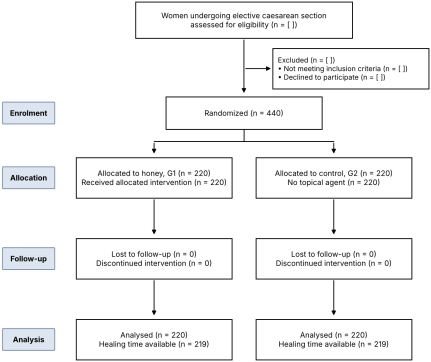
A total of 440 women were randomized: 220 to the honey arm (G1) and 220 to the control arm (G2). All received the allocated intervention, attended every follow-up visit up to day 30 and were included in the analysis, giving a retention rate of 100% (
Figure 1). Healing time was not recorded for one woman in each arm.
Figure 1. CONSORT flow diagram of the trial.
3.2. Baseline Characteristics
The mean age was 27.2 years (range 15–44); 68.9% of women were aged 20–34 years. Most women were housewives (81.3%). The two arms were comparable for age, occupation and type of skin suture (
Table 1). The type of skin incision differed slightly between arms: the Pfannenstiel incision was more frequent in the honey arm (35.9% vs 27.7%), and all five lower midline incisions were in the control arm (p = 0.015).
Table 1. Baseline and operative characteristics by study arm.
Characteristic | Honey (G1) n = 220, n (%) | Control (G2) n = 220, n (%) | p |
Age (years) | | | 0.57a |
≤ 19 | 27 (12.3) | 34 (15.5) | |
20–34 | 156 (70.9) | 147 (66.8) | |
≥ 35 | 37 (16.8) | 39 (17.7) | |
Occupationᵇ | | | 0.33c |
Housewife | 178 (81.3) | 178 (81.3) | |
Civil servant / employee | 19 (8.7) | 13 (5.9) | |
Pupil / student | 12 (5.5) | 16 (7.3) | |
Trader | 4 (1.8) | 9 (4.1) | |
Other | 6 (2.7) | 3 (1.4) | |
Skin incision | | | 0.015c |
Joel-Cohen | 141 (64.1) | 154 (70.0) | |
Pfannenstiel | 79 (35.9) | 61 (27.7) | |
Lower midline | 0 (0.0) | 5 (2.3) | |
Skin suture | | | 0.71a |
Simple interrupted stitches | 196 (89.1) | 201 (91.4) | |
Intradermal running suture | 12 (5.5) | 9 (4.1) | |
Blair-Donati stitches | 12 (5.5) | 10 (4.5) | |
a Pearson's chi-square test. b Data available for 219 women per arm. c Fisher–Freeman–Halton exact test (Monte-Carlo, 20,000 samples).
Medical history was rare: 421 women (95.7%) had none, six (1.4%) had diabetes, three (0.7%) were living with human immunodeficiency virus (HIV) and two (0.5%) had chronic hypertension. One woman in three (145; 33.0%) had a previous caesarean section, and 155 (35.2%) had at least one previous abdominal or pelvic operation. The leading indications for caesarean section were a previous caesarean scar (41.6%), malpresentation (18.6%) and hypertensive disorders of pregnancy (13.6%) (
Table 2).
Table 2. Medical history, surgical history and indications for caesarean section (N = 440).
Variable | n | % |
Medical history | | |
None | 421 | 95.7 |
Diabetes | 6 | 1.4 |
Poliomyelitis sequelae | 4 | 0.9 |
HIV infection | 3 | 0.7 |
Chronic hypertension | 2 | 0.5 |
Heart disease | 2 | 0.5 |
Neurotic disorder | 2 | 0.5 |
Surgical history | | |
None | 285 | 64.8 |
Previous caesarean section | 145 | 33.0 |
Laparotomy | 7 | 1.6 |
Myomectomy | 2 | 0.5 |
Ovarian cystectomy | 1 | 0.2 |
Indication for caesarean sectiona | | |
Previous caesarean scar | 183 | 41.6 |
Malpresentation (other than breech) | 82 | 18.6 |
Hypertensive disorder of pregnancy | 60 | 13.6 |
Placenta praevia | 37 | 8.4 |
Umbilical cord pathology | 21 | 4.8 |
Twin pregnancy | 19 | 4.3 |
Breech presentation | 16 | 3.6 |
Macrosomia | 13 | 3.0 |
Chronic fetal distress | 7 | 1.6 |
a Indication missing for two women.
3.3. Primary Outcome: Surgical Site Infection
Twenty-three women developed an SSI, an overall rate of 5.2%. The SSI rate was 2.7% (6/220) in the honey arm and 7.7% (17/220) in the control arm (RR 0.35; 95% CI 0.14–0.88; p = 0.030) (
Table 3). This corresponds to an absolute risk reduction of 5.0 percentage points: one SSI was prevented for every 20 women treated with honey. All infections were superficial incisional infections; no deep incisional or organ/space infection was observed in either arm.
3.4. Secondary Outcomes
Healing time. The distribution of healing times was shifted towards shorter durations in the honey arm (Mann–Whitney p = 0.031; global chi-square p = 0.085). Before day 14, 64.8% of wounds were healed in the honey arm and 55.3% in the control arm (RR 1.17; 95% CI 1.01–1.37; p = 0.051). Healing took longer than 21 days in 3.2% and 5.9% of women, respectively (
Table 3).
Length of hospital stay. The mean length of stay was 3.6 ± 1.7 days (range 2–19). Most women (78.0%) stayed three to four days, with no significant difference between arms (p = 0.14) (
Table 3).
Table 3. Primary and secondary outcomes by study arm.
Outcome | Honey (G1), n (%) | Control (G2), n (%) | Effect (95% CI) | p |
Surgical site infection at 30 days | 6/220 (2.7) | 17/220 (7.7) | RR 0.35 (0.14–0.88) | 0.030a |
Superficial incisional | 6 (2.7) | 17 (7.7) | | |
Deep incisional or organ/space | 0 | 0 | | |
Healing timeb | | | | 0.031c |
< 14 days | 142 (64.8) | 121 (55.3) | RR 1.17 (1.01–1.37) | 0.051a |
14–21 days | 70 (32.0) | 85 (38.8) | | |
> 21 days | 7 (3.2) | 13 (5.9) | | |
Length of hospital stay | | | | 0.14ᵈ |
< 3 days | 24 (10.9) | 16 (7.3) | | |
3–4 days | 162 (73.6) | 181 (82.3) | | |
5–10 days | 31 (14.1) | 19 (8.6) | | |
> 10 days | 3 (1.4) | 3 (1.4) | | |
RR: relative risk (honey vs control). a Fisher's exact test. b n = 219 per arm. c Mann–Whitney U test on ordered categories. ᵈ Fisher–Freeman–Halton exact test (Monte-Carlo).
3.5. Factors Associated with Surgical Site Infection
In univariable analysis, SSI was associated with medical history (p = 0.001), a maternal indication for caesarean section (p = 0.022), body mass index (p = 0.001), maternal anaemia (p = 0.032), time of day of surgery (p = 0.044) and operative duration (p = 0.003). Age, occupation, mode of admission, type of incision, operator, parity and type of suture were not associated with SSI. In the multivariable model, medical history, maternal anaemia and operative duration remained independently associated with SSI (
Table 4). The risk of SSI rose with the severity of anaemia, and both short (< 30 min) and long (> 60 min) procedures carried a higher risk than procedures lasting 30–60 minutes.
Table 4. Factors independently associated with surgical site infection (multivariable logistic regression).
Variable | Adjusted OR | 95% CI | p |
Medical history (ref.: none) | | | < 0.001 |
Diabetes | 3.10 | 2.06–7.13 | |
HIV infection | 1.21 | 1.06–2.13 | |
Other | 2.37 | 0.60–3.20 | |
Maternal anaemia (ref.: none) | | | < 0.001 |
Mild | 2.37 | 1.06–5.30 | |
Moderate | 1.61 | 0.76–3.43 | |
Severe | 6.21 | 2.79–13.83 | |
Operative duration (ref.: 30–60 min) | | | 0.048 |
< 30 min | 1.97 | 1.03–4.15 | |
> 60 min | 1.92 | 1.20–4.70 | |
Variables entered but not retained: body mass index (p = 0.47), indication for caesarean section (p = 0.32), time of day of surgery (p = 0.052) and operator (p = 0.068).
4. Discussion
In this randomized trial of 440 women undergoing elective caesarean section with early dressing removal, twice-daily topical honey reduced the 30-day SSI rate from 7.7% to 2.7%, a relative reduction of about 65%. Honey also shifted the distribution of healing times towards shorter durations, without changing the length of hospital stay. To our knowledge, this is the first randomized trial of honey on caesarean wounds in sub-Saharan Africa, and the first to test honey applied by the woman herself on an uncovered wound.
4.1. Characteristics of the Study Population
Our patients were young (mean age 27.2 years), mostly housewives, and rarely had chronic disease. This profile is similar to that reported in other West African series of caesarean sections and differs from series that include all gynaecological and obstetric surgery
| [35] | Meylan G, Tschantz P. Dressings versus no dressings for surgical wounds. Ann Chir. 2001; 126(5): 459-62. |
| [36] | Bocoum A, van Riel SJJM, Traoré SO, Ngo Oum II EF, Traoré Y, Thera AT, et al. Medical-grade honey enhances the healing of caesarean section wounds and is similarly effective to antibiotics combined with povidone-iodine in the prevention of infections — a prospective cohort study. Antibiotics (Basel). 2023; 12(1): 92. |
| [37] | Codex Alimentarius Commission (FAO/WHO). Standard for honey (CXS 12-1981, revised 2001). Rome: FAO/WHO; 2001. |
[35-37]
. One woman in three had a previous caesarean section, and a previous scar was the leading indication for the operation (41.6%). This reflects the growing contribution of repeat caesarean sections to obstetric surgery in our setting, as elsewhere
| [1] | Betran AP, Ye J, Moller AB, Souza JP, Zhang J. Trends and projections of caesarean section rates: global and regional estimates. BMJ Glob Health. 2021; 6(6): e005671. |
| [2] | Boerma T, Ronsmans C, Melesse DY, Barros AJD, Barros FC, Juan L, et al. Global epidemiology of use of and disparities in caesarean sections. Lancet. 2018; 392(10155): 1341-8. |
[1, 2]
. Because only elective procedures were included, our population had a lower baseline risk of infection than women operated on in labour or as an emergency.
4.2. Surgical Site Infection
The overall SSI rate of 5.2% is lower than the pooled rates of 10.3–15.6% reported after caesarean section in sub-Saharan Africa
| [6] | Mangram AJ, Horan TC, Pearson ML, Silver LC, Jarvis WR. Guideline for prevention of surgical site infection, 1999. Infect Control Hosp Epidemiol. 1999; 20(4): 250-78. |
[6]
. Mpogoro et al. reported an SSI incidence of 10.9% in Tanzania, in a population that included emergency procedures
| [5] | Sway A, Nthumba P, Solomkin J, Tarchini G, Gibbs R, Ren Y, et al. Burden of surgical site infection following cesarean section in sub-Saharan Africa: a narrative review. Int J Womens Health. 2019; 11: 309-18. |
[5]
. Our lower rate probably reflects the elective nature of the procedures, intact membranes and the systematic five-step antisepsis protocol applied to all women
| [29] | World Medical Association. World Medical Association Declaration of Helsinki: ethical principles for medical research involving human subjects. JAMA. 2013; 310(20): 2191-4. |
[29]
. The control-arm rate of 7.7% nevertheless remained well above the 1–2% expected in high-income settings and above the rates of about 2% reported by Meylan and Dosseh for clean surgery
| [35] | Meylan G, Tschantz P. Dressings versus no dressings for surgical wounds. Ann Chir. 2001; 126(5): 459-62. |
| [37] | Codex Alimentarius Commission (FAO/WHO). Standard for honey (CXS 12-1981, revised 2001). Rome: FAO/WHO; 2001. |
[35, 37]
.
The main finding of this trial is that honey reduced the SSI rate by about two thirds, with an absolute reduction of 5 percentage points and a number needed to treat of 20. This effect is biologically plausible. The high sugar content of honey creates an osmotic environment hostile to bacteria; its acidity and the slow release of hydrogen peroxide by glucose oxidase add a sustained antiseptic effect; and non-peroxide factors such as methylglyoxal and bee defensin-1 remain active against multidrug-resistant organisms and biofilms
| [16] | Vandamme L, Heyneman A, Hoeksema H, Verbelen J, Monstrey S. Honey in modern wound care: a systematic review. Burns. 2013; 39(8): 1514-25. |
| [19] | Jull AB, Cullum N, Dumville JC, Westby MJ, Deshpande S, Walker N. Honey as a topical treatment for wounds. Cochrane Database Syst Rev. 2015;(3): CD005083. |
[16, 19]
. Unlike many antiseptics, honey does not damage fibroblasts or keratinocytes
| [16] | Vandamme L, Heyneman A, Hoeksema H, Verbelen J, Monstrey S. Honey in modern wound care: a systematic review. Burns. 2013; 39(8): 1514-25. |
| [17] | Kwakman PH, te Velde AA, de Boer L, Speijer D, Vandenbroucke-Grauls CM, Zaat SA. How honey kills bacteria. FASEB J. 2010; 24(7): 2576-82. |
[16, 17]
.
Our results are consistent with earlier clinical work. Al-Waili and Saloom showed, in women with wound infections after caesarean section and hysterectomy, that topical honey eradicated infection faster, shortened hospital stay and produced better scars than antiseptic cleaning with ethanol and povidone-iodine
| [22] | Dryden M, Goddard C, Madadi A, Heard M, Saeed K, Cooke J. Using antimicrobial honey to prevent caesarean wound infection. Br J Midwifery. 2014; 22(2): 111-5. |
[22]
. Dryden et al. reported fewer caesarean SSIs after introducing a bioengineered antimicrobial honey into routine wound care
| [24] | Schulz KF, Altman DG, Moher D; CONSORT Group. CONSORT 2010 statement: updated guidelines for reporting parallel group randomised trials. BMJ. 2010; 340: c332. |
[24]
. The Cochrane review by Jull et al. concluded that honey heals infected postoperative wounds faster than antiseptics and gauze, although the certainty of evidence was low
| [21] | Nikpour M, Shirvani MA, Azadbakht M, Zanjani R, Mousavi E. The effect of honey gel on abdominal wound healing in cesarean section: a triple blind randomized clinical trial. Oman Med J. 2014; 29(4): 255-9. |
[21]
. Our trial adds randomized evidence for a preventive use of honey on clean, primarily closed caesarean wounds.
Our previous experience with early dressing removal had shown that this strategy was safe and economical, but that it did not by itself reduce SSI or shorten healing compared with conventional dressings
| [13] | Bayala D. Feasibility of an early rehabilitation protocol following emergency cesarean section at the Bogodogo University Hospital in Ouagadougou [Specialized Graduate Studies (DES) Thesis in Gynecology-Obstetrics No. 241]. Ouagadougou: Joseph KI-ZERBO University; 2020. |
| [14] | Congo JC. Surgical site infections at the Bogodogo University Hospital in Ouagadougou from 2017 to 2018 [Specialized Graduate Studies (DES) Thesis in Gynecology-Obstetrics No. 168]. Ouagadougou: Joseph KI-ZERBO University; 2019. |
| [15] | Cooper R. Honey for wound care in the 21st century. J Wound Care. 2016; 25(9): 544-52. |
[13-15]
. This is in line with Cochrane reviews that found no effect of dressing type or timing of dressing removal on SSI
| [10] | Dumville JC, Gray TA, Walter CJ, Sharp CA, Page T, Macefield R, et al. Dressings for the prevention of surgical site infection. Cochrane Database Syst Rev. 2016; 12: CD003091. |
| [11] | Thomeret G. Complete elimination of postoperative dressings. Presse Med. 1964; 72: 716-7. |
[10, 11]
. The present trial suggests that honey can provide, at very low cost, the local protection that the simple removal of the dressing does not offer. The two measures appear complementary: early removal saves nursing time and consumables and allows the woman to wash, while honey reduces the infectious risk.
All infections in our series were superficial, and no deep or organ/space infection was observed. This is consistent with a topical intervention acting on the skin and subcutaneous tissue. Honey cannot be expected to prevent endometritis or deep infections, which depend on intra-operative contamination and on antibiotic prophylaxis
| [7] | World Health Organization. Global guidelines for the prevention of surgical site infection. 2nd ed. Geneva: WHO; 2018. |
| [8] | Berríos-Torres SI, Umscheid CA, Bratzler DW, Leas B, Stone EC, Kelz RR, et al. Centers for Disease Control and Prevention guideline for the prevention of surgical site infection, 2017. JAMA Surg. 2017; 152(8): 784-91. |
[7, 8]
.
4.3. Wound Healing
Honey shifted healing times towards shorter durations: 64.8% of wounds were healed before day 14 with honey, compared with 55.3% without. The difference in the overall distribution was significant on the Mann–Whitney test, but the proportion healed before day 14 was at the limit of significance. The effect on healing therefore appears modest compared with the effect on SSI. Part of it may be mediated by the reduction in SSI, since infected wounds heal by secondary intention and take much longer to close.
These results agree with the triple-blind trial of Nikpour et al. in Iran, in which a honey gel improved wound scores on the REEDA scale (Redness, Oedema, Ecchymosis, Discharge, Approximation) after caesarean section compared with placebo
| [23] | Ferraz Barbosa B, de Moraes FCA, Araujo Alves da Silva B, Bordignon Barbosa C, Pereira da Silva I, da Silva ER, et al. The use of honey for cicatrization and pain control of obstetric wounds: a systematic review and meta-analysis of randomized controlled trials. Nutrients. 2024; 16(2): 185. |
[23]
, and with the meta-analysis of Ferraz Barbosa et al., which found better healing and less pain when honey was applied to caesarean and episiotomy wounds
| [25] | Friedman LM, Furberg CD, DeMets DL. Fundamentals of clinical trials. 3rd ed. New York: Springer; 1998. |
[25]
. Closer to our setting, a prospective cohort of 766 women in Bamako, Mali, found that medical-grade honey shortened mean healing time after caesarean section (19.1 vs 24.5 days) and was as effective as oral amoxicillin combined with povidone-iodine for preventing SSI
| [18] | Majtan J. Honey: an immunomodulator in wound healing. Wound Repair Regen. 2014; 22(2): 187-92. |
[18]
. Honey maintains a moist environment, which accelerates re-epithelialization
| [19] | Jull AB, Cullum N, Dumville JC, Westby MJ, Deshpande S, Walker N. Honey as a topical treatment for wounds. Cochrane Database Syst Rev. 2015;(3): CD005083. |
[19]
; it reduces oedema and exudate, stimulates angiogenesis and fibroblast proliferation, and modulates the release of inflammatory cytokines
| [16] | Vandamme L, Heyneman A, Hoeksema H, Verbelen J, Monstrey S. Honey in modern wound care: a systematic review. Burns. 2013; 39(8): 1514-25. |
| [20] | Al-Waili NS, Saloom KY. Effects of topical honey on post-operative wound infections due to gram positive and gram negative bacteria following caesarean sections and hysterectomies. Eur J Med Res. 1999; 4(3): 126-30. |
[16, 20]
. In the control arm, healing before day 14 (55.3%) was lower than the 83.7–86.2% reported at day 12 by Kone et al. in Côte d'Ivoire
| [36] | Bocoum A, van Riel SJJM, Traoré SO, Ngo Oum II EF, Traoré Y, Thera AT, et al. Medical-grade honey enhances the healing of caesarean section wounds and is similarly effective to antibiotics combined with povidone-iodine in the prevention of infections — a prospective cohort study. Antibiotics (Basel). 2023; 12(1): 92. |
[36]
. This difference probably reflects differences in the definition and timing of the healing assessment between studies.
4.4. Length of Hospital Stay
The mean length of stay was 3.6 days and did not differ between arms. Discharge after an elective caesarean section in our department follows a fixed enhanced-recovery pathway and is decided on maternal and neonatal criteria, before the wound has healed. Length of stay was therefore not expected to reflect wound outcomes. It was considerably shorter than the 8–10 days reported by Dosseh et al. in Togo
| [35] | Meylan G, Tschantz P. Dressings versus no dressings for surgical wounds. Ann Chir. 2001; 126(5): 459-62. |
[35]
, which illustrates the benefit of early discharge protocols.
4.5. Factors Associated with Surgical Site Infection
Medical history, maternal anaemia and operative duration were independently associated with SSI. Diabetes and HIV infection impair neutrophil function and tissue repair, and their association with SSI after caesarean section is well established
| [6] | Mangram AJ, Horan TC, Pearson ML, Silver LC, Jarvis WR. Guideline for prevention of surgical site infection, 1999. Infect Control Hosp Epidemiol. 1999; 20(4): 250-78. |
| [7] | World Health Organization. Global guidelines for the prevention of surgical site infection. 2nd ed. Geneva: WHO; 2018. |
| [33] | Dosseh ED, Doleagbenou A, Fortey YK, Tengue K, Kassegne I, Attipou K. Pansement versus absence de pansement au-delà de 48 heures en milieu tropical: essai randomise. J Chir (Paris). 2008; 145(2): 143-6. |
[6, 7, 33]
. Anaemia reduces tissue oxygen delivery and is common among pregnant women in Burkina Faso; the risk of SSI in our series increased with its severity. Its correction before elective surgery is a simple, modifiable preventive measure. Prolonged operative time is a recognized and dose-dependent risk factor for SSI
| [34] | Koné M, Konan BR, Seni K. Absence of dressings on surgical wounds in gynecological and obstetric surgery: a comparative study with conventional dressings. Med Afr Noire. 2008; 55(12): 648-52. |
[34]
. The higher risk also observed for procedures shorter than 30 minutes is unexpected; it may reflect hurried closure or chance, given the small number of events. The type of skin suture was not associated with SSI, in agreement with the Cochrane review of skin closure techniques at caesarean section
| [32] | Cheng H, Chen BP, Soleas IM, Ferko NC, Cameron CG, Hinoul P. Prolonged operative duration increases risk of surgical site infections: a systematic review. Surg Infect (Larchmt). 2017; 18(6): 722-35. |
[32]
. These factors must be interpreted with caution: with 23 events, the multivariable model had limited power and was at risk of over-fitting.
4.6. Strengths and Limitations
The strengths of this trial include randomization, a large sample, a pragmatic intervention applied by the women themselves, standardized CDC definitions of SSI and complete 30-day follow-up of all participants.
The trial also has limitations. First, it was open-label: neither women nor assessors were blinded, which may have influenced the assessment of subjective outcomes such as healing. The diagnosis of SSI relied on objective criteria (purulent discharge or reopening of the wound), which limits, but does not remove, this bias. Second, allocation concealment relied on consulting the randomization list after consent rather than on sealed envelopes or a central system, which offers weaker protection against selection bias; the comparability of the two arms for most baseline characteristics is nevertheless reassuring. Third, the control arm received no topical agent and no placebo; the effect of honey cannot therefore be separated from the effect of the additional attention it required. Fourth, adherence to home applications was not formally measured. Fifth, the sample size was calculated on the healing rate rather than on the primary outcome, and healing time was recorded in classes, which did not allow survival analysis. Finally, the trial was single-centre and was not prospectively registered in a clinical trial registry.
Generalizability. The participants were young, mostly healthy women undergoing elective caesarean section with intact membranes in a tertiary hospital applying a standardized antisepsis protocol and an early dressing-removal pathway. Our results cannot be directly extrapolated to emergency caesarean sections, to women operated on in labour or after rupture of the membranes, to settings with different antisepsis or discharge practices, or to other types of honey, whose antibacterial activity varies with floral origin and processing. A multicentre, assessor-blinded trial including these populations is required before generalizing the recommendation.
4.7. Disclaimer (Artificial Intelligence)
The authors hereby declare that a generative AI technology (Claude, Anthropic) was used during the revision of this manuscript for language editing, formatting and the restructuring of sections in response to the reviewers’ comments. The authors reviewed and verified all content and take full responsibility.
5. Conclusion
After elective caesarean section managed with early dressing removal, twice-daily topical honey applied by the woman herself reduced the 30-day SSI rate from 7.7% to 2.7% and modestly shortened healing time, without any reported adverse effect. Honey is cheap, locally produced, culturally accepted and easy to use at home, which makes it well suited to low-resource settings. We recommend its integration into the enhanced-recovery protocol after elective caesarean section in our department, together with the correction of anaemia before surgery and the control of operative duration. Future work should (i) confirm these results in a multicentre, assessor-blinded trial that includes emergency caesarean sections and records healing time as a continuous outcome; (ii) evaluate honey on episiotomy and perineal wounds; and (iii) standardize a locally produced, quality-controlled medical-grade honey that complies with the Codex Alimentarius standard
| [37] | Codex Alimentarius Commission (FAO/WHO). Standard for honey (CXS 12-1981, revised 2001). Rome: FAO/WHO; 2001. |
[37]
.
Abbreviations
aOR | Adjusted Odds Ratio |
ARR | Absolute Risk Reduction |
CDC | Centers for Disease Control and Prevention |
CHU-B | Bogodogo University Teaching Hospital (Centre Hospitalier Universitaire de Bogodogo) |
CI | Confidence Interval |
CONSORT | Consolidated Standards of Reporting Trials |
G1 | Honey Arm |
G2 | Control Arm |
HIV | Human Immunodeficiency Virus |
NNT | Number Needed to Treat |
OR | Odds Ratio |
REEDA | Redness, Oedema, Ecchymosis, Discharge, Approximation |
RR | Relative Risk |
SSI | Surgical Site Infection |
Acknowledgments
The authors thank the midwives of the Department of Gynaecology-Obstetrics and Reproductive Medicine of Bogodogo University Teaching Hospital and the five data collectors for their contribution, and the women who agreed to take part in this trial.
Author Contributions
Ouattara Adama: Conceptualization, Investigation, Methodology, Project administration, Writing – original draft
Sombié Charles: Data curation, Formal Analysis
Ouedraogo Charlemagne: Investigation, Validation, Writing – review & editing
Sawadogo Yobi Alexi: Supervision, Validation, Writing – review & editing
Dakouré Patrick: Supervision, Writing – review & editing
Conflicts of Interest
The authors declare no conflicts of interest.
References
| [1] |
Betran AP, Ye J, Moller AB, Souza JP, Zhang J. Trends and projections of caesarean section rates: global and regional estimates. BMJ Glob Health. 2021; 6(6): e005671.
|
| [2] |
Boerma T, Ronsmans C, Melesse DY, Barros AJD, Barros FC, Juan L, et al. Global epidemiology of use of and disparities in caesarean sections. Lancet. 2018; 392(10155): 1341-8.
|
| [3] |
Ministry of Health, Directorate General for Sectoral Studies and Statistics (DGESS). 2019 Statistical Yearbook. Ouagadougou: Ministry of Health; 2020.
|
| [4] |
Mpogoro FJ, Mshana SE, Mirambo MM, Kidenya BR, Gumodoka B, Imirzalioglu C. Incidence and predictors of surgical site infections following caesarean sections at Bugando Medical Centre, Mwanza, Tanzania. Antimicrob Resist Infect Control. 2014; 3: 25.
|
| [5] |
Sway A, Nthumba P, Solomkin J, Tarchini G, Gibbs R, Ren Y, et al. Burden of surgical site infection following cesarean section in sub-Saharan Africa: a narrative review. Int J Womens Health. 2019; 11: 309-18.
|
| [6] |
Mangram AJ, Horan TC, Pearson ML, Silver LC, Jarvis WR. Guideline for prevention of surgical site infection, 1999. Infect Control Hosp Epidemiol. 1999; 20(4): 250-78.
|
| [7] |
World Health Organization. Global guidelines for the prevention of surgical site infection. 2nd ed. Geneva: WHO; 2018.
|
| [8] |
Berríos-Torres SI, Umscheid CA, Bratzler DW, Leas B, Stone EC, Kelz RR, et al. Centers for Disease Control and Prevention guideline for the prevention of surgical site infection, 2017. JAMA Surg. 2017; 152(8): 784-91.
|
| [9] |
Toon CD, Lusuku C, Ramamoorthy R, Davidson BR, Gurusamy KS. Early versus delayed dressing removal after primary closure of clean and clean-contaminated surgical wounds. Cochrane Database Syst Rev. 2015;(9): CD010259.
|
| [10] |
Dumville JC, Gray TA, Walter CJ, Sharp CA, Page T, Macefield R, et al. Dressings for the prevention of surgical site infection. Cochrane Database Syst Rev. 2016; 12: CD003091.
|
| [11] |
Thomeret G. Complete elimination of postoperative dressings. Presse Med. 1964; 72: 716-7.
|
| [12] |
Zongo H. Feasibility of an early rehabilitation protocol following prophylactic cesarean section at the Bogodogo University Hospital in Ouagadougou [Specialized Graduate Studies (DES) Thesis in Gynecology-Obstetrics No. 162]. Ouagadougou: Joseph KI-ZERBO University; 2019.
|
| [13] |
Bayala D. Feasibility of an early rehabilitation protocol following emergency cesarean section at the Bogodogo University Hospital in Ouagadougou [Specialized Graduate Studies (DES) Thesis in Gynecology-Obstetrics No. 241]. Ouagadougou: Joseph KI-ZERBO University; 2020.
|
| [14] |
Congo JC. Surgical site infections at the Bogodogo University Hospital in Ouagadougou from 2017 to 2018 [Specialized Graduate Studies (DES) Thesis in Gynecology-Obstetrics No. 168]. Ouagadougou: Joseph KI-ZERBO University; 2019.
|
| [15] |
Cooper R. Honey for wound care in the 21st century. J Wound Care. 2016; 25(9): 544-52.
|
| [16] |
Vandamme L, Heyneman A, Hoeksema H, Verbelen J, Monstrey S. Honey in modern wound care: a systematic review. Burns. 2013; 39(8): 1514-25.
|
| [17] |
Kwakman PH, te Velde AA, de Boer L, Speijer D, Vandenbroucke-Grauls CM, Zaat SA. How honey kills bacteria. FASEB J. 2010; 24(7): 2576-82.
|
| [18] |
Majtan J. Honey: an immunomodulator in wound healing. Wound Repair Regen. 2014; 22(2): 187-92.
|
| [19] |
Jull AB, Cullum N, Dumville JC, Westby MJ, Deshpande S, Walker N. Honey as a topical treatment for wounds. Cochrane Database Syst Rev. 2015;(3): CD005083.
|
| [20] |
Al-Waili NS, Saloom KY. Effects of topical honey on post-operative wound infections due to gram positive and gram negative bacteria following caesarean sections and hysterectomies. Eur J Med Res. 1999; 4(3): 126-30.
|
| [21] |
Nikpour M, Shirvani MA, Azadbakht M, Zanjani R, Mousavi E. The effect of honey gel on abdominal wound healing in cesarean section: a triple blind randomized clinical trial. Oman Med J. 2014; 29(4): 255-9.
|
| [22] |
Dryden M, Goddard C, Madadi A, Heard M, Saeed K, Cooke J. Using antimicrobial honey to prevent caesarean wound infection. Br J Midwifery. 2014; 22(2): 111-5.
|
| [23] |
Ferraz Barbosa B, de Moraes FCA, Araujo Alves da Silva B, Bordignon Barbosa C, Pereira da Silva I, da Silva ER, et al. The use of honey for cicatrization and pain control of obstetric wounds: a systematic review and meta-analysis of randomized controlled trials. Nutrients. 2024; 16(2): 185.
|
| [24] |
Schulz KF, Altman DG, Moher D; CONSORT Group. CONSORT 2010 statement: updated guidelines for reporting parallel group randomised trials. BMJ. 2010; 340: c332.
|
| [25] |
Friedman LM, Furberg CD, DeMets DL. Fundamentals of clinical trials. 3rd ed. New York: Springer; 1998.
|
| [26] |
Dean AG, Sullivan KM, Soe MM. OpenEpi: Open Source Epidemiologic Statistics for Public Health, version 3.01. Available:
www.OpenEpi.com
|
| [27] |
French Society for Hospital Hygiene (SFHH). Five-step antisepsis. In: Glossary of Medical Hygiene. Paris: SFHH; 2006.
|
| [28] |
Horan TC, Gaynes RP, Martone WJ, Jarvis WR, Emori TG. CDC definitions of nosocomial surgical site infections, 1992: a modification of CDC definitions of surgical wound infections. Infect Control Hosp Epidemiol. 1992; 13(10): 606-8.
|
| [29] |
World Medical Association. World Medical Association Declaration of Helsinki: ethical principles for medical research involving human subjects. JAMA. 2013; 310(20): 2191-4.
|
| [30] |
Mackeen AD, Berghella V, Larsen ML. Techniques and materials for skin closure in caesarean section. Cochrane Database Syst Rev. 2012;(11): CD003577.
|
| [31] |
Olsen MA, Butler AM, Willers DM, Devkota P, Gross GA, Fraser VJ. Risk factors for surgical site infection after low transverse cesarean section. Infect Control Hosp Epidemiol. 2008; 29(6): 477-84.
|
| [32] |
Cheng H, Chen BP, Soleas IM, Ferko NC, Cameron CG, Hinoul P. Prolonged operative duration increases risk of surgical site infections: a systematic review. Surg Infect (Larchmt). 2017; 18(6): 722-35.
|
| [33] |
Dosseh ED, Doleagbenou A, Fortey YK, Tengue K, Kassegne I, Attipou K. Pansement versus absence de pansement au-delà de 48 heures en milieu tropical: essai randomise. J Chir (Paris). 2008; 145(2): 143-6.
|
| [34] |
Koné M, Konan BR, Seni K. Absence of dressings on surgical wounds in gynecological and obstetric surgery: a comparative study with conventional dressings. Med Afr Noire. 2008; 55(12): 648-52.
|
| [35] |
Meylan G, Tschantz P. Dressings versus no dressings for surgical wounds. Ann Chir. 2001; 126(5): 459-62.
|
| [36] |
Bocoum A, van Riel SJJM, Traoré SO, Ngo Oum II EF, Traoré Y, Thera AT, et al. Medical-grade honey enhances the healing of caesarean section wounds and is similarly effective to antibiotics combined with povidone-iodine in the prevention of infections — a prospective cohort study. Antibiotics (Basel). 2023; 12(1): 92.
|
| [37] |
Codex Alimentarius Commission (FAO/WHO). Standard for honey (CXS 12-1981, revised 2001). Rome: FAO/WHO; 2001.
|
Cite This Article
-
APA Style
Adama, O., Charles, S., Charlemagne, O., Alexi, S. Y., Patrick, D. (2026). Twice-Daily Topical Honey on Caesarean Section Wounds After Early Dressing Removal: A Randomized Controlled Trial at Bogodogo University Hospital, Ouagadougou. Journal of Gynecology and Obstetrics, 14(6), 131-141. https://doi.org/10.11648/j.jgo.20261406.13
 Copy
|
 Download
ACS Style
Adama, O.; Charles, S.; Charlemagne, O.; Alexi, S. Y.; Patrick, D. Twice-Daily Topical Honey on Caesarean Section Wounds After Early Dressing Removal: A Randomized Controlled Trial at Bogodogo University Hospital, Ouagadougou. J. Gynecol. Obstet. 2026, 14(6), 131-141. doi: 10.11648/j.jgo.20261406.13
Copy
|
Download
AMA Style
Adama O, Charles S, Charlemagne O, Alexi SY, Patrick D. Twice-Daily Topical Honey on Caesarean Section Wounds After Early Dressing Removal: A Randomized Controlled Trial at Bogodogo University Hospital, Ouagadougou. J Gynecol Obstet. 2026;14(6):131-141. doi: 10.11648/j.jgo.20261406.13
Copy
|
Download
-
@article{10.11648/j.jgo.20261406.13,
  author = {Ouattara Adama and Sombié Charles and Ouedraogo Charlemagne and Sawadogo Yobi Alexi and Dakouré Patrick},
  title = {Twice-Daily Topical Honey on Caesarean Section Wounds After Early Dressing Removal: A Randomized Controlled Trial at Bogodogo University Hospital, Ouagadougou},
  journal = {Journal of Gynecology and Obstetrics},
  volume = {14},
  number = {6},
  pages = {131-141},
  doi = {10.11648/j.jgo.20261406.13},
  url = {https://doi.org/10.11648/j.jgo.20261406.13},
  eprint = {https://article.sciencepublishinggroup.com/pdf/10.11648.j.jgo.20261406.13},
  abstract = {Surgical site infection (SSI) remains a frequent complication of caesarean section in sub-Saharan Africa, and early removal of the postoperative dressing has not by itself reduced its incidence. This trial aimed to evaluate the effect of twice-daily topical honey on SSI and wound healing after elective caesarean section managed with early dressing removal. An open-label, two-arm, parallel-group randomized controlled trial was conducted in the Department of Gynaecology-Obstetrics and Reproductive Medicine of Bogodogo University Teaching Hospital, Ouagadougou, Burkina Faso, from 1 December 2021 to 31 May 2022. Women undergoing elective (pre-labour) caesarean section with intact membranes were randomized 1:1 after informed consent. In both arms, the dressing was removed on postoperative day 1 and the wound was washed with plain water twice daily; women in the honey arm then applied a thin layer of pharmaceutical-grade honey to the incision until healing, whereas women in the control arm applied no topical agent. Follow-up visits took place on days 7, 11, 15 and 30. The primary outcome was SSI within 30 days according to the Centers for Disease Control and Prevention criteria; secondary outcomes were time to wound healing and length of hospital stay, and factors associated with SSI were explored by logistic regression. All 440 randomized women (220 per arm) completed follow-up; their mean age was 27.2 years (range 15–44). SSI occurred in 6/220 women (2.7%) in the honey arm and in 17/220 (7.7%) in the control arm (relative risk 0.35; 95% confidence interval 0.14–0.88; p = 0.030), corresponding to an absolute risk reduction of 5.0 percentage points and a number needed to treat of 20. All infections were superficial. Healing times were shifted towards shorter durations with honey (Mann–Whitney p = 0.031), with 64.8% versus 55.3% of wounds healed before day 14, whereas length of hospital stay did not differ between arms (p = 0.14). Medical history, maternal anaemia and operative duration were independently associated with SSI. Thus, after elective caesarean section with early dressing removal, twice-daily topical honey applied by the woman reduced the 30-day SSI rate by about two thirds and modestly shortened healing time. Being cheap, locally available and culturally accepted, honey is a promising adjunct to wound care in low-resource settings; confirmation in emergency caesarean sections and in an assessor-blinded multicentre trial is warranted.},
 year = {2026}
}
Copy
|
Download
-
TY  - JOUR
T1  - Twice-Daily Topical Honey on Caesarean Section Wounds After Early Dressing Removal: A Randomized Controlled Trial at Bogodogo University Hospital, Ouagadougou
AU  - Ouattara Adama
AU  - Sombié Charles
AU  - Ouedraogo Charlemagne
AU  - Sawadogo Yobi Alexi
AU  - Dakouré Patrick
Y1  - 2026/11/23
PY  - 2026
N1  - https://doi.org/10.11648/j.jgo.20261406.13
DO  - 10.11648/j.jgo.20261406.13
T2  - Journal of Gynecology and Obstetrics
JF  - Journal of Gynecology and Obstetrics
JO  - Journal of Gynecology and Obstetrics
SP  - 131
EP  - 141
PB  - Science Publishing Group
SN  - 2376-7820
UR  - https://doi.org/10.11648/j.jgo.20261406.13
AB  - Surgical site infection (SSI) remains a frequent complication of caesarean section in sub-Saharan Africa, and early removal of the postoperative dressing has not by itself reduced its incidence. This trial aimed to evaluate the effect of twice-daily topical honey on SSI and wound healing after elective caesarean section managed with early dressing removal. An open-label, two-arm, parallel-group randomized controlled trial was conducted in the Department of Gynaecology-Obstetrics and Reproductive Medicine of Bogodogo University Teaching Hospital, Ouagadougou, Burkina Faso, from 1 December 2021 to 31 May 2022. Women undergoing elective (pre-labour) caesarean section with intact membranes were randomized 1:1 after informed consent. In both arms, the dressing was removed on postoperative day 1 and the wound was washed with plain water twice daily; women in the honey arm then applied a thin layer of pharmaceutical-grade honey to the incision until healing, whereas women in the control arm applied no topical agent. Follow-up visits took place on days 7, 11, 15 and 30. The primary outcome was SSI within 30 days according to the Centers for Disease Control and Prevention criteria; secondary outcomes were time to wound healing and length of hospital stay, and factors associated with SSI were explored by logistic regression. All 440 randomized women (220 per arm) completed follow-up; their mean age was 27.2 years (range 15–44). SSI occurred in 6/220 women (2.7%) in the honey arm and in 17/220 (7.7%) in the control arm (relative risk 0.35; 95% confidence interval 0.14–0.88; p = 0.030), corresponding to an absolute risk reduction of 5.0 percentage points and a number needed to treat of 20. All infections were superficial. Healing times were shifted towards shorter durations with honey (Mann–Whitney p = 0.031), with 64.8% versus 55.3% of wounds healed before day 14, whereas length of hospital stay did not differ between arms (p = 0.14). Medical history, maternal anaemia and operative duration were independently associated with SSI. Thus, after elective caesarean section with early dressing removal, twice-daily topical honey applied by the woman reduced the 30-day SSI rate by about two thirds and modestly shortened healing time. Being cheap, locally available and culturally accepted, honey is a promising adjunct to wound care in low-resource settings; confirmation in emergency caesarean sections and in an assessor-blinded multicentre trial is warranted.
VL  - 14
IS  - 6
ER  -
Copy
|
Download





 Share This Article
 Twitter
 Linked In
 Facebook