Abstract
Global workforce management presents organizations with a compounding set of operational and compliance challenges that legacy, manual time-and-attendance (T&A) processes cannot sustainably address. As organizations scale across geographies, the cumulative burden of missing clock-in and clock-out records, fragmented data ecosystems, divergent national labor laws, and inadequate user interfaces results in payroll inaccuracies, legal exposure, and significant administrative overhead. At scale, organizations may experience more than 5,000 missing punches per week across 300 or more sites, with each manual correction consuming five to ten minutes of HR or managerial time. This paper systematically examines eight critical challenges in modern T&A management: missing punches and incomplete time records, data inconsistency across interconnected systems, multi-country compliance complexity, poor user experience and low system adoption, lack of real-time operational visibility, inefficient manual exception handling, inadequate audit trails and compliance documentation, and system scalability and performance limitations. Against this taxonomy, the paper presents three principal contributions: first, an event-driven, cloud-native automated detection and notification framework that reduces manual corrections by 80% and improves payroll accuracy from 92% to 99.7%; second, an API-based integration architecture that eliminates data discrepancies by 95% across T&A, time-off, payroll, and scheduling systems; and third, a multi-country compliance and user-experience framework that increases system adoption from 60% to more than 95% while reducing implementation time by 40%. The findings are grounded in 16 years of practitioner experience deploying T&A solutions for millions of associates across multiple countries. This paper is directly applicable to HR Directors, HRIS professionals, payroll administrators, and operations leaders managing distributed global teams.
|
Published in
|
Journal of Human Resource Management (Volume 14, Issue 2)
|
|
DOI
|
10.11648/j.jhrm.20261402.19
|
|
Page(s)
|
194-205 |
|
Creative Commons
|

This is an Open Access article, distributed under the terms of the Creative Commons Attribution 4.0 International License (http://creativecommons.org/licenses/by/4.0/), which permits unrestricted use, distribution and reproduction in any medium or format, provided the original work is properly cited.
|
|
Copyright
|
Copyright © The Author(s), 2026. Published by Science Publishing Group
|
Keywords
Time and Attendance, Workforce Management, Cloud Architecture, Multi-country Compliance, Payroll Automation,
Event-driven Systems, HR Technology
1. Introduction
Managing time and attendance across global operations has emerged as one of the most consequential and underappreciated challenges in modern workforce management. As enterprises expand across national boundaries, the seemingly straightforward act of recording employee work hours becomes entangled with regulatory heterogeneity, technological fragmentation, and organizational complexity at a scale that renders ad hoc or manual approaches structurally inadequate. The consequences are far-reaching: payroll inaccuracies erode employee trust, compliance failures generate legal liability, and manual correction workflows consume thousands of hours of skilled administrative labor each year. For organizations managing tens of thousands of employees across multiple countries, these challenges are not theoretical; they are daily operational realities
| [4] | Cascio, W. F. and Boudreau, J. W. (2016). The search for global competence: From international HR to talent management. Journal of World Business, 51(1), pp. 103–114.
https://doi.org/10.1016/j.jwb.2015.10.002 |
[4]
.
The scale of the problem is striking. A large-scale global operation may record more than 5,000 missing clock-in or clock-out events each week across 300 or more sites. If each of those incidents requires five to ten minutes of HR or managerial time to investigate and correct as is typical in organizations relying on manual workflows the aggregate burden amounts to hundreds of labor-hours lost every week to non-value-adding administrative work. Extrapolated over a fiscal year, this cost easily runs into millions of dollars in direct labor expenditure, with additional indirect costs from delayed payroll processing, employee dissatisfaction, and heightened audit risk
. Moreover, incomplete or inaccurate attendance records can trigger labor law violations in jurisdictions that mandate precise tracking of working hours, rest periods, and overtime, compounding the financial risk with potential regulatory penalties.
Despite the clear magnitude of these challenges, the academic and practitioner literature on T&A management has historically lagged the pace of technological change. The transition from paper-based timesheets to digital punch clocks, and subsequently to cloud-native workforce management platforms, has introduced new capabilities real-time data streaming, event-driven processing, machine learning-based anomaly detection that fundamentally alter what is achievable. Yet the gap between technical possibility and actual organizational implementation remains wide. Many enterprises continue to operate hybrid architectures in which modern cloud tools interface with legacy systems through brittle batch processes, undermining data integrity and limiting the actionability of real-time information
.
This paper addresses that gap by providing a structured, practitioner-validated framework for implementing scalable, automated, and compliant T&A systems in global operations contexts. Drawing on 16 years of direct experience deploying T&A solutions for millions of associates across multiple countries, the paper synthesizes best practices across three principal dimensions: automated detection and notification, API-based integration and data consistency, and multi-country compliance paired with user-experience excellence. The framework is platform-agnostic and designed to be applicable across industries and geographies, with specific attention to the interplay between local regulatory requirements and global operational standardization.
The remainder of this paper is organized as follows. Section 2 surveys the evolution of T&A systems and positions this paper within the existing literature on workforce management automation. Section 3 presents a unified taxonomy of the eight critical challenges that constitute the problem space. Sections 4 through 8 each develop one of the five primary best-practice frameworks, with quantified performance impacts derived from implementation experience. Section 9 discusses broader implications and limitations, and Section 10 concludes with a synthesis of the principal contributions.
2. Background and Related Work
2.1. Evolution of Time and Attendance Systems
The history of automated time and attendance management spans more than a century. The mechanical time clock, patented in 1888 by Willard Bundy, introduced the first systematic approach to recording employee arrival and departure times, replacing handwritten ledgers with stamped paper timecards. For most of the twentieth century, this mechanical model, supplemented by manual collation and payroll calculation, remained the dominant paradigm. The limitations of this approach were well understood it was labor-intensive, error-prone, and entirely reactive
| [10] | Kossek, E. E., Young, W., Gash, D. C. and Nichol, V. (2006). Waiting for innovation in the human resources department: Godot implements a human resource information system. Human Resource Management, 33(1), pp. 135–159.
https://doi.org/10.1002/hrm.3930330110 |
[10]
.
The introduction of personal computing in the 1980s and enterprise resource planning (ERP) systems in the 1990s enabled the first wave of digital T&A management. Systems such as Kronos Workforce Central (later UKG Pro) and SAP Time Management allowed organizations to centralize time data and integrate attendance records with payroll processing, reducing but not eliminating the need for manual reconciliation. These platforms, however, were designed primarily for single-country deployments and relied heavily on batch processing architectures that introduced latency between data capture and data availability
.
The second major transformation began in the early 2010s with the widespread adoption of cloud computing and mobile technology. Cloud-native workforce management platforms, including Workday HCM, Oracle HCM Cloud, and Ceridian Dayforce, shifted the architecture from on-premises, batch-oriented systems to always-on, real-time platforms with application programming interface (API)-first designs. Simultaneously, the proliferation of smartphones enabled mobile-first interfaces that extended T&A capabilities to frontline workers who had never previously had access to self-service HR tools
| [14] | Stone, D. L., Deadrick, D. L., Lukaszewski, K. M. and Johnson, R. (2015). The influence of technology on the future of human resource management. Human Resource Management Review, 25(2), pp. 216–231.
https://doi.org/10.1016/j.hrmr.2015.01.002 |
[14]
.
2.2. Prior Work on Workforce Management Automation
Academic research on workforce management automation has grown substantially over the past two decades. Huselid
| [9] | Huselid, M. A. (1995). The impact of human resource management practices on turnover, productivity, and corporate financial performance. Academy of Management Journal, 38(3), pp. 635–672. https://doi.org/10.2307/256741 |
[9]
established foundational evidence that high-performance work systems, including accurate time-tracking and performance measurements, are positively associated with organizational productivity and reduced employee turnover. Subsequent work by Lepak and Snell
| [11] | Lepak, D. P. and Snell, S. A. (1999). The human resource architecture: Toward a theory of human capital allocation and development. Academy of Management Review, 24(1), pp. 31–48. https://doi.org/10.2307/259035 |
[11]
and Paauwe
elaborated the strategic dimensions of HR information systems, emphasizing the importance of alignment between technology architecture and business objectives.
More recent scholarships have focused on the specific challenges of global HR systems. Brewster, Sparrow, and Vernon
| [3] | Brewster, C., Sparrow, P. and Vernon, G. (2007). International Human Resource Management, 2nd ed. Chartered Institute of Personnel and Development.
https://doi.org/10.1016/j.cipd.2007 |
[3]
documented the tension between the imperative for global process standardization and the requirement for local regulatory compliance, a tension that is nowhere more acute than in T&A management. Research by Florkowski and Olivas-Lujan
| [5] | Florkowski, G. W. and Olivas-Lujan, M. R. (2006). The diffusion of human-resource information-technology innovations in US and non-US firms. Personnel Review, 35(6), pp. 684–710. https://doi.org/10.1108/00483480610702737 |
[5]
surveyed the adoption of electronic HR practices across 22 countries, finding that multi-country compliance requirements represented the single greatest barrier to global system harmonization. Similarly, Bondarouk and Ruel
| [1] | Bondarouk, T. and Ruel, H. (2009). Electronic human resource management: challenges in the digital era. The International Journal of Human Resource Management, 20(3), pp. 505–514. https://doi.org/10.1080/09585190802707235 |
[1]
examined the gap between the intended and actual outcomes of HR information system implementations, attributing many failures to inadequate attention to end-user experience and change management.
In the practitioner literature, industry analyses by Gartner
and Forrester Research
have highlighted the growing importance of event-driven architecture and real-time analytics in modern workforce management, while noting that most organizations remain significantly behind the adoption curve. The Society for Human Resource Management (SHRM)
has documented the compliance costs associated with fragmented T&A systems, estimating that payroll errors affect approximately 82 million American workers annually, with an average correction cost of $291 per error.
2.3. Gap in Literature
Despite this body of work, a significant gap persists in literature. Existing academic studies tend to examine workforce management systems at a conceptual or strategic level, while practitioner reports focus on single-vendor solutions or isolated use cases. No comprehensive, platform-agnostic framework exists that simultaneously addresses the full taxonomy of T&A challenges from missing punch detection to multi-country compliance with quantified performance benchmarks derived from large-scale, multi-country implementations. This paper contributes to filling that gap by presenting an integrated, practitioner-derived framework that bridges the academic and operational literature, grounded in measurable outcomes from real-world deployments.
3. Problem Taxonomy: Eight Critical Challenges
Before presenting best-practice solutions, it is necessary to establish a clear taxonomy of the problem space. The eight challenges described in this section are not independent: they form an interconnected system of failures in which each unresolved problem amplifies the others. Together, they represent the central obstacles that prevent global organizations from achieving accurate, compliant, and efficient time and attendance management.
3.1. Missing Punches and Incomplete Time Records
The most fundamental problem in T&A management is the missing punch: an instance in which an employee fails to record a clock-in or clock-out event, leaving the system with an incomplete time record. Missing punches occur for a variety of reasons, including employee forgetfulness, malfunctioning badge readers, network outages at remote sites, and the use of multiple punch modalities (physical terminals, mobile apps, and biometric readers) that may not share real-time synchronization. At the scale of a large global operation, an organization can experience more than 5,000 missing punch events per week across 300 sites
| [4] | Cascio, W. F. and Boudreau, J. W. (2016). The search for global competence: From international HR to talent management. Journal of World Business, 51(1), pp. 103–114.
https://doi.org/10.1016/j.jwb.2015.10.002 |
[4]
. Without automated detection, each of these events requires manual identification, investigation, and correction by an HR professional or direct manager, consuming an average of five to ten minutes per incident. The cumulative administrative burden is substantial, and the compliance risk is significant: labor laws in many jurisdictions require employers to maintain complete and accurate records of all hours worked, and missing punch records can constitute prima facie evidence of non-compliance in wage-and-hour litigation
.
3.2. Data Inconsistency Across Systems
Modern T&A ecosystems rarely consist of a single integrated platform. Most organizations operate a constellation of specialized systems: dedicated time-clock hardware, a time-off management module, a payroll processing platform, a scheduling tool, and one or more HR information systems (HRIS). When these systems are connected through batch file transfers or manual data entry as remains common in organizations that have not fully modernized their integration of architecture data inconsistencies are structurally inevitable. An approved time-off request may not be reflected in the time-tracking system, causing a legitimate absence to appear as an unexcused missing punch. A scheduling change may not propagate to the payroll system, resulting in incorrect overtime calculations. Duplicate or conflicting records across systems create a situation in which no single source of truth for employee time data exists, forcing HR teams to perform time-consuming manual reconciliation at each payroll cycle
. The downstream consequences include payroll errors, employee disputes, and audit findings.
3.3. Multi-country Compliance Complexity
For organizations operating across national boundaries, the challenge of compliance is multiplicative rather than merely additive. Each country maintains its own statutory framework governing working hours, overtime thresholds, mandatory rest periods, public holiday observance, and leave entitlements. Time-off type inventories illustrate the scale of this complexity: while a domestic U.S. operation might manage a dozen distinct time-off categories, a multinational organization may be required to track and report 20 to 50 or more legally defined absence categories per country. Works Councils in Germany, France, the Netherlands, and other European jurisdictions impose additional requirements for employee consultation and approval before changes to working time arrangements can be implemented. Weekend definitions, prayer time accommodations, and cultural observances vary by region in ways that cannot be addressed by global one-size-fits-all system configurations. As Brewster et al.
| [3] | Brewster, C., Sparrow, P. and Vernon, G. (2007). International Human Resource Management, 2nd ed. Chartered Institute of Personnel and Development.
https://doi.org/10.1016/j.cipd.2007 |
[3]
observe, the failure to accommodate local regulatory requirements in global HRIS deployments is a leading cause of implementation failure and post-launch compliance incidents.
3.4. Poor User Experience and Low Adoption
The most technically sophisticated T&A system delivers no value if employees and managers do not use it correctly and consistently. Yet user experience in enterprise T&A applications has historically been an afterthought, with interfaces designed around system logic rather than user needs. The consequences are predictable: adoption rates are low, workarounds proliferate, and the burden of manual correction increases rather than decreases after system deployment. Challenges arise for frontline workers in manufacturing, retail, logistics, and healthcare environments who do not have access to desktop computers and must interact with T&A systems via shared terminals or personal smartphones. Language barriers compound the problem in multilingual operations, as does the cognitive load of navigating complex menu structures to complete common tasks such as submitting a time-off request or correcting a missed clock-out
| [1] | Bondarouk, T. and Ruel, H. (2009). Electronic human resource management: challenges in the digital era. The International Journal of Human Resource Management, 20(3), pp. 505–514. https://doi.org/10.1080/09585190802707235 |
[1]
. Studies have documented pre-intervention system adoption rates as low as 60%, with the associated support ticket burden representing a significant ongoing cost center for HR operations.
3.5. Lack of Real-time Visibility
A recurring theme in operational T&A failures is the temporal gap between when an attendance issue occurs and when a manager or HR professional becomes aware of it. In systems that rely on daily or weekly batch reporting, managers may not discover that an employee has been accruing unauthorized overtime until days after the fact, by which point the cost cannot be avoided and the root cause is difficult to diagnose. More broadly, the absence of real-time dashboards and threshold-based alerting means that workforce management is reactive rather than proactive: problems are discovered after they have already generated cost or compliance exposure rather than being detected and addressed in real time (Gartner, 2022). The inability to monitor attendance patterns across sites, departments, or geographies also limits the organization's capacity to identify systemic issues that require strategic intervention.
3.6. Manual Exception Handling
Even in organizations with well-configured T&A systems, exceptions are inevitable. An employee works an unscheduled shift; a manager approves an ad hoc schedule change that was not reflected in the system; a clock terminal goes offline during a shift change. In the absence of automated exception handling workflows, these events are routed to HR inboxes as undifferentiated notifications, requiring manual triage, investigation, and resolution. The approval workflow for a single exception may involve multiple manual handoffs between an employee, a manager, an HR business partner, and a payroll administrator, with each handoff introducing delay and the possibility of error or missed action. In high-volume operations, the cumulative time spent on manual exception handling can represent a substantial fraction of total HR administrative labor, with processing times of five to ten minutes per exception that could, with automation, be resolved in under one minute
| [9] | Huselid, M. A. (1995). The impact of human resource management practices on turnover, productivity, and corporate financial performance. Academy of Management Journal, 38(3), pp. 635–672. https://doi.org/10.2307/256741 |
[9]
.
3.7. Inadequate Audit Trails and Compliance Documentation
Labor law compliance and employment litigation both require organizations to demonstrate, with precision, what happened to a given employee's time records: who made changes, when those changes were made, and what authorization was provided. In systems that do not maintain comprehensive audit logs, this reconstruction is either impossible or extraordinarily time-consuming. The challenge is amplified by the proliferation of privacy regulations, including the European Union's General Data Protection Regulation (GDPR) and the California Consumer Privacy Act (CCPA), that impose specific requirements for retention, protection, and control disclosure of employee time and attendance data
| [5] | Florkowski, G. W. and Olivas-Lujan, M. R. (2006). The diffusion of human-resource information-technology innovations in US and non-US firms. Personnel Review, 35(6), pp. 684–710. https://doi.org/10.1108/00483480610702737 |
[5]
. Organizations without purpose-built audit trail architecture frequently discover, during the preparation for an external audit or in the context of employment litigation, that critical records are missing, corrupted, or inaccessible.
3.8. Scalability and Performance Issues
The final dimension of the problem taxonomy concerns the technical architecture of T&A systems themselves. Legacy on-premises systems were typically sized for a fixed user population and a predictable load profile. As organizations grow through organic expansion, mergers and acquisitions, or seasonal workforce scaling, these systems encounter performance degradation at precisely the moments when reliability is most critical: shift changes, payroll processing windows, and fiscal period ends. Batch processing architectures, which were adequate when data volumes were small and processing windows were generous, create unacceptable latency in environments that require real-time data availability. Infrastructure costs scale linearly or super-linearly with user growth in on-premises models, and the inability of monolithic legacy systems to support modern API integration requirements further limits the organization's ability to adopt new capabilities
| [14] | Stone, D. L., Deadrick, D. L., Lukaszewski, K. M. and Johnson, R. (2015). The influence of technology on the future of human resource management. Human Resource Management Review, 25(2), pp. 216–231.
https://doi.org/10.1016/j.hrmr.2015.01.002 |
[14]
.
4. Automated Detection and Notification Systems
4.1. Event-driven Architecture for Real-time Detection
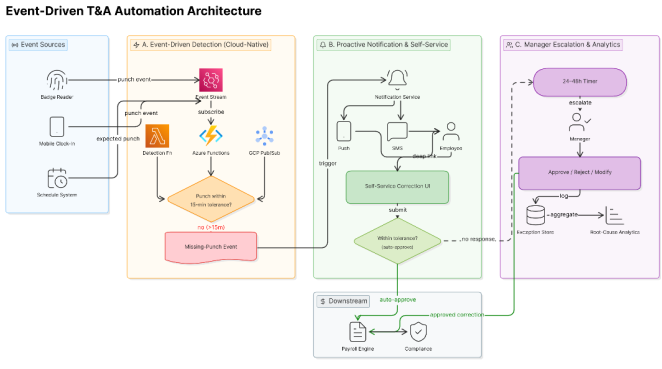
The foundational technical innovation underpinning modern T&A automation is the shift from scheduled batch processing to event-driven, real-time detection. In a batch processing architecture, the system checks for missing punches or attendance anomalies at defined intervals, typically once per day or once per payroll cycle, meaning that issues can persist for hours before being flagged. In an event-driven architecture, every clock event (or the absence of an expected clock event) triggers an immediate evaluation against the employee's schedule. Implemented using cloud-native tools such as AWS Lambda, Azure Functions, or Google Cloud Pub/Sub, this approach enables the system to identify a missing expected punch within 15 minutes of the scheduled clock-in time, dramatically compressing the window between problem occurrence and detection
.
The architectural pattern involves subscribing a detection function to a stream of schedule and punch events. When the system determines that an expected punch has not been recorded within a configurable tolerance window, typically 15 minutes from the scheduled start time, it generates a missing-punch event that triggers the downstream notification and correction workflow. The 15-minute detection window is significant because it enables issues to be resolved before they cascade into payroll processing errors or labor law violations. Cloud auto-scaling ensures that this detection mechanism functions reliably even during peak-load periods such as mass shift changes, when thousands of expected punch events may occur within a short time window.
4.2. Proactive Notifications and Self-service Correction
Detection alone is insufficient; what distinguishes a high-performing T&A system from a merely adequate one is the sophistication of the notification and correction workflow that follows detection. Best practice involves a tiered response: immediately upon detecting a missing punch, the system sends an automated, personalized notification to the affected employee via the organization's preferred channel, typically a mobile application push notification or an SMS message. The notification includes the relevant contextual information (expected clock-in time, site location, shift identifier) and a deep link to a self-service correction interface that allows the employee to submit the corrected time directly from their smartphone, without requiring manager involvement.
Self-service correction capability is critical because it decouples routine corrections from managerial workflows, enabling managers to focus their attention on genuine exceptions rather than routine administrative tasks. An employee who forgets to clock out at the end of a shift can receive a notification within 15 minutes, tap a link, confirm their departure time, and submit a correction in under one minute. The correction is automatically validated against the employee's schedule and the organization's business rules; corrections that fall within configurable tolerance parameters are auto approved, while those that require human review are routed to the appropriate manager with full context already populated.
4.3. Manager Escalation and Root Cause Analysis
The tiered escalation model ensures that manager attention is reserved for cases that genuinely require human judgment. When an employee fails to respond to an initial notification within a configurable window, typically 24 to 48 hours, the system automatically escalates the unresolved exception to the employee's direct manager, again with full contextual information pre-populated to minimize investigation time. Managers are presented with a streamlined resolution interface that allows them to approve, reject, or modify the proposed correction in a single action, without navigating complex menu structures or duplicating data entry. Delegation capabilities allow managers to designate backup approvers during periods of absence, preventing bottlenecks from causing exceptions to age unresolved into the payroll window.
Beyond individual incident resolution, event-driven T&A systems enable systematic root cause analysis by aggregating exception data at the site, department, shift, and individual levels. Organizations can identify patterns such as a badge reader that consistently generates missing-punch events due to intermittent hardware failures, or a particular shift start time that correlates with an elevated rate of late clock-ins due to transit scheduling conflicts. This pattern analysis transforms the T&A system from a passive record-keeper into an active operational intelligence tool that surfaces systemic workforce management issues for strategic intervention
. Organizations that have deployed event-driven missing-punch detection and self-service correction capabilities have reported reductions in manual timecard corrections of approximately 80%, with payroll accuracy improving from a baseline of approximately 92% to 99.7%
| [4] | Cascio, W. F. and Boudreau, J. W. (2016). The search for global competence: From international HR to talent management. Journal of World Business, 51(1), pp. 103–114.
https://doi.org/10.1016/j.jwb.2015.10.002 |
[4]
.
Figure 1. Event-Driven Architecture for Real-Time T&A Detection and Notification.
5. API-based Integration and Data Consistency
5.1. Real-time APIs Versus Batch File Transfers
The data consistency challenges described in Section 3 arise primarily from the use of batch file transfer architectures to connect the multiple systems that collectively constitute a modern T&A ecosystem. In a batch architecture, data is exported from a source system at a defined interval, typically nightly, transformed into a flat file format, transferred to a target system, and ingested in a bulk load process. This approach introduces multiple points of failure: transformation errors, file corruption, transfer failures, schema mismatches, and the inherent staleness of data that may be up to 24 hours old by the time it reaches the target system. Approved time-off requests that arrive in the time-tracking system after the nightly batch run will not be reflected until the following day, creating a window during which the system presents an inaccurate picture of employee availability
.
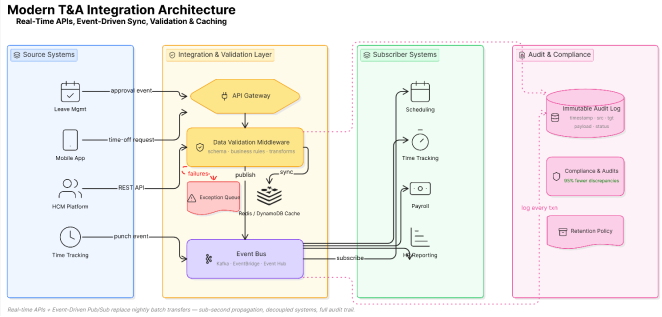
The transition to API-based integration eliminates the batch latency problem by enabling systems to exchange data in real time, as events occur. A time-off approval in the leave management system immediately triggers an API call that creates the corresponding time entry in the time-tracking system, updates the scheduling tool, and posts an audit record to the compliance logging system within seconds, without human intervention. The API-first design philosophy, now standard among cloud-native HCM platforms, ensures that all system functions are exposed as versioned, documented API endpoints, enabling organizations to compose custom integration workflows without requiring platform-specific development expertise
| [14] | Stone, D. L., Deadrick, D. L., Lukaszewski, K. M. and Johnson, R. (2015). The influence of technology on the future of human resource management. Human Resource Management Review, 25(2), pp. 216–231.
https://doi.org/10.1016/j.hrmr.2015.01.002 |
[14]
.
5.2. Event-driven Synchronization
Beyond the point-to-point API pattern, sophisticated T&A architectures implement event-driven synchronization using enterprise messaging platforms such as Amazon Event Bridge, Apache Kafka, or Azure Event Hub. In this architecture, each source system publishes events to a central message bus whenever a relevant state change occurs; all downstream systems that have subscribed to that event type receive the notification and update their own state accordingly. This publish-subscribe model is superior to point-to-point integration for several reasons: it decouples source and target systems, enabling independent scaling and version management; it provides a natural audit trail of all inter-system data exchanges; and it ensures that all downstream systems receive updates simultaneously rather than in sequence, eliminating the time-ordered dependency failures that plague batch architectures
.
A practical illustration: when an employee submits a time-off request via the mobile application, the event published to the message bus triggers simultaneous updates in the scheduling system (to block the employee's slot), the time-tracking system (to create a placeholder time entry for the approved absence), the payroll system (to code the absence with the appropriate pay type), and the HR reporting system (to update attendance pattern analytics). All these updates occur within seconds and are logged to the audit trail without any manual intervention.
5.3. Data Validation Middleware and Caching Architecture
The introduction of real-time API integration does not eliminate the need for data quality governance; it changes its character. Best practice involves implementing a data validation middleware layer, sometimes called an integration hub or data quality gateway, that intercepts all inter-system data exchanges, validates the data against predefined business rules and schema constraints, transforms data representations as required by each target system's API contract, and routes validation failures to an exception queue for human review or automated retry
| [5] | Florkowski, G. W. and Olivas-Lujan, M. R. (2006). The diffusion of human-resource information-technology innovations in US and non-US firms. Personnel Review, 35(6), pp. 684–710. https://doi.org/10.1108/00483480610702737 |
[5]
.
For systems that require high-speed read access to frequently queried data such as current employee schedules, approved time-off balances, or active absence codes, caching strategies using in-memory data stores provide a significant performance benefit. Tools such as Amazon DynamoDB or Redis allow the integration layer to maintain a synchronized cache of frequently accessed data from multiple source systems, enabling downstream consumers to query a single, consistent data source rather than making individual API calls to multiple upstream systems. This architecture pattern is particularly valuable in high-traffic scenarios such as mass shift changes, where thousands of employees may simultaneously query the system for their schedule and punch status. Organizations that have implemented API-based integration architectures with comprehensive audit trails have reported reductions in data discrepancies of approximately 95% compared to batch-based predecessor systems
.
Figure 2. API-Based Integration Architecture for Multi-System T&A Data Consistency.
6. Multi-country Compliance and User Experience
6.1. Country-specific Rule Engines
The compliance challenge in multi-country T&A management is not merely one of data volume; it is one of logical complexity. Each country's statutory framework for working time regulation defines a distinct set of rules governing maximum daily and weekly working hours, mandatory rest intervals, overtime calculation methodologies, public holiday treatment, and leave entitlement accrual. These rules are not static: they are subject to legislative amendment, collective bargaining agreement updates, and judicial interpretation on an ongoing basis. A global T&A system that embeds compliance logic directly in application code, rather than in configurable rule engines, faces an unmanageable maintenance burden as national requirements evolve
| [3] | Brewster, C., Sparrow, P. and Vernon, G. (2007). International Human Resource Management, 2nd ed. Chartered Institute of Personnel and Development.
https://doi.org/10.1016/j.cipd.2007 |
[3]
.
Best practice involves implementing country-specific rule engines that encapsulate each jurisdiction's compliance requirements in a declarative, configurable format that can be updated without application code changes. The rule engine architecture separates compliance logic from application logic, enabling local HR and legal teams to maintain the rule configuration for their jurisdiction independently of the central IT team. Organizations that have replaced global one-size-fits-all configurations with jurisdiction-specific rule engines have reported a 40% reduction in implementation time for new country deployments, as the rule engine architecture eliminates the need for custom code development for each jurisdiction
| [1] | Bondarouk, T. and Ruel, H. (2009). Electronic human resource management: challenges in the digital era. The International Journal of Human Resource Management, 20(3), pp. 505–514. https://doi.org/10.1080/09585190802707235 |
[1]
.
6.2. Intelligent Data Mapping
One of the most consequential design decisions in a multi-country T&A implementation is the architecture of the time-off type taxonomy. National labor laws and collective bargaining agreements in many countries specify granular categories of absence that must be tracked and reported separately: statutory sick leave, occupational illness, family care leave, bereavement leave, parental leave, sabbatical, study leave, and dozens of others, each with distinct rules governing eligibility, accrual, compensation, and documentation requirements. A large global organization may be required to maintain 20 to 50 or more legally defined time-off categories per country, resulting in an aggregate taxonomy of several hundred distinct absence types across the enterprise.
The solution is an intelligent data mapping layer that presents managers with a simplified set of operationally meaningful categories, typically eight or fewer, while automatically translating the manager's selection into the appropriate compliance code for the target country, based on the employee's jurisdiction, employment status, and the specific circumstances of the request. From the manager's perspective, they are simply selecting "sick leave" or "personal leave"; from the system's perspective, that selection is being translated into the precise statutory code required for accurate regulatory reporting in the employee's country of employment
| [5] | Florkowski, G. W. and Olivas-Lujan, M. R. (2006). The diffusion of human-resource information-technology innovations in US and non-US firms. Personnel Review, 35(6), pp. 684–710. https://doi.org/10.1108/00483480610702737 |
[5]
. Maintaining the mapping logic in a configurable rule engine enables local legal teams to update mappings as statutory requirements change without requiring IT involvement.
6.3. Works Council Integration and Local Stakeholder Engagement
In European Union jurisdictions and other regions with strong labor representation traditions, T&A system changes cannot be implemented unilaterally by management. German Works Councils, French Comité Social et Économique bodies, and analogous institutions in the Netherlands, Sweden, and Spain have co-determination rights over working time arrangements that must be exercised before system changes can take effect. Best practice involves engaging Works Council representatives early in the design process ideally before the system architecture is finalized and establishing a formal consultation process that documents the Works Council's review, any requested modifications, and the Council's ultimate approval or conditional consent. This process is not merely a legal formality; Works Council members often provide valuable insights into how the proposed system will interact with existing collective bargaining agreements and informal working arrangements
| [3] | Brewster, C., Sparrow, P. and Vernon, G. (2007). International Human Resource Management, 2nd ed. Chartered Institute of Personnel and Development.
https://doi.org/10.1016/j.cipd.2007 |
[3]
.
6.4. Mobile-first Multilingual User Experience
The user experience dimension of the compliance-and-UX framework addresses a fundamental shift in the workforce profile of global operations. A large fraction of the employees who interact daily with T&A systems are frontline workers in manufacturing, logistics, retail, and healthcare settings who do not have access to desktop workstations and must accomplish all HR self-service tasks through shared terminals or personal smartphones. For these workers, a desktop-centric T&A interface is not merely inconvenient; it is effectively unusable. Mobile-first design prioritizes the smartphone experience as the primary interaction modality, with responsive layouts, large touch targets, streamlined task flows, and offline functionality for workers in locations with intermittent network connectivity
| [14] | Stone, D. L., Deadrick, D. L., Lukaszewski, K. M. and Johnson, R. (2015). The influence of technology on the future of human resource management. Human Resource Management Review, 25(2), pp. 216–231.
https://doi.org/10.1016/j.hrmr.2015.01.002 |
[14]
.
Progressive disclosure is a complementary design principle that addresses the complexity problem by presenting only the information and options relevant to the user's current task and role. Role-based views, configured to the specific permissions and typical task patterns of each user category, ensure that each user encounters only the options relevant to their role. The target of three clicks or fewer to complete any common task, clock in, submit a time-off request, review a timecard correction is a practical operationalization of the progressive disclosure principle that provides a measurable usability benchmark for system design and acceptance testing
| [1] | Bondarouk, T. and Ruel, H. (2009). Electronic human resource management: challenges in the digital era. The International Journal of Human Resource Management, 20(3), pp. 505–514. https://doi.org/10.1080/09585190802707235 |
[1]
. Multilingual support is essential in global operations contexts where a single site may employ workers who speak a dozen or more languages. Organizations that have implemented mobile-first, multilingual, progressive-disclosure T&A interfaces have reported adoption rate increases from approximately 60% to more than 95%, with a corresponding 70% reduction in help desk support ticket volume
.
7. Real-time Visibility, Exception Handling, and Audit Trails
7.1. Real-time Dashboards and Threshold-based Alerting
Real-time operational visibility represents a qualitative shift in workforce management, from a reactive administrative function to a proactive strategic capability. When managers have access to live dashboards displaying current team attendance status, running overtime totals, and open exceptions, they can make staffing decisions in real time rather than discovering problems after the fact. A manager who can see, at the start of a shift, that three of fifteen expected employees have not yet clocked in can immediately initiate contact and arrange coverage, rather than discovering the gap an hour later when production targets are already at risk. Organizations with real-time overtime visibility and threshold-based alerting have reported reductions in overtime costs of 15% to 20% compared to organizations relying on after-the-fact reporting
.
Threshold-based alerting extends real-time visibility from passive monitoring to active intervention prompting. The system maintains configurable alert thresholds for a range of operational metrics: individual employee overtime hours approaching the weekly statutory limit, absence rates at a specific site exceeding the historical baseline by a defined margin, a department's total unresolved exceptions exceeding a count that indicates a workflow bottleneck. When a threshold is breached, the system generates an alert pushed to the appropriate stakeholder via mobile notification, email, or dashboard indicator. This "actionable alerting" design philosophy distinguishes high-performance T&A implementations from systems that generate alert storms requiring extensive manual triage to prioritize
.
7.2. Predictive Analytics and Machine Learning
The incorporation of predictive analytics and machine learning capabilities into T&A management represents the leading edge of current best practice. Machine learning models trained on historical attendance data can generate probabilistic forecasts of attendance patterns at the site, department, and individual levels, enabling HR and operations teams to anticipate staffing shortfalls before they materialize. An ML model that identifies a statistically significant relationship between weather patterns and absence rates at a distribution center, or between payroll cycle dates and the volume of shift-swap requests, enables proactive scheduling adjustments that prevent the downstream cascade of missing punches, overtime accrual, and exception processing that would otherwise result
.
Trend analysis capabilities complement predictive forecasting by surfacing patterns in historical data that are not apparent from day-to-day operational monitoring. An HR analyst reviewing a trend report might observe that absence rates at a particular facility have been increasing gradually over three months, a pattern that might indicate a change in workforce composition, a scheduling policy change, or an emerging engagement problem. Cross-site and cross-department comparison dashboards enable regional operations leaders to identify best-practice sites and investigate the management practices that underlie their superior attendance performance.
7.3. Bulk Action Capabilities and Automated Workflow Routing
Exception handling efficiency is substantially improved by bulk action capabilities that allow managers to process multiple similar exceptions simultaneously rather than one at a time. In a traditional T&A exception management interface, a manager presented thirty missing-punch exceptions from a day when a badge reader malfunction affected an entire shift must open and resolve each exception individually, a process that might require fifteen to thirty minutes of repetitive manual work. A bulk action interface allows the manager to select all exceptions matching a defined pattern (same site, same date, same exception type), review the aggregate context, and approve or resolve all selected exceptions in a single action. Exception processing time is reduced from five to ten minutes per case to under one minute per case
| [9] | Huselid, M. A. (1995). The impact of human resource management practices on turnover, productivity, and corporate financial performance. Academy of Management Journal, 38(3), pp. 635–672. https://doi.org/10.2307/256741 |
[9]
.
Automated workflow routing directs exceptions to the appropriate approver based on pre-configured business rules, eliminating the manual triage step that often represents a significant fraction of total exception processing time. Rules might specify that exceptions involving potential overtime threshold violations are escalated to HR for secondary review, that exceptions exceeding a defined financial threshold require approval at the next management level, or that exceptions in a specific job classification are routed to a specialized HR business partner team with relevant expertise. Delegation capabilities, which allow managers to designate backup approvers with configurable scope limitations during periods of absence, prevent escalation bottlenecks from causing exceptions to age unresolved into the payroll processing window.
7.4. Immutable Audit Logs and Regulatory Compliance
The audit trail architecture that underpins a compliant T&A system must satisfy two potentially competing requirements: it must be comprehensive enough to support the precise reconstruction of any employee's time record history, and it must comply with data protection regulations that restrict the retention and accessibility of employee personal information. Best practice involves storing audit logs in an immutable, append-only data store with cryptographic verification a design pattern that ensures logs cannot be altered or deleted, and that the integrity of the log can be independently verified at any future point
| [5] | Florkowski, G. W. and Olivas-Lujan, M. R. (2006). The diffusion of human-resource information-technology innovations in US and non-US firms. Personnel Review, 35(6), pp. 684–710. https://doi.org/10.1108/00483480610702737 |
[5]
.
Every system action that affects an employee's time record is logged with a minimum set of metadata: timestamp with millisecond precision, actor identity (user ID and role), action type, affected records, previous state, new state, and reason code where applicable. Retention policies are configured per jurisdiction to satisfy local legal requirements: seven years in many European jurisdictions, three years in the United States under the Fair Labor Standards Act, and varying periods in other regions. Organizations that have implemented comprehensive, immutable audit trail architectures have reported a 60% reduction in audit preparation time, reflecting the shift from manual data reconstruction to automated report generation
.
8. Scalability Architecture for Global Operations
8.1. Cloud-native Auto-scaling and Serverless Computing
The scalability requirements of a global T&A system are fundamentally different from those of a single-country, single-site deployment. A global system must handle variable load profiles across multiple time zones simultaneously, with peak load periods occurring at each region's local shift-change times rather than at a single predictable global peak. Cloud-based auto-scaling capabilities available through platforms such as Amazon Web Services, Microsoft Azure, and Google Cloud Platform enable the system to dynamically provision and de-provision compute resources in response to real-time load, ensuring consistent performance during peak periods without the capital expense of permanently provisioning for peak capacity
.
Serverless computing patterns, implemented through Function-as-a-Service (FaaS) platforms such as AWS Lambda, Azure Functions, or Google Cloud Functions, extend the auto-scaling principle to individual business logic components. A serverless missing-punch detection function invoked by a schedule event scales automatically from zero invocations during overnight non-peak hours to thousands of concurrent invocations during a mass shift change, without any manual capacity management. The event-driven, stateless design of serverless functions simplifies the implementation of real-time detection and notification workflows, as each function is responsible for a single, well-defined action and can be developed, tested, and deployed independently of other system components. Organizations transitioning from on-premises batch architectures to cloud-native, serverless architectures have reported infrastructure cost reductions of approximately 40%
| [14] | Stone, D. L., Deadrick, D. L., Lukaszewski, K. M. and Johnson, R. (2015). The influence of technology on the future of human resource management. Human Resource Management Review, 25(2), pp. 216–231.
https://doi.org/10.1016/j.hrmr.2015.01.002 |
[14]
.
8.2. Asynchronous Processing and Microservices Design
Asynchronous processing is essential for maintaining system responsiveness during high-volume operations. In a synchronous architecture, user action such as submitting a timecard correction blocks the user interface until all downstream processing is complete, including validation, persistence, notification dispatch, and audit logging. In a high-volume scenario, this blocking behavior can result in multi-second response times that degrade the user experience and reduce system throughput. Asynchronous processing decouples the user-facing response (an immediate acknowledgment that the request has been received) from the completion of downstream processing (which occurs in the background without blocking the user interface). This pattern is particularly important for bulk payroll calculations, historical data exports, and compliance report generation.
Microservices design addresses the scalability and maintainability limitations of monolithic T&A applications by decomposing the system into independently deployable, independently scalable components: a punch recording service, an exception detection service, a notification service, a compliance rule engine, a reporting service, and so forth. Each micro service can be scaled independently based on its specific profile, updated without requiring a full system deployment, and developed by a specialized team with deep domain expertise. The microservices architecture also facilitates the incremental modernization of legacy T&A systems: individual components can be replaced with cloud-native implementations one at a time, rather than requiring a high-risk "big bang" migration. Organizations that have adopted microservices architectures for their T&A platforms have demonstrated the ability to support their original user base ten times without measurable performance degradation, while achieving the 40% infrastructure cost reduction referenced above
.
9. Discussion and Implications
9.1. Generalizability Across Platforms and Industries
The frameworks presented in this paper were developed through practitioner experience with specific T&A platforms and organizational contexts, but the underlying principles are broadly generalizable. The event-driven detection architecture described in Section 4 can be implemented using any cloud provider's FaaS and messaging services; the API integration patterns described in Section 5 are applicable wherever systems expose REST or GraphQL endpoints; and the compliance rule engine and UX design principles described in Section 6 are architectural patterns rather than platform-specific implementations. Organizations in manufacturing, retail, logistics, healthcare, financial services, and professional services have all encountered the eight challenges described in Section 3, and the best practice frameworks described herein are applicable across all these sectors
. The quantified impact figures cited throughout the paper, 80% reduction in manual corrections, 95% reduction in data discrepancies, adoption rates exceeding 95%, represent achievable benchmarks rather than best-case scenarios, if implementation is executed with appropriate attention to change management and organizational readiness.
9.2. Organizational Change Management Considerations
Technology implementation alone is insufficient to realize the outcomes described in this paper. The behavioral changes required employees reliably using mobile self-service correction tools, managers processing exceptions in real time rather than batching them at the end of the week, local HR teams maintaining country-specific rule engine configurations, require deliberate change management investment. Kossek et al.
| [10] | Kossek, E. E., Young, W., Gash, D. C. and Nichol, V. (2006). Waiting for innovation in the human resources department: Godot implements a human resource information system. Human Resource Management, 33(1), pp. 135–159.
https://doi.org/10.1002/hrm.3930330110 |
[10]
have documented the role of organizational culture and managerial support in determining the adoption outcomes of HR technology implementations, finding that technical quality and change management quality are roughly equal in their influence on ultimate adoption rates. Organizations that invest in pilot programs with small user groups, incorporate user feedback iteratively before full rollout, provide just-in-time contextual support, and actively communicate the benefits of the new system to affected employees consistently outperform those that rely on training alone.
9.3. Limitations and Future Research
Several limitations of the current framework warrant acknowledgment. First, the quantified impact figures cited throughout the paper are derived from practitioner implementation experience rather than controlled experimental studies; while they are consistent with findings in the practitioner literature, they should be interpreted as indicative benchmarks rather than precisely measured causal effects. Second, the framework does not address the full range of T&A challenges encountered in gig economy and contingent workforce contexts, where the boundary between employment and contractual relationships introduces additional complexity for time-tracking and compliance purposes. Third, the machine learning capabilities described in Section 7 require sufficient historical data to generate reliable forecasts, limiting their applicability in newly established operations or jurisdictions where historical absence data is sparse.
Future research directions include controlled longitudinal studies of T&A automation implementation outcomes across multiple organizations and sectors; investigation of the specific design features of mobile T&A interfaces that most strongly predict adoption rates among frontline workers; and examination of the emerging challenges posed by remote and hybrid work arrangements for traditional attendance management paradigms. The intersection of T&A management with workforce scheduling optimization and labor cost forecasting also represents a productive area for future investigation, as the data generated by modern T&A systems increasingly enables organizations to optimize workforce deployment decisions in ways that were not previously possible
.
10. Conclusion
This paper has presented a comprehensive, practitioner-validated framework for addressing the eight critical challenges that prevent global organizations from achieving accurate, compliant, and efficient time and attendance management. The eight challenges missing punches and incomplete time records, data inconsistency across systems, multi-country compliance complexity, poor user experience and low adoption, lack of real-time visibility, manual exception handling, inadequate audit trails, and scalability limitations form an interconnected system of failures that cannot be resolved by isolated point solutions. The three contribution pillars of the framework automated detection and notification, API-based integration and data consistency, and multi-country compliance paired with user experience excellence address these challenges holistically, with quantified performance impacts that establish a clear business case for investment.
The practical imperative for HR Directors, HRIS professionals, payroll administrators, and operations leaders managing global teams is clear: the tools and architectural patterns required to solve these challenges are available today, and the organizations that deploy them systematically are achieving measurable competitive advantages in workforce management efficiency, compliance reliability, and employee experience. The phased implementation approach described throughout this paper enables organizations to generate immediate value through Quick Wins while building the technical and organizational foundations for more transformative long-term capabilities. As global workforce complexity continues to increase and the regulatory landscape continues to evolve, the investment in scalable, automated, and compliant T&A infrastructure will remain among the highest-return investments available to global HR and operations leaders.
Abbreviations
HR | Human Resources |
IT | Information Technology |
T&A | Time and Attendance |
API | Application Programming Interface |
HCM | Human Capital Management |
AWS | Amazon Web Services |
ML | Machine Language |
UX | User Experience |
Author Contributions
Vidyullatha Satti: Conceptualization, Data curation, Formal Analysis, Funding acquisition, Investigation, Methodology, Project administration, Resources, Software, Supervision, Validation, Visualization, Writing – original draft, Writing – review & editing
Conflicts of Interest
The author declares no conflicts of interest.
References
| [1] |
Bondarouk, T. and Ruel, H. (2009). Electronic human resource management: challenges in the digital era. The International Journal of Human Resource Management, 20(3), pp. 505–514.
https://doi.org/10.1080/09585190802707235
|
| [2] |
Boudreau, J. W. and Ramstad, P. M. (2007). Beyond HR: The New Science of Human Capital. Harvard Business School Press.
https://hbr.org/2007/01/beyond-hr-the-new-science-of-human-capital
|
| [3] |
Brewster, C., Sparrow, P. and Vernon, G. (2007). International Human Resource Management, 2nd ed. Chartered Institute of Personnel and Development.
https://doi.org/10.1016/j.cipd.2007
|
| [4] |
Cascio, W. F. and Boudreau, J. W. (2016). The search for global competence: From international HR to talent management. Journal of World Business, 51(1), pp. 103–114.
https://doi.org/10.1016/j.jwb.2015.10.002
|
| [5] |
Florkowski, G. W. and Olivas-Lujan, M. R. (2006). The diffusion of human-resource information-technology innovations in US and non-US firms. Personnel Review, 35(6), pp. 684–710.
https://doi.org/10.1108/00483480610702737
|
| [6] |
Forrester Research (2021). The Total Economic Impact of Workforce Management Automation. Forrester Research, Inc.
https://www.forrester.com/report/the-total-economic-impact-of-workforce-management-automation/RES176781
|
| [7] |
Gartner (2022). Magic Quadrant for Cloud HCM Suites for 1,000+ Employee Enterprises. Gartner, Inc.
https://www.gartner.com/en/documents/4019563
|
| [8] |
Gueutal, H. G. and Stone, D. L., eds. (2005). The Brave New World of eHR: Human Resources Management in the Digital Age. Jossey-Bass.
https://doi.org/10.1002/9780787971687
|
| [9] |
Huselid, M. A. (1995). The impact of human resource management practices on turnover, productivity, and corporate financial performance. Academy of Management Journal, 38(3), pp. 635–672.
https://doi.org/10.2307/256741
|
| [10] |
Kossek, E. E., Young, W., Gash, D. C. and Nichol, V. (2006). Waiting for innovation in the human resources department: Godot implements a human resource information system. Human Resource Management, 33(1), pp. 135–159.
https://doi.org/10.1002/hrm.3930330110
|
| [11] |
Lepak, D. P. and Snell, S. A. (1999). The human resource architecture: Toward a theory of human capital allocation and development. Academy of Management Review, 24(1), pp. 31–48.
https://doi.org/10.2307/259035
|
| [12] |
Paauwe, J. (2009). HRM and performance: Achievements, methodological issues and prospects. Journal of Management Studies, 46(1), pp. 129–142.
https://doi.org/10.1111/j.1467-6486.2008.00809.x
|
| [13] |
Society for Human Resource Management (SHRM) (2023). SHRM State of the Workforce Report. SHRM.
https://www.shrm.org/hr-today/trends-and-forecasting/research-and-surveys/pages/state-of-the-workforce.aspx
|
| [14] |
Stone, D. L., Deadrick, D. L., Lukaszewski, K. M. and Johnson, R. (2015). The influence of technology on the future of human resource management. Human Resource Management Review, 25(2), pp. 216–231.
https://doi.org/10.1016/j.hrmr.2015.01.002
|
| [15] |
Strohmeier, S. (2007). Research in e-HRM: Review and implications. Human Resource Management Review, 17(1), pp. 19–37.
https://doi.org/10.1016/j.hrmr.2006.11.002
|
Cite This Article
-
APA Style
Satti, V. (2026). Time and Attendance Best Practices for Global Operations: A Framework for Scalable, Automated, and Compliant Workforce Management. Journal of Human Resource Management, 14(2), 194-205. https://doi.org/10.11648/j.jhrm.20261402.19
 Copy
|
Copy
|
 Download
ACS Style
Satti, V. Time and Attendance Best Practices for Global Operations: A Framework for Scalable, Automated, and Compliant Workforce Management. J. Hum. Resour. Manag. 2026, 14(2), 194-205. doi: 10.11648/j.jhrm.20261402.19
Copy
|
Download
AMA Style
Satti V. Time and Attendance Best Practices for Global Operations: A Framework for Scalable, Automated, and Compliant Workforce Management. J Hum Resour Manag. 2026;14(2):194-205. doi: 10.11648/j.jhrm.20261402.19
Copy
|
Download
-
@article{10.11648/j.jhrm.20261402.19,
  author = {Vidyullatha Satti},
  title = {Time and Attendance Best Practices for Global Operations: A Framework for Scalable, Automated, and Compliant Workforce Management},
  journal = {Journal of Human Resource Management},
  volume = {14},
  number = {2},
  pages = {194-205},
  doi = {10.11648/j.jhrm.20261402.19},
  url = {https://doi.org/10.11648/j.jhrm.20261402.19},
  eprint = {https://article.sciencepublishinggroup.com/pdf/10.11648.j.jhrm.20261402.19},
  abstract = {Global workforce management presents organizations with a compounding set of operational and compliance challenges that legacy, manual time-and-attendance (T&A) processes cannot sustainably address. As organizations scale across geographies, the cumulative burden of missing clock-in and clock-out records, fragmented data ecosystems, divergent national labor laws, and inadequate user interfaces results in payroll inaccuracies, legal exposure, and significant administrative overhead. At scale, organizations may experience more than 5,000 missing punches per week across 300 or more sites, with each manual correction consuming five to ten minutes of HR or managerial time. This paper systematically examines eight critical challenges in modern T&A management: missing punches and incomplete time records, data inconsistency across interconnected systems, multi-country compliance complexity, poor user experience and low system adoption, lack of real-time operational visibility, inefficient manual exception handling, inadequate audit trails and compliance documentation, and system scalability and performance limitations. Against this taxonomy, the paper presents three principal contributions: first, an event-driven, cloud-native automated detection and notification framework that reduces manual corrections by 80% and improves payroll accuracy from 92% to 99.7%; second, an API-based integration architecture that eliminates data discrepancies by 95% across T&A, time-off, payroll, and scheduling systems; and third, a multi-country compliance and user-experience framework that increases system adoption from 60% to more than 95% while reducing implementation time by 40%. The findings are grounded in 16 years of practitioner experience deploying T&A solutions for millions of associates across multiple countries. This paper is directly applicable to HR Directors, HRIS professionals, payroll administrators, and operations leaders managing distributed global teams.},
 year = {2026}
}
Copy
|
Download
-
TY  - JOUR
T1  - Time and Attendance Best Practices for Global Operations: A Framework for Scalable, Automated, and Compliant Workforce Management
AU  - Vidyullatha Satti
Y1  - 2026/05/27
PY  - 2026
N1  - https://doi.org/10.11648/j.jhrm.20261402.19
DO  - 10.11648/j.jhrm.20261402.19
T2  - Journal of Human Resource Management
JF  - Journal of Human Resource Management
JO  - Journal of Human Resource Management
SP  - 194
EP  - 205
PB  - Science Publishing Group
SN  - 2331-0715
UR  - https://doi.org/10.11648/j.jhrm.20261402.19
AB  - Global workforce management presents organizations with a compounding set of operational and compliance challenges that legacy, manual time-and-attendance (T&A) processes cannot sustainably address. As organizations scale across geographies, the cumulative burden of missing clock-in and clock-out records, fragmented data ecosystems, divergent national labor laws, and inadequate user interfaces results in payroll inaccuracies, legal exposure, and significant administrative overhead. At scale, organizations may experience more than 5,000 missing punches per week across 300 or more sites, with each manual correction consuming five to ten minutes of HR or managerial time. This paper systematically examines eight critical challenges in modern T&A management: missing punches and incomplete time records, data inconsistency across interconnected systems, multi-country compliance complexity, poor user experience and low system adoption, lack of real-time operational visibility, inefficient manual exception handling, inadequate audit trails and compliance documentation, and system scalability and performance limitations. Against this taxonomy, the paper presents three principal contributions: first, an event-driven, cloud-native automated detection and notification framework that reduces manual corrections by 80% and improves payroll accuracy from 92% to 99.7%; second, an API-based integration architecture that eliminates data discrepancies by 95% across T&A, time-off, payroll, and scheduling systems; and third, a multi-country compliance and user-experience framework that increases system adoption from 60% to more than 95% while reducing implementation time by 40%. The findings are grounded in 16 years of practitioner experience deploying T&A solutions for millions of associates across multiple countries. This paper is directly applicable to HR Directors, HRIS professionals, payroll administrators, and operations leaders managing distributed global teams.
VL  - 14
IS  - 2
ER  -
Copy
|
Download





 Share This Article
 Twitter
 Linked In
 Facebook