1. Introduction
Water is one of the most essential and irreplaceable natural resources. It is vital for life and is used for drinking, cleaning, cooking, and many other activities. It is crucial that everyone has access to a reliable and safe water supply, as ensuring this can significantly improve public health
| [10] | WHO. (2010). Sustainable and Safe Water Supply and Service Office Report. New York. USA. |
[10]
. However, the availability of water sources is decreasing at an alarming rate, especially in areas where populations are growing rapidly. This highlights the urgent need for proper planning and management of water resources to support long-term development
| [4] | Khatri. K. (2007). Challenges for urban water supply and sanitation in the developing countries. Netherland. |
[4]
.
The provision of an urban infrastructure system has become a major concern in many developed and developing countries. Contrary to this, the provision of water has been downplayed by the focus on access provision to this infrastructure. This is mostly the case with water supply provision, and other basic infrastructure, such as water supply and sanitation, may be detrimental to the environment, leading to unhealthy living conditions. The performance of one infrastructure may affect the other due to their interconnection, such as water supply and sanitation, which are highly interrelated
| [8] | Salendu. B. (2010). Quality Assesment and Interrelations of Water Supply and Sanitation. yogyakartality, Indonesia. |
[8]
.
The challenges facing several countries in the world today in the struggle for economic and social development are increasingly related to water. According to the World Health Organization and United Nations Children’s Fund report in 2017, more than 2.1 billion people in the world still lack access to water, and 4.5 billion lack access to even sanitation. Particularly in Africa, the problem of water supply is deeply noted and multi-dimensional in Africa
| [11] | Water Utility Partnership. (2003). Better water and sanitation for the urban poor: Good practice from sub-Saharan Africa. Water Utility Partnership for Capacity Building (WUP). |
[11]
. In the year 2000, the World Health Organization estimated that Africa contained 28% of the world’s population without access to improved water supplies. Even though Africa is stated to be currently urbanizing rapidly, and by 2020, it is expected that over 50% of the population in Africa will reside in urban areas, more than 30% of the residents in urban areas currently lack access to adequate water services and facilities
| [9] | UNICEF. (2017). Sustainable water supply and sanitation report (2017) health organization and united nation Childrens, 2000. NewYork, USA. |
| [15] | Yibeltal, B. (2011). The value of improved water supply in Eastern Gojjam (Master’s thesis). Addis Ababa University, Ethiopia. |
[9, 15]
.
Related to numerous civic areas in developing countries, there are serious constraints in meeting the challenge to give sustainable water sustainably for all civic residents in Ethiopia. Water force deficit and quality downfalls are among the problems that bear less attention and action. Colorful strategies are always being developed to make water accessible to all residents. Still, due to inadequate structures coupled with rapid-fire population growth and urbanization, the gap between demand and force for water continues to widen
| [2] | Degnet Ambaw. (2011). Access to Improved Water Resource and Sanitation Service. Addis Ababa. Ethiopia. |
| [5] | Mengistu, T. (2008). Assessment of drinking water quality and sanitation practices in selected urban areas (Master’s thesis). Addis Ababa University, Ethiopia. |
[2, 5]
. For instance, lately, more than 35 million Ethiopians have been deprived of the quality of acceptable sanitation installations to safely contain and dispose of human waste. In addition, half of the 80 million population of Ethiopia is suffering from gratuitous water-related complaints
| [9] | UNICEF. (2017). Sustainable water supply and sanitation report (2017) health organization and united nation Childrens, 2000. NewYork, USA. |
[9]
.
Particularly, the researcher stated that the provision of water in Ethiopia is very poor, as most of the population does not have access to water supply facilities
| [3] | Getachew. (2002). Integrated Water and Land Management Research for Ethiopia, Addis Ababa, Ethiopia. |
[3]
. As a result, around half of the health problems in Ethiopia are due to communicable diseases attributable to unsafe or inadequate water supply and improper waste management, particularly excreta. In the Oromia Region, the performance of potable water supply and distribution is found to be low
| [6] | ORHBR. (2020/21). Oromia Water Supply and Sanitation Profile. Oromia, Ethiopia. |
[6]
. According to, Oromia regional water bureau report, supply coverage does not exceed 60%; this indicates that 40 percent of the people have no access to clean water. This shows that the water supply coverage of the region is too low, which is below half of both the national and the regional reports
| [7] | OWRMB. (2020/21). Oromia Water Resource Management Bureau Report, Oromia, Ethiopia. |
[7]
.
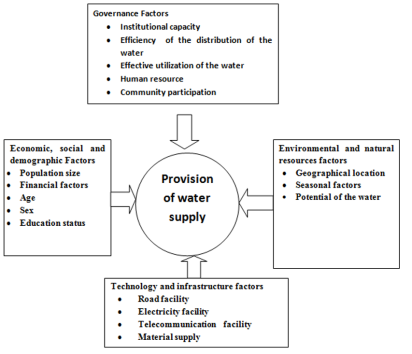
Figure 1. Conceptual Framework.
Specifically, Woliso is one of the towns located in the Southwest Shewa Zone, Oromia region of Ethiopia. The provision of adequate clean drinking water in the area has been an over-challenging situation in recent years. The provision of water and sanitation services is inseparable and must be integrated at all levels through a sustainable and coherent framework. Woliso Town water supply and sanitation service, the appropriate body provision for providing water for the town, had many problems as an institution to warrant the provision of water supply. Currently, there is inadequate water for everyday activities of the household, drinking, cooking, cleaning utensils, and washing clothes. Consequently, residents are required to get water from unprotected sources, which are far from their homes; they also buy water frequently from far areas, which is costly
| [13] | WTWSSE. (2020/21). Woliso Town Water Supply and Sewerage Service Enterprise Annual Report. Woliso, Ethiopia. |
[13]
.
In Woliso Town, which has a long history and is presently one of the towns of the country, the problem of the provision of water supply has become a common feature over the last few decades. However, the tremendous expansion and the rapid population growth of the town in association with the delay of implementation of the designed water supply project have necessitated the design review of the water supply project. Consequently, this revised design report is prepared to accommodate the water demand of the ever-increasing population of the town as well as the annexation of neighboring rural kebeles to the town, which the previous studies have not incorporated
| [13] | WTWSSE. (2020/21). Woliso Town Water Supply and Sewerage Service Enterprise Annual Report. Woliso, Ethiopia. |
[13]
.
Although different research has been conducted in the town in relation to water supply, including environmental sanitation and the extent of bacterial contamination through the different sources of water, there are no studies that have properly addressed the factors affecting the provision of water in particular to Woliso Town. Therefore, this study investigated factors that affect the provision of water supply in the study area.
In providing enough clean water to city residents, the world encounters several challenges. Various factors play a role in this process. First, governance-related issues, including the ability of institutions to function effectively, how efficiently water is distributed, how well it is used, the availability of skilled personnel, and the involvement of the local community, are key factors that can influence water supply in the area. Second, economic, social, and demographic factors, such as the population size, financial resources, age, gender, and education level of people, are also important factors that can impact water availability. Third, environmental and natural resource considerations, such as where a place is located geographically, seasonal changes, and the availability of water sources, are expected to influence the water supply. Lastly, technological and infrastructural elements, including road networks, electricity supply, communication systems, and the availability of materials, are significant factors that can affect the overall provision of water.
2. Study Area Description and Methods
2.1. Description of the Study Area
Woliso Town is located in the Oromia Region, specifically in the Southwest Shewa Zone. It is situated close to Addis Ababa and lies approximately 114 kilometers away from the capital city. Woliso is a reform town within the Oromia Region and is governed by a city administration and municipality. Currently, the town extends into the areas of five neighboring rural kebeles, covering a total area of 2,515.25 hectares. The Oromia Urban Planning Institute is conducting surveying activities to prepare an updated basic structural plan for future development, which includes the integration of these five neighboring rural kebeles into the town's administrative structure. The town is bordered by Genda Bedesa Koricha in the west and northwest, Fodu Gora in the south, Lemen Ayitu and Tonbe Achebe in the east, and Obi Koji in the north, all of which are currently annexed to the town. At a broader level, Woliso Town is bordered by Bacho Woreda to the north, Wonchi Woreda to the west, the Gurage Zone to the southwest, Goro Woreda to the south, and Sadene Soddo Woreda to the east
| [5] | Mengistu, T. (2008). Assessment of drinking water quality and sanitation practices in selected urban areas (Master’s thesis). Addis Ababa University, Ethiopia. |
| [12] | WTM. (2020). Woliso Town Municipality Profile, Woliso, Oromia, Ethiopia. |
[5, 12]
.
According to the Municipality data, the town is home to a population of approximately 118,725 people, with 56,108 men and 62,617 women. The main ethnic groups in the town are the Oromo, Amhara, and Gurage, making up 67.7%, 15.4%, and 14.1% of the population respectively. The majority of the residents follow Ethiopian Orthodox Christianity, with 63.29% identifying with this faith. Other religious affiliations include Protestantism, which is practiced by 19.06% of the population, Islam by 15.6%, and other beliefs by 1.30%. Woliso Town is located in a tropical climate zone. The highest seasonal temperatures in the town occur between February and May, while the lowest temperatures are recorded between July and September. April is the hottest month of the year, while August is the coldest. The mean minimum temperature is 11.10°C, the mean maximum is 24.80°C, and the best mean annual temperature is 18.00°C
| [12] | WTM. (2020). Woliso Town Municipality Profile, Woliso, Oromia, Ethiopia. |
[12].
2.2. Methods
Both qualitative and quantitative approaches were employed for the study
| [1] | Creswell, J. W. (2003) Research Design: Qualitative, Quantitative, and Mixed Method Approaches. Sage Publications, Thousand Oaks. |
[1]
. All the necessary data needed to address the research question were collected from both primary and secondary sources. The main secondary sources included government and non-government publications, annual reports, prior research, and books. For primary data, the researcher distributed questionnaires and conducted interviews with key informants.
When choosing participants for in-depth interviews, the researcher used purposive sampling to select representatives from the population and key informants. Woliso town was selected purposively because, despite having significant potential for water resources, these resources are not being fully utilized. The town is divided into four kebeles. To select a sample kebele, a stratified sampling method was used to ensure that differences in water supply levels across the kebeles were represented. After this, a simple random sampling technique was applied to select one kebele with a better water supply and another one with a lower water supply. The researcher also used purposive sampling to choose key informants from the Woliso Town Water Supply and Sanitation Office. From this office, four key informants were selected. These included the head of the Woliso Town Water Supply, Sewerage Service Enterprise Office, the deputy head, and two senior experts in the office.
Meanwhile, this study was focused on factors affecting the provision of water in Woliso town. According to Woliso Town Municipality
| [12] | WTM. (2020). Woliso Town Municipality Profile, Woliso, Oromia, Ethiopia. |
[12]
, the population for this study was the total number of households in the two kebeles, which is 6260. In addition, in order to determine the representative sample size, the study was planned to use a sample size determination formula, which is provided by Yemane Taro
| [14] | Yemane Taro. (1967). The developing sampling method and sample size calculation. Japan. |
[14]
.
n=is representative sample size
N=the number of households
e=is level of precision error/confidence level/
Depending on this formula:
N=6260 and e=0.08
Due to time and budget constraints, it became difficult to take and administer the questionnaire with this sample. Consequently, the study participants used a confidence level of 0.08 to get the specified sample.
Before the actual collection of data, a document of materials was made to check its validity and clarity. The pre-testing of the questionnaires was undertaken on six sample households, which helped with the implementation of the actual survey and the restructuring of the questionnaire format and content. In this study, the questionnaire consisted of a set of questions that were presented to the respondent and answered by the respondent. It can be both an open-ended and a closed-ended question that was prepared to collect data, which is deemed to be relevant to the study.
To analyze the data collected a combination of quantitative and qualitative analysis was employed. Mainly quantitative data, which was generated from a household survey, was analyzed using simple descriptive statistics tools like frequency and percentages. The qualitative data were collected using interviews and examined through description, narrating the situation contextually so that the town water supply situation was properly exposed.
3. Results and Discussion
3.1. Characteristics of the Respondents
Under the characteristics of respondents like sex and age, the respondent was used appropriately to know the respondents’ characteristics and background information before going to the major part of the study.
3.1.1. Sex Distribution of the Respondents
As indicated in
Table 1 below, out of the total 156 respondents, 107 (68.6%) were male and the remaining 49 (31.4%) were female. Therefore, the survey result indicated that the majority of the respondents were male.
Table 1. Sex distribution of the respondents.
Sex | Frequency | Percentage |
Male | 107 | 68.6 |
Female | 49 | 31.4 |
Total | 156 | 100 |
Source: Ownsurvey, 2020/21 |
3.1.2. Age Distribution of the Respondents
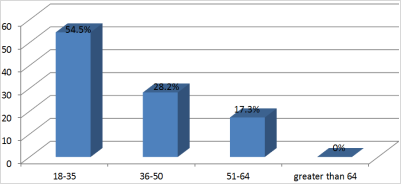
According to the below figure, the ages of respondents from 18-35 were 85 (54.5%), 36-50 were 44 (28.2%), and 51-64 were 27 (17.3%), and there was no respondent above 65 years of age (
Figure 2). Therefore, the data distribution indicated that the majority of respondents are young adults.
Figure 2. Age distribution of the respondents in percentage.
3.2. Current Status of Water Supply in the Town
According to the interview results, residents in the town are beneficiaries of the town water supply service; almost all of them collect water from the water supply system of the town through 59.3% private yard connections, 6.0% house connections, 18.2% public taps, and the rest, 16.5%, from other sources. Therefore, the result indicated that the majority of the households of the town were gaining water services from private yard connections, which were installed by the Woliso Town Water Supply Sewerage Enterprise.
According to data gained from Woliso Town Water Supply Sewerage Enterprise
| [13] | WTWSSE. (2020/21). Woliso Town Water Supply and Sewerage Service Enterprise Annual Report. Woliso, Ethiopia. |
[13]
, the sources of water for the town residents are many. There are about seven main sources of water that meet their daily water needs. These are Prison House-1, Obi-2 (BH-01), Obi-3 (BH-02), Obi-4 (BH-03), Projynest-5 (BH-04), Municipality-6 (BH-05), and Dembeli-7 (BH-06) (WTWSSE 2011).
3.2.1. Accessibility of Water Supply in the Town
The survey result indicated that about 10 (6.4%) of the respondents replied that the accessibility of the water supply is very high. About 15 (9.6%) of the respondents responded that the accessibility of the water supply in Woliso town is high. About 20 (12.8%) of the respondents responded that the accessibility of the water supply in the town is moderate. About 70 (44.9%) of the respondents responded that the accessibility of water supply is low, and the remaining 41 (26.3%) of the respondents responded that the accessibility of water supply is very low (
Table 2). Therefore, the result indicated that most respondents replied that the accessibility of the water supply in the town is low and very low, respectively. In defending the result according to the interview result, accessibility of water supply is not improved, as it was expected or planned to provide for the society.
Table 2. Accessibility of Water Supply.
Accessibility water supply | Frequency | Percentage |
Very high | 10 | 6.4% |
High | 15 | 9.6% |
Moderate | 20 | 12.8% |
low | 70 | 44.9% |
Very low | 41 | 26.3 |
Total | 156 | 100% |
Source: Own survey, 2020/21
3.2.2. Existence of Equitable Water Distribution in the Town
The survey result indicated that only about 27 (17.3%) of the respondents believed that the water distribution in the town is equitable. Whereas, the majority of the respondents and about 129 (82.7%) of the respondents believed that there is no equitable distribution of water in the town. Therefore, the result implies that nearly all respondents claim that there is no equitable distribution of water in the town (
Table 3).
Table 3. Respondent’s assessment toward equitable water distribution in the town.
Presence of equitable water distribution | Frequency | Percentage |
Yes | 27 | 17.3% |
No | 129 | 82.7% |
Total | 156 | 100% |
Source: Own Survey, 2020/21
Regarding factors behind unequal distribution of water supply, the survey result indicated that about 75 (48.1%) of the respondents responded that the main cause of inequitable distribution of water in the town is a lack of administrative problem.
About 22 (14.1%) of the respondents replied that the cause of inequitable water distribution is a lack of maintenance in the town. About 5 (3.2%) of the respondents responded that the cause of inequitable water distribution is geographical topography. About 4 (2.6%) of the respondents replied that the cause of inequitable distribution of water supply is seasonal factors. About 20 (12.8%) of the respondents responded that the cause of inequitable water distribution is the potential of the water. Finally, about 30 (19.2) of the respondents replied that the cause of inequitable water distribution is population size (
Figure 3). Therefore, according to the data, most respondents replied that the main cause of inequitable distribution of water supply is administrative problems in the town. In addition, according to interview results, population growth with high demand for water and the provision of water were highly unmatched or not matched.
Figure 3. Reason for inequitable water distribution.
3.3. Factors Affecting Water Supply in the Study Area
3.3.1. Administrative Problem
Survey results show that most people believe government workers are not very responsible. They are not paying enough attention or responding quickly enough, and they are not fully committed to their duties. There is also a sense of unfair treatment between public officials and regular citizens, as well as between public officials and businesses. For example, small industries such as soap factories, edible oil production units, wood and metal workshops, flour mills, local breweries, and restaurants get more water than other people.
Based on field surveys, it was found that the current water distribution system in the town has limitations. There are frequent water pipe failures, and water loss is quite high in the study area. If this problem continues across all pipes over the years, it will negatively affect the whole water network’s performance. The water loss in the pipelines was calculated using data from the Woliso Town Water Supply and Sewerage Enterprise for 2020/21, and it was below 20% except for the previous year. According to maintenance workers, old pipes breaking frequently is a common issue and most of these pipes are made of low-quality, imported materials from China. These materials are plastic and do not last long. Thus, the use of non-local, low-quality materials in the pipelines is leading to water supply problems in the town, which are linked to administrative issues.
The survey shows that 7 (4.5%) of respondents said the main issue affecting water supply is a lack of groundwater. About 16 (10.2%) of respondents mentioned community participation is the key factor. Around 83 (53.2%) said the main issue is lack of government attention, while 43 (27.6%) pointed out population growth as the main cause. Lastly, about 7 (4.5%) respondents said the main issue is financial. All of these findings show that the town's water supply system is underperforming due to administrative problems.
This shows that those in charge are not taking their responsibilities seriously, responding slowly, showing little commitment, and treating citizens and businesses unfairly. Additionally, there is a mismatch between the increasing water demand in Woliso town due to population growth and the available supply. It was also found that the water distribution accounts for only 59%, showing a significant imbalance with the community’s needs.
Table 4. Factors for supply problem.
Factors for Water Supply Problem | Frequency | Percentage |
Lack of ground water | 7 | 4.5 |
Lack of community participation | 16 | 10.2 |
Low levels of government attention | 83 | 53.2 |
Lack of technology | - | 0 |
Population size | 43 | 27.6 |
Financial factor | 7 | 4.5 |
Total | 156 | 100% |
Source: Own Survey, 2020/21
Similar to the survey results, the interviewee results show that administrative problems; lack of active community participation; unbalanced demand and supply; lack of proper utilization of water resources and skilled manpower; lack of communication and conflict of interest among the enterprise, locality, and originalities of pipelines; rapid population growth; limited budget; and lack of independent channels for basic uses and enterprise are major factors for water supply problems in the town by different degrees. Therefore, according to both the survey and interview results, the major factor in water supply that the majority of respondents agreed on is the lack of government attention towards the issue in the whole town.
3.3.2. Rapid Population Growth
The steady growth of the town population due to natural increase and the expansion of the organization imposed a higher burden upon the utility office of the Woliso town water supply and sanitation office. On average, about 25.5% are less than 15 years old and are young and economically dependent and elderly people account for 2.8% of the total. This would mean only 72.5% of the population is economically active and supports itself and the rest of the population. For such a large productive-age population, employment opportunity creation requires due attention and expenditure for education, health, shelter, food, and other basic services, which is very high. According to the sample household survey conducted in the study town in 2019, the average household size is 4.8. In addition to that, according to information gained from time to time, birth rates in the town were increasing; as a result, it is obvious that demand for water increases
| [13] | WTWSSE. (2020/21). Woliso Town Water Supply and Sewerage Service Enterprise Annual Report. Woliso, Ethiopia. |
[13]
.
According to the relevant data from the Woliso Town Water Supply and Sewerage Enterprise's Annual Report
| [13] | WTWSSE. (2020/21). Woliso Town Water Supply and Sewerage Service Enterprise Annual Report. Woliso, Ethiopia. |
[13]
, there is rapid population growth in the town, which has 6260 households in the selected kebele, despite a limited supply of water. The town comprises four kebele administrations, and the five recently added rural kebeles are accountable to the town administration. According to the interview results, “the distribution of the water supply is 59%, which is unbalanced with the demand of the community.”
3.3.3. Shortage of Skilled Human Power to Solve Water Supply Problem
According to the survey results, about 50 (32.1%) respondents believe that the town water supply and sewerage enterprise has skilled human power to solve the water supply problem. In other words, about 106 (67.9%) of respondents believe that there is no skilled human resource to solve or address the water supply problem in the town (
Table 5). Similar to the survey result, the interview result indicated that there is not enough manpower with the necessary skill and knowledge. Therefore, according to both the survey and interview results, there are not enough human resources with the necessary quality to solve the water supply problem in the town.
Table 5. Presence of skilled human power to solve water supply problem.
Presence of Quantity and quality of human resource | Frequency | Percentage |
Yes | 50 | 32.1% |
No | 106 | 67.9% |
Total | 156 | 100% |
Source: Own survey, 2020/21
Similarly to the survey result, the interview result indicates that, in the town, there are problems with long-term and proper maintenance of water services. Because in the town, there is no enough training or awareness creation about the proper utilization of water resources. Therefore, there is insufficient skilled labor in order to use groundwater resources. More or less, the lack of proper utilization of water resources and skilled workforces is a challenge to the water supply in the town.
3.3.4. Awareness of the Community in the Proper Utilization of Water
Survey results show that about 6 (3.9%) of the respondents responded that the awareness of the community on the proper utilization of water is very high in the town. About 10 (6.4%) of the respondents replied that the awareness of the community on the proper utilization of water is high. About 20 (12.9%) of the respondents responded that the awareness of the community on the proper utilization of water is moderate in the town. About 70 (44.9%) of the respondents responded that the awareness of the community on the proper utilization of water is low in the town, and the remaining 50 (32.1%) of the respondents responded that the awareness of the community on the proper utilization of water is very low (
Table 6). Therefore, as we have seen in the above table, most of the respondents replied that the awareness of the community on the proper utilization of water is low in the town.
Table 6. Awareness Level of community.
Awareness level of community | Frequency | Percentage |
Very high | 6 | 3.9 |
High | 10 | 6.4 |
Moderate | 20 | 12.9 |
Low | 70 | 44.9 |
Very low | 50 | 32.1 |
Total | 156 | 100% |
Source: Own Survey, 2020/21
Similarly to the survey results, many of the respondents’ replies show that the government officials, particularly the Woliso town water supply office, do not give enough room for public participation in the cause of water supply and discussion to increase the awareness of people toward proper utilization of the existing water resource. This shows that there are gaps between the Woliso town water supply officer, citizens, and enterprises.
3.3.5. Lack of Communication and Conflict of Interest Within the Government Bodies
According to the interview results, there is no good communication among government bodies specifically water installation, road construction, and telecommunications office. When the water supply service installs pipelines, they do not consider a master plan. In addition, the road construction enterprise comes and destroys the pipelines. And also telecom service is one of the major means by which people interact within and outside the town for different purposes, but at the same time, telecom companies consider only their own interest. As far as the field survey goes, we observe that there is a conflict of interest among the enterprises. Therefore, lack of communication and conflict of interest within the enterprise lead to a problem or challenge with the water supply service in town.
3.3.6. Budget and Funds and Independent Channel for Basic Uses and Enterprises
According to the interview, the results indicate that the delivery of urban water requires a high level of investment. Due to a lack of sufficient funding, mostly, the quality of water supply services of the Woliso Town Water Supply and Sewerage Enterprise and the coverage were very limited. In addition, the current cost recovery of the town is not sufficient.
According to the key informants, there is no self-regulating source of water for basic needs, and other water required for schools, universities, hospitals, health centers, government offices and services, religious institutions, and other public facilities is classified as public and institutional water demand. The public and institutional water demand is usually expressed as the percentage of the average day's domestic water demand. According to the data collected from the WSSE (2020/21) report, the water consumption of the public and institutions ranges from 11% to 15.6% relative to the existing domestic water consumption, but it is logical to consider 10% of the domestic water demand for future public and institutional water demand. And also other enterprises, such as the Blocket enterprise, animal husbandry, and other business organizations, so these enterprises consume a high percentage of the water source. This leads to a shortage of water supply for household consumers.
3.3.7. Degrees of Water Supply Problem in the Town
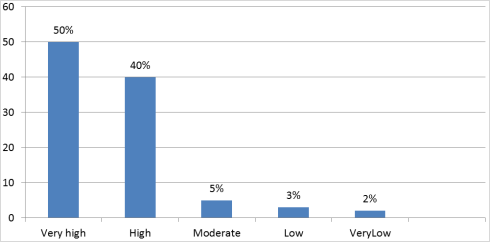
The survey result shows that about 78 (50%) of the respondents responded that the degree of water supply problem in town is very high, and about 63 (40%) of the respondents responded that the degree of water supply problem in town is high. About 8 (5%) of respondents replied that the degree of water supply problem is moderate in the study area. About 4 (3%) of respondents replied that the degree of the water supply problem is low. About 3 (2%) of respondents replied that the degree of water supply problem is very low (
Figure 4). Therefore, according to the majority of respondents, the degree of the water supply problem is very high.
Finally, the water supply in Woliso town is facing several serious challenges. This research outlines the main problems that are affecting the availability and quality of water. The town is experiencing fast and uncontrolled population growth, which is putting a lot of pressure on the current water infrastructure. As more people move in, the demand for water increases, but the system is not able to keep up. There are also management issues within the administration. Poor management and slow decision-making are preventing timely and effective solutions to the water supply problems. Another issue is the lack of involvement from the local community. Without their participation, their needs may not be properly addressed, and they may not feel a sense of responsibility for maintaining the water sources. Inefficient use of water resources is also contributing to shortages. This can happen due to leaks, wastage, or poor distribution methods, which result in less water being available than needed. Additionally, there are problems in the way different organizations involved in water management work together. When these entities do not coordinate well, it can lead to conflicts and disrupt the overall functioning of the water supply system. All these factors together create a complex set of difficulties in ensuring that Woliso's residents have access to sufficient and reliable water.
Figure 4. Degree of water supply problems.
4. Conclusion and Implications
This study aimed to examine the factors influencing the availability of water in Woliso town. From the outset, it was clear that the water supply issue was caused by several interconnected problems, including sudden population growth, administrative hurdles, limited community participation, inefficient use of resources, and poor coordination between critical services like telecommunications, electricity, water supply, and road infrastructure. Our investigation highlighted that the rapid population increase was a major cause of the water shortage in Woliso. As the population grew, the pressure on available water resources became more evident, underscoring the urgent need for thoughtful planning and sustainable solutions to ensure that residents have access to a sufficient and dependable water supply.
To tackle these complex challenges, a united effort from various stakeholders, including local governments, utility providers, and the community, is essential. By understanding the underlying causes of the water supply shortage and applying specific interventions, it is possible to reduce the impact of these factors and enhance the town’s water infrastructure for current and future residents. Based on these findings, the following policy recommendations are proposed to improve water supply services in Woliso Town.
Local authorities, such as the Woliso Town Administration and the Water Supply and Sewerage Service Enterprise, should take complaints seriously and encourage community involvement, as water is a fundamental necessity.
First, the government should allocate special attention to the water supply by setting aside a dedicated budget. Second, updating directives, rules, and regulations related to water services would help align the operations with other authorities. Addressing the performance of unresponsive staff is also crucial. There should be a system in place to monitor how much of the annual budget is spent on water supply services. Cooperation among the three key government institutions especially road construction, telecommunications, and water services is essential for effective infrastructure development. These entities should prioritize their tasks strategically, understanding the order of importance in the planning and implementation process. Good collaboration ensures seamless integration of services and resources.
A major challenge in the town is the inefficient use of water resources. The improper management of water within the community is a serious issue that requires immediate attention from responsible authorities. To address this, organizations must develop a comprehensive strategy that includes education and awareness efforts. Training programs and awareness campaigns can significantly influence the community by promoting responsible water use. Through such initiatives, residents can gain knowledge about water conservation, the consequences of wasteful behavior, and the importance of preserving water for future generations. Equipping the public with the right information and tools can foster a sense of shared responsibility for the town’s water supply. By taking proactive steps in education and awareness, it is possible to create a more sustainable and environmentally mindful community.
To fully address the skill gaps in the workforce of the Water Supply and Sewerage Service Enterprise, a structured framework for continuous training programs must be established. These programs can enhance the expertise and capabilities of employees, improving the overall efficiency and performance of the workforce. By investing in professional development, the enterprise can not only close existing skill gaps but also keep up with the latest industry practices. These training initiatives also cultivate a culture of continuous learning and improvement within the organization, promoting better service quality and customer satisfaction. Ultimately, the integration of regular training programs into the enterprise's operations is essential for maintaining a well-prepared and skilled workforce capable of meeting the evolving needs of the water supply and sewerage sector.





 Share This Article
 Twitter
 Linked In
 Facebook
 Copy
Copy Download