
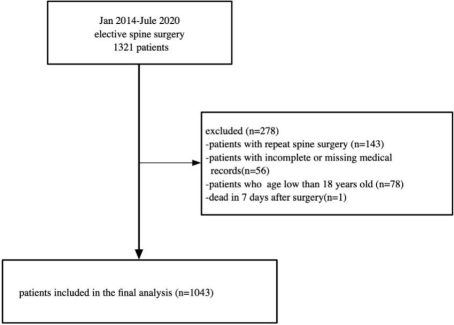
The aim of this study was to determine the incidence and risk factors of postoperative acute kidney injury (AKI) in patients with spinal tuberculosis surgery. And in this retrospective case-control study, patients were diagnosed with AKI after surgery according to kidney disease: improving global outcomes (KDIGO) guidelines. Multivariate logistic regression model was used to calculate the association between perioperative factors and AKI. A propensity score matching (PSM) evaluation was developed for adjustment and matching. The final result was that a total of 86 patients diagnosed AKI and 957 without AKI were selected from 1043 patients. After PSM analysis, preoperative anemia (OR, 3.57; 95%CI, 1.45-8.79; P=0.006), higher erythrocyte sedi-mentation rate (ESR) level (OR, 1.01; 95%CI, 1.00-1.03; P=0.029), intraoperative hypotension (OR, 3.42; 95%CI, 1.40-8.33; P=0.007) were predictors for postoperative AKI, and intraoperative dexmedetomidine (DEX) used (OR, 0.36; 95%CI, 0.14-0.91; P=0.030) was associated with a reduced risk for AKI. Patients with postoperative AKI were associated with increased rates of demanded for intensive care unit (ICU), and prolonged hospital length of stay (P<0.05). The final conclusion was that the postoperative AKI incidence was 8.25%. Moreover, Preoperative anemia, higher level of ESR and intraoperative hypotension can significantly increase the risk of AKI after spinal tuberculosis surgery. DEX infusion was associated with lower incidence of postoperative AKI.
| Published in | Journal of Surgery (Volume 14, Issue 4) |
| DOI | 10.11648/j.js.20261404.13 |
| Page(s) | 81-88 |
| Creative Commons |
This is an Open Access article, distributed under the terms of the Creative Commons Attribution 4.0 International License (http://creativecommons.org/licenses/by/4.0/), which permits unrestricted use, distribution and reproduction in any medium or format, provided the original work is properly cited. |
| Copyright |
Copyright © The Author(s), 2026. Published by Science Publishing Group |
Acute Kidney Injury, Surgery, Spinal Tuberculosis, Case-control Study, Propensity Score
Variables | Entire samples | Matched samples | ||||
|---|---|---|---|---|---|---|
Patients with AKI (n=86) | Patients without AKI (n=957) | p value | Patients with AKI (n=82) | Patients without AKI (n=82) | p value | |
Patients’ demographics | ||||||
Age (yr) | 51 (59.3) | 282 (29.4) | <0.001 | 48 (58.5) | 50 (60.9) | 0.750 |
Sex, male | 51 (59.3) | 495 (51.7) | 0.178 | 35 (42.6) | 29 (35.3) | 0.337 |
BMI (kg/m2) | 23.1 (21.0~25.6) | 22.1 (19.5~24.7) | 0.457 | 23.5±3.4 | 23.41±3.6 | 0.337 |
ASA Ⅲ~Ⅳ | 41 (47.6) | 263 (27.4) | <0.001 | 38 (46.3) | 38 (46.3) | 1.000 |
Hypertension | 40 (46.5) | 161 (16.8) | <0.001 | 38 (46.3) | 37 (45.1) | 0.875 |
Diabetes mellitus | 15 (17.4) | 90 (9.4) | 0.018 | 13 (15.8) | 15 (18.2) | 0.678 |
CKD | 6 (6.9) | 4 (0.4) | <0.001 | 2 (2.4) | 0 (0) | — |
Cerebrovascular disease | 6 (8.1) | 21 (2.1) | 0.020 | 6 (7.3) | 5 (6.1) | 0.755 |
Coronary arterial disease | 15 (17.4) | 45 (4.7) | <0.001 | 13 (15.8) | 14 (17.0) | 0.833 |
Hypoalbuminemia | 49 (56.9) | 275 (28.7) | <0.001 | 45 (54.8) | 29 (35.3) | 0.013 |
Anemia | 42 (48.8) | 197 (20.5) | <0.001 | 38 (46.3) | 54 (65.8) | 0.012 |
ESR (mm/h) | 49.5 (18.7~76.0) | 29.0 (14.0~55.0) | <0.001 | 50.0 (18.0~76.0) | 30.0 (17.7~49.5) | 0.005 |
BUN (mmol/L) | 4.6 (3.6~5.9) | 4.1 (3.3~5.2) | 0.836 | 4.6 (3.6~5.7) | 4.2 (3.3~4.8) | 0.816 |
Serum creatinine (μmol/L) | 63.4 (46.2~80.9) | 58.9 (50.7~69.1) | <0.001 | 62.0 (46.0~77.1) | 61.5 (52.8~70.0) | 0.363 |
Proteinuria | 37 (43.0) | 260 (27.2) | 0.002 | 36 (43.9) | 21 (25.6) | 0.015 |
Intraoperative variables | ||||||
Hypertension | 38 (44.1) | 233 (24.3) | <0.001 | 36 (43.9) | 30 (36.5) | 0.340 |
Hypotension | 42 (48.8) | 182 (19.0) | <0.001 | 39 (47.5) | 20 (24.3) | 0.002 |
Dexmedetomidine | 42 (48.8) | 639 (66.7) | 0.001 | 40 (48.7) | 51 (62.2) | 0.085 |
Tranexamic acid | 25 (29.0) | 380 (39.7) | 0.053 | 24 (29.2) | 34 (41.4) | 0.104 |
NSAIDs | 26 (30.2) | 336 (35.1) | 0.363 | 26 (31.7) | 22 (26.8) | 0.493 |
Blood loss (ml) | 500 (400~800) | 500 (300~700) | 0.007 | 500 (300~800) | 500 (300~700) | 0.187 |
Erythrocyte transfusion (ml) | 0 (0~200) | 0 (0~400) | 0.001 | 400 (0~400) | 0 (0~400) | 0.136 |
Crystalloids (ml) | 2800 (2100~3400) | 2700 (2350~3300) | 0.583 | 2750 (2100~3325) | 2700 (2175~3250) | 0.485 |
Urinary output (ml) | 210 (200~400) | 250 (200~400) | 0.280 | 210 (200~362) | 255 (200~412) | 0.171 |
Duration of surgery (min) | 168.0 (137.5~220.0) | 184.5 (147.0~230.7) | 0.085 | 168.0 (137.5~221.5) | 181.5 (139.7~226.2) | 0.615 |
Entire samples | Matched samples | |||
|---|---|---|---|---|
OR (95%CI) | p Value | OR (95%CI) | p Value | |
Preoperative hypertension | 2.10 (1.14~3.88) | 0.017 | ||
Preoperative CKD | 5.46 (1.06~27.98) | 0.042 | ||
Hypoalbuminemia | 1.85 (1.02~3.35) | 0.042 | 0.51 (0.21~1.21) | 0.129 |
Serum creatine | 1.01 (1.00~1.03) | 0.028 | ||
ESR | 1.01 (1.00~1.02) | <0.001 | 1.01 (1.00~1.03) | 0.029 |
Proteinuria | 1.87 (1.08~3.23) | 0.025 | 0.55 (0.25~1.23) | 0.151 |
Anemia | 5.03 (2.76~9.16) | <0.001 | 3.57 (1.45~8.79) | 0.005 |
Intraoperative hypertension | 1.85 (1.07~3.20) | 0.027 | ||
Intraoperative hypotension | 3.71 (2.09~6.56) | <0.001 | 3.42 (1.40~8.33) | 0.007 |
Dexmedetomidine | 0.44 (0.25~0.79) | 0.006 | 0.36 (0.14~0.91) | 0.030 |
Tranexamic acid | 0.38 (0.21~0.69) | 0.002 | ||
Variables | Entire samples | Matched samples | ||||
|---|---|---|---|---|---|---|
Patients with AKI (n=86) | Patients without AKI (n=957) | P-value | Patients with AKI (n=86) | Patients without AKI (n=957) | P-value | |
ICU needed | 26 (30.2) | 51 (5.3) | 0.0001 | 22 (26.8) | 8 (9.7) | 0.005 |
Hospital days | 18.0 (15.0~27.6) | 14.0 (12.0~17.5) | 0.013 | 15.0 (12.0~21.2) | 13.0 (11.0~18.0) | 0.044 |
RRT | 1 (1.1) | 0 | 0 | 0 | ||
AKI | Acute Kidney Injury |
KDIGO | Kidney Disease: Improving Global Outcomes |
PSM | Propensity Score Matching |
ESR | Erythrocyte Sedi-mentation Rate |
DEX | Dexmedetomidine |
ICU | Intensive Care Unit |
CKD | Chronic Kidney Disease |
ESRD | End-stage Renal Disease |
ASA | American Society of Anesthesiologists |
BMI | Body Mass Index |
BUN | Blood Urea Nitrogen |
OR | Odds Ratios |
95%CI | 95% Confidence Intervals |
BMI | Body Mass Index |
NSAIDs | Non-Steroidal Anti-inflammatory Drugs |
RRT | Renal replacement therapy |
RIFLE | Risk-Injury-Failure-Loss-End |
p-AKT | Phospho-serine/Threonine Protein Kinase |
| [1] | World Health Organization. Global tuberculosis report 2019 [R]. Geneva: World Health Organization, 2019. |
| [2] | Khanna K, Sabharwal S. Spinal tuberculosis: a comprehensive review for the modern spine surgeon. The Spine Journal. 2019; 19(11): 1858-1870. |
| [3] | Zhang HQ, Li JS, Zhao SS, Shao YX, Liu SH, Gao Q, et al. Surgical management for thoracic spinal tuberculosis in the elderly: posterior only versus combined posterior and anterior approaches. Archives of Orthopaedic and Trauma Surgery. 2012; 132(12): 1717-1723. |
| [4] | Rajasekaran S, Khandelwal G. Drug therapy in spinal tuberculosis. European Spine Journal. 2013; 22(Suppl 4): 587-593. |
| [5] | Thakar CV. Perioperative acute kidney injury. Advances in Chronic Kidney Disease. 2013; 20(1): 67-75. |
| [6] | Grams ME, Sang Y, Coresh J, Ballew S, Matsushita K, Molnar MZ, et al. Acute Kidney Injury After Major Surgery: A Retrospective Analysis of Veterans Health Administration Data. American Journal of Kidney Diseases. 2016; 67(6): 872-880. |
| [7] | Uchino S, Bellomo R, Bagshaw SM, Goldsmith D. Transient azotaemia is associated with a high risk of death in hospitalized patients. Nephrology Dialysis Transplantation. 2010; 25(6): 1833-1839. |
| [8] | Li S, Wang S, Priyanka P, Kellum JA. Acute Kidney Injury in Critically Ill Patients After Noncardiac Major Surgery: Early Versus Late Onset. Critical Care Medicine. 2019. |
| [9] | Ponte B, Felipe C, Muriel A, Tenorio MT, Liano F. Long-term functional evolution after an acute kidney injury: a 10-year study. Nephrology Dialysis Transplantation. 2008; 23(12): 3859-3866. |
| [10] | Coca SG, Yusuf B, Garg MG, Ax G, et al. Long-term risk of mortality and other adverse outcomes after acute kidney injury: a systematic review and meta-analysis. American Journal of Kidney Diseases. 2009; 53(6): 961-973. |
| [11] | Chandra H, Mehta N, Arora T, Chaudhary S, Tiwari A, Saxena V, et al. Acute Kidney Injury and Risk of Death After Elective Surgery: Prospective Analysis of Data From an International Cohort Study. Annals of Surgery. 2018. |
| [12] | American Society of Anesthesiologists Task Force on Blood Component Therapy. Practice Guidelines for blood component therapy. Anesthesiology. 1996; 84(3): 732-747. |
| [13] | Khwaja A. KDIGO clinical practice guidelines for acute kidney injury. Nephron Clinical Practice. 2012; 120(4): c179-c184. |
| [14] | Yen T, Chandra S, Luthra S. Acute kidney injury post-major orthopaedic surgery: A single-Centre case-control study. Journal of the College of Physicians and Surgeons Pakistan. 2018; 23(2): 126-132. |
| [15] | Kaya M, Akcan T, Çimen D, Aras M, Bora K, Turan M, et al. Validation of Renal Risk Score Models for Coronary Artery Bypass Surgery in Diabetic Patients. Heart Lung and Circulation. 2019; 28(5): 800-806. |
| [16] | Cho W, Hwang TY, Choi YK, Yang JH, Kim MG, Jo SK, et al. Diastolic dysfunction and acute kidney injury in elderly patients with femoral neck fracture. Kidney Research and Clinical Practice. 2019; 38(1): 33-41. |
| [17] | Sahiratmadja E, Wieringa FT, van Crevel R, de Visser AW, Adnan I, Alisjahbana B, et al. Iron deficiency and NRAMP1 polymorphisms (INT4, D543N and 3'UTR) do not contribute to severity of anaemia in tuberculosis in the Indonesian population. British Journal of Nutrition. 2007; 98(4): 684-690. |
| [18] | Kuznetsov EV, Borisov BE, Borisova EA, de R C, Borisov HM. Risk factors for mortality among adult patients with newly diagnosed tuberculosis in Samara, Russia. International Journal of Tuberculosis and Lung Disease. 2006; 10(11): 1224-1230. |
| [19] | Gil-Santana L, Cruz L, Arriaga M, Miranda P, Fukutani K, Silveira-Mattos P, et al. Tuberculosis-associated anemia is linked to a distinct inflammatory profile that persists after initiation of antitubercular therapy. Scientific Reports. 2019; 9(1): 1381. |
| [20] | Johannes T, Mik EG, Nohe B, Unertl KE, Ince C. Acute decrease in renal microvascular PO2 during acute normovolemic hemodilution. American Journal of Physiology-Renal Physiology. 2007; 292(2): F796-F803. |
| [21] | Estrella MM, Astor BC, Kottgen A, Selvin E, Coresh J, Parekh RS. Prevalence of kidney disease in anaemia differs by GFR-estimating method: the Third National Health and Nutrition Examination Survey (1988-94). Nephrology Dialysis Transplantation. 2010; 25(8): 2542-2548. |
| [22] | Zlonis M. The mystique of the erythrocyte sedimentation rate. A reappraisal of one of the oldest laboratory tests still in use. Clinics in Laboratory Medicine. 1993; 13(4): 787-800. |
| [23] | Yuan Y, Qiu H, Hu X, Luo T, Gao X, Zhao X, et al. Predictive value of inflammatory factors on contrast-induced acute kidney injury in patients who underwent an emergency percutaneous coronary intervention. Clinical Cardiology. 2017; 40(9): 719-725. |
| [24] | Kumar G, Elhence M, Gupta K. Predictive accuracy of urinary β2-microglobulin for kidney injury in children with acute pyelonephritis. Journal of Hospital Infection. 2015; 9(1): 19-24. |
| [25] | Maheshwari K, Turan A, Mao G, Yang D, Niazi AK, Agarwal D, et al. The association of hypotension during non-cardiac surgery, before and after skin incision, with postoperative acute kidney injury: a retrospective cohort analysis. Anaesthesia. 2018; 73(10): 1223-1228. |
| [26] | Cantaluppi C, Emanueli G, Mannino F, Cesare MR, Gentile PT, Tognazzo D, et al. Role of endothelium-related mechanisms in the pathophysiology of renal ischemia/reperfusion in normal rabbits. Kidney International. 1996; 79(5): 1031-1038. |
| [27] | Goligorsky MS, Noiri E, Tsukahara H, Budzikowski AS, Li H. A pivotal role of nitric oxide in endothelial cell dysfunction. Acta Physiologica Scandinavica. 2000; 168(1): 33-40. |
| [28] | Ji F, Li Z, Young JN, Yeranossian A, Liu H. Post-bypass dexmedetomidine use and postoperative acute kidney injury in patients undergoing cardiac surgery with cardiopulmonary bypass. PLoS One. 2013; 8(10): e77446. |
| [29] | Hsing CH, Lin CF, So E, Sun DP, Chen TC, Li CF, et al. alpha2-Adrenoceptor agonist dexmedetomidine protects septic acute kidney injury through increasing BMP-7 and inhibiting HDAC2 and HDAC5. American Journal of Physiology-Renal Physiology. 2012; 303(10): F1443-F1453. |
| [30] | Gu J, Sun P, Zhao H, Watts HR, Sanders RD, Terrando N, et al. Dexmedetomidine provides renoprotection against ischemia-reperfusion injury in mice. Critical Care. 2011; 15(3): R153. |
| [31] | Bayram A, Ulgey A, Baykan A, Narin N, Narin F, Esmaoglu A, Boyaci A. The effects of dexmedetomidine on early stage renal functions in pediatric patients undergoing cardiac angiography using non-ionic contrast media: a double-blind, randomized clinical trial. Paediatric Anaesthesia. 2014; 24(4): 426-432. |
APA Style
Li, R. (2026). Incidence and Risk Factors of Acute Kidney Injury After Spinal Tuberculosis Surgery: A Case-control Study with Propensity Score Analysis. Journal of Surgery, 14(4), 81-88. https://doi.org/10.11648/j.js.20261404.13
ACS Style
Li, R. Incidence and Risk Factors of Acute Kidney Injury After Spinal Tuberculosis Surgery: A Case-control Study with Propensity Score Analysis. J. Surg. 2026, 14(4), 81-88. doi: 10.11648/j.js.20261404.13
@article{10.11648/j.js.20261404.13,
  author = {Ruixue Li},
  title = {Incidence and Risk Factors of Acute Kidney Injury After Spinal Tuberculosis Surgery: A Case-control Study with Propensity Score Analysis},
  journal = {Journal of Surgery},
  volume = {14},
  number = {4},
  pages = {81-88},
  doi = {10.11648/j.js.20261404.13},
  url = {https://doi.org/10.11648/j.js.20261404.13},
  eprint = {https://article.sciencepublishinggroup.com/pdf/10.11648.j.js.20261404.13},
  abstract = {The aim of this study was to determine the incidence and risk factors of postoperative acute kidney injury (AKI) in patients with spinal tuberculosis surgery. And in this retrospective case-control study, patients were diagnosed with AKI after surgery according to kidney disease: improving global outcomes (KDIGO) guidelines. Multivariate logistic regression model was used to calculate the association between perioperative factors and AKI. A propensity score matching (PSM) evaluation was developed for adjustment and matching. The final result was that a total of 86 patients diagnosed AKI and 957 without AKI were selected from 1043 patients. After PSM analysis, preoperative anemia (OR, 3.57; 95%CI, 1.45-8.79; P=0.006), higher erythrocyte sedi-mentation rate (ESR) level (OR, 1.01; 95%CI, 1.00-1.03; P=0.029), intraoperative hypotension (OR, 3.42; 95%CI, 1.40-8.33; P=0.007) were predictors for postoperative AKI, and intraoperative dexmedetomidine (DEX) used (OR, 0.36; 95%CI, 0.14-0.91; P=0.030) was associated with a reduced risk for AKI. Patients with postoperative AKI were associated with increased rates of demanded for intensive care unit (ICU), and prolonged hospital length of stay (P<0.05). The final conclusion was that the postoperative AKI incidence was 8.25%. Moreover, Preoperative anemia, higher level of ESR and intraoperative hypotension can significantly increase the risk of AKI after spinal tuberculosis surgery. DEX infusion was associated with lower incidence of postoperative AKI.},
 year = {2026}
}
TY  - JOUR
T1  - Incidence and Risk Factors of Acute Kidney Injury After Spinal Tuberculosis Surgery: A Case-control Study with Propensity Score Analysis
AU  - Ruixue Li
Y1  - 2026/08/22
PY  - 2026
N1  - https://doi.org/10.11648/j.js.20261404.13
DO  - 10.11648/j.js.20261404.13
T2  - Journal of Surgery
JF  - Journal of Surgery
JO  - Journal of Surgery
SP  - 81
EP  - 88
PB  - Science Publishing Group
SN  - 2330-0930
UR  - https://doi.org/10.11648/j.js.20261404.13
AB  - The aim of this study was to determine the incidence and risk factors of postoperative acute kidney injury (AKI) in patients with spinal tuberculosis surgery. And in this retrospective case-control study, patients were diagnosed with AKI after surgery according to kidney disease: improving global outcomes (KDIGO) guidelines. Multivariate logistic regression model was used to calculate the association between perioperative factors and AKI. A propensity score matching (PSM) evaluation was developed for adjustment and matching. The final result was that a total of 86 patients diagnosed AKI and 957 without AKI were selected from 1043 patients. After PSM analysis, preoperative anemia (OR, 3.57; 95%CI, 1.45-8.79; P=0.006), higher erythrocyte sedi-mentation rate (ESR) level (OR, 1.01; 95%CI, 1.00-1.03; P=0.029), intraoperative hypotension (OR, 3.42; 95%CI, 1.40-8.33; P=0.007) were predictors for postoperative AKI, and intraoperative dexmedetomidine (DEX) used (OR, 0.36; 95%CI, 0.14-0.91; P=0.030) was associated with a reduced risk for AKI. Patients with postoperative AKI were associated with increased rates of demanded for intensive care unit (ICU), and prolonged hospital length of stay (P<0.05). The final conclusion was that the postoperative AKI incidence was 8.25%. Moreover, Preoperative anemia, higher level of ESR and intraoperative hypotension can significantly increase the risk of AKI after spinal tuberculosis surgery. DEX infusion was associated with lower incidence of postoperative AKI.
VL  - 14
IS  - 4
ER  -
Department of Anesthesiology, West China Hospital, Sichuan University, Chengdu, China

Information



 Share This Article
 Twitter
 Linked In
 Facebook
 Copy
Copy Download