Abstract
The acceleration of urbanization has highlighted the stress problems among college students, making environmental interventions to promote physical and mental health an important direction in campus health landscape research. However, the current research faces issues such as weak sample specificity, single indicators, and the absence of saturation variables, making it difficult to support precise design of campus healthy landscapes. Therefore, this study, targeting college students, employed a randomized controlled experiment to set up visual exposure scenarios with low and high saturation green and purple plants, as well as a control group without plants. The purpose of the study is to provide scientific evidence for campus plant landscape design and stress intervention for college students Measurements included systolic blood pressure, diastolic blood pressure, pulse, and Self-Rating Anxiety Scale (SAS) scores, to explore the effects of plant color saturation on physiological and psychological recovery. The results showed that visual exposure to plants effectively reduced blood pressure and anxiety levels, with low saturation plants providing better restorative benefits than high saturation and the control group. Specifically, low saturation green performed better in improving systolic blood pressure, while low saturation purple had advantages in diastolic blood pressure, pulse, and anxiety relief. The study indicates that color saturation is a key visual factor affecting the restorative effects of plant landscapes, providing references for optimizing campus health environments.
|
Published in
|
Psychology and Behavioral Sciences (Volume 15, Issue 2)
|
|
DOI
|
10.11648/j.pbs.20261502.11
|
|
Page(s)
|
21-28 |
|
Creative Commons
|

This is an Open Access article, distributed under the terms of the Creative Commons Attribution 4.0 International License (http://creativecommons.org/licenses/by/4.0/), which permits unrestricted use, distribution and reproduction in any medium or format, provided the original work is properly cited.
|
|
Copyright
|
Copyright © The Author(s), 2026. Published by Science Publishing Group
|
Keywords
Restorative Benefits, Color Saturation, Stress Relief, Campus Landscape
1. Introduction
Rapid urbanization and high-intensity academic life have led to persistent psychological stress among college students, with high incidence of anxiety becoming a significant issue affecting their physical and mental health. As the primary activity space for college students, campus environment quality directly influences individual physical and mental states. Natural environment interventions based on plant landscapes, characterized by non-pharmaceutical, low-cost, and easy promotion, serve as effective way for stress relief and mood improvement, and have become an important direction in healthy campus and restorative environment research.
Restorative environment theory provides the core theoretical support for this study. Ulrich's Stress Reduction Theory points out that natural visual stimuli can inhibit sympathetic nerve excitation by regulating autonomic nervous activity, promoting physiological relaxation and emotional calmness, and color saturation directly determines the intensity of visual stimuli: low saturation colors are softer, effectively reducing neural arousal levels, aligning with the core mechanism of stress relief. Kaplan's Attention Restoration Theory emphasizes that natural environments can alleviate mental fatigue and restore depleted attention; high saturation colors tend to cause visual tension and attention depletion, while low saturation colors are more likely to provide a mild and lasting immersive experience, conducive to attention restoration. As a typical restorative environment, plant landscapes have color saturation as a key visual factor regulating restorative effects, providing a theoretical basis for this study to analyze the physical and mental recovery effects of plants with different saturations.
Existing studies have confirmed the positive effects of plant landscapes on mood improvement and physiological relaxation
| [1] | Su C., Chen Y. X., Wang Y. D. Research on Cultural Value Perception Preferences and Influence Mechanisms of Urban Historical Parks Based on User-Generated Data—A Case Study of Suzhou [J/OL]. New Architecture, 1-14. |
| [2] | Kang N., Li S. H., Li F. H. Research on the Impact of Garden Landscapes on Human Psychology [J]. Chinese Landscape Architecture, 2008, (07): 69-72. |
| [3] | Xing Z. J., Kang Y. G., Li M. D. Research on the Effects of Garden Plant Forms on Human Physiology and Psychology [J]. Journal of Northwest Forestry University, 2015, 30(02): 283-286. https://doi.org/10.3969/j.issn.1001-7461.2015.02.50 |
| [4] | Zhai Y. J., Yu J. Y., Fan B. B. The Impact of Scale and Type of Urban Small Green Spaces on Youth Perception Preferences and Perceived Restoration Benefits [J]. New Architecture, 2024, (06): 37-42. https://doi.org/10.3390/land13091370 |
[1-4]
. As an important visual factor, color hue differences can trigger different psychological and physiological reactions. Natural color systems such as green and purple show significant effects in relaxing mood and relieving anxiety, but overall, there are still research shortcomings. First, most existing achievement focus on comparative analyses of plant presence, species types, and hue differences, with relatively shallow exploration of color dimensions; second, research precisely controlling and quantitatively analyzing saturation as an independent variable is relatively scarce, and the independent contribution and mechanism of saturation to environmental restorative effects have not been clarified; third, most studies only use subjective psychological evaluations, with insufficient multi-dimensional verification combining objective physiological indicators and subjective psychological scales, and the scientificity and robustness of conclusions need strengthening; fourth, targeted studies on college students in campus scenarios are relatively weak, and evidence directly serving healthy campus landscape construction is insufficient.
Current research has problems such as weak sample targeting, single indicators, and missing saturation variables, making it difficult to support precise design of campus health landscapes. Based on this, this paper takes college students as subjects, uses a randomized controlled experiment to systematically explore the effects of low and high saturation green and purple plants on blood pressure, pulse, and anxiety, innovatively focuses on the independent effect of saturation and quantifies its restorative benefits, optimizes plant color configuration patterns, and provides scientific basis for campus plant landscape design and college student stress intervention.
2. Research Methods
2.1. Experimental Subjects
This study used a randomized controlled trial (RCT) design to compare the physiological and psychological recovery differences of college students under visual exposure scenarios with different plant color saturations. Randomized controlled trial is a recognized gold standard method for evaluating interventions
| [5] | Li J. H. Construction of a "Somatized" System for Elderly Depression Intervention [M]. Jinan University Press: 2023. |
[5]
, with advantages such as random grouping, control setup, and confounding variable isolation, which can minimize individual differences, grouping bias, and external factor interference, ensuring reliable causal inference between experimental treatments and physical and mental recovery effects. This method has been widely verified and adopted in landscape visual intervention and stress physiological and psychological research, providing a mature methodological basis for this study. Existing research shows that college students have no significant differences in plant landscape preferences compared to other age groups, so selecting college students as experimental subjects is considered scientific and representative
. This experiment recruited 150 college students, with an average age of 20.42 and a male-to-female ratio of about 1: 2. Using a random number table, participants were randomly assigned to 5 groups: saturation -20 green plant group; saturation +20 green plant group; saturation -20 purple plant group; saturation +20 purple plant group; control group. Each group had 30 people, with a male-to-female ratio of about 1: 2, and experiments were conducted simultaneously
| [7] | Lu Z. G. Study on the Effect of Campus Plant Colors on Regulating College Students' Emotions [J]. Journal of Plant Biology, 2022, 57(02): 263-264. |
| [8] | Tulen J. H. M, Moleman P, Van S. H. G. Characterization of stress reactions to the Stroop Color Word Test [J]. Pharmacology Biochemistry and Behavior, 1989, 32(1): 9-15.
https://doi.org/10.1016/0091-3057(89)90204-9 |
[7, 8]
.
Experimental requirements included normal or corrected vision, no color blindness/weakness, no serious cardiovascular or mental diseases, no alcohol or caffeine intake 24 hours before the experiment, no strenuous exercise, and ability to cooperate in completing physiological indicator measurements and scale filling. Subjects with visual cognitive impairments or unable to stably complete the experimental process were excluded to avoid experimental result errors. This experiment has passed the ethical review of the school's science and technology ethics committee, and all participants have signed informed consent forms.
2.2. Experimental Procedure
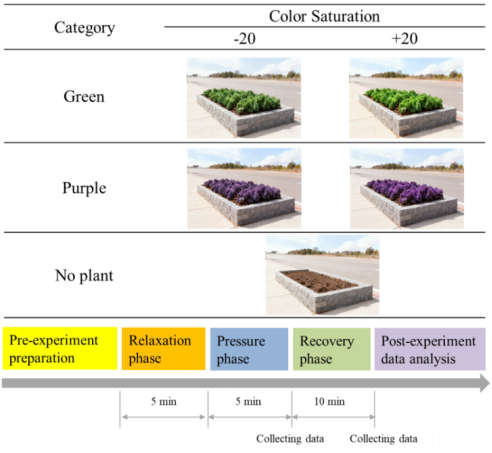
The experiment was conducted in an indoor experimental space that was relatively quiet, with minimal external interference, stable light environment, and indoor illuminance of 500 lux. Kale is a common material in campus plant landscape design, with diverse colors. To avoid differences caused by single flower colors, the experiment used two colors of kale, selecting green and purple, which have been shown to have significant anxiety-relieving effects in existing research. To avoid interference from factors other than plant color, the pictures used in the experiment were consistent except for plant color, using image processing software to unify picture composition, lighting, size, and resolution, only adjusting the color saturation of the experimental plants in the pictures. Based on the standard HSV color space, hue and brightness were fixed, green and purple were calibrated to baseline HSV values, and then saturation was uniformly reduced by 20% (low saturation) and increased by 20% (high saturation) relative to the original image through linear transformation, ensuring that the experimental plants in each group of pictures only differed in saturation, with all other visual elements completely consistent, following the single variable principle. A unified 16-inch computer with a resolution of 2560 x 1600 was used for the experiment, with participants' heads 50 cm from the computer screen to view the pictures, ensuring that physiological and psychological indicator changes were only caused by color saturation. A no-plant blank control group was set up to exclude the impact of sitting quietly during viewing on mood. The experimental procedure is shown in
Figure 1. The experimenter explained the experimental purpose and procedures and helped participants wear equipment. After signing the informed consent form, participants were randomly assigned to one of the 5 groups. Participants first sat quietly for 5 minutes of rest during the relaxation phase, then completed a 5-minute Stroop test to induce stress emotions. The Stroop test is commonly used to study sympathetic nerve changes caused by stress and has been found to increase heart rate, respiratory rate, etc., triggering negative emotions such as anxiety. Then, during the recovery phase, they sat quietly and viewed plants of different colors for 10 minutes. The experiment collected participants' systolic blood pressure, diastolic blood pressure, pulse, and SAS score data after the stress phase and recovery phase, respectively.
Figure 1. Experimental parameters and flowchart.
2.3. Experimental Indicators
Previous studies have found that landscapes can bring psychological effects to the public, and these effects are often recorded and described in the form of mood scales
. However, since emotional recovery is often unconscious
| [10] | Wang X. J. Research on the Restorative Effect and Mechanism of Restorative Environments [D]. Xi'an: Shaanxi Normal University, 2015. |
[10]
and mood fluctuations in the environment are relatively mild, traditional data collection techniques often struggle to accurately reflect and capture true emotions. Using physiological feedback can better understand individual emotions. In recent years, researchers have used various physiological stress indicators, such as heart rate, cortisol, blood pressure, and pulse, to precisely identify human emotions with an accuracy of up to 95%
| [11] | Kim J, Aendre E. Emotion recognition based on physiological changes in music listening [J]. IEEE Transaction on Pattern Analysis and Machine Intelligence, 2008, 30(12): 2067-2083. https://doi.org/10.1109/tpami.2008.26 |
[11]
. Therefore, this experiment selected blood pressure and pulse as experimental indicators, and also selected the Self-Rating Anxiety Scale (SAS) score as an experimental indicator to further enhance the persuasiveness of the experiment.
(1) Blood pressure is positively correlated with anxiety level
| [12] | Ni J. J. Analysis of Comorbid Anxiety and Depression Status and Related Factors in Hypertension [D]. Inner Mongolia Medical University, 2025. |
[12]
and can be used as a measure of stress. An increase in blood pressure represents an individual's transition from a stable to an anxious and tense emotional state, while a decrease indicates stress relief and a gradual trend towards relaxation and calm. Blood pressure, as an important part of the four major vital signs, can not only be used to assess heart health but also to infer the body's internal functional state by observing the activities of the sympathetic and parasympathetic nervous systems
| [13] | Zhang Z. Temperature and Humidity Effects of Plant Communities in Shenzhen Park Green Spaces and Their Impact on Human Physiology and Psychology [D]. Beijing Forestry University, 2014. |
[13]
.
Blood pressure is positively correlated with anxiety level and can be used as a measure of stress. An increase in blood pressure represents an individual's transition from a stable to an anxious and tense emotional state, while a decrease indicates stress relief and a gradual trend towards relaxation and calm. This study used an electronic blood pressure monitor for physiological indicator measurement. The instrument used was the Yuwell Wrist Electronic Blood Pressure Monitor 8800AR Voice Model, which can simultaneously complete the collection of systolic blood pressure, diastolic blood pressure, and pulse. During measurement, subjects sat quietly and relaxed, with unified measurement of left wrist blood pressure. Each test was measured twice consecutively, and the average of the two measurements was taken as the final data to improve result accuracy and stability. Blood pressure, as an important part of the four major vital signs, can not only be used to assess heart health but also to infer the body's internal functional state by observing the activities of the sympathetic and parasympathetic nervous systems.
(2) Past research has proven that pulse accelerates due to negative emotions
. Pulse is an important physiological phenomenon caused by heart contraction, which accelerates blood flow, dilates blood vessels, and can be perceived by the human body. It is one of the four major vital signs and an objective indicator of physiological arousal, measured as beats per minute. Pulse frequency is influenced not only by age and gender but also by the sympathetic and parasympathetic nervous systems, meaning it changes in response to external stimuli.
(3) The Self-Rating Anxiety Scale (SAS) is a relatively simple clinical tool for analyzing patients' subjective anxiety feelings. The scale was compiled by Zung in 1971 and contains 20 assessment items using a 4-level scoring standard. This study used the commonly used Chinese version of the SAS scale, with standard scores for statistical analysis; after testing, the scale's Cronbach's α coefficient in this study was 0.82, and the Cronbach's α coefficients of each experimental group ranged from 0.71 to 0.85, indicating good reliability and stable and reliable measurement results. The standard score range of the scale is 25~100 points, with higher scores indicating more severe anxiety. Scores below 50 indicate no significant anxiety, 50~59 indicate mild anxiety, 60~69 indicate moderate anxiety, and 70 and above indicate severe anxiety.
3. Research Results
3.1. Changes in Blood Pressure Before and After Testing with Plants of Different Saturations
After t-test, in the five experimental conditions, the subjects' systolic and diastolic blood pressure decreased, but the specific decrease varied (
Table 1).
(1) Systolic Blood Pressure
Systolic blood pressure decreased most significantly in the saturation -20 green plant and saturation -20 purple plant conditions, with a decrease of about 6 mmHg. The systolic blood pressure in the saturation -20 green plant and saturation -20 purple plant conditions showed extreme significance at P<0.01 level, rejecting the null hypothesis, so there was a significant difference between pre-test and post-test systolic blood pressure pairs, with Cohen's d values of about 0.74 and 0.53, respectively, indicating medium effect sizes. The systolic blood pressure in the saturation +20 green plant and saturation +20 purple plant conditions decreased next, with a decrease of about 5 mmHg. The saturation +20 green plant condition had P>0.05, indicating no significant difference before and after testing; the saturation +20 purple plant condition had P<0.05, showing significance, rejecting the null hypothesis, so there was a significant difference, with Cohen's d values of about 0.37 and 0.43, respectively, indicating small effect sizes.
Systolic blood pressure in the control condition without plants had the smallest decrease, about 1 mmHg, with significance P>0.05, indicating no significant difference between pre-test and post-test systolic blood pressure, with a Cohen's d value of 0.09, indicating a very small effect size.
Comprehensive judgment in the five experimental conditions showed that the college students' systolic blood pressure relief trend overall: saturation -20 green plant (d=0.74) > saturation -20 purple plant (d=0.53) > saturation +20 purple plant (d=0.43) > saturation +20 green plant (d=0.37) > no plant (d=0.09).
(2) Diastolic Blood Pressure
Diastolic blood pressure decreased most significantly in the saturation -20 green plant and saturation -20 purple plant conditions, with a decrease of about 4.5 mmHg. The diastolic blood pressure in the saturation -20 green plant condition showed significance at P<0.05 level, and the saturation -20 purple plant condition showed extreme significance at P<0.01 level, rejecting the null hypothesis, so there was a significant difference between pre-test and post-test diastolic blood pressure pairs, with Cohen's d values of about 0.49 and 0.59, respectively, with saturation -20 green plant having a small effect size and saturation -20 purple plant having a medium effect size. The diastolic blood pressure in the saturation +20 green plant and saturation +20 purple plant conditions decreased next, with a decrease of about 2.5 mmHg. The diastolic blood pressure in the saturation +20 green plant and saturation +20 purple plant conditions showed significance at P<0.05 level, rejecting the null hypothesis, so there was a significant difference between pre-test and post-test diastolic blood pressure pairs, with Cohen's d values of about 0.41 and 0.39, respectively, indicating small effect sizes.
Diastolic blood pressure in the control condition without plants had the smallest decrease, about 0.2 mmHg, with significance P>0.05, indicating no significant difference between pre-test and post-test diastolic blood pressure, with a Cohen's d value of 0.03, indicating a very small effect size.
Comprehensive judgment in the five experimental conditions showed that the college students' diastolic blood pressure relief trend overall: saturation -20 purple plant (d=0.59) > saturation -20 green plant (d=0.49) > saturation +20 green plant (d=0.41) > saturation +20 purple plant (d=0.39) > no plant (d=0.03).
Table 1. The difference in blood pressure before and after viewing photos of five types of plants.
Physiological indicators | Test situation | Mean (rounded to the nearest integer) ± Standard deviation | P | Cohen'sd |
Before test/mmHg | After test/mmHg | Difference between before and after |
Systolic pressure | Green +20 | 121±17.150 | 117±14.789 | 4.4±11.560 | P=0.054 | 0.37 |
Green -20 | 121±12.435 | 115±10.658 | 6.3±8.507 | P<0.01 | 0.74 |
Purple +20 | 120±19.780 | 115±21.402 | 5.1±7.834 | P<0.05 | 0.43 |
Purple -20 | 117±12.936 | 111±10.022 | 6.0±8.126 | P<0.01 | 0.53 |
No plant | 117±16.818 | 116±15.269 | 0.8±8.803 | P=0.6369 | 0.09 |
Diastolic pressure | Green +20 | 74±11.908 | 72±11.992 | 2.0±4.177 | P<0.05 | 0.41 |
Green -20 | 78±10.142 | 74±9.117 | 4.1±6.920 | P<0.05 | 0.49 |
Pulse +20 | 74±11.197 | 71±12.157 | 2.9±6.209 | P<0.05 | 0.39 |
Pulse -20 | 78±10.307 | 73±10.020 | 5.1±6.116 | P<0.01 | 0.59 |
No plant | 76±9.737 | 75±10.050 | 0.2±5.517 | P=0.863 | 0.03 |
Table 2. The difference in pulse before and after viewing photos of five types of plants.
Physiological indicators | Test situation | Mean (rounded to the nearest integer) ± Standard deviation | P | Cohen'sd |
Before test /bpm | After test /bpm | Difference between before and after |
Pulse value | Green +20 | 78±9.669 | 76±11.294 | 1.7±7.329 | P=0.3 | 0.19 |
Green -20 | 79±10.556 | 77±11.576 | 1.8±6.189 | P=0.21 | 0.23 |
Purple +20 | 78±14.855 | 76±14.404 | 1.6±4.738 | P=0.279 | 0.2 |
Purple -20 | 81±8.996 | 78±8.553 | 2.5±7.533 | P<0.05 | 0.38 |
No plant | 81±10.732 | 81±10.919 | 0.1±5.316 | P=0.892 | 0.03 |
3.2. Changes in Pulse Before and After Testing with Plants of Different Saturations
After t-test, the pulse rates of the subjects decreased in all five experimental conditions, but the extent of decrease varied (
Table 2). Among them, the most significant decrease was observed in the low-saturation purple group, with a reduction of 2.5 bpm, reaching a significant level (P < 0.05). The decreases in the low-saturation green group, high-saturation green group, and high-saturation purple group were 1.8 bpm, 1.7 bpm, and 1.6 bpm, respectively, none of which reached a significant level (P > 0.05). The control group without plants showed the smallest decrease, only 0.1 bpm (P > 0.05).
Overall, under the five experimental conditions, the trend of pulse rate relief in college students is ranked as follows: saturation -20 purple plant (d = 0.38) > saturation -20 green plant (d = 0.23) > saturation +20 purple plant (d = 0.2) > saturation +20 green plant (d = 0.19) > no plant (d = 0.03).
3.3. Changes in SAS Scale Scores Before and After Testing with Plants of Different Saturations
After t-test, in the five experimental conditions, the subjects' SAS scale scores decreased, but the specific decrease varied (
Table 3).
The SAS scale score decreased most significantly in the saturation -20 purple plant and saturation +20 purple plant conditions, with a decrease of about 2.5 points. The SAS scale score in the saturation -20 purple plant and saturation +20 purple plant conditions showed significance at P<0.05 level, rejecting the null hypothesis, therefore there was a significant difference between the pre-test and post-test SAS scale score pairs, with Cohen's d values of about 0.59 and 0.49, respectively. The saturation -20 purple plant condition had a medium effect size, and the saturation +20 purple plant condition had a small effect size. The SAS scale score in the saturation -20 green plant and saturation +20 green plant conditions decreased next, with a decrease of about 2 points. The SAS scale score in the saturation -20 green plant and saturation +20 green plant conditions showed significance at P<0.05 level, rejecting the null hypothesis, therefore there was a significant difference between the pre-test and post-test SAS scale score pairs, with Cohen's d values of about 0.58 and 0.54, respectively, indicating medium effect sizes.
Table 3. Difference in SAS scale scores before and after viewing photos of 5 types of plants.
Physiological indicators | Test situation | Mean (rounded to the nearest integer) ± Standard deviation | P | Cohen'sd |
Before test /bpm | After test /bpm | Difference between before and after |
SAS scale scores | Green +20 | 39±8.121 | 37±8.658 | 2.1±3.166 | P<0.05 | 0.54 |
Green -20 | 43±10.847 | 41±11.629 | 2.2±3.388 | P<0.05 | 0.58 |
Purple +20 | 41±10.689 | 38±10.529 | 2.6±3.461 | P<0.05 | 0.49 |
Purple -20 | 41±7.844 | 39±7.690 | 2.7±3.790 | P<0.05 | 0.59 |
No plant | 41±6.835 | 40±6.638 | 0.8±2.679 | P=0.14 | 0.28 |
The SAS scale score in the control condition without plants had the smallest decrease, about 0.8 points, with significance P>0.05, indicating no significant difference between pre-test and post-test SAS scale scores, with a Cohen's d value of 0.28, indicating a small effect size.
Comprehensive judgment in the five experimental conditions showed that the college students' SAS scale score relief trend overall: saturation -20 purple plant (d=0.59) > saturation -20 green plant (d=0.58) > saturation +20 green plant (d=0.54) > saturation +20 purple plant (d=0.49) > no plant (d=0.28).
4. Discussion
This study, taking college students as subjects, systematically explored the effects of visual exposure to green and purple plants with different saturations on systolic blood pressure, diastolic blood pressure, pulse, and anxiety (SAS scale). Paired t-tests were used for statistical testing, and Cohen's d value was used to quantify the effect size, aiming to reveal the internal relationship between plant color saturation and physiological-psychological restorative effects, and to provide scientific basis for indoor plant configuration, campus environment optimization, and healthy environment design
| [15] | An Y. J.. Study on the Physiological and Psychological Effects of Campus Green Space on College Students in Guiyang Universities [D]. Guizhou University, 2023. |
[15]
. Combining experimental data and related theories, the main results are summarized and discussed in depth as follows.
The experimental results show that visual exposure to plants can effectively improve the blood pressure status of college students, and the physiological restorative effect of low saturation treatment is significantly better than that of high saturation and the no-plant group
| [16] | Wang Z. G., Chi Y. F. Self-Rating Anxiety Scale (SAS)[J]. Shanghai Archives of Psychiatry, 1984, (02): 73-74. |
[16]
.
In terms of systolic blood pressure, both low saturation green and purple plants achieved extremely significant decreases (P<0.01), with a decrease of about 6 mmHg. Among them, the low saturation green group had an effect size of d=0.74, which was the best in the entire group; the high saturation green group showed no statistical difference (P>0.05), and the control group only decreased by 0.8 mmHg. This trend is consistent with the view that low saturation colors can relieve anxiety
| [17] | Wang R. X. The Impact of Emotional Color Expression in Interaction Design on User Decision-Making [J]. Color, 2025, (11): 13-15. |
[17]
, and also verifies the core mechanism in Ulrich's Stress Reduction Theory that mild visual stimuli can inhibit sympathetic nerve excitation. Diastolic blood pressure changes showed a similar pattern. Low saturation purple and green plants decreased by 5.1 mmHg and 4.1 mmHg, respectively, with differences reaching extremely significant or significant levels (P<0.01, P<0.05). The decrease in high saturation plants was only about half of that in the low saturation group, and the control group showed no significant improvement. Compared with existing research proving that cool-colored plants have good emotional restoration benefits, this study further confirms that under the premise of consistent hue, saturation is a key factor determining the intensity of physiological restoration by plant landscapes, and low saturation can significantly improve the regulatory effect of plant landscapes on blood pressure.
For the pulse indicator, only the low saturation purple group showed a significant decrease (P<0.05, d=0.38), while the other plant groups showed no statistical difference, and the control group remained basically unchanged. This result supplements the insufficient attention paid to the physiological effects of purple in existing color research, indicating that low saturation purple has a more targeted regulatory effect on cardiovascular homeostasis
| [18] | Zhu Y. Q, Yang R. T., Li S. H. Warm Colors or Cool Colors—A Study on the Emotional Restoration Benefits of Indoor Colorful Flowering Plants [J]. Community, 2025, (04): 148-157. |
[18]
.
The SAS scale score results show that all four plant intervention groups significantly reduced anxiety levels (P<0.05), with a decrease of 2.1~2.7 points, while the no-plant group only decreased by 0.8 points and the difference was not significant (P>0.05), directly proving the effectiveness of plant visual exposure in relieving anxiety. From the saturation dimension, low saturation purple (d=0.59) and low saturation green (d=0.58) had the best and similar effects, while the high saturation plant groups had lower effect sizes. This supports the conclusion that high saturation colors have stronger stimulation, higher neural arousal levels, and therefore weaker relaxation effects
| [19] | Zhang F. Analysis of Color Dynamic Application Strategies in Interaction Design Based on User Experience [J]. Color, 2025, (07): 28-30. |
[19]
.
From the perspective of neural mechanisms, low saturation color visual stimuli are mild, which can reduce sympathetic nerve excitability and enhance parasympathetic nerve activity
| [20] | Liu B. J. Emotional Orientation Design Strategies for Healing Spaces - Application of Color and Natural Light in Japan's Sumiyoshido Therapy Hall [J]. Journal of Art and Design, 2025, (04): 55-57. |
[20]
, achieving blood vessel dilation, heart rate slowing, and emotional stability; high saturation colors have strong stimulation intensity and high neural arousal levels, weakening the restorative effect. This explanation is consistent with Kaplan's Attention Restoration Theory and also aligns with the current trend in neurophysiological research on healthy environments.
Green and purple show differentiated restorative advantages: green is more prominent in improving systolic blood pressure, which is related to its peaceful and natural psychological image
| [21] | Ren L. J. From Pain Points to Solutions: Reshaping the "Good House" Model with Old House Spatial Narrative [J]. China Interior Decoration, 2026, (05): 20-23. |
[21]
, making it suitable for spaces that require stable emotions and maintained concentration, such as classrooms and libraries; purple performs better in diastolic blood pressure, pulse, and anxiety relief, with stronger regulation of autonomic nerve balance, making it suitable for functional spaces such as psychological counseling rooms, rest areas, and stress relief corners.
Compared with existing research, this study achieves two breakthroughs: first, it breaks through the limitations of traditional hue research and quantitatively confirms the independent contribution of saturation to anxiety relief for the first time; second, it clarifies the restorative effect of low saturation plants in the college student population, providing directly applicable numerical basis for the design of campus healing landscapes. Overall, low saturation green and purple plants can be used as preferred configurations for creating healthy campus environments, providing stable and sustainable environmental support for stress intervention and physical and mental recovery of college students.
5. Conclusions
This study, based on a randomized controlled experiment, explored the effects of plant color saturation on the physiological and psychological recovery of college students. The results indicate:
(1) Visual exposure to plants can significantly reduce blood pressure and anxiety levels, having a certain restorative effect;
(2) The overall recovery effect of low saturation plants is better than that of high saturation and no-plant situations, indicating that saturation is an important visual influencing factor;
(3) Green is better in improving systolic blood pressure, while purple has advantages in diastolic blood pressure, pulse, and anxiety relief.
Overall, the restorative effect of plant landscapes depends not only on "whether they exist" but also on their visual attributes. The conclusions of this paper mainly apply to small-scale campus spaces aimed at stress reduction and emotional recovery. In addition, this study still has certain limitations: the sample only includes college students, the variable setting is relatively simple, and it is based on short-term visual experiments. Future research can expand the study population and color gradients, introduce multi-modal physiological indicators, and conduct verification in real scenarios to further enhance the explanatory power and application value of the research.
Abbreviations
SAS | Self-Rating Anxiety Scale |
Author Contributions
Dongliang Li: Conceptualization, Writing – original draft
Baoyu Huang: Funding acquisition, Writing – review & editing
Junkai Zhao: Writing – original draft
Yang Li: Writing – original draft
Conflicts of Interest
The authors declare no conflicts of interest.
References
| [1] |
Su C., Chen Y. X., Wang Y. D. Research on Cultural Value Perception Preferences and Influence Mechanisms of Urban Historical Parks Based on User-Generated Data—A Case Study of Suzhou [J/OL]. New Architecture, 1-14.
|
| [2] |
Kang N., Li S. H., Li F. H. Research on the Impact of Garden Landscapes on Human Psychology [J]. Chinese Landscape Architecture, 2008, (07): 69-72.
|
| [3] |
Xing Z. J., Kang Y. G., Li M. D. Research on the Effects of Garden Plant Forms on Human Physiology and Psychology [J]. Journal of Northwest Forestry University, 2015, 30(02): 283-286.
https://doi.org/10.3969/j.issn.1001-7461.2015.02.50
|
| [4] |
Zhai Y. J., Yu J. Y., Fan B. B. The Impact of Scale and Type of Urban Small Green Spaces on Youth Perception Preferences and Perceived Restoration Benefits [J]. New Architecture, 2024, (06): 37-42.
https://doi.org/10.3390/land13091370
|
| [5] |
Li J. H. Construction of a "Somatized" System for Elderly Depression Intervention [M]. Jinan University Press: 2023.
|
| [6] |
Kaplan R, He E. J. Culture and sub-culture comparisons in preferences for natural setting [J]. Landscape and Urban Planning, 1987, 14: 281-293.
https://doi.org/10.1016/0169-2046(87)90024-5
|
| [7] |
Lu Z. G. Study on the Effect of Campus Plant Colors on Regulating College Students' Emotions [J]. Journal of Plant Biology, 2022, 57(02): 263-264.
|
| [8] |
Tulen J. H. M, Moleman P, Van S. H. G. Characterization of stress reactions to the Stroop Color Word Test [J]. Pharmacology Biochemistry and Behavior, 1989, 32(1): 9-15.
https://doi.org/10.1016/0091-3057(89)90204-9
|
| [9] |
Wang Z. Q., Li K. K., Dou L. Restorative Effect of Plant Colors on Negative Emotions of College Students [J]. Journal of Northwest Forestry University, 2018, 33(3): 290-296.
https://doi.org/10.3969/j.issn.1001-7461.2018.03.46
|
| [10] |
Wang X. J. Research on the Restorative Effect and Mechanism of Restorative Environments [D]. Xi'an: Shaanxi Normal University, 2015.
|
| [11] |
Kim J, Aendre E. Emotion recognition based on physiological changes in music listening [J]. IEEE Transaction on Pattern Analysis and Machine Intelligence, 2008, 30(12): 2067-2083.
https://doi.org/10.1109/tpami.2008.26
|
| [12] |
Ni J. J. Analysis of Comorbid Anxiety and Depression Status and Related Factors in Hypertension [D]. Inner Mongolia Medical University, 2025.
|
| [13] |
Zhang Z. Temperature and Humidity Effects of Plant Communities in Shenzhen Park Green Spaces and Their Impact on Human Physiology and Psychology [D]. Beijing Forestry University, 2014.
|
| [14] |
Ulrich R. S. Natural versus urban Scenes: Some psychophysiological effects [J]. Environment and Behavior, 1981, 13(5): 523-556.
https://doi.org/10.1177/0013916581135001
|
| [15] |
An Y. J.. Study on the Physiological and Psychological Effects of Campus Green Space on College Students in Guiyang Universities [D]. Guizhou University, 2023.
|
| [16] |
Wang Z. G., Chi Y. F. Self-Rating Anxiety Scale (SAS)[J]. Shanghai Archives of Psychiatry, 1984, (02): 73-74.
|
| [17] |
Wang R. X. The Impact of Emotional Color Expression in Interaction Design on User Decision-Making [J]. Color, 2025, (11): 13-15.
|
| [18] |
Zhu Y. Q, Yang R. T., Li S. H. Warm Colors or Cool Colors—A Study on the Emotional Restoration Benefits of Indoor Colorful Flowering Plants [J]. Community, 2025, (04): 148-157.
|
| [19] |
Zhang F. Analysis of Color Dynamic Application Strategies in Interaction Design Based on User Experience [J]. Color, 2025, (07): 28-30.
|
| [20] |
Liu B. J. Emotional Orientation Design Strategies for Healing Spaces - Application of Color and Natural Light in Japan's Sumiyoshido Therapy Hall [J]. Journal of Art and Design, 2025, (04): 55-57.
|
| [21] |
Ren L. J. From Pain Points to Solutions: Reshaping the "Good House" Model with Old House Spatial Narrative [J]. China Interior Decoration, 2026, (05): 20-23.
|
Cite This Article
-
APA Style
Li, D., Huang, B., Zhao, J., Li, Y. (2026). Study on the Restorative Effects of Plant Color Saturation on College Students' Physical and Mental Recovery. Psychology and Behavioral Sciences, 15(2), 21-28. https://doi.org/10.11648/j.pbs.20261502.11
 Copy
|
Copy
|
 Download
ACS Style
Li, D.; Huang, B.; Zhao, J.; Li, Y. Study on the Restorative Effects of Plant Color Saturation on College Students' Physical and Mental Recovery. Psychol. Behav. Sci. 2026, 15(2), 21-28. doi: 10.11648/j.pbs.20261502.11
Copy
|
Download
AMA Style
Li D, Huang B, Zhao J, Li Y. Study on the Restorative Effects of Plant Color Saturation on College Students' Physical and Mental Recovery. Psychol Behav Sci. 2026;15(2):21-28. doi: 10.11648/j.pbs.20261502.11
Copy
|
Download
-
@article{10.11648/j.pbs.20261502.11,
  author = {Dongliang Li and Baoyu Huang and Junkai Zhao and Yang Li},
  title = {Study on the Restorative Effects of Plant Color Saturation on College Students' Physical and Mental Recovery},
  journal = {Psychology and Behavioral Sciences},
  volume = {15},
  number = {2},
  pages = {21-28},
  doi = {10.11648/j.pbs.20261502.11},
  url = {https://doi.org/10.11648/j.pbs.20261502.11},
  eprint = {https://article.sciencepublishinggroup.com/pdf/10.11648.j.pbs.20261502.11},
  abstract = {The acceleration of urbanization has highlighted the stress problems among college students, making environmental interventions to promote physical and mental health an important direction in campus health landscape research. However, the current research faces issues such as weak sample specificity, single indicators, and the absence of saturation variables, making it difficult to support precise design of campus healthy landscapes. Therefore, this study, targeting college students, employed a randomized controlled experiment to set up visual exposure scenarios with low and high saturation green and purple plants, as well as a control group without plants. The purpose of the study is to provide scientific evidence for campus plant landscape design and stress intervention for college students Measurements included systolic blood pressure, diastolic blood pressure, pulse, and Self-Rating Anxiety Scale (SAS) scores, to explore the effects of plant color saturation on physiological and psychological recovery. The results showed that visual exposure to plants effectively reduced blood pressure and anxiety levels, with low saturation plants providing better restorative benefits than high saturation and the control group. Specifically, low saturation green performed better in improving systolic blood pressure, while low saturation purple had advantages in diastolic blood pressure, pulse, and anxiety relief. The study indicates that color saturation is a key visual factor affecting the restorative effects of plant landscapes, providing references for optimizing campus health environments.},
 year = {2026}
}
Copy
|
Download
-
TY  - JOUR
T1  - Study on the Restorative Effects of Plant Color Saturation on College Students' Physical and Mental Recovery
AU  - Dongliang Li
AU  - Baoyu Huang
AU  - Junkai Zhao
AU  - Yang Li
Y1  - 2026/05/14
PY  - 2026
N1  - https://doi.org/10.11648/j.pbs.20261502.11
DO  - 10.11648/j.pbs.20261502.11
T2  - Psychology and Behavioral Sciences
JF  - Psychology and Behavioral Sciences
JO  - Psychology and Behavioral Sciences
SP  - 21
EP  - 28
PB  - Science Publishing Group
SN  - 2328-7845
UR  - https://doi.org/10.11648/j.pbs.20261502.11
AB  - The acceleration of urbanization has highlighted the stress problems among college students, making environmental interventions to promote physical and mental health an important direction in campus health landscape research. However, the current research faces issues such as weak sample specificity, single indicators, and the absence of saturation variables, making it difficult to support precise design of campus healthy landscapes. Therefore, this study, targeting college students, employed a randomized controlled experiment to set up visual exposure scenarios with low and high saturation green and purple plants, as well as a control group without plants. The purpose of the study is to provide scientific evidence for campus plant landscape design and stress intervention for college students Measurements included systolic blood pressure, diastolic blood pressure, pulse, and Self-Rating Anxiety Scale (SAS) scores, to explore the effects of plant color saturation on physiological and psychological recovery. The results showed that visual exposure to plants effectively reduced blood pressure and anxiety levels, with low saturation plants providing better restorative benefits than high saturation and the control group. Specifically, low saturation green performed better in improving systolic blood pressure, while low saturation purple had advantages in diastolic blood pressure, pulse, and anxiety relief. The study indicates that color saturation is a key visual factor affecting the restorative effects of plant landscapes, providing references for optimizing campus health environments.
VL  - 15
IS  - 2
ER  -
Copy
|
Download




 Share This Article
 Twitter
 Linked In
 Facebook