Abstract
This article examines Bertolt Brecht's Mother Courage and Her Children as a sustained rhetorical critique of war, capitalism, and the ideological contradictions of motherhood through the intersecting frameworks of Brechtian aesthetics, Marxist literary criticism, feminist materialism, and modern drama studies. The study argues that Brecht's epic theatre fundamentally rejects Aristotelian tragedy by replacing emotional catharsis with critical spectatorship through the Verfremdungseffekt, or alienation effect, thereby encouraging audiences to interrogate the historical and material conditions that sustain warfare and economic exploitation. Employing close textual analysis alongside historical and theoretical interpretation, the article investigates the dramatic functions of Mother Courage, Kattrin, Eilif, Schweizerkas, and the symbolic wagon as interconnected representations of survival, commodity exchange, and the commodification of human existence. Particular attention is given to the paradoxical construction of Anna Fierling as both entrepreneurial profiteer and grieving mother, demonstrating how her dependence upon wartime commerce ultimately destroys the family she seeks to preserve. The discussion further explores Brecht's use of episodic structure, gestus, songs, interruptions, and anti-illusionistic staging to transform theatrical performance into a pedagogical space that privileges critical reflection over emotional identification. Drawing upon Walter Benjamin's interpretation of epic theatre together with Roland Barthes's analysis of Mother Courage, the article situates Brecht's dramaturgy within broader debates concerning ideology, spectatorship, and political theatre while also engaging Terry Eagleton's conception of literature as a material social practice. The analysis demonstrates that Brecht exposes war not as an inevitable historical condition but as a system sustained by capitalist interests, ideological manipulation, and the commodification of labour, thereby revealing the structural relationship between militarism and economic profit. The article further argues that Kattrin's sacrificial resistance functions as an ethical counterpoint to Mother Courage's commercial pragmatism, illustrating Brecht's dialectical opposition between humanitarian responsibility and material survival. By integrating literary criticism, theatre studies, and historical contextualization, the study establishes that Mother Courage and Her Children continues to provide an influential model for examining the intersections of political violence, gender, class, and economic power. Ultimately, the article demonstrates the enduring relevance of Brecht's epic theatre for understanding contemporary militarized economies, forced displacement, and global humanitarian crises, while reaffirming the capacity of dramatic literature to cultivate historical consciousness, ideological critique, and socially engaged spectatorship through critical rather than sentimental modes of theatrical representation and democratic public inquiry today.
|
Published in
|
Research & Development (Volume 7, Issue 3)
|
|
DOI
|
10.11648/j.rd.20260703.17
|
|
Page(s)
|
141-149 |
|
Creative Commons
|

This is an Open Access article, distributed under the terms of the Creative Commons Attribution 4.0 International License (http://creativecommons.org/licenses/by/4.0/), which permits unrestricted use, distribution and reproduction in any medium or format, provided the original work is properly cited.
|
|
Copyright
|
Copyright © The Author(s), 2026. Published by Science Publishing Group
|
Keywords
Brechtian Aesthetics, Epic Theatre, Alienation Effect, Feminist Capitalism, Materialist Feminism, Modern European Drama
1. Brechtian Aesthetics and the Philosophy of Modern Drama
Mother Courage bears duteous spirit of loyalty and devotion as well as lackadaisical spirit of recklessness and selfishness toward her children—- the brood of diverse race, nation, culture, ethnicity and genealogy. The anti-heroine’s peripeteia from a protagonist to an antagonist delineates herself as everywoman flustered and crestfallen into the quagmires of ponderous skepticism and helpless misery upon witnessing the cadaverous flesh and blood spectre of Swiss Cheese. Courage, the eponymous anti-heroine as Anna Fierling earlier lambasted the poor Schweizerkas as simpleton because of damn-care attitude manifested upon the imminent stake of his elderly kinsman, Eilif’s capture by the recruiter to be commissioned into the regiment.
Money matters in Courage’s life more than the safety and security of her children. During the angelic seraphim daughter Kattrin’s burial, impulsive and iron-lady, Anna Fierling reckons the value of money supremely and thus vouchsafes a dime back into her leather purpose while paying the peasant for her daughter’s funeral service. This marginal propensity of saving and investment afterall allegorically satirizes her bourgeoise mentality and Eurocentric capitalism following economic recessions of the interwar years. Mercantile meanderings of Mother Courage is of paramount significance to the play which fosters fortunes as well as shadowy gallows of fate. Mother Courage harbours war-feeding entrepreneurship but forsakes maternity of womankind.
2. Mother Courage: The Anti-Heroine as Everywoman
That the titular heroine Mother Courage’s public disavowal of Swiss Cheese’s corpse being dumped into the mass grave delineates the downfall and character assassination of womankind; these capitalistic and materialistic feminists recalcitrantly denounces and renounces maternity for the sole sake of survivalism. Anna Fierling’s silence of conformism complicitly underscores the fantasy world of fiction of her family’s preserving beyond the world of death. Fatal flaws leading to catastrophic consequences thus becomes shadowy appearance in view of Eilif’s execution. “Now she’s asleep”
| [3] | Brecht, B. (1980). Mother Courage and Her Children (E. Bentley, Trans.). London: Methuen. (Original work published 1939). |
[3]
. postulates the world of fantasy fiction through caroling lullaby as Kattrin drifts off to sleep, much to the dismay of a witnessing peasant woman contradicting Anna Fierling’s gesture wrapped in her-self-consoling enactment of fantasy fiction.
Mother Courage eponymously anti-heroine universalizes the petty bourgeoise workhorse of history, representative of the downtrodden who suffer at the hands of fate. ‘Mother Courage and Her Children’ canonically voices the harbinger of anti humanism in geopolitical cerises——-Brechtian touchstone of Soviet anti-war discourse and ideologeme of the campaign against nuclear armament.
3. The Epic Theatre and the Estrangement Effect
Bertolt Brecht’s ‘Mother Courage and Her Children’ is anti-Aristotelian stagecraft of the epic conventions of the dramaturgical traditions indoctrinating audencien to the verfremdungseffekt while breaking the fourth wall. The goal of the estrangement effect and /or alienation effect afterall foreshadows the deconstruction of critical close reading and cross-cultural referencing behind the mise-en-scenes and psychodrama through epic approaches to the production utilizing a montage technique of fragmentation, contrasts, contradictions and interruptions. Brecht furthermore dispels illusionary spectacles of the fictional world through interpolation of songs, choruses and carols such as The Song of the Girl and the Soldier, The Song of the Grand Capitulation and Cook’s Song. Moreover, the gestus phenomenon coincides with the breaking of the fourth wall by distanciation through emotional dissociation and historicization instead of psychological realism of the audience preoccupations and inclinations because of the implausibility of fictional reality that ought to be avoided and hence discordance of
willing suspension of disbelief for the moment, which constitutes the poetic faith”. Bertolt Brecht declaims that the modern theatre is the epic theatre especially in context of a process in which the spectator becomes the observer to face the alterability of mankind and the intuition to alter
| [2] | Benjamin, W. (1998). What Is Epic Theatre? In Understanding Brecht. London: Verso. |
| [8] | Farmer, P. E. (2008). Mother Courage and the future of war. Social Analysis: The International Journal of Social and Cultural Practice, 52(2), 165–184.
http://www.jstor.org/stable/23182403 |
| [12] | Ryan, P. R. (2003). Modern European Drama: A Study of Epic Theatre and Alienation. Cambridge: Cambridge University Press. |
| [13] | Solga, K. (2003). Mother Courage and its abject: Reading the violence of identification. Modern Drama, 46(3), 339–357.
https://doi.org/10.1353/mdr.2003.0008 |
| [14] | Steer, W. A. J. (1968). Brecht’s epic theatre: Theory and practice. The Modern Language Review, 63(3), 636–649.
https://doi.org/10.2307/3722205 |
[2, 8, 12-14]
.
Bertolt Brecht’s Mother Courage and Her Children is a didactic framework of the epic theatre with the evolutionary emergence of unforgettable anti-heroes protagonists living life-in-death existentialist debacle and Kafkaesque sadomasochism. After all, Anna Fierling, Swiss Cheese or Schweizerkas, Eilif and Kattrin are symbolic paragons of humanitarian struggle for existence crusaders.
However, natural selection of the contemporary socio political, sociocultural and socioeconomic backdrop and microcosm epoch instilled in themselves core ideology of gestus that war-feeding enterprises eventually besieges relinquishment of corporeality body polity identity. Because terroristic envisionings of fascism and nazism will be catastrophic cataclysms in the survivalhood and there is vague prospect of newfound reclamation of ethnicity, race, gender, class, caste, creed, nation, colour and so on.
Harsh and cold world of the doggerel warfare polity and sectarian partisanship of religious conformity and allegiances loom ironically as the anti-capitalist and anti-war critique of the epic theatre. Mother Courage’s letting go of bygones be bygones is starkly and strikingly allegorical implication of war-feeding entrepreneurship craftsmanship wagon food-stall proprietary bourgeois demeanor. The cook is the antithetical foil of Mother Courage: a microcosm of the broader themes of corruption and greed as vices and follies of the flesh and blood and spirit, the exploitation of war and the individual quester’s struggle for livelihood in anarchy. Cook’s initial business dealings lately deteriorate into eventual betrayal and depicts radical bourgeois temperament. Hence stoic, intuitive and shrewd Mother Courage or Don-Juan like cynic, skeptic and opportunistic Cook after all are harrowing survivors of the tragic consequences of geopolitical crises encountering hardships, injustices, adversities and discrimination. Notwithstanding the audience’s viewership and spectatorial gaze don’t develop sentimental fellow-feelings and empathetic cordiality with these impresarios and imagoes. The epic theatre reacts reawakening in the exposition of the dreadfulness of warfare and denunciation of virtues during corrupt times.
4. Feminist Materialism and the Deconstruction of Motherhood
Mother Courage or Anna Fierling’s maternity is hauled over the coals by war-mongering outlook that impinges upon herself the demise of her own children. Mother Courage’s realistic and pragmatist down-to-earth mettle is the Brechtian commodity value as implied in contemporary revolutionary issues of the Soviet Union’s cold war rhetoric. Kattrin’s returning to the canteen with disfigured horroresque wound symbolizes devastating plight of feminist and disability trauma survivor cut out consciousness with memory and emotions that registers and retains unwanted and wanted thoughts and feelings of the unthinkable and unspeakable. Courageous’s advances of Yuvette’s high heeled boots resurrects the return of the repressed unheimlich, silencing violence of the trauma, and aligns it with finally depriving Kattrin of her voice.
The title of the Brechtian epic theatre
Mother Courage and Her Children pinpoints maternal figure of everywoman flustered and crestfallen to the stoical preservation and conservancy of the future generation or human race against the invasive nature of geopolitical tension. The subtitle, “A Chronicle of Thirty Year’s War” overarchingly reformulates capitalistic postmodern European ideology of war-feeding enterprise———a zealous and zestful rendition of the bohemian canteen wagonner proprietorial spirit. Stakeholders of the crusade involves partisanship of peasantry craftsmanship and trade apprenticeship in the bloodiest marketplace. Titanic conflict between Catholic and Protestant sects springsforth the chaotic turmoil of the massive upheaval. Mother Courage’s demeanour deconstructively illustrates herself as exodus diasporic displacement migrant refugee crisis survivor and as well as gendered quester harrowing and heart-wrenching victim of race and ethnicity locked in detention camps of warfare. “We’re a peaceable folk and doing honest trade in ham and linen”
| [3] | Brecht, B. (1980). Mother Courage and Her Children (E. Bentley, Trans.). London: Methuen. (Original work published 1939). |
| [11] | Ryan, P. R. (1975). Brecht’s Mother Courage. The Drama Review: TDR, 19(2), 78–93. https://doi.org/10.2307/1144949 |
| [15] | Willett, J. (1964). Brecht on Theatre: The Development of an Aesthetic. New York: Hill and Wang. |
[3, 11, 15]
. delineates survivalist quest of petty bourgeoisie functionary and peasanthood. Brecht underscores Mother Courage’s downfall and damnation in the blind complicity of profit motif incentives that costs her the precious lives of her apples of the eyes: Eilif, Schweizerkas and Kattrin.
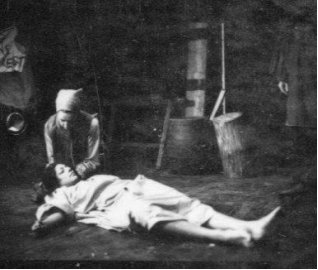
Figure 1. Mother Courage and the dead Kattrin from the Internationalist Theatre production of Mother Courage and Her Children (London, 1982). Digital archival image, Bertolt-Brecht-Archiv, Akademie der Künste, Berlin. Copyright retained by the rights holder; reproduced in accordance with the archive's viewing and reproduction conditions.
“Once fertile fields were rampaged by famines. Now werewolves roamed the burntout fields. Business is very bad, so there is nothing to do but beg”…
| [3] | Brecht, B. (1980). Mother Courage and Her Children (E. Bentley, Trans.). London: Methuen. (Original work published 1939). |
[3]
. These rhetorical statements enact the manifestation of warfare and entrepreneurship. However, enfeeblement of soldiers from hunger and starvation merges as exploitative encroachment and reinforced confiscation of natural resources and anthropological possessions. The ideologeme of economic encumbrance and financial bankruptcy meeting rapprochement through disorder reigning during peacetime becomes inverted or truncated. Hence, hyena of the battlefield must be looking for alternative sources of livelihood subsistence wages to keep herself in power polity. That ‘the human spirit and the semblance of truth’ should cope through adaptation in dire states. The machinery of war-as-business and war-as-religion are interlocked, they interpenetrate one another and converge. The worse that can be anticipated by Mother Courage’s family dwindling to nothing, clothes tattered and cart dilapidated insinuates Brecht’s satirical allegory of Europe killing more than half of Germany’s inhabitants and infecting its survivors with murderous epidemics
| [4] | Butler, J. (2004). Precarious Life: The Powers of Mourning and Violence. London: Verso. |
[4]
.
In Mother Courage and Her Children, the figure of Mother Courage—Anna Fierling—embodies the tragic intersections of femininity, motherhood and survival amid ceaseless warfare. Her world is scattered by famine, violence, civil war, genocide and the loss of loved ones, and the exploited mercenary‐economy of conflict becomes her diaspora. Her daughter Kattrin - deaf and dumb, traumatised and violated by occupying forces - epitomizes grotesqueness in the exploitation of war and the post-apocalyptic billows of woe.
In the wake of modernity—post-Marxism, post-communism, post-fascism and post-Nazism—this epic theatre of Bertolt Brecht reflects the globalised conditions of neo-liberal capitalism, sanctions, mercenary warfare and privatized monopolization trade violence. War is not only a backdrop but a production-system, and Mother Courage’s cart becomes the metaphoric factory of war-profit, where survival, commerce and death are cataclysmal interweavings.
Thus the play resonates not only in its original context but in contemporary conflicts—such as those between Israel and Gaza or Russia and Ukraine—where the logic of war-economies, displacement and geopolitical spectacle mirror the dialectic Brecht laid bare. The stage becomes a site of inquiry: How do globalised warfare, commodification of suffering and the relentless churn of destructive production continually renegotiate human lives, especially those of women who struggle to maintain individuality and community networking in the churn?
However, Mother Courage’s stony heartedness disentangles and estranges the stance of motherhood for preservation stake of survivalist livelihood; grief-stricken and with a heart chilled by loss, one witnesses the posthumous fate of Swiss Cheese. The resilience, ingenuity, perceptiveness, and intuition displayed deserve profound admiration, particularly as they emerge from a gendered quester and displaced racial or ethnic migrant navigating a dystopian spatiotemporal apocalypse. Brecht’s own exile was fueled by the fury and rage wrought by the Nazi German Holocaust during World War II. Anti-Semitism unleashed waves of hatred, oppression, intolerance, and cruelty directed toward Jewish identity. The sustained terror and horror inflicted by Nazi Germany echo the tragic fates of Mother Courage’s children, Swiss Cheese and Eiliff.
In Mother Courage and Her Children, Kattrin embodies a symbolic resonance with Anne Frank’s reflection that dead people receive more flowers than the living, emphasizing how regret often surpasses gratitude. Through Kattrin’s heroic death and self-sacrifice, Brecht illuminates Marxist resistance and revolutionary consciousness. Her silence transforms into an emblem of human agency, challenging the forces that would render her voiceless. The devastation and ruin caused by relentless warfare provide the bleak backdrop orchestrated by the play’s narrative and theatrical dimensionality.
Mother Courage’s insistence on autonomy and agency, alongside her efforts to secure her labor, worth, and profits, mirrors the struggles of serfs and proletarians under dystopian tyrannical regimes, including Nazi Germany. Contemporary audiences and critics often interpret the play as an anti-war statement relevant to present-day conflict zones, where countless “
Mother Courages’’ endure penal servitude, marginalization, and subalteranization. Bold theatrical productions continue to present Brecht’s work as a critique of human exploitation in times of war, emphasizing the endurance and pragmatism required to survive conflict. Her concern for the safety of Eiliff and Kattrin underscores her enduring attachment to family amidst chaos. The preservation of her wagon reflects both her economic livelihood and her indomitable spirit of survival. Yet, as the sergeant warns, “when the war takes all you earn, it may one day demand something in return,”
| [3] | Brecht, B. (1980). Mother Courage and Her Children (E. Bentley, Trans.). London: Methuen. (Original work published 1939). |
[3]
a grim foreshadowing of Swiss Cheese’s fate. Anna Fierling emerges as a character rooted in the petty bourgeoisie, evolving into a figure emblematic of socialist realism, with her story intersecting broader Cold War critiques of capitalism and militarism.
Mother Courage’s duality—quasi -calculating profiteer, quasi- tormented mother—reveals a paradoxical chasm between individual desires and societal rigidification. Her disfigurement symbolizes the corrosive influence of commodity-driven relations and the marketplace on human bonds, ultimately threatening life itself. The wagon, both a vehicle of survival and a metaphor for capitalistic exploitation in wartime, underscores the unsentimental reality of human endurance and the sacrifices imposed by conflict.
Bertolt Brecht, often regarded as a forerunner of anti-war epic theater, anticipates the looming catastrophe of the Second World War and examines the perils inherent in the victimization exemplified by figures such as Solomon, Julius Caesar, Socrates, and St. Martin. While these individuals may be celebrated for their moral integrity and humane qualities, they simultaneously reveal cowardice and moral weakness when subjected to the pressures of wartime. Brecht’s epic theater eschews tragicomic conventions in favor of dialectical critique, cultivating the audience’s critical consciousness through estrangement and detached perspectives. In this framework, the conventional suspension of disbelief is inverted, as Brecht intentionally foregrounds the artificiality of the theatrical experience to stimulate reflective engagement rather than passive absorption.
Anna Fierling’s survival is invested with courage and fortitude and a stoic acceptance of the inhumanity of the human condition. Her sadomasochistic existentialism is the transcendentalist transfiguration in the deconstruction of Brechtian epic theatre tragic heroines and iron lady mothers. It is solely Mother Courage or Anna Fierling’s forecasts which reveals the foreboding death of virtues during corrupt times; ie, Eilif’s bravery, Schweizerkas’s honesty and Kattrin’s terrible compassion as she stakes herself suicidal in salvaging the children of Halle. In
Mother Courage and Her Children by Bertolt Brecht theatre review of Arthur Holmberg endorses the theatrical performances of Mother Courage (Linda Hutch) and the Cook (Brian Doyle-Murray) to throw light upon
the Songs of the Great Souls of the Earth as inversion of Judo-Christian allegory. This florescent projection of experimental idiomatic tone as evidenced in the passage explodes with paganism. According to Holmberg ‘The stage is dark except for one bright spot on the Cook (Brian Doyle-Murray), who belts out the lyrics with showbiz razmatazz. Meantime, sidekick Mother Courage (Linda Hunt), mugs her way through a vaudeville pantomime of Julius Caesar clutching his wounds, Socrates choking on hemlock, and St. Martin shimmying with chilblain- all jollied up with a soft shoe routine’
.
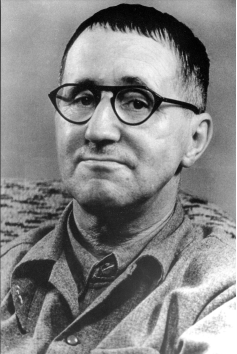
Figure 2. Portrait of Bertolt Brecht (1898–1956). Photograph by Jörg Kolbe, Bundesarchiv, licensed under CC BY-SA 3.0 DE.
5. Moral Bankruptcies: Capitalist Allegory and Cold War Resonance
Hostilities and ambivalence of geopolitical tensions disrupt the peace-mongering pacifism of these harrowing survivors exposing them towards war-feeding enterprises for ensuring peace and tranquility, economic stability and social security of the family cart wagon——the central means of survivalism subsistence wage providence during warfare. Anna Fierling’s submission to the logic and ethic of war-as-business, however prompts feminist materialists theatre performance critics in surmising the neoliberal cold war rhetoric of Americanized Sovietization economic recession during the interwar periods as contemporary penchant of the impetus. Her smearing of Kattrin’s face with ashes and cinders explicate semantic analysis of social gestures; ie Kattrin’s innocence and vulnerability in the face of the wrafthful warfare as well as symbolic commentary of espionage and propaganda to breaching of treaties and alliances such as the collapse of the Warsaw Pact.
Kattrin’s antithetical foil Anna Fierling is the epitome of dues ex machination in gestus ideologems of mothering and womanization. Kattrin’s transformation into a figure of mourning and death through the application of ashes mirrors warfare violence, loss of hopes, dreams and aspirations, innocence and vulnerability of the devastating effects of war on civilians’ loss of lives. After all, the young woman cannot blossom into angel of the hearth but her sacrificial martyrdom epitomizes symbolic nature of heraldic salvaging spirited life-giving-force; destructive power of warfare couldn’t surfeit upon her.
6. Brecht’s Epic Theatre and the Pedagogical Transformation of the Classroom
Unlike classical Aistotlelian dramatic works of the poetics aesthetics of tragedy Brechtian epic theatrical dramaturgy of vermfremdungseffekt production of
Mother Courage and Her Children doesn’t harbour plot as ‘the heart and soul of tragedy’. Brechtian epic theatre performance focuses towards the gestus feminist criticism whose penultimate goal dwells in ‘breaking of the fourth wall’ rather than eliciting ’emotions of pity and fear’ for the arousal of ‘catharsis’ of these emotions in the audience. After all,
Mother Courage and Her Children (1939) is ‘a travelling theory reconsidered’ from the chronicles of the ‘Thirty Years War’ (1618-1648) between the Catholics and the Protestant crusade sects through fictionalization of existentialist survivalism and Gothic macabre befallen by the herculean sacrifices of misfortunes amongst Eilif, Schweizerkas and Kattrin
| [6] | Curran, A. (2001). Brecht’s criticisms of Aristotle’s aesthetics of tragedy. The Journal of Aesthetics and Art Criticism, 59(2), 167–184. http://www.jstor.org/stable/432222 |
[6]
.
The plotlines of the narrative is non-linear contrasting episodic montages of contrasts, contradictions, interpolations and interruptions within different time frames. There is no beginning, middle or ending—-the key determinants of a dramatic performative text for production. Mother Courage’s stone-heartedness and tender-heartedness phenomenologemes of warfare polity is the subject-matter of the epic theatre. Where is a will, there is a way substantiates let bygones be bygones from the viewpoint of mourning the bereaved souls of the departed lives from the clan of future generation—-brood of offsprings.
The central action of the episodic play thus concerns the death of Mother Courage’s two sons and a daughter during the Thirty Years War, which was a European conflagration fought mainly in Germany and split along Catholic and Protestant lines.
| [12] | Ryan, P. R. (2003). Modern European Drama: A Study of Epic Theatre and Alienation. Cambridge: Cambridge University Press. |
[12]
. That the exhibition of the passage of time and the concept of reality in lose, episodic structures contrasts with that of extended poetic image of the psychic moment of subjective consciousness.
Mother Courage and Her Children adopts and adapts Brechtian epic theatre of alienation effects and/or vermfremdungseffekt (V) effect in correspondence with barriers to critical reflection on the social dimension of the tragedy, so that the viewer doesn’t gaze the action of the play from the point of view of the central character and hence appropriately elucidates broader microcosmic spatiotemporality. ‘Fellow feelings for the humanity’ obscures into the theatrical space of psychoramic realm by staging and performing
Mother Courage and Her Children away from the 1940s Germany to alienate or instill in both actors and the audience a distinction between the world of the drama and the context from which they view the action of the play
.
7. Navigating the Moral Debris of Warfare and Capitalism
Mother Courage’s anti-heroic tragic protagonist eponymous heroic feminist is a staunch redeemer of war-feeding enterprises and she stalwartly upholds burgeoning mercenary bourgeoisie commodity value of the bloodiest warfare market place economy above puritanical conservative family value of motherhood and womanization. Her cost and benefit analysis of business endeavour revolutionizes neo-liberal gestus of Cold-War Americanized Sovietization wherein war-as-communism and war-as-capitalism coincides with the US and the USSR’s extensive engagement in espionage and propaganda campaigns to undermine each other influence. In this context, Mother Courage or Anna Fierling’s disavowal and avowal of the warfare is the thesis statement hookers of cliffhangers in prompting subtleties of geopolitics during peace-time and anarchic times and/or treaties and alliances of the Cold War
.
Thoughts and feelings of these tragic protagonists shouldn’t be frozen crystal within interpretative perspectives of characters’ interiority and speech-acts but expand and extend beyond the networks of social gestures. Moreover, anti-method acting reigns in Brechtian epic theatre to detach audiences from the characters and actors from the characters’ feelings so that opinion based freedom of thought critical reflection’ prevails in epic proportions and/or paramount emphasis.
The declaration, “We’re doing an honest trade in ham and linen, and we’re peaceable folk,”
| [3] | Brecht, B. (1980). Mother Courage and Her Children (E. Bentley, Trans.). London: Methuen. (Original work published 1939). |
[3]
. underscores Mother Courage’s mercantile enterprise, positioning her entrepreneurial acumen as the primary means of sustaining her family. Although such declarative is arguable ‘indignant reply of all liberals to violence’ as has been noted by Roland Barthes in
Seven Photo Models of Mother Courage . Her livelihood depends entirely on the profits derived from the trade cart, highlighting the precarious balance between survival and commerce in a wartime economy. The sergeant’s feigned interest in a belt buckle and the recruiter’s abduction of Eiliff astonish the naïve Kattrin, who reacts with frantic gestures. As years pass, Eiliff is enlisted in acts of theft, pilfering livestock from settler supply wagons, and his valor is celebrated in “The Song of the Girl and the Soldier,”
| [3] | Brecht, B. (1980). Mother Courage and Her Children (E. Bentley, Trans.). London: Methuen. (Original work published 1939). |
[3]
performed chorally to honor courage, heroism, and service to the veteran general.
However, the political upheaval marked by the Catholic expulsion of Protestants triggers harsh measures of repression and threatens the security of these ostensibly peaceable citizens once allied forces are defeated. Mother Courage’s adaptability—disguising herself and Kattrin in ashes—and Yvette’s calculated negotiation to ransom Swiss Cheese exemplify the survival strategies imposed by such violent contingencies. Ultimately, Mother Courage’s profit-driven pragmatism is starkly juxtaposed against the tragic loss of Swiss Cheese, whose death at the hands of Catholic forces underscores the human cost of her enterprise. In “The Song of the Great Capitulation,”
| [3] | Brecht, B. (1980). Mother Courage and Her Children (E. Bentley, Trans.). London: Methuen. (Original work published 1939). |
[3]
Mother Courage’s indifferent and nonchalant demeanor, expressed in her remark, “I changed me mind. I ain’t complaining,”
| [3] | Brecht, B. (1980). Mother Courage and Her Children (E. Bentley, Trans.). London: Methuen. (Original work published 1939). |
[3]
reflects her resignation and pragmatic disengagement from the moral and legal accountability of the battlefield.
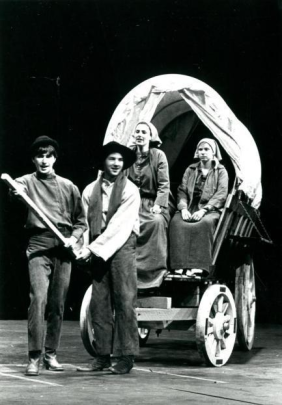
Figure 3. Black and white photo of a covered wagon with two women inside and two young men walking in front in breeches and shirts and scarves. The women are in skirts and coats with covered hair.
Mother Courage’s seizure of the soldier’s allotted overcoat, followed by her refusal to provide clothing for the wounded crusaders, destabilizes her bourgeois, profit-driven identity. Kattrin’s defiance—threatening her mother with a plank—and the chaplain’s opportunistic use of military attire revive the performative symbolism of wartime heroism. Yet the mother’s bluster and self-interest are tempered by Kattrin’s awakening into feminist consciousness, revealed through her instinctive compassion for an orphaned child. Mother Courage emerges as a “hyena of the battlefield,”
| [3] | Brecht, B. (1980). Mother Courage and Her Children (E. Bentley, Trans.). London: Methuen. (Original work published 1939). |
[3]
her pacifism eroded by the demands of commerce and survival. The cry of “War be damned”
| [3] | Brecht, B. (1980). Mother Courage and Her Children (E. Bentley, Trans.). London: Methuen. (Original work published 1939). |
[3]
is paradoxically inverted in her militarized pursuit of profit.
Eiliff’s implication in war crimes during a fragile peace coalition reflects the moral degradation that war breeds, culminating in his trial and punishment. Meanwhile, Mother Courage and Kattrin’s descent into destitution exposes the existential desolation and moral decay of wartime humanity. Brecht’s chilling image—“Once fertile areas are ravaged by famine, wolves roam the burnt-out towns… Business is bad, so there is nothing to do but beg”
| [3] | Brecht, B. (1980). Mother Courage and Her Children (E. Bentley, Trans.). London: Methuen. (Original work published 1939). |
[3]
.—encapsulates the devastation of both landscape and spirit. Yet within this ruin, Mother Courage’s reclaimed womanhood and emergent feminist awareness signal a defiance of patriarchal subjugation, epitomized by her refusal to accept subservience in the chaplain’s tavern. The harrowing ordeal of Mother Courage and Kattrin, as survivors on the margins of war, envisions a fragile utopian hope for the peasantry: “Happy are those with shelter now / When winter winds are freezing.”
| [3] | Brecht, B. (1980). Mother Courage and Her Children (E. Bentley, Trans.). London: Methuen. (Original work published 1939). |
[3]
.
8. Confounding Temporality in Mother Courage and Her Children
Mother Courage remains detached from organized religion and ideology, embodying instead a pragmatic ambivalence towards the adversities that sustain her entrepreneurship. A consummate wartime trader—donning the crooked impostor and profit maximizing schemer for survival—she encapsulates Brecht’s critique of capitalist opportunism amid conflict. Brecht’s portrayal of Mother Courage evokes the paradox of Christian moralism: the admonition to hate the sin but love the sinner. His heroine personifies craftiness, cunning, and resourcefulness, yet her moral blindness is laid bare in her indifference to Swiss Cheese’s corpse—a moment that crystallizes the audience’s moral and emotional reckoning.
Though speech disabled, Kattrin embodies the moral conscience of the play; her sacrificial death, devoid of divine intervention, becomes a testament to human compassion amid desolation. In contrast, Yvette’s ascent from camp follower to colonel’s mistress signifies material pragmatism and social adaptability, distinguishing her trajectory from Mother Courage’s cyclical struggle. Brecht’s gallery of characters—soldiers and generals, peasants and traders, harlots and clients—mirrors the fractured social fabric of twentieth-century Europe, where survival demands moral compromise. The warmongers who prey upon the innocent expose the futility of virtue in a corrupted world, while the suffering of Mother Courage and her children transforms the stage into a mirror of collective trauma. Through emotional restraint and critical distance, Brecht crafts not tragedy in the classical sense, but an epic reflection on endurance, complicity, economical workaholic planetary and the human cost of war.
8.1. Arthur Holmberg on Linda Hunt's Mother Courage
In his theatrical review, Arthur Holmberg interprets Linda Hunt's performance as Mother Courage through an aesthetic that oscillates between grotesque theatricality and tragic sublimity. Although Hunt initially appears as an almost carnivalesque figure within the American theatrical landscape, Holmberg ultimately elevates her portrayal into one of profound tragic transcendence:
"Linda Hunt as Mother Courage transcends such shenanigans and redeems an otherwise silly revival. Her face, squished from unrisen dough, threatens to dissolve at any moment into polymorphous perversity. Her chin—non-existent. Her nose—an afterthought. Her voice—a strangled hiccup. Throughout the evening's proceedings she sucks for dear life on a sour gumball that puckers her cheeks. When her wagon first heaves across the planked stage, one is fascinated by her as one would be by any anomaly of nature."
Holmberg's description simultaneously invokes bodily grotesquerie and theatrical fascination. His repeated emphasis upon Hunt's distorted physiognomy transforms Anna Fierling into a corporeal spectacle whose physical excesses evoke what he calls "an anomaly of nature." Rather than merely ridiculing the character's appearance, however, this grotesque imagery reinforces Brecht's political dramaturgy by exposing the material body as the visible site upon which war, commerce, and survival inscribe themselves. The reviewer thus positions Hunt's Mother Courage as a figure whose unsettling corporeality exceeds conventional realism and assumes an almost mythic theatrical presence.
Holmberg's interpretation culminates in an explicitly allegorical reading of Anna Fierling, whose devotion to commercial survival assumes the dimensions of a pagan faith centred upon Mammon:
"Linda Hunt's Mother is not a survivor; she is a woman eaten alive by the false god she serves—Mammon. The darkening stage overcame her just as Hunt began to keel over. Thanks to this pint-sized actress Mother Courage took on the same flesh, the same blood, of those other eternal figments of our imagination: Oedipus, Lear, Faust. Fiction, not fact. Facts lie. Fiction tells the truth."
Holmberg's formulation shifts Mother Courage beyond historical particularity toward archetypal tragedy. By identifying Mammon as the false deity governing Anna Fierling's existence, he reframes capitalist accumulation as a form of secular idolatry in which economic survival acquires religious intensity. The comparison with Oedipus, Lear, and Faust further situates Mother Courage within a lineage of tragic protagonists whose downfall emerges from an inescapable ethical contradiction. Consequently, Hunt's performance no longer represents merely a wartime trader struggling for survival but an enduring dramatic embodiment of capitalism's destructive theology, where commerce assumes the status of faith and profit supplants moral responsibility.
8.2. Barthes’s Economical Motherhood
In the Drawn Wagon Roland Barthes vindictive stance toward Bertolt Brecht’s Mother Courage further surveys the double alienation with distinctions blurring between exploiter and exploited
. These polarized binaries illustriously illuminates her exploitative craftiness manipulating starving peasants for liquor on the one hand, while on the other, she doesn’t have agency to for salvation from culpability and wrong in the association of superior mobile personages. In his argument Barthes’s motherliness is a stark contrast to that of Holmberg’s motherliness. Whereas Barthes demarcates the indissolubility of capitalism and motherhood as cantiniere’s cooperative partisanship and Holmberg’s portrays Linda Hunt as visceral catharsis of visual language mourning Schweizerkas’s corpse. For glossing this antithetical portraiture of argumentative roles then light can be illuminated on these close readings:
‘To be sure, there is a profound motherliness in Mother Courage. But this motherliness can never be dissociated from the regular running of a business. When Mother Courage loses on of her children, her immediate reaction is businesslike: it is necessary to divide up the work anew, to increase the duties of the children who are left in proportion to the human capital that has been lost. Reduced by each blow, by each cruel loss, the cooperative resumes, losing no time in tears.
The indissolubility of business and motherhood in
Mother Courage is an essential fact. That which is indissoulble cannot give place to the privilege of one or another of the parties: we would be making a mistake to think of Mother Courage as a Niobe crushed by the fatality of war, for Mother Courage prosaically loses her children through the exercise of her trade. But it would also be false to see in her an “unnatural” mother who sacrifices her family to her greed; her canteen is like one of her children and in moments of crisis she runs from the one to the others like a mother hen among her chicks
.’
‘Hunt's portrayal builds slowly. As the evening advances, she grows into the part. Unlike Anne Bancroft, she doesn't use charm to con us. Linda Hunt has no charm and that's her greatest asset. Her spell takes its time to work. First she gains respect by an unusually disciplined body. Her short, hesitation steps; the broad circles she spins across the stage while greed and mother love fight it out and Schweizerkis's life hangs in the balance; the swerve of her body as she bends over and raises the rafters with her own version of Weigel's silent scream, her face whorled in the rigor mortis of pain and guilt- these are the gestures of an actress whose muscles have been trained to an athlete's pitch of perfection. She turns her body into visual language, silent signs that indicate more deeply than words Mother Courage's invisible soul
.’
9. Post Production Reflections on Belvoir’s Stage Adaptation
As theatre critic Richard Cotter examines Mother Courage and Her Children of Belvoir Production in a newspaper review, his arguments posit thoughts for reflection
: resonances and reechoes of contemporary peace and conflict studies, substantiates my argument for the staging of anti-war allegories of Russia-Ukraine and Gaze-Palestine. Richard argues that, ‘One could view Mother Courage and Her Children as a play about pessimism at the precipice of nihilism, but a healthy cynicism saves it from slipping into the abyss. If nothing else,
Mother Courage lives up to her name by continuing to live in the maw of war.
Belvoir's current production of Mother Courage and Her Children, with its extant text mentioning holy war conjures more contemporary conflicts and theatres, like the Middle East and the Balkans and Africa, and provokes pondering about politicians and priests. It seems humans have been waging war since time immemorial, and then began staging anti war plays since at least the Greeks. Paradox.’
10. Conclusion
Bertolt Brecht's Mother Courage and Her Children remains one of the most penetrating dramatic interrogations of war, capitalism, and human survival in modern European literature. Through the principles of epic theatre and the Verfremdungseffekt (alienation effect), Brecht rejects the emotional closure of Aristotelian tragedy and instead cultivates critical spectatorship, compelling audiences to examine the material conditions that produce violence, exploitation, and social inequality. Mother Courage herself emerges as a profoundly paradoxical figure: she is simultaneously a resilient survivor, an entrepreneurial profiteer, and a grieving mother whose dependence on war for economic survival ultimately destroys the very family she struggles to preserve. Her tragic trajectory demonstrates that individual morality cannot be separated from the ideological and economic structures within which it is formed.
The symbolic interplay between Mother Courage, Kattrin, Eilif, and Schweizerkas further exposes the devastating consequences of militarism upon ordinary lives. The wagon, functioning as both a commercial enterprise and an emblem of capitalist production, encapsulates Brecht's sustained critique of the commodification of human existence. Rather than presenting war as an inevitable historical catastrophe, Brecht reveals it as a social and economic system sustained by material interests, commercial opportunism, and ideological manipulation. In doing so, the play transforms theatrical performance into an educational space where audiences are encouraged not merely to sympathize with suffering but to interrogate its structural causes.
This materialist vision closely corresponds to Terry Eagleton's contention that literature cannot be divorced from the ideological and historical circumstances of its production. Eagleton argues that literary works participate in broader social relations rather than existing as autonomous aesthetic objects, making criticism an investigation of the political, economic, and ideological forces embedded within cultural representation. From this perspective,
Mother Courage and Her Children functions not simply as an anti-war drama but as a Marxist critique of capitalist modernity, exposing how economic interests repeatedly transform human life into exchange value and warfare into profitable enterprise (Eagleton, 2002)
| [7] | Eagleton, T. (2002). Marxism and Literary Criticism. London: Routledge. |
[7]
.
The continuing relevance of Brecht's drama is evident in the persistence of contemporary geopolitical conflicts, forced displacement, militarized economies, and humanitarian crises across the globe. Although rooted in the historical context of the Thirty Years' War and shaped by the ideological anxieties surrounding fascism and the Second World War, the play continues to illuminate the contradictions of modern warfare and global capitalism. Brecht's theatre therefore remains an enduring pedagogical intervention that encourages audiences to question accepted ideologies, resist passive spectatorship, and recognize the possibility of historical transformation through critical consciousness. Mother Courage and Her Children ultimately stands as both a theatrical masterpiece and a lasting reminder that genuine social change begins with the capacity to perceive, critique, and challenge the material conditions that perpetuate injustice and human suffering.
Author Contributions
Z I Mahmud: Conceptualization, Data curation, Formal Analysis, Investigation, Methodology, Resources, Validation, Visualization, Writing – original draft, Writing – review & editing
Conflicts of Interest
The author declares no conflicts of interest.
References
| [1] |
Barthes, R., & Bernays, H. F. (1967). Seven Photo Models of “Mother Courage.” TDR (1967–1968), 12(1), 44–55.
https://doi.org/10.2307/1125292
|
| [2] |
Benjamin, W. (1998). What Is Epic Theatre? In Understanding Brecht. London: Verso.
|
| [3] |
Brecht, B. (1980). Mother Courage and Her Children (E. Bentley, Trans.). London: Methuen. (Original work published 1939).
|
| [4] |
Butler, J. (2004). Precarious Life: The Powers of Mourning and Violence. London: Verso.
|
| [5] |
Cotter, R. (2015, June 13). Mother Courage and Her Children | Belvoir. Australian Stage. Available online:
https://australianstage.com.au/201506137329/reviews/sydney/mother-courage-and-her-children-%7c-belvoir.html
(accessed 13 July 2026).
|
| [6] |
Curran, A. (2001). Brecht’s criticisms of Aristotle’s aesthetics of tragedy. The Journal of Aesthetics and Art Criticism, 59(2), 167–184.
http://www.jstor.org/stable/432222
|
| [7] |
Eagleton, T. (2002). Marxism and Literary Criticism. London: Routledge.
|
| [8] |
Farmer, P. E. (2008). Mother Courage and the future of war. Social Analysis: The International Journal of Social and Cultural Practice, 52(2), 165–184.
http://www.jstor.org/stable/23182403
|
| [9] |
Holmberg, A. (1984). Review of Mother Courage and Her Children, by B. Brecht. Theatre Journal, 36(4), 537–540.
https://www.jstor.org/stable/3206748
|
| [10] |
Lyons, C. R. (1967). Some analogies between the epic Brecht and the absurdist Beckett. Comparative Drama, 1(4), 297–304.
http://www.jstor.org/stable/41152448
|
| [11] |
Ryan, P. R. (1975). Brecht’s Mother Courage. The Drama Review: TDR, 19(2), 78–93.
https://doi.org/10.2307/1144949
|
| [12] |
Ryan, P. R. (2003). Modern European Drama: A Study of Epic Theatre and Alienation. Cambridge: Cambridge University Press.
|
| [13] |
Solga, K. (2003). Mother Courage and its abject: Reading the violence of identification. Modern Drama, 46(3), 339–357.
https://doi.org/10.1353/mdr.2003.0008
|
| [14] |
Steer, W. A. J. (1968). Brecht’s epic theatre: Theory and practice. The Modern Language Review, 63(3), 636–649.
https://doi.org/10.2307/3722205
|
| [15] |
Willett, J. (1964). Brecht on Theatre: The Development of an Aesthetic. New York: Hill and Wang.
|
Cite This Article
-
APA Style
Mahmud, Z. I. (2026). The Rhetoric of Bertolt Brecht's Mother Courage and Her Children. Research & Development, 7(3), 141-149. https://doi.org/10.11648/j.rd.20260703.17
 Copy
|
Copy
|
 Download
ACS Style
Mahmud, Z. I. The Rhetoric of Bertolt Brecht's Mother Courage and Her Children. Res. Dev. 2026, 7(3), 141-149. doi: 10.11648/j.rd.20260703.17
Copy
|
Download
AMA Style
Mahmud ZI. The Rhetoric of Bertolt Brecht's Mother Courage and Her Children. Res Dev. 2026;7(3):141-149. doi: 10.11648/j.rd.20260703.17
Copy
|
Download
-
@article{10.11648/j.rd.20260703.17,
  author = {Z I Mahmud},
  title = {The Rhetoric of Bertolt Brecht's Mother Courage and Her Children},
  journal = {Research & Development},
  volume = {7},
  number = {3},
  pages = {141-149},
  doi = {10.11648/j.rd.20260703.17},
  url = {https://doi.org/10.11648/j.rd.20260703.17},
  eprint = {https://article.sciencepublishinggroup.com/pdf/10.11648.j.rd.20260703.17},
  abstract = {This article examines Bertolt Brecht's Mother Courage and Her Children as a sustained rhetorical critique of war, capitalism, and the ideological contradictions of motherhood through the intersecting frameworks of Brechtian aesthetics, Marxist literary criticism, feminist materialism, and modern drama studies. The study argues that Brecht's epic theatre fundamentally rejects Aristotelian tragedy by replacing emotional catharsis with critical spectatorship through the Verfremdungseffekt, or alienation effect, thereby encouraging audiences to interrogate the historical and material conditions that sustain warfare and economic exploitation. Employing close textual analysis alongside historical and theoretical interpretation, the article investigates the dramatic functions of Mother Courage, Kattrin, Eilif, Schweizerkas, and the symbolic wagon as interconnected representations of survival, commodity exchange, and the commodification of human existence. Particular attention is given to the paradoxical construction of Anna Fierling as both entrepreneurial profiteer and grieving mother, demonstrating how her dependence upon wartime commerce ultimately destroys the family she seeks to preserve. The discussion further explores Brecht's use of episodic structure, gestus, songs, interruptions, and anti-illusionistic staging to transform theatrical performance into a pedagogical space that privileges critical reflection over emotional identification. Drawing upon Walter Benjamin's interpretation of epic theatre together with Roland Barthes's analysis of Mother Courage, the article situates Brecht's dramaturgy within broader debates concerning ideology, spectatorship, and political theatre while also engaging Terry Eagleton's conception of literature as a material social practice. The analysis demonstrates that Brecht exposes war not as an inevitable historical condition but as a system sustained by capitalist interests, ideological manipulation, and the commodification of labour, thereby revealing the structural relationship between militarism and economic profit. The article further argues that Kattrin's sacrificial resistance functions as an ethical counterpoint to Mother Courage's commercial pragmatism, illustrating Brecht's dialectical opposition between humanitarian responsibility and material survival. By integrating literary criticism, theatre studies, and historical contextualization, the study establishes that Mother Courage and Her Children continues to provide an influential model for examining the intersections of political violence, gender, class, and economic power. Ultimately, the article demonstrates the enduring relevance of Brecht's epic theatre for understanding contemporary militarized economies, forced displacement, and global humanitarian crises, while reaffirming the capacity of dramatic literature to cultivate historical consciousness, ideological critique, and socially engaged spectatorship through critical rather than sentimental modes of theatrical representation and democratic public inquiry today.},
 year = {2026}
}
Copy
|
Download
-
TY  - JOUR
T1  - The Rhetoric of Bertolt Brecht's Mother Courage and Her Children
AU  - Z I Mahmud
Y1  - 2026/08/06
PY  - 2026
N1  - https://doi.org/10.11648/j.rd.20260703.17
DO  - 10.11648/j.rd.20260703.17
T2  - Research & Development
JF  - Research & Development
JO  - Research & Development
SP  - 141
EP  - 149
PB  - Science Publishing Group
SN  - 2994-7057
UR  - https://doi.org/10.11648/j.rd.20260703.17
AB  - This article examines Bertolt Brecht's Mother Courage and Her Children as a sustained rhetorical critique of war, capitalism, and the ideological contradictions of motherhood through the intersecting frameworks of Brechtian aesthetics, Marxist literary criticism, feminist materialism, and modern drama studies. The study argues that Brecht's epic theatre fundamentally rejects Aristotelian tragedy by replacing emotional catharsis with critical spectatorship through the Verfremdungseffekt, or alienation effect, thereby encouraging audiences to interrogate the historical and material conditions that sustain warfare and economic exploitation. Employing close textual analysis alongside historical and theoretical interpretation, the article investigates the dramatic functions of Mother Courage, Kattrin, Eilif, Schweizerkas, and the symbolic wagon as interconnected representations of survival, commodity exchange, and the commodification of human existence. Particular attention is given to the paradoxical construction of Anna Fierling as both entrepreneurial profiteer and grieving mother, demonstrating how her dependence upon wartime commerce ultimately destroys the family she seeks to preserve. The discussion further explores Brecht's use of episodic structure, gestus, songs, interruptions, and anti-illusionistic staging to transform theatrical performance into a pedagogical space that privileges critical reflection over emotional identification. Drawing upon Walter Benjamin's interpretation of epic theatre together with Roland Barthes's analysis of Mother Courage, the article situates Brecht's dramaturgy within broader debates concerning ideology, spectatorship, and political theatre while also engaging Terry Eagleton's conception of literature as a material social practice. The analysis demonstrates that Brecht exposes war not as an inevitable historical condition but as a system sustained by capitalist interests, ideological manipulation, and the commodification of labour, thereby revealing the structural relationship between militarism and economic profit. The article further argues that Kattrin's sacrificial resistance functions as an ethical counterpoint to Mother Courage's commercial pragmatism, illustrating Brecht's dialectical opposition between humanitarian responsibility and material survival. By integrating literary criticism, theatre studies, and historical contextualization, the study establishes that Mother Courage and Her Children continues to provide an influential model for examining the intersections of political violence, gender, class, and economic power. Ultimately, the article demonstrates the enduring relevance of Brecht's epic theatre for understanding contemporary militarized economies, forced displacement, and global humanitarian crises, while reaffirming the capacity of dramatic literature to cultivate historical consciousness, ideological critique, and socially engaged spectatorship through critical rather than sentimental modes of theatrical representation and democratic public inquiry today.
VL  - 7
IS  - 3
ER  -
Copy
|
Download





 Share This Article
 Twitter
 Linked In
 Facebook