Abstract
Public-Private Partnership (PPP) has emerged as a strategic mechanism for improving the quality, relevance, and labor market responsiveness of Technical and Vocational Education and Training (TVET). Despite policy recognition of PPP in Ethiopia, its implementation remains constrained by weak institutional collaboration, limited industry engagement, inadequate resource mobilization, and inconsistent policy support. This study examined the practices of Public-Private Partnership in Technical and Vocational Education and Training (TVET) institutions in Addis Ababa. Guided by Stakeholder Theory, Human Capital Theory, Resource Dependence Theory, and Collaborative Governance Theory, the study employed a quantitative research approach using a descriptive and explanatory research design. Data was collected from TVET leaders, instructors, industry representatives, and relevant government officials through structured questionnaires. The data collected were analyzed using descriptive statistics, Pearson correlation analysis, and multiple linear regression to determine the influence of institutional commitment, industry participation, resource sharing, and policy support on PPP practice. The findings revealed that the overall practice of PPP in Addis Ababa TVET institutions was moderate, indicating considerable scope for improvement. Correlation analysis demonstrated that all four independent variables were positively and significantly associated with PPP practice. Multiple regression analysis further showed that institutional commitment, industry participation, resource sharing, and policy support each exerted a statistically significant positive influence on PPP implementation, with industry participation emerging as the strongest predictor. These findings suggest that sustainable PPP implementation requires stronger institutional leadership, active private-sector engagement, effective resource mobilization, and supportive governance and policy frameworks. The study contributes to the growing body of knowledge on TVET governance by integrating complementary theoretical perspectives to explain PPP implementation in a developing-country context. It also provides practical and policy-relevant evidence to guide TVET institutions, private enterprises, policymakers, and development partners in strengthening collaborative partnerships that enhance workforce development and improve the quality, relevance, and sustainability of TVET in Ethiopia.
|
Published in
|
Research & Development (Volume 7, Issue 3)
|
|
DOI
|
10.11648/j.rd.20260703.19
|
|
Page(s)
|
156-172 |
|
Creative Commons
|

This is an Open Access article, distributed under the terms of the Creative Commons Attribution 4.0 International License (http://creativecommons.org/licenses/by/4.0/), which permits unrestricted use, distribution and reproduction in any medium or format, provided the original work is properly cited.
|
|
Copyright
|
Copyright © The Author(s), 2026. Published by Science Publishing Group
|
Keywords
Public-Private Partnership (PPP), Industry Participation, Institutional Commitment, Collaborative Governance,
Human Capital Development
1. Introduction
1.1. Background of Study
Technical and Vocational Education and Training (TVET) has become an important component of national development strategies for its central role in producing a skilled workforce responsive to changing labour market demands. Global economic transformation, technological advancement, digitalization, and the transition toward green economies have substantially altered workplace competency requirements. Governments across developed and developing countries have recognized TVET as a strategic instrument for enhancing workforce productivity, reducing unemployment, promoting social inclusion, and supporting sustainable economic growth
, aligned with SDG 4, Targets 4.3 and 4.4
| [14] | International Labour Organization. (2023). Building pathways to sustainable growth: Strengthening Technical and Vocational Education and Training (TVET) and productive sector linkages in Africa. Geneva: ILO & African Development Bank.
https://doi.org/10.54675/MHVE7845 |
| [29] | UNESCO. (2021). Biennial Report 2020-2021: Adapting to the new normal. Bonn: UNESCO-UNEVOC International Centre for TVET. |
[14, 29]
.
Many countries have undertaken comprehensive reforms to modernize their TVET systems, recognizing vocational education as a dynamic system that integrates formal education with workplace learning. International organizations advocate competency-based education, work-based learning, apprenticeships, and stronger employer collaboration as effective strategies for ensuring training outcomes correspond with labour market needs
| [21] | Organisation for Economic Co-operation and Development (OECD). (2018) |
| [33] | World Bank. (2019). Annual report 2019: Ending poverty, investing in opportunity. Washington, DC: World Bank Group. |
[21, 33]
. Countries with institutionalized industry partnerships consistently report stronger labour market responsiveness and higher employment outcomes
| [21] | Organisation for Economic Co-operation and Development (OECD). (2018) |
| [29] | UNESCO. (2021). Biennial Report 2020-2021: Adapting to the new normal. Bonn: UNESCO-UNEVOC International Centre for TVET. |
[21, 29]
.
In Ethiopia, TVET has been identified as a strategic instrument for accelerating industrialization, expanding employment opportunities, and strengthening national human capital development. Successive education reforms have emphasized demand-driven, competency-based training that aligns vocational education with the needs of priority economic sectors. Addis Ababa, as Ethiopia's political, economic, industrial, and commercial centre, provides an especially important context for examining Public-Private Partnership practices in TVET. The city hosts the country's largest concentration of public TVET institutions, manufacturing industries, service enterprises, and government organizations responsible for skills development and employment creation.
These characteristics make Addis Ababa an appropriate setting for investigating the nature and effectiveness of collaboration between TVET institutions and private enterprises. Understanding the current practices, strengths, and challenges of Public-Private Partnership within this context can provide valuable evidence for improving policy implementation, strengthening institutional collaboration, and enhancing the labour market responsiveness of Ethiopia's TVET system.
1.2. Statement of the Problem
Despite these global efforts, many TVET systems, particularly in developing countries, continue to experience persistent challenges in producing graduates whose competencies align with employers' expectations. International evidence indicates that weak institutional collaboration between education providers and industry remains one of the principal causes of graduate unemployment, skills mismatch, low labour productivity, and limited innovation capacity
| [29] | UNESCO. (2021). Biennial Report 2020-2021: Adapting to the new normal. Bonn: UNESCO-UNEVOC International Centre for TVET. |
| [35] | World Bank, UNESCO, & ILO. (2023). Building better formal TVET systems: Principles and practice in low- and middle-income countries. Washington, DC; Paris; Geneva: World Bank, UNESCO, and ILO.
https://doi.org/10.1596/978-1-4648-1906-5 |
[29, 35]
. The Organization for Economic Co-operation and Development
| [21] | Organisation for Economic Co-operation and Development (OECD). (2018) |
[21]
similarly argues that effective employer engagement through apprenticeships, work-based learning, and collaborative governance is essential for ensuring the quality, relevance, and responsiveness of vocational education systems.
To address these challenges, PPP has increasingly been adopted as a strategic governance approach for strengthening TVET systems, encompassing joint curriculum development, cooperative training, apprenticeship, workplace learning, resource sharing, technology transfer, competency assessment, quality assurance, and graduate employment promotion
| [14] | International Labour Organization. (2023). Building pathways to sustainable growth: Strengthening Technical and Vocational Education and Training (TVET) and productive sector linkages in Africa. Geneva: ILO & African Development Bank.
https://doi.org/10.54675/MHVE7845 |
| [29] | UNESCO. (2021). Biennial Report 2020-2021: Adapting to the new normal. Bonn: UNESCO-UNEVOC International Centre for TVET. |
[14, 29]
. Empirical evidence consistently demonstrates that countries with institutionalized TVET-industry partnerships achieve stronger labour market responsiveness, improved graduate employability, and more efficient utilization of educational resources
| [1] | Aarkrog, V. (2021). The impact of virtual reality on learning processes and learning outcome: A study of VR-based learning among social and health care staff and students. In C. Nägele, B. E. Stalder, & M. Weich (Eds.), Pathways in Vocational Education and Training and Lifelong Learning: Proceedings of the 4th Crossing Boundaries Conference in Vocational Education and Training (pp. 11-15). Muttenz and Bern: VETNET, University of Applied Sciences and Arts Northwestern Switzerland.
https://doi.org/10.5281/zenodo.4596448 |
| [21] | Organisation for Economic Co-operation and Development (OECD). (2018) |
| [29] | UNESCO. (2021). Biennial Report 2020-2021: Adapting to the new normal. Bonn: UNESCO-UNEVOC International Centre for TVET. |
[1, 21, 29]
.
Given empirical, theoretical, contextual, and methodological gaps, this study investigates the influence of institutional commitment, industry participation, resource sharing, and policy support on Public-Private Partnership practices in TVET institutions in Addis Ababa. The study contributes to the growing body of knowledge on TVET governance and provides evidence-based recommendations for policymakers, TVET institutions, industry partners, and development partners seeking to strengthen the quality, relevance, and labour-market responsiveness of Ethiopia's TVET system.
1.3. Objectives of the Study
1.3.1. General Objective
The general objective of this study is to examine the practices of Public-Private Partnership (PPP) in Technical and Vocational Education and Training (TVET) institutions in Addis Ababa by investigating the influence of institutional commitment, industry participation, resource sharing, and policy support on PPP implementation.
1.3.2. Specific Objectives
1) To assess the current practices of Public-Private Partnership in Technical and Vocational Education and Training (TVET) institutions in Addis Ababa.
2) To examine the influence of institutional commitment, industry participation, resource sharing, and policy support on Public-Private Partnership practices in TVET institutions.
3) To identify the major challenges affecting the effective implementation of Public-Private Partnership in TVET institutions.
4) To propose evidence-based strategies for strengthening Public-Private Partnership practices in Technical and Vocational Education and Training institutions.
1.4. Research Questions
1) What are the current practices of Public-Private Partnership (PPP) in Technical and Vocational Education and Training (TVET) institutions in Addis Ababa?
2) To what extent do institutional commitment, industry participation, resource sharing, and policy support influence Public-Private Partnership practices in TVET institutions?
3) What are the major challenges affecting the effective implementation of Public-Private Partnership in TVET institutions in Addis Ababa?
4) What strategies can strengthen the implementation and sustainability of Public-Private Partnership in Technical and Vocational Education and Training institutions?
1.5. Research Hypothesis
H1: Institutional commitment has a significant positive influence on Public-Private Partnership practices in Technical and Vocational Education and Training (TVET) institutions in Addis Ababa.
H2: Industry participation has a significant positive influence on Public-Private Partnership practices in Technical and Vocational Education and Training (TVET) institutions in Addis Ababa.
H3: Collaborative resource sharing has a significant positive influence on Public-Private Partnership practices in Technical and Vocational Education and Training (TVET) institutions in Addis Ababa.
H4: Policy support has a significant positive influence on Public-Private Partnership practices in Technical and Vocational Education and Training (TVET) institutions in Addis Ababa.
1.6. Significance of the Study
This study makes significant theoretical, empirical, methodological, policy, and practical contributions to knowledge on PPP in TVET. Theoretically, it extends understanding by integrating Stakeholder Theory, Human Capital Theory, Resource Dependence Theory, and Collaborative Governance Theory. Empirically, it provides evidence on PPP practices in Addis Ababa public TVET institutions. Methodologically, a quantitative multivariate design examines multiple organizational determinants simultaneously. In terms of policy and practice, findings provide evidence-based recommendations for the Ministry of Education, regional authorities, TVET institutions, private-sector organizations, and development partners, supporting institutional collaboration, industry participation, and improved training quality, relevance, and labour-market responsiveness.
Policy and Practical Significance: The findings are expected to provide evidence-based recommendations for the Ministry of Education, regional education authorities, TVET institutions, private-sector organizations, and development partners. The study will support efforts to strengthen institutional collaboration, improve policy implementation, enhance industry participation, promote collaborative resource sharing, and improve the quality, relevance, and labour-market responsiveness of TVET in Ethiopia. Ultimately, strengthening Public-Private Partnership can contribute to workforce development, increased graduate employability, enterprise productivity, and national economic transformation.
1.7. Scope of the Study
This study is delimited in terms of its conceptual, geographical, methodological, and temporal scope.
The study focuses on PPP practices in selected public TVET institutions in Addis Ababa, examining institutional commitment, industry participation, resource sharing, policy support, and their influence on PPP effectiveness. Geographically, it is confined to Addis Ababa, Ethiopia's principal administrative, industrial, and commercial centre with the largest concentration of public TVET institutions and industries. A quantitative cross-sectional survey design is employed, and findings reflect prevailing conditions at the time of data collection without capturing changes over time.
Temporal Scope: The study examines Public-Private Partnership practices as they exist during the period of data collection. Accordingly, the findings reflect the prevailing institutional and organizational conditions at the time the study was conducted and do not capture changes that may occur over time.
2. Literature Review
Introduction: This chapter reviews the theoretical, conceptual, and empirical literature relevant to Public-Private Partnership (PPP) in Technical and Vocational Education and Training (TVET).
The review establishes the scholarly foundation for the study by examining existing knowledge on the role of collaborative partnerships in strengthening TVET systems, enhancing workforce development, and improving labour-market responsiveness. It also synthesizes current evidence regarding the institutional, organizational, and policy factors that influence successful partnership implementation.
2.1. Conceptual Review
Concept of Technical and Vocational Education and Training (TVET): Technical and Vocational Education and Training (TVET) is widely recognized as a critical component of education systems because it bridges formal education and the world of work by equipping individuals with the knowledge, practical skills, competencies, and attitudes required for productive employment, entrepreneurship, and lifelong learning. Over the past two decades, the concept of TVET has evolved from a narrow focus on occupational training to a broader approach that emphasizes human capital development, innovation, social inclusion, environmental sustainability, and economic competitiveness
| [14] | International Labour Organization. (2023). Building pathways to sustainable growth: Strengthening Technical and Vocational Education and Training (TVET) and productive sector linkages in Africa. Geneva: ILO & African Development Bank.
https://doi.org/10.54675/MHVE7845 |
| [30] | UNESCO. (2022). Transforming technical and vocational education and training for successful and just transitions: UNESCO strategy 2022-2029. Paris: UNESCO.
https://doi.org/10.54675/EUDU5854 |
[14, 30]
.
Recent international policy discourse has further expanded the role of TVET beyond workforce preparation. The UNESCO Strategy for TVET (2022-2029) positions TVET as a transformative force for supporting successful transitions to digital, green, inclusive, and knowledge-based economies. The strategy emphasizes that contemporary TVET should develop technical competencies alongside entrepreneurial, digital, problem-solving, communication, and lifelong learning skills, enabling individuals to adapt to rapidly changing labour markets and technological innovation.
Within the Ethiopian context, TVET has undergone substantial reform to support the country's industrialization agenda. National TVET policies emphasize competency-based education and training, occupational standards, cooperative training, and stronger partnerships with industry
| [10] | Federal Democratic Republic of Ethiopia Ministry of Education (FDRE MoE). (2022). |
| [19] | Ministry of Education (MoE). (2022). Education Statistics Annual Abstract: 2021/22 Academic Year. Addis Ababa: FDRE MoE, EMIS and ICT Directorate. |
[10, 19]
. These reforms seek to produce graduates whose competencies correspond to labour market needs while improving productivity and employment. To this study, TVET is conceptualized as a competency-based system integrating classroom instruction with workplace learning through collaborative partnerships between public training institutions and private enterprises, aligning with the study's focus on PPP as a mechanism for improving quality, relevance, and labour-market responsiveness in Addis Ababa
| [12] | GIZ. (2026). Ethio-German sustainable training and education programme report. Deutsche Gesellschaft für Internationale Zusammenarbeit. |
| [32] | Wondwossen, T. (2021). Cooperative training and TVET industry linkage in Ethiopia. Unpublished thesis/report. |
[12, 32]
.
Concept of Public-Private Partnership (PPP): Public-Private Partnership (PPP) has become an increasingly important governance mechanism for improving the efficiency, effectiveness, and sustainability of public service delivery across various sectors, including infrastructure, health, education, and workforce development.
Public-Private Partnership (PPP) has evolved from long-term contractual arrangements for public infrastructure financing to broader forms of collaboration characterized by shared decision-making, joint resource mobilization, mutual accountability, and collective pursuit of public objectives
| [20] | Morrow, J., et al. (2023). TVET and youth employment in Africa: Curriculum and partnership approaches. African Education Review. |
| [30] | UNESCO. (2022). Transforming technical and vocational education and training for successful and just transitions: UNESCO strategy 2022-2029. Paris: UNESCO.
https://doi.org/10.54675/EUDU5854 |
[20, 30]
. Educational PPPs involve governments, institutions, employers, industries, professional associations, and development partners working together to improve curriculum relevance, teaching quality, and graduate employability, emphasizing knowledge sharing and human capital development rather than solely financial investment
| [30] | UNESCO. (2022). Transforming technical and vocational education and training for successful and just transitions: UNESCO strategy 2022-2029. Paris: UNESCO.
https://doi.org/10.54675/EUDU5854 |
[30]
. In TVET, PPP assumes even greater significance because vocational education is inherently linked to the labour market, requiring continuous collaboration to ensure curricula reflect industry requirements and students gain meaningful workplace learning.
Public-Private Partnership in Technical and Vocational Education and Training: The increasing complexity of labour markets, rapid technological advancement, and changing industrial skill requirements have fundamentally transformed the role of Technical and Vocational Education and Training (TVET). Contemporary TVET systems are expected not only to provide technical knowledge but also to develop practical competencies, employability skills, innovation capacity, and lifelong learning abilities that respond to evolving economic and technological demands. Achieving these objectives requires close collaboration between education providers and employers, making Public-Private Partnership (PPP) an indispensable component of modern vocational education systems
| [14] | International Labour Organization. (2023). Building pathways to sustainable growth: Strengthening Technical and Vocational Education and Training (TVET) and productive sector linkages in Africa. Geneva: ILO & African Development Bank.
https://doi.org/10.54675/MHVE7845 |
| [30] | UNESCO. (2022). Transforming technical and vocational education and training for successful and just transitions: UNESCO strategy 2022-2029. Paris: UNESCO.
https://doi.org/10.54675/EUDU5854 |
[14, 30]
.
International experience demonstrates that countries with well-established PPP frameworks achieve stronger vocational education outcomes than those relying on government-led training alone. Dual-training systems in Germany, Switzerland, and Austria—characterized by institutionalized collaboration among governments, vocational schools, and private enterprises—facilitate joint curriculum development, workplace learning, competency assessment, and instructor development, contributing to high graduate employability and workforce productivity
| [21] | Organisation for Economic Co-operation and Development (OECD). (2018) |
| [30] | UNESCO. (2022). Transforming technical and vocational education and training for successful and just transitions: UNESCO strategy 2022-2029. Paris: UNESCO.
https://doi.org/10.54675/EUDU5854 |
| [23] | Organisation for Economic Co-operation and Development (OECD). (2023). Vocational education and training systems for future skills. OECD Publishing. |
[21, 30, 23]
. Despite these positive examples, establishing effective PPP remains a complex institutional process requiring shared vision, clearly defined roles, effective governance, adequate resources, and continuous communication
| [1] | Aarkrog, V. (2021). The impact of virtual reality on learning processes and learning outcome: A study of VR-based learning among social and health care staff and students. In C. Nägele, B. E. Stalder, & M. Weich (Eds.), Pathways in Vocational Education and Training and Lifelong Learning: Proceedings of the 4th Crossing Boundaries Conference in Vocational Education and Training (pp. 11-15). Muttenz and Bern: VETNET, University of Applied Sciences and Arts Northwestern Switzerland.
https://doi.org/10.5281/zenodo.4596448 |
| [27] | Pilz, M., & Li, J. (2021). International transfer of vocational education and training: A literature review. Journal of Vocational Education & Training. Advance online publication.
https://doi.org/10.1080/13636820.2020.1847566 |
[1, 27]
.
Where these enabling conditions are absent, partnerships often remain fragmented, project-based, or limited to short-term activities such as student internships, with little influence on curriculum development, institutional planning, or long-term workforce development
| [1] | Aarkrog, V. (2021). The impact of virtual reality on learning processes and learning outcome: A study of VR-based learning among social and health care staff and students. In C. Nägele, B. E. Stalder, & M. Weich (Eds.), Pathways in Vocational Education and Training and Lifelong Learning: Proceedings of the 4th Crossing Boundaries Conference in Vocational Education and Training (pp. 11-15). Muttenz and Bern: VETNET, University of Applied Sciences and Arts Northwestern Switzerland.
https://doi.org/10.5281/zenodo.4596448 |
| [27] | Pilz, M., & Li, J. (2021). International transfer of vocational education and training: A literature review. Journal of Vocational Education & Training. Advance online publication.
https://doi.org/10.1080/13636820.2020.1847566 |
[1, 27]
.
The literature therefore suggests that the effectiveness of Public-Private Partnership depends not merely on the existence of collaboration but on the quality, depth, and sustainability of institutional relationships between TVET institutions and private-sector organizations. Effective partnerships require integrated institutional commitment, active industry participation, collaborative resource mobilization, and enabling policy environments that collectively support long-term collaboration. These interrelated dimensions provide the conceptual foundation for the present study and underpin the analytical framework used to examine Public-Private Partnership practices in Technical and Vocational Education and Training institutions in Addis Ababa.
Dimensions of Public-Private Partnership: The effectiveness of Public-Private Partnership (PPP) in Technical and Vocational Education and Training (TVET) depends on the interaction of multiple institutional, organizational, and policy factors rather than on isolated collaborative activities. Contemporary literature increasingly conceptualizes PPP as a multidimensional governance framework in which successful partnerships are built upon shared institutional commitment, active industry participation, collaborative resource mobilization, and enabling policy environments. These dimensions collectively influence the extent to which partnerships contribute to improved training quality, curriculum relevance, workforce development, and graduate employability
| [14] | International Labour Organization. (2023). Building pathways to sustainable growth: Strengthening Technical and Vocational Education and Training (TVET) and productive sector linkages in Africa. Geneva: ILO & African Development Bank.
https://doi.org/10.54675/MHVE7845 |
| [21] | Organisation for Economic Co-operation and Development (OECD). (2018) |
| [30] | UNESCO. (2022). Transforming technical and vocational education and training for successful and just transitions: UNESCO strategy 2022-2029. Paris: UNESCO.
https://doi.org/10.54675/EUDU5854 |
[14, 21, 30]
.
Although researchers have proposed different models for evaluating Public-Private Partnership, there is broad consensus that effective partnerships require both organizational capacity and sustained stakeholder collaboration. Institutional commitment provides strategic leadership and organizational support; industry participation ensures labour-market relevance and workplace learning opportunities; collaborative resource sharing strengthens institutional capacity through the exchange of financial, physical, technological, and human resources; while policy support establishes the regulatory and institutional environment necessary for sustaining long-term collaboration. Together, these dimensions form the conceptual basis for examining Public-Private Partnership practices in this study.
Institutional commitment refers to the extent to which organizational leaders demonstrate sustained dedication, strategic support, and resource allocation toward establishing and strengthening PPP initiatives. Within TVET, it reflects the willingness of educational institutions to integrate partnership activities into institutional planning, governance structures, and quality assurance systems rather than treating collaboration as isolated or temporary. The literature consistently identifies institutional commitment as one of the strongest determinants of successful PPP implementation, demonstrated through strategic leadership, dedicated coordination mechanisms, stakeholder engagement, and continuous monitoring
| [8] | Bryson, J. M., Crosby, B. C., & Stone, M. M. (2015). Designing and implementing cross-sector collaborations: Needed competencies and strategies. Public Administration Review, 75(5), 647-663. https://doi.org/10.1111/puar.12432 |
| [9] | Emerson, K., & Nabatchi, T. (2015). Collaborative governance regimes. Georgetown University Press. |
[8, 9]
.
Organizational commitment is demonstrated through strategic leadership, clearly articulated institutional policies, dedicated partnership coordination mechanisms, continuous stakeholder engagement, allocation of financial and human resources, and regular monitoring and evaluation of collaborative activities
| [8] | Bryson, J. M., Crosby, B. C., & Stone, M. M. (2015). Designing and implementing cross-sector collaborations: Needed competencies and strategies. Public Administration Review, 75(5), 647-663. https://doi.org/10.1111/puar.12432 |
| [9] | Emerson, K., & Nabatchi, T. (2015). Collaborative governance regimes. Georgetown University Press. |
[8, 9]
. Institutions that prioritize partnership development are generally more successful in establishing sustainable relationships with industry and responding effectively to changing labour-market demands.
Industry Participation: Industry participation refers to the active involvement of private-sector organizations in the planning, implementation, management, and evaluation of Technical and Vocational Education and Training (TVET). Rather than serving merely as recipients of graduates, industries are increasingly recognized as strategic partners that contribute to curriculum development, occupational standards, workplace learning, apprenticeship programmes, competency assessment, instructor development, technology transfer, research collaboration, and graduate recruitment. Such participation ensures that vocational education remains responsive to changing labour market demands and technological advancements
| [13] | International Labour Organization. (2021). TVET trainer industry exposure and apprenticeship barriers in Ethiopia. ILO PROSPECTS Programme. |
| [14] | International Labour Organization. (2023). Building pathways to sustainable growth: Strengthening Technical and Vocational Education and Training (TVET) and productive sector linkages in Africa. Geneva: ILO & African Development Bank.
https://doi.org/10.54675/MHVE7845 |
| [30] | UNESCO. (2022). Transforming technical and vocational education and training for successful and just transitions: UNESCO strategy 2022-2029. Paris: UNESCO.
https://doi.org/10.54675/EUDU5854 |
[13, 14, 30]
.
The literature consistently identifies industry participation as one of the defining characteristics of high-performing TVET systems. Employers possess current knowledge of technological developments, production processes, occupational standards, and workforce requirements, making their participation essential for aligning educational programmes with labour market expectations. Through continuous collaboration with training institutions, industries help ensure that graduates acquire the competencies, practical experience, and professional attitudes required for successful employment and career progression
| [21] | Organisation for Economic Co-operation and Development (OECD). (2018) |
[21]
.
Collaborative resource sharing refers to the systematic exchange and joint utilization of financial, physical, technological, informational, and human resources among PPP stakeholders to achieve common educational and workforce development objectives | [21] | Organisation for Economic Co-operation and Development (OECD). (2018) |
| [30] | UNESCO. (2022). Transforming technical and vocational education and training for successful and just transitions: UNESCO strategy 2022-2029. Paris: UNESCO.
https://doi.org/10.54675/EUDU5854 |
| [26] | Pfeffer, J., & Salancik, G. R. (1978). The external control of organizations: A resource dependence perspective. Harper & Row. |
Policy Support: Policy support refers to the legislative, regulatory, institutional, and strategic frameworks that enable, guide, and sustain Public-Private Partnership (PPP) initiatives. In the context of Technical and Vocational Education and Training (TVET), it establishes stakeholder roles, governance structures, accountability mechanisms, and incentives for private-sector participation, thereby creating an enabling environment for effective partnership implementation
| [21] | Organisation for Economic Co-operation and Development (OECD). (2018) |
| [30] | UNESCO. (2022). Transforming technical and vocational education and training for successful and just transitions: UNESCO strategy 2022-2029. Paris: UNESCO.
https://doi.org/10.54675/EUDU5854 |
[21, 30]
. The literature identifies policy support as a key driver of successful PPP by providing clear legal and institutional frameworks that reduce uncertainty, strengthen transparency, enhance stakeholder confidence, and encourage long-term collaboration and investment
| [20] | Morrow, J., et al. (2023). TVET and youth employment in Africa: Curriculum and partnership approaches. African Education Review. |
| [35] | World Bank, UNESCO, & ILO. (2023). Building better formal TVET systems: Principles and practice in low- and middle-income countries. Washington, DC; Paris; Geneva: World Bank, UNESCO, and ILO.
https://doi.org/10.1596/978-1-4648-1906-5 |
[20, 35]
.
Public-Private Partnership Practices: Public-Private Partnership (PPP) practices refer to the implementation of collaborative activities and governance arrangements through which public TVET institutions and private-sector organizations pursue shared educational and workforce development objectives. They encompass coordinated planning, implementation, monitoring, evaluation, and continuous improvement of partnership activities, reflecting the quality and sustainability of collaboration rather than the existence of formal agreements alone
| [21] | Organisation for Economic Co-operation and Development (OECD). (2018) |
| [30] | UNESCO. (2022). Transforming technical and vocational education and training for successful and just transitions: UNESCO strategy 2022-2029. Paris: UNESCO.
https://doi.org/10.54675/EUDU5854 |
[21, 30]
. In TVET, these practices include joint curriculum development, labour market needs assessment, cooperative training, apprenticeships, workplace learning, competency assessment, instructor industrial attachment, occupational standards development, technology transfer, quality assurance, graduate employment promotion, and ongoing stakeholder engagement
| [14] | International Labour Organization. (2023). Building pathways to sustainable growth: Strengthening Technical and Vocational Education and Training (TVET) and productive sector linkages in Africa. Geneva: ILO & African Development Bank.
https://doi.org/10.54675/MHVE7845 |
| [30] | UNESCO. (2022). Transforming technical and vocational education and training for successful and just transitions: UNESCO strategy 2022-2029. Paris: UNESCO.
https://doi.org/10.54675/EUDU5854 |
[14, 30]
.
2.2. Theoretical Review
No single theory sufficiently explains all aspects of PPP in TVET. This study therefore adopts four complementary theoretical perspectives: Human Capital Theory, Stakeholder Theory, Resource Dependence Theory, and Collaborative Governance Theory. These collectively explain the rationale for skills investment, the importance of stakeholder collaboration, organizational resource interdependence, and the governance mechanisms sustaining long-term partnerships, providing a comprehensive foundation for examining how institutional commitment, industry participation, collaborative resource sharing, and policy support influence PPP practices.
Human Capital Theory, originally advanced by Schultz
and developed by Becker
| [6] | Becker, G. S. (1964). Human capital: A theoretical and empirical analysis. University of Chicago Press. |
[6]
, argues that investments in education, training, and skills development enhance individuals' productive capacities, thereby increasing productivity, employability, earnings, and economic growth. Education should be viewed as an investment generating long-term returns for individuals, organizations, and society
. Within TVET, this theory provides the economic rationale for investing in vocational skills development: TVET equips learners with technical competencies and employability skills required by the labour market, improving workforce productivity. International organizations consistently emphasize that well-functioning TVET systems contribute significantly to human capital development, innovation, and sustainable economic growth
| [14] | International Labour Organization. (2023). Building pathways to sustainable growth: Strengthening Technical and Vocational Education and Training (TVET) and productive sector linkages in Africa. Geneva: ILO & African Development Bank.
https://doi.org/10.54675/MHVE7845 |
| [30] | UNESCO. (2022). Transforming technical and vocational education and training for successful and just transitions: UNESCO strategy 2022-2029. Paris: UNESCO.
https://doi.org/10.54675/EUDU5854 |
[14, 30]
.
Stakeholder Theory, introduced by Freeman
| [11] | Freeman, R. E. (1984). Strategic management: A stakeholder approach. Pitman. |
[11]
, explains that organizational success depends on effective collaboration among individuals and institutions that influence or are influenced by organizational activities. Within TVET, the theory frames governments, industries, employers, students, instructors, and development partners as stakeholders whose active, coordinated participation determines the quality and effectiveness of vocational education. No single stakeholder can independently achieve the diverse objectives required for relevant, responsive, and high-quality TVET; effective collaboration among all parties is therefore essential for sustainable institutional performance and graduate employability.
Resource Dependence Theory, developed by Pfeffer and Salancik
| [26] | Pfeffer, J., & Salancik, G. R. (1978). The external control of organizations: A resource dependence perspective. Harper & Row. |
[26]
, explains how organizations manage external dependencies to acquire resources necessary for achieving objectives. Organizations are not self-sufficient; they rely on external actors for financial resources, knowledge, technology, expertise, and legitimacy, and therefore establish collaborative relationships to reduce uncertainty and enhance effectiveness. Within TVET, public institutions frequently experience constraints in modern training equipment, industrial technologies, instructor industry exposure, and workplace learning opportunities, while private enterprises require competent graduates. PPP enables both sectors to exchange complementary resources and create mutual value.
Collaborative Governance Theory explains cooperation among public institutions, private organizations, and civil society in addressing complex public policy challenges. Ansell and Gash (2008) define it as a process in which public agencies engage non-state stakeholders in formal, consensus-oriented, deliberative decision-making toward shared public objectives. Emerson and Nabatchi
| [9] | Emerson, K., & Nabatchi, T. (2015). Collaborative governance regimes. Georgetown University Press. |
[9]
emphasize that effective collaboration depends upon principled engagement, shared motivation, institutional capacity, and adaptive leadership. Within TVET, this theory explains how governments, institutions, industries, and development partners jointly plan, implement, monitor, and improve vocational education systems through coordinated rather than hierarchical governance.
2.3. Synthesis of the Theoretical Framework
No single theory adequately explains the institutional, organizational, and governance dimensions of Public-Private Partnership (PPP) in Technical and Vocational Education and Training (TVET). Therefore, this study adopts an integrated theoretical framework combining Human Capital Theory, Stakeholder Theory, Resource Dependence Theory, and Collaborative Governance Theory.
Human Capital Theory provides the economic rationale for investing in TVET to enhance workforce skills, employability, and economic growth. Stakeholder Theory emphasizes the collaborative roles of government, industry, and educational institutions in achieving shared objectives. Resource Dependence Theory explains how organizations form partnerships to access complementary financial, technological, informational, and human resources. Collaborative Governance Theory highlights the leadership, institutional arrangements, and policy environment required to sustain effective collaboration.
These theories collectively explain the study variables: institutional commitment and policy support are primarily grounded in Collaborative Governance Theory; industry participation is informed by Stakeholder Theory; and collaborative resource sharing is explained by Resource Dependence Theory. Together, they demonstrate that successful PPP is not only an investment in human capital but also a collaborative process, a mechanism for resource mobilization, and a system of shared governance. This integrated framework therefore provides a more comprehensive explanation of PPP implementation than any single theory alone.
2.4. Empirical Literature Review
Empirical literature provides evidence on how Public-Private Partnership (PPP) has been implemented in Technical and Vocational Education and Training (TVET) systems across different contexts and identifies the institutional, organizational, and policy factors associated with successful collaboration. Reviewing previous empirical studies enables the identification of consistent findings, contrasting perspectives, methodological approaches, and knowledge gaps that inform the present study. This section critically examines empirical evidence from international, African, and Ethiopian contexts to establish the current state of knowledge regarding Public-Private Partnership practices in TVET.
International Empirical Evidence: International research consistently demonstrates that Public-Private Partnership has become a central strategy for strengthening Technical and Vocational Education and Training systems. Studies conducted in Europe, Asia, Australia, and North America indicate that sustained collaboration between governments, educational institutions, and industry contributes significantly to curriculum relevance, workplace learning, skills development, innovation, graduate employability, and national economic competitiveness. Countries with well-established dual-training systems, particularly Germany, Switzerland, and Austria, continue to be recognized as global examples of effective Public-Private Partnership in TVET. Empirical evidence shows that strong employer participation in curriculum development, apprenticeship training, competency assessment, and institutional governance enables vocational education systems to respond rapidly to labour market changes while maintaining high graduate employment rates
| [21] | Organisation for Economic Co-operation and Development (OECD). (2018) |
| [30] | UNESCO. (2022). Transforming technical and vocational education and training for successful and just transitions: UNESCO strategy 2022-2029. Paris: UNESCO.
https://doi.org/10.54675/EUDU5854 |
[21, 30]
. Similarly, studies from Singapore and South Korea demonstrate that long-term government commitment, industry leadership, and institutional coordination are critical determinants of successful partnership implementation
| [22] | Organisation for Economic Co-operation and Development (OECD). (2020). |
| [23] | Organisation for Economic Co-operation and Development (OECD). (2023). Vocational education and training systems for future skills. OECD Publishing. |
| [24] | OECD & ILO. (2017). Engaging employers in apprenticeship and skills development. OECD/ILO.
https://doi.org/10.1787/9789264266681-en |
[22, 23, 24]
.
Active industry participation significantly improves curriculum relevance, practical skills acquisition, graduate employability, and employer satisfaction with TVET graduates
| [1] | Aarkrog, V. (2021). The impact of virtual reality on learning processes and learning outcome: A study of VR-based learning among social and health care staff and students. In C. Nägele, B. E. Stalder, & M. Weich (Eds.), Pathways in Vocational Education and Training and Lifelong Learning: Proceedings of the 4th Crossing Boundaries Conference in Vocational Education and Training (pp. 11-15). Muttenz and Bern: VETNET, University of Applied Sciences and Arts Northwestern Switzerland.
https://doi.org/10.5281/zenodo.4596448 |
| [27] | Pilz, M., & Li, J. (2021). International transfer of vocational education and training: A literature review. Journal of Vocational Education & Training. Advance online publication.
https://doi.org/10.1080/13636820.2020.1847566 |
[1, 27]
. Collaborative resource sharing has emerged as a significant determinant of partnership effectiveness: institutions that actively share equipment, technology, and expertise with industry partners report more effective training outcomes and stronger alignment with labour market requirements
| [22] | Organisation for Economic Co-operation and Development (OECD). (2020). |
| [23] | Organisation for Economic Co-operation and Development (OECD). (2023). Vocational education and training systems for future skills. OECD Publishing. |
| [24] | OECD & ILO. (2017). Engaging employers in apprenticeship and skills development. OECD/ILO.
https://doi.org/10.1787/9789264266681-en |
[22, 23, 24]
. Countries such as Singapore and South Korea further demonstrate that long-term government commitment, industry leadership, and institutional coordination are critical for sustaining effective collaboration.
Empirical Evidence from Africa: Across Africa, Public-Private Partnership has increasingly been recognized as a strategic approach for improving the quality, relevance, and labour-market responsiveness of Technical and Vocational Education and Training. Governments have introduced reforms aimed at strengthening industry engagement, expanding workplace learning opportunities, and enhancing graduate employability. Nevertheless, empirical evidence indicates that the implementation and effectiveness of Public-Private Partnership vary considerably across countries. Research conducted in countries such as South Africa, Rwanda, Kenya, Ghana, and Nigeria demonstrates that employer participation contributes positively to curriculum relevance, apprenticeship opportunities, competency development, and graduate employment. However, these studies also identify recurring institutional challenges, including limited employer engagement in strategic planning, weak institutional coordination, insufficient resource mobilization, inadequate policy implementation, and low private-sector investment in vocational education
.
Institutional commitment has emerged as one of the most important determinants of successful Public-Private Partnership across African TVET systems. Studies consistently report that institutions with committed leadership, clearly defined partnership strategies, and effective stakeholder coordination mechanisms establish stronger relationships with industry than institutions where collaboration is largely informal or dependent upon individual initiatives
| [3] | African Union. (2020). Annual report on the activities of the African Union and its organs. Addis Ababa: African Union Commission. |
| [25] | Oviawe, J. I. (2018). Public-private partnership in technical and vocational education in Nigeria. International Journal of Vocational and Technical Education.
https://doi.org/10.4314/majohe.v10i1.5 |
[3, 25]
.
Empirical Evidence from Ethiopia: In Ethiopia, Public-Private Partnership (PPP) has become a central element of Technical and Vocational Education and Training (TVET) reform aimed at improving workforce development, enhancing graduate employability, and strengthening the alignment between training provision and labour market needs. National TVET policies promote competency-based training, cooperative training, apprenticeships, and industry participation as mechanisms for improving the quality, relevance, and responsiveness of vocational education. Despite these policy commitments, empirical studies indicate that the implementation and effectiveness of Public-Private Partnership remain uneven across institutions and sectors. Recent empirical research by Melesse, Haley, and Wärvik (2023) examined a Private-Public Development Partnership (PPDP) established to strengthen TVET curriculum development in Ethiopia. The study found that collaboration between government agencies, industry, development partners, and TVET institutions improved the alignment of the intended curriculum with industry requirements and introduced modern industrial knowledge into training programmes. However, the researchers also observed that greater attention was devoted to curriculum design than to the practical conditions required for successful implementation, including institutional readiness, instructor capacity, and the participation of a broader range of local stakeholders. These findings suggest that successful partnership depends not only on curriculum reform but also on the institutional and operational capacity needed to translate policy intentions into effective educational practice
| [4] | Alemu, A. (2024). Apprenticeship and work-based learning in Addis Ababa TVET institutions. Addis Ababa University. |
| [5] | Asrat, T., et al. (2023). Knowledge transfer in private-public development partnerships in Ethiopia and Zambia. Journal of Vocational Education Studies.
https://doi.org/10.7577/sjvd.5099 |
| [15] | Kebede, T., et al. (2024). TVET-industry linkage and cooperative training in Ethiopia: A synthesis. Ethiopian Journal of Education and Development.
https://doi.org/10.1080/2331186X.2024.2406721 |
| [16] | Lantbeye, G., et al. (2022). Cooperative training practice in Amhara region TVET colleges. Journal of Technical Education and Training.
https://doi.org/10.1080/2331186X.2021.2020608 |
| [18] | Melesse, A., et al. (2023). Public-private development partnerships in Ethiopian TVET system. International Journal of Educational Development.
https://doi.org/10.1080/14480220.2022.2159854 |
[4, 5, 15, 16, 18]
.
2.5. Research Gap
The review of conceptual, theoretical, and empirical literature demonstrates that Public-Private Partnership (PPP) has become an essential strategy for improving the quality, relevance, and labour-market responsiveness of Technical and Vocational Education and Training (TVET).
International evidence consistently indicates that effective collaboration between public training institutions and private-sector organizations contributes to enhanced curriculum relevance, workplace learning, graduate employability, institutional innovation, and workforce productivity.
Empirical Gap: Although numerous studies have examined Public-Private Partnership in Technical and Vocational Education and Training, the majority have concentrated on specific aspects of collaboration, including apprenticeship programmes, cooperative training, curriculum development, graduate employability, or policy implementation. Relatively few studies have empirically examined Public-Private Partnership as a multidimensional organizational construct comprising institutional commitment, industry participation, collaborative resource sharing, and policy support within a single analytical framework. Furthermore, many existing studies investigate the outcomes of partnership initiatives without systematically examining the organizational factors that determine partnership effectiveness. Consequently, empirical evidence explaining how these institutional and organizational dimensions jointly influence Public-Private Partnership practices remains limited, particularly within public TVET institutions.
The literature reveals important theoretical limitations: previous studies have frequently relied on a single theoretical perspective—such as Human Capital Theory or Stakeholder Theory—to explain PPP in TVET. While these offer valuable insights, individually they provide only partial explanations of the complex institutional, organizational, and governance processes underlying collaborative partnerships. Limited attention has been given to integrating complementary perspectives that simultaneously explain skills development, stakeholder collaboration, resource interdependence, and collaborative governance. The present study addresses this gap by integrating Human Capital Theory, Stakeholder Theory, Resource Dependence Theory, and Collaborative Governance Theory.
2.6. Conceptual Framework
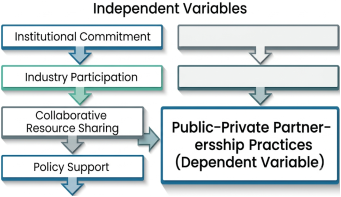
The conceptual framework for this study was developed from the conceptual, theoretical, and empirical literature reviewed in the preceding sections. It is informed by Human Capital Theory, Stakeholder Theory, Resource Dependence Theory, and Collaborative Governance Theory, which collectively explain how institutional, organizational, and policy factors influence Public-Private Partnership (PPP) implementation in Technical and Vocational Education and Training (TVET).
Based on the literature, four independent variables were identified: institutional commitment, industry participation, collaborative resource sharing, and policy support. Institutional commitment refers to the leadership, organizational capacity, and managerial support provided by TVET institutions. Industry participation reflects employer involvement in curriculum development, workplace learning, competency assessment, and other partnership activities. Collaborative resource sharing encompasses the joint use of financial, physical, technological, informational, and human resources, while policy support represents the legislative, regulatory, and institutional environment that enables effective collaboration.
The dependent variable, Public-Private Partnership Practices, refers to the effectiveness of collaboration between public TVET institutions and private-sector organizations in planning, implementing, managing, monitoring, and continuously improving partnership activities to enhance the quality, relevance, and labour-market responsiveness of TVET.
Figure 1. Conceptual framework Source: Survey of 2026.
The framework proposes that Institutional Commitment, Industry Participation, Collaborative Resource Sharing, and Policy Support are the principal organizational determinants of PPP Practices within public TVET institutions. Institutional commitment provides strategic leadership; industry participation ensures labour-market responsiveness; collaborative resource sharing strengthens institutional capacity through joint utilization of financial, technological, and human resources; and policy support creates the enabling regulatory environment for sustaining long-term collaboration. Together, these variables explain the quality and sustainability of PPP implementation.
3. Research Methodology
The study will employ a mixed-methods research approach, integrating quantitative and qualitative techniques within a convergent parallel design. Quantitative data, collected through structured questionnaires, will be used to test the hypotheses set out in Section 6 and to measure the strength of association between the identified variables. Qualitative data, collected through semi-structured key informant interviews, will be used to explain, contextualize, and illustrate the quantitative findings, particularly regarding the specific challenges and strategies that numbers alone cannot fully capture.
Research Design: A descriptive cross-sectional survey design will be employed to capture existing partnership practices, perceptions, and challenges at a single point in time across the selected institutions and enterprises.
Study Area: The study will be conducted in selected public TVET colleges and partner private enterprises located in Addis Ababa. As Ethiopia’s capital and primary industrial and commercial center, Addis Ababa hosts a concentration of public TVET institutions alongside a diverse private enterprise base spanning manufacturing, construction, ICT, hospitality, and other service sectors, making it a substantively appropriate setting for examining PPP practice.
Population of the Study: The target population consists of various respondent categories drawn from selected public TVET colleges and their partner private enterprises. This includes college management, specifically TVET college deans and vice deans, as well as department heads. It also encompasses trainers directly engaged in cooperative training or industry-linkage activities, alongside industry liaison officers who serve as the college-side staff responsible for coordinating with enterprises. Finally, human resource managers and training coordinators from the partner private enterprises are included in this target group.
Sample Size Determination: Given the absence of a precise, up-to-date sampling frame at proposal stage, the sample size is estimated using
| [36] | Yamane, T. (1967). Statistics: An introductory analysis (2nd ed.). Harper & Row. |
[36]
simplified formula for determining sample size from a finite population, expressed as:
n = N / [1 + N(e)2] where n is the required sample size, N is the estimated total population, and e is the acceptable margin of error. For this study, the total population across the five respondent categories listed above, drawn from the purposively selected colleges and partner enterprises, is estimated at approximately N = 300. Applying a margin of error of e = 0.09 (9%) a level commonly used in descriptive education and social science research where a smaller, fully accessible population does not justify the very large sample implied by a 5% margin, but where 10% is considered slightly too permissive — yields:
n = 300 / [1 + 300(0.09)2] = 300 / [1 + 2.43] = 300 / 3.43 ≈ 87.5, rounded up to 88. This figure is consistent with the originally proposed sample of 80-90 respondents and will be refined once the specific colleges and enterprises are confirmed and an accurate sampling frame is established during the data collection preparation phase. The estimated sample is then distributed proportionally across the five respondent categories as follows:
Table 1. Sample Distribution.
Respondent Category | Estimated Population (N) | Sample Size (n) |
College management (deans & vice deans) | 25 | 7 |
Department heads | 40 | 12 |
Trainers (cooperative training / linkage focal trainers) | 120 | 35 |
Industry liaison officers (college side) | 20 | 6 |
Industry HR managers / training coordinators (enterprise side) | 95 | 28 |
Total | 300 | 88 |
Source: Survey Data (2026)
Sampling Techniques: A combination of purposive and stratified random sampling will be used. TVET colleges and their partner enterprises will be selected purposively, based on documented or observable engagement in PPP/cooperative training activities, to ensure that selected sites have meaningful partnership experience to report on. Within each selected college and enterprise, respondents will be stratified by the five categories listed in Section 12.4, and individuals within each stratum will be selected using simple random sampling (or, where a category has very few eligible individuals, a full census of that stratum) to minimize selection bias. Primary Data: Collected directly from respondents through structured questionnaires, semi-structured interviews, and key informant interviews.
Secondary Data: Drawn from relevant policy documents, the National TVET Strategy, cooperative training directives, and institutional reports, used to contextualize and triangulate primary findings.
Questionnaire: A structured questionnaire containing five-point Likert-scale items (Strongly Disagree to Strongly Agree) will be used to collect quantitative data on each of the six independent variables and the dependent variable. The full draft instrument is provided in Appendix A. Interview Guide: Semi-structured interviews will be conducted with key informants college leadership and industry HR managers/training coordinator to obtain in-depth, explanatory information that complements the questionnaire data.
The full draft guide is provided in Appendix B. Document Analysis: Relevant institutional and policy documents (partnership agreements/MOUs where available, cooperative training schedules and college reports) will be reviewed to corroborate respondent accounts.
Validity and Reliability: Content validity will be ensured through expert review of the draft questionnaire and interview guide by the research advisor and at least two TVET professionals familiar with cooperative training practice, with items revised based on their feedback before pilot testing. A pilot test will be administered to approximately 10% of the target sample (drawn from a college not included in the main study, to avoid contamination of the final sample), and internal consistency will be assessed using Cronbach’s Alpha for each construct, with a coefficient of 0.70 or above considered acceptable.
Method of Data Analysis: Descriptive statistics, frequencies, percentages, mean scores, and standard deviations for each variable; Inferential statistics, Pearson product-moment correlation coefficients to test the bivariate relationships specified in hypotheses H1-H6;
.
4. Data Analysis, Results and Interpretation
This chapter presents data analysis and interpretation from respondents on PPP practices in TVET institutions in Addis Ababa. Data were analyzed using SPSS Version 27, applying descriptive statistics (frequencies, percentages, means, standard deviations) and inferential techniques (Pearson correlation and multiple linear regression) to examine relationships between institutional commitment, industry participation, resource sharing, policy support, and PPP effectiveness.
4.1. Response Rate
A total of 88 questionnaires were distributed to respondents selected from public TVET colleges and partner private enterprises in Addis Ababa. Of these, 84 completed questionnaires were returned, representing a response rate of 95.5%. Four questionnaires were excluded because of incomplete responses. According to methodological literature, a response rate exceeding 70% is considered highly satisfactory for survey research. Therefore, the obtained response rate was considered adequate for statistical analysis and interpretation.
Table 2. Response Rate.
Questionnaire | Frequency | Percent |
Distributed | 88 | 100.0 |
Returned | 84 | 95.5 |
Not Returned | 4 | 4.5 |
Source: Field Survey, 2026
The findings in
Table 2 confirm a very high return rate of 95.5%, with only 4.5% of questionnaires not returned. This high response level enhances the reliability and validity of findings, reduces non-response bias, and reflects stakeholders' perceived relevance of PPP issues in TVET institutions and private enterprises.
4.2. Demographic Characteristics of Respondents
Table 3. Position of Respondents.
Position | Frequency | Percent |
College Management | 7 | 8.3 |
Department Heads | 11 | 13.1 |
TVET Trainers | 33 | 39.3 |
Industry Liaison Officers | 6 | 7.1 |
Industry HR Managers | 27 | 32.2 |
Total | 84 | 100 |
Source: Field Survey, 2026
Table 3 shows that the largest proportion of respondents were TVET trainers (39.3%), followed by industry Human Resource (HR) managers (32.2%). Smaller proportions were department heads (13.1%), college management (8.3%), and industry liaison officers (7.1%). This distribution is significant because it captures perspectives from both the implementation level (trainers and HR managers) and the strategic/administrative level (management and liaison officers). The dominance of trainers and HR managers enhances the credibility of the findings, as these groups are directly involved in the day-to-day execution of cooperative training and partnership activities, while the inclusion of leadership roles ensures a broader institutional understanding of PPP practices.
Table 4. Years of Experience.
Experience | Frequency | Percent |
Below 5 Years | 17 | 20.2 |
5-10 Years | 38 | 45.2 |
11-15 Years | 18 | 21.4 |
Above 15 Years | 11 | 13.2 |
Source: Field Survey, 2026
The findings in
Table 4 reveal that a substantial proportion of respondents (45.2%) had between 5 and 10 years of professional experience, followed by those with 11-15 years (21.4%), below 5 years (20.2%), and above 15 years (13.2%). This indicates that most respondents possess moderate to extensive professional experience, particularly relevant to TVET and industry collaboration contexts.
Such experience levels suggest that respondents are sufficiently familiar with institutional practices and PPP implementation processes, thereby enhancing the reliability of their judgments.
The presence of both mid-level and highly experienced professionals further strengthens the depth and balance of the data collected for this study.
4.3. Reliability Analysis
This section presents the reliability analysis of the measurement instruments used in the study. Cronbach’s Alpha was employed to examine the internal consistency of the constructs related to Public-Private Partnership (PPP) practices in TVET institutions and industry engagement. Reliability testing is essential in ensuring that the items used in the questionnaire consistently measure the same underlying concepts and produce stable results across respondents. A Cronbach’s Alpha value of 0.70 and above is generally considered acceptable in social science research, indicating that the instrument is reliable for further statistical analysis and interpretation. Cronbach's Alpha was employed to assess the internal consistency of the measurement scales.
Table 5. Reliability Test.
Variable | Items | Cronbach Alpha |
Institutional Commitment | 6 | 0.861 |
Industry Participation | 5 | 0.845 |
Resource Sharing | 5 | 0.874 |
Policy Support | 5 | 0.836 |
PPP Practice | 6 | 0.902 |
Source: SPSS Output, 2026
The results presented in
Table 5 indicate that all measured constructs achieved Cronbach’s Alpha values above the recommended threshold of 0.70, demonstrating strong internal consistency. Specifically, PPP Practice recorded the highest reliability (α = 0.902), followed by Resource Sharing (α = 0.874), Institutional Commitment (α = 0.861), Industry Participation (α = 0.845), and Policy Support (α = 0.836). These results confirm that all questionnaire items are highly consistent in measuring their respective constructs without significant measurement error. Therefore, the instrument is deemed reliable and suitable for further inferential statistical analysis, as it provides a stable and internally coherent basis for assessing PPP practices in TVET institutions.
4.4. Descriptive Analysis
This section presents descriptive statistics on study variables related to PPP practices. Mean and standard deviation values summarize respondents' perceptions, where higher means indicate stronger agreement and lower standard deviations reflect greater consensus. The results clarify how PPP is implemented and perceived within the selected TVET institutions and partner industries, structured according to the study's specific objectives.
Table 6. Current Practices of Public-Private Partnership.
Variable | Mean | SD |
Joint curriculum development | 3.62 | 0.81 |
Industrial attachment | 3.95 | 0.74 |
Cooperative training | 4.03 | 0.71 |
Joint monitoring | 3.51 | 0.86 |
Information sharing | 3.68 | 0.82 |
Source: SPSS Output, 2026
The findings in
Table 6 indicate that respondents generally acknowledged the presence of Public-Private Partnership practices within TVET institutions, although the strength and consistency of implementation varied across activities. The mean values suggest that PPP practices are moderately to highly implemented, reflecting ongoing collaboration between TVET institutions and private enterprises in areas such as training delivery, workplace exposure, and resource utilization. The standard deviation values further indicate a moderate level of agreement among respondents, suggesting some variation in experiences across institutions. Overall, the results confirm that PPP practices are operational, but still require strengthening to ensure more standardized and effective implementation across all partner institutions.
Table 7. Roles of Public and Private Partners.
Variable | Mean | SD |
Curriculum facilitation by TVET institutions | 4.02 | 0.76 |
Trainee coordination and supervision | 3.89 | 0.79 |
Provision of workplace training by industry | 4.10 | 0.68 |
Workplace mentoring and coaching | 3.97 | 0.72 |
Private sector participation in decision-making | 3.22 | 0.91 |
Source: SPSS Output, 2026
As presented in
Table 7 the overall mean score of 3.84 indicates that respondents agreed on the defined roles of both public and private partners in the implementation of PPP in TVET. Public institutions were perceived to play a leading role in facilitating curriculum delivery, coordinating trainees, and providing institutional supervision, while private enterprises were mainly responsible for offering practical training opportunities, workplace mentoring, and technical support. However, the findings also reveal that private sector involvement in strategic decision-making remains relatively limited. This imbalance suggests that while operational collaboration is relatively strong, participatory governance and shared decision-making between partners still require improvement to achieve a more balanced and effective PPP framework.
Table 8. Opportunities and Benefits of PPP. Opportunities and Benefits of PPP. Opportunities and Benefits of PPP.
Variable | Mean | SD |
Improved graduate employability | 4.25 | 0.66 |
Practical skill acquisition | 4.18 | 0.70 |
Technology transfer | 3.96 | 0.73 |
Curriculum relevance improvement | 4.07 | 0.69 |
Strengthened industry linkage | 3.78 | 0.81 |
Source: SPSS Output, 2026
The results in
Table 8 reveal a high overall mean score of 4.05, indicating that respondents strongly agreed that Public-Private Partnerships in TVET generate significant opportunities and benefits. The highest-rated benefits include improved graduate employability, enhanced practical skill acquisition, effective technology transfer, improved curriculum relevance, and strengthened industry linkages. Among these, employability and workplace readiness were identified as the most prominent outcomes, highlighting the practical value of PPP in bridging the gap between training and labor market demands. The relatively low variation in responses suggests a strong consensus among stakeholders that PPP plays a critical role in enhancing the quality and relevance of TVET education, although further strengthening of collaboration mechanisms is still necessary for sustained impact.
Table 9. Challenges Affecting PPP. Challenges Affecting PPP. Challenges Affecting PPP.
Challenge | Mean |
Insufficient funding | 4.21 |
Weak policy implementation | 4.08 |
Limited industry commitment | 3.97 |
Poor communication | 3.91 |
Lack of monitoring | 3.88 |
Source: SPSS Output, 2026
The results in
Table 9 indicate that respondents strongly agreed on several key challenges affecting the effective implementation of Public-Private Partnerships in TVET institutions, as reflected by relatively high mean scores across all items. Insufficient funding emerged as the most critical challenge (M = 4.21), followed by weak policy implementation (M = 4.08), indicating that financial constraints and inadequate enforcement of existing policies significantly hinder PPP effectiveness. Limited industry commitment (M = 3.97) and poor communication between stakeholders (M = 3.91) were also identified as notable barriers, suggesting gaps in sustained engagement and coordination between partners. Additionally, lack of effective monitoring mechanisms (M = 3.88) further constrains accountability and the smooth execution of partnership activities. Overall, the findings reveal that while PPP is widely recognized as important, its implementation is constrained by structural, institutional, and coordination-related challenges that require targeted policy and managerial interventions.
4.5. Correlation Analysis
Table 10. Correlation Analysis.
Variable | 1 | 2 | 3 | 4 | 5 |
Institutional Commitment | 1 | | | | |
Industry Participation | .612** | 1 | | | |
Resource Sharing | .584** | .647** | 1 | | |
Policy Support | .563** | .599** | .618** | 1 | |
PPP Practice | .698** | .742** | .715** | .671** | 1 |
p <.01 |
Source: SPSS Output, 2026
The correlation analysis in
Table 10 indicates that all independent variables are positively and significantly associated with Public-Private Partnership (PPP) practice at the 0.01 significance level. Industry participation shows the strongest correlation (r = 0.742), followed by resource sharing (r = 0.715), institutional commitment (r = 0.698), and policy support (r = 0.671). These findings suggest that stronger industry engagement, institutional commitment, collaborative resource sharing, and supportive policies are all associated with more effective PPP implementation in TVET institutions.
4.6. Multiple Regression Analysis
Table 11. Model Summary.
R | R2 | Adjusted R2 | Std. Error |
0.829 | 0.687 | 0.672 | 0.451 |
Source: SPSS Output, 2026
The model summary in
Table 11 indicates that the regression model has strong explanatory power. The independent variables jointly explain
68.7% of the variation in Public-Private Partnership (PPP) practice (
R2 = 0.687), while the adjusted
R2 = 0.672 confirms the model's robustness after accounting for the number of predictors. The relatively low standard error (
0.451) further indicates good predictive accuracy. Overall, the findings demonstrate that institutional commitment, industry participation, resource sharing, and policy support are important determinants of PPP practice in TVET institutions.
Table 12. Regression Coefficients.
Variable | Beta | t | Sig |
Institutional Commitment | 0.248 | 3.42 | 0.001 |
Industry Participation | 0.356 | 4.87 | 0.000 |
Resource Sharing | 0.271 | 3.98 | 0.000 |
Policy Support | 0.214 | 2.94 | 0.004 |
Source: SPSS Output, 2026
The regression results in
Table 12 reveal that all independent variables significantly and positively influence PPP practice. Industry participation has the strongest effect (β = 0.356, p < 0.001), indicating that active engagement of industry partners plays the most critical role in enhancing PPP effectiveness. This is followed by resource sharing (β = 0.271, p < 0.001) and institutional commitment (β = 0.248, p = 0.001), both of which also make significant contributions to improving PPP outcomes. Policy support, while having the lowest relative effect (β = 0.214, p = 0.004), remains statistically significant, confirming its important enabling role. Overall, the findings suggest that strengthening industry engagement, improving resource sharing mechanisms, enhancing institutional commitment, and reinforcing policy frameworks are essential for effective PPP implementation in TVET institutions.
5. Key Findings, Discussion, Conclusions and Recommendations
5.1. Overview of the Findings
This chapter summarizes key empirical results in relation to the study objectives, discusses findings in light of relevant theory and previous studies, draws conclusions, presents study contributions, and provides evidence-based recommendations for key stakeholders. Study limitations and future research directions are also addressed.
5.2. Discussion of Findings
The primary purpose of this study was to examine the practices of Public-Private Partnership (PPP) in Technical and Vocational Education and Training (TVET) institutions in Addis Ababa by assessing the influence of institutional commitment, industry participation, resource sharing, and policy support on effective partnership implementation. The discussion presented in this section interprets the empirical findings in relation to previous studies and the theoretical foundations underpinning the study, thereby demonstrating how the results contribute to the broader body of knowledge on PPP implementation in TVET.
The findings indicate that institutional commitment has a significant positive influence on PPP practices in TVET institutions in Addis Ababa. Although respondents rated it as moderate overall, regression analysis showed that stronger leadership, strategic planning, and internal coordination significantly improve PPP implementation. This is consistent with previous studies demonstrating that committed leadership and effective governance are essential for sustainable partnerships, while weak institutional commitment undermines coordination
| [8] | Bryson, J. M., Crosby, B. C., & Stone, M. M. (2015). Designing and implementing cross-sector collaborations: Needed competencies and strategies. Public Administration Review, 75(5), 647-663. https://doi.org/10.1111/puar.12432 |
| [9] | Emerson, K., & Nabatchi, T. (2015). Collaborative governance regimes. Georgetown University Press. |
[8, 9]
. Strengthening institutional commitment is therefore fundamental to enhancing the effectiveness and sustainability of PPP in the TVET system.
Industry Participation and Public-Private Partnership Practice: This study reveals that industry participation is not merely one component of Public-Private Partnership but rather its most influential driver within the Addis Ababa TVET context. Effective employer engagement strengthens institutional relevance, enhances the quality of practical training, promotes efficient resource utilization, supports innovation, and improves graduate employability. The finding therefore reinforces growing international evidence that sustainable TVET reform depends fundamentally on establishing strong, institutionalized, and mutually beneficial partnerships between education providers and the private sector.
This study confirms that resource sharing is a key determinant of effective PPP in Addis Ababa TVET institutions. Beyond financial contributions, sustainable partnerships require sharing infrastructure, technology, expertise, and institutional knowledge to achieve common educational and economic goals. Collaborative resource mobilization strengthens institutional capacity, improves training quality, and supports workforce development. Institutionalizing resource-sharing mechanisms through formal MOUs and joint planning processes should therefore remain a priority for future TVET reforms and PPP initiatives.
This study confirms that policy support represents an indispensable enabling factor for effective PPP in TVET. While Ethiopia has established policy frameworks recognizing the importance of public-private collaboration, strengthening implementation, governance coordination, and stakeholder participation remains essential for sustainable outcomes. The significant positive influence of policy support reinforces international evidence that successful PPPs depend not only on organizational commitment and resource availability, but on coherent policies, effective governance systems, and inclusive stakeholder engagement
| [20] | Morrow, J., et al. (2023). TVET and youth employment in Africa: Curriculum and partnership approaches. African Education Review. |
| [35] | World Bank, UNESCO, & ILO. (2023). Building better formal TVET systems: Principles and practice in low- and middle-income countries. Washington, DC; Paris; Geneva: World Bank, UNESCO, and ILO.
https://doi.org/10.1596/978-1-4648-1906-5 |
[20, 35]
.
5.3. Conclusions
This study examined the practices of Public-Private Partnership (PPP) in Technical and Vocational Education and Training (TVET) institutions in Addis Ababa by assessing the influence of institutional commitment, industry participation, resource sharing, and policy support on partnership implementation. Based on descriptive statistics, correlation analysis, multiple regression, and hypothesis testing, the study concludes that although PPP has become an important strategy for improving the quality and labor market relevance of TVET, its implementation remains at a moderate level due to persistent institutional, organizational, and policy challenges.
The findings confirm that institutional commitment, industry participation, resource sharing, and policy support all have significant positive effects on PPP implementation. Institutions with stronger leadership, strategic planning, effective coordination, active industry engagement, collaborative resource mobilization, and supportive policy environments are more likely to establish sustainable and effective partnerships. However, the moderate performance of these factors indicates the need to strengthen governance, institutional capacity, stakeholder collaboration, and policy implementation.
Overall, the study concludes that improving PPP in Addis Ababa's TVET institutions requires an integrated approach that strengthens institutional leadership, expands industry participation, enhances resource sharing, and reinforces policy support. Achieving sustainable partnerships depends on the shared commitment and coordinated efforts of government, TVET institutions, private enterprises, development partners, and other stakeholders. Strengthening these areas will improve the quality, relevance, and responsiveness of TVET while supporting workforce development, economic competitiveness, and sustainable national development in Ethiopia.
5.4. Contributions of the Study
This study demonstrates that PPP implementation in TVET is best explained through the complementary integration of Stakeholder Theory, Human Capital Theory, Resource Dependence Theory, and Collaborative Governance Theory. By integrating these four perspectives into a single analytical framework, it provides a more comprehensive explanation of PPP implementation than reliance on any single theory, reinforcing Collaborative Governance Theory's emphasis on shared leadership, institutional trust, and coordinated decision-making.
The findings provide practical guidance for TVET leaders, policymakers, and private-sector partners by identifying institutional commitment, industry participation, resource sharing, and policy support as key determinants of effective PPP. The study highlights the need for stronger institutional leadership, formal partnership structures, and accountability. It emphasizes expanding private-sector engagement beyond student placements to include curriculum development, competency assessment, instructor capacity building, technology transfer, and joint planning.
Policy Contribution: The study provides empirical evidence to support improvements in Ethiopia's TVET and PPP policy frameworks. Although current policies promote public-private collaboration, implementation challenges remain. The findings recommend strengthening governance structures, institutional coordination, regulatory implementation, and accountability mechanisms. They further support the development of clear operational guidelines, stronger monitoring and evaluation systems, and incentive mechanisms—such as tax incentives, cost-sharing arrangements, recognition programs, and long-term partnership agreements—to encourage sustained private-sector participation.
This study contributes methodologically by applying a quantitative design integrating descriptive statistics, Pearson correlation, multiple regression, and hypothesis testing to examine determinants of PPP practices in Ethiopian TVET. The conceptual framework provides a practical analytical model for assessing relationships among institutional commitment, industry participation, resource sharing, policy support, and PPP practice, adaptable for similar contexts. It establishes a baseline for future longitudinal, comparative, qualitative, or mixed-methods research on PPP in Ethiopian TVET.
5.5. Recommendations
The findings of this study demonstrate that strengthening Public-Private Partnership (PPP) practices within Technical and Vocational Education and Training (TVET) institutions in Addis Ababa requires coordinated action by multiple stakeholders. Since institutional commitment, industry participation, resource sharing, and policy support were all found to have significant positive influences on PPP implementation, the following evidence-based recommendations are proposed for TVET institutions, private enterprises, policymakers, and development partners.
Recommendations for TVET Institutions: TVET institutions should strengthen institutional leadership and organizational commitment by integrating Public-Private Partnership into their strategic plans, annual operational plans, and institutional performance management systems. Dedicated PPP coordination units with clearly defined mandates, qualified personnel, and adequate operational resources should be established or strengthened to facilitate partnership planning, implementation, monitoring, and evaluation. Institutional leaders should also promote a culture of collaboration by encouraging regular engagement with employers and ensuring that partnership performance is incorporated into institutional accountability mechanisms.
Recommendations for Private Enterprises: Private enterprises should recognize Public-Private Partnership as a strategic investment in workforce development rather than solely as a corporate social responsibility activity. Employers should expand their participation beyond internship provision by contributing to curriculum design, occupational standards development, competency assessment, instructor industrial attachment programs, technology transfer, applied research, and innovation initiatives. Such engagement will help ensure that TVET graduates possess the knowledge, technical competencies, and employability skills required in contemporary workplaces.
Recommendations for Policymakers: Government authorities should strengthen the implementation of existing Public-Private Partnership (PPP) and TVET policies by developing clear operational guidelines that define stakeholder roles, implementation procedures, and accountability mechanisms. They should also establish coordinated governance structures to enhance collaboration among TVET institutions, private enterprises, industry associations, and relevant government agencies. In addition, policymakers should introduce incentive mechanisms—such as tax incentives, matching grants, cost-sharing arrangements, recognition programs, and preferential access to government-supported skills development initiatives—to encourage sustained private-sector participation in TVET partnerships.
Development partners should continue supporting Ethiopia's TVET sector through financial assistance, technical expertise, institutional capacity building, and knowledge exchange. Investment should prioritize modern training infrastructure, digital technologies, instructor professional development, curriculum modernization, and institutional capacity building that strengthens TVET-enterprise collaboration. Technical assistance should improve partnership management systems, monitoring and evaluation frameworks, governance structures, and evidence-based policy implementation to achieve sustainable PPP outcomes.
5.6. Limitations of the Study
This study has several limitations. First, the cross-sectional design captures PPP practices at a single point in time. Second, the quantitative approach limits the depth of contextual understanding that qualitative research could provide. Third, confinement to selected public TVET institutions in Addis Ababa limits generalizability to other regions. Fourth, analysis focused on four key determinants while other factors remain beyond scope. Finally, self-reported data may be subject to response bias despite confidentiality measures.
5.7. Future Direction of the Study
The findings and limitations of this study suggest several directions for future research on Public-Private Partnership (PPP) in Technical and Vocational Education and Training (TVET).
Future studies should employ longitudinal designs to examine how PPPs evolve over time and assess the long-term effects of institutional reforms, policy implementation, industry engagement, and resource mobilization. Mixed-methods and qualitative approaches are also recommended to provide deeper insights into stakeholder experiences, governance processes, institutional challenges, and partnership dynamics.
Comparative research across different regions of Ethiopia and between public and private TVET institutions would improve understanding of contextual and institutional variations in PPP implementation. Future studies should also expand the conceptual framework by examining additional factors such as organizational culture, leadership, innovation capacity, digital transformation, financial sustainability, governance quality, and labor market intelligence.
Finally, research should move beyond implementation practices to evaluate the outcomes and impacts of PPPs on graduate employability, workforce competitiveness, enterprise productivity, institutional innovation, and socioeconomic development. Comparative international studies would further identify transferable good practices and inform context-specific strategies for strengthening TVET partnerships in developing countries.
Abbreviations
TVET | Technical and Vocational Education and Training |
PPP | Public-Private Partnership |
ILO | International Labour Organization |
UNESCO | United Nations Educational, Scientific and Cultural Organization |
OECD | Organisation for Economic Co-operation and Development |
SDG | Sustainable Development Goal |
FDRE | Federal Democratic Republic of Ethiopia |
MoE | Ministry of Education |
SPSS | Statistical Package for the Social Sciences |
RDT | Resource Dependence Theory |
Author Contributions
Seblewongel Haregewein Tsedal: Conceptualization, Data curation, Formal Analysis, Investigation, Methodology, Project administration, Validation, Visualization, Writing – original draft, Writing – review & editing
Biadgelign Ademe: Supervision, Writing – review & editing
Conflicts of Interest
The authors declare no conflicts of interest.
References
| [1] |
Aarkrog, V. (2021). The impact of virtual reality on learning processes and learning outcome: A study of VR-based learning among social and health care staff and students. In C. Nägele, B. E. Stalder, & M. Weich (Eds.), Pathways in Vocational Education and Training and Lifelong Learning: Proceedings of the 4th Crossing Boundaries Conference in Vocational Education and Training (pp. 11-15). Muttenz and Bern: VETNET, University of Applied Sciences and Arts Northwestern Switzerland.
https://doi.org/10.5281/zenodo.4596448
|
| [2] |
African Development Bank. (2022). Skills development and TVET financing in Africa. AfDB.
https://doi.org/10.7551/mitpress/13002.001.0001
|
| [3] |
African Union. (2020). Annual report on the activities of the African Union and its organs. Addis Ababa: African Union Commission.
|
| [4] |
Alemu, A. (2024). Apprenticeship and work-based learning in Addis Ababa TVET institutions. Addis Ababa University.
|
| [5] |
Asrat, T., et al. (2023). Knowledge transfer in private-public development partnerships in Ethiopia and Zambia. Journal of Vocational Education Studies.
https://doi.org/10.7577/sjvd.5099
|
| [6] |
Becker, G. S. (1964). Human capital: A theoretical and empirical analysis. University of Chicago Press.
|
| [7] |
Braun, V., & Clarke, V. (2006). Using thematic analysis in psychology. Qualitative Research in Psychology, 3(2), 77-101.
https://doi.org/10.1191/1478088706qp063oa
|
| [8] |
Bryson, J. M., Crosby, B. C., & Stone, M. M. (2015). Designing and implementing cross-sector collaborations: Needed competencies and strategies. Public Administration Review, 75(5), 647-663.
https://doi.org/10.1111/puar.12432
|
| [9] |
Emerson, K., & Nabatchi, T. (2015). Collaborative governance regimes. Georgetown University Press.
|
| [10] |
Federal Democratic Republic of Ethiopia Ministry of Education (FDRE MoE). (2022).
|
| [11] |
Freeman, R. E. (1984). Strategic management: A stakeholder approach. Pitman.
|
| [12] |
GIZ. (2026). Ethio-German sustainable training and education programme report. Deutsche Gesellschaft für Internationale Zusammenarbeit.
|
| [13] |
International Labour Organization. (2021). TVET trainer industry exposure and apprenticeship barriers in Ethiopia. ILO PROSPECTS Programme.
|
| [14] |
International Labour Organization. (2023). Building pathways to sustainable growth: Strengthening Technical and Vocational Education and Training (TVET) and productive sector linkages in Africa. Geneva: ILO & African Development Bank.
https://doi.org/10.54675/MHVE7845
|
| [15] |
Kebede, T., et al. (2024). TVET-industry linkage and cooperative training in Ethiopia: A synthesis. Ethiopian Journal of Education and Development.
https://doi.org/10.1080/2331186X.2024.2406721
|
| [16] |
Lantbeye, G., et al. (2022). Cooperative training practice in Amhara region TVET colleges. Journal of Technical Education and Training.
https://doi.org/10.1080/2331186X.2021.2020608
|
| [17] |
Marginson, S. (2019). Limitations of human capital theory. Studies in Higher Education, 44(2), 287-301. Routledge/Taylor & Francis.
https://doi.org/10.1080/03075079.2017.1359823
|
| [18] |
Melesse, A., et al. (2023). Public-private development partnerships in Ethiopian TVET system. International Journal of Educational Development.
https://doi.org/10.1080/14480220.2022.2159854
|
| [19] |
Ministry of Education (MoE). (2022). Education Statistics Annual Abstract: 2021/22 Academic Year. Addis Ababa: FDRE MoE, EMIS and ICT Directorate.
|
| [20] |
Morrow, J., et al. (2023). TVET and youth employment in Africa: Curriculum and partnership approaches. African Education Review.
|
| [21] |
Organisation for Economic Co-operation and Development (OECD). (2018)
|
| [22] |
Organisation for Economic Co-operation and Development (OECD). (2020).
|
| [23] |
Organisation for Economic Co-operation and Development (OECD). (2023). Vocational education and training systems for future skills. OECD Publishing.
|
| [24] |
OECD & ILO. (2017). Engaging employers in apprenticeship and skills development. OECD/ILO.
https://doi.org/10.1787/9789264266681-en
|
| [25] |
Oviawe, J. I. (2018). Public-private partnership in technical and vocational education in Nigeria. International Journal of Vocational and Technical Education.
https://doi.org/10.4314/majohe.v10i1.5
|
| [26] |
Pfeffer, J., & Salancik, G. R. (1978). The external control of organizations: A resource dependence perspective. Harper & Row.
|
| [27] |
Pilz, M., & Li, J. (2021). International transfer of vocational education and training: A literature review. Journal of Vocational Education & Training. Advance online publication.
https://doi.org/10.1080/13636820.2020.1847566
|
| [28] |
Schultz, T. W. (1961). Investment in human capital. The American Economic Review, 51(1), 1-17.
https://doi.org/10.2307/1818907
|
| [29] |
UNESCO. (2021). Biennial Report 2020-2021: Adapting to the new normal. Bonn: UNESCO-UNEVOC International Centre for TVET.
|
| [30] |
UNESCO. (2022). Transforming technical and vocational education and training for successful and just transitions: UNESCO strategy 2022-2029. Paris: UNESCO.
https://doi.org/10.54675/EUDU5854
|
| [31] |
UNESCO IIEP-Dakar. (2022). Digital transformation in TVET systems in Africa. UNESCO.
|
| [32] |
Wondwossen, T. (2021). Cooperative training and TVET industry linkage in Ethiopia. Unpublished thesis/report.
|
| [33] |
World Bank. (2019). Annual report 2019: Ending poverty, investing in opportunity. Washington, DC: World Bank Group.
|
| [34] |
World Bank. (2022). Annual report 2022: Helping countries adapt to a changing world. Washington, DC: World Bank Group.
https://doi.org/10.1596/978-1-4648-1901-0
|
| [35] |
World Bank, UNESCO, & ILO. (2023). Building better formal TVET systems: Principles and practice in low- and middle-income countries. Washington, DC; Paris; Geneva: World Bank, UNESCO, and ILO.
https://doi.org/10.1596/978-1-4648-1906-5
|
| [36] |
Yamane, T. (1967). Statistics: An introductory analysis (2nd ed.). Harper & Row.
|
Cite This Article
-
APA Style
Tsedal, S. H., Ademe, B. (2026). Practices of Public-Private Partnership in Technical and Vocational Education and Training (TVET) in Addis Ababa, Ethiopia. Research & Development, 7(3), 156-172. https://doi.org/10.11648/j.rd.20260703.19
 Copy
|
Copy
|
 Download
ACS Style
Tsedal, S. H.; Ademe, B. Practices of Public-Private Partnership in Technical and Vocational Education and Training (TVET) in Addis Ababa, Ethiopia. Res. Dev. 2026, 7(3), 156-172. doi: 10.11648/j.rd.20260703.19
Copy
|
Download
AMA Style
Tsedal SH, Ademe B. Practices of Public-Private Partnership in Technical and Vocational Education and Training (TVET) in Addis Ababa, Ethiopia. Res Dev. 2026;7(3):156-172. doi: 10.11648/j.rd.20260703.19
Copy
|
Download
-
@article{10.11648/j.rd.20260703.19,
  author = {Seblewongel Haregewein Tsedal and Biadgelign Ademe},
  title = {Practices of Public-Private Partnership in Technical and Vocational Education and Training (TVET) in Addis Ababa, Ethiopia},
  journal = {Research & Development},
  volume = {7},
  number = {3},
  pages = {156-172},
  doi = {10.11648/j.rd.20260703.19},
  url = {https://doi.org/10.11648/j.rd.20260703.19},
  eprint = {https://article.sciencepublishinggroup.com/pdf/10.11648.j.rd.20260703.19},
  abstract = {Public-Private Partnership (PPP) has emerged as a strategic mechanism for improving the quality, relevance, and labor market responsiveness of Technical and Vocational Education and Training (TVET). Despite policy recognition of PPP in Ethiopia, its implementation remains constrained by weak institutional collaboration, limited industry engagement, inadequate resource mobilization, and inconsistent policy support. This study examined the practices of Public-Private Partnership in Technical and Vocational Education and Training (TVET) institutions in Addis Ababa. Guided by Stakeholder Theory, Human Capital Theory, Resource Dependence Theory, and Collaborative Governance Theory, the study employed a quantitative research approach using a descriptive and explanatory research design. Data was collected from TVET leaders, instructors, industry representatives, and relevant government officials through structured questionnaires. The data collected were analyzed using descriptive statistics, Pearson correlation analysis, and multiple linear regression to determine the influence of institutional commitment, industry participation, resource sharing, and policy support on PPP practice. The findings revealed that the overall practice of PPP in Addis Ababa TVET institutions was moderate, indicating considerable scope for improvement. Correlation analysis demonstrated that all four independent variables were positively and significantly associated with PPP practice. Multiple regression analysis further showed that institutional commitment, industry participation, resource sharing, and policy support each exerted a statistically significant positive influence on PPP implementation, with industry participation emerging as the strongest predictor. These findings suggest that sustainable PPP implementation requires stronger institutional leadership, active private-sector engagement, effective resource mobilization, and supportive governance and policy frameworks. The study contributes to the growing body of knowledge on TVET governance by integrating complementary theoretical perspectives to explain PPP implementation in a developing-country context. It also provides practical and policy-relevant evidence to guide TVET institutions, private enterprises, policymakers, and development partners in strengthening collaborative partnerships that enhance workforce development and improve the quality, relevance, and sustainability of TVET in Ethiopia.},
 year = {2026}
}
Copy
|
Download
-
TY  - JOUR
T1  - Practices of Public-Private Partnership in Technical and Vocational Education and Training (TVET) in Addis Ababa, Ethiopia
AU  - Seblewongel Haregewein Tsedal
AU  - Biadgelign Ademe
Y1  - 2026/08/18
PY  - 2026
N1  - https://doi.org/10.11648/j.rd.20260703.19
DO  - 10.11648/j.rd.20260703.19
T2  - Research & Development
JF  - Research & Development
JO  - Research & Development
SP  - 156
EP  - 172
PB  - Science Publishing Group
SN  - 2994-7057
UR  - https://doi.org/10.11648/j.rd.20260703.19
AB  - Public-Private Partnership (PPP) has emerged as a strategic mechanism for improving the quality, relevance, and labor market responsiveness of Technical and Vocational Education and Training (TVET). Despite policy recognition of PPP in Ethiopia, its implementation remains constrained by weak institutional collaboration, limited industry engagement, inadequate resource mobilization, and inconsistent policy support. This study examined the practices of Public-Private Partnership in Technical and Vocational Education and Training (TVET) institutions in Addis Ababa. Guided by Stakeholder Theory, Human Capital Theory, Resource Dependence Theory, and Collaborative Governance Theory, the study employed a quantitative research approach using a descriptive and explanatory research design. Data was collected from TVET leaders, instructors, industry representatives, and relevant government officials through structured questionnaires. The data collected were analyzed using descriptive statistics, Pearson correlation analysis, and multiple linear regression to determine the influence of institutional commitment, industry participation, resource sharing, and policy support on PPP practice. The findings revealed that the overall practice of PPP in Addis Ababa TVET institutions was moderate, indicating considerable scope for improvement. Correlation analysis demonstrated that all four independent variables were positively and significantly associated with PPP practice. Multiple regression analysis further showed that institutional commitment, industry participation, resource sharing, and policy support each exerted a statistically significant positive influence on PPP implementation, with industry participation emerging as the strongest predictor. These findings suggest that sustainable PPP implementation requires stronger institutional leadership, active private-sector engagement, effective resource mobilization, and supportive governance and policy frameworks. The study contributes to the growing body of knowledge on TVET governance by integrating complementary theoretical perspectives to explain PPP implementation in a developing-country context. It also provides practical and policy-relevant evidence to guide TVET institutions, private enterprises, policymakers, and development partners in strengthening collaborative partnerships that enhance workforce development and improve the quality, relevance, and sustainability of TVET in Ethiopia.
VL  - 7
IS  - 3
ER  -
Copy
|
Download





 Share This Article
 Twitter
 Linked In
 Facebook