
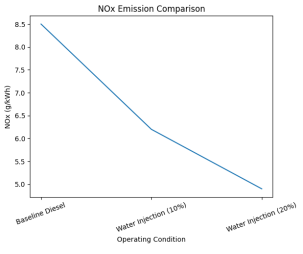
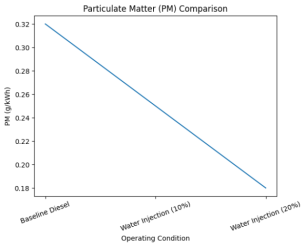
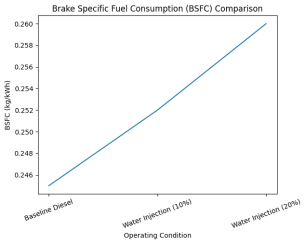
The research target is the significance of nitrogen oxides (NOx) and particulate matter (PM) emissions reduction of diesel-powered engines that are still significant sources of air pollution in terms of transportation and industrial activity. The suggested exhaust-driven water vapor injection system will make use of exhaust pressure to actuate a gear-cam nozzle assembly to inject water vapor in the combustion process in a controlled manner. This solution seems promising and innovative in the form of a retrofit solution to the current diesel engines. Combination of thermodynamic analysis: the thermodynamic modeling is done to consider the impact of water vapor injection on maximum flame temperature and NOx production with extended Zeldovich kinetics and first-law energy balance. The final experimental results reported show that despite the injection ratio of water being 10 and 20 per cent, the up to 42 and 44 percent of NOx emissions and particles are reduced, which is quite optimistic in its environmental improvement. Moreover, the resemblance to the latest literature allows locating the findings in the context of emission control technologies. Nonetheless, there are several things that need to be better explained and elaborated. The description does not provide sufficient details on the experimental setup, engine details, instrumentation, and measurement procedures, which makes it difficult to fully assess the reliability and reproducibility of the reported results. Moreover, there is no description of the modelling assumptions and validation approach. The rise of the brake specific fuel consumption (BSFC) is mentioned and not analysed adequately in terms of overall engine efficiency and performance trade-offs. Better articulation of the methodology and rigorous validation of the model, a more articulate discussion of performance implications, would enhance the scientific applicability and clarity of the work.
| Published in | Science Discovery Energy (Volume 1, Issue 1) |
| DOI | 10.11648/j.sdenergy.20260101.15 |
| Page(s) | 49-53 |
| Creative Commons |
This is an Open Access article, distributed under the terms of the Creative Commons Attribution 4.0 International License (http://creativecommons.org/licenses/by/4.0/), which permits unrestricted use, distribution and reproduction in any medium or format, provided the original work is properly cited. |
| Copyright |
Copyright © The Author(s), 2026. Published by Science Publishing Group |
Diesel Emission Control, Water Vapor Injection, NOx Kinetics, Particulate Matter, Thermodynamic Modeling, Mechanical Actuation
DPF | Diesel Particulate Filter |
BSFCC | Brake Specific Fuel Consumption |
EGR | Exhaust Gas Recirculation |
HVOC | Hydrotreated Vegetable Oil |
NRMMC | Non-Road Mobile Machinery |
RSM | Response Surface Methodology |
CFD | Computational Fluid Dynamics |
CI | Compression Ignition |
SCR | Selective Catalytic Reduction |
WED | Water-Emulsified Diesel |
NO | Nitric Oxide |
NOx | Nitrogen Oxides |
PM | Particulate Matter |
| [1] | D. Szőllősi and P. Kiss, “Effects of water injection in diesel engine emission treatment system—A review in the light of EURO 7,” Energies, vol. 17, no. 20, p. 5107, 2024. |
| [2] | P. K. Mondal and B. K. Mandal, “Effect of fuel injection pressure on the performances of a CI engine using water-emulsified diesel (WED) as a fuel,” Energy, Sustainability and Society, vol. 14, p. 12, 2024. |
| [3] | A. Khanjani and M. A. Sobati, “Performance and emission of a diesel engine using different water/waste fish oil (WFO) biodiesel/diesel emulsion fuels: Optimization of fuel formulation via response surface methodology (RSM),” Fuel, vol. 288, p. 119662, 2021. |
| [4] | J. Fuhrmeister, S. Mayer, and M. Günthner, “Impact of water injection on emission formation in an HVO-fuelled NRMM engine,” SAE Technical Paper 2025-32-0067, 2025. |
| [5] | Z. Mao, “Advanced diesel engine emission control: Current technologies and future alternatives,” Highlights in Science, Engineering and Technology, vol. 120, 2025. |
| [6] | J. Serrano, F. J. Jiménez-Espadafor, A. Lora, L. Modesto-López, A. Gañán-Calvo, and J. López-Serrano, “Experimental analysis of NOx reduction through water addition and comparison with exhaust gas recycling,” Energy, vol. 168, pp. 737–752, 2019. |
| [7] | S. Bari and H. Yu, “Water injection for diesel engine emission reduction,” Energy Conversion and Management, vol. 149, pp. 247–256, 2017. |
| [8] | K. Kim, J. Lee, and S. Park, “Experimental study on water direct injection to reduce NOx emissions in diesel engines,” Applied Energy, vol. 254, p. 113633, 2019. |
| [9] | T. Yao, Z. Zheng, and M. Liu, “Combustion and emission characteristics of water-in-diesel emulsion fuel,” Energy, vol. 91, pp. 803–812, 2015. |
| [10] | M. Lapuerta, O. Armas, and J. Rodríguez-Fernández, “Effect of water addition on diesel combustion and emissions,” Fuel Processing Technology, vol. 176, pp. 18–27, 2018. |
| [11] | H. Wei, Y. Zhu, and L. Shuai, “Thermodynamic and kinetic analysis of NOx formation under water injection conditions,” Applied Thermal Engineering, vol. 147, pp. 120–131, 2019. |
| [12] | S. Park and C. Bae, “Effects of direct water injection on combustion and emissions in a diesel engine,” International Journal of Engine Research, vol. 20, no. 4, pp. 356–367, 2019. |
| [13] | J. Liu, Q. Tang, and Y. Zhang, “Numerical simulation of water vapor injection on NO formation kinetics,” Combustion and Flame, vol. 211, pp. 1–14, 2020. |
| [14] | R. Payri, J. Benajes, and A. García, “Comparison of EGR and water injection for NOx reduction in CI engines,” Applied Energy, vol. 262, p. 114546, 2020. |
| [15] | L. Zhou, Y. Wang, and X. Li, “Investigation of micro-explosion phenomenon in water-diesel emulsions,” Fuel, vol. 278, p. 118190, 2020. |
| [16] | A. Kumar and R. Singh, “Recent advances in in-cylinder emission control technologies,” Renewable and Sustainable Energy Reviews, vol. 135, p. 110346, 2021. |
| [17] | M. Zhao, K. Li, and H. Chen, “Impact of water injection timing on combustion and NOx reduction,” Energy Conversion and Management, vol. 245, p. 114588, 2021. |
| [18] | S. Rajak, P. Nashine, and A. Verma, “Performance and emission analysis of diesel engine with water-diesel blends,” Cleaner Engineering and Technology, vol. 5, p. 100306, 2022. |
| [19] | J. Wang, H. Zhao, and L. Jiang, “CFD modeling of water injection strategies in diesel engines,” Applied Thermal Engineering, vol. 214, p. 118907, 2022. |
| [20] | T. Elkelawy, M. Bastawissi, and M. Alm El-Din Bastawissi, “Emission reduction techniques for CI engines under modern regulations,” Fuel, vol. 346, p. 128309, 2023. |
| [21] | M. A. Kalam et al., “Recent developments in diesel engine emission reduction techniques,” Energy Reports, vol. 9, pp. 213–229, 2023. |
| [22] | B. Patel and S. Sharma, “Experimental investigation on water vapor injection in heavy-duty diesel engines,” International Journal of Hydrogen Energy, vol. 48, 2023. |
| [23] | H. Nguyen and T. Pham, “Thermochemical modeling of NO formation under temperature-suppressed combustion,” Combustion Science and Technology, vol. 196, 2024. |
| [24] | Y. Li, G. Sun, and M. Huang, “Optimization of water injection ratio for emission-performance trade-off,” Energy, vol. 284, 2024. |
| [25] | S. Ahmed and M. Rashid, “Integrated thermodynamic-mechanical modeling of emission control systems,” Applied Energy, vol. 372, 2024. |
| [26] | D. Verma and A. Chandra, “Exhaust-driven actuation systems for retrofit diesel emission control,” SAE Technical Paper 2024-01-2103, 2024. |
| [27] | R. Das and P. K. Bose, “NOx–PM trade-off analysis in water-assisted diesel combustion,” Fuel, vol. 355, 2024. |
| [28] | L. Chen, Y. Wu, and J. Gao, “Water vapor injection for low-temperature combustion enhancement,” Energy Conversion and Management, vol. 310, 2025. |
| [29] | M. S. Rahman and S. Bari, “Advanced water injection strategies for Euro VII compliant diesel engines,” Applied Thermal Engineering, vol. 240, 2025. |
| [30] | X. Zhao, T. Li, and H. Yang, “Multi-objective optimization of water injection in heavy-duty diesel engines,” Energy, vol. 305, 2025. |
APA Style
Bekele, B. W. (2026). Mechanically Actuated Water Injection for Advanced Diesel Emission Control. Science Discovery Energy, 1(1), 49-53. https://doi.org/10.11648/j.sdenergy.20260101.15
ACS Style
Bekele, B. W. Mechanically Actuated Water Injection for Advanced Diesel Emission Control. Sci. Discov. Energy 2026, 1(1), 49-53. doi: 10.11648/j.sdenergy.20260101.15
@article{10.11648/j.sdenergy.20260101.15,
  author = {Berisso Woyessa Bekele},
  title = {Mechanically Actuated Water Injection for Advanced Diesel Emission Control},
  journal = {Science Discovery Energy},
  volume = {1},
  number = {1},
  pages = {49-53},
  doi = {10.11648/j.sdenergy.20260101.15},
  url = {https://doi.org/10.11648/j.sdenergy.20260101.15},
  eprint = {https://article.sciencepublishinggroup.com/pdf/10.11648.j.sdenergy.20260101.15},
  abstract = {The research target is the significance of nitrogen oxides (NOx) and particulate matter (PM) emissions reduction of diesel-powered engines that are still significant sources of air pollution in terms of transportation and industrial activity. The suggested exhaust-driven water vapor injection system will make use of exhaust pressure to actuate a gear-cam nozzle assembly to inject water vapor in the combustion process in a controlled manner. This solution seems promising and innovative in the form of a retrofit solution to the current diesel engines. Combination of thermodynamic analysis: the thermodynamic modeling is done to consider the impact of water vapor injection on maximum flame temperature and NOx production with extended Zeldovich kinetics and first-law energy balance. The final experimental results reported show that despite the injection ratio of water being 10 and 20 per cent, the up to 42 and 44 percent of NOx emissions and particles are reduced, which is quite optimistic in its environmental improvement. Moreover, the resemblance to the latest literature allows locating the findings in the context of emission control technologies. Nonetheless, there are several things that need to be better explained and elaborated. The description does not provide sufficient details on the experimental setup, engine details, instrumentation, and measurement procedures, which makes it difficult to fully assess the reliability and reproducibility of the reported results. Moreover, there is no description of the modelling assumptions and validation approach. The rise of the brake specific fuel consumption (BSFC) is mentioned and not analysed adequately in terms of overall engine efficiency and performance trade-offs. Better articulation of the methodology and rigorous validation of the model, a more articulate discussion of performance implications, would enhance the scientific applicability and clarity of the work.},
 year = {2026}
}
TY  - JOUR
T1  - Mechanically Actuated Water Injection for Advanced Diesel Emission Control
AU  - Berisso Woyessa Bekele
Y1  - 2026/03/26
PY  - 2026
N1  - https://doi.org/10.11648/j.sdenergy.20260101.15
DO  - 10.11648/j.sdenergy.20260101.15
T2  - Science Discovery Energy
JF  - Science Discovery Energy
JO  - Science Discovery Energy
SP  - 49
EP  - 53
PB  - Science Publishing Group
UR  - https://doi.org/10.11648/j.sdenergy.20260101.15
AB  - The research target is the significance of nitrogen oxides (NOx) and particulate matter (PM) emissions reduction of diesel-powered engines that are still significant sources of air pollution in terms of transportation and industrial activity. The suggested exhaust-driven water vapor injection system will make use of exhaust pressure to actuate a gear-cam nozzle assembly to inject water vapor in the combustion process in a controlled manner. This solution seems promising and innovative in the form of a retrofit solution to the current diesel engines. Combination of thermodynamic analysis: the thermodynamic modeling is done to consider the impact of water vapor injection on maximum flame temperature and NOx production with extended Zeldovich kinetics and first-law energy balance. The final experimental results reported show that despite the injection ratio of water being 10 and 20 per cent, the up to 42 and 44 percent of NOx emissions and particles are reduced, which is quite optimistic in its environmental improvement. Moreover, the resemblance to the latest literature allows locating the findings in the context of emission control technologies. Nonetheless, there are several things that need to be better explained and elaborated. The description does not provide sufficient details on the experimental setup, engine details, instrumentation, and measurement procedures, which makes it difficult to fully assess the reliability and reproducibility of the reported results. Moreover, there is no description of the modelling assumptions and validation approach. The rise of the brake specific fuel consumption (BSFC) is mentioned and not analysed adequately in terms of overall engine efficiency and performance trade-offs. Better articulation of the methodology and rigorous validation of the model, a more articulate discussion of performance implications, would enhance the scientific applicability and clarity of the work.
VL  - 1
IS  - 1
ER  -
Department of Mechanical Engineering, Dambi Dollo University, Dambi Dollo, Ethiopia

Information



 Share This Article
 Twitter
 Linked In
 Facebook
 Copy
Copy Download