Abstract
Background: Norovirus infection is one of the leading causes of acute gastroenteritis outbreaks globally, commonly in enclosed spaces like schools. Norovirus acute gastroenteritis was reported in a primary school in Bahla, Oman, in December 2024. The objectives of this study were to determine the causal agent, describe the epidemiological features, and facilitate control methods. Methods: A retrospective descriptive study was conducted. Data from the electronic notification system (Tarassud) was collected. Case defined as any one presented with vomiting, abdominal pain with/or loose motion, fever between December 8 and 29, 2024, reported from health centers nearby primary school, Bahla, Oman. Four cases of stool samples were tested by PCR. An epidemic curve was plotted to show transmission patterns. Results: 271 cases were identified. Most cases were children aged 6–10 years (42%) and ≤5 years (26%). 56% of the cases were male. Most cases had symptoms and signs of vomiting (99.3%), followed by diarrhea (73%), and abdominal pain (92.6%). Just two cases (0.7%) required hospital admission. Norovirus Geno group II (GII) was detected in four samples. A point-source exposure was followed by secondary transmission from person to person, according to the epidemic curve. Conclusions: Norovirus GII was confirmed in gastroenteritis cases, which had minor clinical signs and symptoms among young children. Health education, environmental disinfection, and school closure were among the quick control measures that were successfully implemented. To stop future school epidemics, surveillance must be strengthened, and strict hand hygiene and disinfection procedures must be followed.
|
Published in
|
Science Discovery Medicine (Volume 1, Issue 1)
|
|
DOI
|
10.11648/j.sdmed.20260101.17
|
|
Page(s)
|
47-52 |
|
Creative Commons
|

This is an Open Access article, distributed under the terms of the Creative Commons Attribution 4.0 International License (http://creativecommons.org/licenses/by/4.0/), which permits unrestricted use, distribution and reproduction in any medium or format, provided the original work is properly cited.
|
|
Copyright
|
Copyright © The Author(s), 2026. Published by Science Publishing Group
|
Keywords
Norovirus, Acute Gastroenteritis, School, Oman, Epidemiological Investigation
1. Introduction
Norovirus is one of the most common causes of acute gastroenteritis globally
| [1] | Ahmed, S. M., Hall, A. J., Robinson, A. E., Verhoef, L., Premkumar, P., Parashar, U. D., Koopmans, M., & Vinjé, J. (2014). Global prevalence of norovirus in cases of gastroenteritis: A systematic review and meta-analysis. The Lancet Infectious Diseases, 14(8), 725-730.
https://doi.org/10.1016/S1473-3099(14)70767-4 |
[1]
. It has been the most common cause of both sporadic cases and pandemic viral gastroenteritis in children and adults in both industrialized and developing countries since rotavirus vaccinations were introduced
| [2] | Payne, D. C., Vinjé, J., Szilagyi, P. G., Edwards, K. M., Staat, M. A., Weinberg, G. A., Hall, C. B., Chappell, J., Curns, A. T., & Parashar, U. D. (2013). Norovirus and medically attended gastroenteritis in U.S. children. New England Journal of Medicine, 368(13), 1157-1165.
https://doi.org/10.1056/NEJMsa1206589 |
[2]
. The virus is a single-stranded, non-enveloped RNA pathogen that exhibits great infectivity and genetic diversity. Its infectious dose is thought to be as low as 10–100 viral particles
| [4] | Robilotti, E., Deresinski, S., & Pinsky, B. A. (2015). Norovirus. Clinical Microbiology Reviews, 28(1), 134-164.
https://doi.org/10.1128/CMR.00075-14 |
| [5] | Teunis, P. F., Moe, C. L., Liu, P., Miller, S. E., Lindesmith, L., Baric, R. S., Le Pendu, J., & Calderon, R. L. (2008). Norwalk virus: How infectious is it? Journal of Medical Virology, 80(8), 1468-1476. https://doi.org/10.1002/jmv.21237 |
[4, 5]
. The norovirus can sustain temperatures ranging from freezing to 60°C and chlorine concentrations up to 10 parts per million
. Additionally, it can live for up to two weeks on surfaces and several months in water.
The fecal-oral route is one of the ways that viruses spread, along with direct person-to-person contact, eating contaminated food (especially shellfish and ready-to-eat items), coming into contact with contaminated surfaces in the environment, and vomiting episodes caused by the aerosolization of viral particles, which is most common in school environments
| [4] | Robilotti, E., Deresinski, S., & Pinsky, B. A. (2015). Norovirus. Clinical Microbiology Reviews, 28(1), 134-164.
https://doi.org/10.1128/CMR.00075-14 |
| [5] | Teunis, P. F., Moe, C. L., Liu, P., Miller, S. E., Lindesmith, L., Baric, R. S., Le Pendu, J., & Calderon, R. L. (2008). Norwalk virus: How infectious is it? Journal of Medical Virology, 80(8), 1468-1476. https://doi.org/10.1002/jmv.21237 |
[4, 5]
.
In temperate locations, norovirus infections show significant seasonality, peaking during the colder months. Outbreaks are most likely to occur in communal settings, including kindergartens, schools, and nursing facilities
.
Norovirus is becoming more widely acknowledged as a major cause of viral gastroenteritis in the Gulf Cooperation Council (GCC) countries, with molecular epidemiology research establishing GII.4 as the prevalent genotype circulating in the region
| [6] | Kreidieh, K., Charide, R., Dbaibo, G., & Melhem, N. M. (2017). The epidemiology of norovirus in the Middle East and North Africa (MENA) region: A systematic review. Virology Journal, 14, Article 220.
https://doi.org/10.1186/s12985-017-0877-3 |
| [7] | Al-Rashidi, F., Al-Fouzan, W., Al-Nakib, W., & Ahmad, S. (2013). Different norovirus genotypes in patients with gastroenteritis in Kuwait. Journal of Medical Virology, 85(9), 1648-1654. https://doi.org/10.1002/jmv.23645 |
[6, 7]
. A comprehensive review of viral acute gastroenteritis in the Middle East and North Africa region, including GCC states, reported an overall norovirus prevalence of 13.9% among tested samples
| [6] | Kreidieh, K., Charide, R., Dbaibo, G., & Melhem, N. M. (2017). The epidemiology of norovirus in the Middle East and North Africa (MENA) region: A systematic review. Virology Journal, 14, Article 220.
https://doi.org/10.1186/s12985-017-0877-3 |
[6]
. Recent data from Saudi Arabia identified norovirus in 13.2% of gastroenteritis cases, making it the most commonly detected viral pathogen, with peaks observed during winter and spring seasons
| [8] | Almuhayawi, M. S., Al-Johani, S. M., Sohrab, S. S., El-Shorbagi, S., Al-Mozaini, M., & Al-Hazmi, M. H. (2021). Molecular detection of norovirus in patients with acute gastroenteritis in Saudi Arabia. Journal of Infection and Public Health, 14(10), 1453-1458.
https://doi.org/10.1016/j.jiph.2021.08.018 |
[8]
. Acute vomiting, cramping in the abdomen, and diarrhea are the most common clinical manifestations. There is a clear age-dependent pattern, with infants experiencing more vomiting and adults mostly experiencing diarrhea
. Severe dehydration necessitating hospitalization is rare, with the exception of sensitive populations such young children, the elderly, and immunocompromised people
| [9] | Lanata, C. F., Fischer-Walker, C. L., Poole, C., Boschi-Pinto, C., Black, R. E., & Child Health Epidemiology Reference Group of the World Health Organization and UNICEF. (2013). Global causes of diarrheal disease mortality in children <5 years of age: A systematic review. PLoS ONE, 8(9), e72788. https://doi.org/10.1371/journal.pone.0072788 |
[9]
. The sickness typically resolves on its own. Effective outbreak management requires thorough hand washing with soap and water, case exclusion until at least 48–72 hours after symptom resolution, and environmental disinfection with chlorine-based solutions at concentrations of 1,000–5,000 ppm because alcohol-based sanitizers are ineffective against non-enveloped viruses
| [2] | Payne, D. C., Vinjé, J., Szilagyi, P. G., Edwards, K. M., Staat, M. A., Weinberg, G. A., Hall, C. B., Chappell, J., Curns, A. T., & Parashar, U. D. (2013). Norovirus and medically attended gastroenteritis in U.S. children. New England Journal of Medicine, 368(13), 1157-1165.
https://doi.org/10.1056/NEJMsa1206589 |
| [4] | Robilotti, E., Deresinski, S., & Pinsky, B. A. (2015). Norovirus. Clinical Microbiology Reviews, 28(1), 134-164.
https://doi.org/10.1128/CMR.00075-14 |
[2, 4]
.
Objectives:
1) Describe the clinical appearance and severity of the sickness and the demographics of the cases impacted by the gastrointestinal outbreak.
2) Examine the distribution of cases and determine the mode of transmission.
3) Provide multi-sectorial approach for controlling and preventing outbreaks in educational environments.
2. Methodology
i: Study design and setting
A retrospective descriptive epidemiological study was conducted in December 2024 to investigate an acute gastrointestinal outbreak at a primary school in Bahla wilayat, Al Dakhliyah Governorate, Oman. This primary school is located in Bahla, about 200 kilometers from Muscat, the capital of the Sultanate of Oman. At the time of the outbreak, the school community had 667 students, 53 instructors, and 25 bus drivers.
ii: Case Definition
1) Suspected case: as any one presented with vomiting, abdominal pain with/or loose motion, fever, between December 8 and 29, 2024 reported from health centers nearby primary school, Bahla Wilayte, Oman.
2) Probable case: a suspected case with epidemiological link with confirmed case.
3) Confirmed case: As above, with laboratory confirmation by stool PCR.
iii: Data Collection
Data were collected from schools and nearby health institutes by electronic notification (Tarassud). Information included:
1) Demographic: age, gender, occupation (student, teacher, pre-school, bus driver, others)
2) Clinical data: presenting symptoms (vomiting, diarrhea, abdominal pain, nausea, headache, fever)
3) Severity indicators: hospitalization status (admitted vs an outpatient)
iv: Data Analysis
Microsoft Excel was used to analyze the data. Descriptive statistics were done for data analysis. Frequencies and percentages were calculated for demographic and clinical variables. Age was categorized into groups (≤5 years, 6–10 years, 11–15 years, 16–20 years, 21–30 years, 31–40 years, and ≥41 years). An epidemic curve was done for visualization of the outbreak’s progression over time and how the disease was transmitted.
v: Public health action
On December 9, 2024, the primary health center's doctors reported that they had received cases of gastroenteritis from a nearby primary school. In response, the Al Dakhliyah governorate's Rapid Response Team (RRT) was activated on December 10, 2024, to undertake an on-site school investigations in coordination with the municipality and the education department. Water samples were collected for examination, and food preparation locations, water sources, and high-contact surfaces were evaluated as part of the environmental inspection. The school was temporarily closed for two days for cleaning and to stop transmission.
Students, parents, and staff were given health education materials that emphasized good environmental cleaning and hand hygiene with soap and water. A post-outbreak evaluation verified that the transmission had stopped and developed suggestions for preventing similar incidents in the future. Health centers in the area have been advised to improve norovirus surveillance.
3. Results
a) Descriptive Epidemiology
1) Age
The age distribution showed that cases ranged from ≤ 5 years to ≥ 41 years, with a total of 271 individuals affected. The majority of the cases were in the 5–10-year age group (n=113, 42%), followed by the ≤ 5 years’ age group (n= 72, 26%), as shown in
Figure 1.
Figure 1. Distribution of cases by age groups of Norovirus outbreak at primary school, Bahla, Oman, December 2024 (n=271).
2) Gender
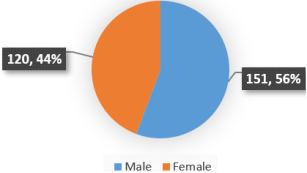
Males accounted for the majority of the cases (n=151, 56%), while females represented a smaller proportion (n= 120, 44%), as shown in
Figure 2.
Figure 2. Distribution of cases by gender of Norovirus outbreak at primary school, Bahla, Oman, December 2024 (n=271).
3) Clinical Presentation
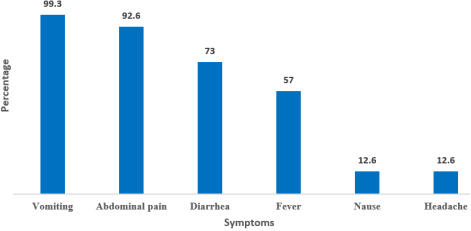
Vomiting was the most prevalent symptom, reported by nearly all patients (n=269, 99.3%), followed by abdominal pain (n=251, 92.6%) and diarrhea (n=197, 73%). Fever affected over half of the cases (n=154, 57%). This is shown in
Figure 3.
Figure 3. Distribution of patients according to presenting symptoms of Norovirus outbreak at Primary school, Bahla Oman, December 2024 (n=271).
4) Occupation of cases:
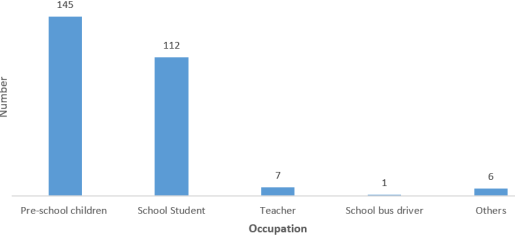
Pre-school children represented the largest proportion (n=145, 53.5%), followed by school students (n= 112, 41.3%). In contrast, school staff and others (parents of the school students) were minimally affected, with only 7 teachers, 6 others, and 1 school bus driver reported, as shown in
Figure 4.
Figure 4. Occupation of case of Norovirus outbreak at Primary school, Bahla Oman, December 2024 (n=271).
5) Severity of the outbreak:
The majority of the 271 cases were mild and treated as outpatients (n=269, 99%). Only 2 cases (0.7–1%) required admission.
b) Distribution of Cases by Time
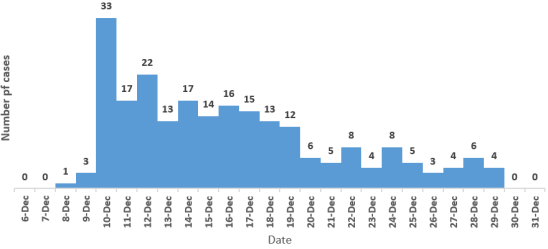
Figure 5 shows an epidemic curve indicating a point-source outbreak followed by secondary spread. Cases began on December 8, 2024, and increased dramatically to a peak of 33 cases on December 10. After that, cases declined slowly over three weeks, with a secondary spike on December 12 and 14. No more cases were reported after December 29, 2024.
Figure 5. Epidemic curve of Norovirus outbreak at Primary school, Bahla Oman, December 2024 (n=271).
Attack Rate During Norovirus Outbreaks
The overall attack rate in the school was 34%. 17.0% among primary school students, 13.2% among teachers, and 4.0% among school bus drivers
Environmental inspection:
An environmental inspection was conducted to evaluate food safety and hygiene at the primary school. Proper sanitary procedures were observed, and the food preparation area was tidy and well-maintained. After a water sample was collected from different sources and resulted no contaminations. Only properly packaged food items were supplied at school’s canteen. Overall, the inspection results point to compliance with suggested food safety and environmental health regulations.
c) Genotyping procedures
The Central Public Health Laboratory (CPHL) tested specimens from four suspected cases using PCR for viral gastroenteritis. Norovirus Geno group II (GII) was detected in all four samples, confirming it as the causative agent among the tested cases.
4. Discussion
The finding that children aged 6–10 years constituted the largest proportion of cases (42%), followed by those ≤5 years (26%), aligns with established norovirus epidemiology. Norovirus is recognized as the leading cause of acute gastroenteritis across all age groups, with children in mass settings experiencing the highest attack rates
| [1] | Ahmed, S. M., Hall, A. J., Robinson, A. E., Verhoef, L., Premkumar, P., Parashar, U. D., Koopmans, M., & Vinjé, J. (2014). Global prevalence of norovirus in cases of gastroenteritis: A systematic review and meta-analysis. The Lancet Infectious Diseases, 14(8), 725-730.
https://doi.org/10.1016/S1473-3099(14)70767-4 |
[1]
. The high proportion of preschool-aged children (26%) reflects their susceptibility and potential for introducing the virus into households
| [10] | Phillips, G., Tam, C. C., Rodrigues, L. C., & Lopman, B. (2010). Prevalence and characteristics of asymptomatic norovirus infection in the community in England. Epidemiology and Infection, 138(10), 1454-1458.
https://doi.org/10.1017/S095026881000044X |
[10]
.
The clinical picture—dominated by vomiting (99.3%), abdominal pain (92.6%), and diarrhea (73%)—is characteristic of norovirus gastroenteritis. The near-universal presence of vomiting serves as a clinical hallmark, particularly in children.
| [2] | Payne, D. C., Vinjé, J., Szilagyi, P. G., Edwards, K. M., Staat, M. A., Weinberg, G. A., Hall, C. B., Chappell, J., Curns, A. T., & Parashar, U. D. (2013). Norovirus and medically attended gastroenteritis in U.S. children. New England Journal of Medicine, 368(13), 1157-1165.
https://doi.org/10.1056/NEJMsa1206589 |
[2]
.
The mild clinical course (0.7–1% hospitalization) is consistent with self-limiting norovirus illness in immunocompetent hosts, where hospitalization typically ranges from 0.5–2% in community settings.
.
A 2023 Chinese middle school outbreak showed a propagated epidemic curve, with case-control analysis confirming close contact as the main transmission route (OR = 6.250). This aligns with our observed multi-modal decline pattern typical of person-to-person spread after initial introduction.
| [11] | Wu, D., Yang, J., & Wu, D. (2024). Investigation of an acute gastroenteritis epidemic caused by norovirus infection in a middle school in Songtao, Tongren, Guizhou, 2023. Disease Surveillance, 39(1), 115-120.
https://doi.org/10.3784/jbjc.202306020262 |
[11]
.
The December outbreak aligns with 2023 Korean surveillance data documenting that 26.5% of school outbreaks occur in winter, driven by indoor crowding.
| [12] | Park, W.-J., Kim, B. J., Seo, D. W., Park, Y. C., Joo, I., & Suh, S. H. (2025). Molecular epidemiology of norovirus outbreaks in childcare centers and schools in South Korea in 2023. Journal of Microbiology and Biotechnology, 35, Article e2503025. https://doi.org/10.4014/jmb.2503.03025 |
[12]
.
In this study, a 34% attack rate aligns with 2023 US surveillance data showing that school norovirus outbreaks average 33 cases and account for 64.4% of school outbreaks
| [13] | Mattison, C. P., Calderwood, L. E., Marsh, Z. A., Wikswo, M. E., Balachandran, N., Kambhampati, A. K., Gleason, M. E., Lawinger, H., & Mirza, S. A. (2022). Childcare and school acute gastroenteritis outbreaks: 2009-2020. Pediatrics, 150(5), Article e2021056002.
https://doi.org/10.1542/peds.2021-056002 |
[13]
.
Preschoolers (53.5%) and students (41.3%) accounted for most cases, with minimal staff involvement, reflecting children's higher susceptibility due to underdeveloped immunity, limited hygiene practices, and greater exposure intensity.
| [1] | Ahmed, S. M., Hall, A. J., Robinson, A. E., Verhoef, L., Premkumar, P., Parashar, U. D., Koopmans, M., & Vinjé, J. (2014). Global prevalence of norovirus in cases of gastroenteritis: A systematic review and meta-analysis. The Lancet Infectious Diseases, 14(8), 725-730.
https://doi.org/10.1016/S1473-3099(14)70767-4 |
| [2] | Payne, D. C., Vinjé, J., Szilagyi, P. G., Edwards, K. M., Staat, M. A., Weinberg, G. A., Hall, C. B., Chappell, J., Curns, A. T., & Parashar, U. D. (2013). Norovirus and medically attended gastroenteritis in U.S. children. New England Journal of Medicine, 368(13), 1157-1165.
https://doi.org/10.1056/NEJMsa1206589 |
[1, 2]
.
Norovirus GII detected in all four tested specimens confirms this genogroup as the causative agent. Studies from GCC countries consistently identify GII.4 as the most common.
.
5. Conclusions
This investigation confirmed norovirus GII as the cause of a gastroenteritis outbreak at a primary school in Bahla, Oman, in December 2024. Children aged ≤10 years were mostly affected, with vomiting as the predominant symptom. The clinical course was mild, with minimal hospitalization. The epidemic curve showed point-source exposure followed by person-to-person spread. Rapid control measures—including school closure, environmental disinfection, and health education—terminated transmission effectively. These findings emphasize the importance of early detection and prompt implementation of infection prevention measures to control norovirus outbreaks in school settings.
6. Recommendation
1) Strengthen surveillance systems to ensure early detection and rapid reporting of gastroenteritis cases in school settings.
2) Implement strict hand hygiene with soap and water. enhance routine environmental disinfection using appropriate chlorine-based solutions.
3) Provide continuous health education for students, staff, and parents to reinforce infection prevention practices and reduce future outbreaks.
7. Limitations
Limitations included laboratory testing being restricted to only four specimens, a retrospective design susceptible to recall bias, and the absence of both risk factor analysis to identify a point source and assessment of asymptomatic infections.
Abbreviations
RNA | Ribonucleic Acid |
GCC | Gulf Cooperation Council |
PCR | Polymerase Chain Reaction |
CPHL | Central Public Health Laboratory |
Acknowledgments
The author gratefully acknowledges the assistance and cooperation of the Directorate General of Education of Al Dakhliyah Governorate and Al-Dakhliyah Municipality, Nizwa, Sultanate of Oman.
Author Contributions
Salim Al-Busaidi: Conceptualization, Project administration
Ahmed Al-Busaidi: Methodology, Resources
Kishor Duthade: Methodology, Visualization
Maymoona Al Dhuhli: Data curation, Writing – original draft
Saud Al-Jamoudi: Investigation, Software
Mohammed Al-Tobi: Supervision, Writing – review & editing
Conflicts of Interest
The authors declare they have no conflict of interest
References
| [1] |
Ahmed, S. M., Hall, A. J., Robinson, A. E., Verhoef, L., Premkumar, P., Parashar, U. D., Koopmans, M., & Vinjé, J. (2014). Global prevalence of norovirus in cases of gastroenteritis: A systematic review and meta-analysis. The Lancet Infectious Diseases, 14(8), 725-730.
https://doi.org/10.1016/S1473-3099(14)70767-4
|
| [2] |
Payne, D. C., Vinjé, J., Szilagyi, P. G., Edwards, K. M., Staat, M. A., Weinberg, G. A., Hall, C. B., Chappell, J., Curns, A. T., & Parashar, U. D. (2013). Norovirus and medically attended gastroenteritis in U.S. children. New England Journal of Medicine, 368(13), 1157-1165.
https://doi.org/10.1056/NEJMsa1206589
|
| [3] |
Centers for Disease Control and Prevention. (2024). Norovirus illness: Key facts and figures. U.S. Department of Health & Human Services.
https://www.cdc.gov/norovirus/about/key-facts.html
|
| [4] |
Robilotti, E., Deresinski, S., & Pinsky, B. A. (2015). Norovirus. Clinical Microbiology Reviews, 28(1), 134-164.
https://doi.org/10.1128/CMR.00075-14
|
| [5] |
Teunis, P. F., Moe, C. L., Liu, P., Miller, S. E., Lindesmith, L., Baric, R. S., Le Pendu, J., & Calderon, R. L. (2008). Norwalk virus: How infectious is it? Journal of Medical Virology, 80(8), 1468-1476.
https://doi.org/10.1002/jmv.21237
|
| [6] |
Kreidieh, K., Charide, R., Dbaibo, G., & Melhem, N. M. (2017). The epidemiology of norovirus in the Middle East and North Africa (MENA) region: A systematic review. Virology Journal, 14, Article 220.
https://doi.org/10.1186/s12985-017-0877-3
|
| [7] |
Al-Rashidi, F., Al-Fouzan, W., Al-Nakib, W., & Ahmad, S. (2013). Different norovirus genotypes in patients with gastroenteritis in Kuwait. Journal of Medical Virology, 85(9), 1648-1654.
https://doi.org/10.1002/jmv.23645
|
| [8] |
Almuhayawi, M. S., Al-Johani, S. M., Sohrab, S. S., El-Shorbagi, S., Al-Mozaini, M., & Al-Hazmi, M. H. (2021). Molecular detection of norovirus in patients with acute gastroenteritis in Saudi Arabia. Journal of Infection and Public Health, 14(10), 1453-1458.
https://doi.org/10.1016/j.jiph.2021.08.018
|
| [9] |
Lanata, C. F., Fischer-Walker, C. L., Poole, C., Boschi-Pinto, C., Black, R. E., & Child Health Epidemiology Reference Group of the World Health Organization and UNICEF. (2013). Global causes of diarrheal disease mortality in children <5 years of age: A systematic review. PLoS ONE, 8(9), e72788.
https://doi.org/10.1371/journal.pone.0072788
|
| [10] |
Phillips, G., Tam, C. C., Rodrigues, L. C., & Lopman, B. (2010). Prevalence and characteristics of asymptomatic norovirus infection in the community in England. Epidemiology and Infection, 138(10), 1454-1458.
https://doi.org/10.1017/S095026881000044X
|
| [11] |
Wu, D., Yang, J., & Wu, D. (2024). Investigation of an acute gastroenteritis epidemic caused by norovirus infection in a middle school in Songtao, Tongren, Guizhou, 2023. Disease Surveillance, 39(1), 115-120.
https://doi.org/10.3784/jbjc.202306020262
|
| [12] |
Park, W.-J., Kim, B. J., Seo, D. W., Park, Y. C., Joo, I., & Suh, S. H. (2025). Molecular epidemiology of norovirus outbreaks in childcare centers and schools in South Korea in 2023. Journal of Microbiology and Biotechnology, 35, Article e2503025.
https://doi.org/10.4014/jmb.2503.03025
|
| [13] |
Mattison, C. P., Calderwood, L. E., Marsh, Z. A., Wikswo, M. E., Balachandran, N., Kambhampati, A. K., Gleason, M. E., Lawinger, H., & Mirza, S. A. (2022). Childcare and school acute gastroenteritis outbreaks: 2009-2020. Pediatrics, 150(5), Article e2021056002.
https://doi.org/10.1542/peds.2021-056002
|
| [14] |
Capece, G., & Tobin, E. H. (2025). Norovirus. In StatPearls. StatPearls Publishing.
https://www.ncbi.nlm.nih.gov/books/NBK513265/
|
Cite This Article
-
APA Style
Al-Busaidi, S., Al-Busaidi, A., Duthade, K., Dhuhli, M. A., Al-Jamoudi, S., et al. (2026). Norovirus Gastroenteritis Outbreak at Primary School, Bahla, Oman, December 2024. Science Discovery Medicine, 1(1), 47-52. https://doi.org/10.11648/j.sdmed.20260101.17
 Copy
|
Copy
|
 Download
ACS Style
Al-Busaidi, S.; Al-Busaidi, A.; Duthade, K.; Dhuhli, M. A.; Al-Jamoudi, S., et al. Norovirus Gastroenteritis Outbreak at Primary School, Bahla, Oman, December 2024. Sci. Discov. Med. 2026, 1(1), 47-52. doi: 10.11648/j.sdmed.20260101.17
Copy
|
Download
AMA Style
Al-Busaidi S, Al-Busaidi A, Duthade K, Dhuhli MA, Al-Jamoudi S, et al. Norovirus Gastroenteritis Outbreak at Primary School, Bahla, Oman, December 2024. Sci Discov Med. 2026;1(1):47-52. doi: 10.11648/j.sdmed.20260101.17
Copy
|
Download
-
@article{10.11648/j.sdmed.20260101.17,
  author = {Salim Al-Busaidi and Ahmed Al-Busaidi and Kishor Duthade and Maymoona Al Dhuhli and Saud Al-Jamoudi and Mohammed Al-Tobi},
  title = {Norovirus Gastroenteritis Outbreak at Primary School, Bahla, Oman, December 2024},
  journal = {Science Discovery Medicine},
  volume = {1},
  number = {1},
  pages = {47-52},
  doi = {10.11648/j.sdmed.20260101.17},
  url = {https://doi.org/10.11648/j.sdmed.20260101.17},
  eprint = {https://article.sciencepublishinggroup.com/pdf/10.11648.j.sdmed.20260101.17},
  abstract = {Background: Norovirus infection is one of the leading causes of acute gastroenteritis outbreaks globally, commonly in enclosed spaces like schools. Norovirus acute gastroenteritis was reported in a primary school in Bahla, Oman, in December 2024. The objectives of this study were to determine the causal agent, describe the epidemiological features, and facilitate control methods. Methods: A retrospective descriptive study was conducted. Data from the electronic notification system (Tarassud) was collected. Case defined as any one presented with vomiting, abdominal pain with/or loose motion, fever between December 8 and 29, 2024, reported from health centers nearby primary school, Bahla, Oman. Four cases of stool samples were tested by PCR. An epidemic curve was plotted to show transmission patterns. Results: 271 cases were identified. Most cases were children aged 6–10 years (42%) and ≤5 years (26%). 56% of the cases were male. Most cases had symptoms and signs of vomiting (99.3%), followed by diarrhea (73%), and abdominal pain (92.6%). Just two cases (0.7%) required hospital admission. Norovirus Geno group II (GII) was detected in four samples. A point-source exposure was followed by secondary transmission from person to person, according to the epidemic curve. Conclusions: Norovirus GII was confirmed in gastroenteritis cases, which had minor clinical signs and symptoms among young children. Health education, environmental disinfection, and school closure were among the quick control measures that were successfully implemented. To stop future school epidemics, surveillance must be strengthened, and strict hand hygiene and disinfection procedures must be followed.},
 year = {2026}
}
Copy
|
Download
-
TY  - JOUR
T1  - Norovirus Gastroenteritis Outbreak at Primary School, Bahla, Oman, December 2024
AU  - Salim Al-Busaidi
AU  - Ahmed Al-Busaidi
AU  - Kishor Duthade
AU  - Maymoona Al Dhuhli
AU  - Saud Al-Jamoudi
AU  - Mohammed Al-Tobi
Y1  - 2026/03/27
PY  - 2026
N1  - https://doi.org/10.11648/j.sdmed.20260101.17
DO  - 10.11648/j.sdmed.20260101.17
T2  - Science Discovery Medicine
JF  - Science Discovery Medicine
JO  - Science Discovery Medicine
SP  - 47
EP  - 52
PB  - Science Publishing Group
UR  - https://doi.org/10.11648/j.sdmed.20260101.17
AB  - Background: Norovirus infection is one of the leading causes of acute gastroenteritis outbreaks globally, commonly in enclosed spaces like schools. Norovirus acute gastroenteritis was reported in a primary school in Bahla, Oman, in December 2024. The objectives of this study were to determine the causal agent, describe the epidemiological features, and facilitate control methods. Methods: A retrospective descriptive study was conducted. Data from the electronic notification system (Tarassud) was collected. Case defined as any one presented with vomiting, abdominal pain with/or loose motion, fever between December 8 and 29, 2024, reported from health centers nearby primary school, Bahla, Oman. Four cases of stool samples were tested by PCR. An epidemic curve was plotted to show transmission patterns. Results: 271 cases were identified. Most cases were children aged 6–10 years (42%) and ≤5 years (26%). 56% of the cases were male. Most cases had symptoms and signs of vomiting (99.3%), followed by diarrhea (73%), and abdominal pain (92.6%). Just two cases (0.7%) required hospital admission. Norovirus Geno group II (GII) was detected in four samples. A point-source exposure was followed by secondary transmission from person to person, according to the epidemic curve. Conclusions: Norovirus GII was confirmed in gastroenteritis cases, which had minor clinical signs and symptoms among young children. Health education, environmental disinfection, and school closure were among the quick control measures that were successfully implemented. To stop future school epidemics, surveillance must be strengthened, and strict hand hygiene and disinfection procedures must be followed.
VL  - 1
IS  - 1
ER  -
Copy
|
Download

 ,
Ahmed Al-Busaidi
,
Ahmed Al-Busaidi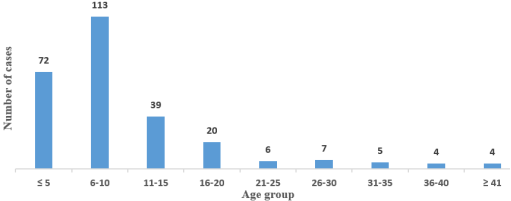



 Share This Article
 Twitter
 Linked In
 Facebook