
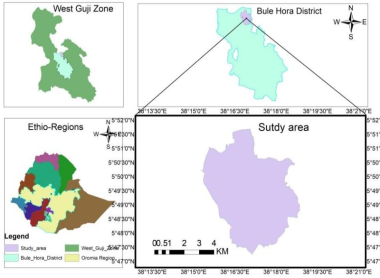
Bread wheat is one of the key food crops in the study area and grown for home consumption, market and strategic crop to address food security in Ethiopia. However, the productivity and yield is mostly constrained by soil fertility and lack of better fertilizer rate in the study area. The study was conducted at Bule Hora District, southern Ethiopia during the main cropping season of 2023. The study was aimed to identify the optimum fertilizer for higher grain yield with the higher economic return. The treatments were: (0 NPS) negative control, 60Kg NPS, 120kg NPS, and 180 kg NPS) and (0N) negative control, 140kgN, 280kg N) and positive control (100/100kg ha-1 NPS/ N). The treatments were arranged in a randomized complete block design and replicated three times. Soil samples for the experimental site were taken before sowing and post harvesting for soil physicochemical analysis. Data of Yield was collected and analyzed using GLM procedure of SAS (Version 9.3) and means differences were tested for the significance with least significant difference (LSD) method at 0.05 probability level. The results of analysis of variance for yield indicated that the effect of fertilizer application rates were significant for the maximum above-ground biomass (AGB) (13.33 ton), straw yields (10.077 ton) were obtained from 60kg NPS ha-1 + 140kg N ha-1 fertilizer rate and grain yield obtained due to the application of 120/140 kg ha-1 NPS/Urea(N). The results of economic analysis indicated that the maximum net benefit of 213489.73 ETB ha-1 and marginal rate of return (MRR) of 121479.6% were obtained due to the application of 120/140 kg ha-1 NPS/Urea(N). Therefore, 120/140 kg ha-1 NPS/ urea(N) can be used by the farming community in the study area. However, the study is better conducted for more year in multiple locations to give conclusive recommendations.
| Published in | Science Discovery Plants (Volume 1, Issue 2) |
| DOI | 10.11648/j.sdplants.20260102.14 |
| Page(s) | 100-110 |
| Creative Commons |
This is an Open Access article, distributed under the terms of the Creative Commons Attribution 4.0 International License (http://creativecommons.org/licenses/by/4.0/), which permits unrestricted use, distribution and reproduction in any medium or format, provided the original work is properly cited. |
| Copyright |
Copyright © The Author(s), 2026. Published by Science Publishing Group |
Bread Wheat, Bule Hora, Fertilizer Rate, Grain Yield
No Trt | Fertilizer treatments | Nutrient contents | ||
|---|---|---|---|---|
N | P2O5 | S | ||
1 | Control (negative) | 0 | 0 | 0 |
2 | 140kg UREA(N) | 64.4 | 0 | 0 |
3 | 280kg UREA(N) | 128.8 | 0 | 0 |
4 | 60 kgNPS | 10.8 | 22.8 | 4.2 |
5 | 60 kgNPS + 140kg UREA(N) | 75.2 | 22.8 | 4.2 |
6 | 60 kgNPS + 280kg UREA(N) | 139.6 | 22.8 | 4.2 |
7 | 120kg NPS | 21.6 | 45.6 | 8.4 |
8 | 120kg NPS + 140kg UREA(N) | 86 | 45.6 | 8.4 |
9 | 120kg NPS + 280kg UREA(N) | 150.4 | 45.6 | 8.4 |
10 | 180kg NPS | 32.4 | 68.4 | 12.6 |
11 | 180kg NPS + 140kg UREA(N) | 96.8 | 68.4 | 12.6 |
12 | 180kg NPS + 280kg UREA(N) | 161.2 | 68.4 | 12.6 |
13 | 100kgNPS+100kgUREA(N) control (positive) | 64 | 38 | 7 |

Properties | Values | Ratings | ||
|---|---|---|---|---|
Before | After | Before | After | |
Clay (%) | 14.6 | |||
Silt (%) | 12.7 | |||
Sand (%) | 72.7 | |||
Textural class | Sandy loam | |||
pH: (H2O) 1: 2: 5 | 5.8 | 6.16 | Moderately acid | Slightly acid |
Organic Carbon (%) | 1.91 | 1.73 | low | low |
Total nitrogen (%) | 0.16 | 0.17 | medium | medium |
Available phosphorus (mg/kg soil) | 7.8 | 45.63 | low | Very high |
Available Sulfar (mg/kg soil) | 0.036 | 0.042 | Very low | Very low |
Cathane Exchange Capacity (CEC meq/100g) | 5.6 | 23.52 | Very low | medium |
No trt. | Fertilizer treatments | AGB (t/ha) | SY (t/ha) | GY (qt/ha) |
|---|---|---|---|---|
1 | Control (negative) | 5.32d | 3.98f | 13.42g |
2 | 140kg UREA(N) | 11.81abc | 8.84abc | 29.67 f |
3 | 280kg UREA(N) | 12.02ab | 8.68abc | 33.50 de |
4 | 60 kgNPS | 11.11abc | 7.94abcd | 31.67 ef |
5 | 60 kgNPS + 140kg UREA(N) | 13.33a | 10.02a | 33.00e |
6 | 60 kgNPS + 280kg UREA(N) | 13.03a | 9.66ab | 33.67de |
7 | 120kg NPS | 11.19abc | 8.03abcd | 31.67ef |
8 | 120kg NPS + 140kg UREA(N) | 9.92 b | 6.15de | 37.67bc |
9 | 120kg NPS + 280kg UREA(N) | 10.23b | 6.33de | 39.50b |
10 | 180kg NPS | 10.23b | 7.03cde | 32.33ef |
11 | 180kg NPS + 140kg UREA(N) | 9.72c | 5.42ef | 43.00a |
12 | 180kg NPS + 280kg UREA(N) | 11.22 abc | 6.79cde | 44.33a |
13 | 100kgNPS+100kgUREA(N) control (positive) | 11.44 abc | 7.8bcd | 36.33cd |
Means | 10.82 | 7.43 | 33.83 | |
CV% | 12.03 | 17.07 | 6.87 | |
S.L. Trt | Fertilizer treatments | TVC (ETB) ha-1 | AGY Kgha-1 | Price(ETB) | GBKgha-1 | NB (ETB) ha-1 | MRR% |
|---|---|---|---|---|---|---|---|
T1 | 0 Negative control | 0.00 | 1206.9 | 62 | 74827.8 | 74827.80 | 0 |
T2 | 140Urea(N) | 11068.56 | 2669.4 | 62 | 176718.6 | 165650.04 | 1496.58 |
T3 | 280Urea(N) | 13456.56 | 3014.1 | 62 | 202721.4 | 189264.84 | 988.89 |
T4 | 60NPS | 15844.56 | 2850.3 | 62 | 220410 | 204565.44 | 640.73 |
T5 | 60NPS+140Urea(N) | 22751.11 | 2970 | 62 | 165502.8 | 142751.69 | D |
T6 | 60NPS+280Urea(N) | 28141.11 | 3030.3 | 62 | 186874.2 | 158733.09 | 296.50 |
T7 | 120NPS | 33819.67 | 2850.3 | 62 | 184140 | 150320.33 | D |
T8 | 120NPS+140Urea(N) | 33871.67 | 3390.3 | 62 | 247361.4 | 213489.73 | 121479.6 |
T9 | 120NPS+280Urea(N) | 36207.67 | 3555 | 62 | 176718.6 | 140510.93 | D |
T10 | 180NPS | 38595.67 | 2909.7 | 62 | 180401.4 | 141805.73 | 54.22 |
T11 | 180NPS+140Urea(N) | 39209.67 | 3870 | 62 | 187878.6 | 148668.93 | 1117.79 |
T12 | 180NPS+280Urea(N) | 41597.67 | 3989.7 | 62 | 210198.6 | 168600.93 | 834.67 |
T13 | 100NPS+100Urea(N) +ve control | 43985.67 | 3269.7 | 62 | 239940 | 195954.33 | 1145.45 |
AGB | Above-ground Biomass |
AGY | Average Grain Yield |
CEC | Cathane Exchange Capacity |
CV | Coefficient of Variation |
D | Dominated |
ETB | Ethiopia Birr |
GB | Gross Benefit |
GLM | Generalized Linear Model |
JARC | Jimma Agricultural Research Center |
LSD | Level of Significance |
MRR | Marginal Rate of Return |
NB | Net Benefit |
NPS | Nitrogen Phosphorus Sulfar |
OC | Organic Carbon |
OM | Organic Matter |
TVC | Total of Vary Cost |
YPDARC | Yabello Pastoral and Dry Land Agriculture Research Center |
| [1] | Abera Donis, Dejene Getahun, Tadele Geremu, Dereje Girma, Abreham Feyisa, Lello Dejene, Meron Tolosa. (2021). Determination of NPS Fertilizer Rate Based on Calibrated Phosphorus for Yield of Bread Wheat in Wachale District, North Shewa Zone, Oromia, Ethiopia. American Journal of Plant Biology. Vol. 6, No. 3, pp. 73-77. |
| [2] | Abera, D., Tana, T. and Dessalegn, T., (2020). Effects of blended NPSB fertilizer rates on yield and grain quality of durum wheat (Triticum turgidum L.) varieties in Minijar Shenkora District, Central Ethiopia. Ethiopian Journal of Agricultural Sciences, 30(3), pp. 57-76. |
| [3] | Abera, T. and Adinew, A., 2020. Effect of blended NPS fertilizer supplemented with nitrogen on yield components and yield of maize (Zea mays L.) in Kachabirra district, Kembata Tambaro zone, southern Ethiopia. International Journal of Research in Agricultural Sciences, 7(3), pp. 2348-3997. |
| [4] | Abera, T., Lemma, A., Hundesa, C. and Husen, A., (2021). Response of Yield Components and Yield of Bread Wheat (Triticum aestivum L.) to Blended NPS and N fertilizers Levels at Liban Chukala District, East, 8(1), pp. 1–9. |
| [5] | Abera, T., Tola, B., Tufa, T. and Adugna, A. (2021). Effects of Blended (NPSB) and Urea Fertilizer Rate on Yield and Yield Components of Wheat in Ultisols of Liben Jawi District, Oromia, Ethiopia, (August). |
| [6] | Aboye, A. D. and Teto, A. M., (2022). Pilot review study on current research status and economic value limitations of bread wheat (Triticum aestivum L.) Production in Ethiopia. Economics, 11(4), pp. 137-166. |
| [7] | Alemu, S., (2017). Effect of blended NPS and N fertilizer rates on yield components, yield and grain protein content of bread wheat (Triticum aestivum L.) in Bore district, Guji Zone, Southern Ethiopia (Doctoral dissertation, MSc Thesis. School of Plant Sciences, Haramaya University, Ethiopia). |
| [8] | Arega, G. and Setu, B., (2014). Prevalence, Incidence and Severity of Wheat Rust, an Response of Wheat Cultivars to Rust Infection. International Journal of Agronomy and Plant Production, 5(1), pp. 13-19. |
| [9] | Assefa, S., Haile, W. and Tena, W. (2021). Response of bread wheat to sulfur and phosphorus fertilizers in the north central, Agriculture & Food Security, pp. 1–10. |
| [10] | Awash, M. (2019). Evaluation of Bread Wheat (Triticum aestivum L.) Genotypes for Yield Advances in Crop Science and Technology Evaluation of Bread Wheat (Triticum aestivum L.) Genotypes for Yield Potential and Related Traits Under High Temperature Stress Condition at Middle Awash, Ethiopia, (March). |
| [11] | Basha Kebede, G. A. and D. K., (2021). Popularization of Sanate Bread Wheat Variety in the Highlands of Guji Zone, Southern Oromia, Ethiopia (3), pp. 25–30. |
| [12] | Beketa, H. J., Kefale, D. and Yoseph, T., (2020). Effect of Blended Fertilizer Types and Rates on Growth, Yield and Yield Components of Bread Wheat (Triticum aestivum L.) in Wondo District, Southern Ethiopia. International Journal of Agriculture Innovations and Research, 8(4), pp. 326-342. |
| [13] | Bereket H, Dawit H, Mehretab H, Gebremedhin G., (2014). Effects of Mineral Nitrogen and Phosphorus Fertilizers on Yield and Nutrient Utilization of Bread Wheat (Tritcum aestivum) on the Sandy Soils of Hawzen District, Northern Ethiopia. Agriculture, Forestry and Fisheries 3(3): 189-198. |
| [14] | Bizuwork Tafes. (2018). Growth, Yield and Grain Quality of Durum Wheat (Triticum turgidum L. var. durum) as Influenced by Rates of Blended NPSB and N Fertilizers at Debre Zeit, Central Ethiopia. MSc Thesis, Haramaya University. |
| [15] | Brzegen, A. (2019) ‘GROWTH AND YIELD RESPONSES OF BREAD WHEAT (Triticum aestivum L.) TO SEEDING AND NPS RATES IN BORENA DISTRICT, SOUTH WOLLO ADMINISTRATIVE ZONE, ETHIOPIA’. |
| [16] | Chaparro., J. M., Sheflin, A. M., Manter, D. K. and Vivanco, J. M., (2012). Manipulating the soil microbiome to increase soil health and plant fertility. Biology and Fertility of Soils, 48, pp. 489-499. |
| [17] | Chapman, H. D., (1965). Cation‐exchange capacity. Methods of soil analysis: Part 2 Chemical and microbiological properties, 9, pp. 891-901. |
| [18] | CIMMYT Economics Program, (1988). From agronomic data to farmer recommendations: an economics training manual (No. 27). |
| [19] | Das, D. K. and Mandal, M., (2015). Advanced technology of fertilizer uses for crop production. Fertilizer Technology I Synthesıs. Sinha, S., Pant, KK, Bajpai, S. (Eds.). Studium Press, LLC, USA, pp. 101-150. |
| [20] | Değirmenci, F. Ö., Ulaş, B., Kansu, Ç., Uluğ, A., Caneva, I., Asal, R. and Kaya, Z., (2023). The ancient DNA and archaeobotanical analysis suggest cultivation of Triticum aestivum subsp. spelta at Yumuktepe and Yenikapı Pottery Neolithic sites in Turkey. Genetic Resources and Crop Evolution, 70(2), pp. 657-676. |
| [21] | Dewis, J. and Freitas, F., (1970). Physical and chemical methods of soil and water analysis. |
| [22] | Dick W. A., Kost, D. and Chen, L., (2008). Availability of sulfur to crops from soil and other sources. Sulfur: A missing link between soils, crops, and nutrition, 50, pp. 59-82. |
| [23] | Diriba Shiferaw, G., Rut-Duga, D. and Wogayehu, W., (2019). Effects of blended fertilizer rates on bread wheat (Triticum aestivum L.) varieties on growth and yield attributes. J Ecol & Nat Resour, 3(3), pp. 1-13. |
| [24] | Duga, R. and Worku, W. (2019) ‘Effects of Blended Fertilizer Rates on Bread Wheat (Triticum Aestivum L.) Varieties on Growth and Yield Attributes’, (September). |
| [25] | Erenstein, O., Jaleta, M., Mottaleb, K. A., Sonder, K., Donovan, J. and Braun, H. J., (2022). Global trends in wheat production, consumption and trade. In Wheat improvement: food security in a changing climate (pp. 47-66). Cham: Springer International Publishing. |
| [26] | Govindan, V., Gupta, O. P., Kumar, S., Mishra, C. N. and Singh, G., (2023). Wheat Nutraceutomics: Breeding, Genomics, Biotechnology, and Nanotechnology. In Compendium of Crop Genome Designing for Nutraceuticals (pp. 61-83). Singapore: Springer Nature Singapore. |
| [27] | Hirel, B. and Lea, P. J., (2018). Genomics of nitrogen use efficiency in maize: From basic approaches to agronomic applications. The Maize Genome, pp. 259-286. |
| [28] | Hoogenboom G.; Porter, C. H.; Shelia, V.; Boote, K. J.; Singh, U.; White, J. W.; Hunt, L. A.; Ogoshi, R.; Lizaso, J. I.; Koo, J., (2019). Decision support system for agro technology transfer (DSSAT) version 4.7. DSSAT Found. Gainesv. Florida. USA. Available. |
| [29] | Ishete, T. A. and Tana, T., (2019). Growth, yield component and yield response of durum wheat (Triticum turgidum L. var. Durum) to blended NPS fertilizer supplemented with N rates at Arsi Negelle, Central Ethiopia. African Journal of Plant Science, 13(1), pp. 9-20. |
| [30] | Itelima, J. U., Bang, W. J., Onyimba, I. A., Sila, M. D. and Egbere, O. J., (2018). Bio-fertilizers as key player in enhancing soil fertility and crop productivity: A review. |
| [31] | Iticha, B., Mosley, L. M. and Marschner, P., (2024). Combining lime and organic amendments based on titratable alkalinity for efficient amelioration of acidic soils. Soil, 10(1), pp. 33-47. |
| [32] | Menamo., M. (2016). The Effect of Application of Different Rate N-P Fertilizers Rate on Yield and Yield Attributes of Bread Wheat in Case of Chancha 6(5), pp. 63–66. |
| [33] | Nigussie, Z., Tsunekawa, A., Haregeweyn, N., Adgo, E., Nohmi, M., Tsubo, M.,... & Abele, S. (2015). Farmers' perception about soil erosion in Ethiopia. Land degradation & development, 28(2), 401-411. |
| [34] | Olsen, S. R. (1954). Estimation of available phosphorus in soils by extraction with sodium bicarbonate (No. 939). US Department of Agriculture. |
| [35] | Selim, M. M. (2020). Introduction to the integrated nutrient management strategies and their contribution to yield and soil properties. International Journal of Agronomy, 2020(1), 2821678. |
| [36] | Senbeta, A. F., & Worku, W. (2023). Ethiopia’s wheat production pathways to self-sufficiency through land area expansion, irrigation advance, and yield gap closure. Heliyon, 9(10). |
| [37] | Sigaye, M. H., Mekuria, R., & Kebede, K. (2022). Effect of NPS-B blended and nitrogen fertilizers application on bread wheat yield and economic profitability on Nitisol of Southern, Ethiopia. International Journal of Food Science and Agriculture, 6(2). |
| [38] | Stewart, W. M., Dibb, D. W., Johnston, A. E., & Smyth, T. J. (2005). The contribution of commercial fertilizer nutrients to food production. Agronomy journal, 97(1), 1-6. |
| [39] | Tadesse, W., Zegeye, H., Debele, T., Kassa, D., Shiferaw, W., Solomon, T.,... & Assefa, S. (2022). Wheat production and breeding in Ethiopia: retrospect and prospects. Crop Breeding, Genetics and Genomics, 4(3). |
| [40] | Terfa, A. E., Mellisse, B. T., Kebede, M. M., Elias, E., & Yadessa, G. B. (2023). Effect of blended fertilizer application on bread wheat yield and profitability on andosols of southwestern highlands of ethiopian. Communications in Soil Science and Plant Analysis, 54(1), 73-82. |
| [41] | Tilahun Abera Ishete, T. A. I., & Tamado Tana, T. T. (2019). Growth, yield component and yield response of durum wheat (Triticum turgidum L. var. Durum) to blended NPS fertilizer supplemented with N rates at Arsi Negelle, Central Ethiopia. |
| [42] | Walkley, A., & Black, I. A. (1934). An examination of the Degtjareff method for determining soil organic matter, and a proposed modification of the chromic acid titration method. Soil science, 37(1), 29-38.. |
| [43] | Xiang, Y. A. N., Jin, J. Y., Ping, H. E., & Liang, M. Z. (2008). Recent advances on the technologies to increase fertilizer use efficiency. Agricultural Sciences in China, 7(4), 469-479. |
APA Style
Megersa, D. (2026). Effect of NPS and Urea Fertilizer Combined Application on Bread Wheat Yield at Bule Hora, Southern Ethiopia. Science Discovery Plants, 1(2), 100-110. https://doi.org/10.11648/j.sdplants.20260102.14
ACS Style
Megersa, D. Effect of NPS and Urea Fertilizer Combined Application on Bread Wheat Yield at Bule Hora, Southern Ethiopia. Sci. Discov. Plants 2026, 1(2), 100-110. doi: 10.11648/j.sdplants.20260102.14
@article{10.11648/j.sdplants.20260102.14,
  author = {Deme Megersa},
  title = {Effect of NPS and Urea Fertilizer Combined Application on Bread Wheat Yield at Bule Hora, Southern Ethiopia},
  journal = {Science Discovery Plants},
  volume = {1},
  number = {2},
  pages = {100-110},
  doi = {10.11648/j.sdplants.20260102.14},
  url = {https://doi.org/10.11648/j.sdplants.20260102.14},
  eprint = {https://article.sciencepublishinggroup.com/pdf/10.11648.j.sdplants.20260102.14},
  abstract = {Bread wheat is one of the key food crops in the study area and grown for home consumption, market and strategic crop to address food security in Ethiopia. However, the productivity and yield is mostly constrained by soil fertility and lack of better fertilizer rate in the study area. The study was conducted at Bule Hora District, southern Ethiopia during the main cropping season of 2023. The study was aimed to identify the optimum fertilizer for higher grain yield with the higher economic return. The treatments were: (0 NPS) negative control, 60Kg NPS, 120kg NPS, and 180 kg NPS) and (0N) negative control, 140kgN, 280kg N) and positive control (100/100kg ha-1 NPS/ N). The treatments were arranged in a randomized complete block design and replicated three times. Soil samples for the experimental site were taken before sowing and post harvesting for soil physicochemical analysis. Data of Yield was collected and analyzed using GLM procedure of SAS (Version 9.3) and means differences were tested for the significance with least significant difference (LSD) method at 0.05 probability level. The results of analysis of variance for yield indicated that the effect of fertilizer application rates were significant for the maximum above-ground biomass (AGB) (13.33 ton), straw yields (10.077 ton) were obtained from 60kg NPS ha-1 + 140kg N ha-1 fertilizer rate and grain yield obtained due to the application of 120/140 kg ha-1 NPS/Urea(N). The results of economic analysis indicated that the maximum net benefit of 213489.73 ETB ha-1 and marginal rate of return (MRR) of 121479.6% were obtained due to the application of 120/140 kg ha-1 NPS/Urea(N). Therefore, 120/140 kg ha-1 NPS/ urea(N) can be used by the farming community in the study area. However, the study is better conducted for more year in multiple locations to give conclusive recommendations.},
 year = {2026}
}
TY  - JOUR
T1  - Effect of NPS and Urea Fertilizer Combined Application on Bread Wheat Yield at Bule Hora, Southern Ethiopia
AU  - Deme Megersa
Y1  - 2026/05/27
PY  - 2026
N1  - https://doi.org/10.11648/j.sdplants.20260102.14
DO  - 10.11648/j.sdplants.20260102.14
T2  - Science Discovery Plants
JF  - Science Discovery Plants
JO  - Science Discovery Plants
SP  - 100
EP  - 110
PB  - Science Publishing Group
SN  - 3142-7421
UR  - https://doi.org/10.11648/j.sdplants.20260102.14
AB  - Bread wheat is one of the key food crops in the study area and grown for home consumption, market and strategic crop to address food security in Ethiopia. However, the productivity and yield is mostly constrained by soil fertility and lack of better fertilizer rate in the study area. The study was conducted at Bule Hora District, southern Ethiopia during the main cropping season of 2023. The study was aimed to identify the optimum fertilizer for higher grain yield with the higher economic return. The treatments were: (0 NPS) negative control, 60Kg NPS, 120kg NPS, and 180 kg NPS) and (0N) negative control, 140kgN, 280kg N) and positive control (100/100kg ha-1 NPS/ N). The treatments were arranged in a randomized complete block design and replicated three times. Soil samples for the experimental site were taken before sowing and post harvesting for soil physicochemical analysis. Data of Yield was collected and analyzed using GLM procedure of SAS (Version 9.3) and means differences were tested for the significance with least significant difference (LSD) method at 0.05 probability level. The results of analysis of variance for yield indicated that the effect of fertilizer application rates were significant for the maximum above-ground biomass (AGB) (13.33 ton), straw yields (10.077 ton) were obtained from 60kg NPS ha-1 + 140kg N ha-1 fertilizer rate and grain yield obtained due to the application of 120/140 kg ha-1 NPS/Urea(N). The results of economic analysis indicated that the maximum net benefit of 213489.73 ETB ha-1 and marginal rate of return (MRR) of 121479.6% were obtained due to the application of 120/140 kg ha-1 NPS/Urea(N). Therefore, 120/140 kg ha-1 NPS/ urea(N) can be used by the farming community in the study area. However, the study is better conducted for more year in multiple locations to give conclusive recommendations.
VL  - 1
IS  - 2
ER  -
Department of Horticulture and Plant Science, Jimma University, Jimma, Ethiopia;Oromia Agriculture Research Institute, Addis Ababa, Ethiopia;Yabelo Pastoral and Land Agricultural Research Center, Yabelo, Ethiopia

Information



 Share This Article
 Twitter
 Linked In
 Facebook
 Copy
Copy Download