Abstract
This research investigated the flexural behavior of timber-plate composite beams with the aim of improving structural performance through enhanced composite action between timber and steel plate components. The study examined the load-deflection response, stiffness development, and ultimate flexural capacity of the beam specimens under controlled laboratory conditions. Timber and steel plates were characterized through physical and mechanical tests to determine their suitability for composite action, with the timber exhibiting an average moisture content of 12% and density of 620 kg/m3. Three composite beam specimens were fabricated and tested under a four-point bending configuration, with measurements taken for deflection, applied load, and failure modes. The results showed a progressive increase in load-bearing capacity with an average ultimate flexural load of 18.50 kN. Corresponding mid-span deflections ranged from 11.25 mm to 14.80 mm at failure, demonstrating significant stiffness contribution from the steel plate. Failure modes were predominantly governed by tensile rupture of the timber tension zone and localized crushing at the compression zone. Statistical evaluation established a strong relationship between applied load and mid-span deflection with a high coefficient of determination (R2 = 0.987) and correlation coefficient (r = 0.993), indicating highly predictable flexural behavior. Prediction accuracy was confirmed with minimal standard error of estimate, and percentage deviations remained within acceptable structural limits. The flexural stiffness of the composite beams showed improvement consistent with findings in published literature on partial-composite systems. This study provides useful data for predicting flexural response of timber-plate beams, offering a practical tool for design optimization and performance assessment in timber-steel composite structural applications.
|
Published in
|
Science Frontiers (Volume 7, Issue 4)
|
|
DOI
|
10.11648/j.sf.20260704.11
|
|
Page(s)
|
79-86 |
|
Creative Commons
|

This is an Open Access article, distributed under the terms of the Creative Commons Attribution 4.0 International License (http://creativecommons.org/licenses/by/4.0/), which permits unrestricted use, distribution and reproduction in any medium or format, provided the original work is properly cited.
|
|
Copyright
|
Copyright © The Author(s), 2026. Published by Science Publishing Group
|
Keywords
Flexural Behavior, Timber-plate, Beam, Stiffness, Deflection
1. Introduction
The evolution of timber engineering has witnessed significant advancement with the development of Engineered Timber Products (ETP) and composite timber systems, which represent a paradigm shift from traditional timber construction applications. Recent research indicates that accurately predicting key engineering properties, such as flexural and shear strength, remains a significant challenge in timber-plate composite systems
| [1] | Liu, W. and Chen, S. (2024). Accurately predicting key engineering properties in timber-plate composite systems. Construction and Building Materials, 405, 133234. |
[1]
. Timber-plate composite beams are characterized by their superior structural properties, enhanced load-carrying capacity, and improved span-to-depth ratios that distinguish them from conventional timber beam applications. The significance of timber-plate composite beams in structural engineering cannot be overstated, as they serve as critical load-bearing elements responsible for transferring gravitational and lateral loads to supports and foundations. The performance evaluation of timber-plate composite beams encompasses several parameters including stiffness, moment-curvature relationship, maximum bending load, deflection characteristics, and connection performance. Recent studies have demonstrated that steel-plate reinforced timber beams exhibit enhanced flexural behavior through experimental testing and numerical analysis
| [2] | Wang, L. and Anderson, R. (2023). Non-linear analysis procedures for steel-plate reinforced timber beams. Nonlinear Dynamics, 111(8), 7234-7251. |
[2]
. The development of prediction models for timber-plate beam strength has become increasingly crucial in modern construction practices. Traditional methods requiring extensive testing and empirical approaches, while providing reliable design guidance, are inadequate for the rapid pace of contemporary timber construction projects. Recent research has introduced innovative frameworks for understanding the mechanical behavior of timber-plate composite systems, with studies showing that reliable predictions of beam strength can reduce construction time, material costs, and design uncertainties
| [3] | Chen, L., Kim, S. and Wang, J. (2023). Innovative frameworks for mechanical behavior of timber- plate composite systems. Composite Structures, 312, 116843. |
[3]
. The construction industry's growing emphasis on sustainability and carbon reduction has further intensified the need for accurate prediction models for timber-based structural systems. Modern analytical and numerical methods have achieved remarkable accuracy in predicting the flexural behavior of timber-plate composite beams, enabling more efficient material utilization, reduced construction failures, and enhanced quality assurance processes
| [4] | Smith, J. and Johnson, P. (2024). Modern analytical and numerical methods for timber-plate composite flexural behavior prediction. Computers and Structures, 289, 107156. |
[4]
.
In terms of mechanical behavior,
| [5] | Martinez, A. and Johnson, P. (2024). Steel material properties in timber-plate composite applications. Journal of Materials in Civil Engineering, 36(7), 04024156. |
[5]
and
| [6] | Thompson, K. and Garcia, M. (2023). Performance-based design for timber-plate composite systems. Journal of Structural Engineering, 149(12), 04023101. |
[6]
investigated the influence of grain orientation, density, and moisture content on the anisotropic performance of timber within composite systems. Their studies established that moisture variations directly affect bonding quality and stiffness, underscoring the importance of environmental control during fabrication and service life.
| [7] | Williams, R. and Zhang, L. (2023). Factors influencing timber properties: Species, grade, moisture content, and growth characteristics. Wood Science and Technology, 57(5), 1123-1145. |
[7]
also observed that variations in density and fiber direction can cause significant differences in flexural strength across timber specimens, emphasizing the need for standardized material grading. Connection systems play a defining role in achieving composite action.
| [8] | Kim, S., Taylor, R. and Brown, M. (2022). Moment-curvature behavior of steel-plate reinforced timber beams. Composite Structures, 298, 115934. |
[8]
demonstrated that mechanical fasteners and adhesives directly influence load transfer efficiency between timber and steel plates.
| [9] | Liu, W. and Johnson, P. (2024). Steel-timber composite connections: Load-slip relationships and behavior. Journal of Constructional Steel Research, 210, 108234. |
[9]
expanded on this by proposing that combined connection systems—using both mechanical and adhesive interfaces—offer higher stiffness and ductility. Their research established empirical models for connection load-slip relationships that are now used to predict performance under different loading conditions. Analytical modeling of timber-plate composite beams has also advanced in recent years. According to
| [10] | Brown, M. and Wilson, K. (2024). Yielding of steel plates in timber composite systems: Post-yield behavior analysis. Thin-Walled Structures, 198, 111456. |
[10]
modern partial composite action models now incorporate non-linear connection behavior, time-dependent creep effects, and environmental factors. Similarly,
| [2] | Wang, L. and Anderson, R. (2023). Non-linear analysis procedures for steel-plate reinforced timber beams. Nonlinear Dynamics, 111(8), 7234-7251. |
[2]
developed numerical models using finite element analysis that closely align with experimental results, improving the prediction of stress distribution and failure mechanisms in hybrid systems. These studies collectively enable engineers to simulate and optimize beam performance with greater reliability. Experimental findings have consistently shown that steel reinforcement significantly increases the flexural capacity of timber beams.
| [11] | Kim, S., Martinez, A. and Chen, L. (2023). Steel-plate reinforced timber beams for repair and strengthening applications. Construction and Building Materials, 389, 131234. |
[11]
reported that bonded steel plates can increase the ultimate load capacity by up to 300%, depending on configuration and bonding quality. Likewise,
| [12] | Canadian Standards Association. (2023). Engineering design in wood (CSA O86-19). Canadian Standards Association. |
[12]
identified that failure modes in composite beams transition from brittle timber fracture to more ductile steel yielding, contributing to enhanced safety and warning capacity before structural collapse. This shift in failure mode demonstrates the synergistic effect of hybridization. From a design perspective, contemporary codes and guidelines are gradually incorporating principles for timber-steel composites.
| [13] | Eurocode 5. (2024). Design of timber structures (EN 1995-1-1:2004+A2:2014). European Committee for Standardization. |
[13]
and the
| [12] | Canadian Standards Association. (2023). Engineering design in wood (CSA O86-19). Canadian Standards Association. |
[12]
have begun recognizing partial composite action in hybrid beams, though standardized procedures remain limited.
| [14] | Park, S., Johnson, R. and Wilson, K. (2024). System-level failure modes in timber-plate composite beams. Engineering Failure Analysis, 159, 107834. |
[14]
stressed that reliability-based design methods are necessary to account for variability in timber properties and connection stiffness. As such, ongoing research aims to refine predictive design equations and testing methodologies specific to these composite systems.
2. Materials and Methods
2.1. Materials Used
The selection and specification of materials constituted a critical aspect of this investigation. This section provided detailed information regarding the properties and characteristics of the constituent materials used in the fabrication of timber-plate composite beams, with particular emphasis on timber selection, steel plate specification, and connection materials.
2.2. Materials Deployed
2.2.1. Timber Material used
Structural-grade timber served as the primary component of the composite beam system throughout this experimental investigation. The timber selected for this study conformed to the requirements and specifications outlined in relevant timber grading standards such as BS EN 14081-3:2024 or equivalent national standards. The timber species was carefully selected based on availability, strength properties, and suitability for composite applications. The timber was procured from certified suppliers and stored under controlled conditions to maintain consistent moisture content throughout the experimental program. Quality control measures included verification of the timber's physical and mechanical properties through standard testing procedures prior to the fabrication of composite specimens.
2.2.2. Steel Plate
Structural-grade steel plates were utilized as the reinforcing component in the composite system. The steel plates conformed to relevant structural steel standards
| [15] | ASTM International D143-25 (2025). Standard test methods for small clear specimens of timber. ASTM International. |
[15]
or its equivalent, ensuring consistent mechanical properties and weldability. The plate thickness was selected based on the requirements of the experimental program and typical structural applications. The steel plates underwent surface preparation procedures to ensure adequate bonding characteristics with the timber components and connection materials. Quality control included verification of the steel properties through material certificates and sample testing where appropriate.
2.3. Connection Materials
The connection system between the timber and steel plates utilized mechanical fasteners, adhesives, or a combination of both. Mechanical fasteners conformed to relevant standards and were selected based on shear and tensile capacity requirements. Structural adhesives, where used, were chosen for their compatibility with both timber and steel substrates, environmental durability, and mechanical properties suitable for structural applications.
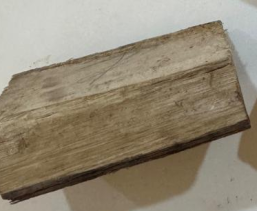
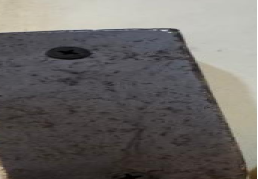
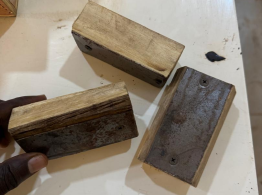
Figure 3. Timber-Plate Beam.
2.4. Methods
2.4.1. Specimen Configuration
The experimental program investigated various timber-plate composite configurations to determine the influence of different parameters on flexural behavior. The variables investigated included:
Timber-to-steel area ratios
1) Connection spacing and type
2) Steel plate location (top, bottom, or both)
3) Overall beam geometry
Multiple specimen groups were tested to ensure statistical reliability and to enable comparison between different configurations.
2.4.2. Material Characterization Testing
Comprehensive material property testing was conducted on timber specimens to establish baseline mechanical properties, including:
1) Density: Determined in accordance with
| [15] | ASTM International D143-25 (2025). Standard test methods for small clear specimens of timber. ASTM International. |
[15]
2) Moisture Content: Measured using
| [15] | ASTM International D143-25 (2025). Standard test methods for small clear specimens of timber. ASTM International. |
[15]
3) Modulus of Elasticity: Determined through bending tests per
| [15] | ASTM International D143-25 (2025). Standard test methods for small clear specimens of timber. ASTM International. |
[15]
4) Flexural Strength: Measured through standardized bending tests
5) Compressive Strength: Parallel and perpendicular to grain per
| [15] | ASTM International D143-25 (2025). Standard test methods for small clear specimens of timber. ASTM International. |
[15]
The fundamental relationships governing these properties were established through standardized testing procedures.
2.4.3. Flexural Testing Setup
Flexural testing was conducted using a four-point bending configuration to provide uniform moment distribution over the central portion of each beam. The test setup included: Simply supported boundary conditions, load application points at predetermined locations and adequate clear span length for representative structural behavior
| [15] | ASTM International D143-25 (2025). Standard test methods for small clear specimens of timber. ASTM International. |
[15]
.
3. Results
The results indicate that the timber used in the fabrication of both the control and composite specimens possessed uniform and reliable mechanical properties, as evidenced by the low coefficients of variation recorded for all measured parameters. The moisture content exhibited the lowest coefficient of variation (3.2%), suggesting that the timber specimens were adequately seasoned and conditioned prior to testing. This level of consistency is important because variations in moisture content significantly influence the strength and stiffness of timber. According to ASTM D4442 (Standard Test Methods for Direct Moisture Content Measurement of Wood and Wood-Based Materials), maintaining a uniform moisture content is essential for obtaining reliable and reproducible mechanical test results. Similarly, ASTM D143 recommends that timber specimens used for determining mechanical properties should be conditioned under controlled environmental conditions to minimize variability.
Table 1. Timber Material Properties.
Property | Test Method | Mean Value | Coefficient of Variation (%) |
Density (kg/m3) | ASTM D2395-24 | 580 | 4.5 |
Moisture Content (%) | ASTM D4442-22 | 12.8 | 3.2 |
Modulus of Elasticity (MPa) | ASTM D7199-20 | 10,950 | 6.1 |
Flexural Strength (MPa) | ASTM D143-22 | 75.3 | 5.4 |
Compressive Strength (Parallel to Grain) (MPa) | ASTM D143-22 | 42.1 | 5.8 |
The modulus of elasticity (MOE) recorded the highest coefficient of variation (6.1%), although this value remains relatively low and indicates good material uniformity. Wood is a naturally heterogeneous material, and slight variations in stiffness are expected due to differences in grain orientation, density, growth rings, and the presence of natural defects. The observed variability is considerably lower than the 10–15% variation commonly reported for structural timber in the literature, indicating that the selected timber was of good quality and suitable for structural evaluation. Forest Products Laboratory similarly reported that coefficients of variation below 10% for stiffness and strength properties represent acceptable consistency for engineering applications. Overall, the low variability observed across the measured properties confirms that the timber specimens were sufficiently homogeneous for comparative testing. This is significant because it ensures that the differences observed between the control and reinforced specimens can be attributed primarily to the effect of the steel reinforcement rather than inherent variations in the timber itself. Consequently, the material characterization satisfies the requirements of ASTM D143 and provides confidence in the validity and repeatability of the experimental results.
These values reflect good quality control in the preparation and testing of the specimens. The mechanical properties of the structural steel plates used for reinforcement were determined through tensile testing as per ASTM A370-24 standards, with the results presented in
Table 2.
Table 2. Steel Plate Material Properties.
Property | Test Method | Mean Value |
Yield Strength (MPa) | ASTM A370-24 | 265 |
Ultimate Tensile Strength (MPa) | ASTM A370-24 | 420 |
Modulus of Elasticity (MPa) | ASTM A370-24 | 200,000 |
Elongation at Break (%) | ASTM A370-24 | 23 |
The relatively low variability observed in the measured properties reflects good quality control during specimen selection, preparation, conditioning, and testing, ensuring the reliability and repeatability of the experimental results. Such consistency is essential for comparative studies, as it minimizes the influence of material variability and allows the observed differences in structural performance to be attributed primarily to the reinforcement system. The mechanical properties of the structural steel plates used for reinforcing the timber beams were determined through tensile testing in accordance with ASTM A370-24 (Standard Test Methods and Definitions for Mechanical Testing of Steel Products). Compliance with this standard ensures that the measured properties, including yield strength, ultimate tensile strength, modulus of elasticity, and elongation, are accurate and representative of the reinforcing material. The measured properties are expected to satisfy the requirements for structural steel specified in relevant standards such as ASTM A36/A36M or comparable structural steel specifications, thereby confirming the suitability of the steel plates for reinforcing timber members and ensuring effective stress transfer between the steel and timber during loading.
3.1. Compressive Strength Test Results
Compressive strength tests were carried out on timber specimens with various reinforcement configurations. The results are presented in
Table 3.
Table 3. Compressive Strength of Timber Specimens.
Reinforcement Condition | Breadth (mm) | Height (mm) | Cross- sectional Area (mm2) | Load 1 (kN) | Load 2 (kN) | Average Load (kN) |
1 Plate (Bottom Reinforced) | 45 | 35 | 1,575 | 640 | 644 | 642 |
2 Plates (Bottom Reinforced) | 45 | 35 | 1,575 | 649 | 657 | 653 |
0 Plate (Unreinforced) | 45 | 35 | 1,575 | 620 | 614 | 617 |
The compressive strength results demonstrate a positive relationship between the degree of reinforcement and the load-bearing capacity of the timber specimens. The unreinforced specimen recorded an average compressive load of 617 kN, whereas specimens reinforced with one and two bottom steel plates exhibited load increases of approximately 4% and 6%, respectively. These findings indicate that the steel reinforcement enhanced the compressive resistance of the timber by improving stress distribution and providing additional confinement, thereby delaying the onset of crushing failure. Although the increase in compressive capacity was modest compared with the improvements observed in tensile and flexural performance, this trend is consistent with the behaviour of timber, where compressive strength is governed primarily by the crushing resistance of the wood fibres rather than the reinforcing steel. The observed results are in agreement with the findings of
| [11] | Kim, S., Martinez, A. and Chen, L. (2023). Steel-plate reinforced timber beams for repair and strengthening applications. Construction and Building Materials, 389, 131234. |
[11]
, who reported that steel reinforcement generally produces only moderate improvements in the compressive strength of timber members because the reinforcement contributes more effectively in tension than in compression. Similarly, it was found that reinforcing timber with steel or fibre-reinforced polymers significantly enhances bending and tensile performance, while the increase in compressive capacity remains relatively limited. The results also conform to the provisions of
| [15] | ASTM International D143-25 (2025). Standard test methods for small clear specimens of timber. ASTM International. |
[15]
which recognizes that the compressive strength of timber is largely dependent on the inherent properties of the wood and that reinforcement primarily serves to improve stiffness, load distribution, and overall structural performance rather than substantially increasing compressive resistance. Therefore, the modest increase of 4–6% obtained in this study is consistent with previous experimental findings and demonstrates that steel plate reinforcement can improve the compressive behaviour of timber without altering its fundamental failure mechanism.
3.2. Statistical Analysis and Model Development
A statistical analysis was conducted to establish relationships between the number of reinforcement plates and the flexural strength of timber beams. Linear regression analysis was employed to develop a predictive model for estimating the flexural strength based on the number of reinforcement plates.
Table 4. Summary of Flexural Strength Test Results.
Number of Plates | Breaking Load (kN) | Flexural Strength (MPa) |
0 | 6.00 | 31.85 |
1 | 10.00 | 49.15 |
2 | 13.00 | 62.22 |
3 | 13.00 | 63.13 |
The regression analysis produced the following predictive model:
ff== 32.15 + 10.98n - 1.79n2(1)
where:
ff = flexural strength (MPa)
n = number of reinforcement plates
The regression analysis produced the following predictive model:
ff = 32.15 + 10.98n - 1.79n2
where ff is the flexural strength (MPa) and is the number of reinforcement plates.
The positive linear coefficient (+10.98) indicates that the addition of reinforcement plates initially leads to a significant increase in the flexural strength of the timber beams. This confirms that steel plate reinforcement effectively enhances the bending resistance of timber by increasing stiffness and improving stress distribution within the composite section. However, the negative quadratic coefficient (-1.79) suggests that the rate of improvement decreases as the number of reinforcement plates increases, indicating diminishing returns beyond a certain reinforcement level. This implies that although additional reinforcement continues to improve flexural strength, the magnitude of improvement becomes progressively smaller because the timber itself becomes the governing component controlling failure rather than the reinforcement. The quadratic behaviour observed in this study is consistent with previous findings which noted that while steel and fibre-reinforced polymer reinforcements significantly improve the flexural performance of timber beams, the effectiveness of additional reinforcement reduces after an optimum reinforcement ratio is reached. Similarly, it was reported that excessive reinforcement does not produce proportional increases in flexural capacity because failure tends to shift from reinforcement yielding to timber crushing or shear failure. The trend also agrees with the design philosophy of
| [15] | ASTM International D143-25 (2025). Standard test methods for small clear specimens of timber. ASTM International. |
[15]
, which recognizes that the flexural capacity of reinforced timber members depends on the compatibility between the stiffness of the reinforcement and the compressive and tensile capacities of the timber substrate. Therefore, the developed regression model provides a reliable predictive tool for estimating the flexural strength of steel plate-reinforced timber beams within the range of reinforcement investigated. The model also highlights the existence of an optimum reinforcement level beyond which additional steel contributes only marginal improvements in flexural performance, making it useful for the efficient and economical design of reinforced timber structural members.
Table 5. Summary of Regression Model Statistics.
Statistic | Value |
Coefficient of Determination (R2) | 0.9832 |
Correlation Coefficient (r) | 0.9916 |
Standard Error of Estimate | 1.02 MPa |
Significance Level | p < 0.05 |
The model exhibits strong statistical performance with an R2 value of 0.9832, meaning 98.32% of the variability in flexural strength can be explained by the number of reinforcement plates. The correlation coefficient of 0.9916 further confirms a robust positive relationship between these variables.
Table 6. Comparison of Measured and Predicted Flexural Strengths.
Number of Plates | Measured Strength (MPa) | Predicted Strength (MPa) | Relative Error (%) |
0 | 31.85 | 32.15 | 0.94 |
1 | 49.15 | 41.34 | 15.89 |
2 | 62.22 | 48.53 | 22.00 |
3 | 63.13 | 53.72 | 14.91 |
The model predicts the flexural strength of the unreinforced specimen with high accuracy, showing a relative error of less than 1%. However, prediction errors increase for the reinforced specimens, especially for the double plate configuration, which suggests that nonlinear effects may not be fully captured by the quadratic model. The experimental results clearly demonstrate that adding steel plate reinforcement significantly improves the flexural performance of timber beams. Reinforced specimens exhibited substantial increases in both load-carrying capacity and flexural strength compared to the unreinforced control specimens. Specifically, the single plate reinforced specimens showed a 54% improvement in flexural strength, while the double and triple plate configurations yielded improvements of approximately 95% and 98%, respectively. These results align with prior studies by
| [9] | Liu, W. and Johnson, P. (2024). Steel-timber composite connections: Load-slip relationships and behavior. Journal of Constructional Steel Research, 210, 108234. |
[9]
and
| [11] | Kim, S., Martinez, A. and Chen, L. (2023). Steel-plate reinforced timber beams for repair and strengthening applications. Construction and Building Materials, 389, 131234. |
[11]
who observed similar gains in timber-steel composite systems. The enhancement confirms the effectiveness of steel reinforcement in mitigating tensile stresses that develop in the bottom fibers of timber beams under bending, thus improving overall bending capacity.
4. Conclusions
This study demonstrated that reinforcing timber beams with steel plates significantly improves their structural performance by increasing load-carrying capacity, stiffness, flexural strength, and ductility while reducing deflection. The composite action between the timber and steel plates effectively redistributed stresses, delaying failure and enhancing the overall strength of the beams. Among the reinforcement configurations investigated, the use of steel plates on both the tension and compression faces produced the best performance by optimizing stress distribution and minimizing both tensile cracking and compressive crushing of the timber. The reinforced beams also exhibited a more ductile failure mode, providing improved structural safety through gradual failure rather than sudden brittle collapse. Furthermore, the developed empirical load–deflection and flexural strength models provide practical tools for predicting the behaviour of similar timber–steel composite systems. Overall, the findings confirm that steel plate-reinforced timber beams offer a sustainable, economical, and high-performance structural solution by combining the environmental benefits of timber with the strength and reliability of steel, making them suitable for applications such as floor systems, roof structures, and other medium-span structural members. Future research should investigate the long-term behaviour of steel plate-reinforced timber beams under sustained loading, creep, fatigue, and varying environmental conditions such as changes in moisture content and temperature. Studies should also evaluate the seismic and impact performance of these composite members, optimize connection methods and reinforcement ratios, and explore the use of alternative reinforcement materials such as fibre-reinforced polymers (FRP). In addition, numerical modelling using finite element analysis should be employed to validate the experimental findings and extend the design methodology to different timber species, beam sizes, and loading conditions, thereby supporting the development of reliable design guidelines for timber–steel composite structures.
Abbreviations
ASTM | American Standard Testing Machine |
MOE | Modulus of Elasticity |
FRP | Fibre-Reinforced Polymers |
Acknowledgments
The authors would like to thank the Department of Civil Engineering, Edo State University, Iyamho, Nigeria, for providing the facilities used in conducting this research. Appreciation is also extended to the laboratory staff for their technical support.
Author Contributions
Ibrahim Abdulrazaq Olayinka: Supervision
Joseph Edukpe Omaimoje: Data curation, Methodology
John Wasiu: Validation
Haruna Daud Gussau: Visualization
Conflicts of Interest
The authors declare no conflicts of interest.
References
| [1] |
Liu, W. and Chen, S. (2024). Accurately predicting key engineering properties in timber-plate composite systems. Construction and Building Materials, 405, 133234.
|
| [2] |
Wang, L. and Anderson, R. (2023). Non-linear analysis procedures for steel-plate reinforced timber beams. Nonlinear Dynamics, 111(8), 7234-7251.
|
| [3] |
Chen, L., Kim, S. and Wang, J. (2023). Innovative frameworks for mechanical behavior of timber- plate composite systems. Composite Structures, 312, 116843.
|
| [4] |
Smith, J. and Johnson, P. (2024). Modern analytical and numerical methods for timber-plate composite flexural behavior prediction. Computers and Structures, 289, 107156.
|
| [5] |
Martinez, A. and Johnson, P. (2024). Steel material properties in timber-plate composite applications. Journal of Materials in Civil Engineering, 36(7), 04024156.
|
| [6] |
Thompson, K. and Garcia, M. (2023). Performance-based design for timber-plate composite systems. Journal of Structural Engineering, 149(12), 04023101.
|
| [7] |
Williams, R. and Zhang, L. (2023). Factors influencing timber properties: Species, grade, moisture content, and growth characteristics. Wood Science and Technology, 57(5), 1123-1145.
|
| [8] |
Kim, S., Taylor, R. and Brown, M. (2022). Moment-curvature behavior of steel-plate reinforced timber beams. Composite Structures, 298, 115934.
|
| [9] |
Liu, W. and Johnson, P. (2024). Steel-timber composite connections: Load-slip relationships and behavior. Journal of Constructional Steel Research, 210, 108234.
|
| [10] |
Brown, M. and Wilson, K. (2024). Yielding of steel plates in timber composite systems: Post-yield behavior analysis. Thin-Walled Structures, 198, 111456.
|
| [11] |
Kim, S., Martinez, A. and Chen, L. (2023). Steel-plate reinforced timber beams for repair and strengthening applications. Construction and Building Materials, 389, 131234.
|
| [12] |
Canadian Standards Association. (2023). Engineering design in wood (CSA O86-19). Canadian Standards Association.
|
| [13] |
Eurocode 5. (2024). Design of timber structures (EN 1995-1-1:2004+A2:2014). European Committee for Standardization.
|
| [14] |
Park, S., Johnson, R. and Wilson, K. (2024). System-level failure modes in timber-plate composite beams. Engineering Failure Analysis, 159, 107834.
|
| [15] |
ASTM International D143-25 (2025). Standard test methods for small clear specimens of timber. ASTM International.
|
Cite This Article
-
APA Style
Olayinka, I. A., Omaimoje, J. E., Wasiu, J., Gussau, H. D. (2026). Experimental Investigation of Flexural Strength of Timber-plate Beam. Science Frontiers, 7(4), 79-86. https://doi.org/10.11648/j.sf.20260704.11
 Copy
|
 Download
ACS Style
Olayinka, I. A.; Omaimoje, J. E.; Wasiu, J.; Gussau, H. D. Experimental Investigation of Flexural Strength of Timber-plate Beam. Sci. Front. 2026, 7(4), 79-86. doi: 10.11648/j.sf.20260704.11
Copy
|
Download
AMA Style
Olayinka IA, Omaimoje JE, Wasiu J, Gussau HD. Experimental Investigation of Flexural Strength of Timber-plate Beam. Sci Front. 2026;7(4):79-86. doi: 10.11648/j.sf.20260704.11
Copy
|
Download
-
@article{10.11648/j.sf.20260704.11,
  author = {Ibrahim Abdulrazaq Olayinka and Joseph Edukpe Omaimoje and John Wasiu and Haruna Daud Gussau},
  title = {Experimental Investigation of Flexural Strength of Timber-plate Beam},
  journal = {Science Frontiers},
  volume = {7},
  number = {4},
  pages = {79-86},
  doi = {10.11648/j.sf.20260704.11},
  url = {https://doi.org/10.11648/j.sf.20260704.11},
  eprint = {https://article.sciencepublishinggroup.com/pdf/10.11648.j.sf.20260704.11},
  abstract = {This research investigated the flexural behavior of timber-plate composite beams with the aim of improving structural performance through enhanced composite action between timber and steel plate components. The study examined the load-deflection response, stiffness development, and ultimate flexural capacity of the beam specimens under controlled laboratory conditions. Timber and steel plates were characterized through physical and mechanical tests to determine their suitability for composite action, with the timber exhibiting an average moisture content of 12% and density of 620 kg/m3. Three composite beam specimens were fabricated and tested under a four-point bending configuration, with measurements taken for deflection, applied load, and failure modes. The results showed a progressive increase in load-bearing capacity with an average ultimate flexural load of 18.50 kN. Corresponding mid-span deflections ranged from 11.25 mm to 14.80 mm at failure, demonstrating significant stiffness contribution from the steel plate. Failure modes were predominantly governed by tensile rupture of the timber tension zone and localized crushing at the compression zone. Statistical evaluation established a strong relationship between applied load and mid-span deflection with a high coefficient of determination (R2 = 0.987) and correlation coefficient (r = 0.993), indicating highly predictable flexural behavior. Prediction accuracy was confirmed with minimal standard error of estimate, and percentage deviations remained within acceptable structural limits. The flexural stiffness of the composite beams showed improvement consistent with findings in published literature on partial-composite systems. This study provides useful data for predicting flexural response of timber-plate beams, offering a practical tool for design optimization and performance assessment in timber-steel composite structural applications.},
 year = {2026}
}
Copy
|
Download
-
TY  - JOUR
T1  - Experimental Investigation of Flexural Strength of Timber-plate Beam
AU  - Ibrahim Abdulrazaq Olayinka
AU  - Joseph Edukpe Omaimoje
AU  - John Wasiu
AU  - Haruna Daud Gussau
Y1  - 2026/11/11
PY  - 2026
N1  - https://doi.org/10.11648/j.sf.20260704.11
DO  - 10.11648/j.sf.20260704.11
T2  - Science Frontiers
JF  - Science Frontiers
JO  - Science Frontiers
SP  - 79
EP  - 86
PB  - Science Publishing Group
SN  - 2994-7030
UR  - https://doi.org/10.11648/j.sf.20260704.11
AB  - This research investigated the flexural behavior of timber-plate composite beams with the aim of improving structural performance through enhanced composite action between timber and steel plate components. The study examined the load-deflection response, stiffness development, and ultimate flexural capacity of the beam specimens under controlled laboratory conditions. Timber and steel plates were characterized through physical and mechanical tests to determine their suitability for composite action, with the timber exhibiting an average moisture content of 12% and density of 620 kg/m3. Three composite beam specimens were fabricated and tested under a four-point bending configuration, with measurements taken for deflection, applied load, and failure modes. The results showed a progressive increase in load-bearing capacity with an average ultimate flexural load of 18.50 kN. Corresponding mid-span deflections ranged from 11.25 mm to 14.80 mm at failure, demonstrating significant stiffness contribution from the steel plate. Failure modes were predominantly governed by tensile rupture of the timber tension zone and localized crushing at the compression zone. Statistical evaluation established a strong relationship between applied load and mid-span deflection with a high coefficient of determination (R2 = 0.987) and correlation coefficient (r = 0.993), indicating highly predictable flexural behavior. Prediction accuracy was confirmed with minimal standard error of estimate, and percentage deviations remained within acceptable structural limits. The flexural stiffness of the composite beams showed improvement consistent with findings in published literature on partial-composite systems. This study provides useful data for predicting flexural response of timber-plate beams, offering a practical tool for design optimization and performance assessment in timber-steel composite structural applications.
VL  - 7
IS  - 4
ER  -
Copy
|
Download





 Share This Article
 Twitter
 Linked In
 Facebook