3. Conceptual Literature Review
A critical review of existing literature on firm performance and its associated phenomena was undertaken.
3.1. Concept of Firm Performance
Firm performance is one of the most extensively researched concepts in management and strategic studies; however, it remains a multifaceted and, at times, ambiguously defined construct. It generally refers to the extent to which an organization effectively and efficiently achieves its strategic objectives and meets stakeholder expectations
| [57] | Richard, P. J., Devinney, T. M., Yip, G. S., & Johnson, G. (2009). Measuring organizational performance: Towards methodological best practice. Journal of Management, 35(3), 718–804. https://doi.org/10.1177/0149206308330560 |
[57]
. Firm performance is a key indicator of organizational success, reflecting how effectively a firm utilizes its resources and capabilities to create value, sustain competitiveness, and ensure long-term survival in dynamic business environments.
Firm performance encompasses both financial and non-financial dimensions. Financial performance measures include profitability, sales growth, return on assets (ROA), and return on investment (ROI), which provide a quantitative assessment of a firm’s economic outcomes
| [68] | Venkatraman, N., & Ramanujam, V. (1986). Measurement of business performance in strategy research: A comparison of approaches. Academy of Management Review, 11(4), 801–814. https://doi.org/amr.1986.4283976 |
[68]
. In contrast, non-financial performance measures include customer satisfaction, employee engagement, innovation capability, operational efficiency, and social responsibility
| [32] | Kaplan, R. S., & Norton, D. P. (1996). The balanced scorecard: Translating strategy into action. Harvard Business School Press. |
| [33] | Kaplan, R. S., & Norton, D. P. (2001). Transforming the balanced scorecard from performance measurement to strategic management: Part II. Accounting horizons, 15(2), 147-160. |
[32, 33]
. Theoretically, the Resource-Based View (RBV) posits that firm performance is determined by the acquisition and effective utilization of valuable, rare, inimitable, and organized (VRIO) resources
. In parallel, the Dynamic Capabilities perspective argues that sustained performance in dynamic environments depends not only on resource possession but also on the firm’s ability to integrate, build, and reconfigure internal and external competencies to address environmental changes
.
3.2. Measurement of Firm Performance
The measurement of firm performance has long posed a challenge in management and organizational research due to its multidimensional nature and contextual variability. Scholars generally agree that no single universally accepted approach exists, as performance indicators vary depending on organizational objectives, industry characteristics, and the theoretical perspective adopted
| [18] | Combs, J. G., Crook, T. R., & Shook, C. L. (2005). The dimensionality of organizational performance and its implications for strategic management research. Research Methodology in Strategy and Management, 2, 259–286.
https://doi.org/10.1016/S1479-8387(05)02011-4 |
[18]
. Consequently, performance measurement frameworks have evolved from reliance on simple financial metrics to more comprehensive systems that integrate both quantitative and qualitative dimensions.
Financial measures remain the most widely used indicators for assessing firm performance, particularly in empirical research. These measures capture a firm’s economic outcomes and are typically derived from accounting- and market-based data
| [68] | Venkatraman, N., & Ramanujam, V. (1986). Measurement of business performance in strategy research: A comparison of approaches. Academy of Management Review, 11(4), 801–814. https://doi.org/amr.1986.4283976 |
[68]
. Common indicators include profitability ratios such as return on assets, return on equity, and net profit margin; growth measures such as revenue and sales growth; and market-based indicators such as stock returns and market share
| [57] | Richard, P. J., Devinney, T. M., Yip, G. S., & Johnson, G. (2009). Measuring organizational performance: Towards methodological best practice. Journal of Management, 35(3), 718–804. https://doi.org/10.1177/0149206308330560 |
[57]
. Financial measures are valued for their objectivity, comparability, and accessibility, making them suitable for both cross-sectional and longitudinal analyses. However, they also have notable limitations, including their retrospective orientation and their inability to capture intangible drivers of future performance, such as learning, innovation, and employee competence
| [32] | Kaplan, R. S., & Norton, D. P. (1996). The balanced scorecard: Translating strategy into action. Harvard Business School Press. |
| [62] | Sila, I., & Ebrahimpour, M. (2005). Critical linkages among TQM factors and business results. International Journal of Operations & Production Management, 25(11), 1123–1155.
https://doi.org/10.1108/01443570510626925 |
[32, 62]
.
Non-financial measures capture the qualitative and process-oriented dimensions of performance that contribute to long-term competitiveness. These include customer satisfaction, product quality, employee engagement, innovation capability, and operational efficiency
| [51] | Neely, A., Gregory, M., & Platts, K. (2005). Performance measurement system design: A literature review and research agenda. International Journal of Operations & Production Management, 25(12), 1228–1263.
https://doi.org/10.1108/01443570510633639 |
[51]
. Such indicators reflect internal capabilities and stakeholder relationships that often precede financial success. The growing adoption of the Balanced Scorecard (BSC) introduced by Kaplan and Norton
| [31] | Kaplan, R. S., & Norton, D. P. (1992). The balanced scorecard—Measures that drive performance. Harvard Business Review, 70(1), 71–79. |
| [32] | Kaplan, R. S., & Norton, D. P. (1996). The balanced scorecard: Translating strategy into action. Harvard Business School Press. |
[31, 32]
has further popularized the use of non-financial measures in both academia and practice. The BSC assesses organizational performance across four perspectives: financial, customer, internal business processes, and learning and growth. This framework provides a more strategic and forward-looking approach, emphasizing alignment between day-to-day operations and long-term organizational objectives.
In research practice, firm performance can be measured using either objective or subjective indicators. Objective measures are based on verifiable financial data, whereas subjective measures rely on managerial perceptions of performance relative to competitors
| [70] | Wall, T. D., Michie, J., Patterson, M., Wood, S. J., Sheehan, M., Clegg, C. W., & West, M. (2004). On the validity of subjective measures of company performance. Personnel Psychology, 57(1), 95–118.
https://doi.org/10.1111/j.1744-6570.2004.tb02485.x |
[70]
. Subjective assessments are particularly useful in contexts where reliable financial data are unavailable, such as in private firms or emerging markets
| [20] | Dess, G. G., & Robinson, R. B. (1984). Measuring organizational performance in the absence of objective measures: The case of the privately‐held firm and conglomerate business unit. Strategic Management Journal, 5(3), 265–273.
https://doi.org/10.1002/smj.4250050306 |
[20]
. Empirical evidence indicates that subjective and objective measures are often positively correlated, supporting the validity of perceptual assessments
| [57] | Richard, P. J., Devinney, T. M., Yip, G. S., & Johnson, G. (2009). Measuring organizational performance: Towards methodological best practice. Journal of Management, 35(3), 718–804. https://doi.org/10.1177/0149206308330560 |
| [70] | Wall, T. D., Michie, J., Patterson, M., Wood, S. J., Sheehan, M., Clegg, C. W., & West, M. (2004). On the validity of subjective measures of company performance. Personnel Psychology, 57(1), 95–118.
https://doi.org/10.1111/j.1744-6570.2004.tb02485.x |
[57, 70]
. Recent scholarship further emphasizes the need for multidimensional measurement frameworks that integrate financial and non-financial indicators to capture the complexity of firm performance
| [58] | Santos-Vijande, M. L., López-Sánchez, J. Á., & Rudd, J. (2021). Frontline employees’ innovativeness in the hospitality industry: The role of dynamic capabilities and customer orientation. International Journal of Hospitality Management, 94, 102863. https://doi.org/10.1016/j.ijhm.2020.102863 |
| [59] | Saunila, M. (2020). Innovation capability for SME success: Perspectives of financial and non-financial performance. Journal of Advances in Management Research, 17(1), 71–86. https://doi.org/10.1108/JAMR-11-2018-0107 |
[58, 59]
. Accordingly, the selection of performance indicators should align with the firm’s strategic orientation, industry context, and environmental conditions
| [29] | Homburg, C., Krohmer, H., & Workman, J. P. (2004). A strategy implementation perspective of market orientation. Journal of Business Research, 57(12), 1331–1340.
https://doi.org/10.1016/S0148-2963(03)00069-9 |
| [35] | Kela-Kahingo, C. M., Kinyua, G. M. & Muchemi, A. (2024). Does Strategic Flexibility Influence Organisation Performance of Commercial Banks in Kenya? The Moderating Role of Environmental Dynamism. International Journal of Education and Research, 12(10). 41-60. |
| [39] | Kiarie, M. M. & Kinyua, G. M. (2025). Strategic Fit as an Antecedent of Firm Performance: Evidence from Review of Literature. International Journal of Education and research, 13(2): 221-252. |
| [47] | Mogaka, D. M., Kinyua, G. & Kimencu, L. (2025). Does Regulatory Framework Moderate the Nexus Between Inter-Firm Networks and Firm Performance? Empirical Evidence from Pharmaceutical Manufacturing Firms in Nairobi City County, Kenya. International Journal of Economics, Commerce and Management, 13(8): 41-71. |
[29, 35, 39, 47]
.
Recent studies have applied both financial and non-financial measures of firm performance. For instance,
| [49] | Munawar, F., Kaniawati, K., Latifah, I., & Martri Aji, D. (2023). Achieving performance through strategic agility and entrepreneurial innovation: An empirical research in SMEs sector. Jurnal Aplikasi Manajemen, 21(1), 25–41.
https://doi.org/10.21776/ub.jam.2023.021.1.03 |
[49]
examined the relationship between strategic agility, entrepreneurial innovation, and firm performance using survey data from 110 SME managers and partial least squares structural equation modeling (PLS-SEM). Firm performance was measured using market growth, profitability, and operational effectiveness. The findings indicate that agile firms are better able to respond to market changes and exploit emerging opportunities, thereby improving overall performance outcomes. Similarly,
| [40] | Kiilu, P., Machuki, V., Aosa, E., & Ngahu, C. (2024). Strategic agility and performance of accredited universities in Kenya. DBA Africa Management Review, 14(1). |
[40]
analyzed the relationship between strategic agility and organizational performance in accredited universities in Kenya. Performance was measured using multiple indicators, including customer outcomes (student satisfaction and stakeholder value), funding performance (revenue generation and financial sustainability), internal processes (operational efficiency and service delivery), and learning and growth (staff development). Based on survey data from 78 universities and inferential statistical analysis, the study found that strategic agility has a statistically significant positive effect on organizational performance.
Additionally,
| [5] | Alkandi, I., & Helmi, M. A. (2024). The impact of strategic agility on organizational performance: The mediating role of market orientation and innovation capabilities in emerging industrial sector. Cogent Business & Management, 11(1), Article 2396528. https://doi.org/10.1080/23311975.2024.2396528 |
[5]
measured organizational performance using financial, market, and innovation dimensions, including profitability, sales growth, market share growth, and new product development success, thereby reflecting the role of agility in enhancing firm performance. Similarly,
| [55] | Okunda, C., & Enos, N. (2025). Innovation capability and competitive advantage among SMEs in East Africa. International Journal of Entrepreneurship and Small Business, 45(1), 55–70. |
[55]
assessed hotel performance using both financial and service-related indicators, such as profitability, occupancy rates, customer satisfaction, and service quality. These measures capture the multidimensional nature of firm performance by integrating both financial and non-financial aspects. Accordingly, this study conceptualizes firm performance as a multidimensional construct encompassing financial (e.g., profitability and revenue growth) and non-financial (e.g., service quality, customer satisfaction, and operational efficiency) dimensions. This conceptualization aligns with the dynamic capabilities’ perspective, which views performance as an outcome of an organization’s ability to integrate, reconfigure, and deploy resources in response to environmental change
| [67] | Teece, D. J., Pisano, G., & Shuen, A. (1997). Dynamic capabilities and strategic management. Strategic Management Journal, 18(7), 509–533.
https://doi.org/10.1002/(SICI)1097-0266(199708)18:7 |
| [73] | Wilden, R., Devinney, T. M., & Dowling, G. R. (2022). The architecture of dynamic capabilities: A configurational approach. Academy of Management Perspectives, 36(1), 28–49. https://doi.org/10.5465/amp.2018.0093 |
[67, 73]
.
3.3. Concept of Strategic Agility
Strategic agility has become a central concept in contemporary strategic management as firms confront persistent uncertainty, technological disruption, and rapidly evolving market conditions. However, despite growing scholarly attention, the concept remains theoretically fragmented, with limited consensus regarding its definition and scope
| [21] | Diego, A., & Almodóvar, P. (2021). Knowledge management and innovation: The role of organizational capabilities. Journal of Knowledge Management, 25(6), 1450–1468. |
[21]
. Early studies conceptualized strategic agility as a firm’s ability to respond rapidly to environmental changes through flexible production systems and adaptive processes.
| [45] | McCann, J. (2004). Organizational effectiveness: Changing concepts for changing environments. Human Resource Planning, 27(1), 42–50. |
[45]
further described it as the capability to anticipate environmental change and respond swiftly through strategic renewal. Similarly,
| [24] | Doz, Y. L., & Kosonen, M. (2010). Embedding strategic agility: A leadership agenda for accelerating business model renewal. Long Range Planning, 43(2–3), 370–382.
https://doi.org/10.1016/j.lrp.2009.07.006 |
[24]
define strategic agility as an organization’s capacity to detect, interpret, and respond to strategic opportunities and threats more quickly than competitors, while maintaining strategic coherence and the ability to reconfigure resources.
extend this perspective by emphasizing the integration of leadership processes, strategic decision-making mechanisms, and resource redeployment capabilities. Unlike operational or process-level agility, which focuses on speed and flexibility in execution, strategic agility represents a higher-order capability that enables firms to adapt their strategic direction and business models in response to environmental shifts. As such, it constitutes a meta-capability that facilitates the translation of environmental sensing into strategic change and sustained competitive advantage.
Scholars commonly conceptualize strategic agility as a multidimensional construct. A widely cited framework by
| [23] | Doz, Y. L., & Kosonen, M. (2008). Fast strategy: How strategic agility will help you stay ahead of the game. Pearson Education. |
| [24] | Doz, Y. L., & Kosonen, M. (2010). Embedding strategic agility: A leadership agenda for accelerating business model renewal. Long Range Planning, 43(2–3), 370–382.
https://doi.org/10.1016/j.lrp.2009.07.006 |
| [25] | Doz, Y. L., & Kosonen, M. (2021). The practice of strategic agility: Paradoxes and tensions in responding to environmental uncertainty. Long Range Planning, 54(2), 102070.
https://doi.org/10.1016/j.lrp.2020.102070 |
[23, 24, 25]
and
| [17] | Clauss, T., Abebe, M., Tangpong, C., & Hock, M. (2021). Strategic agility, business model innovation, and firm performance: An empirical investigation. Journal of Business Research, 143, 285–297. https://doi.org/10.1016/j.jbusres.2022.01.012 |
[17]
identifies three interrelated dimensions: strategic sensitivity (the capacity to sense weak signals and emerging trends), resource fluidity (the ability to rapidly reallocate and reconfigure resources), and leadership unity (coherent and decisive top management action)
| [24] | Doz, Y. L., & Kosonen, M. (2010). Embedding strategic agility: A leadership agenda for accelerating business model renewal. Long Range Planning, 43(2–3), 370–382.
https://doi.org/10.1016/j.lrp.2009.07.006 |
[24]
. Similarly,
and
| [30] | Ivory, C., & Brooks, S. (2018). Managing corporate sustainability with a paradoxical lens: Lessons from strategic agility. Strategic Change, 27(1), 27–34.
https://doi.org/10.1002/jsc.2185 |
[30]
conceptualize strategic agility along comparable dimensions, substituting leadership unity with collective commitment as the third component. This tripartite framework captures how sensing, decision-making, and resource mobilization capabilities interact to enable agility at the strategic level. Contemporary empirical and conceptual studies further extend this perspective by demonstrating that strategic agility often coexists with other forms of agility such as supply chain, IT, and marketing agility and that a firm’s overall agility profile may comprise multiple, interacting sub-capabilities
| [52] | Nguyen, T., Le, C. V., Nguyen, M., Nguyen, G., Tran, T. H. L., & Nguyen, O. (2024). The organisational impact of agility: A systematic literature review. Management Review Quarterly. Advance online publication.
https://doi.org/10.1007/s11301-024-00446-9 |
[52]
.
Strategic sensitivity refers to an organization’s capacity to sense and anticipate changes in the external environment, including customer needs, technological advancements, and competitor actions
| [24] | Doz, Y. L., & Kosonen, M. (2010). Embedding strategic agility: A leadership agenda for accelerating business model renewal. Long Range Planning, 43(2–3), 370–382.
https://doi.org/10.1016/j.lrp.2009.07.006 |
[24]
. It enables firms to detect weak signals and emerging trends at an early stage. This capability allows organizations to interpret environmental changes more effectively and understand their strategic implications. Firms with high strategic sensitivity are therefore better positioned to identify opportunities and threats before competitors. This enhanced environmental awareness supports timely and informed decision-making that ultimately improves organizational performance.
Resource fluidity reflects a firm’s ability to rapidly reconfigure and redeploy both tangible and intangible resources to exploit emerging opportunities or mitigate threats
| [24] | Doz, Y. L., & Kosonen, M. (2010). Embedding strategic agility: A leadership agenda for accelerating business model renewal. Long Range Planning, 43(2–3), 370–382.
https://doi.org/10.1016/j.lrp.2009.07.006 |
[24]
. It emphasizes flexibility in resource allocation, cross-functional collaboration, and the dynamic restructuring of organizational processes to achieve strategic objectives. Firms with high resource fluidity are able to quickly redirect investments, redeploy employees, and adjust operational processes in response to environmental changes
| [41] | Kitur, C., & Kinyua, G. (2020). Innovation capability and performance of commercial banks in Kenya. International Journal of Business Innovation and Research, 22(3), 345–360.
https://doi.org/10.1504/IJBIR.2020.108869 |
[41]
. This capability enables organizations to respond effectively to shifting market conditions and competitive pressures. Accordingly,
| [17] | Clauss, T., Abebe, M., Tangpong, C., & Hock, M. (2021). Strategic agility, business model innovation, and firm performance: An empirical investigation. Journal of Business Research, 143, 285–297. https://doi.org/10.1016/j.jbusres.2022.01.012 |
[17]
find that firms with flexible resource allocation are better positioned to implement strategic changes and innovate their business models.
Leadership unity refers to the alignment and cohesion of top management in setting strategic priorities, fostering organizational learning, and promoting a culture that supports agility and adaptability
| [24] | Doz, Y. L., & Kosonen, M. (2010). Embedding strategic agility: A leadership agenda for accelerating business model renewal. Long Range Planning, 43(2–3), 370–382.
https://doi.org/10.1016/j.lrp.2009.07.006 |
[24]
. It reflects the extent to which senior leaders share a common strategic vision and act in a coordinated manner when making and implementing decisions. Cohesive leadership ensures that strategic priorities are consistently translated into organizational actions and that responses to environmental challenges are well integrated. This alignment enhances the effectiveness of strategic execution across the organization. Consequently, research indicates that strong leadership unity positively influences firm performance by enabling rapid and coordinated organizational responses.
The theoretical foundations of strategic agility are grounded in the dynamic capabilities perspective and are complementary to the Resource-Based View (RBV). While RBV explains performance differences through the possession of valuable, rare, and inimitable resources, the dynamic capabilities framework emphasizes a firm’s ability to integrate, reconfigure, and renew resources and routines in response to environmental change
| [66] | Teece, D. J., Peteraf, M. A., & Leih, S. (2016). Dynamic capabilities and organizational agility: Risk, uncertainty, and strategy in the innovation economy. California Management Review, 58(4), 13–35. https://doi.org/10.1525/cmr.2016.58.4.13 |
[66]
. Accordingly, strategic agility can be conceptualized as a higher-order dynamic capability: it reflects not merely the possession of resources or technologies, but the capacity to sense environmental changes and deliberately reconfigure organizational assets, routines, and priorities to sustain performance advantages over time. Recent syntheses of the agility literature support this view, highlighting that dynamic capabilities and strategic leadership are key enablers of strategic agility and the performance outcomes it generates
| [52] | Nguyen, T., Le, C. V., Nguyen, M., Nguyen, G., Tran, T. H. L., & Nguyen, O. (2024). The organisational impact of agility: A systematic literature review. Management Review Quarterly. Advance online publication.
https://doi.org/10.1007/s11301-024-00446-9 |
| [69] | Vrontis, D., Belás, J., Thrassou, A., Santoro, G., & Christofi, M. (2023). Strategic agility, openness and performance: A mixed-method comparative analysis of firms operating in developed and emerging markets. Review of Managerial Science, 17, 1365–1398. https://doi.org/10.1007/s11846-022-00562-4 |
[52, 69]
.
Empirical evidence drawing from the last five years has both deepened and diversified understanding of the drivers and enablers of strategic agility. Studies employing configurational approaches and case-based analyses suggest that there is no single pathway to achieving strategic agility; rather, different combinations of firm characteristics (such as size, age, and international exposure), capability and technology investments, and environmental conditions can lead to agile outcomes
| [19] | de Diego Ruiz, E., Almodóvar, P., & Danvila del Valle, I. (2023). What drives strategic agility? Evidence from a fuzzy-set qualitative comparative analysis (FsQCA). International Entrepreneurship and Management Journal, 19, 599–627. https://doi.org/10.1007/s11365-022-00820-7 |
[19]
. Mixed-method comparative research further highlights the importance of openness—particularly open innovation and external knowledge inflows—in strengthening the relationship between strategic agility and firm performance
| [69] | Vrontis, D., Belás, J., Thrassou, A., Santoro, G., & Christofi, M. (2023). Strategic agility, openness and performance: A mixed-method comparative analysis of firms operating in developed and emerging markets. Review of Managerial Science, 17, 1365–1398. https://doi.org/10.1007/s11846-022-00562-4 |
[69]
. In addition, recent systematic reviews report generally positive associations between various forms of organizational agility and performance, while also emphasizing measurement heterogeneity and the need to examine boundary conditions and mediating mechanisms
| [52] | Nguyen, T., Le, C. V., Nguyen, M., Nguyen, G., Tran, T. H. L., & Nguyen, O. (2024). The organisational impact of agility: A systematic literature review. Management Review Quarterly. Advance online publication.
https://doi.org/10.1007/s11301-024-00446-9 |
[52]
. Collectively, these findings suggest that strategic agility is best understood as a dynamic and multifaceted capability that integrates environmental sensing, leadership coordination, and resource reconfiguration. It is therefore firmly anchored in the dynamic capabilities’ perspective and the Resource-Based View.
3.3.1. Perspectives of Strategic Agility
Strategic agility has been examined from multiple theoretical and managerial perspectives, each highlighting different mechanisms through which firms sustain competitiveness in turbulent environments. The three dominant perspectives are the dynamic capabilities perspective, the leadership perspective, and the organizational learning perspective. From the dynamic capabilities’ perspective, strategic agility is conceptualized as a higher-order capability that enables firms to sense opportunities and threats, seize them through timely decisions, and transform resources to sustain performance
| [66] | Teece, D. J., Peteraf, M. A., & Leih, S. (2016). Dynamic capabilities and organizational agility: Risk, uncertainty, and strategy in the innovation economy. California Management Review, 58(4), 13–35. https://doi.org/10.1525/cmr.2016.58.4.13 |
[66]
. This perspective positions agility as an operational manifestation of dynamic capabilities, where the ability to rapidly reconfigure, assets is central to maintaining strategic fit in dynamic contexts.
| [65] | Teece, D. J. (2023). Dynamic capabilities and entrepreneurial management in large organizations: Toward a theory of the (entrepreneurial) firm. Strategic Management Review, 4(1), 1–35. https://doi.org/10.1561/111.00000024 |
[65]
further argues that agility bridges the gap between resource endowments and strategic execution by embedding flexibility into decision-making routines and organizational processes. Similarly,
| [50] | Nadkarni, S., & Narayanan, V. K. (2020). Strategic schemas, temporal flexibility, and firm performance: An empirical study. Strategic Management Journal, 41(2), 251–276.
https://doi.org/10.1002/smj.3088 |
[50]
emphasize that agile firms develop temporal flexibility, enabling alignment between short-term responsiveness and long-term strategic intent. Overall, this perspective underscores strategic agility as an orchestrated capability that integrates sensing, learning, and resource renewal under conditions of uncertainty.
The leadership perspective emphasizes the human and behavioral dimensions of strategic agility.
| [22] | Doz, Y. L. (2020). Fostering strategic agility: How individual executives and human resource practices contribute. Human Resource Management Review, 30(1), 100693.
https://doi.org/10.1016/j.hrmr.2019.100693 |
[22]
and
argue that agile organizations rely on leaders who foster openness, collaboration, and decentralized decision-making. Leadership agility is therefore essential in creating shared purpose and ensuring rapid alignment across hierarchical levels, particularly in complex and cross-functional settings.
| [54] | O’Reilly, C. A., & Tushman, M. L. (2021). Organizational ambidexterity: Past, present, and future. Academy of Management Perspectives, 35(2), 139–152.
https://doi.org/10.5465/amp.2019.0079 |
[54]
further conceptualize strategic agility as an outcome of ambidextrous leadership, which balances exploration of new opportunities with exploitation of existing strengths. From this perspective, agility depends on cultivating trust, communication, and psychological safety that enable employees to respond quickly and innovatively.
add that agility emerges from the interaction of micro-level adaptive behaviors, leadership support, and organizational design that allows firms to change direction without losing coherence.
The organizational learning perspective highlights that strategic agility is sustained through continuous learning, experimentation, and knowledge sharing. In this view, agility thrives in environments that support feedback loops, knowledge integration, and creative problem-solving
| [4] | Akone, B. K. & Kinyua, G. M. (2025). Strategic Agility as an Antecedent of Operational Performance: Evidence from Review of Literature. International Journal of Education and research, 13(2): 139-174. |
| [61] | Shuradze, G., Wagner, S. M., & Clarke, A. H. (2018). How firms leverage capabilities to realize strategic agility: A configurational approach. International Journal of Operations & Production Management, 38(12), 2343–2366.
http://doi.org/10.1108/IJOPM-04-2018-0210 |
| [69] | Vrontis, D., Belás, J., Thrassou, A., Santoro, G., & Christofi, M. (2023). Strategic agility, openness and performance: A mixed-method comparative analysis of firms operating in developed and emerging markets. Review of Managerial Science, 17, 1365–1398. https://doi.org/10.1007/s11846-022-00562-4 |
[4, 61, 69]
. These learning processes enhance a firm’s ability to anticipate and respond to environmental dynamism by improving its absorptive and adaptive capacity
| [36] | Keya, L. W. & Kinyua, G. M. (2025). Organizational Learning as an Antecedent of Competitive Advantage: Evidence from Review of Literature. International Journal of Education and research, 13(2): 13-38. |
| [53] | Ocharo, M. O. & Kinyua, G. (2021). Firm Competitiveness in Small Medium Enterprises in Starehe Sub-County in Kenya: What Role Does Organizational Learning Play? International Journal of Managerial Studies and Research, 9(11), 32-44. |
[36, 53]
. Accordingly, strategic agility can be understood as a learning-based system in which innovation serves as a key mechanism for adaptability.
Collectively, these perspectives demonstrate that strategic agility is a multifaceted construct encompassing operational, structural, and behavioral dimensions. It represents a critical capability that enables organizations not only to survive but also to shape and redefine their competitive environments. Understanding these perspectives provides a strong theoretical foundation for analyzing how strategic agility influences firm performance, as explored in the subsequent section of this study.
3.3.2. Dimensions of Strategic Agility
Strategic agility is a multidimensional construct that captures an organization’s ability to rapidly sense, seize, and respond to environmental changes while maintaining strategic coherence and long-term competitiveness. Building on the foundational work of
| [23] | Doz, Y. L., & Kosonen, M. (2008). Fast strategy: How strategic agility will help you stay ahead of the game. Pearson Education. |
| [24] | Doz, Y. L., & Kosonen, M. (2010). Embedding strategic agility: A leadership agenda for accelerating business model renewal. Long Range Planning, 43(2–3), 370–382.
https://doi.org/10.1016/j.lrp.2009.07.006 |
[23, 24]
, three key dimensions of strategic agility have been widely recognized in the literature: strategic sensitivity, resource fluidity, and leadership unity. These dimensions collectively enable firms to anticipate change, reconfigure resources efficiently, and maintain coordinated strategic action. Contemporary research continues to validate and extend these dimensions, emphasizing their interdependence and dynamic contribution to organizational performance in volatile environments
| [22] | Doz, Y. L. (2020). Fostering strategic agility: How individual executives and human resource practices contribute. Human Resource Management Review, 30(1), 100693.
https://doi.org/10.1016/j.hrmr.2019.100693 |
| [42] | Lewis, M. W., Andriopoulos, C., & Smith, W. K. (2022). Paradoxical leadership to enable strategic agility. Strategic Organization, 20(4), 598–619.
https://doi.org/10.1177/14761270211059779 |
| [65] | Teece, D. J. (2023). Dynamic capabilities and entrepreneurial management in large organizations: Toward a theory of the (entrepreneurial) firm. Strategic Management Review, 4(1), 1–35. https://doi.org/10.1561/111.00000024 |
[22, 42, 65]
.
Strategic sensitivity refers to a firm’s ability to detect emerging opportunities and threats in the external environment and to interpret weak signals that may shape its strategic trajectory
| [24] | Doz, Y. L., & Kosonen, M. (2010). Embedding strategic agility: A leadership agenda for accelerating business model renewal. Long Range Planning, 43(2–3), 370–382.
https://doi.org/10.1016/j.lrp.2009.07.006 |
[24]
. It encompasses environmental scanning, foresight, and strategic cognition that foster organizational alertness and proactive decision-making
| [50] | Nadkarni, S., & Narayanan, V. K. (2020). Strategic schemas, temporal flexibility, and firm performance: An empirical study. Strategic Management Journal, 41(2), 251–276.
https://doi.org/10.1002/smj.3088 |
[50]
. Firms with high strategic sensitivity typically possess flexible information systems, boundary-spanning teams, and a culture that encourages openness to change and external learning
| [17] | Clauss, T., Abebe, M., Tangpong, C., & Hock, M. (2021). Strategic agility, business model innovation, and firm performance: An empirical investigation. Journal of Business Research, 143, 285–297. https://doi.org/10.1016/j.jbusres.2022.01.012 |
| [66] | Teece, D. J., Peteraf, M. A., & Leih, S. (2016). Dynamic capabilities and organizational agility: Risk, uncertainty, and strategy in the innovation economy. California Management Review, 58(4), 13–35. https://doi.org/10.1525/cmr.2016.58.4.13 |
[17, 66]
.
| [22] | Doz, Y. L. (2020). Fostering strategic agility: How individual executives and human resource practices contribute. Human Resource Management Review, 30(1), 100693.
https://doi.org/10.1016/j.hrmr.2019.100693 |
[22]
further argues that this dimension is particularly critical in fast-paced industries such as technology and services, where early identification of shifts in customer preferences or technological trends is essential for sustaining competitive advantage.
Moreover,
| [73] | Wilden, R., Devinney, T. M., & Dowling, G. R. (2022). The architecture of dynamic capabilities: A configurational approach. Academy of Management Perspectives, 36(1), 28–49. https://doi.org/10.5465/amp.2018.0093 |
[73]
emphasize that strategic sensitivity enables organizations to move beyond reactive crisis responses toward anticipatory strategies that enhance innovation and resilience.
| [24] | Doz, Y. L., & Kosonen, M. (2010). Embedding strategic agility: A leadership agenda for accelerating business model renewal. Long Range Planning, 43(2–3), 370–382.
https://doi.org/10.1016/j.lrp.2009.07.006 |
[24]
similarly found that firms with strong strategic sensitivity are better able to recognize emerging opportunities and respond effectively to environmental turbulence. Their findings indicate that strategic sensitivity significantly enhances strategic decision-making and firm performance. Likewise,
| [25] | Doz, Y. L., & Kosonen, M. (2021). The practice of strategic agility: Paradoxes and tensions in responding to environmental uncertainty. Long Range Planning, 54(2), 102070.
https://doi.org/10.1016/j.lrp.2020.102070 |
[25]
report that organizations with well-developed market intelligence systems demonstrate higher levels of strategic sensitivity, which in turn improves their ability to anticipate market changes and respond swiftly to competitive threats.
Resource fluidity denotes the ease with which an organization can redeploy, reconfigure, and recombine its tangible and intangible resources in response to environmental changes
| [22] | Doz, Y. L. (2020). Fostering strategic agility: How individual executives and human resource practices contribute. Human Resource Management Review, 30(1), 100693.
https://doi.org/10.1016/j.hrmr.2019.100693 |
[22]
. This flexibility in resource allocation enables firms to shift priorities, adjust structures, and implement new processes without incurring high coordination costs. From a dynamic capabilities perspective, resource fluidity reflects a firm’s internal capacity to transform its resource base and operational routines in order to sustain competitive advantage
| [65] | Teece, D. J. (2023). Dynamic capabilities and entrepreneurial management in large organizations: Toward a theory of the (entrepreneurial) firm. Strategic Management Review, 4(1), 1–35. https://doi.org/10.1561/111.00000024 |
| [73] | Wilden, R., Devinney, T. M., & Dowling, G. R. (2022). The architecture of dynamic capabilities: A configurational approach. Academy of Management Perspectives, 36(1), 28–49. https://doi.org/10.5465/amp.2018.0093 |
[65, 73]
.
argue that resource fluidity is strongly influenced by modular organizational designs, cross-functional integration, and digital infrastructure that facilitate rapid resource reallocation. In the digital era,
| [52] | Nguyen, T., Le, C. V., Nguyen, M., Nguyen, G., Tran, T. H. L., & Nguyen, O. (2024). The organisational impact of agility: A systematic literature review. Management Review Quarterly. Advance online publication.
https://doi.org/10.1007/s11301-024-00446-9 |
[52]
further assert that digital transformation initiatives enhance resource fluidity by reducing information asymmetries and enabling real-time decision-making. Ultimately, resource fluidity ensures that strategic sensitivity is effectively translated into action, allowing firms to capitalize on identified opportunities and mitigate emerging risks.
Leadership unity represents the collective commitment and alignment among top management members in formulating and executing agile strategies
| [24] | Doz, Y. L., & Kosonen, M. (2010). Embedding strategic agility: A leadership agenda for accelerating business model renewal. Long Range Planning, 43(2–3), 370–382.
https://doi.org/10.1016/j.lrp.2009.07.006 |
[24]
. It captures the ability of leadership teams to act coherently, resolve strategic conflicts, and mobilize the organization toward a shared purpose during periods of uncertainty.
| [22] | Doz, Y. L. (2020). Fostering strategic agility: How individual executives and human resource practices contribute. Human Resource Management Review, 30(1), 100693.
https://doi.org/10.1016/j.hrmr.2019.100693 |
[22]
highlights that leadership unity is achieved through open communication, a shared vision, and trust-based collaboration across leadership tiers. In agile firms, leadership unity fosters a decision-making environment characterized by both speed and consensus, balancing diverse perspectives while avoiding paralysis by analysis
| [54] | O’Reilly, C. A., & Tushman, M. L. (2021). Organizational ambidexterity: Past, present, and future. Academy of Management Perspectives, 35(2), 139–152.
https://doi.org/10.5465/amp.2019.0079 |
[54]
.
note that paradoxical leadership plays a vital role in maintaining unity by enabling leaders to balance the exploitation of existing resources with the exploration of new opportunities. Organizations characterized by cohesive leadership teams demonstrate higher levels of strategic responsiveness and improved firm performance. Their findings indicate that leadership unity facilitates effective coordination and reduces delays in strategic decision-making. Leadership unity thus serves as an integrative force linking strategic sensitivity and resource fluidity, ensuring that agility efforts are not fragmented but systematically aligned with strategic intent.
Although each dimension contributes uniquely to organizational agility, its effectiveness depends on their interdependence. Strategic sensitivity without resource fluidity may lead to paralysis, as firms may recognize opportunities but lack the flexibility to act. Similarly, resource fluidity without leadership unity may result in fragmented or conflicting actions that dilute strategic focus. Conversely, leadership unity ensures that sensing and reconfiguration activities are cohesively directed toward common objectives
| [25] | Doz, Y. L., & Kosonen, M. (2021). The practice of strategic agility: Paradoxes and tensions in responding to environmental uncertainty. Long Range Planning, 54(2), 102070.
https://doi.org/10.1016/j.lrp.2020.102070 |
[25]
.
| [65] | Teece, D. J. (2023). Dynamic capabilities and entrepreneurial management in large organizations: Toward a theory of the (entrepreneurial) firm. Strategic Management Review, 4(1), 1–35. https://doi.org/10.1561/111.00000024 |
[65]
conceptualizes this triadic interplay as an “agility architecture,” in which sensing, seizing, and transforming capabilities operate as an integrated system that enhances firm adaptability and long-term performance. Contemporary empirical studies further reaffirm that organizations strong across all three dimensions are more likely to sustain innovation, maintain operational resilience, and achieve superior financial and non-financial performance
| [17] | Clauss, T., Abebe, M., Tangpong, C., & Hock, M. (2021). Strategic agility, business model innovation, and firm performance: An empirical investigation. Journal of Business Research, 143, 285–297. https://doi.org/10.1016/j.jbusres.2022.01.012 |
| [69] | Vrontis, D., Belás, J., Thrassou, A., Santoro, G., & Christofi, M. (2023). Strategic agility, openness and performance: A mixed-method comparative analysis of firms operating in developed and emerging markets. Review of Managerial Science, 17, 1365–1398. https://doi.org/10.1007/s11846-022-00562-4 |
[17, 69]
.
Notably, the dimensions of strategic agility, strategic sensitivity, resource fluidity, and leadership unity constitute a cohesive framework that enables firms to respond effectively to environmental dynamism. Collectively, they provide the foundation for strategic adaptation, continuous learning, and sustained competitive advantage. Understanding these dimensions not only clarifies how agility operates at the organizational level but also illuminates the mechanisms through which strategic agility enhances firm performance.
3.3.3. Adoptions and Outcomes of Strategic Agility in Strategic Management
In contemporary strategic management, strategic agility has evolved from a conceptual construct to a critical organizational competence that underpins sustained competitiveness and innovation. As firms face accelerating technological disruption, geopolitical shifts, and heightened customer expectations, strategic agility has increasingly been adopted across industries as a core strategic approach for achieving resilience, adaptability, and superior performance
| [17] | Clauss, T., Abebe, M., Tangpong, C., & Hock, M. (2021). Strategic agility, business model innovation, and firm performance: An empirical investigation. Journal of Business Research, 143, 285–297. https://doi.org/10.1016/j.jbusres.2022.01.012 |
| [22] | Doz, Y. L. (2020). Fostering strategic agility: How individual executives and human resource practices contribute. Human Resource Management Review, 30(1), 100693.
https://doi.org/10.1016/j.hrmr.2019.100693 |
| [65] | Teece, D. J. (2023). Dynamic capabilities and entrepreneurial management in large organizations: Toward a theory of the (entrepreneurial) firm. Strategic Management Review, 4(1), 1–35. https://doi.org/10.1561/111.00000024 |
[17, 22, 65]
. Its integration into strategic management practices signifies a paradigm shift from static strategic planning to dynamic strategic execution, where continuous sensing, rapid decision-making, and flexible resource reconfiguration are prioritized over rigid, long-term planning
| [25] | Doz, Y. L., & Kosonen, M. (2021). The practice of strategic agility: Paradoxes and tensions in responding to environmental uncertainty. Long Range Planning, 54(2), 102070.
https://doi.org/10.1016/j.lrp.2020.102070 |
| [52] | Nguyen, T., Le, C. V., Nguyen, M., Nguyen, G., Tran, T. H. L., & Nguyen, O. (2024). The organisational impact of agility: A systematic literature review. Management Review Quarterly. Advance online publication.
https://doi.org/10.1007/s11301-024-00446-9 |
[25, 52]
.
The adoption of strategic agility within organizations often begins with a transformation in strategic mindset and leadership orientation. Modern firms are embedding agility into strategic management processes such as strategy formulation, scenario planning, and performance management to enhance responsiveness to change.
| [65] | Teece, D. J. (2023). Dynamic capabilities and entrepreneurial management in large organizations: Toward a theory of the (entrepreneurial) firm. Strategic Management Review, 4(1), 1–35. https://doi.org/10.1561/111.00000024 |
[65]
argues that strategic agility forms an operational backbone of dynamic capabilities, enabling firms to continuously realign resources in order to exploit emerging opportunities. Similarly,
highlight that organizations adopt strategic agility through structural redesigns such as decentralized decision-making and cross-functional integration, which enhance communication speed and collaboration.
Industry-specific applications of strategic agility have also been widely documented. In manufacturing and supply chain sectors, agility has been used to enhance resilience and reduce response times during global disruptions such as the COVID-19 pandemic
| [27] | Fernando, Y., Jasmi, M. F. A., & Wahyuni-TD, I. S. (2022). Supply chain agility, resilience, and performance: Lessons from the COVID-19 pandemic. Journal of Manufacturing Technology Management, 33(6), 1008–1030.
https://doi.org/10.1108/JMTM-07-2021-0232 |
[27]
. In technology and service industries, firms leverage agility to accelerate digital transformation and strengthen innovation cycles
| [52] | Nguyen, T., Le, C. V., Nguyen, M., Nguyen, G., Tran, T. H. L., & Nguyen, O. (2024). The organisational impact of agility: A systematic literature review. Management Review Quarterly. Advance online publication.
https://doi.org/10.1007/s11301-024-00446-9 |
[52]
. Similarly, in financial and healthcare institutions, strategic agility has become central to strategic renewal, enabling organizations to respond effectively to regulatory changes, customer demands, and market volatility
| [37] | Kharabsheh, R., Al-Damen, R., & Abu Khadra, H. (2021). Strategic agility and firm performance: The mediating role of learning orientation. Journal of Organizational Change Management, 34(6), 1182–1199.
https://doi.org/10.1108/JOCM-11-2020-0342 |
| [69] | Vrontis, D., Belás, J., Thrassou, A., Santoro, G., & Christofi, M. (2023). Strategic agility, openness and performance: A mixed-method comparative analysis of firms operating in developed and emerging markets. Review of Managerial Science, 17, 1365–1398. https://doi.org/10.1007/s11846-022-00562-4 |
[37, 69]
. These applications demonstrate that strategic agility is not industry-specific but a universal strategic orientation relevant to organizations operating under uncertainty.
Empirical research consistently demonstrates a positive relationship between strategic agility and firm performance. Agile firms outperform their less agile counterparts across both financial and non-financial dimensions
| [17] | Clauss, T., Abebe, M., Tangpong, C., & Hock, M. (2021). Strategic agility, business model innovation, and firm performance: An empirical investigation. Journal of Business Research, 143, 285–297. https://doi.org/10.1016/j.jbusres.2022.01.012 |
| [61] | Shuradze, G., Wagner, S. M., & Clarke, A. H. (2018). How firms leverage capabilities to realize strategic agility: A configurational approach. International Journal of Operations & Production Management, 38(12), 2343–2366.
http://doi.org/10.1108/IJOPM-04-2018-0210 |
[17, 61]
. Financially, agility enhances profitability, revenue growth, and market share by enabling faster responses to competitive shifts and changing customer needs
| [22] | Doz, Y. L. (2020). Fostering strategic agility: How individual executives and human resource practices contribute. Human Resource Management Review, 30(1), 100693.
https://doi.org/10.1016/j.hrmr.2019.100693 |
[22]
. Non-financially, it strengthens customer satisfaction, employee engagement, and innovation capability, all of which are critical for long-term sustainability
| [38] | Khin, S., & Ho, T. C. F. (2019). Digital technology, digital capability and organizational performance: A mediating role of digital innovation. International Journal of Innovation Science, 11(2), 177–195.
https://doi.org/10.1108/IJIS-08-2018-0083 |
[38]
. A key outcome of strategic agility is its influence on innovation capability, as agile firms tend to foster cultures of experimentation, collaboration, and knowledge sharing that enhance innovation outcomes
| [16] | Chen, Y., Wang, Y., Nevo, S., Jin, J., Wang, L., & Chow, W. S. (2022). IT capability and organizational performance: The roles of business process agility and innovation capability. Information & Management, 59(1), 103590.
https://doi.org/10.1016/j.im.2021.103590 |
| [69] | Vrontis, D., Belás, J., Thrassou, A., Santoro, G., & Christofi, M. (2023). Strategic agility, openness and performance: A mixed-method comparative analysis of firms operating in developed and emerging markets. Review of Managerial Science, 17, 1365–1398. https://doi.org/10.1007/s11846-022-00562-4 |
[16, 69]
. Furthermore, strategic agility enhances organizational resilience, enabling firms to absorb shocks and recover more effectively from disruptions
. It also supports strategic renewal by allowing organizations to reconfigure business models, reallocate resources, and explore new markets in response to evolving conditions
| [25] | Doz, Y. L., & Kosonen, M. (2021). The practice of strategic agility: Paradoxes and tensions in responding to environmental uncertainty. Long Range Planning, 54(2), 102070.
https://doi.org/10.1016/j.lrp.2020.102070 |
[25]
.
Adopting a strategic management perspective, agility supports strategic ambidexterity, where firms balance exploration of new opportunities with exploitation of existing strengths
| [54] | O’Reilly, C. A., & Tushman, M. L. (2021). Organizational ambidexterity: Past, present, and future. Academy of Management Perspectives, 35(2), 139–152.
https://doi.org/10.5465/amp.2019.0079 |
[54]
. This dual capability enables organizations not only to respond to external turbulence but also to proactively shape their competitive environments. Recent studies also highlight the digital dimension of agility, showing that digital transformation initiatives such as automation, analytics, and artificial intelligence act as catalysts for enhancing strategic agility and, in turn, firm performance
| [52] | Nguyen, T., Le, C. V., Nguyen, M., Nguyen, G., Tran, T. H. L., & Nguyen, O. (2024). The organisational impact of agility: A systematic literature review. Management Review Quarterly. Advance online publication.
https://doi.org/10.1007/s11301-024-00446-9 |
[52]
. In summary, strategic agility has become a cornerstone of modern strategic management, reflecting an organization’s capacity to sustain competitive advantage in an era defined by volatility and complexity. Its adoption spans industries and organizational levels, while its outcomes, including improved performance, innovation, resilience, and ambidexterity, underscore its significance. Strategic agility therefore stands out not only as a reactive capability but also as a proactive strategic orientation that shapes long-term competitiveness and success.
4. Literature Review
An extensive review of both theoretical and empirical literature on the study constructs was undertaken to identify existing research gaps.
4.1. Theoretical Review
The relationship between strategic agility and firm performance is grounded in key strategic management theories, particularly the Resource-Based View (RBV) and Dynamic Capabilities Theory (DCT). These perspectives explain how firms build, leverage, and renew resources to sustain competitive advantage in dynamic environments. Together, they provide a foundation for understanding how strategic agility enhances performance by enabling swift and effective responses to environmental change.
4.1.1. Resource-Based View
The Resource-Based View (RBV) of the firm, formally introduced by
and later popularized by
, posits that sustained competitive advantage and superior performance arise from the effective acquisition and utilization of resources that are valuable, rare, inimitable, and organized (VRIO). From this perspective, organizational resources include both tangible and intangible assets such as technology, human capital, organizational culture, and managerial competencies
. Strategic agility can be conceptualized within the RBV as a dynamic organizational capability that enables firms to sense, seize, and respond to emerging opportunities
. It reflects a firm’s ability to deploy and redeploy resources effectively in response to environmental change. Firms with high strategic agility are better able to reconfigure their resource base and make timely strategic decisions, leading to improved operational efficiency, innovation, and financial performance
| [24] | Doz, Y. L., & Kosonen, M. (2010). Embedding strategic agility: A leadership agenda for accelerating business model renewal. Long Range Planning, 43(2–3), 370–382.
https://doi.org/10.1016/j.lrp.2009.07.006 |
[24]
.
Several studies have applied the Resource-Based View (RBV) to examine the relationship between strategic agility and firm performance.
| [75] | Yusup, M., Subyantoro, A., & Kristanto, H. (2025). The role of innovation capability in improving organizational performance: Evidence from Indonesian SMEs. International Journal of Business and Society, 26(1), 67–82. |
[75]
investigated this relationship among micro, small, and medium enterprises (MSMEs), positioning strategic agility as a valuable organizational resource that facilitates innovation. Based on a sample of 50 MSMEs, the findings indicate that strategic agility significantly improves firm performance, reinforcing RBV’s argument that effective internal resource orchestration underpins superior outcomes. Similarly,
examined the impact of strategic agility on competitive advantage in the Egyptian banking sector. Anchored in RBV, the study conceptualizes resource fluidity as the firm’s ability to efficiently reallocate strategic assets. The results show that strategic agility significantly enhances competitive advantage, supporting the RBV proposition that internally developed capabilities are key drivers of performance.
Al-Shawabkeh, K. M.
| [8] | Al-Shawabkeh, K. M. (2024). Digital transformation and innovation capability in enhancing organizational performance. Journal of Open Innovation: Technology, Market, and Complexity, 10(2), 1–14.
https://doi.org/10.37394/23207.2022.19.20 |
[8]
also examined the effect of strategic agility on competitive advantage in Jordanian telecommunications firms, finding that strategic agility contributes to performance through the reconfiguration of internal resources. This reinforces RBV’s emphasis on capability development and renewal as sources of sustained advantage and improved firm performance. Likewise,
| [55] | Okunda, C., & Enos, N. (2025). Innovation capability and competitive advantage among SMEs in East Africa. International Journal of Entrepreneurship and Small Business, 45(1), 55–70. |
[55]
, drawing on RBV in the hospitality sector, report a positive relationship between strategic agility and firm performance in five-star hotels, suggesting that agile internal processes enhance responsiveness and performance outcomes. However, despite these contributions, the traditional RBV has been criticized for its relatively static nature and its limited ability to explain how firms renew resources and capabilities over time
. This limitation has contributed to the development of the Dynamic Capabilities Theory, which extends RBV by emphasizing adaptability, learning, and resource reconfiguration in dynamic environments.
4.1.2. Dynamic Capabilities Theory
The Dynamic Capabilities Theory (DCT), developed by
| [63] | Teece, D. J. (2007). Explicating dynamic capabilities: The nature and microfoundations of (sustainable) enterprise performance. Strategic Management Journal, 28(13), 1319–1350. https://doi.org/10.1002/smj.640 |
[63]
, extends the Resource-Based View (RBV) by arguing that firms sustain performance not only through possession of valuable resources but also through their continuous renewal, integration, and reconfiguration in response to environmental change. Dynamic capabilities are defined as “the firm’s ability to integrate, build, and reconfigure internal and external competencies to address rapidly changing environments”
. Strategic agility is widely regarded as an expression of dynamic capabilities
| [66] | Teece, D. J., Peteraf, M. A., & Leih, S. (2016). Dynamic capabilities and organizational agility: Risk, uncertainty, and strategy in the innovation economy. California Management Review, 58(4), 13–35. https://doi.org/10.1525/cmr.2016.58.4.13 |
[66]
. It encompasses three core dimensions—strategic sensitivity, resource fluidity, and leadership unity
| [24] | Doz, Y. L., & Kosonen, M. (2010). Embedding strategic agility: A leadership agenda for accelerating business model renewal. Long Range Planning, 43(2–3), 370–382.
https://doi.org/10.1016/j.lrp.2009.07.006 |
[24]
—which collectively enable firms to detect change, respond proactively, and coordinate strategic actions efficiently. Through these mechanisms, firms develop resilience and maintain competitiveness in volatile markets. Empirical evidence supports the view that dynamic capabilities, including strategic agility, positively influence firm performance through enhanced innovation, adaptability, and decision-making speed
| [17] | Clauss, T., Abebe, M., Tangpong, C., & Hock, M. (2021). Strategic agility, business model innovation, and firm performance: An empirical investigation. Journal of Business Research, 143, 285–297. https://doi.org/10.1016/j.jbusres.2022.01.012 |
| [74] | Wilden, R., Gudergan, S. P., Nielsen, B. B., & Lings, I. (2013). Dynamic capabilities and performance: Strategy, structure and environment. Long Range Planning, 46(1–2), 72–96.
https://doi.org/10.1016/j.lrp.2012.12.001 |
[17, 74]
. In rapidly evolving environments, agile firms are better able to sense technological trends, exploit opportunities quickly, and avoid strategic inertia, thereby achieving superior performance relative to less agile competitors
| [1] | Afsar, B., Cheema, S., & Saeed, B. B. (2023). Strategic agility, knowledge management, and firm performance: The moderating role of environmental dynamism. Journal of Business Research, 157, 113522. https://doi.org/10.1016/j.jbusres.2023.113522 |
[1]
.
Several studies have operationalized Dynamic Capabilities Theory across different contexts.
| [44] | Liu, L., Cui, L., Han, Q., & Zhang, C. (2024). The impact of digital capabilities and dynamic capabilities on business model innovation: The moderating effect of organizational inertia. Humanities and Social Sciences Communications, 11(1), Article 420. https://doi.org/10.1057/s41599-024-02940-0 |
[44]
examined the impact of dynamic capabilities on business model innovation using a time-lagged survey of 262 entrepreneurs in China. Their findings show that digital capabilities positively influence business model innovation, with this relationship fully mediated by dynamic capabilities conceptualized through sensing, seizing, and reconfiguration processes. In addition,
| [6] | Al-Moaid, A., & Almarhdi, M. (2024). Innovation capability and organizational performance in SMEs: The mediating role of knowledge management. International Journal of Innovation Management, 28(1), 1–18. |
[6]
investigated dynamic capabilities in the telecommunications sector and found that they significantly predict successful digital transformation outcomes based on a survey of 350 managers. Collectively, these findings suggest that within the DCT framework, strategic agility functions as a higher-order capability that enables firms to transform resources into performance outcomes by facilitating organizational learning, resource reallocation, and continuous strategic renewal
.
The integration of RBV and DCT provides a comprehensive theoretical lens for understanding how strategic agility influences firm performance. While RBV emphasizes the possession of valuable and rare resources, DCT focuses on their renewal and reconfiguration in response to environmental dynamism
. Strategic agility embodies this integration by relying on both the availability of strategic assets (RBV) and the capability to dynamically reconfigure them (DCT). Firms that possess valuable resources but lack agility may struggle to adapt to environmental change, whereas agile firms are able to continuously realign their strategic priorities to sustain performance in dynamic markets
. Therefore, the convergence of RBV and DCT provides a robust theoretical foundation for analyzing the relationship between strategic agility and firm performance. It highlights that long-term competitiveness depends not only on the resources a firm owns, but also on how effectively and flexibly those resources are deployed.
4.2. Empirical Literature Review
Venkatraman, N., & Ramanujam, V.
| [68] | Venkatraman, N., & Ramanujam, V. (1986). Measurement of business performance in strategy research: A comparison of approaches. Academy of Management Review, 11(4), 801–814. https://doi.org/amr.1986.4283976 |
[68]
conducted a study on strategic sensitivity and firm performance in the manufacturing sector in Nigeria. The study examined strategic insight and strategic acumen as dimensions of strategic agility, with organizational performance as the dependent variable. A quantitative survey design was employed, and data were analyzed using multiple regression analysis. The findings revealed that both components of strategic sensitivity have a significant positive effect on firm performance. However, the study presents a methodological limitation in that organizational performance was measured using perceptual or composite indicators, without incorporating objective financial metrics such as profitability or return on assets, thereby limiting measurement robustness.
Similarly,
| [46] | Mueni, J., & Wanyoike, D. (2023). Innovation capability and performance of small and medium enterprises in Kenya. International Journal of Entrepreneurship and Project Management, 8(2), 34–50. |
[46]
examined the effect of strategic agility on firm performance among state-owned commercial enterprises in Kenya using a descriptive research design. Primary data were collected through questionnaires and analyzed to determine the relationship between strategic sensitivity and firm performance. The results indicated a significant positive effect. Nevertheless, the study is constrained by its cross-sectional design, which limits the ability to establish causal relationships. Given that strategic capabilities evolve over time through learning and environmental adaptation, a longitudinal or panel design would have been more appropriate to capture dynamic effects and strengthen causal inference.
Clauss, T., Abebe et al.
| [17] | Clauss, T., Abebe, M., Tangpong, C., & Hock, M. (2021). Strategic agility, business model innovation, and firm performance: An empirical investigation. Journal of Business Research, 143, 285–297. https://doi.org/10.1016/j.jbusres.2022.01.012 |
[17]
investigated strategic agility, business model innovation, environmental turbulence, and firm performance using survey data from 432 participants in German electronics firms. Their findings show that strategic sensitivity enables firms to detect market trends early and respond proactively, thereby enhancing both operational and financial performance. Despite these contributions, the study relies on self-reported questionnaire data, which introduces potential response bias and limits the objectivity of performance measurement.
A study examined the effect of resource fluidity on firm performance in media firms in Nairobi using data collected from 122 departmental heads across six firms.
| [48] | Mukeya, F., Wanjere, D., & Mamadi, K. (2024). Organizational innovation capability and competitive advantage in the service sector. African Journal of Business Management, 18(5), 211–223. |
[48]
The results indicated that resource fluidity has a statistically significant positive effect on firm performance (p < 0.05), suggesting that firms with greater flexibility in reallocating resources tend to perform better. However, performance was measured based on managerial perceptions, which may introduce bias, and the study did not incorporate objective performance indicators such as profitability ratios or revenue growth.
A study examined team cohesion as an aspect of leadership unity and its effect on enterprise performance in SMEs in Guangdong, China.
| [76] | Zhou, Y., & Laokulrach, M. (2025). The Impact of Team Learning and Team Cohesion on the Performance of Small and Micro Enterprises: The Mediating Role of Team Performance. International Journal of Sociologies and Anthropologies Science Reviews, 6(1). |
[76]
Data were collected from 738 respondents, including managers and team members, using a five-point Likert scale questionnaire and analyzed using Partial Least Squares Structural Equation Modeling (PLS-SEM). The findings indicate that team cohesion has a positive influence on firm performance. However, the study presents a conceptual limitation as it focuses narrowly on team cohesion without fully capturing the broader construct of leadership unity, thereby limiting the comprehensiveness of its findings regarding leadership unity and firm performance.
5. Proposed Conceptual Model
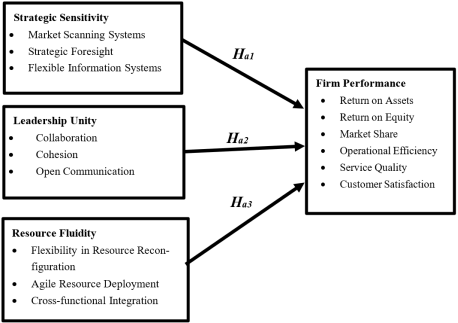
Building on the conceptual, theoretical, and empirical literature reviewed, the proposed model integrates the key constructs and illustrates their relationships in explaining organizational outcomes. The conceptual framework provides a structured lens for understanding the direct relationship between strategic agility and firm performance. In this model, strategic agility is the independent variable, while firm performance is the dependent variable, as shown in
Figure 1 below.
Figure 1. The Proposed Conceptual Model.
The constructs of this study are strategic agility and firm performance. Strategic agility is positioned as the independent variable, while firm performance represents the dependent variable. Firm performance remains the ultimate indicator of organizational success and sustainability. The reviewed literature conceptualizes it as a multidimensional construct encompassing both financial and non-financial indicators, including profitability, revenue growth, customer satisfaction, innovation effectiveness, and operational efficiency. It reflects how effectively an organization deploys its resources and strategies to achieve objectives and ensure long-term viability.
Strategic agility emerges as a key dynamic capability that enables firms to sense opportunities and threats, seize them effectively, and reconfigure resources to maintain strategic fit in turbulent environments. Its dimensions—strategic sensitivity, resource fluidity, and leadership unity—provide the foundation for adaptive decision-making and continuous renewal. Strategic sensitivity refers to a firm’s ability to detect emerging opportunities and threats and interpret weak signals that may shape its strategic direction through environmental scanning, foresight, and strategic cognition. Resource fluidity denotes the organization’s ability to redeploy and reconfigure tangible and intangible resources in response to environmental change, enabling timely adjustments in priorities, structures, and processes without excessive coordination costs. Leadership unity reflects the collective alignment and commitment of top management in formulating and executing strategies, ensuring coherent action, conflict resolution, and organizational focus under uncertainty.
Although each dimension contributes uniquely to organizational agility, their effectiveness depends on interdependence. Strategic sensitivity without resource fluidity may lead to paralysis, as opportunities are identified but cannot be acted upon. Conversely, resource fluidity without leadership unity may result in fragmented or conflicting actions that weaken strategic focus and dilute organizational effectiveness.
Based on the reviewed literature, this study proposes that strategic agility has a positive effect on firm performance. Accordingly, the following directional hypotheses are advanced for future research:
Ha1: Strategic sensitivity has a positive effect on firm performance.
Ha2: Resource fluidity has a positive effect on firm performance.
Ha3: Leadership unity has a positive effect on firm performance.
In conclusion, the conceptualization of strategic agility as a multidimensional construct comprising strategic sensitivity, resource fluidity, and leadership unity provides a comprehensive lens for understanding how firms achieve superior performance in dynamic environments. The propositions outlined above reflect both the individual and collective effects of these dimensions on firm performance, emphasizing the importance of their interdependence. Collectively, they offer a structured basis for future empirical testing and contribute to a deeper understanding of how strategic agility translates into sustainable competitive advantage in increasingly volatile and uncertain business contexts.





 Share This Article
 Twitter
 Linked In
 Facebook
 Copy
Copy Download