
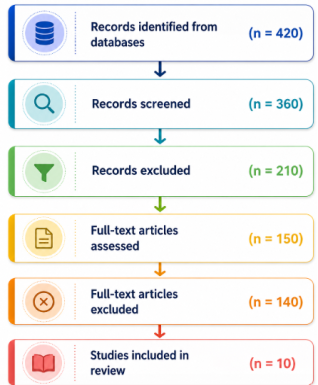
Telehealth implementation in Nigeria is constrained by infrastructural deficits, poor digital literacy, inadequate funding and sociocultural resistance to digital health technologies. This study examines the strategic improvement of patient performance through a cross-cultural project management approach for managing telehealth projects in Nigeria. The study adopts a systematic review methodology guided by the PRISMA framework and synthesizes evidence from peer-reviewed studies published between 2015 and 2024. Database search generated 420 records. 360 records were subjected to title and abstract screening. 210 records were excluded because they did not satisfy the inclusion criteria. 150 articles were obtained in full text and assessed for eligibility. 140 articles were excluded due to methodological limitations and lack of relevance to the study focus. 10 studies fulfilled all inclusion criteria and were retained for the final review. RE-AIM framework was employed to evaluate telehealth integration across diverse healthcare settings. Findings indicate that telehealth significantly improves healthcare accessibility, reduces travel time and supports better patient engagement. The paper concludes that integrating telehealth projects through a strategic project management lens substantially improve patient performance. It recommends stronger public-private investment in digital infrastructure, enhanced training programs, and culturally inclusive implementation models to scale telehealth sustainably within health systems.
| Published in | Science Journal of Business and Management (Volume 14, Issue 4) |
| DOI | 10.11648/j.sjbm.20261404.14 |
| Page(s) | 190-198 |
| Creative Commons |
This is an Open Access article, distributed under the terms of the Creative Commons Attribution 4.0 International License (http://creativecommons.org/licenses/by/4.0/), which permits unrestricted use, distribution and reproduction in any medium or format, provided the original work is properly cited. |
| Copyright |
Copyright © The Author(s), 2026. Published by Science Publishing Group |
Telehealth, Patient Performance, Cross-Cultural Project Management, Rural Healthcare, Healthcare Access, Telemedicine, Project Management Strategies
S/N | Theme | Description of Theme | Studies | (%) | Interpretation |
|---|---|---|---|---|---|
1 | Improvement in Healthcare Access | Telehealth expanded reach, reduced travel time, improved appointment access | 9 | 90% | Very strong evidence |
2 | Cost Efficiency and Economic Benefits | Reduced patient costs and improved system efficiency | 7 | 70% | Strong evidence |
3 | Technological and Infrastructure Barriers | Internet, power, ICT limitations affecting implementation | 10 | 100% | Critical universal barrier |
4 | User Acceptance and Satisfaction | Positive perceptions and willingness to use telehealth | 8 | 80% | Strong but conditional acceptance |
5 | Training and Digital Literacy Needs | Need for capacity building among staff and patients | 6 | 60% | Moderate evidence |
| [1] | Adair, J., Wholey, D., Christianson, J., White, K., Britt, H., & Lee, S. (2020). Improving chronic disease care through telehealth interventions: Patient and provider perspectives. Journal of Telemedicine and Telecare, 26(5), 289–297. |
| [2] | Adeloduna, M. O., & Anyanwub, E. C. (2025). Telehealth implementation: a review of project management practices and outcomes. conditions for success?. Implementation Science, 1(1), 18. |
| [3] | Agbeyangi, A. O., & Lukose, J. M. (2025, March). Telemedicine adoption and prospects in sub-Sahara Africa: a systematic review with a focus on South Africa, Kenya, and Nigeria. In Healthcare (Vol. 13, No. 7, p. 762). MDPI. |
| [4] | Anawade, P. A., Sharma, D., Gahane, S., Anawade Sr, P. A., & Sharma, D. S. (2024). A comprehensive review on exploring the impact of telemedicine on healthcare accessibility. Cureus, 16(3). |
| [5] | Barbosa, W., Zhou, K., Waddell, E., Myers, T., & Dorsey, E. R. (2021). Improving access to care: telemedicine across medical domains. Annual Review of Public Health, 42(1), 463-481. |
| [6] | Berenbrok, L. A., Tang, S., Gabriel, N., Guo, J., Sharareh, N., Patel, N., & Dickson, S. (2020). Access to community pharmacy services during the COVID-19 pandemic: Telehealth and remote care opportunities. Journal of the American Pharmacists Association, 60(6), e75–e80. |
| [7] | Caroline, A., Coun, M., Gunawan, A., & Stoffers, J. (2024). Cybersecurity awareness and digital competence in telehealth implementation: Implications for healthcare project sustainability. International Journal of Medical Informatics, 188, 105462. |
| [8] | Chike-Harris, K. E., Durham, C., Logan, A., Smith, G., & DuBose-Morris, R. (2021). Integration of telehealth education into health care provider training programs: A review. Telemedicine and e-Health, 27(2), 137–149. |
| [9] | Alakeel, A. N., Alskait, B. K., Binshafi, G. B., AlAmro, H. A., Alkharji, S. K., Elsherbini, M., Aleid, N. A., Alfrayan, R. A., Binshafi, G. B. B., AlAmro, H. and Alkharji, S., 2025. The impact of telehealth adoption on patient outcomes: a systematic review. Cureus, 17(10). |
| [10] | Cole, O. K., Abubakar, M. M., Isah, A., Sule, S. H., & Ukoha-Kalu, B. O. (2025). Barriers and facilitators of provision of telemedicine in Nigeria: A systematic review. PLOS Digital Health, 4(7), e0000934. |
| [11] | Corvalan, C., & McKee, M. (2020). Telemedicine and healthcare delivery in resource-constrained settings: Challenges and opportunities. Health Policy and Technology, 9(4), 100451. |
| [12] | Enabulele, A. B. O., Eleweke, C. C., Okechukwu, O., Akanbi, O. O., & Majesty, C. (2025). A strategic project management framework for implementing patient-centered digital health record systems to improve chronic disease outcomes in the United States. Journal of Sustainable Research and Development, 1(2), 55-67. |
| [13] | Farietta, T. P., Lu, X., Touchett, H., & Garcia, M. (2018). Cost-effectiveness of telehealth interventions in healthcare systems: A systematic review. Health Economics Review, 8(1), 25–36. |
| [14] | Gagnon, M. P., Duplantie, J., Fortin, J. P., & Landry, R. (2006). Implementing telehealth to support medical practice in rural/remote regions: what are the. |
| [15] | Gomes, J. V., & Romão, M. J. B. (2025). Benefits and project management to improve success of IS/IT projects in healthcare. In Cases on sustainable organizational performance and competitive advantages (pp. 313-354). IGI Global Scientific Publishing. |
| [16] | Higginbottom, G. M. A., Evans, C., Morgan, M., Bharj, K., Eldridge, J., Hussain, B., & Boadu, N. Y. (2019). Telehealth and healthcare access in rural communities: A systematic review of barriers and facilitators. BMC Health Services Research, 19(1), 1–12. |
| [17] | Holmes, J. H., & Chen, Y. (2016). Challenges and opportunities in telehealth implementation in developing countries. International Journal of Medical Informatics, 94, 73–79. |
| [18] | Jayousi, S., Cinelli, M., Bigazzi, R., Bianchi, S., Scalvini, S., Borghi, G., & Giansanti, D. (2025). Transforming telemedicine: Strategic lessons and metrics from Italy’s telemechron project (telemechron study). Technologies, 13(2), 44. |
| [19] | Johnson, C., Nguyen, M., Patel, V., & Roberts, D. (2022). Healthcare provider experiences and patient satisfaction with telehealth services: Evidence from post-pandemic healthcare systems. BMC Health Services Research, 22(1), 1284. |
| [20] | Kadel, R., Allen, J., Darlington, O., Masters, R., Collins, B., Charles, J. M., & Cookson, R. (2022). Cost of health inequality to the NHS in Wales. Frontiers in Public Health, 10, 959283. |
| [21] | Kamal, S. A., Shafiq, M., & Kakria, P. (2020). Investigating acceptance of telemedicine services through an extended technology acceptance model. Technology in Society, 60, 101212. |
| [22] | Kehinde, O. (2024). Achieving strategic excellence in healthcare projects: Leveraging benefit realization management framework. World Journal of Advanced Research and Reviews, 21(01), 2925-50. |
| [23] | Kruse, F. M., Stadhouders, N. W., Adang, E. M., Groenewoud, S., & Jeurissen, P. P. (2018). Do private hospitals outperform public hospitals regarding efficiency, accessibility, and quality of care in the European Union? A literature review. The International Journal of Health Planning and Management, 33(2), e434-e453. |
| [24] | Mendoza-Chan, S., & Pee, L. G. (2024). Digital skills development and telehealth readiness among healthcare professionals: A systematic review. Journal of Medical Internet Research, 26, e56789. |
| [25] | Namara, M., Wilkinson, D., Lowens, B. M., Knijnenburg, B. P., Orji, R., & Sekou, R. L. (2018, December). Cross-cultural perspectives on eHealth privacy in Africa. In Proceedings of the Second African Conference for Human Computer Interaction: Thriving Communities (pp. 1-11). |
| [26] | Nelson, R., Krzyzaniak, N., Pereira, A., & Scott, A. (2022). Telehealth implementation and healthcare accessibility: Evidence from global healthcare systems. International Journal of Medical Informatics, 163, 104784. |
| [27] | Olaniyan, O., Yusuf, A., Oluwakemi, A. K. H., & Igbin, L. A. (2022). The Impact of Digital Health and Telemedicine on Healthcare Accessibility and Quality. |
| [28] | Olufunlayo, T. F., Ojo, O. O., Ozoh, O. B., Agabi, O. P., Opara, C. R., Taiwo, F. T., Fasanmade, O. A., &Okubadejo, N. U. (2023). Telemedicine ready or not? A cross-sectional assessment of telemedicine maturity of federally funded tertiary health institutions in Nigeria. Digital Health, 9, 20552076221150072. |
| [29] | Omaghomi, T. T., Arowoogun, J. O., Akomolafe, O., Odilibe, I. P., & Elufioye, O. A. (2024). Telemedicine in rural Africa: A review of accessibility and impact. World J. Adv. Res. Rev, 21(2), 421-431. |
| [30] | Omboni, S., Padwal, R. S., Alessa, T., Benczúr, B., Green, B. B., Hubbard, I., & Wang, J. (2022). The worldwide impact of telemedicine during COVID-19: current evidence and recommendations for the future. Connected Health, 1, 7. |
| [31] | Rêgo, B. S., Lourenço, D., Moreira, F., & Pereira, C. S. (2024). Digital transformation, skills and education: A systematic literature review. Education and Information Technologies. |
| [32] | Research in Globalization (2025). Bridging digital skill gaps in the global workforce: A synthesis and conceptual framework building. Research in Globalization, 11, 100311. |
| [33] | Samuel, O. O., Akorede, A. O., & Karimu, T. A. (2025). Digital literacy competencies and telehealth project success in developing healthcare systems. African Journal of Health Informatics, 12(1), 45–59. |
| [34] | Burrell, D. N. (2024). Telehealth technologies, disruptions, and health literacy. Health Economics and Management Review, 5(4), 33-46. |
| [35] | Arora, S., Huda, R. K., Verma, S., Khetan, M., Sangwan, R. K., HUda Sr, R. K., & Sangwan, R. K. (2024). Challenges, barriers, and facilitators in telemedicine implementation in India: a scoping review. Cureus, 16(8). |
| [36] | Amin, M. M., Munmun, Z. S., Atayeva, J., Ahmed, S. W., Shamim, I., & Akter, M. H. (2025). Developing a Project Management Dashboard for Telehealth Implementation. The Science Post, 1(2). |
| [37] | Mishra, V., & Sharma, M. G. (2022). Digital transformation evaluation of telehealth using convergence, maturity, and adoption. Health policy and technology, 11(4), 100684. |
| [38] | Dinesen, B., Nonnecke, B., Lindeman, D., Toft, E., Kidholm, K., Jethwani, K., ... & Nesbitt, T. (2016). Personalized telehealth in the future: a global research agenda. Journal of medical Internet research, 18(3), e53. |
APA Style
Agbeche, A. O., Ndudi, F., Emurotu, E. O. (2026). Strategic Improvement of Patient Performance: A Cross-cultural Approach for Managing Telehealth Projects in Nigeria, Africa. Science Journal of Business and Management, 14(4), 190-198. https://doi.org/10.11648/j.sjbm.20261404.14
ACS Style
Agbeche, A. O.; Ndudi, F.; Emurotu, E. O. Strategic Improvement of Patient Performance: A Cross-cultural Approach for Managing Telehealth Projects in Nigeria, Africa. Sci. J. Bus. Manag. 2026, 14(4), 190-198. doi: 10.11648/j.sjbm.20261404.14
@article{10.11648/j.sjbm.20261404.14,
  author = {Aaron Oghenevwayere Agbeche and Francis Ndudi and Edafe Oghenegangan Emurotu},
  title = {Strategic Improvement of Patient Performance:
A Cross-cultural Approach for Managing Telehealth Projects in Nigeria, Africa},
  journal = {Science Journal of Business and Management},
  volume = {14},
  number = {4},
  pages = {190-198},
  doi = {10.11648/j.sjbm.20261404.14},
  url = {https://doi.org/10.11648/j.sjbm.20261404.14},
  eprint = {https://article.sciencepublishinggroup.com/pdf/10.11648.j.sjbm.20261404.14},
  abstract = {Telehealth implementation in Nigeria is constrained by infrastructural deficits, poor digital literacy, inadequate funding and sociocultural resistance to digital health technologies. This study examines the strategic improvement of patient performance through a cross-cultural project management approach for managing telehealth projects in Nigeria. The study adopts a systematic review methodology guided by the PRISMA framework and synthesizes evidence from peer-reviewed studies published between 2015 and 2024. Database search generated 420 records. 360 records were subjected to title and abstract screening. 210 records were excluded because they did not satisfy the inclusion criteria. 150 articles were obtained in full text and assessed for eligibility. 140 articles were excluded due to methodological limitations and lack of relevance to the study focus. 10 studies fulfilled all inclusion criteria and were retained for the final review. RE-AIM framework was employed to evaluate telehealth integration across diverse healthcare settings. Findings indicate that telehealth significantly improves healthcare accessibility, reduces travel time and supports better patient engagement. The paper concludes that integrating telehealth projects through a strategic project management lens substantially improve patient performance. It recommends stronger public-private investment in digital infrastructure, enhanced training programs, and culturally inclusive implementation models to scale telehealth sustainably within health systems.},
 year = {2026}
}
TY  - JOUR
T1  - Strategic Improvement of Patient Performance:
A Cross-cultural Approach for Managing Telehealth Projects in Nigeria, Africa
AU  - Aaron Oghenevwayere Agbeche
AU  - Francis Ndudi
AU  - Edafe Oghenegangan Emurotu
Y1  - 2026/11/16
PY  - 2026
N1  - https://doi.org/10.11648/j.sjbm.20261404.14
DO  - 10.11648/j.sjbm.20261404.14
T2  - Science Journal of Business and Management
JF  - Science Journal of Business and Management
JO  - Science Journal of Business and Management
SP  - 190
EP  - 198
PB  - Science Publishing Group
SN  - 2331-0634
UR  - https://doi.org/10.11648/j.sjbm.20261404.14
AB  - Telehealth implementation in Nigeria is constrained by infrastructural deficits, poor digital literacy, inadequate funding and sociocultural resistance to digital health technologies. This study examines the strategic improvement of patient performance through a cross-cultural project management approach for managing telehealth projects in Nigeria. The study adopts a systematic review methodology guided by the PRISMA framework and synthesizes evidence from peer-reviewed studies published between 2015 and 2024. Database search generated 420 records. 360 records were subjected to title and abstract screening. 210 records were excluded because they did not satisfy the inclusion criteria. 150 articles were obtained in full text and assessed for eligibility. 140 articles were excluded due to methodological limitations and lack of relevance to the study focus. 10 studies fulfilled all inclusion criteria and were retained for the final review. RE-AIM framework was employed to evaluate telehealth integration across diverse healthcare settings. Findings indicate that telehealth significantly improves healthcare accessibility, reduces travel time and supports better patient engagement. The paper concludes that integrating telehealth projects through a strategic project management lens substantially improve patient performance. It recommends stronger public-private investment in digital infrastructure, enhanced training programs, and culturally inclusive implementation models to scale telehealth sustainably within health systems.
VL  - 14
IS  - 4
ER  -
Business Administration, Dennis Osadebay University, Asaba, Nigeria
Business Administration, Dennis Osadebay University, Asaba, Nigeria
Allied Medical Science, Dennis Osadebay University, Asaba, Nigeria

Information



 Share This Article
 Twitter
 Linked In
 Facebook

 Copy
 Download