
 ,
Anicet Frederic Binaki,
Hubert Makomo,
Sarah Theresia Blanche Mbaka,
Jean Mathurin Nzikou,
Thomas Silou
Oil palm wine is highly perishable, and conversion into syrup offers a technically accessible route for local value addition. This study described open-pan evapoconcentration profiles and the immediate physicochemical quality of syrups prepared from four identified batches of oil palm wine. For each batch, 2 L of wine were heated at a nominal hotplate setpoint of 80°C under regular manual stirring. Apparent total soluble solids were measured every 20 min, and five nonlinear equations were compared using the root mean square error, coefficient of determination, corrected Akaike information criterion, and physical admissibility of the fitted parameters. The syrups were characterized for pH, titratable acidity, moisture, dry matter, and water activity immediately after processing. Apparent soluble solids increased from 6.97-10.00°Brix to 74.25-87.77°Brix within 200-260 min, corresponding to concentration factors of 8.18-10.65. Apparent syrup recovery ranged from 6.83 to 11.24 g per 100 mL of feed. A simplified evaporation-balance equation best represented batches S1 and S4, whereas a power-law equation described S2 and S3; the selected fits gave R2 values of 0.9713-0.9944 and root mean square errors of 1.434-2.976°Brix. Final pH ranged from 3.92 to 4.08 and titratable acidity from 0.36 to 0.91 g acetic acid equivalents per 100 g. Water activity separated the products into two lower-moisture syrups (0.472-0.482) and two higher-moisture syrups (0.660-0.704). The results establish the feasibility of producing highly concentrated oil palm wine syrup and identify simple nonlinear equations that can support endpoint control. Replicated runs with direct product-temperature measurement and standardized evaporation geometry are required for process optimization.
| Published in | Science Journal of Chemistry (Volume 14, Issue 5) |
| DOI | 10.11648/j.sjc.20261405.12 |
| Page(s) | 152-160 |
| Creative Commons |
This is an Open Access article, distributed under the terms of the Creative Commons Attribution 4.0 International License (http://creativecommons.org/licenses/by/4.0/), which permits unrestricted use, distribution and reproduction in any medium or format, provided the original work is properly cited. |
| Copyright |
Copyright © The Author(s), 2026. Published by Science Publishing Group |
Elaeis Guineensis, Palm Wine, Open-Pan Evaporation, Nonlinear Modeling, Soluble Solids, Water Activity, Palm Syrup
Batch | Holding time (d) | Initial (°Brix) | Final (°Brix) | Process time (min) | Concentration factor | Syrup mass (g) | Apparent recovery (g 100 mL⁻1) | Concentration factor |
|---|---|---|---|---|---|---|---|---|
S1 | 1 | 10.00 | 81.80 | 220 | 8.18 | 136.55 | 6.83 | 8.18 |
S2 | 2 | 10.00 | 87.77 | 200 | 8.78 | 170.67 | 8.53 | 8.78 |
S3 | 3 | 7.26 | 75.11 | 240 | 10.35 | 145.22 | 7.26 | 10.35 |
S4 | 4 | 6.97 | 74.26 | 260 | 10.65 | 224.79 | 11.24 | 10.65 |
Batch | Selected model | Fitted coefficients | RMSE (°Brix) | R2 | AICc |
|---|---|---|---|---|---|
S1 | Simplified evaporation balance | k = 0.00399 min⁻1 | 2.598 | 0.9821 | 25.31 |
S2 | Power law | a = 1.44 × 10⁻6; b = 3.37 | 2.307 | 0.9917 | 23.89 |
S3 | Power law | a = 4.30 × 10⁻14; b = 6.38 | 1.434 | 0.9944 | 14.56 |
S4 | Simplified evaporation balance | k = 0.00347 min⁻1 | 2.976 | 0.9713 | 32.87 |
Batch | Apparent TSS (°Brix) | pH | Titratable acidity (g 100 g⁻1) | Moisture (%) | Dry matter (%) | Water activity (aw) |
|---|---|---|---|---|---|---|
S1 | 81.80 | 4.08 | 0.49 | 23.74 | 76.26 | 0.482 |
S2 | 87.76 | 3.93 | 0.36 | 22.46 | 77.54 | 0.472 |
S3 | 75.11 | 3.92 | 0.82 | 36.34 | 63.66 | 0.704 |
S4 | 74.25 | 3.95 | 0.91 | 33.87 | 66.13 | 0.660 |
AICc | Corrected Akaike Information Criterion |
a_w | Water Activity |
HMF | 5-Hydroxymethylfurfural |
RMSE | Root Mean Square Error |
TSS | Total Soluble Solids |
Time (min) | S1 (°Brix) | S2 (°Brix) | S3 (°Brix) | S4 (°Brix) |
|---|---|---|---|---|
0 | 10 | 10 | 7.26 | 6.97 |
20 | 13 | 10.26 | 6.87 | 6.86 |
40 | 14 | 11.86 | 7.34 | 7.19 |
60 | 16 | 13.54 | 7.85 | 7.43 |
80 | 17 | 15.74 | 7.99 | 7.38 |
100 | 20 | 18.95 | 8.94 | 9.1 |
120 | 22 | 23.18 | 10.14 | 9.33 |
140 | 25 | 30.1 | 12 | 10.65 |
160 | 31 | 47.06 | 14.64 | 12.87 |
180 | 39.67 | 70.94 | 18.72 | 16.11 |
200 | 47.2 | 87.77 | 25.93 | 20.52 |
220 | 81.8 | - | 44.82 | 24.28 |
240 | - | - | 75.11 | 35.1 |
260 | - | - | - | 74.26 |
| [1] | Hebbar, K. B., Pandiselvam, R., Manikantan, M. R., Arivalagan, M., Beegum, S., Chowdappa, P. Palm Sap-Quality Profiles, Fermentation Chemistry, and Preservation Methods. Sugar Tech. 2018, 20(6), 621-634. |
| [2] | Hai, A., Rambabu, K., Al Dhaheri, A. S., Kurup, S. S., Banat, F. Tapping into Palm Sap: Insights into Extraction Practices, Quality Profiles, Fermentation Chemistry, and Preservation Techniques. Heliyon. 2024, 10(15), e35611. |
| [3] | Amoa-Awua, W. K., Sampson, E., Tano-Debrah, K. Growth of Yeasts, Lactic and Acetic Acid Bacteria in Palm Wine During Tapping and Fermentation from Felled Oil Palm (Elaeis guineensis) in Ghana. Journal of Applied Microbiology. 2007, 102(2), 599-606. |
| [4] | Karamoko, D., Djeni, N. T., N'Guessan, K. F., Bouatenin, K. M. J.-P., Djè, K. M. The Biochemical and Microbiological Quality of Palm Wine Samples Produced at Different Periods During Tapping and Changes Which Occurred During Their Storage. Food Control. 2012, 26(2), 504-511. |
| [5] | Djeni, T. N., Kouame, K. H., Ake, F. D. M., Amoikon, L. S. T., Dje, M. K., Jeyaram, K., et al. Microbial Diversity and Metabolite Profiles of Palm Wine Produced from Three Different Palm Tree Species in Côte d'Ivoire. Scientific Reports. 2020, 10, 1715. |
| [6] | Djeni, T. N., Keisam, S., Kouame, K. H., Assohoun-Djeni, C. N., Ake, F. D. M., Amoikon, L. S. T., et al. Dynamics of Microbial Populations and Metabolites of Fermenting Saps Throughout Tapping Process of Ron and Oil Palm Trees in Côte d'Ivoire. Frontiers in Microbiology. 2022, 13, 954917. |
| [7] | Saputro, A. D., Van de Walle, D., Dewettinck, K. Palm Sap Sugar: A Review. Sugar Tech. 2019, 21(6), 862-867. |
| [8] | Naknean, P., Meenune, M. Impact of Clarification of Palm Sap and Processing Method on the Quality of Palm Sugar Syrup (Borassus flabellifer Linn.). Sugar Tech. 2015, 17(2), 195-203. |
| [9] | Makhlouf-Gafsi, I., Baklouti, S., Mokni, A., Danthine, S., Attia, H., Blecker, C., Besbes, S., Masmoudi, M. Effect of Ultrafiltration Process on Physico-Chemical, Rheological, Microstructure and Thermal Properties of Syrups from Male and Female Date Palm Saps. Food Chemistry. 2016, 203, 175-182. |
| [10] | Phetrit, R., Chaijan, M., Sorapukdee, S., Panpipat, W. Characterization of Nipa Palm's (Nypa fruticans Wurmb.) Sap and Syrup as Functional Food Ingredients. Sugar Tech. 2020, 22(1), 191-201. |
| [11] | Saengkrajang, W., Chaijan, M., Panpipat, W. Physicochemical Properties and Nutritional Compositions of Nipa Palm (Nypa fruticans Wurmb.) Syrup. NFS Journal. 2021, 23, 58-65. |
| [12] | Le, D. H. T., Chiu, C.-S., Chan, Y.-J., Wang, C.-C. R., Liang, Z.-C., Hsieh, C.-W., Lu, W.-C., Mulio, A. T., Wang, Y.-J., Li, P.-H. Bioactive and Physicochemical Characteristics of Natural Food: Palmyra Palm (Borassus flabellifer Linn.) Syrup. Biology. 2021, 10(10), 1028. |
| [13] | Julai, K., Sridonpai, P., Ngampeerapong, C., Tongdonpo, P., Suttisansanee, U., Kriengsinyos, W., On-Nom, N., Tangsuphoom, N. Effects of Extraction and Evaporation Methods on Physico-Chemical, Functional, and Nutritional Properties of Syrups from Barhi Dates (Phoenix dactylifera L.). Foods. 2023, 12(6), 1268. |
| [14] | Naknean, P., Meenune, M., Roudaut, G. Changes in Properties of Palm Sugar Syrup Produced by an Open Pan and a Vacuum Evaporator During Storage. International Food Research Journal. 2013, 20(5), 2323-2334. |
| [15] | Makhlouf-Gafsi, I., Krichen, F., Ben Mansour, R., Mokni, A., Sila, A., Bougatef, A., Blecker, C., Attia, H., Besbes, S. Ultrafiltration and Thermal Processing Effects on Maillard Reaction Products and Biological Properties of Date Palm Sap Syrups (Phoenix dactylifera L.). Food Chemistry. 2018, 256, 397-404. |
| [16] | Van Boekel, M. A. J. S. Kinetic Modeling of Food Quality: A Critical Review. Comprehensive Reviews in Food Science and Food Safety. 2008, 7(1), 144-158. |
| [17] | Akaike, H. A New Look at the Statistical Model Identification. IEEE Transactions on Automatic Control. 1974, 19(6), 716-723. |
| [18] | Hurvich, C. M., Tsai, C.-L. Regression and Time Series Model Selection in Small Samples. Biometrika. 1989, 76(2), 297-307. |
| [19] | Burnham, K. P., Anderson, D. R. Model Selection and Multimodel Inference: A Practical Information-Theoretic Approach. 2nd ed. New York, NY: Springer; 2002. |
| [20] | AOAC International. Official Methods of Analysis of AOAC International. 21st ed. Rockville, MD: AOAC International; 2019. |
| [21] | International Organization for Standardization. Foodstuffs-Determination of Water Activity (ISO 18787:2017). Geneva, Switzerland: ISO; 2017. |
| [22] | Barbosa-Cánovas, G. V., Fontana, A. J., Schmidt, S. J., Labuza, T. P., Eds. Water Activity in Foods: Fundamentals and Applications. Ames, IA: Blackwell Publishing; 2007. |
| [23] | Tokuoka, K., Ishitani, T. Minimum Water Activities for the Growth of Yeasts Isolated from High-Sugar Foods. Journal of General and Applied Microbiology. 1991, 37(1), 111-119. |
| [24] | Capuano, E., Fogliano, V. Acrylamide and 5-Hydroxymethylfurfural (HMF): A Review on Metabolism, Toxicity, Occurrence in Food and Mitigation Strategies. LWT-Food Science and Technology. 2011, 44(4), 793-810. |
| [25] | Antal, M. J., Jr., Mok, W. S. L., Richards, G. N. Mechanism of Formation of 5-(Hydroxymethyl)-2-Furaldehyde from D-Fructose and Sucrose. Carbohydrate Research. 1990, 199(1), 91-109. |
APA Style
Biassala, E. T., Loumouamou, B. W., Binaki, A. F., Makomo, H., Mbaka, S. T. B., et al. (2026). Open-Pan Evapoconcentration Kinetics and Physicochemical Characteristics of Oil Palm Wine Syrups. Science Journal of Chemistry, 14(5), 152-160. https://doi.org/10.11648/j.sjc.20261405.12
ACS Style
Biassala, E. T.; Loumouamou, B. W.; Binaki, A. F.; Makomo, H.; Mbaka, S. T. B., et al. Open-Pan Evapoconcentration Kinetics and Physicochemical Characteristics of Oil Palm Wine Syrups. Sci. J. Chem. 2026, 14(5), 152-160. doi: 10.11648/j.sjc.20261405.12
@article{10.11648/j.sjc.20261405.12,
  author = {Eliane Therese Biassala and Bob Wilfrid Loumouamou and Anicet Frederic Binaki and Hubert Makomo and Sarah Theresia Blanche Mbaka and Jean Mathurin Nzikou and Thomas Silou},
  title = {Open-Pan Evapoconcentration Kinetics and Physicochemical Characteristics of Oil Palm Wine Syrups},
  journal = {Science Journal of Chemistry},
  volume = {14},
  number = {5},
  pages = {152-160},
  doi = {10.11648/j.sjc.20261405.12},
  url = {https://doi.org/10.11648/j.sjc.20261405.12},
  eprint = {https://article.sciencepublishinggroup.com/pdf/10.11648.j.sjc.20261405.12},
  abstract = {Oil palm wine is highly perishable, and conversion into syrup offers a technically accessible route for local value addition. This study described open-pan evapoconcentration profiles and the immediate physicochemical quality of syrups prepared from four identified batches of oil palm wine. For each batch, 2 L of wine were heated at a nominal hotplate setpoint of 80°C under regular manual stirring. Apparent total soluble solids were measured every 20 min, and five nonlinear equations were compared using the root mean square error, coefficient of determination, corrected Akaike information criterion, and physical admissibility of the fitted parameters. The syrups were characterized for pH, titratable acidity, moisture, dry matter, and water activity immediately after processing. Apparent soluble solids increased from 6.97-10.00°Brix to 74.25-87.77°Brix within 200-260 min, corresponding to concentration factors of 8.18-10.65. Apparent syrup recovery ranged from 6.83 to 11.24 g per 100 mL of feed. A simplified evaporation-balance equation best represented batches S1 and S4, whereas a power-law equation described S2 and S3; the selected fits gave R2 values of 0.9713-0.9944 and root mean square errors of 1.434-2.976°Brix. Final pH ranged from 3.92 to 4.08 and titratable acidity from 0.36 to 0.91 g acetic acid equivalents per 100 g. Water activity separated the products into two lower-moisture syrups (0.472-0.482) and two higher-moisture syrups (0.660-0.704). The results establish the feasibility of producing highly concentrated oil palm wine syrup and identify simple nonlinear equations that can support endpoint control. Replicated runs with direct product-temperature measurement and standardized evaporation geometry are required for process optimization.},
 year = {2026}
}
TY  - JOUR
T1  - Open-Pan Evapoconcentration Kinetics and Physicochemical Characteristics of Oil Palm Wine Syrups
AU  - Eliane Therese Biassala
AU  - Bob Wilfrid Loumouamou
AU  - Anicet Frederic Binaki
AU  - Hubert Makomo
AU  - Sarah Theresia Blanche Mbaka
AU  - Jean Mathurin Nzikou
AU  - Thomas Silou
Y1  - 2026/10/20
PY  - 2026
N1  - https://doi.org/10.11648/j.sjc.20261405.12
DO  - 10.11648/j.sjc.20261405.12
T2  - Science Journal of Chemistry
JF  - Science Journal of Chemistry
JO  - Science Journal of Chemistry
SP  - 152
EP  - 160
PB  - Science Publishing Group
SN  - 2330-099X
UR  - https://doi.org/10.11648/j.sjc.20261405.12
AB  - Oil palm wine is highly perishable, and conversion into syrup offers a technically accessible route for local value addition. This study described open-pan evapoconcentration profiles and the immediate physicochemical quality of syrups prepared from four identified batches of oil palm wine. For each batch, 2 L of wine were heated at a nominal hotplate setpoint of 80°C under regular manual stirring. Apparent total soluble solids were measured every 20 min, and five nonlinear equations were compared using the root mean square error, coefficient of determination, corrected Akaike information criterion, and physical admissibility of the fitted parameters. The syrups were characterized for pH, titratable acidity, moisture, dry matter, and water activity immediately after processing. Apparent soluble solids increased from 6.97-10.00°Brix to 74.25-87.77°Brix within 200-260 min, corresponding to concentration factors of 8.18-10.65. Apparent syrup recovery ranged from 6.83 to 11.24 g per 100 mL of feed. A simplified evaporation-balance equation best represented batches S1 and S4, whereas a power-law equation described S2 and S3; the selected fits gave R2 values of 0.9713-0.9944 and root mean square errors of 1.434-2.976°Brix. Final pH ranged from 3.92 to 4.08 and titratable acidity from 0.36 to 0.91 g acetic acid equivalents per 100 g. Water activity separated the products into two lower-moisture syrups (0.472-0.482) and two higher-moisture syrups (0.660-0.704). The results establish the feasibility of producing highly concentrated oil palm wine syrup and identify simple nonlinear equations that can support endpoint control. Replicated runs with direct product-temperature measurement and standardized evaporation geometry are required for process optimization.
VL  - 14
IS  - 5
ER  -

Laboratory of Food Chemistry and Technology & Faculty of Science and Technology, Marien Ngouabi University, Brazzaville, Republic of the Congo;Process Engineering Laboratory & National Advanced School of Engineering, Marien Ngouabi University, Brazzaville, Republic of the Congo
Laboratory of Food Chemistry and Technology & Faculty of Science and Technology, Marien Ngouabi University, Brazzaville, Republic of the Congo
Laboratory of Organic and Analytical Chemistry of Bioactive Substances & Faculty of Science and Technology, Marien Ngouabi University, Brazzaville, Republic of the Congo
Laboratory of Food Chemistry and Technology & Faculty of Science and Technology, Marien Ngouabi University, Brazzaville, Republic of the Congo
Process Engineering Laboratory & National Advanced School of Engineering, Marien Ngouabi University, Brazzaville, Republic of the Congo
Laboratory of Food Chemistry and Technology & Faculty of Science and Technology, Marien Ngouabi University, Brazzaville, Republic of the Congo
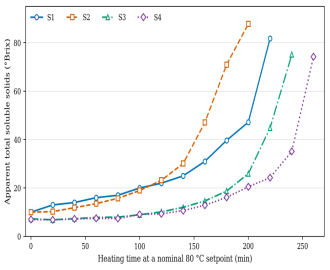
Figure 1. Evolution of apparent total soluble solids during open-pan evapoconcentration of four oil palm wine batches under regular manual stirring.
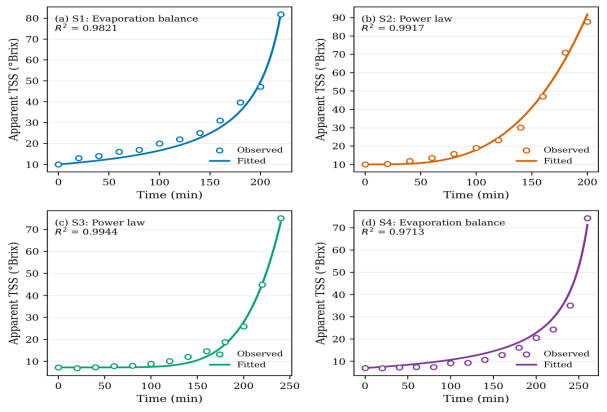
Figure 2. Observed apparent soluble solids and selected physically admissible nonlinear models for batches S1-S4. Panels (a) and (d) show the simplified evaporation-balance equation; panels (b) and (c) show the power-law equation.

Information


 Share This Article
 Twitter
 Linked In
 Facebook

 Copy
 Download