
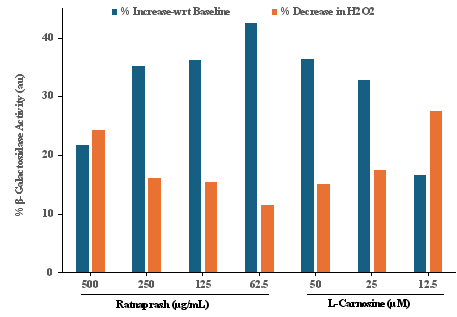
Aging is a natural biological phenomenon including oxidative stress, chronic inflammation, cellular senescence and cumulative metabolic dysfunction in human body. In Ayurveda ‘aging’, known as Jara - denotes natural aging process by progressive degradation of body tissues and declined in physiological function. Ayurvedic formulations are well known for their rejuvenation property and to support longevity, vitality and physiological balance. DRDC/2015/003, a Herbo-mineral blend derived by fortification of Chyawanprash with some well-reported Ayurvedic ingredients like Mukta (Pearl calax), Safed musli (Chlorophylum borivilianum) and Kesar (Crocus sativa) responsible for decreasing oxidative stress. Current in vitro study assessed anti-aging potential of DRDC/2015/003, on human fibroblast cell (HFF-1). The non-cytotoxic concentration of DRDC/2015/003 was evaluated by MTT assay, followed by assessment of H2O2 induced beta galactosidase activity as oxidative stress marker. Results indicated to marked reduction (17.1% decrease) in H2O2 induced cellular senescence with β–galactosidase (SA- β-gal) activity, in the test setup as compared with controlled cells setup. Such observed activity of DRDC/2015/003 in reducing H2O2 induced beta galactosidase activity in HFF-1 cells indicated to its significant role in anti- aging property and delaying premature cellular aging.
| Published in | Science Journal of Public Health (Volume 14, Issue 2) |
| DOI | 10.11648/j.sjph.20261402.13 |
| Page(s) | 74-79 |
| Creative Commons |
This is an Open Access article, distributed under the terms of the Creative Commons Attribution 4.0 International License (http://creativecommons.org/licenses/by/4.0/), which permits unrestricted use, distribution and reproduction in any medium or format, provided the original work is properly cited. |
| Copyright |
Copyright © The Author(s), 2026. Published by Science Publishing Group |
DRDC/2015/003, Anti-aging, Antioxidant, SA β – Galactosidase, Cellular Senescence, Rasayan
Contents | Quantity (g) |
|---|---|
Emblica officinalis | 64 |
Mukta Pisti | 0.028 |
Sesamum indicum seed oil | 0.61 |
Clarified butter | 1.22 |
Chlorophytum tuberosum, Mucuna prurita | 0.1 |
Elttaria cardamomum | 0.554 |
Syzygium aromaticum | 0.062 |
Crystal Sugar | 64 |
Honey | 0.731 |
Aegla marmelos, Clerodendrum phlomidis, Oroxylum indicum, Stereospermum suaveolens, Gmelina arborea, Desmodium gangeticum, Urari picta, | 0.285 each |
Solanum indicum, Solanum surattence, Tribulus terrestris, Vitis vinifera, Tinospora cordifolia, Bacopa monnieri, Sida cordifolia, Inula racemosa | |
Laptadenia reticulata, Phaseolus trilobus, Teramnus labialis, Pistacis integerrima, Phyllanthus niruri, Terminalia chebula, | |
curcuma zedoaria, Cyperus rotundus, Boerhaavia diffusa, Nympaea stellate, Adhatoda vasica, Glycyrrhiza glabra, Martynia, annua, | |
Cinnamomum zeylanicum, Cinnnamomum tamala, Mesua ferrea | 0.107 |
Piper longum | 0.258 |
Bambusa bambos | 0.75 |
Abhrak Bhasma, Anacyclus pyrethrum | 0.175 |
Chlorophytum tuberosum, Mucuna prurita | 0.1 |
Crocus sativus | 0.1 |
Syzygium aromaticum | 0.062 |
Elettaria cardamomum, | 0.554 |
*Each 100 g of Dabur DRDC/2015/003 |
Treatment | Test Concentration | % Cytotoxicity wrt untreated cells |
|---|---|---|
RATNAPRASH SUGAR FREE (DRDC/2015/003) (µg/ml) in DMSO | 0.1 | 7.52 |
1 | 0.55 | |
15.6 | 2.57 | |
31.2 | 14.85 | |
62.5 | 1.25 | |
125 | 7.05 | |
250 | 2.73 | |
500 | 22.53 | |
1000 | 33.87 | |
L-Carnosine (mM) in DMEM | 12.5 | 18.55 |
25 | 14.77 | |
50 | 22.53 | |
100 | 34.96 |
DRDC | Dabur Research and Development Centre |
HFF | Human Diploid Fibroblasts Cultured |
ROS | Reactive Oxygen Species |
H2O2 | Hydrogen Peroxide |
ATCC | American Type Cell Culture |
USA | United States of America |
SA β – Gal | Senescence-associated-beta Galactosidase |
DMEM | Dulbecco’s Modified Eagle’s Medium |
g | Grams |
μg | Micro Gram |
mL | Milli Litre |
mM | Millimole |
| [1] | Canfield, C.-A., & Bradshaw, P. C. (2019). Amino acids in the regulation of aging and aging-related diseases. Translational Medicine of Aging, 3, 70–89. |
| [2] | Chiu, H.-F., Hsiao, S.-C., Lu, Y.-Y., Han, Y.-C., Shen, Y.-C., Venkatakrishnan, K., & Wang, C.-K. (2018). Efficacy of protein rich pearl powder on antioxidant status in a randomized placebo-controlled trial. Journal of Food and Drug Analysis, 26(1), 309–317. |
| [3] | Devasagayam, T. P. A., & Sainis, K. B. (2002). Immune system and antioxidants, especially those derived from Indian medicinal plants. Indian Journal of Experimental Biology, 40(6), 639–655. |
| [4] | Duan, J., Duan, J., Zhang, Z., & Tong, T. (2005). Irreversible cellular senescence induced by prolonged exposure to H2O2 involves DNA-damage-and-repair genes and telomere shortening. The International Journal of Biochemistry & Cell Biology, 37(7), 1407–1420. |
| [5] | Guruprasad, K. P., Dash, S., Shivakumar, M. B., Shetty, P. R., Raghu, K. S., Shamprasad, B. R., Udupi, V., Acharya, R. V., Vidya, P. B., Nayak, J., Mana, A. E., Moni, R., Sankaran, M. T., & Satyamoorthy, K. (2017). Influence of Amalaki Rasayana on telomerase activity and telomere length in human blood mononuclear cells. Journal of Ayurveda and Integrative Medicine, 8(2), 105–112. |
| [6] | Labunskyy, V. M., & Gladyshev, V. N. (2013). Role of Reactive Oxygen Species-Mediated Signaling in Aging. Antioxidants & Redox Signaling, 19(12), 1362–1372. |
| [7] | Madaan, A., Kanjilal, S., Gupta, A., Sastry, J. L. N., Verma, R., Singh, A. T., & Jaggi, M. (2015). Evaluation of immunostimulatory activity of Chyawanprash using in vitro assays. Indian Journal of Experimental Biology, 53(3), 158–163. |
| [8] | Maggi, M. A., Bisti, S., & Picco, C. (2020). Saffron: Chemical Composition and Neuroprotective Activity. Molecules, 25(23), 5618. |
| [9] | Płóciniczak, A., Bukowska-Olech, E., & Wysocka, E. (2025). The Complexity of Oxidative Stress in Human Age-Related Diseases—A Review. Metabolites, 15(7), 479. |
| [10] | Rao, R. V. (2018). Ayurveda and the science of aging. Journal of Ayurveda and Integrative Medicine, 9(3), 225–232. |
| [11] | Sanjana Shrivastava, Jaspreet Kaur, Mahrukh Mehraj, Fathima Feroz, Jyoti Chawla, Surbhi Kumari. (n.d.). Emblica officinalis (Amla): A comprehensive review of the miracle berry. 11(6), 06–16. |
| [12] | Sastry, J. L. N., Brindavanam, N. B., Kanjilal, S., Kumar, S., Setia, M., Vedula, S., & Srivastava, R. (2011). Quantification of Immunity Status of Dabur Chyawanprash—A Review Part- 2 (Clinical Studies). Indian Journal of Applied Research, 4(3), 205–211. |
| [13] | Sharma, V., & Chaudhary, A. K. (2014). Concepts of Dhatu Siddhanta (theory of tissues formation and differentiation) and Rasayana; probable predecessor of stem cell therapy. Ayu, 35(3), 231–236. |
| [14] | Tamboli, F. A., More, H. N., Khairmode, S. S., Patil, D. R., Tambare, P. D., Shinde, A. J., Jadhav, N. R., & Bhandari, S. V. (2021). CHYAWANPRASH: A TRADITIONAL INDIAN BIOACTIVE HERBAL MEDICINAL FORMULATION TO BOOST IMMUNITY AND RESTORE YOUTHFULNESS. Tropical Journal of Pharmaceutical and Life Sciences, 8(1), 21–28. |
| [15] | Tukanatti, P., Wasedar, V. S., Jadar, P., & Bhat, K. (2025). Immuno-Modulatory activity of Mukta Bhasma (Calx of Cultured Pearls) | International Journal of Ayurvedic Medicine (Vol. 16 No. 2 (2025)). International Journal of Ayurvedic Medicine. |
| [16] | Valieva, Y., Ivanova, E., Fayzullin, A., Kurkov, A., & Igrunkova, A. (2022). Senescence-Associated β-Galactosidase Detection in Pathology. Diagnostics, 12(10), 2309. |
| [17] | Vilema-Enríquez, G., Arroyo, A., Grijalva, M., Amador-Zafra, R. I., & Camacho, J. (2016). Molecular and Cellular Effects of Hydrogen Peroxide on Human Lung Cancer Cells: Potential Therapeutic Implications. Oxidative Medicine and Cellular Longevity, 2016, 1908164. |
APA Style
Mishra, B., Yathapu, S. R., Rajesh, A. S., Priya, D. (2026). Assessment of Anti-aging Potential of a Poly-Herbomineral Blend: An in Vitro Study Lead. Science Journal of Public Health, 14(2), 74-79. https://doi.org/10.11648/j.sjph.20261402.13
ACS Style
Mishra, B.; Yathapu, S. R.; Rajesh, A. S.; Priya, D. Assessment of Anti-aging Potential of a Poly-Herbomineral Blend: An in Vitro Study Lead. Sci. J. Public Health 2026, 14(2), 74-79. doi: 10.11648/j.sjph.20261402.13
@article{10.11648/j.sjph.20261402.13,
  author = {Baidyanath Mishra and Srinivasa Reddy Yathapu and Apratim Sai Rajesh and Divyanshi Priya},
  title = {Assessment of Anti-aging Potential of a Poly-Herbomineral Blend: An in Vitro Study Lead},
  journal = {Science Journal of Public Health},
  volume = {14},
  number = {2},
  pages = {74-79},
  doi = {10.11648/j.sjph.20261402.13},
  url = {https://doi.org/10.11648/j.sjph.20261402.13},
  eprint = {https://article.sciencepublishinggroup.com/pdf/10.11648.j.sjph.20261402.13},
  abstract = {Aging is a natural biological phenomenon including oxidative stress, chronic inflammation, cellular senescence and cumulative metabolic dysfunction in human body. In Ayurveda ‘aging’, known as Jara - denotes natural aging process by progressive degradation of body tissues and declined in physiological function. Ayurvedic formulations are well known for their rejuvenation property and to support longevity, vitality and physiological balance. DRDC/2015/003, a Herbo-mineral blend derived by fortification of Chyawanprash with some well-reported Ayurvedic ingredients like Mukta (Pearl calax), Safed musli (Chlorophylum borivilianum) and Kesar (Crocus sativa) responsible for decreasing oxidative stress. Current in vitro study assessed anti-aging potential of DRDC/2015/003, on human fibroblast cell (HFF-1). The non-cytotoxic concentration of DRDC/2015/003 was evaluated by MTT assay, followed by assessment of H2O2 induced beta galactosidase activity as oxidative stress marker. Results indicated to marked reduction (17.1% decrease) in H2O2 induced cellular senescence with β–galactosidase (SA- β-gal) activity, in the test setup as compared with controlled cells setup. Such observed activity of DRDC/2015/003 in reducing H2O2 induced beta galactosidase activity in HFF-1 cells indicated to its significant role in anti- aging property and delaying premature cellular aging.},
 year = {2026}
}
TY  - JOUR
T1  - Assessment of Anti-aging Potential of a Poly-Herbomineral Blend: An in Vitro Study Lead
AU  - Baidyanath Mishra
AU  - Srinivasa Reddy Yathapu
AU  - Apratim Sai Rajesh
AU  - Divyanshi Priya
Y1  - 2026/03/30
PY  - 2026
N1  - https://doi.org/10.11648/j.sjph.20261402.13
DO  - 10.11648/j.sjph.20261402.13
T2  - Science Journal of Public Health
JF  - Science Journal of Public Health
JO  - Science Journal of Public Health
SP  - 74
EP  - 79
PB  - Science Publishing Group
SN  - 2328-7950
UR  - https://doi.org/10.11648/j.sjph.20261402.13
AB  - Aging is a natural biological phenomenon including oxidative stress, chronic inflammation, cellular senescence and cumulative metabolic dysfunction in human body. In Ayurveda ‘aging’, known as Jara - denotes natural aging process by progressive degradation of body tissues and declined in physiological function. Ayurvedic formulations are well known for their rejuvenation property and to support longevity, vitality and physiological balance. DRDC/2015/003, a Herbo-mineral blend derived by fortification of Chyawanprash with some well-reported Ayurvedic ingredients like Mukta (Pearl calax), Safed musli (Chlorophylum borivilianum) and Kesar (Crocus sativa) responsible for decreasing oxidative stress. Current in vitro study assessed anti-aging potential of DRDC/2015/003, on human fibroblast cell (HFF-1). The non-cytotoxic concentration of DRDC/2015/003 was evaluated by MTT assay, followed by assessment of H2O2 induced beta galactosidase activity as oxidative stress marker. Results indicated to marked reduction (17.1% decrease) in H2O2 induced cellular senescence with β–galactosidase (SA- β-gal) activity, in the test setup as compared with controlled cells setup. Such observed activity of DRDC/2015/003 in reducing H2O2 induced beta galactosidase activity in HFF-1 cells indicated to its significant role in anti- aging property and delaying premature cellular aging.
VL  - 14
IS  - 2
ER  -
Dabur Research and Development, Dabur India Limited, Ghaziabad, India
Dabur Research and Development, Dabur India Limited, Ghaziabad, India
Dabur Research and Development, Dabur India Limited, Ghaziabad, India

Information



 Share This Article
 Twitter
 Linked In
 Facebook
 Copy
Copy Download