
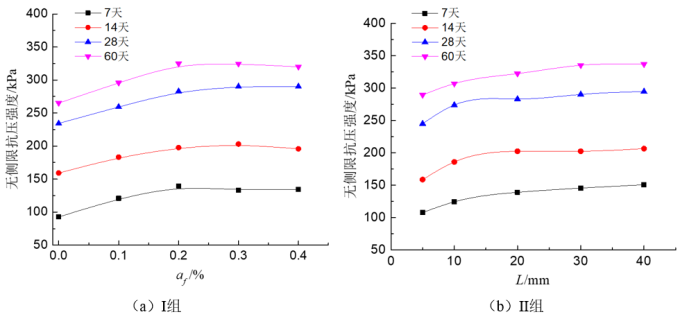
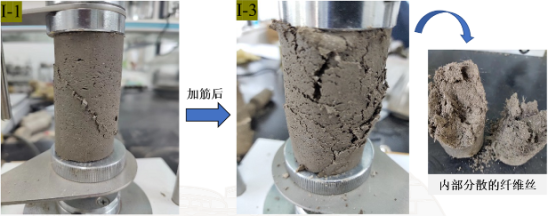
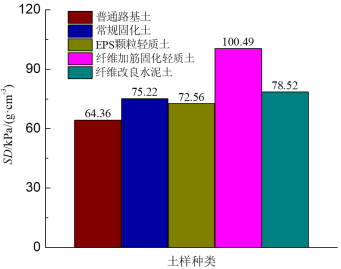
To address the technical challenge associated with the inability to utilize dredged sediments from existing rivers and lakes, this study focused on dredged ultra-soft soil from coastal areas. Taking into account various factors such as soil moisture content, dosage of curing agent and foaming agents, as well as fiber type, dosage, and size, research was conducted on lightweight solidification technologies suitable for fiber-reinforced high water content ultra-soft soil. The test results indicate: 1) The fiber reinforcement effect significantly improved the brittle failure mode of the solidified lightweight soil, substantially enhancing the structural stability and ductility, with basalt fiber providing the best reinforcement effect. 2) The increase in unconfined compressive strength of solidified lightweight soil ranged from 10.2% to 23.4% under different fiber dosages and lengths. When the fiber length exceeded 20 mm, the increase in strength gradually stabilized. With the increase of fiber dosage, the strength showed a trend of increasing first and then decreasing. 3) The 7d density-strength ratio of fiber-reinforced dredged solidified lightweight soil reached 100.49 kPa/(g·cm-3), representing increases of approximately 56.1%, 33.6%, 38.5%, and 28.0% compared to ordinary subgrade soil, conventional solidified soil, fiber-modified cement soil, and EPS-particle lightweight soil, respectively. The research findings can provide theoretical foundation for ultra-soft soil treatment in activities such as coastal tidal flat development, river dredging, and road subgrade renovation and expansion.
| Published in | Science Research (Volume 14, Issue 4) |
| DOI | 10.11648/j.sr.20261404.12 |
| Page(s) | 135-145 |
| Creative Commons |
This is an Open Access article, distributed under the terms of the Creative Commons Attribution 4.0 International License (http://creativecommons.org/licenses/by/4.0/), which permits unrestricted use, distribution and reproduction in any medium or format, provided the original work is properly cited. |
| Copyright |
Copyright © The Author(s), 2026. Published by Science Publishing Group |
Fiber, Ultra-Soft Soil, Lightweight Stabilization, Unconfined Compressive Strength, Density-Strength Ratio
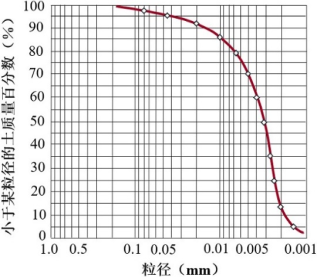
含水率 w/% | 密度 ρ/(g·cm-3) | 比重 Gs | 孔隙比 e | 液限 wL/% | 塑限 wP/% | 塑性指数 IP | 液性指数 IL | 压缩系数 a1-2/MPa−1 | 压缩模量 Es/MPa | 有机质含量 /% |
|---|---|---|---|---|---|---|---|---|---|---|
46.9 | 1.76 | 2.74 | 1.287 | 43.6 | 24.9 | 18.7 | 1.18 | 1.036 | 2.208 | 3.4~5.2 |
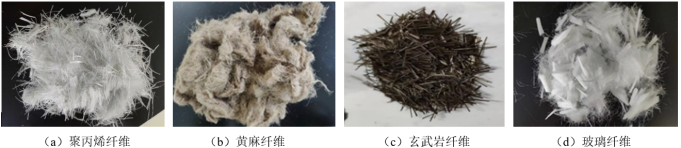
纤维种类 | 密度/(g·cm-3) | 平均直径/μm | 抗拉强度/MPa | 弹性模量/GPa | 熔点/℃ | 极限伸长率/% |
|---|---|---|---|---|---|---|
聚丙烯纤维 | 0.95 | 31 | 1030 | ≥3.85 | 150~160 | 10.1 |
黄麻纤维 | 1.21 | 18 | 650 | 3.15 | 130~170 | 1.8 |
玄武岩纤维 | 2.63 | 25 | 3250 | 68.2~90 | 1350~1500 | 3.5 |
玻璃纤维 | 2.69 | 16 | 3100 | 72.5 | 700~900 | 2.8 |
水平 | 湿土含水率 | A(纤维种类) | B(纤维掺量) | C(纤维长度) |
|---|---|---|---|---|
1 | 85.0% | 黄麻纤维 | 0.10% | 5mm |
2 | 85.0% | 玻璃纤维 | 0.20% | 10mm |
3 | 85.0% | 玄武岩纤维 | 0.30% | 15mm |
4 | 85.0% | 聚丙烯纤维 | 0.40% | 20mm |
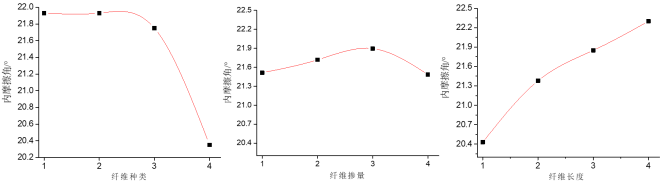
指标 | 内摩擦角φ/° | 黏聚力c/kPa | ||||
|---|---|---|---|---|---|---|
A | B | C | A | B | C | |
S1 | 87.7 | 89.2 | 81.7 | 297.67 | 322.85 | 328.46 |
S2 | 87.7 | 86.6 | 85.5 | 337.79 | 330.71 | 326.79 |
S3 | 87.0 | 84.4 | 87.4 | 359.52 | 323.12 | 323.77 |
S4 | 81.4 | 83.6 | 89.2 | 319.07 | 327.37 | 325.03 |
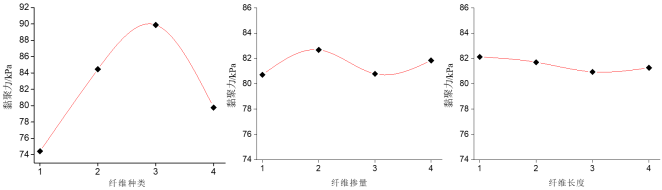
M1 | 21.93 | 22.30 | 20.43 | 74.42 | 80.71 | 82.12 |
M2 | 21.93 | 21.65 | 21.38 | 84.45 | 82.68 | 81.70 |
M3 | 21.75 | 21.10 | 21.85 | 89.88 | 80.78 | 80.94 |
M4 | 20.35 | 20.90 | 22.30 | 79.77 | 81.84 | 81.26 |
极差R | 1.58 | 1.40 | 1.87 | 15.46 | 1.97 | 1.18 |
编号 | 含水率 | ac | al | as | af | L/mm |
|---|---|---|---|---|---|---|
Ⅰ-1 | 85.0% | 10% | 7% | 0.1% | 0% | 20 |
Ⅰ-2 | 85.0% | 10% | 7% | 0.1% | 0.1% | 20 |
Ⅰ-3 | 85.0% | 10% | 7% | 0.1% | 0.2% | 20 |
Ⅰ-4 | 85.0% | 10% | 7% | 0.1% | 0.3% | 20 |
Ⅰ-5 | 85.0% | 10% | 7% | 0.1% | 0.4% | 20 |
Ⅱ-1 | 85.0% | 10% | 7% | 0.1% | 0.2% | 5 |
Ⅱ-2 | 85.0% | 10% | 7% | 0.1% | 0.2% | 10 |
Ⅱ-3 | 85.0% | 10% | 7% | 0.1% | 0.2% | 20 |
Ⅱ-4 | 85.0% | 10% | 7% | 0.1% | 0.2% | 30 |
Ⅱ-5 | 85.0% | 10% | 7% | 0.1% | 0.2% | 40 |
水平 | A(含水率) | B(ac) | C(al) | D(as) | E(af) | F(L) |
|---|---|---|---|---|---|---|
1 | 80% | 5% | 4% | 0.04% | 0.10% | 10mm |
2 | 85% | 7% | 5% | 0.06% | 0.15% | 15mm |
3 | 90% | 9% | 6% | 0.08% | 0.20% | 20mm |
4 | 95% | 11% | 7% | 0.10% | 0.25% | 25mm |
5 | 100% | 13% | 8% | 0.12% | 0.30% | 30mm |
组号 | A | B | C | D | E | F | 发泡率 | 7d强度/kPa | 14d强度/kPa | 28d强度/kPa |
|---|---|---|---|---|---|---|---|---|---|---|
1 | 1 | 1 | 1 | 1 | 1 | 1 | 20.95% | 68.47 | 102.94 | 135.21 |
2 | 1 | 2 | 2 | 2 | 2 | 2 | 25.34% | 62.47 | 94.84 | 126.21 |
3 | 1 | 3 | 3 | 3 | 3 | 3 | 22.66% | 118.27 | 170.17 | 199.91 |
4 | 1 | 4 | 4 | 4 | 4 | 4 | 27.12% | 187.05 | 245.02 | 283.07 |
5 | 1 | 5 | 5 | 5 | 5 | 5 | 31.80% | 197.44 | 257.05 | 288.67 |
6 | 2 | 1 | 2 | 3 | 4 | 5 | 21.18% | 56.62 | 86.93 | 107.43 |
7 | 2 | 2 | 3 | 4 | 5 | 1 | 25.11% | 73.00 | 109.05 | 131.99 |
8 | 2 | 3 | 4 | 5 | 1 | 2 | 26.60% | 83.37 | 123.05 | 147.56 |
9 | 2 | 4 | 5 | 1 | 2 | 3 | 23.85% | 128.63 | 184.15 | 215.45 |
10 | 2 | 5 | 1 | 2 | 3 | 4 | 19.54% | 176.73 | 249.08 | 287.59 |
11 | 3 | 1 | 3 | 5 | 2 | 4 | 27.86% | 46.84 | 76.74 | 92.76 |
12 | 3 | 2 | 4 | 1 | 3 | 5 | 25.71% | 67.89 | 102.15 | 124.34 |
13 | 3 | 3 | 5 | 2 | 4 | 1 | 25.71% | 78.84 | 116.93 | 140.76 |
14 | 3 | 4 | 1 | 3 | 5 | 2 | 23.85% | 112.30 | 162.11 | 190.95 |
15 | 3 | 5 | 2 | 4 | 1 | 3 | 24.44% | 180.94 | 254.78 | 293.92 |
16 | 4 | 1 | 4 | 2 | 5 | 3 | 32.17% | 66.90 | 100.81 | 122.85 |
17 | 4 | 2 | 5 | 3 | 1 | 4 | 35.00% | 53.85 | 83.19 | 103.27 |
18 | 4 | 3 | 1 | 4 | 2 | 5 | 33.44% | 85.05 | 125.32 | 150.08 |
19 | 4 | 4 | 2 | 5 | 3 | 1 | 32.84% | 65.78 | 99.30 | 121.16 |
20 | 4 | 5 | 3 | 1 | 4 | 2 | 28.46% | 140.81 | 200.59 | 218.72 |
21 | 5 | 1 | 5 | 4 | 3 | 2 | 34.70% | 55.58 | 85.53 | 105.87 |
22 | 5 | 2 | 1 | 5 | 4 | 3 | 34.40% | 70.21 | 105.28 | 127.82 |
23 | 5 | 3 | 2 | 1 | 5 | 4 | 20.14% | 68.55 | 103.04 | 125.32 |
24 | 5 | 4 | 3 | 2 | 1 | 5 | 28.16% | 80.49 | 119.17 | 143.24 |
25 | 5 | 5 | 4 | 3 | 2 | 1 | 26.30% | 85.32 | 125.68 | 150.48 |
因素 | 7d/28d无侧限抗压强度/kPa | 极差R | ||||
|---|---|---|---|---|---|---|
M1 | M2 | M3 | M4 | M5 | 7d/28d | |
A | 126.7/206.6 | 103.7/178.0 | 97.4/168.5 | 82.5/143.2 | 72.0/130.5 | 54.7/76.1 |
B | 58.9/112.8 | 65.5/122.7 | 86.8/152.7 | 114.9/190.8 | 156.2/227.9 | 97.3/115.1 |
C | 102.6/178.3 | 86.9/154.8 | 91.9/157.3 | 98.1/205.7 | 122.9/170.8 | 36.0/50.9 |
D | 94.9/163.8 | 93.1/164.1 | 85.3/150.4 | 116.3/193.0 | 92.7/155.6 | 31.0/42.6 |
E | 93.4/164.6 | 81.7/147.0 | 96.9/167.8 | 106.7/195.6 | 103.6/172.0 | 25.0/48.6 |
F | 74.3/135.9 | 90.9/157.9 | 103.0/172.0 | 96.6/178.4 | 97.5/164.8 | 28.7/42.5 |
试样种类 | 1.0ρ0 | 1.1ρ0 | 1.2ρ0 | 1.3ρ0 |
实测密度g/cm3 | 1.26 | 1.36 | 1.48 | 1.65 |
计算密度g/cm3 | / | 1.38 | 1.51 | 1.64 |
 (1)
(1) | [1] | Ai C F, Ma Y X, Han C W, et al. Capacity assessment of the recurrent disposal of dredged materials in a marine disposal area [J]. Ocean & Coastal Management, 2024, 249: 107005. |
| [2] | Yin X H, Tian C J, Hong J T, et al. Study on the properties of solidified silt based on microbially stimulated recycled hardened cement powder [J]. Materials, 2025, 18(11): 2575. |
| [3] | 吴燕开, 许美玲, 杨椿茂, 等. 海水侵蚀下复合固化剂改良淤泥质土的物理力学特性研究 [J]. 硅酸盐通报, 2025, 44(4): 1535-1545. |
| [4] | Cerbo A A V, Ballesteros F J, Chen T C, et al. Solidification/stabilization of fly ash from city refuse incinerator facility and heavy metal sludge with cement additives [J]. Environmental Science and Pollution Research, 2017, 24(2): 1748-1756. |
| [5] | Yazici E, Unsever Y S. Investigation of cement and fly ash on the improvement of fine sand soil [J]. Applied Sciences, 2024, 14(7): 2908. |
| [6] | 胡志明, 王子帅, 张艳林, 等. 粉煤灰联合水泥原位固化软土现场试验研究 [J]. 中国港湾建设, 2024, 44(5): 40-47+72. |
| [7] | 耿茹. 烧碱激发下钢渣粉加固软土动力特性研究 [D]. 华北理工大学, 2022. |
| [8] | 徐日庆, 朱坤垅, 黄伟, 等. 淤泥质土固化及路用性能试验研究 [J]. 湖南大学学报(自然科学版), 2022, 49(3): 167-174. |
| [9] | 梅利芳, 徐光黎. 纤维聚苯乙烯泡沫颗粒轻质土的制备及力学性能 [J]. 复合材料学报, 2016, 33(10): 2355-2362. |
| [10] | Jiang P, Fu Y, Chen L, et al. Mechanical properties of SCA modified EPS lightweight soil and modification mechanism [J]. Geosynthetics International, 2025, 32(6): 885-907. |
| [11] | Haseeb M, Maqsood Z, Baqir M, et al. Sustainable fill solutions: recycling EPS waste in shredded EPS-clayed soil composites for improved mechanical and compaction behaviour [J]. Transportation Geotechnics, 2025, 54: 101614. |
| [12] | 翁洋, 陈锡锋. EPS颗粒混合轻质土在高速公路中的施工技术及应用[J]. 公路交通科技(应用技术版), 2013, 9(1): 39-41. |
| [13] | Yang A W, Yang S P, Zhong X K, et al. Mechanical properties and structural evolution of sludge-cured lightweight soils subjected to freeze-thaw cycles [J]. KSCE Journal of Civil Engineering, 2022, 26(11): 4478-4488. |
| [14] | Neramitkornburi A, Horpibulsuk S, Shen S L, et al. Durability against wetting-drying cycles of sustainable Lightweight Cellular Cemented construction material comprising clay and fly ash wastes [J]. Construction and Building Materials, 2015, 77: 41-49. |
| [15] | GB/T 50123-2019. 土工试验方法标准 [S]. 北京: 中国计划出版社, 2019. |
| [16] | 杨少坤, 任毅青, 庞辉, 等. 主应力旋转效应下碱渣固化轻质土动强度及刚度特性 [J]. 陆军工程大学学报, 2025, 4(6): 96-104. |
| [17] | Tang K, Xu J, Huang L. Mechanical reinforcement mechanisms and seismic performance of randomly distributed polypropylene fiber-reinforced soil [J]. Geotechnical and Geological Engineering, 2026, 44(2): 112. |
| [18] | 李梦瑶, 刘松玉, 张翔, 等. 轻质土动力特性研究进展 [J]. 工程科学学报, 2024, 46(11): 2099-2109. |
APA Style
Yang, S., Xu, M., Deng, Y. (2026). Experimental Study on the Technology of Fiber-Admixture Composite Stabilization for Ultra-Soft Soil. Science Research, 14(4), 135-145. https://doi.org/10.11648/j.sr.20261404.12
ACS Style
Yang, S.; Xu, M.; Deng, Y. Experimental Study on the Technology of Fiber-Admixture Composite Stabilization for Ultra-Soft Soil. Sci. Res. 2026, 14(4), 135-145. doi: 10.11648/j.sr.20261404.12
@article{10.11648/j.sr.20261404.12,
  author = {Shaokun Yang and Mingfei Xu and Yongcun Deng},
  title = {Experimental Study on the Technology of Fiber-Admixture Composite Stabilization for Ultra-Soft Soil},
  journal = {Science Research},
  volume = {14},
  number = {4},
  pages = {135-145},
  doi = {10.11648/j.sr.20261404.12},
  url = {https://doi.org/10.11648/j.sr.20261404.12},
  eprint = {https://article.sciencepublishinggroup.com/pdf/10.11648.j.sr.20261404.12},
  abstract = {To address the technical challenge associated with the inability to utilize dredged sediments from existing rivers and lakes, this study focused on dredged ultra-soft soil from coastal areas. Taking into account various factors such as soil moisture content, dosage of curing agent and foaming agents, as well as fiber type, dosage, and size, research was conducted on lightweight solidification technologies suitable for fiber-reinforced high water content ultra-soft soil. The test results indicate: 1) The fiber reinforcement effect significantly improved the brittle failure mode of the solidified lightweight soil, substantially enhancing the structural stability and ductility, with basalt fiber providing the best reinforcement effect. 2) The increase in unconfined compressive strength of solidified lightweight soil ranged from 10.2% to 23.4% under different fiber dosages and lengths. When the fiber length exceeded 20 mm, the increase in strength gradually stabilized. With the increase of fiber dosage, the strength showed a trend of increasing first and then decreasing. 3) The 7d density-strength ratio of fiber-reinforced dredged solidified lightweight soil reached 100.49 kPa/(g·cm-3), representing increases of approximately 56.1%, 33.6%, 38.5%, and 28.0% compared to ordinary subgrade soil, conventional solidified soil, fiber-modified cement soil, and EPS-particle lightweight soil, respectively. The research findings can provide theoretical foundation for ultra-soft soil treatment in activities such as coastal tidal flat development, river dredging, and road subgrade renovation and expansion.},
 year = {2026}
}
TY  - JOUR
T1  - Experimental Study on the Technology of Fiber-Admixture Composite Stabilization for Ultra-Soft Soil
AU  - Shaokun Yang
AU  - Mingfei Xu
AU  - Yongcun Deng
Y1  - 2026/08/06
PY  - 2026
N1  - https://doi.org/10.11648/j.sr.20261404.12
DO  - 10.11648/j.sr.20261404.12
T2  - Science Research
JF  - Science Research
JO  - Science Research
SP  - 135
EP  - 145
PB  - Science Publishing Group
SN  - 2329-0927
UR  - https://doi.org/10.11648/j.sr.20261404.12
AB  - To address the technical challenge associated with the inability to utilize dredged sediments from existing rivers and lakes, this study focused on dredged ultra-soft soil from coastal areas. Taking into account various factors such as soil moisture content, dosage of curing agent and foaming agents, as well as fiber type, dosage, and size, research was conducted on lightweight solidification technologies suitable for fiber-reinforced high water content ultra-soft soil. The test results indicate: 1) The fiber reinforcement effect significantly improved the brittle failure mode of the solidified lightweight soil, substantially enhancing the structural stability and ductility, with basalt fiber providing the best reinforcement effect. 2) The increase in unconfined compressive strength of solidified lightweight soil ranged from 10.2% to 23.4% under different fiber dosages and lengths. When the fiber length exceeded 20 mm, the increase in strength gradually stabilized. With the increase of fiber dosage, the strength showed a trend of increasing first and then decreasing. 3) The 7d density-strength ratio of fiber-reinforced dredged solidified lightweight soil reached 100.49 kPa/(g·cm-3), representing increases of approximately 56.1%, 33.6%, 38.5%, and 28.0% compared to ordinary subgrade soil, conventional solidified soil, fiber-modified cement soil, and EPS-particle lightweight soil, respectively. The research findings can provide theoretical foundation for ultra-soft soil treatment in activities such as coastal tidal flat development, river dredging, and road subgrade renovation and expansion.
VL  - 14
IS  - 4
ER  -
Army Engineering University of PLA, Xuzhou, P.R. China; State Key Laboratory of Advanced Fiber Materials, Donghua University, Shanghai, P.R. China
Army Engineering University of PLA, Xuzhou, P.R. China
Army Engineering University of PLA, Xuzhou, P.R. China

Information



 Share This Article
 Twitter
 Linked In
 Facebook
 Copy
Copy Download