Tribulus terrestris is a highly potent medicinal plant belonging to the caltrop family. This study reviews its wide range of therapeutic applications and health benefits. The plant exhibits strong diuretic and anti-urolithiatic properties, making it effective for promoting urination and preventing kidney stones. Additionally, it serves as an antimicrobial and anthelminthic agent to combat infections and parasites. Cardiotonic and hepatoprotective actions ensure the protection of vital organs like the heart and liver. It effectively manages metabolic health through Hypolipidemic and antidiabetic activities that lower cholesterol and blood sugar levels. Furthermore, the plant offers pain relief, reduces inflammation, and prevents muscle spasms due to its analgesic, anti-inflammatory, and antispasmodic traits. As an aphrodisiac and immunomodulator, it enhances sexual health and strengthens the immune system. Finally, its antioxidant, anti-tumor, and anti-cariogenic properties help neutralize cellular damage, fight cancer cells, and protect dental health, highlighting its vast pharmaceutical potential The active compound, protodioscin, was identified and measured in the fruit extract of Tribulus terrestris using advanced testing methods. First, a UV spectrophotometer confirmed the compound by showing its peak light absorption at 205 nm. Then, TLC and HPLC testing methods were used to find the exact amount of protodioscin present in the fruit. Protodioscin is the substances of potential therapeutic interest are steroidal saponins. The following furostanol saponins-protodioscin, neoprotodioscin and their respective sulphates methylprotodioscin, prototribestrin, methylprorotribestrin and many more. Overall review of protodioscin medicinal applications like kidney and urinary tract health, sexual and reproductive wellness, athletic performance and muscle building and general health and wellness.
This is an Open Access article, distributed under the terms of the Creative Commons Attribution 4.0 International License (http://creativecommons.org/licenses/by/4.0/), which permits unrestricted use, distribution and reproduction in any medium or format, provided the original work is properly cited.
Tribulus Terrestris Linn, Protodioscin, Liquid Chromatography-Mass Spectroscopy,
High Performance Liquid Chromatography
1. Introduction
Tribulus terrestris Linn, is a traditional me decimal herb, belongs to Zygophyllacaceae Caltrop family, commonly known as “Gokhru” in Indian traditional medicine and in traditional European medicine agency respectively (EMA/HMPC/886105/2022). Tribulus terrestris Linn, has diversified uses in agriculture, ayurvedic as well as allopathic system of medicines with thousands of years of clinical application
[5]
Wu TS, Shi LS, Kuo SC. Alkaloids and other constituents from Tribulus terrestris. Phytochemistry. 1999, 50(8), 1411–1415.
. Dried fruits contain semi drying oil, peroxides, diastase, and traces of glycosides, resins, protein and large amount of inorganic matters
[1]
Anonymous. Publications and Information Directorate. Vol. 9. New Delhi: CSIR; 1972. The wealth of India. Raw materials. 1972; p. 472.
[1]
.
Tribulus terrestris Linn, North and North West India’s (Primary Hub) states are Rajasthan, Punjab, Haryana and Gujarat. Central India and indo-genetic Plains are Madhya Pradesh and Uttar Pradesh. And sub Himalayan foothills Uttarakhand, Jammu Kashmir and himachal pradesh. The extracts and active components of Tribulus terrestris Linn, demonstrated multiple biological activities, including acclaimed diuretic, Anti-urolithiatic, Antimicrobial, Anthelminthic, Cardio tonic, Anti-inflammatory, Hypolipidemic, Immuno-modulatory, Antispasmodic, Analgesic, Aphrodisiac, Anti diabetic, Anti-tumor, Hepato-protective, Anti-cariogenic, Anti-oxidant (wjpmr, 2025, 11(2), 107-115;) The principal bioactive compound of gokhru is protodioscin.
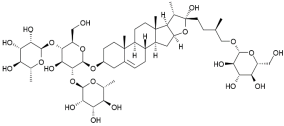
It is a naturally occurring Steroidal saponin (specifically a furostanol saponin)
IUPAC name (3β,22R,25R)-26-(β-D-glucopyranosyloxy)-22-hydroxyfurost-5-en-3-yl α-L-rhamnopyranosyl-(1→2)- [α-L-rhamnopyranosyl-(1→4)]-β-D-glucopyranoside. Beside the Protodioscin is a compound found in several plants, including the Trigonella and Dioscorea families. In this study, scientists extracted protodioscin from Tribulus terrestris using methanol, then purified and verified the compound.
Tribulus terrestris is used to make natural, hormone-free health supplements. Because the strength of the plant changes depending on where it grows, scientists use a main compound called protodioscin to check the quality of different water and alcohol extracts
[6]
Bedir E, Khan IA. New steroidal glycosides from the fruits of Tribulus terrestris. Journal of Natural Products. 2000, 63(12), 1699–1701.
Gokhru Plant Fruit: The raw Tribulus terrestris fruits were purchased from a vendor in Haridwar and officially verified by the Patanjali Research Foundation Herbarium (PRHF). The fruits were dried in the shade, ground into a coarse powder, and stored in airtight zipper bags for later use.
Chemicals: All chemicals and solvents used were of high-grade quality (reagent and analytical grade) purchased from Merck Ltd (Mumbai, India). The reference standard for protodioscin (98.0% pure) was sourced from Sigma Aldrich (Phytolab, Germany.
Extraction of crude Protodioscin: Dried fruit powder (250 g) was extracted three times using a Soxhlet apparatus with a water-and-methanol mix (80:20) at 60°C for three hours each time. A rotary evaporator removed the solvent under vacuum pressure, leaving 25.62 g of dry extract, which was weighed, calculated for percentage yield, and stored in a refrigerator for analysis
[1]
Anonymous. Publications and Information Directorate. Vol. 9. New Delhi: CSIR; 1972. The wealth of India. Raw materials. 1972; p. 472.
[1]
.
3. Determination of Absorption Maxima
UV spectrophotometer: To measure the UV spectra, a Shimadzu UV-1800 double-beam spectrophotometer was used with quartz cuvettes (1 cm path length) across a 190-800 nm wavelength range
[8]
Deepak M, Dipankar G, Prashanth D, Asha MK, Amit A, Venkataraman BV. Tribulosin and β-sitosterol-D-glucoside, the anthelmintic principles of Tribulus terrestris. Phytomedicine. 2002, 9(8), 753–756.
. Before testing, all glassware was cleaned with a chromic and sulphuric acid solution, rinsed with double-distilled water, and dried in a hot air oven. To prepare the sample, 10 mg of protodioscin was dissolved in 10% methanol in water inside a 100 mL volumetric flask to create a 100 µg/mL stock solution. This final solution was scanned to determine the exact absorption peak lambda max of protodioscin
[2]
Jayanthy A, Deepak M, Remashree, AB. Pharmacognostic characterization and comparison of fruits of Tribulus terrestris L. and Pedalium murex L. International Journal of Herbal Medicine. 2013; 1: 29-34.
[2]
.
4. Identification and Quantification
TLC (Thin layer chromatography): To identify protodioscin quickly and affordably, a TLC method was chosen because it tests multiple samples at once while saving time and solvents. Merck silica gel plates (60 F254) were used, and glass capillaries spotted the samples and reference standard in duplicate
[4]
Bhutani SP, Chibber SS, Seshadri TR. Flavonoids of the fruits and leaves of Tribulus terrestris: Constitution of tribuloside. Phytochemistry. 1969, 8(1), 299–303.
. The plate was placed in a chamber pre-saturated for two hours with a toluene: ethyl acetate (7:3) mobile phase, letting the solvent travel 6.0 cm. The completed plates were viewed under 254 nm and 366 nm UV light to determine and match the Rf values.
5. HPLC (High Performance Liquid Chromatography)
Protodioscin was measured in the Tribulus terrestris fruit extract using a Shimadzu i-series LC 2050 HPLC system equipped with a quaternary pump and a PDA detector. Separation was achieved at 25°C on an RP-18 column (150 mm × 4.6 mm, 5 µm) with a 1.0 mL/min flow rate. The mobile phase consisted of a gradient mix of Milli-Q water (A) and 100% acetonitrile (B), using 10% methanol in water as the diluent. Psoralen was monitored at 247 nm, and the retention time for the protodioscin standard was confirmed at 12.897 minutes
[6]
Bedir E, Khan IA. New steroidal glycosides from the fruits of Tribulus terrestris. Journal of Natural Products. 2000, 63(12), 1699–1701.
. All data were collected and processed using LabSolutions software.
5.1. Standard Preparation
A 10 mg reference standard of protodioscin was dissolved in the diluent and mixed using a sonicated for 15 minutes.
5.2. Sample Preparation
5.2.1. Raw Material
Four grams of raw material was boiled with 10 mL of diluent on a water bath for 15 minutes, cooled, and filtered into a 50 mL volumetric flask. To maximize recovery, the plant residue was extracted two more times under the same conditions, blending all cooled filtrates together into the flask
[8]
Deepak M, Dipankar G, Prashanth D, Asha MK, Amit A, Venkataraman BV. Tribulosin and β-sitosterol-D-glucoside, the anthelmintic principles of Tribulus terrestris. Phytomedicine. 2002, 9(8), 753–756.
. The combined mixture was then centrifuged at 5000 rpm for 5 minutes and cleared through a 0.45 µm filter right before HPLC injection.
5.2.2. Herbal Extract (Hydro-alcoholic and Aqueous)
Two grams of raw material was boiled with 10 mL of diluent on a water bath for 15 minutes, cooled, and filtered into a 50 mL flask. The plant residue was extracted two more times under the same conditions, pooling all cooled filtrates into the flask
[8]
Deepak M, Dipankar G, Prashanth D, Asha MK, Amit A, Venkataraman BV. Tribulosin and β-sitosterol-D-glucoside, the anthelmintic principles of Tribulus terrestris. Phytomedicine. 2002, 9(8), 753–756.
. The combined liquid was centrifuged at 5000 rpm for 5 minutes and cleared through a 0.45 µm filter for HPLC analysis.
6. The Testing Followed the Specific Guidelines Recommended by the FDA, USP, and ICH
6.1. System Suitability
In system suitability we injected the six injection of reference standard protodioscin to check the parameters are RSD% of the area, RT and height, Theoretical plates and tailing factor. Result comes RSD of area is 0.114%, RT is 0.252%, height 0.465% and theoretical plate (USP2) 161617 and tailing factor 0.872. Then all parameters of system suitability is pass as per the ICH guideline
[11]
Rawat AKS, Srivastava A, Tiwari SS, Srivastava S. Quantification of protodioscin and prototribestin in fruits of Tribulus terrestris L. collected from different phyto-geographical zones of India. Journal of Liquid Chromatography & Related Technologies. 2013, 36(13), 1810–1821.
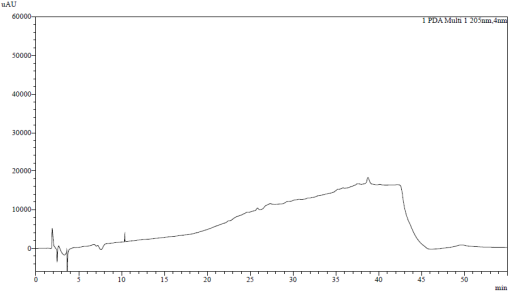
In this parameter we injected the replicate 20 injection of placebo. Their no peak interfere between the RT times of protodioscin, this parameters pass as per the ICH guideline
[9]
Conrad J, Dinchev D, Klaiber I, Mika S, Kostova I, Kraus W. A novel furostanol saponin from Tribulus terrestris of Bulgarian origin. Fitoterapia. 2004, 75(2), 117–122.
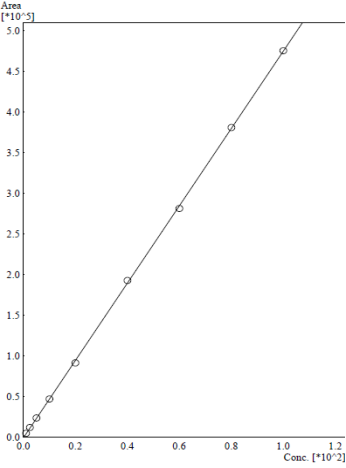
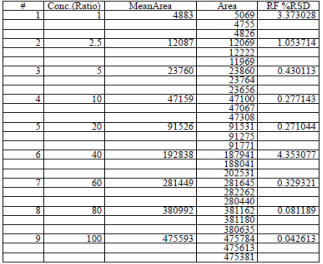
Protodioscin solutions at 9 levels were prepared from 1 ppm to 100 ppm of protodioscin reference standard concentration. At each level, analysis was carried out in triplicate. The peak areas versus concentrations data was evaluated by linear regression analysis.
Three data set corresponding to triplicate analysis were constructed and calculate the value of R2 =0.9999324 and plot the linearity curve y = mx + b. this parameters pass as per the ICH guideline
[9]
Conrad J, Dinchev D, Klaiber I, Mika S, Kostova I, Kraus W. A novel furostanol saponin from Tribulus terrestris of Bulgarian origin. Fitoterapia. 2004, 75(2), 117–122.
6.4. Limit of Quantification and Detection (LOD & LOQ)
The limit of detection (LOD) is pass at 2.5 ppm of reference standard protodioscin signal to noise is come 3.87 which equal to greater than 3.0. On other hand the limit of quantification (LOD) is pass at 10 ppm of reference standard protodioscin signal to noise is come 13.79
[9]
Conrad J, Dinchev D, Klaiber I, Mika S, Kostova I, Kraus W. A novel furostanol saponin from Tribulus terrestris of Bulgarian origin. Fitoterapia. 2004, 75(2), 117–122.
which equal to greater than 10.0. Both result fulfilled the guideline of ICH.
6.5. Accuracy
we perform the recovery (Accuracy) of sample at two points 500 ppm and 1000 ppm in both raw material and herbal dry extract. Result of raw material at 500 ppm is 96.18% and at 1000ppm 97.90ppm on other side herbal dry extract recovery at 500ppm id 91.19% and 1000ppm is 101.06%
[9]
Conrad J, Dinchev D, Klaiber I, Mika S, Kostova I, Kraus W. A novel furostanol saponin from Tribulus terrestris of Bulgarian origin. Fitoterapia. 2004, 75(2), 117–122.
. both point of recovery lies between 80 to 120% as per guideline of ICH.
6.6. Repeatability (Precision)
In repeatability we prepared the sample of raw material and herbal extract in replicate an analyzed the RSD of the result which lie between in 2.0% or not. the result is come in raw material is 0.162% and herbal dry extract is 0.065%
[10]
Su L, Feng SG, Qiao L, Zhou YZ, Yang RP, Pei YH. Two new steroidal saponins from Tribulus terrestris. Journal of Asian Natural Products Research. 2009, 11(1), 38–43.
we perform the robustness on two parameter flow and oven temperature in flow and oven temperature. We check the RT, Area RSD which RSD not greater than 2%. In oven temperature RSD is 0.047% and in flow 0.610% of RT
[10]
Su L, Feng SG, Qiao L, Zhou YZ, Yang RP, Pei YH. Two new steroidal saponins from Tribulus terrestris. Journal of Asian Natural Products Research. 2009, 11(1), 38–43.
Compounds were identified and characterized using optimized UV, HPLC, and LC-MS spectral techniques. Under TLC conditions, the reference standard, raw material, and dry extract all shared a retention factor Rf of 0.57 ±0.02, confirming the presence of protodioscin
[13]
Nessa F, Khan SA. Evaluation of free radical scavenging activity and toxic heavy metal contents of commercially available fruits of Tribulus terrestris Linn. European Journal of Medicinal Plants. 2015, 9(3), 1–14.
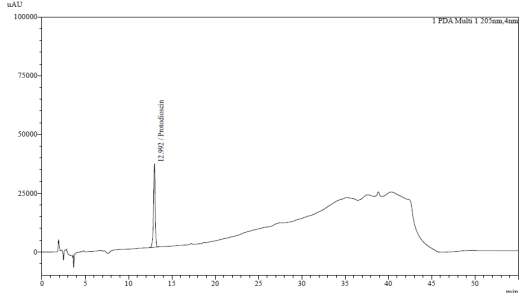
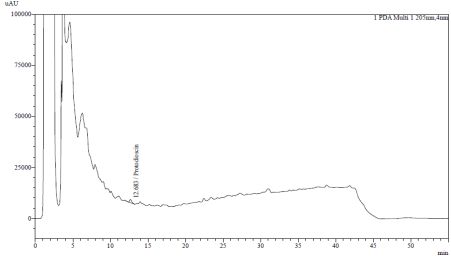
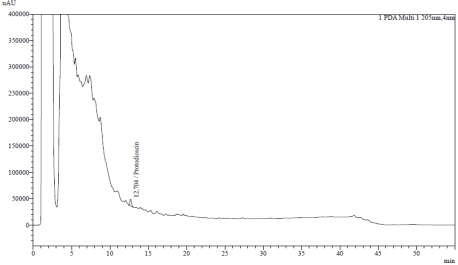
The characteristic retention time (RT) chromatograms are illustrated in Figures 2, 3, 6, and 7. The protodioscin reference standard eluted at 12.992 minutes, while the protodioscin in both the raw material and dry extract eluted at 12.993 minutes. Quantitative peak area analysis showed that protodioscin is a major compound, with a purity concentration of 0.01%w/w in the raw material and 0.1%w/w in the herbal extract
[16]
Reshma PL, Sainu NS, Mathew AK, Raghu KG. Mitochondrial dysfunction in H9c2 cells during ischemia and amelioration with Tribulus terrestris L. Life Sciences. 2016, 152, 220–230.
The analytical method was validated according to regulatory parameters:
1) Linearity: The calibration curve showed excellent linearity with an R2 value of 0.9999324.
2) Precision (Repeatability): The method demonstrated high reproducibility, yielding a Relative Standard Deviation (RSD) of 0.162% for the raw material and 0.065% for the herbal extract.
3) Sensitivity: Limits of Detection (LOD) and Quantification (LOQ) were successfully established.
4) Robustness: The method remained reliable under minor variations in operating conditions
[15]
Sonia, Singh S. Tribulus terrestris L. fruits: An extensive pharmacognostical and phytochemical quality assessment using UV-spectrophotometer. Research Journal of Pharmacy and Technology. 2022, 15(12), 5431–5435.
Accuracy was evaluated by spiking samples at two different concentrations:
Table 1. Spike Testing.
S.no
Sample Type
Spiked Concentration
Recovery Rate
7.4.1
Raw Material
100 ppm
96.18%
7.4.2
Raw Material
500 ppm
97.90%
7.4.3
Dry Extract
100 ppm
91.19%
7.4.4
Dry Extract
500 ppm
101.96%
7.5. Solution Stability
Stability testing of the reference standard solution revealed that it degraded after 15 days at room temperature. However, when stored in a refrigerator at 2 to 4 ᵒC the solution remained stable for 45 days
[12]
Tian C, Chang Y, Liu X, Zhang Z, Guo Y, Lan Z, Zhang P, Liu M. Anti-inflammatory activity in vitro, extractive process and HPLC-MS characterization of total saponins extract from Tribulus terrestris L. fruits. Industrial Crops and Products. 2020, 150, 112343.
Figure 7. HPLC chromatogram showing the presence of protodioscin in Tribulus terrestris Linn. herbal dry extract.
8. Conclusions
A simple, sensitive HPLC-PAD and LCMS technique was demonstrated and justified for the characterization and quantitative estimation of the main protodioscin in the fruit raw material and herbal extract of Tribulus terrestris Linn. The HPLC results confirmed the existence of protodioscin in the raw material and herbal extract of Tribulus terrestris Linn fruit. It is concluded that the highest amount of protodioscin was found in the fruit and herbal extract of of Tribulus terrestris Linn
[14]
Kumar D, Shah N, Al-Anazi KM, Farah MA, Ali MA, Lee J, Ali A. Potential role of Tribulus terrestris fruit extract in inhibition of advanced glycation end products. Pharmacognosy Magazine. 2022, 18(78), 341–347.
The authors would like to acknowledge Patanjali Ayurved Limited, Patanjali Research Foundation and Patanjali Foods Limited for providing all necessary support in preparation of this manuscript.
All data available in hard and softcopy in our software.
Conflicts of Interest
The authors declare no conflicts of interest.
References
[1]
Anonymous. Publications and Information Directorate. Vol. 9. New Delhi: CSIR; 1972. The wealth of India. Raw materials. 1972; p. 472.
[2]
Jayanthy A, Deepak M, Remashree, AB. Pharmacognostic characterization and comparison of fruits of Tribulus terrestris L. and Pedalium murex L. International Journal of Herbal Medicine. 2013; 1: 29-34.
[3]
Wang Y, Ohtani K, Kasai R, Yamasaki K. Steroidal saponins from fruits of Tribulus terrestris. Phytochemistry. 1996, 42(5), 1417–1422.
Bhutani SP, Chibber SS, Seshadri TR. Flavonoids of the fruits and leaves of Tribulus terrestris: Constitution of tribuloside. Phytochemistry. 1969, 8(1), 299–303.
Deepak M, Dipankar G, Prashanth D, Asha MK, Amit A, Venkataraman BV. Tribulosin and β-sitosterol-D-glucoside, the anthelmintic principles of Tribulus terrestris. Phytomedicine. 2002, 9(8), 753–756.
Conrad J, Dinchev D, Klaiber I, Mika S, Kostova I, Kraus W. A novel furostanol saponin from Tribulus terrestris of Bulgarian origin. Fitoterapia. 2004, 75(2), 117–122.
Su L, Feng SG, Qiao L, Zhou YZ, Yang RP, Pei YH. Two new steroidal saponins from Tribulus terrestris. Journal of Asian Natural Products Research. 2009, 11(1), 38–43.
Rawat AKS, Srivastava A, Tiwari SS, Srivastava S. Quantification of protodioscin and prototribestin in fruits of Tribulus terrestris L. collected from different phyto-geographical zones of India. Journal of Liquid Chromatography & Related Technologies. 2013, 36(13), 1810–1821.
Tian C, Chang Y, Liu X, Zhang Z, Guo Y, Lan Z, Zhang P, Liu M. Anti-inflammatory activity in vitro, extractive process and HPLC-MS characterization of total saponins extract from Tribulus terrestris L. fruits. Industrial Crops and Products. 2020, 150, 112343.
Nessa F, Khan SA. Evaluation of free radical scavenging activity and toxic heavy metal contents of commercially available fruits of Tribulus terrestris Linn. European Journal of Medicinal Plants. 2015, 9(3), 1–14.
Kumar D, Shah N, Al-Anazi KM, Farah MA, Ali MA, Lee J, Ali A. Potential role of Tribulus terrestris fruit extract in inhibition of advanced glycation end products. Pharmacognosy Magazine. 2022, 18(78), 341–347.
Sonia, Singh S. Tribulus terrestris L. fruits: An extensive pharmacognostical and phytochemical quality assessment using UV-spectrophotometer. Research Journal of Pharmacy and Technology. 2022, 15(12), 5431–5435.
Reshma PL, Sainu NS, Mathew AK, Raghu KG. Mitochondrial dysfunction in H9c2 cells during ischemia and amelioration with Tribulus terrestris L. Life Sciences. 2016, 152, 220–230.
Bharat, S. R., Jha, S. K., Saini, R., Fore, S., Kumar, B., et al. (2026). Standardization of Protodioscin Quantification in Tribulus Terrestris Linn to Resolve Analytical Variances. Science Research, 14(5), 382-389. https://doi.org/10.11648/j.sr.20261405.26
Bharat, S. R.; Jha, S. K.; Saini, R.; Fore, S.; Kumar, B., et al. Standardization of Protodioscin Quantification in Tribulus Terrestris Linn to Resolve Analytical Variances. Sci. Res.2026, 14(5), 382-389. doi: 10.11648/j.sr.20261405.26
@article{10.11648/j.sr.20261405.26,
  author = {Shri Ram Bharat and Suman Kumar Jha and Rajeev Saini and Satyavrat Fore and Brijesh Kumar and Rishabh Kumar Prajapati and Prashant Yadav and Pragati Singh},
  title = {Standardization of Protodioscin Quantification in Tribulus Terrestris Linn to Resolve Analytical Variances},
  journal = {Science Research},
  volume = {14},
  number = {5},
  pages = {382-389},
  doi = {10.11648/j.sr.20261405.26},
  url = {https://doi.org/10.11648/j.sr.20261405.26},
  eprint = {https://article.sciencepublishinggroup.com/pdf/10.11648.j.sr.20261405.26},
  abstract = {Tribulus terrestris is a highly potent medicinal plant belonging to the caltrop family. This study reviews its wide range of therapeutic applications and health benefits. The plant exhibits strong diuretic and anti-urolithiatic properties, making it effective for promoting urination and preventing kidney stones. Additionally, it serves as an antimicrobial and anthelminthic agent to combat infections and parasites. Cardiotonic and hepatoprotective actions ensure the protection of vital organs like the heart and liver. It effectively manages metabolic health through Hypolipidemic and antidiabetic activities that lower cholesterol and blood sugar levels. Furthermore, the plant offers pain relief, reduces inflammation, and prevents muscle spasms due to its analgesic, anti-inflammatory, and antispasmodic traits. As an aphrodisiac and immunomodulator, it enhances sexual health and strengthens the immune system. Finally, its antioxidant, anti-tumor, and anti-cariogenic properties help neutralize cellular damage, fight cancer cells, and protect dental health, highlighting its vast pharmaceutical potential The active compound, protodioscin, was identified and measured in the fruit extract of Tribulus terrestris using advanced testing methods. First, a UV spectrophotometer confirmed the compound by showing its peak light absorption at 205 nm. Then, TLC and HPLC testing methods were used to find the exact amount of protodioscin present in the fruit. Protodioscin is the substances of potential therapeutic interest are steroidal saponins. The following furostanol saponins-protodioscin, neoprotodioscin and their respective sulphates methylprotodioscin, prototribestrin, methylprorotribestrin and many more. Overall review of protodioscin medicinal applications like kidney and urinary tract health, sexual and reproductive wellness, athletic performance and muscle building and general health and wellness.},
 year = {2026}
}
TY  - JOUR
T1  - Standardization of Protodioscin Quantification in Tribulus Terrestris Linn to Resolve Analytical Variances
AU  - Shri Ram Bharat
AU  - Suman Kumar Jha
AU  - Rajeev Saini
AU  - Satyavrat Fore
AU  - Brijesh Kumar
AU  - Rishabh Kumar Prajapati
AU  - Prashant Yadav
AU  - Pragati Singh
Y1  - 2026/09/24
PY  - 2026
N1  - https://doi.org/10.11648/j.sr.20261405.26
DO  - 10.11648/j.sr.20261405.26
T2  - Science Research
JF  - Science Research
JO  - Science Research
SP  - 382
EP  - 389
PB  - Science Publishing Group
SN  - 2329-0927
UR  - https://doi.org/10.11648/j.sr.20261405.26
AB  - Tribulus terrestris is a highly potent medicinal plant belonging to the caltrop family. This study reviews its wide range of therapeutic applications and health benefits. The plant exhibits strong diuretic and anti-urolithiatic properties, making it effective for promoting urination and preventing kidney stones. Additionally, it serves as an antimicrobial and anthelminthic agent to combat infections and parasites. Cardiotonic and hepatoprotective actions ensure the protection of vital organs like the heart and liver. It effectively manages metabolic health through Hypolipidemic and antidiabetic activities that lower cholesterol and blood sugar levels. Furthermore, the plant offers pain relief, reduces inflammation, and prevents muscle spasms due to its analgesic, anti-inflammatory, and antispasmodic traits. As an aphrodisiac and immunomodulator, it enhances sexual health and strengthens the immune system. Finally, its antioxidant, anti-tumor, and anti-cariogenic properties help neutralize cellular damage, fight cancer cells, and protect dental health, highlighting its vast pharmaceutical potential The active compound, protodioscin, was identified and measured in the fruit extract of Tribulus terrestris using advanced testing methods. First, a UV spectrophotometer confirmed the compound by showing its peak light absorption at 205 nm. Then, TLC and HPLC testing methods were used to find the exact amount of protodioscin present in the fruit. Protodioscin is the substances of potential therapeutic interest are steroidal saponins. The following furostanol saponins-protodioscin, neoprotodioscin and their respective sulphates methylprotodioscin, prototribestrin, methylprorotribestrin and many more. Overall review of protodioscin medicinal applications like kidney and urinary tract health, sexual and reproductive wellness, athletic performance and muscle building and general health and wellness.
VL  - 14
IS  - 5
ER  -
Bharat, S. R., Jha, S. K., Saini, R., Fore, S., Kumar, B., et al. (2026). Standardization of Protodioscin Quantification in Tribulus Terrestris Linn to Resolve Analytical Variances. Science Research, 14(5), 382-389. https://doi.org/10.11648/j.sr.20261405.26
Bharat, S. R.; Jha, S. K.; Saini, R.; Fore, S.; Kumar, B., et al. Standardization of Protodioscin Quantification in Tribulus Terrestris Linn to Resolve Analytical Variances. Sci. Res.2026, 14(5), 382-389. doi: 10.11648/j.sr.20261405.26
@article{10.11648/j.sr.20261405.26,
  author = {Shri Ram Bharat and Suman Kumar Jha and Rajeev Saini and Satyavrat Fore and Brijesh Kumar and Rishabh Kumar Prajapati and Prashant Yadav and Pragati Singh},
  title = {Standardization of Protodioscin Quantification in Tribulus Terrestris Linn to Resolve Analytical Variances},
  journal = {Science Research},
  volume = {14},
  number = {5},
  pages = {382-389},
  doi = {10.11648/j.sr.20261405.26},
  url = {https://doi.org/10.11648/j.sr.20261405.26},
  eprint = {https://article.sciencepublishinggroup.com/pdf/10.11648.j.sr.20261405.26},
  abstract = {Tribulus terrestris is a highly potent medicinal plant belonging to the caltrop family. This study reviews its wide range of therapeutic applications and health benefits. The plant exhibits strong diuretic and anti-urolithiatic properties, making it effective for promoting urination and preventing kidney stones. Additionally, it serves as an antimicrobial and anthelminthic agent to combat infections and parasites. Cardiotonic and hepatoprotective actions ensure the protection of vital organs like the heart and liver. It effectively manages metabolic health through Hypolipidemic and antidiabetic activities that lower cholesterol and blood sugar levels. Furthermore, the plant offers pain relief, reduces inflammation, and prevents muscle spasms due to its analgesic, anti-inflammatory, and antispasmodic traits. As an aphrodisiac and immunomodulator, it enhances sexual health and strengthens the immune system. Finally, its antioxidant, anti-tumor, and anti-cariogenic properties help neutralize cellular damage, fight cancer cells, and protect dental health, highlighting its vast pharmaceutical potential The active compound, protodioscin, was identified and measured in the fruit extract of Tribulus terrestris using advanced testing methods. First, a UV spectrophotometer confirmed the compound by showing its peak light absorption at 205 nm. Then, TLC and HPLC testing methods were used to find the exact amount of protodioscin present in the fruit. Protodioscin is the substances of potential therapeutic interest are steroidal saponins. The following furostanol saponins-protodioscin, neoprotodioscin and their respective sulphates methylprotodioscin, prototribestrin, methylprorotribestrin and many more. Overall review of protodioscin medicinal applications like kidney and urinary tract health, sexual and reproductive wellness, athletic performance and muscle building and general health and wellness.},
 year = {2026}
}
TY  - JOUR
T1  - Standardization of Protodioscin Quantification in Tribulus Terrestris Linn to Resolve Analytical Variances
AU  - Shri Ram Bharat
AU  - Suman Kumar Jha
AU  - Rajeev Saini
AU  - Satyavrat Fore
AU  - Brijesh Kumar
AU  - Rishabh Kumar Prajapati
AU  - Prashant Yadav
AU  - Pragati Singh
Y1  - 2026/09/24
PY  - 2026
N1  - https://doi.org/10.11648/j.sr.20261405.26
DO  - 10.11648/j.sr.20261405.26
T2  - Science Research
JF  - Science Research
JO  - Science Research
SP  - 382
EP  - 389
PB  - Science Publishing Group
SN  - 2329-0927
UR  - https://doi.org/10.11648/j.sr.20261405.26
AB  - Tribulus terrestris is a highly potent medicinal plant belonging to the caltrop family. This study reviews its wide range of therapeutic applications and health benefits. The plant exhibits strong diuretic and anti-urolithiatic properties, making it effective for promoting urination and preventing kidney stones. Additionally, it serves as an antimicrobial and anthelminthic agent to combat infections and parasites. Cardiotonic and hepatoprotective actions ensure the protection of vital organs like the heart and liver. It effectively manages metabolic health through Hypolipidemic and antidiabetic activities that lower cholesterol and blood sugar levels. Furthermore, the plant offers pain relief, reduces inflammation, and prevents muscle spasms due to its analgesic, anti-inflammatory, and antispasmodic traits. As an aphrodisiac and immunomodulator, it enhances sexual health and strengthens the immune system. Finally, its antioxidant, anti-tumor, and anti-cariogenic properties help neutralize cellular damage, fight cancer cells, and protect dental health, highlighting its vast pharmaceutical potential The active compound, protodioscin, was identified and measured in the fruit extract of Tribulus terrestris using advanced testing methods. First, a UV spectrophotometer confirmed the compound by showing its peak light absorption at 205 nm. Then, TLC and HPLC testing methods were used to find the exact amount of protodioscin present in the fruit. Protodioscin is the substances of potential therapeutic interest are steroidal saponins. The following furostanol saponins-protodioscin, neoprotodioscin and their respective sulphates methylprotodioscin, prototribestrin, methylprorotribestrin and many more. Overall review of protodioscin medicinal applications like kidney and urinary tract health, sexual and reproductive wellness, athletic performance and muscle building and general health and wellness.
VL  - 14
IS  - 5
ER  -




 Share This Article
 Twitter
 Linked In
 Facebook
 Copy
Copy Download