1. Introduction
Humans have been dumping tons of plastic waste into the ocean over the course of the last few decades. Every minute, 1 garbage truck full of plastic is thrown into the ocean (1960 - present) somewhere in the world. On a single day, humans dump 2000 truckloads of plastic waste into the ocean
. It is estimated that 8 million pieces of plastic waste end up in the ocean. Plastic pollution can now be found on every beach in the world, from busy tourist beaches to uninhabited tropical islands. Nowhere on earth is safe from plastic, as it has indeed reached the ends of the earth. The major problem is that plastic takes thousands of years to decompose
. It is estimated that 8 million pieces of plastic waste end up in the ocean. Plastic pollution can now be found on every beach in the world, from busy tourist beaches to uninhabited tropical islands. This brings to the shocking revelation that all the plastics that were ever produced on earth are still on earth. It is undeniable that the production and consumption of plastic are on the rise each year. Prof. Christopher J Rhodes, a director of Fresh-lands Environmental Actions, U.K., wrote that since 2004, there has been as much plastic globally as the 50 years preceding it
. Therefore, it is not difficult to imagine the extent of plastic pollution in our lands and oceans and the harm it can cause to wildlife
.
The problem with plastics is their ability to undergo fragmentation to yield a greater number of increasingly smaller 'secondary' microplastic particles. These smaller particles of plastic, with the increased overall surface area, have a greater ability to absorb and concentrate persistent organic pollutants (POPs) such as dichlorodiphenyltrichloroethane (DDT) and polychlorinated biphenyls (PCBs). This, in turn allows the potential transferability to the body tissues of animals that ingest the microplastic particles, in a particular aquatic wildlife. The Environmental Investigation Agency (EIA) estimates that by the year 2040, the weight of plastics in the ocean may exceed that of fish. The international NGO cautions that plastic waste is as serious a threat to the planet as climate change and urges the need to enact an internationally binding treaty to control plastic production
.
This is due to the fact that climate change will have a dire long-term impact on nature in many ways, including rising sea levels and an increasing spread of infectious diseases. Plastic waste has the potential to seriously cripple the entire ecosystem of our earth. The lack of awareness and the attitude of placing convenience above consequences by the general public, including university students on the dangers of plastic waste exacerbates the problem of plastic pollution. There is a need for a concerted effort by all parties concerned to overcome this large-scale issue. This includes proper education to create awareness of why disposable plastics make the world suffer. Educating people is an important step to take as the right thoughts lead to the correct behaviour
| [24] | Ugwu, C. O., Ozoegwu, C. G., Ozor, P. A., Agwu, N. & Mbohwa, C. (2021). Waste reduction and utilization strategies to improve municipal solid waste management on Nigerian campuses. Fuel Communications. 9.
https://doi.org/10.1016/j.jfueco.2021.100025 |
[24]
. However, though awareness is a prerequisite for behavioural change, it may be insufficient to affect any changes, making a more holistic approach necessary
| [1] | Afroz, R., Rahman, A., Masud, M. M., Akhtar, R. (2017). The knowledge, awareness, attitude and motivation of plastic waste and household perspective in Malaysia. Enviton Sci Pollut Res, 24, 2304-2315. https://doi.org/10.1007/s11356-016-8336-y |
[1]
, such as implementing 3R (Reduce, Reuse, Recycle) throughout the country.
The aim of this project is to develop a method of reducing or doing away with single-use plastic usage in two cafeterias at UiTM, Shah Alam campus, as an effort to support the environment. It is hoped that the project, through its initiative to develop an SOP, would help turn UiTM Shah Alam into a single-use plastic-free campus. The SOP could then be extended to all branch campuses, enabling UiTM to be the largest single-use plastic-free university in the country and perhaps the world.
2. Literature on Plastic Pollution
2.1. Shocking Facts on Plastic Waste
It is estimated that the total mass of virgin plastics produced amounts to 8.3 billion tonnes between 1950 and 2015, and out of the total 6.3 billion tonnes of primary and secondary (recycled) plastic waste generated, only 9% was recycled, 12% incinerated, while the remaining 79% either ended up in landfills or were released directly into the natural environment
. The 2015 statistics estimated that of the 407 million tonnes of plastic produced worldwide, 164 million tonnes (36%) was made for the packaging industry, out of which approximately 40% goes to landfill while 32% escapes the collection system
. Unfortunately, plastics are not biodegradable and thus take thousands of years to decompose. Reports show that over 320 million tons of plastic were produced in 2016 and this figure is expected to double by 2034
. Statistics show that plastic waste made up 30% - 39% of segregated waste compositions in Malaysia from 2015-2018. As much as 79% of plastic waste in Malaysia ends up in landfills, whereby 12% is burned and only 9% is recycled
| [13] | Liyana. (2021, February 18). Malaysia is not benefited by the global plastic waste problem; rather, it increases the risk, Amanz Media. |
[13]
. A study conducted in a tourist destination in Bangladesh along the Cox's Bazar beach found microplastics larger than 1 mm in the beach sediments, while those below 0.5 mm were prevalent in marine fish samples
| [19] | Pushan, Z. A., Rahman, E., Islam, N. & Aich, N. (2022). A critical review of the emerging research on the detection and assessment of microplastic pollution in the coastal, marine and urban Bangladesh. Frontiers of Environmental Science and Engineering. 16(10), 128 (2022).
https://doi.org/10.1007/s11783-022-1563-2 |
[19]
. In Malaysia, the seriousness of the issue of microplastics is due to their presence in surface water, sediments, fishes, zooplankton and products such as dried fish, salt, canned sardine, bottled water and others
| [17] | Noor, N. S., Yahaya, N., Mohamad Zain, N. N., Nik Momahad Kamal, N. N. S, Mansor, M. S., Aziz, M. Y. & Nasution Waras, M. (2024). Microplastic polluton in Malaysia: Status and challenges – a brief overview. Malaysian Journal of Analytical Sciences, 28(3), 569-585.
https://mjas.analis.com.my/mjas/v28_n3/pdf/Noor_28_3_9.pd |
[17]
.
It is also a very disturbing fact that microplastics have been detected in places uninhabited by humans, such as the mountain soils in Switzerland and in Arctic ice core samples which were most likely carried by ocean currents from the Pacific garbage patch, local pollution from shipping and fishing. Thus, the sea ice traps large amounts of microplastics and transports them across the Arctic Ocean, and these particles will be released into the global environment when the ice melts, more so in this age of global warming
. In their recent articles, Dewan and the National Oceanic and Atmospheric Administration have highlighted the growing threat of plastic pollution in oceans
.
2.2. Shocking Statistics on Ocean Plastic
The ocean needs to be protected as it is the earth's life support as 97% of the world's water is held by the ocean. It regulates our climate, absorbs CO2 & it is also the number one source of protein for over a billion people on earth. Plastics pose a massive threat to marine life, the ocean & humanity. Recent studies have revealed that marine plastic pollution was found in 100% of marine turtles, 59% of whales, 36% of seals and 0% of seabird species examined. Annually, about 100,000 marine mammals and turtles, as well as 1 million seabirds are killed by marine plastic pollution. In his article entitled
Plastic Pollution and Potential Solutions, Prof Christopher J. Rhodes recorded that about 10% of the mass of municipal waste was made up of plastic
. However, up to 85% of marine debris was plastic items with the five heaviest plastic polluters contributing to 56% of global plastic waste being China, Indonesia, the Philippines, Vietnam and Sri Lanka.
In a study conducted, 92% of water samples taken in the USA and 72% in Europe showed the presence of plastic particles in them, not discounting the possibility of food sources being contaminated by air-borne plastic particles
. These alarming statistics indicate that we have a major problem that can threaten our very existence. The environment, particularly the ocean, has become highly polluted, leading to the ocean and wildlife being intoxicated
. Chemicals released into the water by these plastic pollutants enter our food chain. Fish and sea mammals become easily contaminated by the chemicals in the water
. Ingesting these contaminated fish has far-reaching health consequences for humans. To avoid global-scale deadly health effects, humans must take serious initiatives to reduce the use of disposable plastics.
2.3. Plastic in the Human System
With so much plastic particles in the environment where the human food chain including our drinking water, is being contaminated, it is not hard to imagine the possibility of the presence of plastic particles in the human body. AFP Relaxnews reported that more and more recent scientific research is discovering the presence of microplastics in major human organs, including the bloodstream
| [14] | Microplastics are everywhere (2022, July 10) The Sunday Star, AFPRelaxnews Starlivestyle, p. 18. |
[14]
. Vethaak and Legler indicated serious concern over the omnipresence of microplastics (plastic particles < 5mm, including nanosised plastics < 1 µm) in the atmosphere on human health, and there is scientific evidence to show that humans inhale and ingest them regularly
.
It comes as little surprise that microscopic plastic particles have been detected in human lung tissue, potentially posing health risks under certain conditions. In
The Times on August 18 2020, Rhys Blakely reported that a study found tiny fragments of microplastic particles deep inside the human body for the first time
. Scientists examined 47 tissue samples taken from the lungs, liver, spleen and kidneys and detected traces of plastic contamination in all of these major organs of the human body
. The same report indicates that the contaminants found were polyethylene terephthalate, typically used in the manufacture of plastic drinks bottles, and polyethylene, used in the production of plastic bags. In another recent study where scientists analysed blood samples from 22 anonymous donors who were all healthy adults, they found plastic particles in 17 donors. The breakdown of these plastic contaminants showed that half contained PET plastic commonly used in drinks bottles, a third contained polystyrene, used for packaging food while a quarter contained polyethylene used to make plastic carriers
| [12] | Leslie, H. A., Van Veizen, M. J. M., Brandsma S. H., Vethaak, A. D., Garcia-Vallejo J. J. & Lamoree M. H. (2022). Discovery and quantification of plastic particle pollution in human blood. Environment International. 163 (2022) 107199.
https://doi.org/10.1016/j.envint.2022.107199 |
[12]
.
In a shocking revelation, researchers found twelve microplastic fragments in four of the six human placentas analysed using high-tech equipment called Raman Microspectroscopy which is used to evaluate the presence of microplastics
| [20] | Ragusa, A., Svelato, A., Santacroce, C., Catalano, P., Notarstefano, V., Carnevali, O., Giorgini, E. (2021). Plasticenta: First evidence of microplastics in human placenta. Environment International 146 (2021) 106274.
https://doi.org/10.1016/j.envint.2020.106274 |
[20]
. The research concluded that the presence of plastics in an unborn foetus may have serious health and development implications for the baby in the future. This raises the issue of the kind of world we humans have created for our future generation.
2.4. Plastic Waste Issues in Malaysia
Until 2017, China had been the most extensive global importer of plastic waste, making it the biggest polluter of plastic in the world. In July 2017,
China announced at the World Trade Organization (WTO) its decision to ban the imports of most plastic waste starting from January 1 2018. This was in line with its "National Sword Policy", which aimed at reducing pollution levels and subsequently banned 24 types of plastic waste imports. Following China's no plastic waste import, the world's plastic waste was then diverted to other countries, especially South-East Asian countries. Malaysia began to experience an influx of tonnes of low-quality, contaminated and mostly non-recyclable plastic piled up in its ports, much of which was brought into the country without proper documentation and falsification of declaration forms. Importers of plastic waste used a different commodity code, HS3920, which does not require a permit instead of the designated code for plastic waste, HS3915
.
Plastic waste manufacturers dramatically grew with China's announcement of the ban to over 1,300, making Malaysia one of the largest plastic production industries globally
| [3] | Chen, H. L., Nath, T. K., Chong, S., Foo, V., Gibbins, C. & Lechner, A. M. (2021). The plastic waste problem in Malaysia: management, recycling and disposal of local and global plastic waste. S. N. Appl. Sci. Vol (3), 437.
https://doi.org/10.1007/s42452-021-04234-y |
[3]
. Most of the plastic waste came from developed countries, with the United States contributing the most in 2018 with approximately 218,000 tonnes, followed by Japan at ~119,000 tonnes and the United Kingdom at ~112,000 tonnes
.
It is reported that most Southeast Asian countries, including Malaysia, have waste management systems that are inadequate to handle the volume of plastic waste produced, with land filling and domestic burning being the main disposal methods
| [3] | Chen, H. L., Nath, T. K., Chong, S., Foo, V., Gibbins, C. & Lechner, A. M. (2021). The plastic waste problem in Malaysia: management, recycling and disposal of local and global plastic waste. S. N. Appl. Sci. Vol (3), 437.
https://doi.org/10.1007/s42452-021-04234-y |
[3]
. This especially raised serious concerns over the detrimental aspects of plastic, when in 2018, there was a visibly marked increase of foreign plastic waste in Malaysia, perceived by many as turning our nation into a global dumpsite for plastic waste.
2.5. Plastic Waste Management in Higher Education Institutions
Single-use plastics are widely used in university cafeterias. In University of Ghana, the consumption of plastic bags and water sachets were the highest among the categories of plastic waste and 30% of plastic waste was found at the cafeterias
| [18] | Nyavor-Akporyo, A. B., Kutsanedzie, F., Achio, S., Nyame-Tawiah, V., Appiah Gyekye, L. & Mensah, E. (2013). Alternative way of managing plastic waste on campuses, International Journal of Development and Sustainability, Vol. 2(3), 2176-2187. |
[18]
. At Universiti Malaysia Terengganu (UMT), 13.4% of plastic waste was collected at the cafeteria due to the practice of buying packed food
| [10] | Jaafar, I, Ibrahim, T. Z., Mat Ila, N. H., Mohd Zaki, N. S. (2017). Waste audit in UMT campus: Generation and management of waste in cafeteria and food kiosk. Journal of BIMP-EAGA Regional Development Vol. 3(1).
https://doi.org/10.51200/jbimpeagard.v3i1.1033 |
[10]
. In terms of the consumption behaviour, based on the survey conducted by Nguyen et al., the consumption of plastic bottles was the highest followed by plastic cups and plastic bags at three universities in Danang City, Vietnam
| [16] | Nguyen X. C., Dao, D. C., Nguyen, T. T., Tran, Q. B., Huyen Nguyen, T. T., Tuan, T. A., Phuong Nguyen, K. L., Nguyen, V. T., Nadda, A. K., Thanh-Nho, N., Chung, W. J., Chang, S. W., Nguyen, D. D. (2022). Generation patterns and consumer behavior of single-use plastic towards plastic-free university campuses. Chemosphere 291.
https://doi.org/10.1016/j.chemosphere.2021.133059 |
[16]
. The study revealed that about 94% of students used single-use plastics knowing of their negative impact on the environment, and 67% felt uneasy. Surprisingly, about 82% of the students thought that they themselves should handle the plastic waste issue.
Educational institutions are good platforms to educate the young generation about caring for the environment. The fate of Mother Earth is in the hands of these future leaders thus, they should be instilled with awareness through environmental projects and initiatives
. The green initiatives at Sunway College, Bring Your Own (BYO) policy at the Dengkil campus cafeteria of UiTM and the implementation of single-use plastic free cafeteria at the Bukit Jalil campus of International Medical University are some applaudable green efforts by Malaysian higher institutions. Strategies for solid waste management which include disposal, energy recovery, recycling, reuse, minimisation and prevention can be gradually introduced and then practised on university campuses. Plastic-free campus can be achieved through awareness campaigns and the banning of single-use plastic in cafeterias
| [24] | Ugwu, C. O., Ozoegwu, C. G., Ozor, P. A., Agwu, N. & Mbohwa, C. (2021). Waste reduction and utilization strategies to improve municipal solid waste management on Nigerian campuses. Fuel Communications. 9.
https://doi.org/10.1016/j.jfueco.2021.100025 |
[24]
. The goal of single-use plastic-free university is achieved when its use is significantly reduced or eliminated, which is the objective of this research paper.
3. Methods
Generally, there were three main stages involved in this innovation project; firstly, selecting the environmental issue that should be addressed; secondly, implementation of single-use plastic-free cafeteria and finally, formulating the standard operation procedure (SOP). These measures were implemented to reduce or eliminate the use of single-use plastic in cafeterias at UiTM, Shah Alam campus.
The first stage involved selecting an environmental issue by conducting an environmental awareness survey randomly among UiTM students from various faculties. Some 214 students responded by filling in the Google forms distributed via WhatsApp. Based on the background information, 75 per cent of the respondents were female, and 25 per cent were male who were studying at 13 faculties. The majority (84 percent) stayed on campus, while the remaining stayed off campus.
The purpose of this survey was to identify the environmental issues students were most concerned about and those they felt were most possible to overcome. Students' perception of this matter is important because they are the end users who would be participating in the environmental project. Research on gathering students’ knowledge and perception on waste management issues have been conducted in the past. Nyavor-Akporyo researched students' knowledge on the types of waste produced and the ways of handling them
| [18] | Nyavor-Akporyo, A. B., Kutsanedzie, F., Achio, S., Nyame-Tawiah, V., Appiah Gyekye, L. & Mensah, E. (2013). Alternative way of managing plastic waste on campuses, International Journal of Development and Sustainability, Vol. 2(3), 2176-2187. |
[18]
. Nguen et al. conducted a survey on student awareness of the impacts of plastic, and their feelings towards using single-use plastic
| [16] | Nguyen X. C., Dao, D. C., Nguyen, T. T., Tran, Q. B., Huyen Nguyen, T. T., Tuan, T. A., Phuong Nguyen, K. L., Nguyen, V. T., Nadda, A. K., Thanh-Nho, N., Chung, W. J., Chang, S. W., Nguyen, D. D. (2022). Generation patterns and consumer behavior of single-use plastic towards plastic-free university campuses. Chemosphere 291.
https://doi.org/10.1016/j.chemosphere.2021.133059 |
[16]
. In this study, the questionnaire focused on 11 types of environmental issues such as water, air, land, noise, food waste and others. Using the Likert scale of 1-10, respondents were asked to rate the severity of the environmental problems (least pressing - the most pressing) and the ability as an individual to solve them (least capable - most capable).
The data were analysed using percentage values. The results showed that plastic waste was the most pressing environmental issue, with 68.4 per cent of respondents rating it highly (scores of 8–10). It was also considered the issue most amenable to individual action, with 42.9 per cent assigning it high feasibility ratings (scores of 8–10). Based on these findings, plastic waste was selected as the focus of the innovation project, as it was perceived to be both the most urgent issue and one with a high potential to be addressed. Stage 2 included the implementation of a single-use plastic-free cafeteria. Awareness of the importance of reducing single-use plastic usage among cafeteria users is crucial prior to the implementation of a single-use plastic-free cafeteria. Therefore, faculty members were exposed to the single-use plastic issue during a five-day campaign. The cafeteria at the Faculty of Architecture, Planning and Surveying (FSPU), UiTM Shah Alam was selected for the implementation of the single-use plastic-free cafeteria, followed by the cafeteria at the Faculty of Computer and Mathematical Science (FSKM), UiTM Shah Alam. There were 5 steps towards the implementation of a single-use plastic-free cafeteria including, approval from the deans of selected faculties, recruitment of facilitators, dissemination of information, awareness campaign on refusing single-use plastic and finally implementation of a single-use plastic free cafeteria.
The Single-use Plastic Free campaign was assisted by student facilitators from the respective faculties. These volunteers helped promote the activities and the campaign via different social media platforms such as WhatsApp, Instagram and Facebook. Promotional materials like posters and banners were displayed at the booth and around the faculty. During the campaign, activities such as quizzes, sales of reusable containers and environmental talk by a speaker from an NGO were conducted to reach out to as many faculty members as possible. Attractive prizes and gifts were effective in attracting crowds to participate in the activities. The campaign aimed to create awareness and educate students and staff on the types of single-use plastics and their negative effects on the ecosystem and environment. According to Smyth et al., visual displays and educational techniques often produce only short-term changes in individual behaviour; while policies tend to have more lasting effect
| [22] | Smyth, D. P., Fredeen, A. L., Booth, A. L. (2010). Reducing solid waste in higher education: The first step towards ‘greening’ a university campus. Resources, Conservation and Recycling. Vol. 54(11), 1007-1016.
https://doi.org/10.1016/j.resconrec.2010.02.008 |
[22]
. This five-day event was conducted to ensure the preparedness of the faculty members for the implementation of a single-use plastic-free cafeteria. The encouraging response of FSPU faculty members was reflected by 122 Facebook likes, 214 Instagram likes and 536 quiz participation.
The implementation of a single-use plastic free cafeteria at FSPU began immediately after the campaign. Plastic bags, cups, straws and boxes were banned. About 80 percent of single-use plastic items were replaced with paper cups, paper straws, paper bags and paper boxes. Customers were encouraged to eat in or bring their own containers for packed food and drinks. Otherwise, they would be charged 20-50 cents per paper-made item. This is to discourage customers from using paper-made items freely. To change consumer behaviour and decrease waste, packaging surcharges is a simple policy measure that can be implemented
.
Subsequently, the campaign for a single-use plastic-free cafeteria was conducted at FSKM following its success at FSPU. Methods of communication were mainly improved after the first experience, resulting in a more efficient dissemination of information. The use of social media platforms was heightened, and the quiz was conducted using Google Forms to reach out to more participants. The response was reflected by 231 Facebook likes, 280 Instagram likes, and 471 quiz participation although the campaign was run during the final examination weeks. Immediately after the awareness campaign, the implementation of a single-use plastic-free cafeteria was carried out. Overall, cooperation from the vendor, support from the faculty administration and faculty members’ readiness contributed to the success of the implementation of a single-use plastic-free cafeteria at both faculties.
4. Results and Discussions
Following the implementation of campaigns in two faculties at UiTM, SOPs for both the institution and cafeteria operations were developed in Stage 3. This is to create an awareness of the dangers of plastic waste before implementing a single-use plastic-free cafeteria at an institutional level. This involves a concerted effort from all parties at the institution, faculty and department levels.
4.1. Institutional SOP
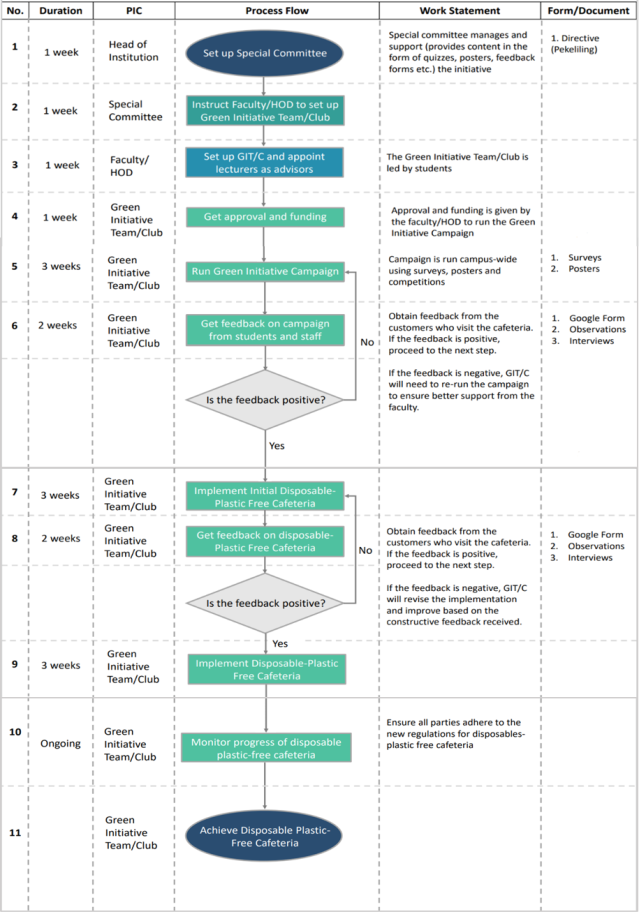
The Institutional SOP (refer to
Figure 1) is developed to assist institutions to reduce the use of single-use plastic containers so that all cafeterias achieve the Single-use Plastic Free Cafeteria status. To achieve this, it will take approximately 4 months to create awareness among staff and students.
There are eleven steps for an institution to follow in order to achieve a single-use plastic-free cafeteria campus. The first step is for the Head of an Institution to set up a Special Committee to manage and support the initiative. The function of the Special Committee is to provide content for the campaign in the form of quizzes, posters, feedback forms, etc. The document needed for this step to run smoothly is the directive circular from the Head of the Institution. This step takes only one week. The second step is for the Special Committee to instruct the Faculty/Head of the Department to set up a Green Initiative Team/Club (GIT/C) at the faculty/department level. This step takes one week at most. The third step is for the Faculty/Head of Department to set up the GIT/C and appoint lecturers/staff as advisors. This is because the GIT/C is supposed to be led by students. The setting up of the GIT/C should take one week. The fourth step is for the GIT/C to apply for approval of the Green Initiative Campaign (GIC) and funding for the campaign from the Faculty/Head of the Department. Once the approval is given by the Faculty/Head of Department to run the GIC within one week, the fifth step is the running of the GIC by students and staff. The preparation and execution of the GIC can take up to three weeks. The campaign is run campus-wide using surveys, posters and holding competitions. The sixth step is getting feedback on the effectiveness of the campaign from students and staff who are the customers of the cafeteria. If the feedback is positive, the GIT/C can proceed to the next step. If the feedback is negative, the GIT/C needs to re-run the campaign to ensure better support from the student and staff. This will take approximately two weeks.
After the campaign is successful, the seventh step is the initial implementation of the single-use plastic-free cafeteria. The Cafeteria SOP will begin at this point (refer to
Figure 2). This will run for three weeks before getting feedback from the customers who visit the cafeteria. The feedback can be done via questionnaires and interviews. If the feedback is positive, the GIT/C can proceed to the eighth step. If the feedback is negative, the GIT/C needs to re-run the implementation of the Single-use Plastic Free Cafeteria campaign to ensure a majority of the staff and students support the campaign. This step takes approximately two weeks. Once there is support, the GIT/C can fully implement the single-use plastic free cafeteria which is the ninth step in the Institutional SOP. This initiative does not end here as the next step, monitoring the implementation of the single-use plastic-free cafeteria is imperative. The monitoring step is the tenth step and it is important because the GIT/C must ensure that all parties adhere to the regulations for the single-use plastic-free cafeteria. If all regulations are adhered to by both staff and students, the cafeteria will have achieved single-use plastic-free status. and would be given a certificate of compliance by the university/institution. This certificate should be mandatory for cafeteria operators seeking a contract extension from the university or institution.
Figure 1. Institutional SOP.
4.2. Cafeteria SOP
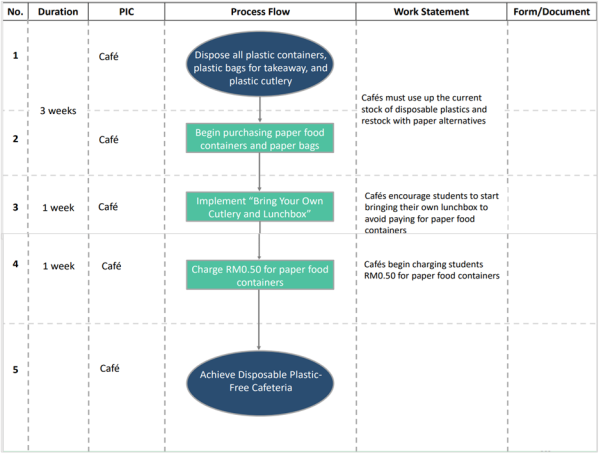
The SOP for cafeterias is developed to assist food and beverages operators to reduce the use of single-use plastic containers and replace them with paper containers. If possible, the project team would like the cafeteria operators to not use any plastic containers, plastic bags for takeaways or plastic cutlery at all. This is not possible as the use of cup lids cannot be replaced with any types of materials unless students and staff bring their own water bottles or tumblers.
Figure 2 shows the five steps for cafeteria operators to follow in order to achieve the single-use plastic-free cafeteria status. The first step is to dispose of all plastic containers, plastic bags for takeaway food and drinks and plastic cutlery. The cafeteria operators are given three weeks to comply and they must use up the current stock of disposable plastics and restock with paper alternatives. The second step is to begin purchasing paper food and drinks containers and paper bags. This step will take approximately one week to be completed. The third step is to implement "Bring Your Own Cutlery and Lunchbox" where cafeteria operators should encourage students and staff to start bringing their own lunchbox and cutlery to avoid paying for paper food containers. This step could be achieved within one week before moving on to the fourth step which is charging RM0.50 for paper food containers. Once this step is implemented, the cafeteria would achieve the single-use plastic-free cafeteria status.
5. Conclusion
This UiTM initiative, which aims to find a means to reduce or eliminate the use of single-use plastic in cafeterias on UiTM Shah Alam campus to protect the environment, will assist and educate the university in particular and the country at large to become a plastic-free nation. The initiative to create an SOP is part of the goal of the project to help UiTM Shah Alam become a plastic-free campus. It will have a great impact on individuals, universities and the Malaysian community at large by inculcating the habit of 3R. This project also provides information on students' awareness of environmental issues and how they could contribute to conserving the environment through reduced plastic usage in their daily lives. The SOP developed could then be implemented across all UiTM campuses, making it the country's and probably the world's largest disposable plastic-free university.
The significance of the project is the development of a system that can be replicated by food operators in other institutions to become plastic-free eateries. This approach could be employed first on all UiTM campuses and eventually be adopted by all other cafeterias throughout the country. The reduction in the use of plastics will contribute to combating plastic pollution in the environment and help to sustain life on earth.
Let us become environmental stewards by ceasing the use of disposable plastic on campus through habits of dining in at the cafeteria, bringing our own food and beverage containers, recycling, refusing disposable plastics, saying no to plastic, and promoting environmental awareness. Malaysia's Roadmap Towards Zero Single-use Plastics 2018-2030, which aims to eliminate single-use plastics by 2030 can achieve this goal through the measures recommended in this research.





 Share This Article
 Twitter
 Linked In
 Facebook
 Copy
Copy Download