
The development of low-cost biosorbents from agricultural biomass offers a sustainable approach for the remediation of heavy metal-contaminated wastewater. In this study, Delonix regia seed (DRS) was evaluated as a natural biosorbent for the removal of Pb(II), Ni(II), and Co(II) ions from simulated wastewater. The adsorbent was characterized using X-ray diffraction (XRD), scanning electron microscopy (SEM), and Fourier-transform infrared spectroscopy (FTIR), revealing an amorphous surface enriched with hydroxyl and carbonyl functional groups that participate in metal ion binding. Batch adsorption experiments were conducted to investigate the effects of solution pH, adsorbent dosage, initial metal ion concentration, contact time, and temperature. Maximum removal efficiencies exceeding 90% were achieved under optimized conditions. Equilibrium data were best described by the Langmuir isotherm, with maximum monolayer adsorption capacities of 62.57 mg g⁻1 for Pb(II), 59.26 mg g⁻1 for Co(II), and 73.59 mg g⁻1 for Ni(II), indicating favorable monolayer adsorption on a homogeneous surface. Kinetic analysis showed that the adsorption process followed the pseudo-second-order model, suggesting that chemisorption is the dominant rate-controlling mechanism. The combined characterization and adsorption results demonstrate that Delonix regia seed is an abundant, inexpensive, and environmentally sustainable biosorbent with considerable potential for heavy metal removal in wastewater treatment applications.
| Published in | World Journal of Applied Chemistry (Volume 11, Issue 3) |
| DOI | 10.11648/j.wjac.20261103.13 |
| Page(s) | 86-100 |
| Creative Commons |
This is an Open Access article, distributed under the terms of the Creative Commons Attribution 4.0 International License (http://creativecommons.org/licenses/by/4.0/), which permits unrestricted use, distribution and reproduction in any medium or format, provided the original work is properly cited. |
| Copyright |
Copyright © The Author(s), 2026. Published by Science Publishing Group |
Delonix Regia, Biosorption, Pb(II), Ni(II), Co(II), Adsorption Isotherm, Adsorption Kinetics
Isotherms | Pb2+ | Co2+ | Ni2+ |
|---|---|---|---|
Langmuir | |||
Qmax (mg g⁻1) | 62.57 | 59.26 | 73.59 |
KL | 1.191 | 0.847 | 0.153 |
RL (L mg⁻1) | 0.046 | 0.098 | 0.096 |
R2 | 0.989 | 0.996 | 0.947 |
Freundlich | |||
n | 3.827 | 2.139 | 4.362 |
KF (mg g⁻1) | 1.543 | 1.034 | 1.374 |
R2 | 0.875 | 0.887 | 0.831 |
Temkin | |||
BT (J mol⁻1) | 1.681 | 2.697 | 3.522 |
KT (L g⁻1) | 0.823 | 0.744 | 0.935 |
R2 | 0.926 | 0.943 | 0.942 |
Kinetic Models | Pb2+ | Co2+ | Ni2+ |
|---|---|---|---|
Pseudo-first order | |||
qe (mg g-1) | 7.4534 | 6.7623 | 6.1267 |
K1 (min-1) | 0.0794 | 0.06533 | 0.05947 |
R2 | 0.8778 | 0.8534 | 0.8694 |
Pseudo-second order | |||
qe (mg g-1) | 8.7522 | 7.6748 | 7.4562 |
K2 (g mg-1 min-1) | 0.0452 | 0.0551 | 0.0621 |
R2 | 0.9998 | 0.8834 | 0.9989 |
DRS | Delonix Regia Seed |
FTIR | Fourier-transform Infrared Spectroscopy |
XRD | X-ray Diffraction |
SEM | Scanning Electron Microscopy |
| [1] | Abiodun, O.-A. O., Oluwaseun, O., Oladayo, O. K., Abayomi, O., George, A. A., Opatola, E., Orah, R. F., Isukuru, E. J., Ede, I. C., Oluwayomi, O. T., Okolie, J. A., & Omotayo, I. A. (2023). Remediation of heavy metals using biomass-based adsorbents: Adsorption kinetics and isotherm models. Clean Technologies, 5(3), 934-960. |
| [2] | Singh, V., Singh, N., Rai, S. N., Kumar, A., Singh, A. K., Singh, M. P., Sahoo, A., Shekhar, S., Vamanu, E., & Mishra, V. (2023). Heavy Metal Contamination in the Aquatic Ecosystem: Toxicity and Its Remediation Using Eco-Friendly Approaches. Toxics, 11(2), 147. |
| [3] | Sanusi, I. O., Adepoju, A. A., & Abdulrahman, B. D. (2025). Heavy metal contamination, human health impact, and remediation techniques in water bodies: a review. Discov Environ 3, 268. |
| [4] | Nemeș, N. S., Negrea, A., Ciopec, M., Negrea, P., Duțeanu, N., & Duda-Seiman, D. M. (2026). Heavy Metal Ion Removal: A Global Review of Wastewater Treatment Technologies. International Journal of Molecular Sciences, 27(4), 1741. |
| [5] | Zielińska, M., & Bułkowska, K. (2025). Use of Membrane Techniques for Removal and Recovery of Nutrients from Liquid Fraction of Anaerobic Digestate. Membranes, 15(2), 45. |
| [6] | Ayach, J., El Malti, W., Duma, L., Lalevée, J., Al Ajami, M., Hamad, H., & Hijazi, A. (2024). Comparing Conventional and Advanced Approaches for Heavy Metal Removal in Wastewater Treatment: An In-Depth Review Emphasizing Filter-Based Strategies. Polymers, 16(14), 1959. |
| [7] | Laishram, D., Kim, S. B., Lee, S. Y., & Park, S. J. (2025). Advancements in Biochar as a Sustainable Adsorbent for Water Pollution Mitigation. Advanced Science (Weinheim, Baden-Württemberg, Germany), 12(19), e2410383. |
| [8] | Bahsaine, K., Mekhzoum, M. E. M., Benzeid, H., Qaiss, A., & Bouhfid, R. (2022). Recent progress in heavy metals extraction from phosphoric acid: A short review. Journal of Industrial and Engineering Chemistry, 115, 120-134. |
| [9] | Banerjee, J., Bar, N., Basu, R. K., & Das, S. K. (2022). Development of Ni(II)-resistant Saccharomyces cerevisiae and its application: Adsorption study and modeling. Chemosphere, 309(Pt 1), 136647. |
| [10] | Shabir, G., Anwar, F., Sultana, B., Khalid, Z. M., Afzal, M., Khan, Q. M., & Ashrafuzzaman, M. (2011). Antioxidant and antimicrobial attributes and phenolics of different solvent extracts from leaves, flowers, and bark of Gold Mohar [Delonix regia (Bojer ex Hook.) Raf]. Molecules (Basel, Switzerland), 16(9), 7302–7319. |
| [11] | Essel, V., & Raynie, D. E. (2025). Systematic Isolation and Characterization of Regenerated Hemicellulose and Lignin from Soybean Feedstocks Using Ionic Liquids. Separations, 12(2), 37. |
| [12] | Santiago-Martínez, L., Avraamidou, S., Ayala-Cortés, A., Azike, R., Bakshi, S., Banik, C., Bar-Ziv, E., Canales, E., Carlson, T., Dumesic, J. A., Klinger, J. L., Lee, J. M., Long, F., McDonald, A. G., Mohapatra, S., Ong, R. G., Palomo Gonzalez, L. F., Pan, X., Saha, N., Sanchez Castillo, M. A., … Huber, G. W. (2026). Biomass Demineralization: A Critical Need for Future Biorefineries. Chemical Reviews, 126(8), 4511–4591. |
| [13] | Chen, X., Hossain, M. F., Duan, C., Lu, J., Tsang, Y. F., Islam, M. S., & Zhou, Y. (2022). Isotherm models for adsorption of heavy metals from water: A review. Chemosphere, 307(Pt 1), 135545. |
| [14] | Chen, X., Huang, C., Li, H., Zhao, S., & Zhang, L. (2025). Selective adsorption of vanadyl porphyrin on solid adsorbent in the presence of polycyclic aromatic hydrocarbons. Chemistry, 7(6), 195. |
| [15] | Edet, U. A., & Ifelebuegu, A. O. (2020). Kinetics, isotherms, and thermodynamic modelling of phosphate adsorption using recycled brick waste. Processes, 8, 665. |
| [16] | Eleryan, A., Hassaan, M., Nazir, M. A., Shah, S. S. A., Ragab, S., & El Nemr, A. (2024). Isothermal and kinetic screening of methyl red and methyl orange dye adsorption from water by Delonix regia biochar-sulfur oxide (DRB-SO). Scientific reports, 14(1), 13585. |
| [17] | El-Sayed, G. O., Dessouki, H. A., & Ibrahiem, S. S. (2011). Removal of Zn(II), Cd(II), and Mn(II) from aqueous solutions by adsorption on maize stalks. Malaysian Journal of Analytical Sciences, 15, 8-21. |
| [18] | Gonçalves, J. O., Leones, A. R., de Farias, B. S., da Silva, M. D., Jaeschke, D. P., Fernandes, S. S., Ribeiro, A. C., Cadaval, T. R. S., Jr., & Pinto, L. A. d. A. (2025). A Comprehensive Review of Agricultural Residue-Derived Bioadsorbents for Emerging Contaminant Removal. Water, 17(14), 2141. |
| [19] | Hama Aziz, K. H., Mustafa, F. S., Omer, K. M., Hama, S., Hamarawf, R. F., & Rahman, K. O. (2023). Heavy metal pollution in the aquatic environment: efficient and low-cost removal approaches to eliminate their toxicity: a review. RSC Advances, 13(26), 17595-17610. |
| [20] | He, S. R., Li, Y. T., Weng, L. P., Wang, J. J., He, J. X., Liu, Y. L., Zhang, K., Wu, Q. H., Zhang, Y. L., & Zhang, Z. (2018). Competitive adsorption of Cd2⁺, Pb2⁺, and Ni2⁺ onto Fe3⁺-modified argillaceous limestone. Science of the Total Environment, 637-638, 69-78. |
| [21] | Danat, B. T., Wuana, R. A., Chahul, H. F. et al. Review of adsorption isotherm models. Appl Water Sci 16, 72 (2026). |
| [22] | Ebada, D., Hefnawy, H. T., Gomaa, A., Alghamdi, A. M., Alharbi, A. A., Almuhayawi, M. S., Alharbi, M. T., Awad, A., Al Jaouni, S. K., Selim, S., Eldeeb, G. S., & Namir, M. (2023). Characterization of Delonix regia Flowers' Pigments and Polysaccharides: Evaluating Their Antibacterial, Anticancer, and Antioxidant Activities and Their Application as a Natural Colorant and Sweetener in Beverages. Molecules (Basel, Switzerland), 28(7), 3243. |
| [23] | Wang, Y., Zhang, Y., Cui, Q., Feng, Y., & Xuan, J. (2024). Composition of Lignocellulose Hydrolysate in Different Biorefinery Strategies: Nutrients and Inhibitors. Molecules, 29(10), 2275. |
| [24] | Silva, T. A. L., Varão, L. H. R., Pasquini, D. (2024). Lignocellulosic Biomass. In: Thomas, S., Hosur, M., Pasquini, D., Jose Chirayil, C. (eds.) Handbook of Biomass. Springer, Singapore. |
| [25] | Medinat, O., Abdullahi, S., Oyewole, T. S., Tovide, O. O., Sarah, S., Sewanu, K., & Olowu, R. A. (2024). Adsorption of Pb2⁺ and Mn2⁺ using Phoenix dactylifera seed. Journal of Research and Review in Science, 11, 30-46. |
| [26] | Shi, Z., Zhu, A., Chen, F., Cai, Y., & Deng, L. (2025). Synthesis of Amorphous MnFe@SBA Composites for Efficient Adsorptive Removal of Pb(Ⅱ) and Sb(V) from Aqueous Solution. Molecules, 30(3), 679. |
| [27] | Musah, M., Yisa, J., Suleiman, M. A. T., Mann, A., Shaba, E. Y., & Aliyu, A. (2018). Kinetics and isotherm studies of Cr6⁺, Mn2⁺, and Cd2⁺ adsorption. Biological and Environmental Sciences Journal for the Tropics, 15(1), 28-34. |
| [28] | Olowu, R. A., Osundiya, M. O., Oyewole, T. S., Onwordi, C. T., Yusuff, O. K., Osifeko, O. L., & Tovide, O. O. (2022). Removal of Zn(II) and Cr(VI) ions using pineapple peels. European Journal of Applied Sciences, 10(5). |
| [29] | Olowu, R. A., Osundiya, M. O., Sobola, A. O., Osifeko, O. L., Tovide, O. O., Oyewole, T. S., Elesho, A. O., Onifade, O. O., Majolagbe, A. O., Onwordi, C. T., & Adejare, A. A. (2024). Sorption of Pb(II), Ni(II), and Cd(II) using tiger nut chaff. Physical Chemistry, 13(2), 19-31. |
| [30] | Oyewole, T. S., Inuikim, A. E., Osundiya, M. O., Osifeko, O. L., Olowu, R. A. O., Isaac, I. B., Taiwo, R. O., Adejare, A. A., & Oresanya, Z. O. (2023). Equilibrium, Thermodynamics, Kinetics of Adsorption of CO3^2- and SO4^2- Ions on Modified Plantain Peels. International Journal of Engineering Research & Science (IJOER), 9(11), 1-12. |
| [31] | Sui, C., Xie, W., Bian, Y., & Li, X. (2026). Recent Progress in Adsorption Removal of Heavy Metal Ions from Wastewater Using Biomass-Based Materials. Gels, 12(4), 311. |
| [32] | Zhu, Q., Ghnim, Z. S., Chandra, S., Makasana, J., Ganesan, S., Shankhyan, A., Kumar, M. R., Sharma, G. C., Adhab, A. H., Mahdi, M. S., Mansoor, A. S., Radi, U. K., Abd, N. S., Herati, K., & Muzammil, K. (2025). Modeling Urotropine adsorption thermodynamics on kaolinite particles. Scientific reports, 15(1), 35143. |
| [33] | Bakalis, E., & Zerbetto, F. (2025). Adsorption Kinetics: Classical, Fractal, or Fractional?. Langmuir: the ACS journal of surfaces and colloids, 41(30), 19834–19844. |
| [34] | Sandoval-Peraza, V. M., Ramos-Ocharán, O., Alcalá-Escamilla, K. I., Molina-Rosas, M. Y., Chel-Guerrero, L., & Betancur-Ancona, D. (2026). Delonix regia Seed Germ as an Underutilized Biomass Resource: Nutritional Value, Safety, and Potential for Sustainable Protein Supply for Food Systems. Resources, 15(3), 37. |
| [35] | Svobodová, E., Tišler, Z., Peroutková, K., Strejcová, K., Abrham, J., Šimek, J., Gholami, Z., & Vakili, M. (2024). Adsorption of Cu(II) and Ni(II) from Aqueous Solutions Using Synthesized Alkali-Activated Foamed Zeolite Adsorbent: Isotherm, Kinetic, and Regeneration Study. Molecules, 29(10), 2357. |
| [36] | Çiçekçi, A., Sevim, F., Sevim, M., & Kavcı, E. (2025). Adsorption Capacity, Reaction Kinetics and Thermodynamic Studies on Ni(II) Removal with GO@Fe3O4@Pluronic-F68 Nanocomposite. Polymers, 17(15), 2141. |
| [37] | Nurgain, A., Nazhipkyzy, M., Özsin, G., Zhaparova, A. A., & Apaydın-Varol, E. (2025). Efficient Pb(II) Adsorption by Natural Mugaldzhar Diatomite: Isotherm, Kinetic, and Thermodynamic Analysis. Journal of Composites Science, 9(11), 625. |
| [38] | Bullen, J. C., Saleesongsom, S., Gallagher, K., & Weiss, D. J. (2021). A Revised Pseudo-Second-Order Kinetic Model for Adsorption, Sensitive to Changes in Adsorbate and Adsorbent Concentrations. Langmuir: the ACS journal of surfaces and colloids, 37(10), 3189–3201. |
| [39] | Ye, S., Zhang, W., Hu, X., He, H., Zhang, Y., Li, W., Hu, G., Li, Y., & Deng, X. (2023). Selective Adsorption Behavior and Mechanism for Cd(II) in Aqueous Solution with a Recoverable Magnetic-Surface Ion-Imprinted Polymer. Polymers, 15(11), 2416. |
| [40] | Yousef, R., Qiblawey, H., & El-Naas, M. H. (2020). Adsorption as a process for produced water treatment. Processes, 8, 1657. |
| [41] | Molebatsi, M., Nkoane, B., Keroletswe, N., Chigome, S., & Kabomo, M. T. (2025). The Use of Biosorbents in Water Treatment. Environments, 12(9), 302. |
APA Style
Seun, O. T., Olubunmi, O. M., Chukwuma, A. E., Temidayo, O. H., Eyue, S. I., et al. (2026). Adsorptive Removal of Pb(II), Ni(II), and Co(II) from Simulated Wastewater Using Delonix Regia Seed: Equilibrium and Kinetic Studies. World Journal of Applied Chemistry, 11(3), 86-100. https://doi.org/10.11648/j.wjac.20261103.13
ACS Style
Seun, O. T.; Olubunmi, O. M.; Chukwuma, A. E.; Temidayo, O. H.; Eyue, S. I., et al. Adsorptive Removal of Pb(II), Ni(II), and Co(II) from Simulated Wastewater Using Delonix Regia Seed: Equilibrium and Kinetic Studies. World J. Appl. Chem. 2026, 11(3), 86-100. doi: 10.11648/j.wjac.20261103.13
AMA Style
Seun OT, Olubunmi OM, Chukwuma AE, Temidayo OH, Eyue SI, et al. Adsorptive Removal of Pb(II), Ni(II), and Co(II) from Simulated Wastewater Using Delonix Regia Seed: Equilibrium and Kinetic Studies. World J Appl Chem. 2026;11(3):86-100. doi: 10.11648/j.wjac.20261103.13
@article{10.11648/j.wjac.20261103.13,
  author = {Oyewole Toyib Seun and Osundiya Medinat Olubunmi and Agumadu Emmanuel Chukwuma and Ogunbamowo Haminat Temidayo and Salawu Ismael Eyue and Idowu Owoyemi Fatai and Badejo Olayemi Aderanti and Olowu Rasaq Adewale},
  title = {Adsorptive Removal of Pb(II), Ni(II), and Co(II) from Simulated Wastewater Using Delonix Regia Seed: Equilibrium and Kinetic Studies},
  journal = {World Journal of Applied Chemistry},
  volume = {11},
  number = {3},
  pages = {86-100},
  doi = {10.11648/j.wjac.20261103.13},
  url = {https://doi.org/10.11648/j.wjac.20261103.13},
  eprint = {https://article.sciencepublishinggroup.com/pdf/10.11648.j.wjac.20261103.13},
  abstract = {The development of low-cost biosorbents from agricultural biomass offers a sustainable approach for the remediation of heavy metal-contaminated wastewater. In this study, Delonix regia seed (DRS) was evaluated as a natural biosorbent for the removal of Pb(II), Ni(II), and Co(II) ions from simulated wastewater. The adsorbent was characterized using X-ray diffraction (XRD), scanning electron microscopy (SEM), and Fourier-transform infrared spectroscopy (FTIR), revealing an amorphous surface enriched with hydroxyl and carbonyl functional groups that participate in metal ion binding. Batch adsorption experiments were conducted to investigate the effects of solution pH, adsorbent dosage, initial metal ion concentration, contact time, and temperature. Maximum removal efficiencies exceeding 90% were achieved under optimized conditions. Equilibrium data were best described by the Langmuir isotherm, with maximum monolayer adsorption capacities of 62.57 mg g⁻1 for Pb(II), 59.26 mg g⁻1 for Co(II), and 73.59 mg g⁻1 for Ni(II), indicating favorable monolayer adsorption on a homogeneous surface. Kinetic analysis showed that the adsorption process followed the pseudo-second-order model, suggesting that chemisorption is the dominant rate-controlling mechanism. The combined characterization and adsorption results demonstrate that Delonix regia seed is an abundant, inexpensive, and environmentally sustainable biosorbent with considerable potential for heavy metal removal in wastewater treatment applications.},
 year = {2026}
}
TY  - JOUR
T1  - Adsorptive Removal of Pb(II), Ni(II), and Co(II) from Simulated Wastewater Using Delonix Regia Seed: Equilibrium and Kinetic Studies
AU  - Oyewole Toyib Seun
AU  - Osundiya Medinat Olubunmi
AU  - Agumadu Emmanuel Chukwuma
AU  - Ogunbamowo Haminat Temidayo
AU  - Salawu Ismael Eyue
AU  - Idowu Owoyemi Fatai
AU  - Badejo Olayemi Aderanti
AU  - Olowu Rasaq Adewale
Y1  - 2026/09/24
PY  - 2026
N1  - https://doi.org/10.11648/j.wjac.20261103.13
DO  - 10.11648/j.wjac.20261103.13
T2  - World Journal of Applied Chemistry
JF  - World Journal of Applied Chemistry
JO  - World Journal of Applied Chemistry
SP  - 86
EP  - 100
PB  - Science Publishing Group
SN  - 2637-5982
UR  - https://doi.org/10.11648/j.wjac.20261103.13
AB  - The development of low-cost biosorbents from agricultural biomass offers a sustainable approach for the remediation of heavy metal-contaminated wastewater. In this study, Delonix regia seed (DRS) was evaluated as a natural biosorbent for the removal of Pb(II), Ni(II), and Co(II) ions from simulated wastewater. The adsorbent was characterized using X-ray diffraction (XRD), scanning electron microscopy (SEM), and Fourier-transform infrared spectroscopy (FTIR), revealing an amorphous surface enriched with hydroxyl and carbonyl functional groups that participate in metal ion binding. Batch adsorption experiments were conducted to investigate the effects of solution pH, adsorbent dosage, initial metal ion concentration, contact time, and temperature. Maximum removal efficiencies exceeding 90% were achieved under optimized conditions. Equilibrium data were best described by the Langmuir isotherm, with maximum monolayer adsorption capacities of 62.57 mg g⁻1 for Pb(II), 59.26 mg g⁻1 for Co(II), and 73.59 mg g⁻1 for Ni(II), indicating favorable monolayer adsorption on a homogeneous surface. Kinetic analysis showed that the adsorption process followed the pseudo-second-order model, suggesting that chemisorption is the dominant rate-controlling mechanism. The combined characterization and adsorption results demonstrate that Delonix regia seed is an abundant, inexpensive, and environmentally sustainable biosorbent with considerable potential for heavy metal removal in wastewater treatment applications.
VL  - 11
IS  - 3
ER  -
Department of Chemistry, Lagos State University, Ojo, Nigeria
Department of Chemistry, Lagos State University, Ojo, Nigeria
Department of Chemistry, Lagos State University, Ojo, Nigeria
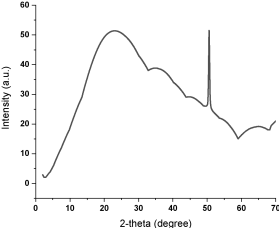
Figure 1. XRD plot of Delonix regia seed.
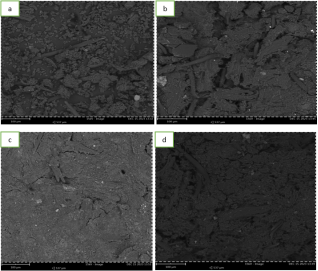
Figure 2. SEM images of Delonix regia seed residue (a): before adsorption; (b, c, and d) post-adsorption of Pb2+, Co2+, and Ni2+, respectively.
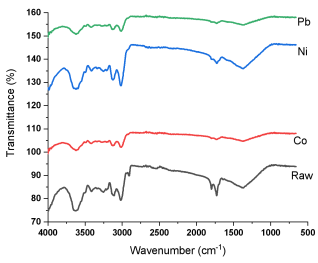
Figure 3. FTIR Results of raw Delonix regia seeds before and after adsorption of Pb2+, Ni2+, and Co2+.
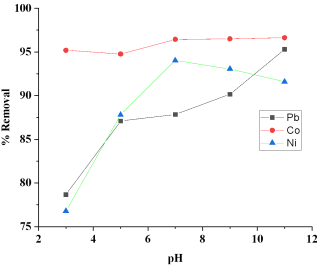
Figure 4. The graph of% removal of Pb2+, Co2+ and Ni2+ against pH.
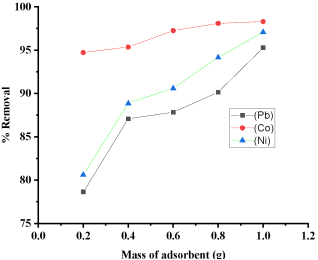
Figure 5. The graph of% removal of Pb2+, Co2+ and Ni2+ against adsorbent dose.
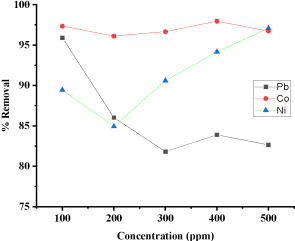
Figure 6. The graph of% removal of Pb2+, Co2+ and Ni2+ against concentration.
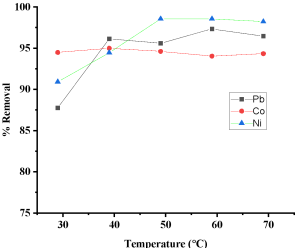
Figure 7. The graph of% removal of Pb2+, Co2+ and Ni2+ against temperature.
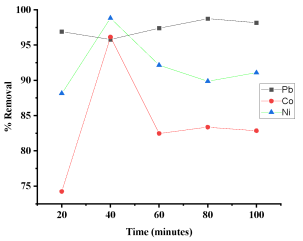
Figure 8. The graph of% removal of Pb2+, Co2+ and Ni2+ against time.
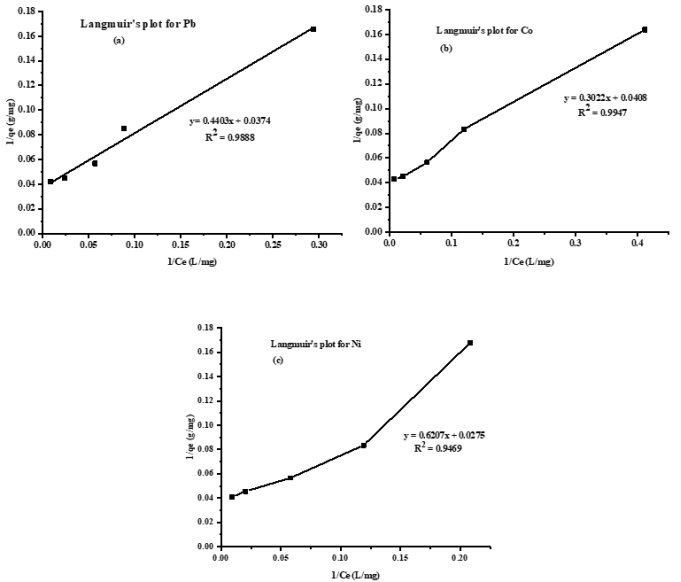
Figure 9. Langmuir linear plot for adsorption of (a) Pb2+, (b) Co2+, and (c) Ni2+ onto Delonix Regia seed.
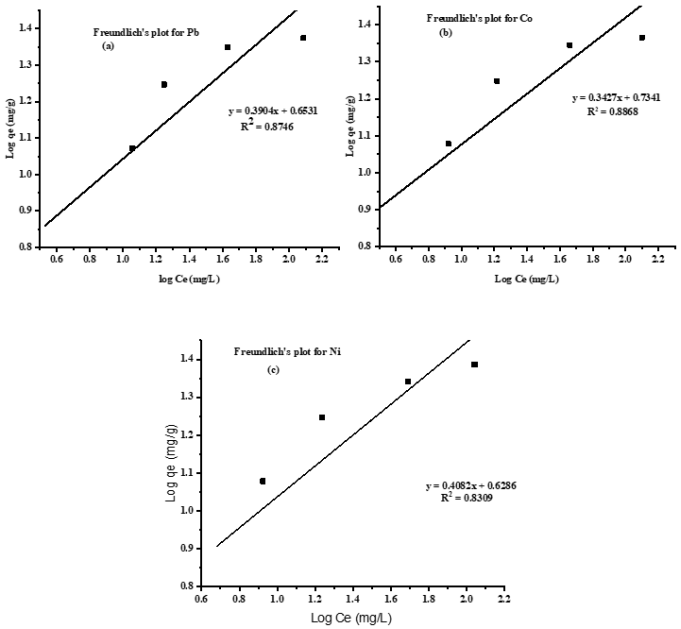
Figure 10. Freundlich linear plot for adsorption of (a) Pb2+, (b) Co2+, and (c) Ni2+ onto Delonix Regia seed.
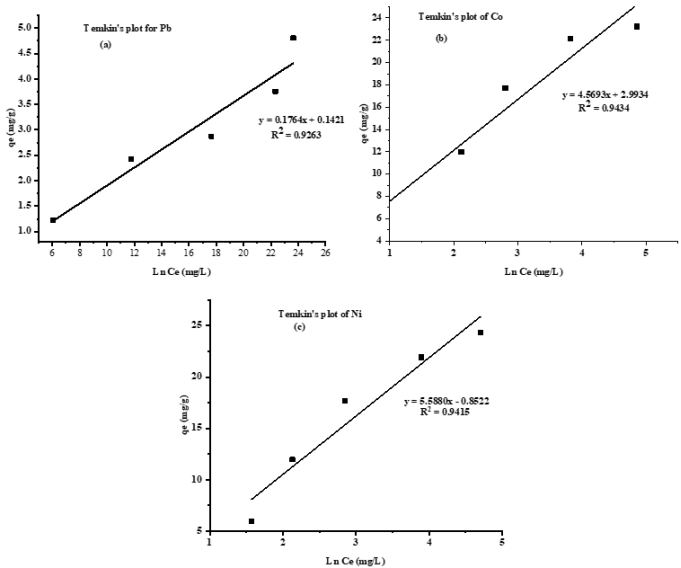
Figure 11. Temkin linear plot for adsorption of (a) Pb2+, (b) Co2+, and (c) Ni2+ onto Delonix Regia seed.
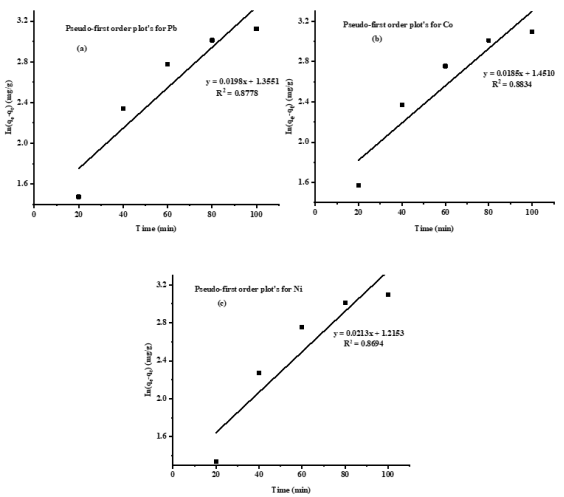
Figure 12. Pseudo-first-order plot for adsorption of (a) Pb2+, (b) Co2+, and (c) Ni2+ onto Delonix Regia seed.
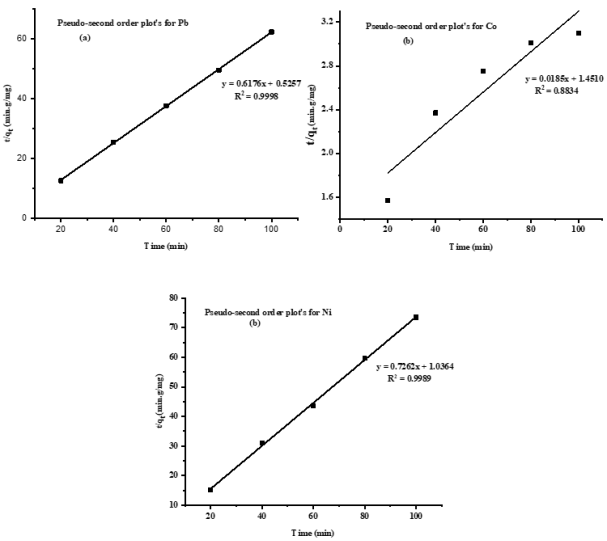
Figure 13. Pseudo-second-order plot for adsorption of (a) Pb2+, (b) Co2+, and (c) Ni2+ onto Delonix Regia seed.

Information



 Share This Article
 Twitter
 Linked In
 Facebook
 Copy
Copy Download