
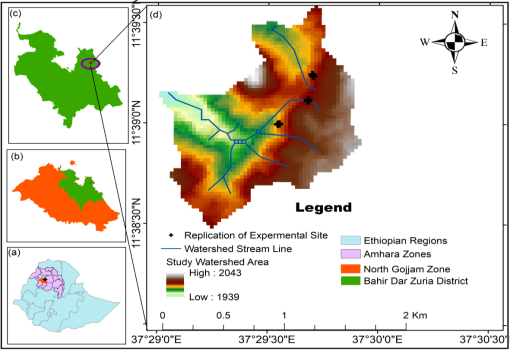
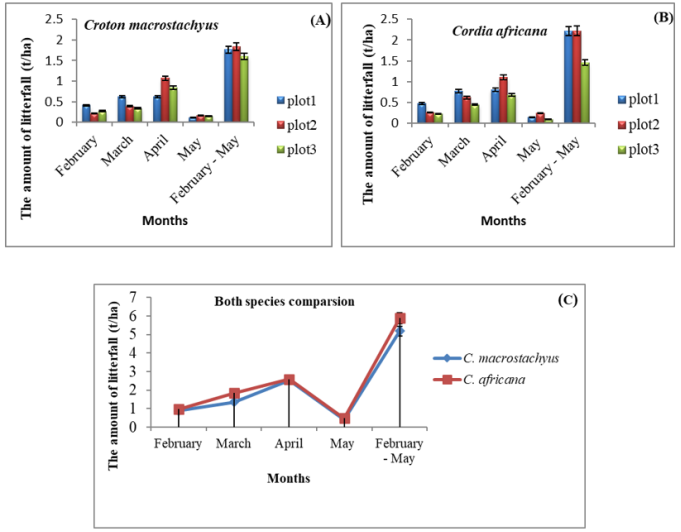
Litter decomposition is influenced by litter quality, decomposer activity, macro- and microclimatic conditions, and soil nutrient status, while mixing leaves of species with different resource qualities and structural characteristics can further modify the physical and chemical environment in which decomposition occurs. The selection and use of appropriate agroforestry tree species that maintain soil nutrients thereby improving productivity remains to challenge in low-input agricultural systems. Therefore, this research focuses on two agroforestry tree species, C.macrostachyus and C.africana. This study evaluated the litterfall and decomposition rates of two agroforestry tree species, C. macrostachyus, and C. africana, in the Aba Gerima watershed to improve soil nutrient management in low-input agricultural systems. Using litter-bag techniques and RCBD design, estimating the amount of litterfall was collected every 15 days from February to May 2023, and decomposition rates were monitored over 30, 60, 90, and 120 days during both dry and wet seasons for February to May 2023 and June to September 2023, respectively. Soil samples were analyzed for physicochemical properties of the under-canopy and outside-canopy. Results indicated that C. africana produced more litterfall (5.89 t/ha) compared to C. macrostachyus (5.19 t/ha). However, C. macrostachyus decomposed faster, with higher mass loss (94% in the dry season) and a greater impact on soil nutrient input. Both species showed no significant difference in decomposition during the wet season. The study concludes that litterfall and organic matter from C. macrostachyus and C. africana can be used as mulch or compost to enhance soil fertility. Raising community awareness about conserving these trees in cropland and homegarden agroforestry practices can improve soil fertility and crop productivity.
| Published in | World Journal of Health Services Research (Volume 1, Issue 1) |
| DOI | 10.11648/j.wjhsr.20260101.16 |
| Page(s) | 54-62 |
| Creative Commons |
This is an Open Access article, distributed under the terms of the Creative Commons Attribution 4.0 International License (http://creativecommons.org/licenses/by/4.0/), which permits unrestricted use, distribution and reproduction in any medium or format, provided the original work is properly cited. |
| Copyright |
Copyright © The Author(s), 2026. Published by Science Publishing Group |
Litterfall, Decomposition Rate, Agroforestry System, C. Macrostachyus, C. Africana
Incubation period (day) KD (gday-1) | ||||
|---|---|---|---|---|
Species ± | 30D | 60D | 90D | 120D |
The dry season mass loss% of mean value and std dev. Respectively | ||||
C. Macrostachyus | 10.33 ± 3.44867 | 44.33 ± 4.22532 | 72.53 ± 2.90057 | 94.00 ± 3.34066 |
Cordia Africana | 3.87 ± 1.50111 | 15.33 ± 1.94251 | 30.40 ± 4.27551 | 47.93 ± 8.01332 |
R-Square | 0.956 | 0.995 | 0.992 | 0.991 |
CV | 19.952 | 5.825 | 6.207 | 5.259 |
LSD (0.05) | 4.977* | 6.105** | 11.244** | 13.11** |
The wet season mass loss% mean value and std dev. Respectively | ||||
C. Macrostachyus | 76.33 ±.90185 | 85.93 ±.50332 | 99.70 ±.08718 | 100.00 ±.00000 |
Cordia Africana | 55.00 ±1.24900 | 80.33 ±1.10151 | 97.66 ±.30551 | 100.00 ±.00000 |
R-Square | 0.994 | 0.949 | 0.987 | 0 |
CV | 2.179 | 1.361 | 0.209 | 0 |
LSD (0.05) | 5.026** | 3.975** | 0724* | Ns |
Incubation period (day) | KD (gday-1) | |||
|---|---|---|---|---|
Species | 30D | 60D | 90D | 120D |
The dry season decomposition rate of mean value and std dev. Respectively | ||||
C. macrostachyus | .0172a ±.00575 | .0369a ±.00352 | .0403a ±.00161 | .0392a ±.00139 |
C. africana | .0064b ±.00250 | .0128b ±.00162 | .0169b ±.00238 | .0200b ±.00334 |
R-Square | 0.95788 | 0.9954 | 0.991917 | 0.989874 |
CV | 19.48312 | 5.887841 | 6.477498 | 5.786078 |
LSD (0.05) | 0.041* | 0.000** | 0.000** | 0.001** |
The Wet season decomposition rate of mean value and std dev. Respectively | ||||
C. macrostachyus | .1272a ±.00150 | .0716a ±.00042 | .0554a ±.00005 | .0416 ±.000 |
Cordia africana | .0916b ±.00208 | .0669b ±.00092 | .0542b ±.00017 | .0416 ±.000 |
R-Square | 0.994045 | 0.948773 | 0.986737 | 0 |
CV | 2.178605 | 1.360911 | 0.208824 | 0 |
LSD (0.05) | 0.0084* | 0.0033** | 0.0004** | Ns |
AF | Agroforestry |
ANOVA | A One-Way Analysis of Variance |
BDUSL | Bahir Dar University Soil Laboratory |
CBD | Complete Block Design |
CO2 | Carbon Dioxide |
D | Date |
DSRD | Dry Season Rate of Decomposition |
Ha | Hectare |
HFA, | Home Field Advantage |
HGA | Homegarden Agroforestry |
WSRD | Wet Season Rate of Decomposition |
| [1] | Abraham Mahari. (2014). Leaf litter decomposition and nutrient release from Cordia africana Lam. and Croton macrostachyus Del. tree Species. Journal of Environment and Earth Science, 4(15), 1-8. |
| [2] | Ambachew Demessie, Singh, B. R., Lal, R., & Strand, L. T. (2012). Leaf litterfall and litter decomposition under Eucalyptus and coniferous plantations in Gambo District, southern Ethiopia. Acta Agriculturae Scandinavica Section B: Soil and Plant Science, 62(5), 467-476. |
| [3] | Bekele, W., Nigatu, L., & Wogi, L. (2021). Foliage Litter Decomposition of Agroforestry Shrub Species in Dello-Menna District of Bale Zone, Southeast Ethiopia. Journal of Environment and Earth Science, 8(May), 411–417. |
| [4] | Chave, J., Navarrete, D., Almeida, S., Álvarez, E., Aragão, L. E. O. C., Bonal, D., Châtelet, P., Silva-Espejo, J. E., Goret, J. Y., Von Hildebrand, P., Jiménez, E., Patiño, S., Peñuela, M. C., Phillips, O. L., Stevenson, P., & Malhi, Y. (2010). Regional and seasonal patterns of litterfall in tropical South America. Biogeosciences, 7(1), 43-55. |
| [5] | Darmawan, A. A., Ariyanto, D. P., Basuki, T. M., & Syamsiyah, J. (2021). Measuring of leaf litter decomposition rate and flux of carbon dioxide in various land cover in Gunung Bromo Education Forest, Karanganyar. IOP Conference Series: Earth and Environmental Science, 824(1), 1-9. |
| [6] | Getachew, K., Itanna, F., & Mahari, A. (2015). Evaluation of locally available fertilizer tree/shrub species in Gozamin Woreda, North Central Ethiopia. Agriculture and Environmental Management, 4(3), 164-168. |
| [7] | Hailie Shiferaw Wolle, Barberi, P., & Carlesi, S. (2021). Effect Of Homegarden And Parkland Agroforestry Practices In Ethiopia On Selected Soil Properties. African Journal of Food, Agriculture, Nutrition and Development, 21(5), 18115-18130. |
| [8] | Kuyah, S., & Muthuri, C. (2012). Crown area allometries for estimation of aboveground tree biomass in agricultural landscapes of western Kenya. 267–277. |
| [9] | Leakey, R. R. B. (2017). Definition of Agroforestry Revisited. Multifunctional Agriculture, February, 5-6. |
| [10] | Lisanework, N., & Michelsen, A. (1994). Litterfall and nutrient release by decomposition in three plantations compared with a natural forest in the Ethiopian highland. Forest Ecology and Management, 65(2-3), 149-164. |
| [11] | Liu, C., Westman, C. J., Berg, B., Kutsch, W., Wang, G. Z., Man, R., & Ilvesniemi, H. (2004). Variation in litterfall‐climate relationships between coniferous and broadleaf forests in Eurasia. Global Ecology and Biogeography, 13(2), 105-114. |
| [12] | Makkonen, M., Berg, M. P., Handa, I. T., Hättenschwiler, S., van Ruijven, J., van Bodegom, P. M., & Aerts, R. (2012). Highly consistent effects of plant litter identity and functional traits on decomposition across a latitudinal gradient. Ecology Letters, 15(9), 1033–1041. |
| [13] | Nivethadevi, P., Swaminathan, C., Sangeetha, K., Kannan, P., & Sivasankari, B. (2022). Evaluating Litter Decomposition Rate of Five Tropical Trees using Litter Bag Technique. Ecology, Environment and Conservation, 28, 191-197. |
| [14] | Olsen, S. R. (1954). Estimation of available phosphorus in soils by extraction with sodium bicarbonate. US Department of Agriculture. |
| [15] | Petit-aldana, J., Rahman, M. M., Parraguirre-lezama, C., Infante-cruz, A., & Romero-arenas, O. (2019). Litter Decomposition Process in Coffee Agroforestry Systems. Forest and Environmental Science, 35(2), 121-139. |
| [16] | Staelens, J., Nachtergale, L., De Schrijver, A., Vanhellemont, M., Wuyts, K., & Verheyen, K. (2011). Spatio-temporal litterfall dynamics in a 60-year-old mixed deciduous forest. Annals of Forest Science, 68(1), 89-98. |
| [17] | Talemos Seta, Demissew, S., & Woldu, Z. (2018). Litterfall dynamics in Boter-Becho Forest: Moist evergreen montane forest of Southwestern Ethiopia. Journal of Ecology and The Natural Environment, 10(1), 13-21. |
| [18] | Tripathi, O. P., Pandey, H. N., & Tripathi, R. S. (2009). Litter production, decomposition, and physico-chemical properties of soil in 3 developed agroforestry systems of Meghalaya, Northeast India. African Journal of Plant Science, 3(8), 160-167. |
| [19] | Vitoussek, P. M., & Sanford, R. L. (1986). Nutrient cycling in moist tropical forest. Annu Rev Ecol Syst, 17, 137-167. |
| [20] | Zenebe Argado, Ambachew Wele, T. A. (2024). Litter Production and Decomposition in Agro-ecosystems of Aleta Chuko District of Sidama Region, Ethiopia. Research Square, 1-15. |
| [21] | Zhou, G., Guan, Æ. L., Wei, Æ. X., Zhang, Æ. D., & Zhang, Æ. Q. (2007). Litterfall production along successional and altitudinal gradients of subtropical monsoon evergreen broadleaved forests in Guangdong, China. Plant Ecol, 188, 77-89. |
APA Style
Fentie, K. A., Deffersha, H. A., Gizaw, A. K. (2026). Estimating the Amount Litterfall and the Rate of Decomposition: The Case of Two Selected Agroforestry Species in the Aba Gerima Watershed, Northwest Ethiopia. World Journal of Health Services Research, 1(1), 54-62. https://doi.org/10.11648/j.wjhsr.20260101.16
ACS Style
Fentie, K. A.; Deffersha, H. A.; Gizaw, A. K. Estimating the Amount Litterfall and the Rate of Decomposition: The Case of Two Selected Agroforestry Species in the Aba Gerima Watershed, Northwest Ethiopia. World J. Health Serv. Res. 2026, 1(1), 54-62. doi: 10.11648/j.wjhsr.20260101.16
AMA Style
Fentie KA, Deffersha HA, Gizaw AK. Estimating the Amount Litterfall and the Rate of Decomposition: The Case of Two Selected Agroforestry Species in the Aba Gerima Watershed, Northwest Ethiopia. World J Health Serv Res. 2026;1(1):54-62. doi: 10.11648/j.wjhsr.20260101.16
@article{10.11648/j.wjhsr.20260101.16,
  author = {Kerebih Aragaw Fentie and Habtamu Assaye Deffersha and Asmamaw Ketema Gizaw},
  title = {Estimating the Amount Litterfall and the Rate of Decomposition: The Case of Two Selected Agroforestry Species in the Aba Gerima Watershed, Northwest Ethiopia},
  journal = {World Journal of Health Services Research},
  volume = {1},
  number = {1},
  pages = {54-62},
  doi = {10.11648/j.wjhsr.20260101.16},
  url = {https://doi.org/10.11648/j.wjhsr.20260101.16},
  eprint = {https://article.sciencepublishinggroup.com/pdf/10.11648.j.wjhsr.20260101.16},
  abstract = {Litter decomposition is influenced by litter quality, decomposer activity, macro- and microclimatic conditions, and soil nutrient status, while mixing leaves of species with different resource qualities and structural characteristics can further modify the physical and chemical environment in which decomposition occurs. The selection and use of appropriate agroforestry tree species that maintain soil nutrients thereby improving productivity remains to challenge in low-input agricultural systems. Therefore, this research focuses on two agroforestry tree species, C.macrostachyus and C.africana. This study evaluated the litterfall and decomposition rates of two agroforestry tree species, C. macrostachyus, and C. africana, in the Aba Gerima watershed to improve soil nutrient management in low-input agricultural systems. Using litter-bag techniques and RCBD design, estimating the amount of litterfall was collected every 15 days from February to May 2023, and decomposition rates were monitored over 30, 60, 90, and 120 days during both dry and wet seasons for February to May 2023 and June to September 2023, respectively. Soil samples were analyzed for physicochemical properties of the under-canopy and outside-canopy. Results indicated that C. africana produced more litterfall (5.89 t/ha) compared to C. macrostachyus (5.19 t/ha). However, C. macrostachyus decomposed faster, with higher mass loss (94% in the dry season) and a greater impact on soil nutrient input. Both species showed no significant difference in decomposition during the wet season. The study concludes that litterfall and organic matter from C. macrostachyus and C. africana can be used as mulch or compost to enhance soil fertility. Raising community awareness about conserving these trees in cropland and homegarden agroforestry practices can improve soil fertility and crop productivity.},
 year = {2026}
}
TY  - JOUR
T1  - Estimating the Amount Litterfall and the Rate of Decomposition: The Case of Two Selected Agroforestry Species in the Aba Gerima Watershed, Northwest Ethiopia
AU  - Kerebih Aragaw Fentie
AU  - Habtamu Assaye Deffersha
AU  - Asmamaw Ketema Gizaw
Y1  - 2026/09/24
PY  - 2026
N1  - https://doi.org/10.11648/j.wjhsr.20260101.16
DO  - 10.11648/j.wjhsr.20260101.16
T2  - World Journal of Health Services Research
JF  - World Journal of Health Services Research
JO  - World Journal of Health Services Research
SP  - 54
EP  - 62
PB  - Science Publishing Group
UR  - https://doi.org/10.11648/j.wjhsr.20260101.16
AB  - Litter decomposition is influenced by litter quality, decomposer activity, macro- and microclimatic conditions, and soil nutrient status, while mixing leaves of species with different resource qualities and structural characteristics can further modify the physical and chemical environment in which decomposition occurs. The selection and use of appropriate agroforestry tree species that maintain soil nutrients thereby improving productivity remains to challenge in low-input agricultural systems. Therefore, this research focuses on two agroforestry tree species, C.macrostachyus and C.africana. This study evaluated the litterfall and decomposition rates of two agroforestry tree species, C. macrostachyus, and C. africana, in the Aba Gerima watershed to improve soil nutrient management in low-input agricultural systems. Using litter-bag techniques and RCBD design, estimating the amount of litterfall was collected every 15 days from February to May 2023, and decomposition rates were monitored over 30, 60, 90, and 120 days during both dry and wet seasons for February to May 2023 and June to September 2023, respectively. Soil samples were analyzed for physicochemical properties of the under-canopy and outside-canopy. Results indicated that C. africana produced more litterfall (5.89 t/ha) compared to C. macrostachyus (5.19 t/ha). However, C. macrostachyus decomposed faster, with higher mass loss (94% in the dry season) and a greater impact on soil nutrient input. Both species showed no significant difference in decomposition during the wet season. The study concludes that litterfall and organic matter from C. macrostachyus and C. africana can be used as mulch or compost to enhance soil fertility. Raising community awareness about conserving these trees in cropland and homegarden agroforestry practices can improve soil fertility and crop productivity.
VL  - 1
IS  - 1
ER  -
Department of Natural Resource Management, Assosa University, Assosa, Ethiopia
Department of Natural Resource Management, Bahir Dar University, Bahir Dar, Ethiopia
Department of Soil Resource and Watershed Management, Assosa University, Assosa, Ethiopia

Information



 Share This Article
 Twitter
 Linked In
 Facebook
 Copy
Copy Download