3. Literature Review
3.1. Church in Politics and Governance
The church is both salt and light in the world, and it is called to preserve politics from decay and to offer direction to the political leaders whose practices are derailing from the principles guiding good politics. She ought not to be swallowed up by the agenda of the corrupt leaders in society
| [30] | Orji, D. O. (2011). The role of the Churches in combatting corruption among political leaders in Anambra state, Nigeria. A Thesis submitted to the department of religion and cultural studies, faculty of social sciences, university of Nigeria, Nsukka. |
[30]
. It is true that many have debated why the church should be or not be involved in politics. Hence, the words of Jesus on giving to Caesar what belongs to him and giving to God what belongs to God (Mk. 12: 17), do not isolate the church from participating in politics. There may be misinterpretation of the passage. However, Orji rightly observes that Jesus was indeed making a distinction between the secular and the spiritual. However, he was not teaching non-engagement in governance or total exclusion from secular affairs. He was advocating responsible involvement in both premises. However, Jesus was not promoting the separation of the Church from the state; rather, he was teaching about responsible and godly involvement in both
| [30] | Orji, D. O. (2011). The role of the Churches in combatting corruption among political leaders in Anambra state, Nigeria. A Thesis submitted to the department of religion and cultural studies, faculty of social sciences, university of Nigeria, Nsukka. |
[30]
.
The church leaders and clerics must continue to speak against most of the political deviances and compromises exhibited by political leaders, irrespective of their connections with such leaders. As cited in Ndukwe, "the church is a divinely privileged political body that is saddled with a significant responsibility: to embody a distinctive ethic that sets an agenda for the world"
| [23] | Ndukwe, O. (2011). Among the nations: Rebranding the Christian Church for a disappointed world. Enugu: Precious Grace Publication. |
[23]
. Ndukwe further avers that the church should encourage her members to keep to the ethics of politics
| [23] | Ndukwe, O. (2011). Among the nations: Rebranding the Christian Church for a disappointed world. Enugu: Precious Grace Publication. |
[23]
. The participation of Christians in politics should serve as direction and correctional measure to corrupt politicians
| [23] | Ndukwe, O. (2011). Among the nations: Rebranding the Christian Church for a disappointed world. Enugu: Precious Grace Publication. |
[23]
. Onwunta sees one of the missions of the church as Believers going into the world to be involved or participate in the affairs of the people in their contexts, identifying with them and demonstrating to them God’s love and concern for people
| [29] | Onwunta, U. A. (2010). Ethnicity and the mission of the Church in Nigeria: A presbyterian perspective. Port Harcourt, River State; Josany Press. |
[29]
. In the first instance, it is not God at work in the world in a mysterious way, but people whose agenda for life has been prescribed to them by God, made flesh in Jesus of Nazareth
| [29] | Onwunta, U. A. (2010). Ethnicity and the mission of the Church in Nigeria: A presbyterian perspective. Port Harcourt, River State; Josany Press. |
[29]
.
The participation of the church is inevitable if sanity is to be restored in world’s political setting. There is no need for Christians to complain about how corrupt the system has become; rather, their participation in politics will create a new dimension of political leadership and rebuild the trust that has been lost in the system. Hence, Eme points out that one of the Church's messages is one of liberty
| [9] | Eme, N. N. (2010). Gender (in) justice and Nigerian women. Enugu, Nigeria: Praise Print. |
[9]
. Also, Christian emancipation entails freedom from political dominance, social injustice, economic exploitation, and demeaning cultural practices, in addition to freedom from sin and eternal punishment. Matsane opines that the church of Jesus Christ is the community that can read the signs of the time, seeing God’s struggle in the struggle of those living in immorality in a giving community…have no choice but to join the movement of liberation on the side of the poor, fighting against structures of injustice, prejudices and perception
| [19] | Matsane. (2004). Moral Regeneration: The Role of the Church in Reviewing Morality in the 2004. |
[19]
. Hence the society cannot do without the Church.
The involvement of the church in politics and governance gives the society a better foundation for existence and operation. The liberating message of the church is inevitable if there must be literation from evil. Churches in many developing countries play a vitally important role in speaking out against abuses of human rights, social injustice and poverty. The church has a vital obligation to the community in which she is domiciled. According to Matsane, the church proclaims the reality of divine liberation and it actively shares in the liberation struggle. The church lives on the basis of the gospel and makes the gospel message as social, economic and political reality”
| [19] | Matsane. (2004). Moral Regeneration: The Role of the Church in Reviewing Morality in the 2004. |
[19]
. The church has a mandate to promote morality and sanctity in the world through the proclamation of the gospel. The church's work in manifesting and promoting morality has led to a high rate of moral revival. As Dada observes:
The ideology machines of today are religious, and they assume, in many cases, the functions of the guidance of the public (moral) order, the platform of political conscience, and the refuge of a bruised and disarticulated sociability… if there is an organized community, which now is part of the foundation of the democratic field of tomorrow, it is the church, in a generic rather than an institutional sense
| [6] | Dada, A. O. (2005) “repositioning the Nigerian Church towards national rebirths and development.” Insight of religious Studies. |
[6]
.
The church that is mentioned here is not just the church as an institution, but the church as God’s people everywhere. Nwaomah observes that church leadership must seek to reflect the high moral values enunciated in its sacred scriptures
| [25] | Nwaomah, S. M. (2006). “The Role of the Church in Combating Corruption in Church” Lagos: Babcock University. |
[25]
. The church must proclaim against morally deviated actions by her members and condemn such even in the society wherein she is domiciled
| [25] | Nwaomah, S. M. (2006). “The Role of the Church in Combating Corruption in Church” Lagos: Babcock University. |
[25]
. It is pertinent to note that the church is the backbone of morality. She must continue to condemn flamboyancy in every aspect of life by preaching holiness with contentment. Obasanjo points out the church’s role in restoring moral values and states that the Church must embark on a moral rearrangement for its members and the nation
| [26] | Obasanjo O. (2017). The role of the Church in the fight against corruption in Nigeria. Premium Times Opinion. |
[26]
. According to Ogbuagu in Orji, "The church has an immemorial history of relevance in spiritual, socio-economic, political, and cultural affairs of the people. It predates nation-states in many parts of the world; as an ancient historical institution, it has demonstrated its long "life" and significant continuity in serving society"
| [30] | Orji, D. O. (2011). The role of the Churches in combatting corruption among political leaders in Anambra state, Nigeria. A Thesis submitted to the department of religion and cultural studies, faculty of social sciences, university of Nigeria, Nsukka. |
[30]
. Accordingly, the Church must continue to raise its voice to speak against corruption and corrupt leaders, just like John the Baptist did not spare the Pharisees and Sadducees but spoke vehemently against their ungodly attitudes and practices.
3.2. Seventh-day Adventist Church’s Position in Political Matters
Seventh-day Adventists have often found themselves in a dilemma when confronted with the issue of political engagement
| [14] | Johnson W. (2000). “Guns in Paradise,” Adventist Review. |
[14]
. The Seventh-day Adventists elsewhere including in Malawi accept the Bible as their only creed and hold certain fundamental beliefs to the teaching of the Holy Scriptures. Since the beginnings of Seventh-day Adventism there have been real or perceived tensions between two contrasting perspectives of church-state relationships: (a) the “eschatological view” that a union of church and state will lead to persecution in the times preceding the second coming of Christ, and (b) the “temporal view” that in order to accomplish its mission in the present, the church needs to work in an independent, but non-conflictual relationship with the state as far as it can do so without violating its primary allegiance to God. Ellen White’s principles of church-state relationships grew out of her worldview of a Great Controversy between good and evil. She believed that both church and state had been established by God as separate institutions with distinct purposes for the benefit of humankind. Involvement with political parties was strongly discouraged by Ellen White
| [21] | Millar, E. J. (2001). Truth or Consequences, Downers Grove: Intervarsity Press. |
[21]
. Goetzmann agrees that Ellen White saw no coherence between the ultimate interests of political parties and the interests that Adventists should be working toward
| [12] | Goetzmann W. H. (2009). Beyond the Revolution: A History of American Thought from Paine to Pragmatism, New York: Basic Books. |
[12]
. White understood that Adventists could not join a political party and remain true to the church as well
| [44] | White, E. G. Great Controversy. (2021). Copyright © 2012-2025 Global Grey Publishers, published on 4th April 2018 and updated on 1st October 2021. Pragmatism, New York: Basic Books. British Journal of Politics and International Relations, 7(2). |
[44]
.
3.3. Politics and the Process of Selecting Government Leaders
White in her writings about politics states that participation in the process of selecting people or parties for governing positions poses no problem, but it is not mandatory
| [43] | White, E. G. (2017). The Great Controversy (1911). Copyright © 2017, Ellen G. White Estate, Inc. |
[43]
. Ellen White’s most significant documents on the subject of political involvement are a fifteen-page letter dated February 20, 1898, addressed to the brethren in Battle Creek and a fourteen-page letter dated June 16, 1899, addressed to the teachers and managers of the Adventist schools. In those letters, White expressed specific concerns about different types of political engagement, such as party affiliation, campaigning, and voting
| [41] | White Ellen G. (1899). Church and the World United. Ellen’s Letter 38, 1888 published in Selected Messages 1, 76. |
[41]
. There were also other occasions when White expressed her thoughts about voting and politics that shed more light on her concerns. Her opinions about voting can be divided mostly into two categories: voting for a cause and voting for a person
| [44] | White, E. G. Great Controversy. (2021). Copyright © 2012-2025 Global Grey Publishers, published on 4th April 2018 and updated on 1st October 2021. Pragmatism, New York: Basic Books. British Journal of Politics and International Relations, 7(2). |
[44]
.
4. Research Design and Methodology
4.1. Paradigm
The study was guided by social constructivism whereby individuals seek an understanding of the world they live and work in
| [4] | Bodgan, R. C. & Biklen, S. K. (2007). Qualitative Research for Education: An Introduction to Theory and Methods (5th Ed.). Boston: Allyn & Bacon. |
[4]
. They develop subjective meanings of their experiences and meanings directed toward certain objects or things. According to Creswell and Poth, meanings are varied and multiple, leading researchers to seek the complexity of views rather than narrow them into a few categories or ideas
| [5] | Creswell, J. W. & Poth, C. N. (2018). Qualitative Inquiry and Research Design. Choosing Among Five Approaches (4th Ed.). International Student Edition, SAGE. London. |
[5]
.
4.2. Research Approach
The study employed qualitative approach characterized by phenomenological traits. Fraenkel, Wallen, and Hyun observe that, phenomenological approach investigates various reactions to, or perceptions of a particular phenomenon
| [10] | Fraenkel, J. R., Wallen, N. E. & Hyun, H. H. (2015). How to Design and Evaluate Research in Education. (Ninth Edition), McGraw Hill Education: New York. |
[10]
. The choice of this approach was based on its preference of narrative description, assessment of validity through cross-checking sources of information (triangulation), preference of narrative summary of results, unwillingness to tamper with naturally occurring phenomena, and preference for expert information (purposive) samples
| [4] | Bodgan, R. C. & Biklen, S. K. (2007). Qualitative Research for Education: An Introduction to Theory and Methods (5th Ed.). Boston: Allyn & Bacon. |
[4]
.
4.3. Study Population
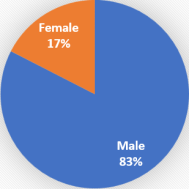
This study therefore targeted the Presidents for Malawi Union Conference (MUC), South Malawi Conference (SMC), Central Malawi Conference (CMC) and North Malawi Conference (NMC) of the Seventh-day Adventist church, pastors, lay pastors, church elders, women, the youth, and other fork church concepts of the SDA church in Malawi. The choice of the population was based on the fact that the researcher believed that these people were the eligible candidates to provide reliable data for the study. The distribution of participants by gender is summarized in
Figure 1 below:
Figure 1. Summary of Participants’ Gender.
The pie-chart above indicates that a total of sixty-three (63) participants were sampled for the study. Out of 63 participants, 52 (83%) were male participants and 11 (17%) were female participants. These findings are indicative of the probability that more male members of the Seventh-day Adventist church are entrusted with church leadership than female members. The denial of female church members to lead in various positions cut across several areas including being ordained as church elders, pastors, conference presidents, and many others.
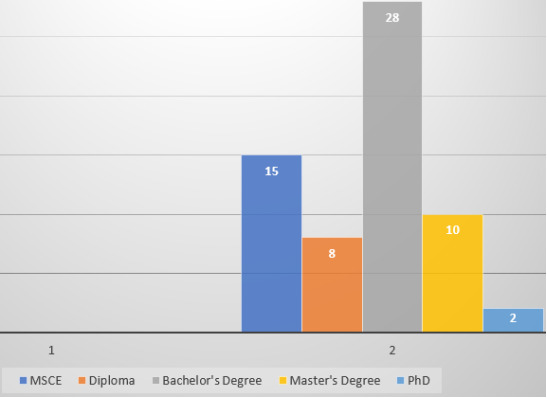
Figure 2. Graph showing Participants’ Academic Qualifications.
The graph captioned above shows that 15 out of 63 participants have Malawi School Certificate of Education (MSCE) as their highest qualification. This represents 24% of the participants. Furthermore, 8 out of 63 participants have Diploma Certificates representing 13%, and that 28 out of 63 participants are Bachelor’s Degree holders representing 44% of the total participants of the study. According to the findings of the study, 10 out of 63 participants are holding Master’s Degree representing 16% of the whole sample population. Finally, only 2 out of 63 participants possess Doctor of Philosophy Degree (PhD) each, representing 3% of the participants.
4.4. Sample Size
The study used case study design to examine the SDA church doctrines and practices in upholding principles of democracy and good governance in Malawi. The formula for descriptive studies is
where N = sample size; Z= Critical value corresponding to 95% confidence level= 1.96; P= proportion with parameter = 20%; Q= 1p; D= precision
| [16] | Lwanga, S., & Lemeshow, S. (1991). Sample Size Determination in Health Studies: A Practical Manual. Geneva. World Health Organization. |
[16]
.
N= (1.96)2* 0.2* 0.2/ 0.0025
N= 3.92 X 0.04/0.0025
N= 0.1568/0.0025
N=62.72
N=63.
4.5. Data Analysis
The collected data was analyzed descriptively using thematic approach to obtain tables, frequencies and percentages for presentation of data. This was done because data analysis in qualitative research relies heavily on description; even when certain statistics are calculated, they tend to be used in a descriptive rather than an inferential sense
| [5] | Creswell, J. W. & Poth, C. N. (2018). Qualitative Inquiry and Research Design. Choosing Among Five Approaches (4th Ed.). International Student Edition, SAGE. London. |
[5]
.
4.6. Ethical Consideration
Permission was sought from the Malawi Union Conference (MUC) to allow their participation, and the participation of their folk church concepts members to participate in the study. Individual written and oral consent were obtained from the respondents. To maintain the respondent's privacy, their profession, organization, and designation were not indicated. Furthermore, all recordings and transcripts were stored securely to ensure that participants’ privacy and confidentiality are protected. Pseudonyms were used throughout the study to protect their identities
| [4] | Bodgan, R. C. & Biklen, S. K. (2007). Qualitative Research for Education: An Introduction to Theory and Methods (5th Ed.). Boston: Allyn & Bacon. |
[4]
.
5. Results and Discussion
The main objective of this study was to analyse the role of Seventh-day Adventist church in upholding principles of democracy and good governance in Malawi. Data analysis led to the following key themes: doctrine enforcement, promotion of moral leadership, community service, promotion of health and temperance, education and empowerment, resting on the Sabbath, and enhancing social responsibilities. These findings are discussed in details in the following paragraphs:
5.1. Resting on the Sabbath
The study has revealed that the SDA church is grounded on the observation of Saturday as the Sabbath day. According to one senior members of the church, the central point of the Seventh-day Adventist church is resting of its members on Saturday. In his statement, the informant emphasized that it is this resting on Saturday that differentiates a true Adventist and the false one, and also a true Adventist and someone from other Christian churches. According to him, there was a commotion at Lilongwe Teachers’ Training College (TTC) during Dr. Hastings Kamuzu Banda’s regime. Adventist students refused to sit for examinations on one Saturday, and the matter was reported to Hon. Justin Malewezi, the then Principal Secretary (PS). The Malawi Union Conference President of that time was summoned to the palace alongside the informant to defend the church’s position on the same. The meeting was presided over by the deputy PS, who wanted to know what the church will do if the Minister comes from Mangochi district where he went for official duties, comes to conduct a meeting with them. The then, Hon. Malewezi intervened in favour of the church. After a lengthy discussion, the resolution was made that the suspended students should report back to school.
Surprisingly, several students belonging to other churches failed examinations, but all the Adventist students who were suspended excelled. This implies that God intervened and fought on behalf of the Adventist students. This rest provides an ideal opportunity for gathering together as a family, as friends, or as a faith community, all in the name of Jesus and what He has done for His people. When everyone is allowed to stop and enjoy the world around them together, relationships can grow, too
| [27] | Ogbuchi, F. I. (2017). Christian Ethics in a Corrupt Society: A Challenge to Christians in Nigeria. |
[27]
. These findings are in tandem agreement with the Sabbath Origins and Benefits advanced by the General Conference that, people’s bonds can deepen as they worship, pray, and study the Bible together
| [11] | General Conference of Seventh-day Adventists and Mennonite World Conference. (2014). “From Symposiums to Stadiums: Promoting Religious Freedom,” Living the Christian Life in Today’s World: A Conversation between Mennonite World Conference and the Seventh-day Adventist Church, 2011-2012. |
| [35] | Sabbath: Origins and Benefits. (2025). 2025 General Conference Corporation of Seventh-day Adventist 12501 Old Columbia Pike Silver Spring, MD 20904 USA 301-680-600. |
[11, 35]
. Consequently, healthy relationships and a strong community provide support and peace of mind, which in turn promotes both physical and mental well-being. That is; by adhering to the observation of the Sabbath fully the Seventh-day Adventist church’s doctrines and practices help to enhance principles of democracy and good governance in Malawi.
Since the Sabbath is the memorial of creative power, it is the day above all others when Christians should acquaint ourselves with God through His works (Exodus 31: 13). The relevance of Sabbath observance can be seen in both social and spiritual contexts. Sabbath, the day of rest ordained by the Law of God, provides time for humans to rest, worship, and connect with others. Sabbath observance not only holds spiritual implications but also economic and social ones. It restricts economic activities, thus aiding in reducing social disparities temporarily
| [11] | General Conference of Seventh-day Adventists and Mennonite World Conference. (2014). “From Symposiums to Stadiums: Promoting Religious Freedom,” Living the Christian Life in Today’s World: A Conversation between Mennonite World Conference and the Seventh-day Adventist Church, 2011-2012. |
| [22] | Mulyono Antonius Dwiky & Hendriks Alvyn C. (2024). Sabbath Observance: Social Analysis in the Context of Community Welfare. Universitas Advent Indonesia, Indonesia. Journal Syntax Idea. Vol. 6, No. 04. |
[11, 22]
. Furthermore, the Sabbath strengthens brotherhood and unity within communities. This implies that the observation of the Sabbath by the Adventists contributes a lot to the national development by reducing social disparities, strengthens brotherhood and unity within communities, and providing debt release and emancipation of slaves, providing opportunities for the less fortunate among others. Martin Luther viewed the Sabbath as a time and opportunity to interact together in worship, listen to the word of God, and praise and pray together. For him, the Sabbath day is not only concerned with a vertical relationship with God, but also plays a role in building social relations among fellow believers
| [15] | Luther Martin. (1959). The Large Catechism of Martin Luther. Fortress Press. |
[15]
. This follows that Sabbath observation goes beyond resting and enhance unity among believers which eventually leads to the national development as people share views and ideas. It takes the society that is united to develop their families and the nation at large thereby contributing positively to the uplifting of principles of democracy and good governance both as individual members and as an institution.
5.2. Doctrine Enforcement to Its Members
The findings of the study revealed that the Seventh-day Adventist (SDA) church promotes doctrines that align with principles of good governance, emphasizing values such as integrity, accountability, and service to the community. For example, one participant opines that this is emphasized in the twenty-eight fundamental beliefs of the SDA church which serves as guiding principles of the church members. According to him, one of the topics that unpark this belief is the topic on the Christian way of life (standard of Christian living). This belief helps its members to live positively when interacting with others in society with the expectation of the hereafter thereby making them good citizens of the country. Regarding the findings about integrity, the findings are in agreement with the Scripture which maintains that it becomes an understatement if people begin to cry out loud on the need for leaders to maintain personal integrity
| [27] | Ogbuchi, F. I. (2017). Christian Ethics in a Corrupt Society: A Challenge to Christians in Nigeria. |
[27]
. People commonly find in different societies men of low esteem not because they are not full of age but rather, they lack integrity. The Bible holds the account of Samuel’s farewell speech to the children of Israel (1 Sam. 12: 3). He made bold to say that he would repay. Also, the account of Job shows that he was a man of integrity, the ordeal he went through was enough for him to make a change of heart but he did not. His family and friends encouraged, they tried to influence his character yet, and he remained resolute; so confident that his Redeemer is alive.
While in terms of the findings about accountability, the findings are in tandem with Rotberg who contends that accountability is the cornerstone of good governance theory which guides this study
| [33] | Rotberg, R. I. (2004). Strengthening Governance. Washington Quarterly 38. |
[33]
. According to Rotberg, accountability emphasizes that all actors, particularly those in government, business, voluntary agencies, civil-societies, among others are to be made answerable to the society
| [33] | Rotberg, R. I. (2004). Strengthening Governance. Washington Quarterly 38. |
[33]
. This principle of accountability differs from organization to organization and depends on the source of the decision which could be within or without. The principle stipulates that the political actors and civil servant are to be made answerable to the society for their actions
| [27] | Ogbuchi, F. I. (2017). Christian Ethics in a Corrupt Society: A Challenge to Christians in Nigeria. |
[27]
. Hence, public officials including elected and appointed, are to be accountable for their political actions and answerable to the source or organ from which their power originates. Another informant avers that the SDA doctrines uphold good governance in the country in the sense that its teachings are centred on the observation of the Decalogue. Interestingly, the government of Malawi extracts its national laws from the Decalogue hence advancing common objectives in society.
Another informant supported the above-captioned idea of the emphasis on the decalogue. In his words, the informant argued that the constitution of Malawi has entrenched this law in ensuring good governance through application of justice through courts and several parliamentary Acts such Malawi Human Rights Commission (MHRC), Anti-Corruption Bureau (ACB), and the Public Procurement and Disposal Act (PPDA). This implies that the Constitution of the Republic of Malawi derives most of its laws from the Decalogue which acts as the focal point of the Seventh-day Adventist church. Therefore, the similarity between God’s Commandments and the Laws of Malawi suggest that the SDA church plays a major role in nurturing its followers to be law-abiding citizens hence fostering democracy and good governance. These findings are consistent with Ellen White who often expressed her convictions on the supremacy of God’s laws
| [44] | White, E. G. Great Controversy. (2021). Copyright © 2012-2025 Global Grey Publishers, published on 4th April 2018 and updated on 1st October 2021. Pragmatism, New York: Basic Books. British Journal of Politics and International Relations, 7(2). |
[44]
. The parliamentary Acts stated above ensure that citizens who break the laws by violating human rights, involved in corruption and procurement related issues respectively are brought to book. Through the doctrine of the great controversy, members are encouraged to critically analyze issues before making a decision to prevent the dire consequences of irrational reasoning. This definitely brings about good governance as it ensures that good decisions are made after a clearly thought on issue. In this case, the Seventh-day Adventist church is known to operate in the integration of its fundamental beliefs (doctrines) that reflect their faith and commitment to Biblical teachings meant to guide members in all aspects of human faculties, being it political, economic, social, and spiritual life.
My field notes do not in any way contradict with Sheng’s findings on principles of good governance who eloquently affirms that good governance practice requires consensus orientation, coalition building and mediation among the different interests and social forces in society in order to have a general agreement as far as a country’s overall interest can be defined and achieved
| [36] | Sheng Y. K. (2013). What is good governance? United Nations Economic and Social Commission for Asia and the Pacific (UNESCAP), 2008. Retrieved on March 12, 2013 from
http://www.unescap.org |
[36]
. Sheng emphasizes the general agreement on socio-economic and political issues, such as human development as well as its attainment
| [36] | Sheng Y. K. (2013). What is good governance? United Nations Economic and Social Commission for Asia and the Pacific (UNESCAP), 2008. Retrieved on March 12, 2013 from
http://www.unescap.org |
[36]
. Besides that, the principle of consensus can only be achieved through a proper knowledge of the history, culture and sociology of a society. Thus, good governance theory emphasizes broad consensus or mediation among the contending groups in the society in order to reach a general agreement that will completely and satisfactorily accommodate the differing interests and views of the various groups, and where possible, on policies and procedures. The similarity between the SDA church doctrines and the outlined principles of good governance indicate that the SDA church’s doctrines uphold principles of good governance in Malawi. Of equally importance, the similarity between the responses from the SDA church members and the authoritative guiding principles of good governance speak volumes in the way how the SDA church doctrines and practices uphold principles of good governance in the country. Rothstein and Teorell view efficiency as an element of good governance theory that embraces the long-lasting use of God-given resources of the society and most especially environmental protection, the principle of effectiveness emphasizes the good use of the natural resources of the society by the government
| [34] | Rothstein B. & Teorell, J. (2008). What is Quality of Government: A Theory of Impartial Political Institutions. Governance-An International Journal of Policy and Administration, 21. |
[34]
. The good use of the natural resources indicated here is in line with the Seventh-day Adventist Church’s teaching on Stewardship. Environmental sustainability is central in exercising one’s stewardship and helps to ensure sustainable development in a country. Development programmes based on minimizing depletion of natural resources can be sustained without causing further harm to the environment.
The underlying concern as Christians is that, while people might enjoy the spoils of the environment today, they owe it to future generations of Malawians to do so responsibly and sustainably with an ethic of care
| [27] | Ogbuchi, F. I. (2017). Christian Ethics in a Corrupt Society: A Challenge to Christians in Nigeria. |
[27]
. Therefore, caring for the environment not only pleases God, but also helps to conserve the soil which eventually helps to reduce natural disasters including floods, Cyclone Freedy and other disasters. In this regard, government saves financial resources that could be used to develop the country by diverting it to support the victims. The material world matters to God; He upholds, sustains it (Colossians, 1: 17; Hebrews, 1: 3) and reveals His supremacy to humankind through it (Psalms, 8: 3, 4; Romans, 1: 20). This principle forms the basis for believers’ commitment to care for the earth: thereby to bring glory to God and witness to the world (Matthew, 5: 16). Believers are required to live responsibly and to tread judiciously on the earth, to use its resources wisely and to nurture and protect it, in other words to act as responsible stewards for the environment as God commanded (cf. Genesis, 2: 15)
| [27] | Ogbuchi, F. I. (2017). Christian Ethics in a Corrupt Society: A Challenge to Christians in Nigeria. |
[27]
. From a scriptural perspective, Christians could be guiding the environmental agenda. Christians, as believers and followers of God’s word, are biblically appointed as stewards of the created biophysical world (Genesis, 1: 26-31; Genesis, 2: 15). This task is accomplished through practicing Environmental Stewardship (ES) which acts as the benchmark of the Seventh-day Adventist church’s Bible Studies. The study has revealed that most of the Bible Studies for the Adventists are based on Stewardship although some of the preachers divert the focus to advance their agenda on returning Tithe.
All in all, reverence for God’s creation underlies the Christian yearning to obey, honour and bring glory to God. In the church, educating for Environmental Stewardship consequently should be based foremost on nurturing reverence for God’s creation. It is argued that Environmental Stewardship will be more effective if reverence for creation is at the
| [20] | Merritt, J. A. M, & Beisner, C. (2017). How Concerned Christians Should be about Environmental Care. |
[20]
. The Seventh-day Adventist church in Malawi, through its biblically mandated duty of care for the environment strives to raise awareness and responsible decision making and action taking regarding the environment among its followers. The church also deploys Adventist Youth (AY) Department visiting nature, and conducts nature walk to appreciate God’s creation. Apart from it’s imperative to provide spiritual guidance that leads to salvation, the church also engage with issues that relate to the biophysical world such as promoting the issue of environmental and social justice, environmental awareness and environmentally responsible attitudes and behaviour amongst congregants. However, to be good environmental stewards, individuals need to be sufficiently knowledgeable, have the right attitude and have the necessary skills to implement ways in which to actively engage in caring for the environment.
Based on the findings of this study, it can be concluded that the challenges confronting environmental sustainability in Malawi are both externally and internally induced. These include: natural disasters and climate adversities; environmental degradation; weak institutional capacity and coordination exacerbated by political interference in regulation and enforcement. In addition, limited awareness of environmental best practices; data gaps and limited funding for environment sustainability initiatives. The findings of the study also revealed that the church teaches about stewardship through proper time management. These findings may help in accomplishing tasks within allocated time. Secondly, through the proper use of resources including finances
| [37] | Social Action Now: (1977). A Challenge to the Seventh-day Adventist Church, in: Symposium on Mission and Social Action: The Role of Social Ministry in the Seventh-day Adventist Church, ed. John WILCOX, Silver Springs: ADRA. |
[37]
. This helps in reducing debts to be fairly affordable. According to this informant, most people commit suicide because of improper use of finances and accumulation of debts. Finally, Malawi’s land resources such as soils, forestry, vegetative cover and minerals, among others, shall be mapped. This will help determine optimum utility and allocation of the resources to those with the capacity and ability to productively use such resources in generating wealth for sustaining the country’s economy and the livelihoods of people thereby upholding principles of good governance in the country.
5.3. Moral Leadership
When interviewed, another respondent said that Adventists emphasize much on ethical behavior, encouraging both leaders and the laity to act with honesty and fairness, which are essential for good governance. These findings are in agreement with the dictates of the Bible. The Holy Scripture is replete with examples of church leaders who lived up to their divine expectations before God and humanity and were so rewarded. Men like Stephen (Acts 6: 3-7; 7: 59-60), Saint Paul and Timothy (2 Corinthians 1: 12-2: 11), Noah (Genesis 6: 9), Jesus Christ, Job (Job 1: 1; 2: 3), Joseph (Genesis 39: 7-9) just to list a few are worth mentioning. In these chapters, the Bible clearly states that integrity is cardinal to everyone that wishes to win the heart and confidence of those around him, significantly Integrity is very crucial to the church leaders if they intend to impact their adherents optimistically, gain both divine and human applauds. The anticipation of society and God from church leaders is very high
| [27] | Ogbuchi, F. I. (2017). Christian Ethics in a Corrupt Society: A Challenge to Christians in Nigeria. |
[27]
. The society expects the church leaders to conduct themselves in the family, church and society in a way that the ministry is not blamed (2 Corinthians 6: 3).
The findings of the study further reveal that the church's teachings promote justice and equality, urging leaders to ensure that all individuals are treated fairly and have equal access to opportunities. These findings are consistent with Harrison who observed that equality is one of the significant principles of good governance
| [13] | Harrison, G. (2005). The World Bank, Governance and Theories of Political Action in Africa. British Journal of Politics and International Relations, 7(2). |
[13]
. This principle stipulates that the various groups especially the most susceptible to attack must not only be protected but also given opportunity to enhance their well-being
| [13] | Harrison, G. (2005). The World Bank, Governance and Theories of Political Action in Africa. British Journal of Politics and International Relations, 7(2). |
[13]
. A morally upright leader demonstrates no cruelty, no favoritism, and leads with vibrant leadership skills that promotes peace. By encouraging leaders to be morally upright, the SDA church advocates the spirit of loving one another both within and outside church thereby promoting democracy and good governance in Malawi. It must be noted that only church leaders that are morally upright can provide moral education to citizens in the country. Alexander confirms that moral education can be seen as an essential instrument for equipping an individual to be able to judge what is right or wrong, appropriate or inappropriate, just or unjust and good or bad in social relations
| [2] | Alexander, A. B. (2007). Christianity and Ethics. Aba: Inestimable Life Publication. |
[2]
. According to Alexander, moral education inculcates in an individual the appreciation of the values of honesty, integrity, altruism, accountability, hard work, justice, equity, patience and discipline
| [2] | Alexander, A. B. (2007). Christianity and Ethics. Aba: Inestimable Life Publication. |
[2]
.
The above-cited findings are akin to the findings of the study conducted in Nigeria by Ejike who opines that it is a common phenomenon that churches that enforce discipline in all ramifications are no longer in the good book of natives of that particular country
| [7] | Ejike, E. (2014). Nigeria Ranks 136th Most Corrupt Country in Latest Global Corruption. |
[7]
. They prefer churches that provide comfort zone‟ for immorality. If corrupt elites were not being treated like the way King Saul treated Agag in (1 Samuel 15: 8-9) probably, moral decadence might not be on the rise in Malawi. Ethical business practices, honesty, and community solidarity promoted by religious teachings can contribute to a more stable and trustworthy economic environment. The emphasis on ethical conduct can reduce corruption and enhance economic performance in the country
| [8] | Ellis S. & TerHaar, G. (2004). Worlds of Power: Religious Thought and Political Practice in Africa, Oxford University Press. |
[8]
. These three episodes indicate that the Seventh-day Adventist church’s doctrines and practices help in upholding principles of democracy and good governance in Malawi as it discourages its followers to quarrel over witchcraft accusations. The study therefore encourages the Adventists to continue being actively involved in public, moral issues as a Christian witness. It is a good thing for the members and other Christians to be seen as citizens who make a constructive contribution to their neighborhood.
5.4. Community Service
According another informant, the SDA church plays a pivotal key in society in that it renders its support to the community. The informant expressed that the church advocates for service to others, inspiring individuals to prioritize the well-being of their communities and address social issues. When asked, the informant had stipulated that the Seventh-day Adventist church plays a significant role in promoting education in the country through its provision of primary and secondary schools, as well as tertiary institutions including Malamulo College of Health Sciences, and Malawi Adventist University (MAU)-Lake-View Campus. The informant also cited the establishment of Adventist Hospital in Blantyre City. It should be noted that the establishment of Blantyre Adventist Hospital and Malamulo Hospital in Thyolo District not only helped in beautifying the country, but also helped citizens of the country to access healthcare services hence assisting the government in building the nation. The church is committed in providing quality education in all its schools and colleges at the same time instilling moral values to the youthful adults for the better Malawi. It finally demonstrates peaceful co-existence. This is a clear indicator that the Seventh-day Adventist church is a partner in development with the state.
The above-captioned findings are in line with the fact that the growth of the Seventh-day Adventist church also led to the addition of many new branches to its ministry, including hospitals, and universities. In all these added activities, the church had to work closely with national and local government authorities around the world
| [11] | General Conference of Seventh-day Adventists and Mennonite World Conference. (2014). “From Symposiums to Stadiums: Promoting Religious Freedom,” Living the Christian Life in Today’s World: A Conversation between Mennonite World Conference and the Seventh-day Adventist Church, 2011-2012. |
[11]
. On the other hand, in the twentieth century, the Seventh-day Adventist Church created two other agencies that interfaced even more closely with governments: (a) The Adventist Development and Relief Agency International (ADRA), which is financed mostly by government funds, both of the United States and other countries; and (b) the Department of Public Affairs. The need for an integrated position on church-state relationships, which started before the organization of the Seventh-day Adventist church, continues to this day
| [31] | Pearson, M. (2008). Millennial Dreams and Moral Dilemmas: Seventh-Day Adventism and Contemporary Ethics, Cambridge: Cambridge University Press. |
[31]
. The findings of the study further align with Majawa’s study findings that there was some consensus among the churches that led to a peaceful cohabitation between churches and the state, which was not, however, without a number of inevitable problems
| [18] | Majawa Clement. (1999). “The Church’s Role in Defining Genuine Democracy in Africa”. In AFER, Vol. 42. Nos. 1 & 2. |
[18]
. According to Clement Majawa, from independence and long before, churches collaborated with the state in the provision of education, healthcare and in building a cultural identity. Churches became part of the engine for raising people’s living standards. However, although the churches aligned themselves with the state in the nation building project, this co-existence did not diminish their ‘apolitical’ stance
| [18] | Majawa Clement. (1999). “The Church’s Role in Defining Genuine Democracy in Africa”. In AFER, Vol. 42. Nos. 1 & 2. |
[18]
. In Malawi, Adventist Development and Relief Agency (ADRA), has been in existence providing community services under the leadership of Dr. Michael Bizwick Usi as a Director. Adventists have been helping the needy as one of the practical ways of sharing God’s love. They have been involved in feeding the hungry, visiting the sick, or helping the homeless. These actions open up opportunities to conversations about Jesus Christ and His message of salvation.
5.5. Promotion of Health and Temperance
When asked the role of the SDA church in upholding principles of democracy and good governance in Malawi, another respondent was quick to say that: The SDA church conducts Bible Studies which some of the topics tackle the Health Living of its members in society. These findings are at par with the findings from another church member in one of the fork concept churches who advocates that Adventist members are fully equipped with good dietary tips for its members to live prolonged life by not eating everything. According to these informants, the emphasis was that among the Adventists some are vegetarians. It should be pointed out that whether a vegetarian or not, what fits all is the amount of food to be taken by an Adventist. The benchmark here is that, SDA members are advised to take more breakfast if possible than lunch meals, then lesser supper than lunch meals because they believe that digestion does not occur when one is in bed. Therefore, consuming more supper will lead to constipation of an individual thereby negatively affecting his or her health. The fact that the Seventh-day Adventist church emphasizes on health and temperance indicates that the church’s doctrines and practices contribute positively to the upholding of democracy and good governance in Malawi through disseminating information on good dietary and good eating habits. According to the Adventists, only a health citizen can contribute positively to the development of a country. This entails that all Adventists should understand the relationship between plain living and high thinking
| [37] | Social Action Now: (1977). A Challenge to the Seventh-day Adventist Church, in: Symposium on Mission and Social Action: The Role of Social Ministry in the Seventh-day Adventist Church, ed. John WILCOX, Silver Springs: ADRA. |
[37]
. It rests with individually to decide whether their lives shall be controlled by the mind or by the body. Therefore, the researcher reminds the Seventh-day Adventist church youth and other adults that they must make right choices that will help them shape their lives for them to live longer and contribute positively to the achievement of good governance of the country they are embedded in.
5.6. Education and Empowerment
According to one participant who asked for anonymity, the Seventh-day Adventist church equips individuals with knowledge and skills, empowering them to participate actively in governance and decision-making processes through its educational programs. In her statement, the participants explained that this is achieved through conducting Bible Studies which encourage its members to be analytical. The lessons allow members to critique ideas and not accepting anything presented to them. These findings are in line with Maduewese who elaborates that education can be defined in several ways depending on an individual’s perception of the subject matter
| [19] | Matsane. (2004). Moral Regeneration: The Role of the Church in Reviewing Morality in the 2004. |
[19]
. It can be described as the development of a person spiritually, morally and intellectually, physically and emotionally- process of socialization that enhances the person’s adaptability to society and to his or cultural environment
| [17] | Maduewesi, E. (2006). Teaching Moral and Ethical Behaviour as the Foundation for Leadership. |
[17]
. As observed by other authors, education goes beyond literacy alone but also includes the acquisition of functional skills, moral identity, and ambition to succeed in life and to improve the society. Education can be seen as an essential instrument for equipping an individual to live a successful life in society thereby contributing positively towards socio-economic, technological, scientific, cultural and political development of the nation
| [28] | Ogelenya G. (2015). Annotated Lecture Note of Nigerian Nation. Abraka: Delta State University. |
[28]
. On the other hand, civic education programmes are an opportunity to train and sensitize citizens about, for example, their rights and responsibilities, democratic principles, the constitution and good leadership
| [32] | Powley Elizabeth. (2004). Strengthening Governance: The Role of Women in Rwanda’s Transition. Washington, DC: 20 July 2004, Women Waging Peace. |
[32]
. Civic education is a longer and more extensive process than voter education. It should begin in schools and communities long before elections are scheduled and continue after they have been held. Civic education is based on the concept that a democracy needs an informed and critical population to succeed. Powley further posits that civic education programmes also provide an opportunity to confront attitudes and biases that impede women’s participation in the governance of the country; they should emphasize women’s rights and abilities
| [32] | Powley Elizabeth. (2004). Strengthening Governance: The Role of Women in Rwanda’s Transition. Washington, DC: 20 July 2004, Women Waging Peace. |
[32]
. During Bible Studies, church members become more active in contributing their views to the hot spiritual debates. Everyone is given an opportunity to express their views thereby encouraging them to contribute their views depending on their exegesis of certain verses from the Bible.




 Share This Article
 Twitter
 Linked In
 Facebook
 Copy
Copy Download